COORD-Harness
Health Warn
- License — License: MIT
- Description — Repository has a description
- Active repo — Last push 0 days ago
- Low visibility — Only 5 GitHub stars
Code Pass
- Code scan — Scanned 12 files during light audit, no dangerous patterns found
Permissions Pass
- Permissions — No dangerous permissions requested
No AI report is available for this listing yet.
An autonomous multi-agent orchestration harness. Agents coordinate through one SQLite-WAL authority — claim work, hand off bounded context, assign audits, run tracked local model jobs, and resume across multi-day horizons — with federated retrieval over large multi-domain repos and read-only web, macOS and iOS clients.
COORD-Harness
Two different AI coding agents. One codebase. One database that keeps them honest.
COORD-Harness lets a Claude Code session and a Codex session — plus any other MCP client,
shell agent, or local model job — work the same repository at the same time: seeing what the
others are doing, taking ownership without colliding, handing work over, reviewing each other,
and finishing only when the proof they declared up front actually exists.
One authority. Many workers. Inspectable proof.



What this is, in plain words
Two AI coding agents — say a Claude Code session and a Codex session — are both
working on your repository. Each is a separate process with its own context window, its own
idea of what it is doing, and no way to see the other one. Left to themselves they edit the
same file at the same time, redo work the other already finished, both report the same task
as complete, and each marks its own output as reviewed.
COORD-Harness is the layer that makes that stop. It is one SQLite file on your machine
that every agent reads and writes through a small typed vocabulary:
- An agent that wants work claims a row. The claim carries a lease, so if that agent
dies the work returns to circulation instead of sitting "in progress" forever. - An agent that wants to give work away performs a handoff. The row's assignee changes,
and the previous owner's next claim attempt fails with an error instead of quietly
succeeding. - An agent that wants to finish must point at the artifact it declared up front. The file
has to exist, be non-empty, and be tracked in Git's index. Saying "done" is not enough. - An agent cannot pass its own review. A verdict written by the same lane that authored
the work is recorded and then does not count —classify_verdict_status()returnsself_verdictand the row stays unreviewed.
The two agents never talk to each other. There is no chat channel between them, no message
bus, no sync protocol. Everything either one knows about the other, it learned by reading the
same database. That sounds austere, and it is the entire trick: a message can be missed,
contradicted, or quietly ignored, but a row is either claimed or it is not, and the claim
names who holds it and when the lease expires.
Around that file sit surfaces so a human can watch without joining in — a terminal board, a
loopback web console, a macOS menu-bar glance, a native Cockpit window, an iOS client. None
of them can mutate a claim.
flowchart LR
  subgraph W["Writers — any agent, any vendor"]
    C["Claude Code session<br/>lane: claude"]
    X["Codex session<br/>lane: codex"]
    S["Your own script or CI<br/>Python API"]
    J["Tracked local jobs<br/>CPU · GPU"]
  end

  DB[("coord.db<br/>one SQLite file, WAL mode<br/>work · claims · runs · events · artifacts")]

  subgraph R["Readers — projections, never a second authority"]
    B["coord board<br/>terminal"]
    WB["coord-board<br/>127.0.0.1:7870"]
    MB["COORD<br/>macOS menu bar"]
    CK["COORD Cockpit<br/>macOS · iOS"]
  end

  C -->|"coord CLI · MCP tools"| DB
  X -->|"coord CLI · MCP tools"| DB
  S --> DB
  J -->|"pid · progress · exit"| DB
  DB --> B
  DB --> WB
  DB --> MB
  DB --> CK
Note what is missing: there is no edge between the two agents. They are the same kind of writer — neither is the authority — and everything either knows about the other is a read of the same file. Awareness being a read is why it survives an agent crashing, restarting, or being a different agent than it was last time.
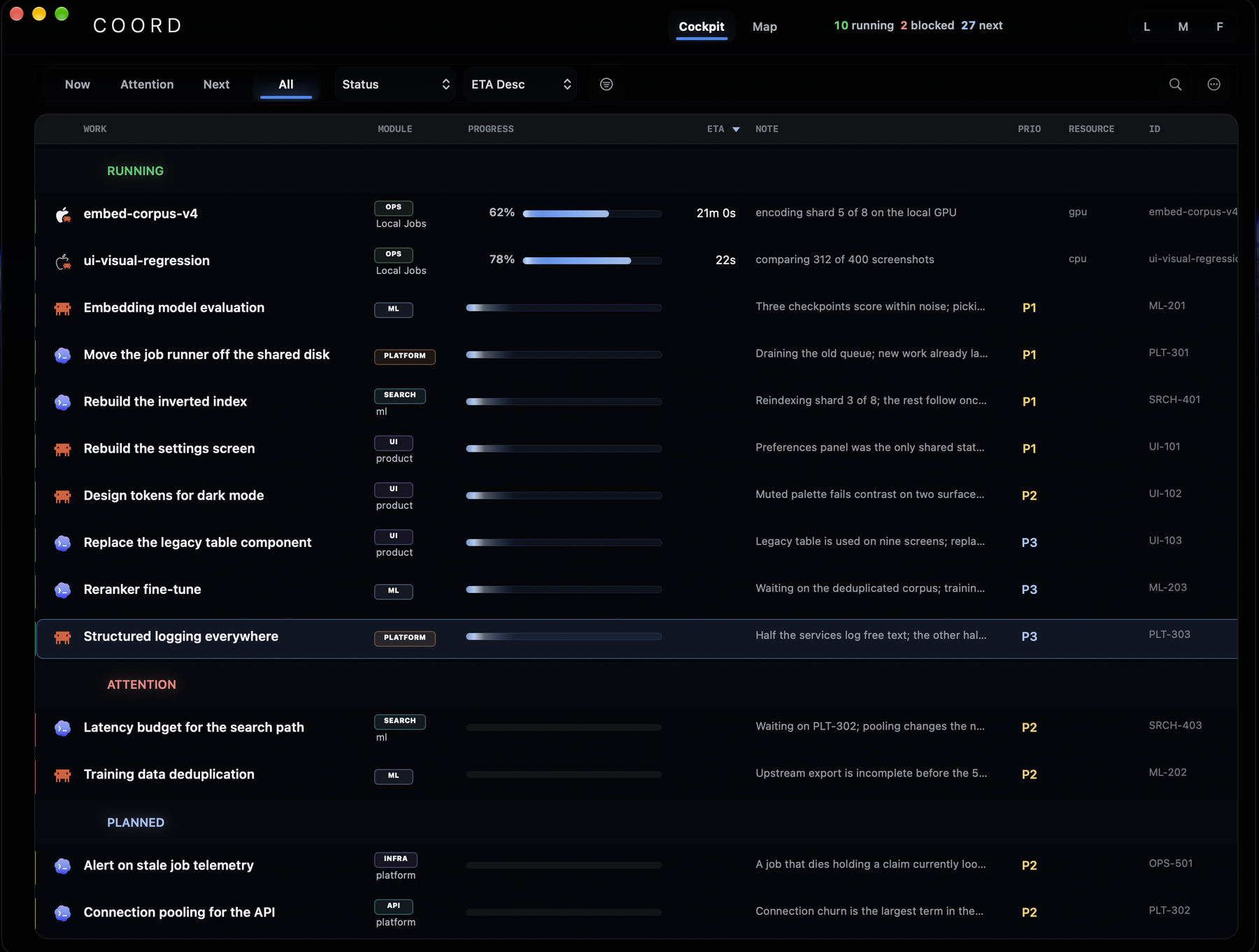
This is the surface an operator lives in. Grouped, dense, and capped: each group renders a bounded number of rows and then states exactly how many it is withholding. The title is the only element at full contrast, so the list can be scanned by title alone.
What it is · What you can do · Install · How two agents share work · Independent review · Five-minute start · The product · Mechanism · Every verb · Context and memory · Troubleshooting
A single agent in a chat window needs none of this. A fleet does — several
agents, of different kinds, working the same large repository across days, where
no one process lives long enough to remember what happened and no human is
watching every minute.
coordharness is the local-first machinery that makes that fleet durable. Claude
Code, Codex, generic MCP clients, shell automation, and local CPU/GPU jobs share
one typed operating vocabulary without making any individual client the
authority.
Nothing here is a hosted service. It is one database, one machine, one trusted
user account, and a handful of processes that agree to write through the same
door.
Distribution: this repository is the public source for COORD-Harness. It does not claim a hosted service, package-index publication, App Store availability, or signed binary distribution.
What you can actually do with it
Everything below is implemented in this repository. Maturity per capability is in
Maturity at a glance and machine-readable indocs/feature-status.json; nothing here is a roadmap item.
Run two agents on one repository without them colliding.
Each agent takes a lane (claude and codex by default) and a stable session identity.coord claim gives one agent exclusive ownership of a row; a second lane trying the same row
is refused by name. Before writing, an agent can declare which parts of the tree it intends
to touch with coord claim --write-scope or coord declare-write-set, and any agent can askcoord conflicts which currently-held claims have overlapping scopes — so two agents editing
the same directory is a question you can answer before the edit, not after the merge.
Add more than two agents. The lane vocabulary is configuration, not a fixed pair:COORD_LANES=claude,codex,gemini makes gemini a first-class lane that registers sessions,
claims rows, receives handoffs, and reviews the others' work. Two invariants hold at any lane
count: a lane cannot hand work to itself, and a lane cannot pass its own work.
Keep a backlog agents pull from on their own. coord create adds proof-gated work items;
rows persist for the life of the project and nothing is deleted on completion, so a board
accumulates. An agent starting cold does not need to be told what to do — it asks
(coord board, or MCP preflight / next_work) and picks up the next eligible row itself.
Survive agents dying. Claims are leased, not permanent — one hour by default
(LEASE_DEFAULT_S = 3600), renewed by a heartbeat. Status is never stored: it is derived at
read time from declared intent, lease validity, and whether the recorded pid is still alive,
so nothing can sit at "running" because a process crashed under it. Claiming or
conflict-checking a specific row also releases that row's expired claim inline. Sweeping the
whole board is a separate, explicit command — coord-reaper releases expired claims, reaps
zombie sessions, and finalises dead runs; it is not wired into any coord subcommand and
is yours to schedule. Run it with --dry-run first: the preview executes the real reaper
logic against a disposable snapshot, so it cannot drift from what a real run would do.
Move work between agents deliberately. coord handoff is a typed, fenced transfer that
demands the exact row version, owner, and event heads; coord reassign is the one-command
twin that snapshots those fences for you and still fails closed if another writer changes them
first. The handoff carries the task, why it matters, evidence refs, acceptance criteria, and
the artifact path that must exist before the work can be called done.
Let agents talk mid-run without taking each other's work. coord note posts an
append-only message to another lane, attached to a row, carrying no authority at all — it
cannot change ownership, status, or verdict. coord inbox reads what arrived, newest first,
and reports what it did not show.
Make agents review each other, and make the review mean something. coord request-audit
asks the other lane to look at a row you authored; coord verdict records PASS, FLAG, orBLOCKED on the other lane's work. Reviewedness is computed, never stored — see
Independent review. coord sign-off
is the human override, recorded as such.
Refuse completion that has no proof. Every work item declares a done_signal when it is
created. coord done succeeds only when that exact artifact exists, is non-empty, resolves
under the project root, and is tracked in Git's index — with a narrow exemption for artifact
kinds that structurally cannot live in Git.
Supervise long local processes instead of babysitting an LLM loop. coord-jobs launch
runs a command in its own process group under an RSS cap, re-validating the claim fence inside
a transaction immediately before it starts, writing a compact JSON progress sidecar
(state, pct, step, rate, eta_s, …) and an authoritative runs row carrying the real
pid and pgid. coord-jobs status prints the read-only snapshot.
Run local models under a real lock. coord-models list | check | run drives a declared
model catalog with a hardware-readiness probe and a bounded generation request; GPU-requiring
models execute under a process-held fcntl lock, because one machine has one GPU.
Carry context between sessions without dragging a transcript along. A fresh session boots
from a small capsule and expands only the source-bound context it needs. Behind that: a
bitemporal fact ledger with supersession chains, a full-text index over your docs, an
append-only accepted-memory store with immutable generations, and a federator that fans one
query across all of them and returns a byte-bounded, deduplicated, provenance-carrying result.
Agents propose memory; proposals are rate-limited, require an evidence pointer, and — like
verdicts — cannot be accepted by their own author.
Watch the whole fleet. coord board in the terminal, coord-board onhttp://127.0.0.1:7870 with Board / Mesh / Map / Atlas, a macOS menu-bar app with a progress
ring, a native Cockpit window, and an iOS client. tools/export_static_board.py writes a
self-contained index.html you can open from disk with no server at all.
Route work by measured usage. A local hash-chained ledger records token and cost metrics;coord route reports which provider has headroom. It is advice — it reads the ledger and
writes nothing.
Check your own install. coord doctor is a read-only health report that opens nothing it
does not have to, writes nothing at all, and exits 0 only when every finding passes.coord onboard verifies agent instructions, configs, database, and MCP wiring.
Drop it into your agents as a package. This repository ships a Claude Code plugin manifest
(.claude-plugin/plugin.json), one skill (operating-coordharness), and five slash commands —coord-start, coord-claim, coord-close, coord-handoff, coord-recover — mirrored
byte-identically under .claude/ for Claude Code and .agents/ for Codex, so neither
vendor gets a better-maintained copy than the other.
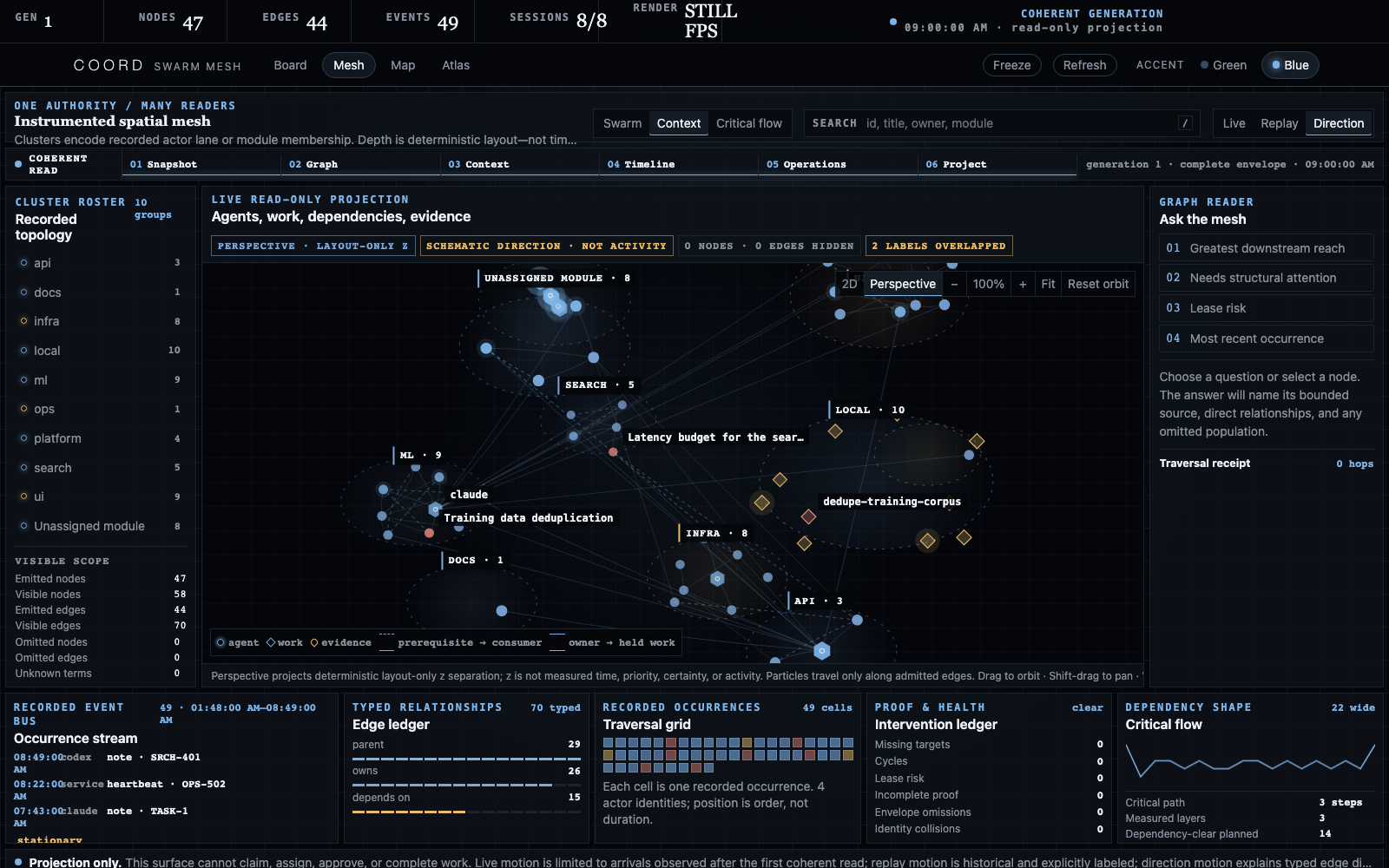
The fleet as one coherent read. The Cockpit above remains the primary operating surface; Mesh adds the spatial view of the same bounded authority, with typed relationships, traversal, and explicit receipts for what the read omitted.
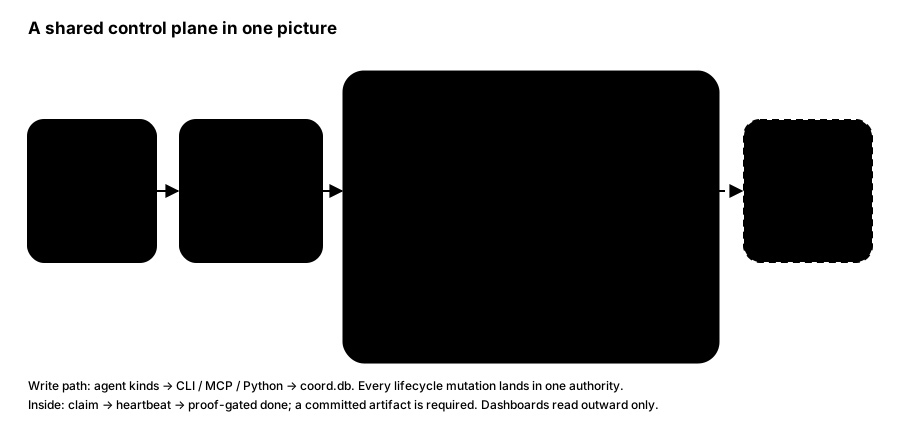
One database owns lifecycle truth. CLI, MCP, and Python are clients of its fenced operation contract, never parallel authorities. Claims prevent collisions, heartbeats renew ownership, completion is proof-gated, and every viewer is a read-only projection.
Install
Requires Python 3.11 or newer and Git. Nothing below configures a provider account
or a background service.
One command, on any OS with Python 3.11+ (no Xcode or XcodeGen required for
this base path):
git clone https://github.com/0marm0/COORD-Harness.git && cd COORD-Harness && ./scripts/setup.sh
It creates .venv, installs the package with MCP support, and owns the clone's.coordharness/coord.db. By default it does not touch anything outside the
clone: Claude Code/Codex client registration is opt-in via --register-clients,
and the native macOS/iOS app lane is opt-in via --native (macOS + Xcode
command-line tools + XcodeGen only — a
no-op notice on other OSes). ./scripts/setup-macos.sh — kept only as a 2-line
shim to this script for existing doc references — used to default both flags on;
see Native projections.
Manual, five commands — no Xcode required, works on Linux too:
git clone https://github.com/0marm0/COORD-Harness.git
cd COORD-Harness
python3 -m venv .venv
. .venv/bin/activate
python -m pip install -e '.[mcp,dev]'
Core CLI and library use only the Python standard library. The [mcp] extra installs
the MCP runtime; [dev] installs the test and lint toolchain — install -e . alone
for just the core.
Verify entry points (either path leaves a .venv at the repo root):
.venv/bin/coord --help
.venv/bin/coord-board --help
.venv/bin/coord-jobs --help
.venv/bin/coord-models --help
.venv/bin/coord-reaper --help
Installing the package puts six executables on the path — those five plus coord-mcp, which
an MCP client launches rather than a human. See
The complete verb surface for what each one is for.
Connect an MCP client
Point each client at the same project root and database:
Claude Code, from the repository you want to coordinate:
claude mcp add --scope project --transport stdio \
  -e COORD_PROJECT_ROOT=/absolute/path/to/project \
  -e COORD_DB=/absolute/path/to/project/.coordharness/coord.db \
  -e COORD_DEPLOYMENT_PROFILE=generic \
  coordharness -- /absolute/path/to/COORD-Harness/.venv/bin/coord-mcp
Codex, registering the same executable and authority:
codex mcp add coordharness \
  --env COORD_PROJECT_ROOT=/absolute/path/to/project \
  --env COORD_DB=/absolute/path/to/project/.coordharness/coord.db \
  --env COORD_DEPLOYMENT_PROFILE=generic \
  -- /absolute/path/to/COORD-Harness/.venv/bin/coord-mcp
Generic MCP client:
{
  "mcpServers": {
    "coordharness": {
      "command": "/absolute/path/to/COORD-Harness/.venv/bin/coord-mcp",
      "env": {
        "COORD_PROJECT_ROOT": "/absolute/path/to/project",
        "COORD_DB": "/absolute/path/to/project/.coordharness/coord.db"
      }
    }
  }
}
These registrations use absolute paths because they point a client at a repository it
does not necessarily run in. The repository's own checked-in .mcp.json and.codex/config.toml are the other case: a project-scoped client launched in this
repository, where ./.venv/bin/python, COORD_PROJECT_ROOT=".", andCOORD_DB=".coordharness/coord.db" resolve against that working directory and stay
free of any developer's absolute path. Use relative paths in-repo and absolute paths
whenever the MCP process does not inherit the coordinated repository as its working
directory — see agent onboarding. Full client setup, tool
groups, and a complete session sequence live in
MCP integration and
MCP server reference.
Try it: claim a row, produce proof, complete it
Run this in a disposable clone. The demo data is synthetic; set SOURCE_DATE_EPOCH
when a fixed capture clock is required (python -m coordharness.demo still works too,
if you prefer invoking the module directly).
coord demo
coord board --group-by module

# ML-204 is a planned Codex row in the synthetic board. COORD_ACTOR and
# COORD_SESSION_ID outrank every ambient identity, so this works even inside
# a Claude Code shell, where CLAUDE_CODE_SESSION_ID would otherwise win.
export COORD_ACTOR=codex COORD_SESSION_ID=codex:demo
coord claim ML-204 --step "documenting the quantisation pass"

mkdir -p docs/reports
printf '%s\n' '# Quantisation for the local runtime' '' 'Synthetic demo proof.' \
  > docs/reports/ml-204.md
git add docs/reports/ml-204.md

coord done ML-204 --artifact docs/reports/ml-204.md
coord board --group-by module
coord doctor    # still PASS, exit 0, with the completion recorded
coord creates .coordharness/coord.db and applies migrations on first use. Thedone command succeeds because ML-204 declares docs/reports/ml-204.md as itsdone_signal, the non-empty proof exists, and Git's current index tracks
it. Staging is sufficient; no commit is required — but an untracked proof of any
type, or a project that is not a Git repository at all, is refused withartifact proof does not exist or is incomplete. The only artifacts exempt from
tracking are the kinds that structurally cannot live in Git — databases, dataset
dumps, serialized models, archives — listed in DEFAULT_CUSTODY_EXEMPT_SUFFIXES
in src/coordharness/jobs/status.py and rebindable withCOORD_COMPLETION_CUSTODY_EXEMPT. Exempt kinds still have to exist; the
exemption is about custody, not about proof. For a clean reset, remove only the
disposable clone's .coordharness/ directory; never point cleanup commands at a
broad directory or an unresolved variable.
Everything at once:
./scripts/demo.sh --native
Seeds a synthetic board under var/demo/, serves it on http://127.0.0.1:7870, builds
both macOS apps and launches them against that board. Nothing touches a real database:
the clients are started with COORD_DB pointed at the demo, and they are launched as
binaries rather than through open, because open does not pass environment through.
Add --reset to rebuild the board from scratch. Ctrl-C stops the server; the apps
are separate processes and are quit from the menu bar and the window.
Tracked local jobs:
# OPS-501 is a planned Codex row in the synthetic demo.
coord claim OPS-501 --step "launching the synthetic telemetry check"

# Copy claim_id and claim_fence exactly from that JSON response.
coord-jobs launch \
  --job-id DEMO-JOB \
  --roadmap-id OPS-501 \
  --session-id codex:demo \
  --claim-id CLAIM_ID_FROM_CLAIM \
  --claim-fence CLAIM_FENCE_FROM_CLAIM \
  -- python -c "import time; [time.sleep(1) for _ in range(5)]"
Runnable, narrower walkthroughs live in examples/. For client wiring,
local data locations, capability boundaries, uninstall, and a clean-machine checklist,
use the standalone setup guide.
Point your agent at this repo
Once a client is wired up (above), the fastest orientation is to let the agent read
its own contract instead of paraphrasing it by hand. Paste this into Claude Code or
Codex from the repository you want it to coordinate:
Read AGENTS.md and set this repository up for yourself. Then run
.venv/bin/coord onboardand show me the receipt.
AGENTS.md is the machine-readable operating contract every agent in
this repository follows. coord onboard is the command that actually detects the
caller's identity, checks lifecycle policy, and — asked for explicitly — registers
this clone with the MCP clients installed on the machine; the JSON receipt it prints
is the same one getting started and
agent onboarding walk through by hand.
Two agents, one file
This is the part that is easy to overcomplicate, so here it is plainly.
Claude and Codex never talk to each other directly. There is no chat channel
between them, no shared queue, no sync protocol. Both read and write one SQLite
file, and everything either one knows about the other, it learned by reading it.
That sounds austere, and it is the entire trick. A message can be missed,
contradicted, or quietly ignored. A row in a database cannot: it is either claimed
or it is not, and the claim names who holds it and when the lease expires.
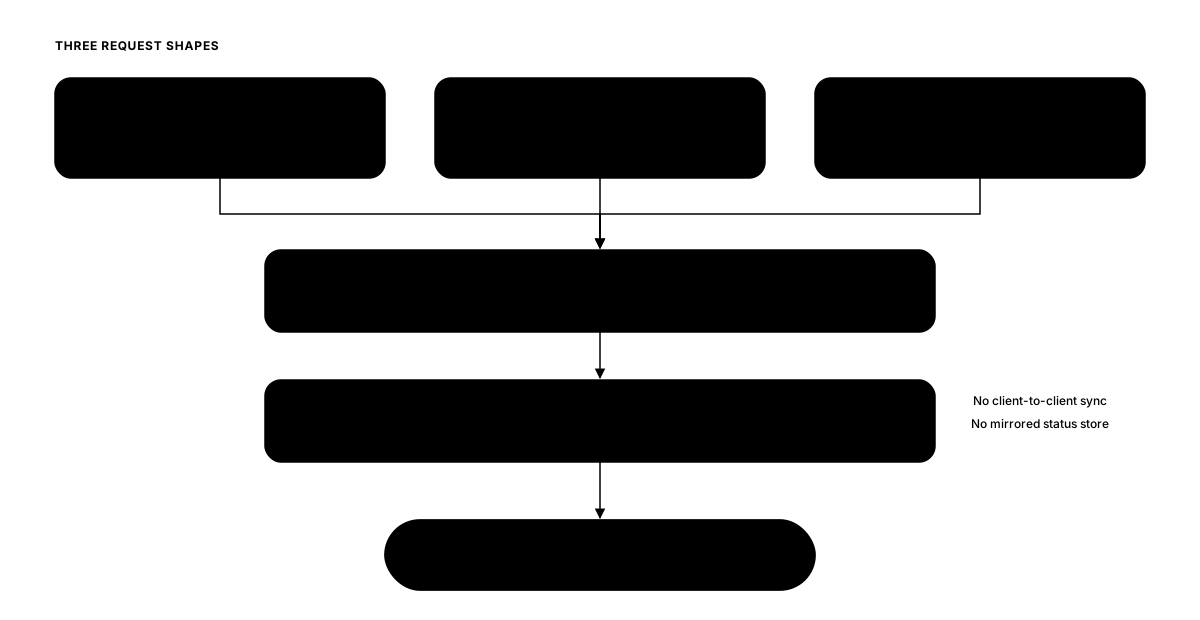
Three ways in, one way through. A claim made by coord claim, by claim_work(...) over MCP, and by the Python API are the same row written by the same code. No client-to-client sync. No mirrored status store.
How each agent knows what the other is doing
An agent starts by asking the board, not its colleague. One call returns what is
running, what is blocked, who holds which claim, and what recently changed.
Awareness is a read, not a broadcast — which is why it survives an agent
crashing, restarting, or being a different agent than it was last time.
Status is never stored. It is derived at read time from the claim lease and
whether the process holding it is still alive. Nothing can be marked "running" by
a process that has died, because nothing marks it running at all.
Handing work over
A handoff is an ownership transaction, not a request. When one agent hands a
row to the other, the row's assignee changes in the database, and the previous
owner's next attempt to claim it fails with an error rather than succeeding
quietly.
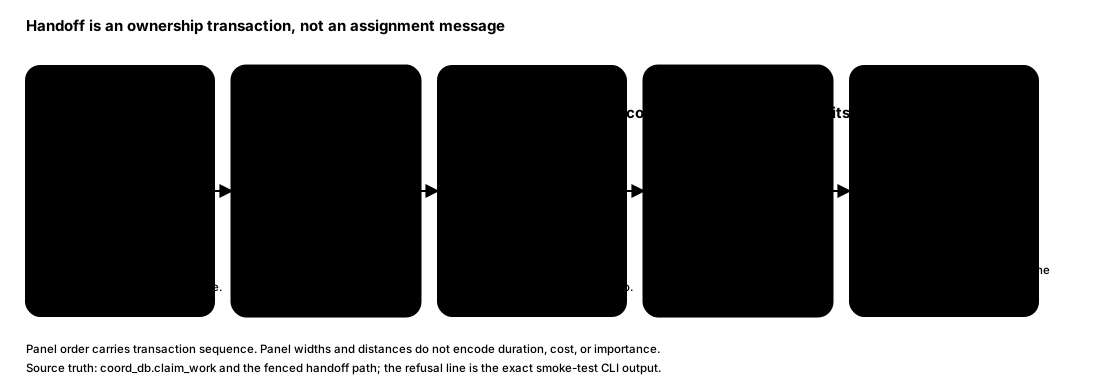
The refusal is the point. Two agents cannot both believe they own the same work, because the second one to try is told cannot claim work assigned to 'codex'. The fence — the row's version and its event heads — makes the transfer atomic against a board that is still moving.
The handoff carries what the receiver actually needs: the task, why it matters,
pointers to the evidence, the acceptance criteria, and a concrete artifact path
that must exist before the work can be called done.
Talking mid-run without taking the work
Sometimes an agent needs to tell the other something while it is still working —
a number moved, an assumption broke, a file is being edited. That is a note:
an append-only message attached to a row, addressed to the other lane, carrying
no authority at all. It cannot change ownership, status, or verdict.
That is exactly why it is safe. One agent can warn another mid-run without
reaching into its work.
# Claude, mid-run, tells Codex something it needs before it quotes a number
coord note ML-204 \
  --body "The denominator moved from 8,642 to 8,648 while you were running. Re-read before quoting a rate." \
  --ref docs/coordination-model.md

# Codex, on its next check — newest first, and it says what it did not show
coord inbox
{"count": 20, "unread_total": 46, "not_shown": 26, "order": "newest_first", ...}
The inbox reads newest first, because the question an agent asks mid-run is
"did anything arrive while I was working", not "let me drain the queue in order".--backlog restores queue order for the case that wants it. It also reportsunread_total and not_shown, so "nothing new arrived" is a fact rather than an
artefact of a limit.
Why a swarm still shows as one row
When an agent fans out to a dozen subagents, the board does not sprout a dozen
rows. The orchestrator holds one claim; the subagents roll up beneath it. The
operator sees one piece of work with one owner, which is the only reading that
stays legible once several agents are working at once.
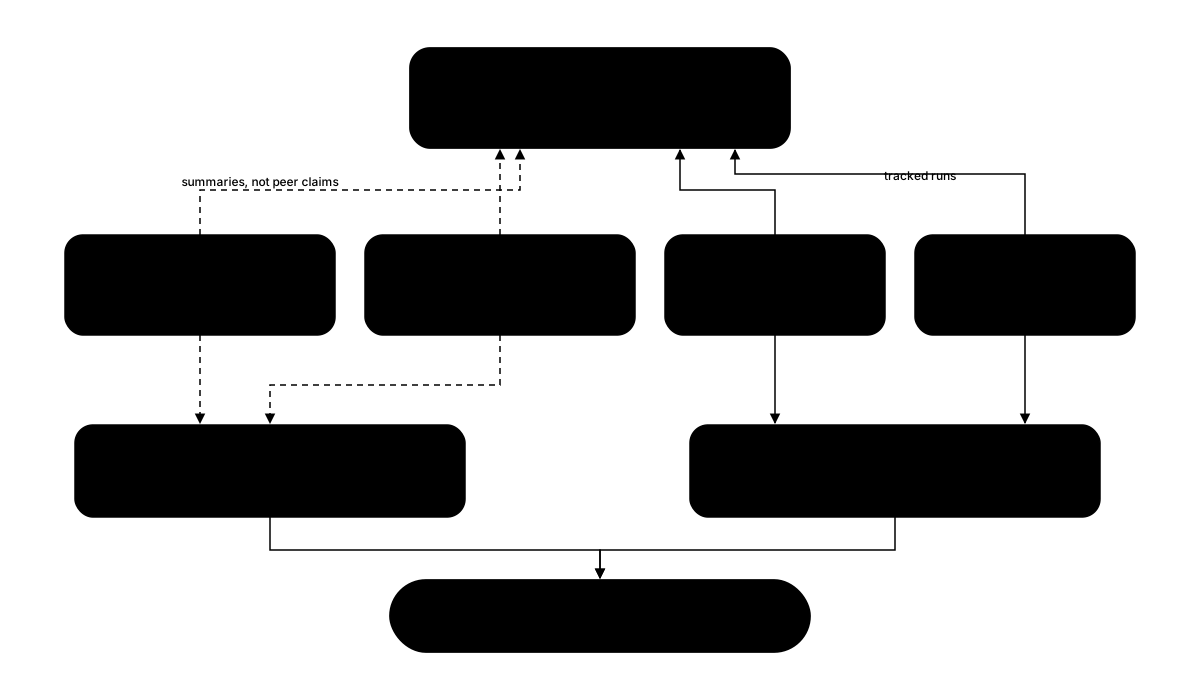
Bounded subagents return refs and conclusions to their owner instead of impersonating peer sessions. Local jobs run as tracked processes in their own lanes — the GPU lane serialized, because one machine has one GPU.
Independent review: why you want your agents to disagree
Two agents on one problem is not redundancy. It is the only cheap way to find the class of
mistake a single agent cannot find in itself — a plan that is internally consistent and wrong,
a number carried forward from the wrong denominator, a test that passes because it asserts
what the code does rather than what the code should do. An agent that wrote something is the
worst available reviewer of it, and it is worst in a specific way: it will re-derive the same
error from the same premises and report agreement.
So the harness makes independence structural rather than procedural. It is not a
convention that the other lane reviews your work; it is a property of the row that a same-lane
verdict cannot satisfy.
sequenceDiagram
    autonumber
    participant A as Author lane
    participant DB as coord.db
    participant B as Reviewer lane

    A->>DB: claim WORK-1
    A->>DB: done WORK-1 --artifact docs/report.md
    Note over DB: refused. The row is T0, so completion<br/>raises until an independent lane has passed it
    A->>DB: request-audit WORK-1 --task … --why … --ref …
    DB-->>B: the row surfaces in the reviewer lane's queue
    A->>DB: verdict WORK-1 --verdict PASS
    Note over DB: recorded, and it does NOT count.<br/>classify_verdict_status returns self_verdict<br/>and the row stays unreviewed
    B->>DB: verdict WORK-1 --verdict FLAG --ref …
    Note over DB: a negative verdict blocks completion<br/>at any review tier, not just T0
    A->>DB: fix the work, re-stage the artifact
    B->>DB: verdict WORK-1 --verdict PASS --ref …
    Note over DB: reviewed — the verdict came from<br/>a lane other than the author's
    A->>DB: done WORK-1 --artifact docs/report.md
    Note over DB: accepted. The declared artifact exists,<br/>is non-empty, and git's index tracks it
Reviewedness is computed, not stored. There is no boolean anyone can flip. Whether a row
counts as reviewed is derived at read time by classify_verdict_status(), and its two
load-bearing rejections are the two ways a fleet fakes a review by accident:
self_verdict— the most recent verdict was written by the same lane that authored the
work. The verdict exists in the event log; it simply does not make the row reviewed.cross_row_verdict— a verdict recorded on some other row that merely mentions this
one in its refs or body. That is the shape a hurried fleet produces on its own: one
subagent's review pointed at as if it covered a sibling's output. Rejected the same way.
Independence is lane-level, not call-level. This is the part that catches people. An
orchestrator that spawns the subagent doing the work and the subagent grading it has not
produced independent review, however the two calls are labelled — the schema's notion of
independence is which actor authored the claim, not which prompt issued the verdict. Getting a
real second opinion means routing the review through a different lane's claim.
Because the lane set is configuration, "who may review whom" is a deployment decision:
export COORD_LANES=claude,codex,gemini
Name only agents you would accept as independent eyes on the others' work. Two invariants hold
at any lane count: a lane cannot hand work to itself, and a lane's verdict on its own work
never counts — independence is defined as inequality with the author, never membership in a
privileged pair.
How much review a row needs
Review is tiered, so routine work is not blocked behind ceremony it does not need. Tiers are
declared, but a declared tier is escalated automatically when the row's title, acceptance
criteria, or paths match a T0 predicate — irreversible, externally published, ground-truth,
verified-output. You cannot quietly self-certify a dangerous row as routine.
| Tier | What it is for | What the completion gate does |
|---|---|---|
| T2 | declared docs, analysis, reversible tooling | gates only; no review event required |
| T1 | the default for code and data | completes now; review is batched, not blocking |
| T0 | irreversible, external-facing, served numbers, ground truth, cross-lane config | blocking — coord done raises until an independent lane's verdict passes |
Two things bind at every tier. A negative verdict (FLAG or BLOCKED) blocks completion
regardless of tier, and coord sign-off — the human override of the review gate — is recorded
on the row as exactly that, an override, not a pass.
The same no-self-approval rule governs memory: an agent may propose a durable memory entry,
but review_proposal() refuses a reviewer whose identity equals the proposal's source actor.
Proposals also require an evidence pointer and are rate-limited, so a chatty session cannot
flood the ledger.
Full treatment: multi-agent patterns and
review tiers.
Five-minute start
Already installed (see Install above)? This is a second, wider demo —
a fictional multi-row board to look around in, rather than the single claimed row
above. It configures no provider account or background service, and every file it
writes lands in a disposable clone's own gitignored .coordharness/ directory:
coord demo                     # seeds .coordharness/coord.db with 37 synthetic rows
coord doctor                   # read-only health report; prints PASS and exits 0
coord board --group-by module  # at a terminal: the grouped human table; add --json for the board as JSON
coord-board                    # read-only web board on http://127.0.0.1:7870
coord doctor is the answer to "did that work?". It opens nothing it does not
have to, writes nothing at all, prints one JSON document, and exits 0 only when
every finding passes — so it is worth running again after anything surprising.
Then open / for triage,/mesh for the spatial control room,/map for analytical lenses, or/ops for the joined operational document.
Keep the database and the state directory together. coord and coord doctor both
default to .coordharness/coord.db under the project root; pointing --db somewhere
outside .coordharness/ still works for the CLI and the board, but coord doctor
will report database_outside_state_root rather than silently trusting it.
To throw it away, delete that one clone. Never point a cleanup command at a broad
directory or an unresolved variable.
Getting started continues from here: claim a row, satisfy
its declared proof, and complete it.
What an operator actually sees
Everything in this section reads the deterministic, entirely fictional board
created by python -m coordharness.demo.
The Board is where an operator lives. A destination rail separates Attention —
grouped by the plane that raised each row — from overview, work, jobs, graph and
activity. Selecting a row opens one canonical detail plane beside the list rather
than navigating away from it.
(The work table above is this same Board — the destination rail just adds
Attention, jobs, graph and activity around it.)

Overview · decide what needs attention. Live claims and reported steps sit beside blocked, failed, and flagged rows. Progress and ETA appear only when a tracked job reported them. |

Atlas · inspect one coherent generation. Snapshot, graph, context, timeline, operations, and read health meet in one source-accounted document. |
Semantic filters are evaluated by the server and carry a complete matched-ID
receipt; saved views store the query token, never a frozen row list. Display
choices — density, grouping — are personal and stored locally, so a link you send
shows the recipient your population, never your row height. The command palette
unifies destinations, rows, and non-mutating actions under one keyboard vocabulary,
and shows refused actions with the reason they were refused.
A selected row travels between Board, Mesh, Map, and Atlas in the canonical #sel=
URL capsule. Each destination either focuses the admitted node or states that this
bounded projection omitted it; none silently turns "not rendered here" into "does
not exist."
Choose the surface by question
The four areas share one navigation bar, one palette and one typeface contract. The
macOS Cockpit hosts the same four in the same order, so a Windows or Linux operator
on the web build and a Mac operator in the native window see the same product.
| Question | Area | Why |
|---|---|---|
| What is running or needs attention? | Board / |
compact row state and tracked-job telemetry |
| How is the fleet connected in this coherent read? | Swarm Mesh /mesh |
clustered actor-lane/module/dependency layouts, typed motion, traversal, receipts |
| What does the estate look like through one analytical lens? | Coordination Map /map |
dependencies, shape, subjects, order, crossings, context, recorded parallelism |
| What is structurally actionable in this generation? | Operations Atlas /ops |
joined graph envelope, operational metrics, health, bounded questions |
| What can I glance at away from the browser? | macOS, menu bar, iOS | native projections of the same read contract |
Every area is a read-only projection of the same lifecycle authority. Job telemetry
contributes process evidence; graph context and accepted memory improve navigation
and recall; neither can mutate a claim or complete work.
The analytical lens gallery — six Map views and the exact question each answers
The same rows, asked different questions. Each view states in its own copy what its
geometry does not mean: where position or order is arbitrary it says so, and where
a shape would have to imply a measurement the data does not carry, it prints a
sentence instead of drawing the shape.

Fleet — who is working where. Recorded lanes against subject areas, with running and attention marked explicitly. |

Dependencies — two structural questions a row list cannot answer: recorded downstream reach, and the longest acyclic walk the bounded graph can prove. Neither claims elapsed time or effort. |

Order — precedence without a clock. Grouped by recorded event order and prerequisite direction; missing events stay missing, and no ordering is presented as elapsed time. |

Pulse — the record as a live wire. A poll of the record, not a push feed, and it says so. |

Ceiling — a bounded parallelism thought experiment. Each row gets one equal unit and can start only after its recorded prerequisites. Structural concurrency under that assumption — not duration, effort, or a staffing forecast. |

Lanes — the fleet as an org in motion: every held row under its lane, the lane's live sessions, and the recorded acts that crossed between lanes. |
Motion is evidence, not ambience. Every moving mark passes through one audited
engine: an arrival pulse fires only for an event genuinely absent from the previous
poll, a marching dash rides only a path drawn in a recorded dependency's direction,
a breathing mark sits only on a row that derives to running. prefers-reduced-motion
stills all of it with every fact intact.
The remaining lenses — Shape, Subjects, Orbit, Crossings, Context, Stations — and the
full geometry and motion contract live in the visual atlas
and the Operations Atlas contract.
How work moves
The key separation is between declared intent and observed state. A work item
may say it is running, but readers only show it as running when a live claim backs
that declaration.
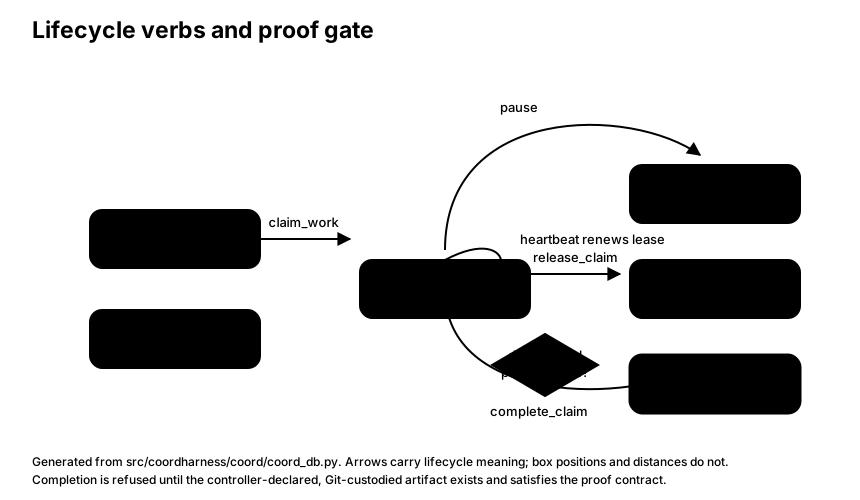
Watch the asymmetry: a bare running claim with no live successor is requeued automatically, but a blocked or paused row keeps its disposition even after its claim releases — that stop was deliberate, not a dropped lease.
Mechanical work becomes a tracked local process instead of an LLM loop. A wrapper
forks the child into its own process group and writes two channels: a fast local
sidecar and an authoritative runs row carrying the real pid and pgid.
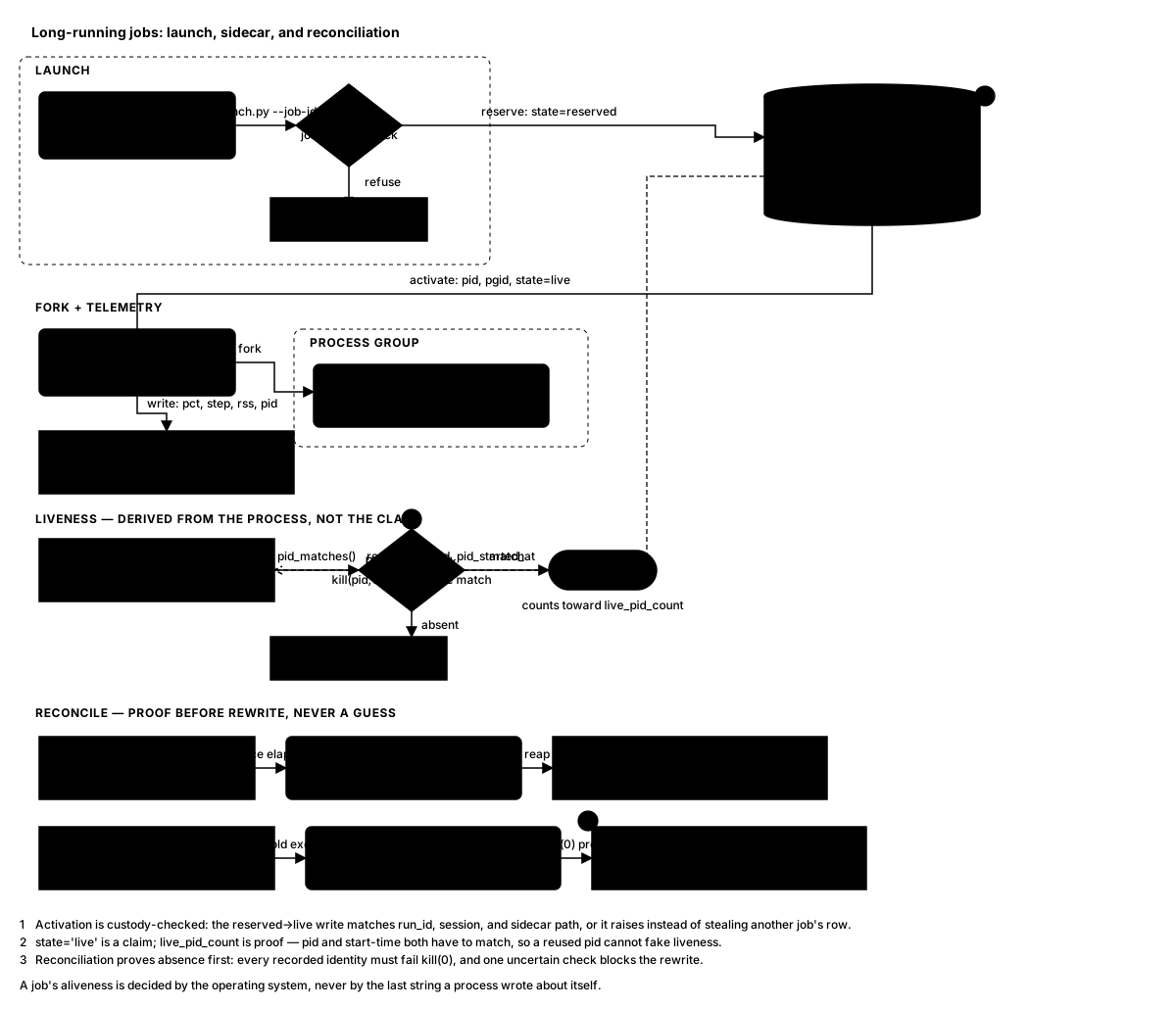
The board never trusts a stored status string — it re-derives liveness by matching the recorded pid against the live process. Two independent paths catch a dead one: an expired lease releases the claim, and a sidecar is marked failed only after every process identity is proven absent, never assumed.
What it refuses to do
Most of the design is a refusal. Each of these is enforced in code, not by convention:
- No duplicate ownership. One held claim per work item, enforced transactionally.
- No immortal "running" rows. Status is derived from intent, lease validity, and process evidence at read time — never stored and trusted.
- No completion by assertion. A claim completes only when its controller-declared
done_signalis satisfied. - No client lock-in. The CLI, Python API, and MCP server converge on the same lifecycle functions.
- No giant cold-start dump. Preflight, work context, event context, facts, and knowledge queries are bounded.
- No hidden local work. Long-running processes report through run records and compact JSON sidecars.
- No accidental second authority. Web and native clients consume read-only projections.
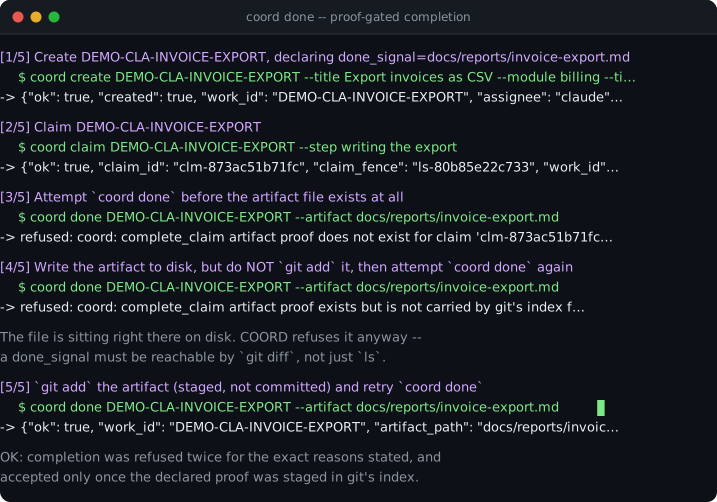
No completion by assertion, shown rather than claimed. The unedited stdout of examples/proof-gated-done/run.py: coord done refused for a missing artifact, refused again for one that exists but is not staged, then accepted once git add stages it.
The database
One SQLite database in WAL mode, .coordharness/coord.db (WAL keeps -wal and-shm working files beside it). WAL is the whole reason a fleet can share it:
readers never block the writer and the writer never blocks readers, so a menu-bar
app polling four times a minute cannot stall an agent mid-claim.
Two writers sharing one file is the whole premise, so the concurrency contract is worth
stating rather than assuming. Every connection opens with journal_mode=WAL,busy_timeout=5000 and foreign_keys=ON; read-only clients additionally get query_only=ON.
Write transactions open BEGIN IMMEDIATE, taking the write lock up front instead of
discovering the conflict on first write — the deferred-transaction upgrade deadlock two
concurrent writers would otherwise hit. Above that sits application-level compare-and-swap: a
row carries a version, and the typed operations that move ownership updateWHERE version = ?, so a transfer fenced on stale state fails closed instead of overwriting
whatever the other agent just did. There is no OS-level advisory locking anywhere in the
coordination path.
Six lifecycle tables carry the operating core:
| Table | What it is |
|---|---|
agent_sessions |
who is present — one row per orchestrator session, with its runner type and identity |
work_items |
the work itself — id, title, module, declared intent, priority, and the done_signal it must satisfy |
claims |
ownership — who holds what, since when, and until when the lease expires |
runs |
tracked local processes — the real pid and pgid, so liveness is checked against the OS rather than believed |
events |
the append-only history — claims, notes, decisions, handoffs, audit requests and verdicts |
artifacts |
the proof — what a completion pointed at, recorded with the transition in one transaction |
The generated schema also contains migration metadata, display titles,
request/inbox cursors, exact-authority and provenance records, and native
projection tables. Those support audit and bounded read models; they do not replace
the six lifecycle tables as the writer authority.
Two properties matter more than the shape. Nothing is deleted on completion — a
done row keeps its whole history, which is why "did we already do this?" is a query
rather than a memory. And status is not a column. It is computed at read time
from declared intent, lease validity, and process evidence, through views likev_work_owner and v_runs_read_model. A row cannot sit at running because a
crashed process left it there.
Migrations are ordered SQL under coord/migrations/, applied on first use.
Read architecture, coordination model, data model, and context architecture for the full treatment.
What the harness remembers
Coordination state and memory are different problems, and this project keeps them
apart on purpose. The section above is the board. This one is everything an agent is
allowed to carry between sessions.
The problem it exists to solve is that a conversation transcript grows without a
ceiling and every call re-reads all of it. A fresh session instead boots from a
bounded capsule, then expands only the source-bound context its work requires.
So memory lives in three stores, and they are not interchangeable:
| Store | Holds | Lifetime |
|---|---|---|
| Coordination database | work rows, sessions, claims, runs, events, artifacts | the project's whole history; nothing is deleted on completion |
| Knowledge store | the fact ledger, the full-text index, the memory-proposal queue | rebuildable — the index is derived, the facts and proposals are not |
| Accepted-memory store | content-addressed accepted notes and a compiled boot kernel | append-only; generations are immutable once built |
Everything else an agent knows is transient. There is no transcript store, no
conversation archive, no vector database, and no per-agent scratch memory. A
session that ends leaves rows, events, artifacts and possibly a memory proposal —
nothing else survives it.
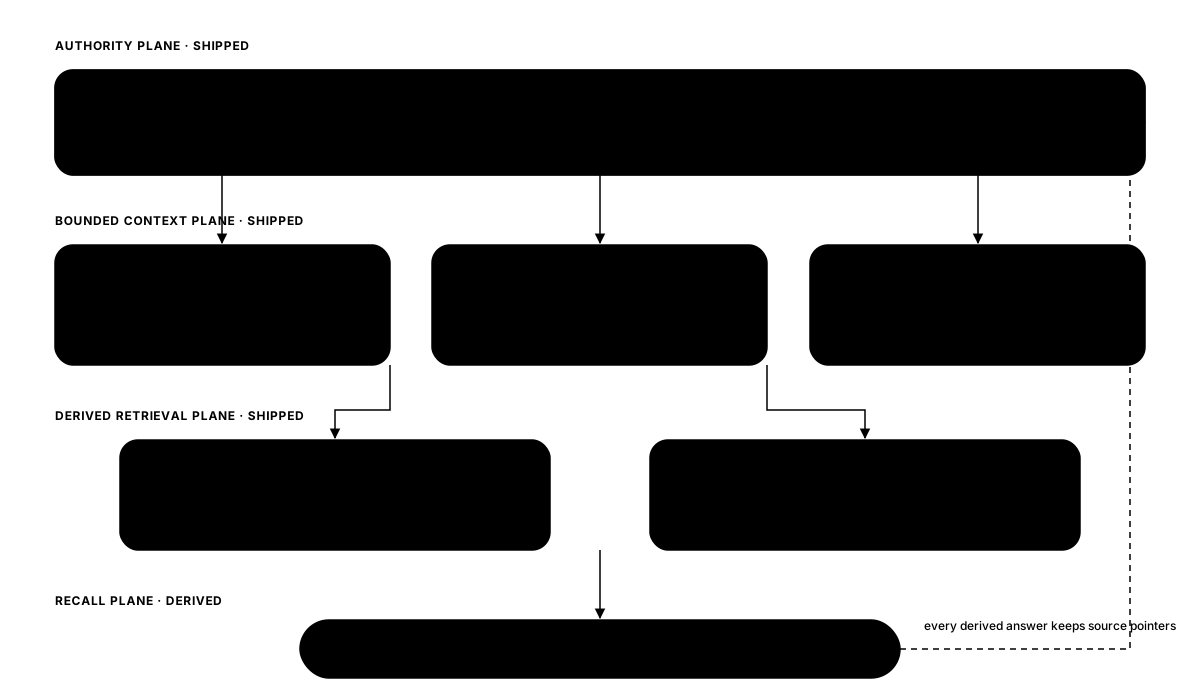
Exact board state stays authoritative. Bounded capsules and source-bound graph views help retrieval; accepted memory is a derived recall aid, never a writer and never a lifecycle authority.
The knowledge store is reachable through read-only MCP tools — fact queries, index
status, and the proposal queue — each capped, each carrying provenance, and each
covered by a test that fingerprints the store to prove a read wrote nothing.
The MCP server creates that store on startup, and a fact read names the store it
read. If the ledger is missing or has no schema, facts_lookup refuses with that
condition and knowledge_search records it as an error on the facts provider. It
does not return count: 0, because a zero from a store that does not exist is
indistinguishable from a store that genuinely holds no match.
Two things stated plainly rather than implied. The proposal queue has a narrow,
fenced producer: a successful session closeout offers only typed decisions
explicitly marked memory_candidate=true; ordinary decisions, notes, summaries and
empty sessions emit nothing. And the board's own context endpoint carries
structure, not prose — parents, dependencies, dependents and siblings — because
the browser board is read-only and unauthenticated, and decisions and notes are not public.
Context and memory is the full chapter — every store,
every module, what each is for, and what is deliberately never written down.
Lifecycle clients: CLI, Python, and MCP
The table names equivalent operations, not separate authorities. They call the same
core against the same file.
| Task | CLI | MCP | Python |
|---|---|---|---|
| Orient | coord board |
preflight, next_work |
coord_db.board_rows(...) |
| Claim | coord claim WORK --step "…" |
claim_work(...) |
coord_db.claim_work(...) |
| Renew | coord heartbeat-claim CLAIM --step "…" |
heartbeat(...) |
coord_db.heartbeat_claim(...) |
| Pause/block | coord release CLAIM --status paused|blocked ... |
park(...), block(...) |
typed lifecycle functions |
| Message mid-run | coord note WORK --body "…" |
note(...) |
coord_db.post_note(...) |
| Reassign work | coord reassign WORK --owner-lane … |
handoff_existing(...) |
coord_db.post_existing_work_handoff(...) |
| Read messages | coord inbox |
inbox, inbox_recent |
coord_db.read_inbox(...) |
| Complete | coord done WORK --artifact PATH |
complete(...) |
coord_db.complete_claim(...) |
| Read board | coord board --group-by module |
board(...) |
read-only board queries |
The complete verb surface
The table above is the common path. This is everything, so nothing useful stays hidden behind
a --help a reader never runs. coord --help prints the same list.
The six installed executables:
| Executable | What it is for |
|---|---|
coord |
the lifecycle CLI — the 21 verbs below |
coord-mcp |
the MCP stdio server an agent client launches |
coord-board |
the loopback web console (127.0.0.1:7870 by default) |
coord-jobs |
launch a supervised local process, or print its status |
coord-models |
list, check, or run a declared local model under a GPU lock |
coord-reaper |
writes — sweep expired claims, zombie sessions and dead runs; --dry-run first |
coord verbs, grouped by what you are trying to do:
| Group | Verbs | Notes |
|---|---|---|
| Presence | session start|heartbeat|end |
registers who is here and renews the session lease |
| Orient | board, work-context, inbox |
bounded reads; work-context also returns a row's handoff fences |
| Create work | create |
refuses a row without a concrete repository-relative done_signal |
| Own work | claim, heartbeat-claim, release |
release --status paused|blocked is the CLI form of park/block |
| Collision control | declare-write-set, conflicts |
declare the scopes a claim intends to write; list overlapping live claims |
| Move work | handoff, reassign |
handoff takes the fences by hand; reassign snapshots them for you |
| Talk | note |
append-only, addressed to a lane or one live session, carries no authority |
| Review | request-audit, verdict, sign-off |
ask for review · record the other lane's verdict · human override |
| Finish | done |
proof-gated; refuses without the declared, staged artifact |
| Operate | doctor, onboard, route, usage-scan, demo |
read-only health · setup verification · usage-based routing advice · parse local CLI transcripts into the usage scan store · seed a fictional board |
park and block are MCP-only tool names; on the CLI they arecoord release --status paused|blocked. A park additionally requires a non-empty next_step
and resume_when, so a paused row always carries the contract for resuming it.
What MCP is doing here
The Model Context Protocol is how an agent gets
tools it did not ship with: the client launches a server process, they speak
JSON-RPC over stdin and stdout, and the server advertises a catalog the model can
call. No network, no port, no daemon.
coord-mcp is that server for this harness. It exposes the same lifecycle functions
the CLI calls — a claim made through claim_work and a claim made throughcoord claim are the same row, written by the same code, because the MCP layer is a
transport rather than a second implementation.
It declares 37 tools and exposes 36 by default; handoff_existing is withheld from
the default profile and promoted deliberately, because handing a row to another
agent is the one operation that moves ownership out from under a live holder.
Current boundary: the default generic profile is the one to use. All 36 default tools
register against a fresh local database, and the ones a first session needs answer there:preflight,board,next_work,work_context,event_context,inbox,inbox_recent,runs,knowledge_search,facts_query,facts_lookup,knowledge_index_status, the
memory-proposal reads, and theclaim_work/heartbeat/note/audit/decision/park/release
writers. The MCP server creates its backing knowledge store at process startup, before the first
tool call runs, so on the standard install path (scripts/setup.sh, whose onboarding self-test
starts that same stdio process) the store already exists by the time a session begins.facts_lookup'sFactStoreUnavailablerefusal is a defensive guard for a store that was deleted
or never went through that startup path — for example a caller that invokes the tool function
directly rather than through the running server — not a boundary a stranger following the setup
docs will hit. Onlyorientfails closed on a fresh checkout: it
requires an enforced exact-authority policy that a fresh checkout does not activate. The
remaining lifecycle writers refuse by contract until their preconditions hold:complete
demands the declared artifact in Git's index — every artifact type, with a narrow
exemption for kinds that structurally cannot live there (seedocs/comparison.md),verdictrefuses a same-lane pass, andrequest_auditrefuses T2/T1 rows that self-verify. The strict deployment profile adds
repository-custody and exact-authority gates that a public checkout cannot satisfy — it is for
a deployment that has done its own authority activation, and its refusals there are working as
designed. Typed handoff over MCP stays behind the promotion contract; the CLIcoord handoff
reaches the same fenced operation and demands the exact row version, owner, and event heads by
hand.coord reassignis the concise twin: it snapshots those same fences once and still fails
closed if another writer changes them before commit.
Client wiring commands, the claim-and-complete walkthrough, and the tracked-jobs
demo all moved to Install so a new reader hits them before any
conceptual prose — see
Connect an MCP client and
Try it: claim a row, produce proof, complete it.
Native projections
COORD Cockpit is the same Board — the exact work table shown at the top of
this page — inside a native window, plus the whole Board, Mesh, Map, and Atlas
navigation alongside it. It is a client of the harness, not another lifecycle
authority; the pixels differ, the data does not.
 |
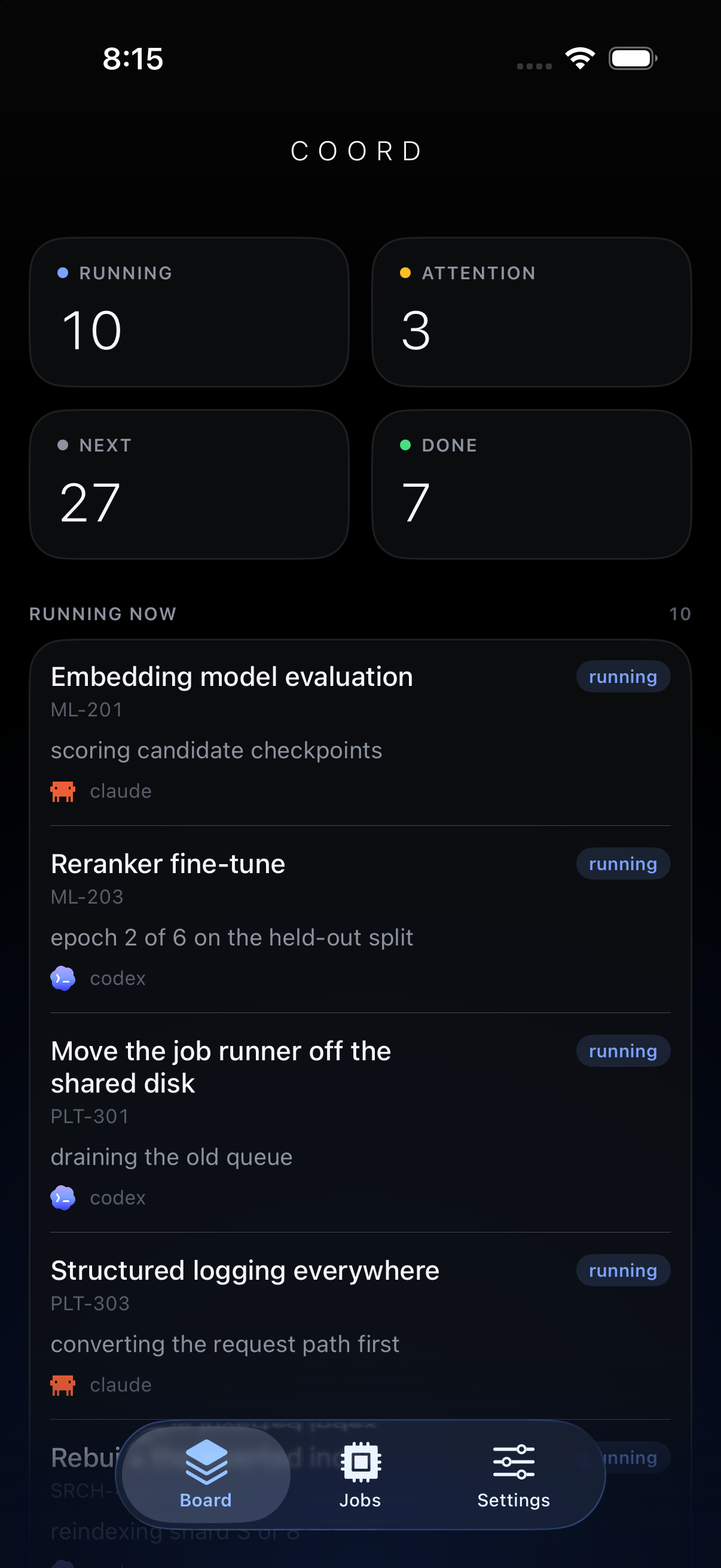 |
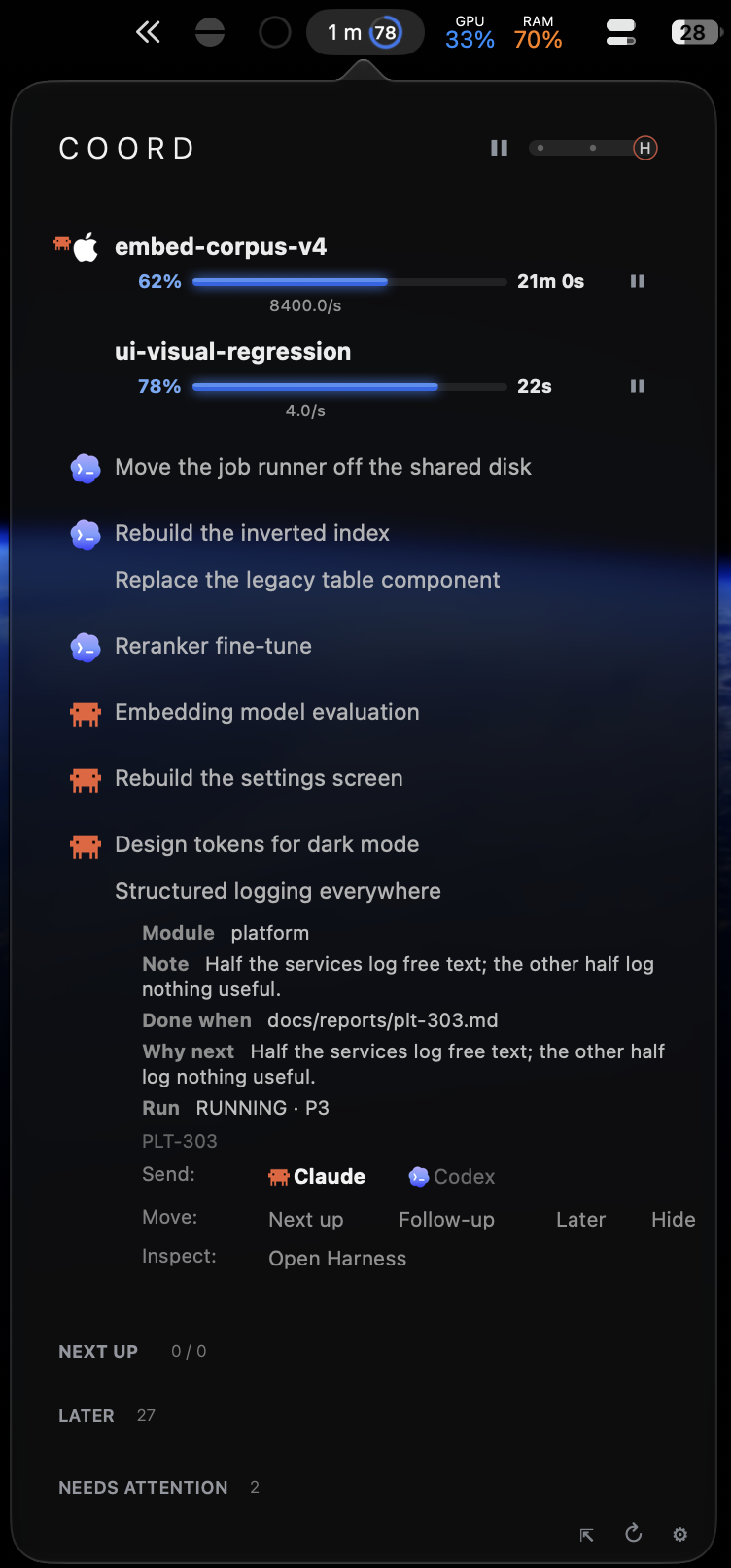
| COORD is the glance, and it has no Dock icon by design. The ring sits in the menu bar itself — the strip along the top of that capture — carrying elapsed time and percentage without opening anything. | Coord Cockpit for iOS is the same board away from the machine, on the same palette, accent, agent marks and derived status vocabulary as the desktop clients. |
There is no download. The apps are unsigned local builds — shipping a notarised
binary would mean an Apple developer identity in a public repository, which is
exactly the kind of thing this repository's extraction gate exists to keep out.
Requirements: macOS 14 or newer, Xcode, and XcodeGen (brew install xcodegen).
cd apps && xcodegen generate
xcodebuild -project CoordCockpit.xcodeproj -scheme CoordMenuBar -configuration Release -derivedDataPath .build build
xcodebuild -project CoordCockpit.xcodeproj -scheme CoordCockpitWindow -configuration Release -derivedDataPath .build build
That produces apps/.build/Build/Products/Release/COORD.app and COORD Cockpit.app.
Run either directly, pointing it at a board:
COORD_DB=$PWD/.coordharness/coord.db COORD_BOARD_URL=http://127.0.0.1:7870 \
  "apps/.build/Build/Products/Release/COORD.app/Contents/MacOS/COORD"
| App | What it is | Where it appears |
|---|---|---|
| COORD | Status-bar panel: a progress ring in the menu bar, running work and local jobs in the popover, with pause and mode controls | The system menu bar — no Dock icon by design |
| COORD Cockpit | Full window: the Board plus embedded Mesh, Map, and Atlas views under one navigation | The Dock |
Both read the database directly through a read-only SQLite connection
(SQLITE_OPEN_READONLY plus PRAGMA query_only=ON) and fall back to the HTTP
snapshot. By default neither can write to the board. An explicitapps/install.sh --enable-native-operator-writes opt-in enables only native task
reassignment over a fixed loopback endpoint, with an owner-only bearer,
confirmation, exact row/version/assignment-head fences, idempotent receipts, and
refusal while a claim or run is live. Browser actions remain read-only; the native
client never writes SQLite directly. Reading the
file directly couples these two apps to the SQLite schema; the iOS client and the
snapshot-only CoordCockpitMac target take /api/v1/snapshot over HTTP instead and
stay independent of it. See compatibility.COORD_DB chooses the board, COORD_BOARD_URL the map to embed, andCOORD_MENUBAR_CONFIG the panel's appearance. Exact targets and the iOS client are
documented in native clients.
Web control room
The board server binds loopback only and serves read-only projections of the same
lifecycle authority. The Content-Security-Policy admits no inline script or style.
This is not safe to expose to a LAN or the internet.
Precisely: no HTTP route can create, claim, complete, or review work. Three POST endpoints
exist and none of them touch lifecycle state — two manage local usage/provider settings and are
gated on a loopback bind plus a matching Origin, and the third is the opt-in native
reassignment endpoint described above, disabled unless COORD_NATIVE_OPERATOR_WRITES=1 and
additionally guarded by a bearer token compared in constant time. GET reads are
unauthenticated, which is the other reason loopback is not a formality.
Maturity at a glance
The machine-readable source for this table is docs/feature-status.json. "Preview" means source exists in this branch but its public contract can still change.
| Capability | Status | Public contract |
|---|---|---|
| SQLite-WAL lifecycle, claims, leases, proof, events | Shipped | Stable local core |
coord CLI and Python API |
Shipped | Stable core surface |
| MCP stdio server | Preview | 37 tools declared, 36 exposed by default; fresh generic preflight, board, and lifecycle writes answer, while facts_lookup and orient fail closed until a knowledge store and an enforced exact-authority policy exist; strict-profile custody remains deployment-specific |
coord-mcp executable |
Preview | Packaged stdio launcher; the checked-in project-scoped configs use paths relative to the project root, and absolute paths are required whenever the client does not launch the server there |
| Local jobs and run telemetry | Shipped | Library surface; CLI is preview |
| Bounded context, facts, and full-text retrieval | Preview | The capsule, digest, skeleton, focus, search, and curation lenses render on a fresh generic coord.db; the MCP server names the fact ledger on every read but does not create it, and knowledge indexing and accepted-memory bootstrap remain library workflows |
coord doctor safety report |
Shipped | Read-only stable v1 PASS/BLOCKED contract; exits 0 on a freshly seeded board and after a completed claim |
| Codex and Claude project skill packages | Shipped | Byte-identical repository integration |
| Local MLX model orchestration | Preview | Explicit catalog, preflight, and process-held resource lock |
| Source-bound graph views (Board, Mesh, Map, Atlas) | Preview | Read models over one bounded authority; never a freeform whiteboard or writer |
| Freeform shared whiteboard | Planned | No authoritative standalone implementation |
| Rich private-product operations console | Excluded | Product modules, branded actions, and hosted operations stay private |
| Loopback read-only web board | Preview | Branch surface; localhost only |
| macOS and iOS clients | Preview | Clean-room read-only clients by default; opt-in macOS task reassignment is loopback-only, authenticated, confirmed, and CAS-fenced |
| Distributed, hosted, or multi-tenant coordination | Excluded | Single-machine trust model |
Security boundary
coordharness assumes trusted processes under one local user account. Actor and session labels are coordination identity, not cryptographic authentication. The database can contain work titles, event text, and local metadata; keep it out of source control and protect it with filesystem permissions.
- Do not bind the board beyond loopback.
- Do not share
coord.dbover a network filesystem. - Do not put secrets, prompts, source bodies, argv, or stdout in events or sidecars.
- Do not treat read-only clients as authorization boundaries.
- Run the publication gate before any external release.
Read the full security and privacy model and security policy.
Platform support
macOS has the full path: CLI, MCP, board, and the native menu-bar/Cockpit/iOS
clients. Linux has the CLI and MCP path — core coordination, the web board, and
local jobs — without the native Xcode-built clients, which are macOS-only by
toolchain. Windows process-liveness support is planned, not a current claim; see
compatibility for the full runtime matrix and promises.
Versioning
main is the release channel until v0.1.0 tags land — no numbered releases exist
yet, and compatibility promises attach to shipped surfaces (see
compatibility), not to a version number.
Troubleshooting
Full list of nine, with fixes, in
getting started → Troubleshooting. The
six most likely on a first run:
coord: could not prepare the database — the parent directory is not
writable, or the path is a zero-byte or foreign SQLite file. The loader fails
closed rather than writing coordination tables into an unrelated database.
ValueError: ambiguous agent identity — both a Claude Code and a Codex
session variable are set, so the CLI refuses to guess which lane owns the work.
Set COORD_ACTOR=claude or COORD_ACTOR=codex with a matchingCOORD_SESSION_ID and re-run.
claim says the row belongs to another actor — use the correct
actor/session identity or a typed handoff. Never overwrite the assignee or reuse
another process's session ID.
done says proof is missing or incomplete — the artifact path must exactly
match the row's declared done_signal, resolve beneath COORD_PROJECT_ROOT,
exist, and be non-empty. It must also be tracked in Git's index — git add it;
staging is enough, no commit needed. This applies to a proof of any type: up
to 0.1.0 only .md proofs were custody-checked and everything else completed on
existence alone, so a .json, .txt or .html completion that used to succeed
untracked is now refused. The exceptions are artifact kinds that structurally
cannot live in Git — .parquet, .duckdb, .db, .joblib, .bz2, .backup —
which must still exist but need not be tracked. SetCOORD_COMPLETION_CUSTODY_EXEMPT to a comma-separated suffix list to rebind that
set for an unusual artifact kind, or to * to turn the custody requirement off
entirely.
coord doctor reports database_outside_state_root — the database exists
but sits outside the state root doctor was given. Pass a matching --state-root,
or keep the database at the default .coordharness/coord.db.
The board viewer cannot open the database — create it first with any coord
command or the demo seeder, and confirm the viewer and CLI point to the same
absolute COORD_DB.
Documentation
Contributing guidance is in CONTRIBUTING.md; COORD-Harness is released under the MIT License.
Visual index — every figure on this page, numbered
Reference a figure by its number to cut it, move it, or swap it. Diagrams are D#,
screenshots are S#, inline Mermaid sources are M#, and each number appears as an HTML
comment directly above its figure in the source, so grep -n "S7" README.md finds it
instantly.
| # | File | Section | What it is for |
|---|---|---|---|
| M1 | inline Mermaid | What this is | Two agent lanes writing one authority; surfaces reading it; no channel between agents |
| M2 | inline Mermaid | Independent review | The review loop, including the self-verdict that is recorded and does not count |
| S1 | screens/macos-cockpit.png |
Hero | The work table, native — the surface an operator lives in — before any prose |
| S2 | screens/swarm-mesh-context.png |
Intro | The fleet as one coherent spatial read, shortly below the primary Cockpit hero |
| D1 | birdseye.svg |
Intro | One authority, many read-only projections |
| D2 | single-authority-flow.svg |
Two agents, one file | CLI/MCP/Python converge; no client-to-client sync |
| D3 | handoff-sequence.svg |
Handing work over | Handoff is an ownership transaction; the refusal proves it |
| D4 | multi-agent-jobs.svg |
Why a swarm is one row | Subagents roll up; job lanes |
| S3 | screens/board-overview.png |
What an operator sees | Attention and running work |
| S4 | screens/operations-atlas-overview.png |
What an operator sees | One coherent generation, joined |
| S5 | screens/map-fleet.png |
Lens gallery | Who is working where |
| S6 | screens/map-deps.png |
Lens gallery | Downstream reach and longest walk |
| S7 | screens/map-chronicle.png |
Lens gallery | Precedence without a clock |
| S8 | screens/map-pulse.png |
Lens gallery | The record as a live wire |
| S9 | screens/map-ceiling.png |
Lens gallery | Bounded parallelism thought experiment |
| S10 | screens/map-topology.png |
Lens gallery | The fleet as an org in motion |
| D5 | lifecycle.svg |
How work moves | Intent vs observed state; the proof gate |
| D6 | jobs.svg |
How work moves | Tracked processes and liveness re-derivation |
| D8 | proof-gated-done.svg |
How work moves | Real transcript: coord done refused twice, accepted once staged |
| D7 | context-retrieval.svg |
What the harness remembers | Authority vs bounded retrieval vs recall |
| S11 | screens/macos-panel.png |
Native | The menu-bar glance |
| S12 | screens/ios-home.png |
Native | The same board on a phone |
Deliberately not on this page, still in docs/assets/ and reachable from the
deeper documents: board-work.png (the same work table as S1, in the web console instead of
native — the native section now says that in one sentence instead of showing it
twice); handoff.svg (superseded by D3, which shows the same transaction
and its refusal); architecture.svg and system-architecture.svg (two
overlapping views of one actor model — one belongs in
architecture, not here); context.svg, context-tiers.svg,lifecycle-proof.svg, projection-topology.svg, extraction.svg; the remaining Map
lenses map-shape, map-subjects, map-orbit, map-crossings, map-context,map-search, map-drawer, map-flowpath; and board-jobs, board-graph,board-activity, operations-atlas-topology, swarm-mesh-critical,swarm-mesh-owners, swarm-mesh-traversal, swarm-mesh-mobile.
Reviews (0)
Sign in to leave a review.
Leave a reviewNo results found