claude-delegator-deepseek-mcp
Health Pass
- License — License: MIT
- Description — Repository has a description
- Active repo — Last push 0 days ago
- Community trust — 64 GitHub stars
Code Warn
- process.env — Environment variable access in smoke.mjs
- process.env — Environment variable access in src/client.mjs
- process.env — Environment variable access in src/colors.mjs
- process.env — Environment variable access in src/paths.mjs
Permissions Pass
- Permissions — No dangerous permissions requested
No AI report is available for this listing yet.
MCP server: delegate heavy-token tasks from Claude Code to DeepSeek, Kimi, GLM, Qwen, Grok, or any OpenAI-compatible model. Mix providers per task, cost receipt on every call. Zero dependencies.
Claude Code DeepSeek Delegator
🚀 3.0 is out — now model-agnostic
One tool, any model: DeepSeek, Kimi, GLM, Qwen, Grok, Groq, OpenRouter, even your local ollama — and you can mix them per task. Plus a rebuilt interactive installer, a model picker inside Claude Code, and a receipt for every cent. v2 installs keep working untouched. See what's new ↓
Cut your Claude Code bill by 90–97% on heavy work — big file audits, long generations, deep reasoning — by delegating it to a cheaper model without leaving your session.
Claude orchestrates; the delegate does the grunt work (big file audits, long generations, deep reasoning) at a fraction of the price. One tool call, no subagent spawn, no daemon, zero dependencies.
One command installs everything. init is an interactive wizard that wires up the delegate tool, the automatic gate (the "Delegate to DeepSeek? (y/n)" nudge before heavy reads and skill loads), your provider + API key (live-validated), and how models get picked. Run it once, restart Claude Code, and delegation just happens.





⭐ If this saves you money, please star the repo. It's the single biggest thing that helps other Claude Code users find it.
![A Claude Code session in a light macOS terminal: the gate asks 'Delegate to DeepSeek? (y/n)', the user answers y, files are handed off via files[], a receipt line shows saved $0.194 (94% vs Opus) · spent $0.012, and Claude synthesizes the three findings](https://raw.githubusercontent.com/12122J/claude-delegator-deepseek-mcp/main/assets/hero.svg)
Every call ends with a receipt — shown to you automatically, straight from the API's own token counts. You always know what you spent and what you saved.
What's new in 3.0
- Any model, not just DeepSeek. 8 providers vendored (DeepSeek, Moonshot/Kimi, Z.AI + Zhipu/GLM, Alibaba/Qwen, Groq, xAI/Grok, OpenRouter) plus any OpenAI-compatible endpoint you add — including local ollama/vllm for $0 delegation.
- Mix and match providers. Select several providers in one init (space in the picker), give each its key, then route digestion to GLM-flash, code generation to DeepSeek-pro, keep a Kimi in your shortlist. Keys live in a keyring that survives re-runs and provider switches.
- A setup wizard that's actually nice. Arrow-key rail UI, live API-key validation against the real endpoint, full disclosure before anything is written, one question for model strategy.
- Pick the model your way. Smart split (cheap model digests, big model creates), a shortlist picker rendered by Claude Code's own UI, always-best, always-cheapest, or fully custom per kind of work.
- Honest receipts. Cost per call from the provider's own token counts, cached tokens billed at cached rates, savings baseline of your choice (Opus, Sonnet, or off).
- Nothing breaks. The
deepseektool name, env var, and hooks from v2 all keep working. No config = exact v2 behavior.
Install (one command)
npx claude-code-deepseek-delegator init
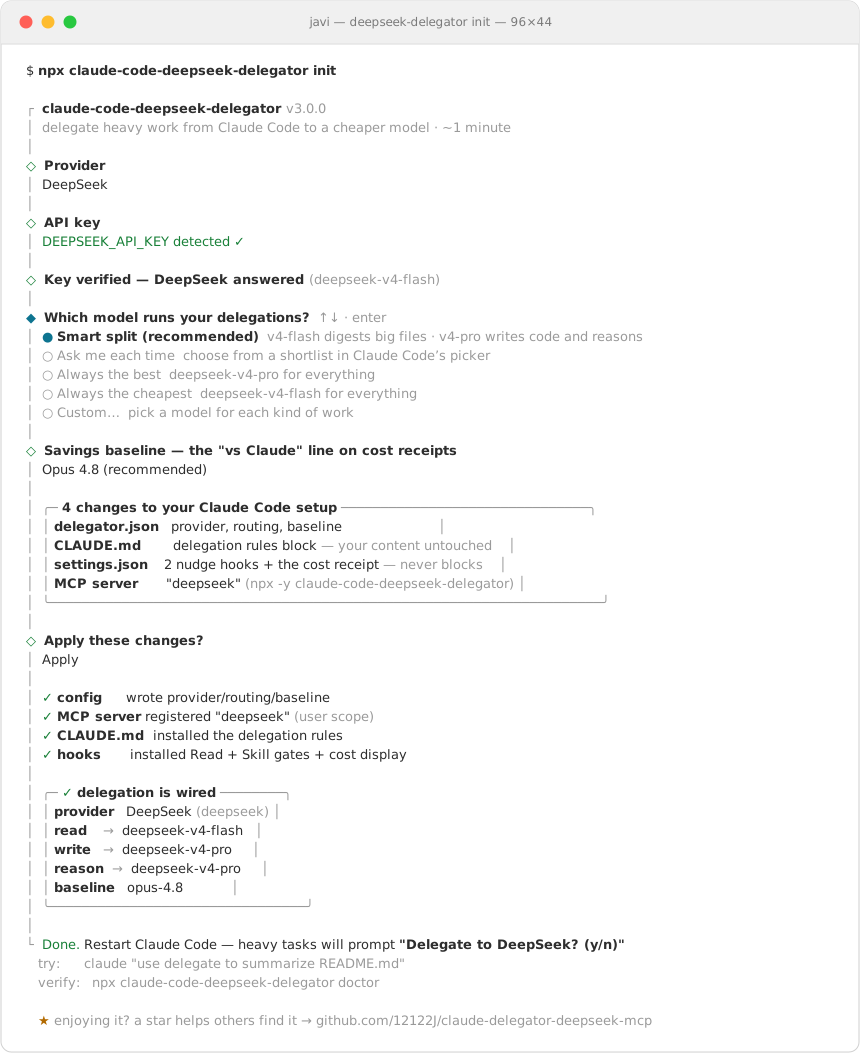
The wizard walks you through four choices — arrow keys, ~1 minute:
- Providers — DeepSeek, Moonshot (Kimi), Z.AI / Zhipu (GLM), Alibaba (Qwen), Groq, xAI (Grok), OpenRouter, or any custom OpenAI-compatible endpoint (ollama, vllm, LM Studio, a proxy). Enter picks one; space picks several — enroll DeepSeek and Z.AI in the same run and mix them in step 3 (the first becomes the primary that names the gate).
- API keys — one per chosen provider: detected from your environment, or paste it (hidden). The wizard live-fires a 1-token request so a bad key fails right there with the provider's real error, not on tomorrow's first delegation.
- Which model runs your delegations — a smart split (the cheap model digests, the big one creates), a shortlist you pick from each time, always best / always cheapest, or custom (see below).
- Savings baseline — measure savings against Opus 4.8, Sonnet 5, or don't show savings.
It then shows exactly what it will change, asks, applies, and prints a recap:
Sanity-check anytime:
npx claude-code-deepseek-delegator doctor
doctor doesn't just check that files exist — it actually fires the gate hooks, resolves every configured model against the registry, and confirms the delegation prompt is live.
What init actually changes (full disclosure)
~/.claude/delegator.json— your provider, model routing, and savings baseline. Edit it anytime; changes apply on the next call, no restart.- A clearly-labeled block in
~/.claude/CLAUDE.md— the delegation rules, fenced with<!-- >>> ... >>> -->markers. Never touches anything else in your file. - Three hooks in
~/.claude/settings.json— twoPreToolUsenudges (before large reads and skill loads) and onePostToolUsecost receipt. They only add context or display info — they never block, delete, or modify your tool calls. - An MCP server named
delegate(npx -y claude-code-deepseek-delegator) — so Claude Code shows "Calling delegate…" on every call. v2'sdeepseekserver key keeps working on untouched installs and is migrated automatically when you re-run init.
Before any of that, it writes a timestamped backup of every file it changes. To undo everything — including the config files:
npx claude-code-deepseek-delegator uninstall
Which model does the work?
Not every delegation deserves your best model. "Summarize this 2,000-line file" is digestion — a cheap model does it fine. "Rewrite this module" is creation — you want the good one. Paying pro prices for flash work is where delegation savings quietly leak.
So the wizard asks one question — "Which model runs your delegations?" — with answers that map to how people actually think:
- Smart split (recommended) — the cheap model digests big files, the big model writes code and reasons. You never think about it again; the receipt shows which one ran.
- Ask me each time — you keep a shortlist, and when you approve a delegation Claude shows it through Claude Code's native picker UI (the same one
/modeluses) with prices. You tap the model, it delegates there. - Always the best / Always the cheapest — one model for everything, zero decisions.
- Custom — pick a model per kind of work (
read/write/reason), mixing providers freely: the menus list models from every provider whose key is detected, so "reads on GLM-flash, writes on DeepSeek-pro, reasoning on Kimi" is three arrow-key picks.
What each choice feels like in a session
Smart split. You never see a model decision — the same y/n gives cheap digestion and quality creation:
❯ summarize what src/auth.py does            (2,100 lines)
> Delegate to DeepSeek? (y/n)  y
⎿ delegate deepseek-v4-flash via deepseek · saved $0.081 (94% vs Opus) · spent $0.005
                    ↑ digestion → the cheap model ran

❯ now rewrite it with proper token rotation
> Delegate to DeepSeek? (y/n)  y
⎿ delegate deepseek-v4-pro via deepseek · saved $0.152 (91% vs Opus) · spent $0.019
                    ↑ creation → the big model ran
Ask me each time. After your y, Claude opens Claude Code's picker with your shortlist and prices; your tap decides:
> Delegate to DeepSeek? (y/n)  y

  Which model?                       ← Claude Code's native picker
  ❯ deepseek-v4-flash   $0.14 / $0.28 per 1M
    deepseek-v4-pro     $0.435 / $0.87 per 1M
    moonshot:kimi-k2.5  $0.20 / $1.20 per 1M

⎿ delegate kimi-k2.5 via moonshot · saved $0.117 (88% vs Opus) · spent $0.016
Always the best / cheapest. Every delegation is the same model — exactly how v2 behaved, one price.
Under the hood every choice just writes ~/.claude/delegator.json, which you can edit anytime — changes apply on the next call, no restart:
{
  "provider": "deepseek",
  "mode": "auto",                        // or "ask" for the shortlist picker
  "shortlist": ["deepseek-v4-flash", "deepseek-v4-pro", "moonshot:kimi-k2.5"],
  "routing": {
    "read":   "deepseek-v4-flash",       // digest/summarize big inputs
    "write":  "deepseek-v4-pro",         // generate code and docs
    "reason": "deepseek-v4-pro"          // math, logic, architecture
  },
  "baseline": "opus-4.8"
}
How the smart split works mechanically: Claude labels each delegation task: "read" | "write" | "reason", the server looks the label up in routing, and that model id goes on the wire (this chain is covered by an end-to-end test against a mock provider). An explicit model argument — like the one your picker choice produces in ask mode — always beats the routing table. If Claude omits the label entirely, the provider's default large model runs: the failure mode is a price tier, never a crash.
Providers
| Provider | id | Env var | Example models |
|---|---|---|---|
| DeepSeek | deepseek |
DEEPSEEK_API_KEY |
deepseek-v4-pro, deepseek-v4-flash |
| Moonshot | moonshot |
MOONSHOT_API_KEY |
kimi-k2.5, kimi-k2.7-code |
| Z.AI | zai |
ZAI_API_KEY |
glm-5, glm-4.7-flash |
| Zhipu | zhipu |
ZHIPU_API_KEY |
glm-5, glm-4.7 |
| Alibaba | alibaba-singapore |
ALIBABA_SINGAPORE_API_KEY |
qwen3.7-max, qwen3.6-flash |
| Groq | groq |
GROQ_API_KEY |
llama-4-maverick, kimi-k2 |
| xAI | xai |
XAI_API_KEY |
grok-4.5, grok-code-fast-2 |
| OpenRouter | openrouter |
OPENROUTER_API_KEY |
~25 curated ids across every lab |
Provider definitions (endpoints, models, prices) follow the catwalk schema, vendored from charmbracelet's registry (MIT). Add your own in ~/.claude/delegator-providers.json — any OpenAI-compatible endpoint works, including local ones:
{
  "name": "Local Ollama", "id": "ollama", "type": "openai-compat",
  "api_key": "none", "api_endpoint": "http://localhost:11434/v1",
  "default_large_model_id": "qwen3-coder",
  "models": [{ "id": "qwen3-coder", "cost_per_1m_in": 0, "cost_per_1m_out": 0,
               "context_window": 128000, "default_max_tokens": 8192 }]
}
Why this instead of spawning a subagent?
The usual pattern for heavy work — spawning a Claude subagent — starts a brand new context window: you re-pay the full context, lose your current state, and still bill at Claude rates.
This MCP server stays in your current session. Claude calls delegate(...) like any tool — no new context, no re-init, no spawn overhead — and the delegate does the heavy compute at a fraction of the rate.
The files[] trick (this is the real win)
When Claude reads files and pastes them into a prompt, those bytes land in Claude's context first — you pay Claude's rate just to pass content through.
With files[], Claude passes only the paths. The MCP server reads the bytes off disk and forwards them straight to the delegate. Large codebases never touch Claude's context.
// Claude calls the tool like this — no Read calls first:
delegate({
  prompt: "Audit these files for security vulnerabilities and rank by severity.",
  task: "read",
  files: ["/abs/path/auth.py", "/abs/path/middleware.py", "/abs/path/payments.py"]
})
Claude then synthesizes the answer for you instead of pasting it verbatim — so you get the conclusion, cheaply, in the same conversation.
The cost receipt (you see every cent)
After every call, a one-line receipt is displayed to you:
delegate deepseek-v4-pro via deepseek · saved $0.2472 (96% vs Opus) · spent $0.0114 · 28,410 tokens
It's computed from the API's own token usage (cached prompt tokens billed at the cached rate) and shown by a PostToolUse hook — deterministically, not by asking the model to remember. Claude physically cannot swallow the number. The baseline is yours to choose: Opus 4.8, Sonnet 5, or off.
Tools
delegate
| Param | Type | Default | Description |
|---|---|---|---|
prompt |
string | required | The task for the delegate. Be specific. |
task |
string | — | read / write / reason — routes to the configured model. |
model |
string | routed | Override: bare id or provider:model (e.g. openrouter:moonshotai/kimi-k2.5). |
provider |
string | configured | Override the active provider by id. |
files |
string[] | — | Absolute paths. The server reads them — bytes never enter Claude's context. |
system |
string | — | Optional system prompt. |
temperature |
number | 0.3 |
0–2, lower = more deterministic. |
stream |
boolean | false |
Stream chunks instead of buffering. Good for very large outputs. |
delegate_models
Lists every provider with key status, models, context windows, and prices, plus your active routing.
deepseek / deepseek_models
Aliases of the above — v2 names, kept working forever.
CLI reference
npx claude-code-deepseek-delegator <command>

  (no command)   Run the MCP server (how Claude Code launches it)
  init           Interactive setup wizard: provider, key, routing, gate (asks first)
  doctor         Verify the install, resolve the config, live-fire the gate hooks
  uninstall      Cleanly remove everything init added (incl. delegator.json)
  help           Show help
  --version      Print version

  init flags:  --dry-run · --no-hooks · --yes ·
               --provider <id[,id…]> (first is primary) · --key <key> ·
               --preset balanced|cheapest|max · --mode auto|ask ·
               --baseline opus|sonnet|none
Environment variables
| Variable | Default | Description |
|---|---|---|
<PROVIDER>_API_KEY |
— | Key for each provider (see the table above). |
DELEGATOR_CONFIG |
~/.claude/delegator.json |
Config file location. |
DELEGATOR_TIMEOUT |
120000 |
Request timeout (ms). DEEPSEEK_TIMEOUT still works. |
DELEGATOR_MAX_RETRIES |
2 |
Retries on 429/5xx. DEEPSEEK_MAX_RETRIES still works. |
DEEPSEEK_API_HOST |
api.deepseek.com |
v2 compat: overrides the DeepSeek hostname. |
CLAUDE_CONFIG_DIR |
~/.claude |
Honored if you've relocated Claude's config. |
Migrating from v2
Nothing to do. Existing installs keep working unchanged: the deepseek tool name, DEEPSEEK_API_KEY, the MCP server entry, and the installed hooks all still function, and with no config file the behavior is identical to v2 (DeepSeek v4-pro for everything). Run init once to unlock providers, task routing, and the shortlist picker.
FAQ
Does npm install alone enable the gate? No. Installing only provides the binary. Run init to wire it in.
Will it overwrite my CLAUDE.md? Never. It appends one fenced block and shows you the exact text first. Everything else is left byte-for-byte.
How do I remove it? npx claude-code-deepseek-delegator uninstall. Clean and complete — MCP entry, rules, hooks, and config files.
Is my key safe? Use the env-var reference and it's never written to disk. Or paste the literal key if you prefer.
Can I use two providers at once? Yes — select both in the wizard's provider step (space toggles) and give each its key in the same run; the Custom and Shortlist menus then mix their models. Under the hood routing values and shortlist entries are provider:model specs, keys live as a keyring in the MCP env block (surviving re-runs and provider switches), and doctor verifies every referenced provider's key.
Why is the package still called deepseek-delegator if it's model-agnostic? it was initially only for deepseek. 12k installs a month depend on the npm name and the v2 tool alias. The engine is agnostic; the packaging keeps its name so nobody's setup breaks. (The MCP server itself registers as delegate since 3.0.)
License
MIT. Provider registry data vendored from charmbracelet/catwalk (MIT).
Built by Javi. If this saves you money, a star is the nicest way to say thanks — it's how other Claude Code users find it.
Reviews (0)
Sign in to leave a review.
Leave a reviewNo results found