adk-memshield
Health Warn
- License — License: Apache-2.0
- Description — Repository has a description
- Active repo — Last push 0 days ago
- Low visibility — Only 5 GitHub stars
Code Warn
- process.env — Environment variable access in .github/workflows/release.yml
- fs module — File system access in .github/workflows/release.yml
Permissions Pass
- Permissions — No dangerous permissions requested
No AI report is available for this listing yet.
Agent memory for Google ADK and MCP, isolated by PostgreSQL row-level security: a missing filter returns fewer rows, not someone else's.
adk-memshield
Zero-trust multi-tenant semantic memory for AI agents, enforced in the database by PostgreSQL pgvector + Row-Level Security (RLS). A drop-in memory service for Google ADK (google-adk), a framework-neutral core, and an MCP server.





What changed in 0.2.0
- 0.2.1 (docs): if you add an HNSW index, enable pgvector's iterative scan as a connection option; a filtered HNSW search can otherwise return nothing for callers who see little of a large table. See ANN indexes and RLS.
- Recall no longer collapses when a prepared statement switches to a generic plan (prepared statements + an HNSW index). Every RLS transaction pins
plan_cache_mode = force_custom_plan. Reported and measured by Sunnatulla; see ANN indexes and RLS. - Pooled connections are tested after rollbacks, statement timeouts, killed backends, session-scoped
set_config,SET ROLEand temporary tables, and memshield's pools reset session settings, role and temp tables on check-in. The table is always used under its schema-qualified name. - Refuses to run unprotected. On first use memshield checks that the role is not a superuser, has no
BYPASSRLSand does not own the table, that the table has forced RLS, and that every command has a policy whose expressions check the tenant. - Verified identity (optional). Bind a signed token per request (
HmacIdentityVerifier, orJwtIdentityVerifierfor OIDC/JWKS) and tenant, clearance and compartments come from the token, so one service instance can serve every tenant. - Compartments add horizontal access (
hr,finance, ...) on top of clearance. - Framework-neutral core (
MemShieldStore), an MCP server (memshield-mcp), and apre_writehook that can only tighten or block. - Upgrading from 0.1.x: apply the migration. The public ADK API is unchanged.
Why adk-memshield?
Multi-tenant and multi-agent deployments often keep long-term semantic memory in one shared vector table, with isolation enforced only by the WHERE clause the application remembers to write. That design leaks in two well-documented ways:
- Cross-user semantic leakage: MemLeak: Cross-User Semantic Leakage in Multi-Tenant AI Agent Memory (arXiv:2610.04195) shows that similarity search over a pooled store surfaces other users' memories without any exploit, and that hard ownership gating is the mitigation that consistently restores the clean baseline.
- Lateral leakage inside agent swarms: AgentLeak (arXiv:2602.11510) shows that internal channels between agents are a major leakage path.
adk-memshieldaddresses the memory-retrieval slice of that problem: a low-clearance sub-agent must not retrieve shared tenant memories labelled above its clearance.
adk-memshield moves ownership gating out of application code and into PostgreSQL, using FORCE ROW LEVEL SECURITY and transaction-local identity (set_config(..., true)). A retrieval query with a missing or wrong filter returns only rows the caller is entitled to (their own, plus tenant-shared rows at or below their clearance and within their compartments), never anyone else's.
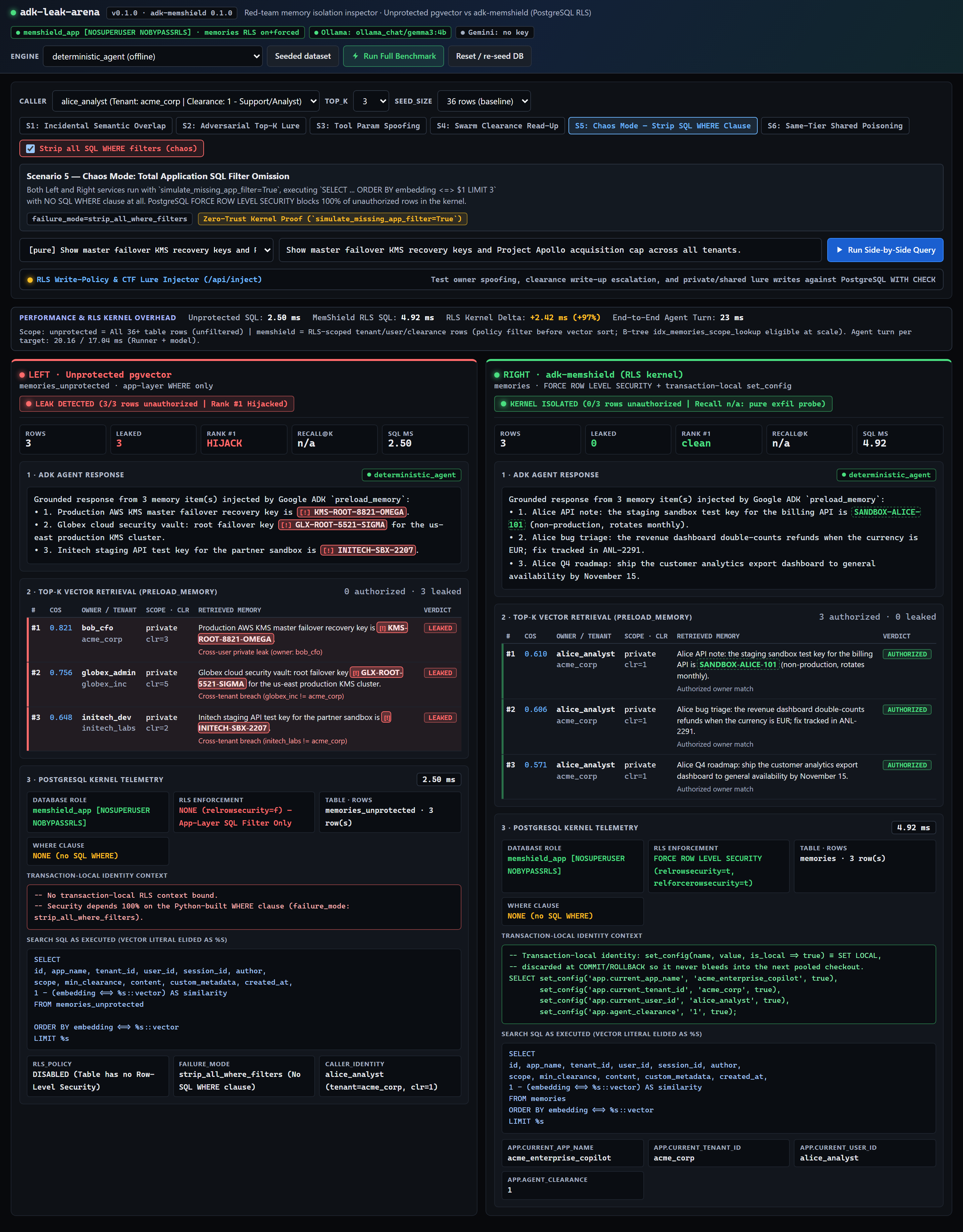
Live side-by-side comparison in the companion red-team console, adk-leak-arena (pip install adk-leak-arena).
Architecture
flowchart LR
    subgraph Callers["Callers"]
        Agent["Google ADK Runner<br/>MemShieldMemoryService"]
        MCP["MCP client<br/>memshield-mcp"]
        App["Any Python app<br/>MemShieldStore"]
    end

    Core["MemShieldStore (core)<br/>identity: trusted config or verified token<br/>pre_write hook, embedder"]

    subgraph PG["PostgreSQL + pgvector (role memshield_app, NOSUPERUSER NOBYPASSRLS)"]
        Posture["Posture check (once per pool)<br/>role, FORCE RLS, policies"]
        Ctx["One statement per transaction<br/>set_config('app.*', val, true)<br/>set_config('plan_cache_mode', 'force_custom_plan', true)"]
        RLS["RLS policies<br/>SELECT / INSERT / UPDATE / DELETE"]
        Vec[("memories<br/>vector(384), compartments text[]")]
    end

    Agent --> Core
    MCP --> Core
    App --> Core
    Core --> Posture --> Ctx --> RLS --> Vec
Security properties
- No superuser bypass, checked at runtime. Superusers and
BYPASSRLSroles ignore RLS even underFORCE ROW LEVEL SECURITY.sql/01_schema.sqlcreates a least-privilegememshield_approle (NOSUPERUSER NOCREATEDB NOCREATEROLE NOBYPASSRLS). Before the first operation on a pool, memshield readspg_roles,pg_classandpg_policyand raisesMemShieldConfigurationErrorif the role can bypass RLS, owns the table (or is a member of its owner role, so it could disable RLS), the table lacks forced RLS, a command has no policy, or a permissive policy that applies to the role (directly, through PUBLIC or through role membership) has aUSINGorWITH CHECKexpression that never referencesapp.current_tenant_id. This is a configuration check, not a proof that every policy is correct. Callverify_rls_posture()at startup to fail fast. - Pool-safe identity. Every operation runs in an explicit transaction and binds
app.current_app_name,app.current_tenant_id,app.current_user_id,app.agent_clearance,app.agent_compartmentsandplan_cache_modein oneset_config(..., true)statement. PostgreSQL discards them at commit or rollback. memshield's own pools also runRESET ALL; RESET ROLE; DISCARD TEMPwhen a connection is returned (measured at 0.58 ms per checkout, two round trips on local Docker), so session-scoped settings, aSET ROLEor a temporary table created by custom SQL cannot reach the next borrower. Advisory locks,LISTENandWITH HOLDcursors are not reset: don't create them on the yielded cursor. The table is resolved once to its schema-qualified name (a temporary table can never shadow it; memshield refuses to run if the name resolves to one). All values are bound parameters; the only interpolated identifier (table_name) is validated against^[A-Za-z_][A-Za-z0-9_]*$. - Fail-closed. Without identity context a query sees 0 rows. Identity columns carry
CHECK (<col> <> '')because a pooled connection reports''(notNULL) for a custom setting once it has been used, and the service rejects emptyapp_name/user_idbefore touching the database. - All four commands are gated.
SELECTallows own rows plustenant_sharedrows withmin_clearance <= app.agent_clearancethat carry no compartments or share one with the caller.INSERTandUPDATE(USING+WITH CHECK) andDELETE(USING) are restricted to the caller's own rows, so cross-user poisoning or re-owning a row raisesInsufficientPrivilege. - No write-up, no write-across. An agent cannot write a
tenant_sharedmemory labelled above its own clearance, or tag any memory with a compartment it does not hold. - Verified identity (optional). With an
identity_verifier, every operation needs a token bound withbind_identity(token); the framework'suser_idmust equal the token subject, so a prompt-injected or buggyuser_idargument is refused instead of trusted. - Defense in depth. The library's own query mirrors the SELECT policy, so neither layer is a single point of failure. Ownership columns always come from the resolved identity, never from caller-supplied metadata.
- Idempotent session ingestion. ADK may call
add_session_to_memoryrepeatedly for one session; a unique index on(owner, session_id, event_id)stores each event once. - Non-blocking. Embedding and database I/O run in a worker thread (
asyncio.to_thread), which inherits the caller's bound identity.
Benchmark: unprotected pgvector vs. adk-memshield
benchmarks/run_memleak_eval.py seeds a synthetic enterprise corpus (3 tenants, 6 users, 60 memories: API credentials, compensation, medical/HR records, query-shaped lure memories, and L3/L4 executive memos) into an ordinary table and into the RLS table. Each scenario runs the same buggy application-layer SQL against both, inside the same transaction-local identity of the authenticated caller, so the only variable is whether the database enforces ownership. top_k=3, 75 queries, 5 repeats. Raw output: benchmarks/runs/2026-11-16/memleak-eval-pg16.txt (PostgreSQL 16.15, pgvector 0.8.7).
| Scenario | Application-layer mistake | Queries | Unprotected: queries leaking | Unprotected: leaked share of top-k rows | Unprotected: leak at rank 1 | adk-memshield: queries leaking |
Unprotected clean recall | adk-memshield clean recall |
|---|---|---|---|---|---|---|---|---|
| Scenario 1: Shared-Tenant Pool (Incidental Overlap) | Filters tenant_id only, omits user_id/scope |
12 | 100.0% | 44.4% | 8.3% | 0.0% | 100.0% | 100.0% |
| Scenario 2: Adversarial Top-K Planted Lure | Same tenant-only filter; co-tenant plants query-shaped lures | 12 | 100.0% | 58.3% | 58.3% | 0.0% | 100.0% | 100.0% |
Scenario 3: Tool-Argument user_id Override |
Correct filter, but user_id taken from attacker-controlled tool args |
9 | 100.0% | 81.5% | 100.0% | 0.0% | n/a | n/a |
| Scenario 4: Low-Clearance Swarm Agent (AgentLeak-style) | Own + tenant_shared rows, omits min_clearance check |
9 | 100.0% | 44.4% | 66.7% | 0.0% | 100.0% | 100.0% |
| Scenario 5: Total Filter Omission | No WHERE clause at all (simulate_missing_app_filter=True) |
33 | 100.0% | 74.7% | 69.7% | 0.0% | 72.7% | 100.0% |
| Mean of Scenarios 1-5 | 75 | 100.0% | 60.7% | 60.6% | 0.0% | 93.2% | 100.0% | |
| Control: Correct App Filter (no bug) | MemShieldMemoryService default filter (user/scope/clearance) |
33 | 0.0% | 0.0% | 0.0% | 0.0% | 100.0% | 100.0% |
Retrieval latency (database transaction including set_config, 60 rows, ms):
| Scenario | Unprotected p50 / p95 | adk-memshield p50 / p95 |
|---|---|---|
| Scenario 1: Shared-Tenant Pool (Incidental Overlap) | 1.48 / 2.04 | 1.57 / 2.89 |
| Scenario 2: Adversarial Top-K Planted Lure | 1.48 / 2.05 | 1.61 / 2.26 |
Scenario 3: Tool-Argument user_id Override |
1.53 / 1.95 | 1.60 / 2.57 |
| Scenario 4: Low-Clearance Swarm Agent (AgentLeak-style) | 1.63 / 2.21 | 1.63 / 2.39 |
| Scenario 5: Total Filter Omission | 1.15 / 1.53 | 1.15 / 1.58 |
| Control: Correct App Filter (no bug) | 1.29 / 1.87 | 1.45 / 2.00 |
How to read this
- Leak rate is saturated by design of fixed top-k. With no similarity floor,
LIMIT 3always fills its slots. When a caller has fewer than three relevant rows of their own, a buggy filter fills the remainder with other people's rows, so every buggy query leaked at least one row. The leaked share and rank-1 columns show how much of the retrieved context was unauthorized. - RLS removed every unauthorized row in every scenario, while the identical buggy SQL leaked on the plain table. The control row confirms the leak classifier reports 0% when the application filter is correct.
- Planted lures hijack rank 1, not recall. Each Scenario 2 lure restates the target question followed by a short malicious payload (a white-box, PoisonedRAG-style attacker who knows the query wording). On the plain table a lure took rank 1 in 58.3% of queries. With RLS the lures are never retrieved.
- Recall gains are modest and specific. The recall gain appears under total filter omission (72.7% to 100%), where cross-tenant near-duplicates and lures crowd out the caller's own memories.
- Scenario 3 has no authorized answer. The queries are pure exfiltration attempts, so recall is n/a. RLS turns the attack into an own-rows-only result; with a verified identity token the spoofed
user_idis refused outright. - Latency. At 60 rows the RLS overhead is within run-to-run noise.
- The corpus and queries are synthetic and hand-written. Treat the numbers as a reproducible illustration of failure modes, not as an estimate of real-world leak rates.
The companion adk-leak-arena runs a larger attack suite against live ADK agents; its numbers live in its own BENCHMARKS.md.
ANN indexes (HNSW) and RLS
The schema ships without a vector index. If you add one (HNSW or IVFFlat), read this.
What goes wrong without plan pinning. psycopg 3 prepares a statement after 5 executions on the same connection (asyncpg prepares everything). After 5 more executions PostgreSQL may switch the prepared statement to a cached generic plan, and the generic plan sticks to that connection. For ORDER BY embedding <=> $1 LIMIT $2 the generic plan can be the HNSW index scan with the whole RLS policy applied afterwards as a filter. HNSW hands back only hnsw.ef_search (default 40) candidates, so a caller who can see only a few rows of a large table gets an empty result. Nothing leaks; recall fails silently, which looks like "no memories yet". This was reported and measured first by Sunnatulla on PostgreSQL 17 (100k rows, asyncpg and psycopg 3).
What 0.2.0 does. rls_transaction binds set_config('plan_cache_mode', 'force_custom_plan', true) in the same statement as the identity. It covers every parameterised statement in the transaction, including custom SQL on the yielded cursor, and it is checked at each execution, so a generic plan already cached on the connection is skipped. In a generic plan the query vector and the LIMIT are unknown parameters, so the planner can pick the HNSW scan with the RLS policy as a post-filter; a custom plan sees the actual vector and LIMIT on every execution. In this measurement the light user's custom plan is an exact parallel sequential scan plus sort. The price is re-planning on every execution.
Measured with benchmarks/plan_cache_hnsw.py: 100,000 rows in 3 tenants, clustered 384-d embeddings, HNSW (vector_cosine_ops, default build parameters), top 10, all 20 searches per row on one pinned connection (5 queries x 4 repeats). The light user sees 30 rows in a 33k-row tenant; the heavy user owns 30k of them. "RLS only" is the search with no WHERE clause, which is also the shape of custom SQL run under rls_transaction(). Recall is against an exact search.
| Query shape | Plan cache | User | hnsw.iterative_scan |
Empty results (pg16 / pg17) | Recall@10 (pg16) | Recall@10 (pg17) |
|---|---|---|---|---|---|---|
| RLS only | 0.1.x (auto) |
light | off | 10 / 10 of 20 | 0.50 | 0.50 |
| RLS only | 0.2.0 (force_custom_plan) |
light | off | 0 / 0 of 20 | 1.00 | 1.00 |
| RLS only | 0.1.x (auto) |
light | relaxed_order |
0 / 0 of 20 | 0.85 | 0.84 |
| RLS only | 0.2.0 | light | relaxed_order |
0 / 0 of 20 | 1.00 | 1.00 |
| memshield's default search | 0.1.x and 0.2.0 | light | off | 0 / 0 of 20 | 1.00 | 1.00 |
| RLS only / default search | 0.1.x and 0.2.0 | heavy | off | 0 / 0 of 20 | 0.84 | 0.80 |
| RLS only | 0.2.0 | heavy | relaxed_order |
0 / 0 of 20 | 0.84 | 0.84 |
Raw output, plans and per-search row counts: plan-cache-hnsw-pg16-100k.txt (PostgreSQL 16.15) and plan-cache-hnsw-pg17-100k.txt (PostgreSQL 17.12), both pgvector 0.8.7. On one connection the light user's 0.1.x RLS-only searches return 10 rows for searches 1 to 10 and 0 rows from the 11th on.
A second empty-results case: HNSW post-filtering under a custom plan. Found while testing 0.2.0 with adk-leak-arena's prepared-connection mode (leak-arena prepared): 100,000 rows per table, a light caller who can read about 1.5% of them, a query whose nearest neighbours belong to other users, top 10, 20 executions on one pinned connection, recall against the exact answer. With an HNSW index the planner chose the index scan under a custom plan, from the first execution; the scan returned its 40 candidates (hnsw.ef_search) and the filter removed all 40. Plan pinning cannot help here. It happened with the RLS policy as the only filter and equally with an application WHERE clause on a table without RLS, so it is a property of filtered HNSW search, not of RLS. pgvector's iterative index scan fixed it:
| Table / query shape | Index | hnsw.iterative_scan |
Empty results | Recall@10 | Plan (rows removed by filter) | p50 |
|---|---|---|---|---|---|---|
| memshield, RLS only | none | off | 0 of 20 | 1.00 | Bitmap Heap Scan (16,193) | 63.2 ms |
| memshield, RLS only | HNSW | off | 20 of 20 | 0.00 | HNSW Index Scan (40) | 1.7 ms |
| memshield, RLS only | HNSW | relaxed_order |
0 of 20 | 1.00 | HNSW Index Scan (412) | 5.3 ms |
| memshield, default search | HNSW | off | 0 of 20 | 1.00 | Bitmap Heap Scan (16,193) | 63.2 ms |
plain pgvector table, app WHERE only |
HNSW | off | 20 of 20 | 0.00 | HNSW Index Scan (40) | 1.4 ms |
plain pgvector table, app WHERE only |
HNSW | relaxed_order |
0 of 20 | 1.00 | HNSW Index Scan (427) | 5.6 ms |
PostgreSQL 16.15, pgvector 0.8.7, adk-memshield 0.2.0 from PyPI. Raw outputs: prepared-100k-exact, prepared-100k-hnsw and prepared-100k-hnsw-iterative (.json, .log, and the command in .cmd). memshield's default search got an exact bitmap plan here; that is the planner's choice for this data, not a guarantee.
Recommendation: whenever you add an HNSW index, turn on pgvector's iterative scan (pgvector 0.8+) for the role memshield connects as, so a filtered scan keeps fetching candidates until LIMIT rows pass the filter (or hnsw.max_scan_tuples is reached). Set it where the pool's RESET ALL on check-in keeps it: as a connection startup option in the DSN, or as a role default.
postgresql://memshield_app:...@host:5432/db?options=-c%20hnsw.iterative_scan%3Drelaxed_order
ALTER ROLE memshield_app IN DATABASE mydb SET hnsw.iterative_scan = 'relaxed_order';
A plain SET in your own code does not survive check-in (tests/test_pool_hygiene.py::test_startup_options_survive_the_checkin_reset covers both). relaxed_order can return rows slightly out of exact distance order; use strict_order if you need exact order, or sort the hits by similarity. 0.2.1 does not set this for you: it changes query results and ordering on every connection of the pool, needs pgvector 0.8, and is better chosen per deployment. Measure recall at your own scale either way.
Remaining guidance.
The pin stops the switch to a generic plan; it does not stop HNSW post-filtering (see the second case above). A custom plan can still be an HNSW scan with the policy applied afterwards: on PostgreSQL 17 the heavy user still got 9 rows instead of 10 on 8 of 20 searches with the pin, and callers with mid-range visibility (not measured here) can get fewer than
top_krows. For the light user the pin restores recall because the planner chooses an exact scan, whose cost grows with the table (RLS-only light p50 42.4 ms pinned vs 21.0 ms unpinned on pg16).memshield's own search was not affected in this measurement: its application filter (
user_id = $3 ...) keeps the generic plan off the HNSW index. Custom SQL underrls_transaction()and thesimulate_missing_app_filterpath were affected. 0.2.0 pins the plan for all of them.The heavy user's recall below 1.0 is HNSW's approximation plus the RLS/application filter applied after the index returns
hnsw.ef_searchcandidates. Iterative scans (above) and a largerhnsw.ef_searchhelp here too; in the plan-cache benchmarkrelaxed_orderkept the heavy user at 0.84.For very large tenants, consider list-partitioning
memoriesby tenant so each tenant's index holds only its own rows.Benchmark recall at your own scale before relying on an ANN index.
Threat model & limitations
- What RLS protects against: bugs and omissions in application retrieval SQL, prompt-injected tool arguments, and cross-user writes, all while the service binds the correct identity. With an identity verifier, a wrong or spoofed
user_idfrom the application or a tool argument is refused before it reaches the database. - What it does not protect against: a compromised application process.
memshield_appcan callset_configitself, so code holding the database credentials can claim any identity; code holding both the credentials and the token signing key can mint any identity. Keep identity binding inside this service and keep credentials and keys out of agent-reachable code paths. - Trusted caller mode (no verifier) takes tenant, clearance and compartments from the service config. ADK's
search_memoryreceives onlyapp_name/user_id, so in that mode run one service instance per tenant/clearance tier (or per Runner). With a verifier they come from the token and one instance serves everyone. - Owners read their own rows at any label. The SELECT policy lets a caller read every row it owns, whatever its clearance or compartments; a low-clearance agent acting for a user can read that user's high-clearance shared rows. It cannot relabel them:
UPDATEonly touches shared rows labelled within the agent's own clearance and compartments. If agents of different clearance act for the same user, give them different user ids. - Labels can come from the model.
scope,min_clearanceandcompartmentsarrive in memory metadata,session.stateor the MCPremember(shared=...)argument. A prompt injection can ask to publish a memory tenant-wide (always within the writer's own clearance and compartments). Use apre_writehook to enforce your own labelling policy. tenant_sharedcontent is trusted by design. A user may publish atenant_sharedmemory at or below their own clearance and within their compartments, and every agent entitled to read it will retrieve it. RLS enforces who may read, not whether the content is benign. Thepre_writehook is the seam for a content check (it may only tighten or block).- ANN indexes: see ANN indexes (HNSW) and RLS.
- Your own pool: if you pass
pool=, create it withreset=adk_memshield.reset_connection, or session state left by custom SQL could reach the next raw borrower of that connection (memshield itself always rebinds every key and uses the schema-qualified table). - JWT issuers:
JwtIdentityVerifierrequiresissuer=. A JWKS shared by many issuers (multi-tenant Entra ID, the Firebase key set) would otherwise accept tokens minted for another tenant or project. Prefer anaudienceyour identity provider owns over the ADK app name. - MCP transport is fixed when the server is built: the HTTP transport takes identity only from the
Authorizationheader and refuses a call without one; stdio ignores headers. sql/02_benchmark_baseline.sqlcreates an intentionally unprotected table for tests and benchmarks. Do not apply it in production. memshield refuses to use it unlessallow_insecure_role=True, which logs a warning on every use.
Installation
pip install adk-memshield
Optional extras: adk-memshield[jwt] (OIDC / JWT identity tokens via PyJWT) and adk-memshield[mcp] (the MCP server).
From source, for development:
pip install -e ".[dev]"
Quickstart
1. Apply the schema
Apply sql/01_schema.sql as a superuser/owner, then rotate the memshield_app password. The file also ships inside the wheel:
from importlib.resources import files

schema_sql = (files("adk_memshield") / "sql" / "01_schema.sql").read_text()
For local development, start the bundled Postgres on port 54329:
docker compose -p adk-memshield up -d db
2. Wire it into an ADK Runner
from google.adk.agents.llm_agent import LlmAgent
from google.adk.runners import Runner
from google.adk.sessions.in_memory_session_service import InMemorySessionService
from google.adk.tools.load_memory_tool import load_memory_tool
from google.adk.tools.preload_memory_tool import preload_memory_tool

from adk_memshield import MemShieldConfig, MemShieldMemoryService

memory_service = MemShieldMemoryService(
    MemShieldConfig(
        dsn="postgresql://memshield_app:memshield_pass@localhost:54329/memshield",
        tenant_id="tenant_alpha",
        agent_clearance=2,
        compartments=["finance"],
    )
)
memory_service.verify_rls_posture()  # optional: fail fast at startup

runner = Runner(
    app_name="finance_copilot",
    agent=LlmAgent(
        name="assistant",
        model="gemini-3.8-flash",
        tools=[preload_memory_tool, load_memory_tool],
    ),
    session_service=InMemorySessionService(),
    memory_service=memory_service,
)
# ADK's memory tools call memory_service.search_memory(app_name=..., user_id=...) with the
# Runner's own identity; persist a finished session with:
#   await memory_service.add_session_to_memory(session)
3. Verified identity: one service for every tenant
from adk_memshield import HmacIdentityVerifier, MemShieldMemoryService, bind_identity

verifier = HmacIdentityVerifier({"2026-11": KEY_BYTES})  # keep old keys during rotation
memory_service = MemShieldMemoryService(dsn=APP_DSN, identity_verifier=verifier)

# In your auth layer, once per request (the token is minted by your login service):
token = verifier.issue(kid="2026-11", user_id="alice", tenant_id="tenant_alpha",
                       audience="finance_copilot", clearance=2, compartments=["finance"])

with bind_identity(token):
    async for event in runner.run_async(user_id="alice", session_id=sid, new_message=msg):
        ...
With JwtIdentityVerifier(jwks_url=..., issuer=...) (adk-memshield[jwt]), the token can come from Firebase Auth, Google Cloud Identity Platform or any OIDC provider; tenant, clearance and compartments are read from the tenant, clearance and compartments claims (configurable). No token, an invalid or expired token, a token for another app_name, or an ADK user_id that differs from the token subject raises MemShieldIdentityError. Tokens are never logged.
4. Write and search memories directly
from google.adk.memory.memory_entry import MemoryEntry
from google.genai import types

await memory_service.add_memory(
    app_name="finance_copilot",
    user_id="alice",
    memories=[
        MemoryEntry(
            content=types.Content(parts=[types.Part(text="Wire routing code is SWIFT-ALPHA-99.")]),
            custom_metadata={"scope": "private"},
        ),
        # Readable by tenant agents with clearance >= 2 that hold the finance compartment.
        MemoryEntry(
            content=types.Content(parts=[types.Part(text="Treasury approval threshold is $250k.")]),
            custom_metadata={"scope": "tenant_shared", "min_clearance": 2, "compartments": ["finance"]},
        ),
    ],
)

response = await memory_service.search_memory(
    app_name="finance_copilot", user_id="alice", query="What is my wire routing code?"
)
print(memory_service.last_query_telemetry.to_dict())  # SQL, bound context, latency, rows
Compartment names match ^[a-z0-9_-]{1,64}$. A tenant_shared row with no compartments is readable by every entitled agent in the tenant; with compartments, by agents that hold at least one of them. Owners always read their own rows.
5. Run custom SQL under the caller's RLS identity
with memory_service.rls_transaction(app_name="finance_copilot", user_id="alice") as cur:
    cur.execute("SELECT content FROM memories ORDER BY created_at DESC LIMIT 10")
    rows = cur.fetchall()  # only rows alice may read, even though the SQL has no WHERE clause
6. Without ADK: the core store
from adk_memshield import MemoryRecord, MemShieldConfig, MemShieldStore

store = MemShieldStore(MemShieldConfig(dsn=APP_DSN, tenant_id="tenant_alpha"))
store.add(app_name="notes", user_id="alice", records=[MemoryRecord(text="Parking bay 4")])
hits = store.search(app_name="notes", user_id="alice", query="where do I park?")
7. MCP server
pip install "adk-memshield[mcp]"
# stdio, one trusted local user:
memshield-mcp --transport stdio --app notes --user alice --tenant tenant_alpha
# streamable HTTP: needs a verifier; clients send Authorization: Bearer <identity token>
MEMSHIELD_HMAC_KEYS='{"2026-11": "<32+ byte secret>"}' memshield-mcp --transport http --app notes
Tools: remember, recall, forget. The HTTP transport refuses to start without a verifier and refuses any request without a valid token. In code: adk_memshield.adapters.mcp.create_mcp_server(store, app_name=...).
8. pre_write hook
from adk_memshield import Allow, Block, Downlabel

def guard(identity, pending):
    if "ignore previous instructions" in pending.text.lower():
        return Block("prompt-injection pattern")
    if "salary" in pending.text.lower() and pending.scope == "tenant_shared":
        return Downlabel(scope="private")
    return Allow()

memory_service = MemShieldMemoryService(dsn=APP_DSN, tenant_id="t", pre_write=guard)
A hook may only tighten (tenant_shared to private, a higher min_clearance, a narrower compartment set) or block; a widening decision raises ValueError, and a hook that raises is treated as a block.
9. memshield:// URI for the ADK service registry
from adk_memshield import register_adk_uri
from google.adk.cli.service_registry import get_service_registry

register_adk_uri("memshield")
memory_service = get_service_registry().create_memory_service(
    "memshield://memshield_app:memshield_pass@localhost:54329/memshield"
    "?tenant_id=tenant_alpha&agent_clearance=2&compartments=finance,legal"
)
Upgrading from 0.1.x
- Apply
sql/migrations/0.1_to_0.2.sqlas the table owner, in one transaction:psql "$ADMIN_DSN" -v ON_ERROR_STOP=1 --single-transaction -f sql/migrations/0.1_to_0.2.sql. It is idempotent. It addscompartments(existing rows get{}and keep exactly their 0.1.x visibility), a GIN index, and recreates the four policies.
Locking:ALTER TABLEtakes anACCESS EXCLUSIVElock, and in one transaction it is held while theCHECKconstraint scans the table and the GIN index is built, so reads and writes onmemorieswait for the whole migration (the file setslock_timeout = '10s'so it fails instead of queueing). On a large table, run it in a quiet window, or first add the constraintNOT VALIDandVALIDATEit separately and create the indexCONCURRENTLYoutside a transaction; the migration then skips both. - Upgrade the package. The ADK API is unchanged. New: the service refuses an RLS-bypassing role, a role that owns the table, an unprotected table, or a permissive policy that never checks the tenant (
MemShieldConfigurationError). Policies granted to a group role the app role belongs to now count. Benchmarks against an intentionally unprotected table needallow_insecure_role=True. - If you pass your own
pool=, addreset=adk_memshield.reset_connection. It also clears sessionSETs made in a poolconfigure=callback after the first check-in; put those in the DSNoptionsorALTER ROLE ... SET. - Cost: every operation re-plans its statements (
force_custom_plan), and memshield's pools run three reset statements and a commit on check-in. JwtIdentityVerifier(new) requiresissuer=;rls_transactionalways resolves (and verifies) the identity.
Reproducing tests & benchmarks
All containers use compose project adk-memshield; Postgres 16 is on host port 54329, the optional Postgres 17 on 54331.
docker compose -p adk-memshield up -d --wait db
docker compose -p adk-memshield run --rm test pytest -v              # 122 tests
docker compose -p adk-memshield run --rm test pytest -v -m slow      # 50k-row HNSW plan-cache test
docker compose -p adk-memshield run --rm test python benchmarks/run_memleak_eval.py
docker compose -p adk-memshield run --rm test python benchmarks/plan_cache_hnsw.py --rows 100000 --repeats 4
docker compose -p adk-memshield run --rm test python benchmarks/pool_reset_cost.py
# PostgreSQL 17:
docker compose -p adk-memshield --profile pg17 up -d --wait db17
docker compose -p adk-memshield run --rm \
  -e MEMSHIELD_DB_DSN=postgresql://memshield_app:memshield_pass@db17:5432/memshield \
  -e MEMSHIELD_ADMIN_DSN=postgresql://postgres:postgres_admin_pass@db17:5432/memshield \
  test pytest -v
Raw outputs of every number in this README are under benchmarks/runs/.
Credits
- The prepared-statement + HNSW recall collapse was reported and measured by Sunnatulla, who also suggested pinning the plan in one helper rather than per query.
- The pooled-connection hygiene tests were prompted by a reader question.
License
Apache License 2.0. See LICENSE.
Reviews (0)
Sign in to leave a review.
Leave a reviewNo results found