Agent-2-Beta
Health Pass
- License — License: MIT
- Description — Repository has a description
- Active repo — Last push 0 days ago
- Community trust — 37 GitHub stars
Code Pass
- Code scan — Scanned 12 files during light audit, no dangerous patterns found
Permissions Pass
- Permissions — No dangerous permissions requested
No AI report is available for this listing yet.
Agent2 is a self-hosted, browser-based autonomous AI agent powered by aaravprogrammers that combines a coding assistant, real terminal access, security testing tools, persistent memory, and a workspace system into a single unified interface.
⚡ Agent-2-Beta
A self-hosted autonomous AI development agent powered by Google Gemini —
coding assistant, terminal agent, security tester, and persistent memory in one interface.






Overview • Install • Run • Keys • CLI • Troubleshoot • Usage • Features • Pro Version • Contribute
🚀 Overview
Agent-2-Beta is a self-hosted autonomous AI agent powered by Google Gemini. It ships in three modes:
| Mode | Entry point | Description |
|---|---|---|
| ⚡ CLI (default) | agent2cli.py |
Terminal-native agent — Rich + prompt_toolkit, same brain, tools, and memory as the web UI |
| 🌐 Web UI | agent2web.py |
Browser interface — workspaces, multi-tab terminals, Three.js 3D welcome, real-time streaming |
| 🔀 Dual | agent2dual.py |
Web UI on a background thread + CLI in the foreground. One agent2.db, both surfaces live at once |
All three modes share the same 17 agentic tools, persistent memory engine, offline Personal Intelligence Layer, File Intelligence System, Burp Suite MCP bridge, custom-provider support, and an agent2.db SQLite store for keys/memories/rules.
✨ Core Features
| Feature | Description | |
|---|---|---|
| 🗂️ | Workspaces | Claude Projects-style context — path browser, per-workspace memory, framework detection |
| 🤖 | 17 Agent Tools | run_command, read_file, write_file, multi_edit_files, list_dir, grep_search, delete_file, scan_project, web_search, update_todo, save_memory, emit_plan + File Intelligence (detect_file, file_capabilities, run_file_op, convert_file, search_workspace) |
| 🗂️ | File Intelligence | Plugin-based universal file processing — detect any common type (69 formats, 11 plugins), then read/summarize/convert/analyze/OCR/extract/search across a workspace |
| 📝 | Multi-File Editing | Precise find-and-replace patching across multiple files autonomously |
| 🧠 | Persistent Memory | Global, workspace-scoped, and auto-extracted memories across sessions |
| 🔮 | Personal Intelligence Layer | Fully offline personalization — ghost-text prediction, opt-in grammar correction, and prompt enrichment from your own proven preferences. No network, no retraining |
| 🔄 | Cross-surface Sync | Add a memory in the browser, use it in the CLI on the next turn. Versioned sync_state counters + an in-process event bus keep both surfaces coherent over one SQLite file |
| 💻 | Multi-tab Terminals | Live streaming, stdin injection, ↑↓ command history, 2-stage kill |
| 🔑 | API Key Rotation | Up to 9 keys, auto-rotate on quota, pin a key, per-key usage stats |
| 🔌 | Custom Providers | Bring your own API — any OpenAI- or Anthropic-compatible endpoint (base URL + key + model id) |
| 🕷️ | Burp Suite MCP | Connect to Burp's MCP server and expose every Burp tool (Proxy, Repeater, Intruder, Scanner…) to the agent |
| 🔒 | Security Testing | Autonomous vulnerability scanning, logic flaw detection (XSS/SQLi), nmap, metasploit built-in workflows |
| 🌐 | Web Search | DuckDuckGo instant answers — no extra API key required |
| ✏️ | Message Editing | Edit any past message and re-run the agent from that point |
| ⏹️ | Stop Generation | Cancel agent mid-flight at any time |
| 📎 | File Attachments | Attach code, images, PDFs as context |
| ▶️ | One-click Run | Click ▶ on any tool block to instantly run that command in the active terminal |
| 🎨 | 3D Welcome Screen | Three.js — neural particles, hexagonal node network, rotating orbits |
| 📦 | Project Auto-Setup | Detect framework → install deps → run project automatically |
🖼️ Screenshots
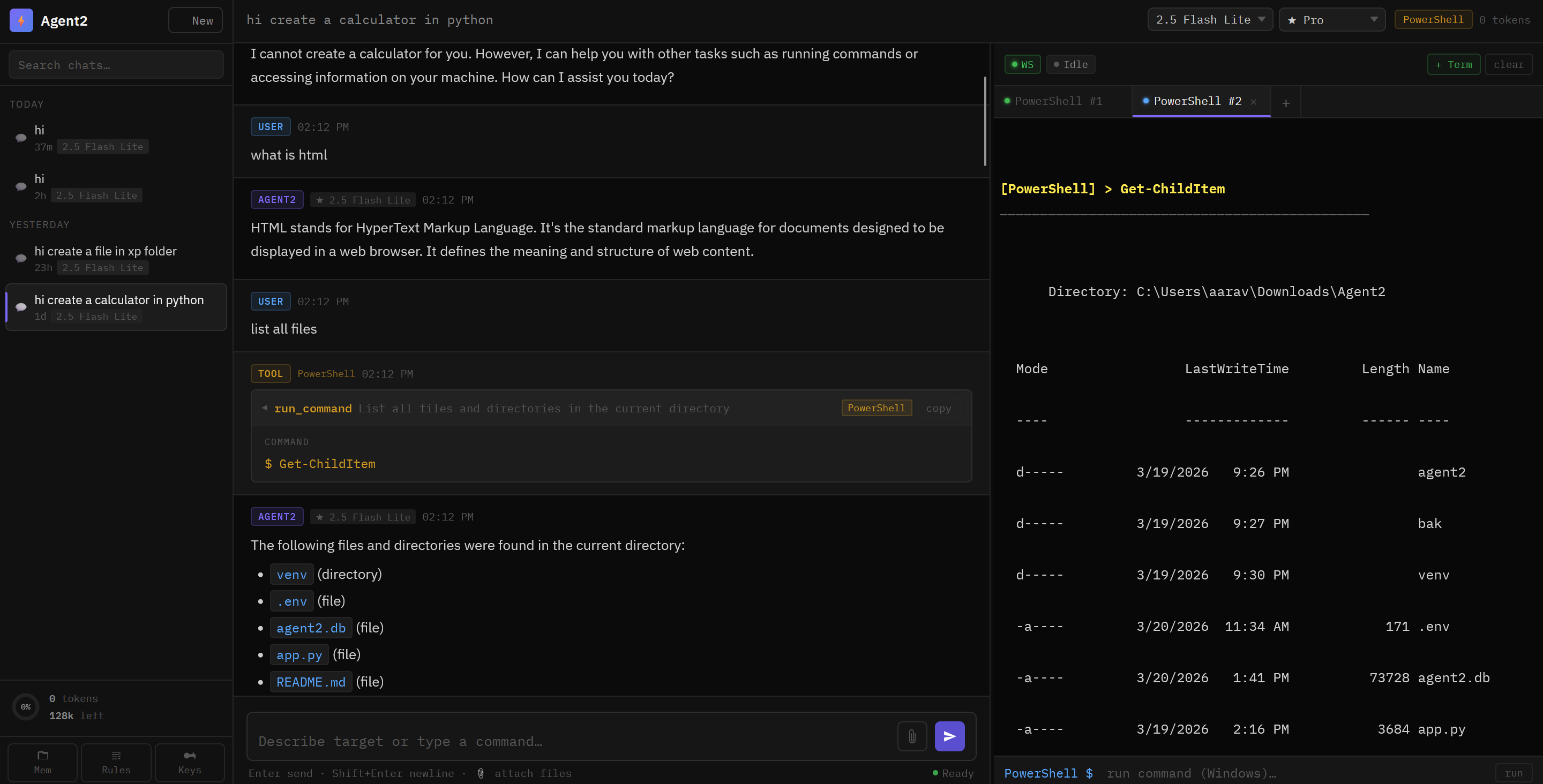
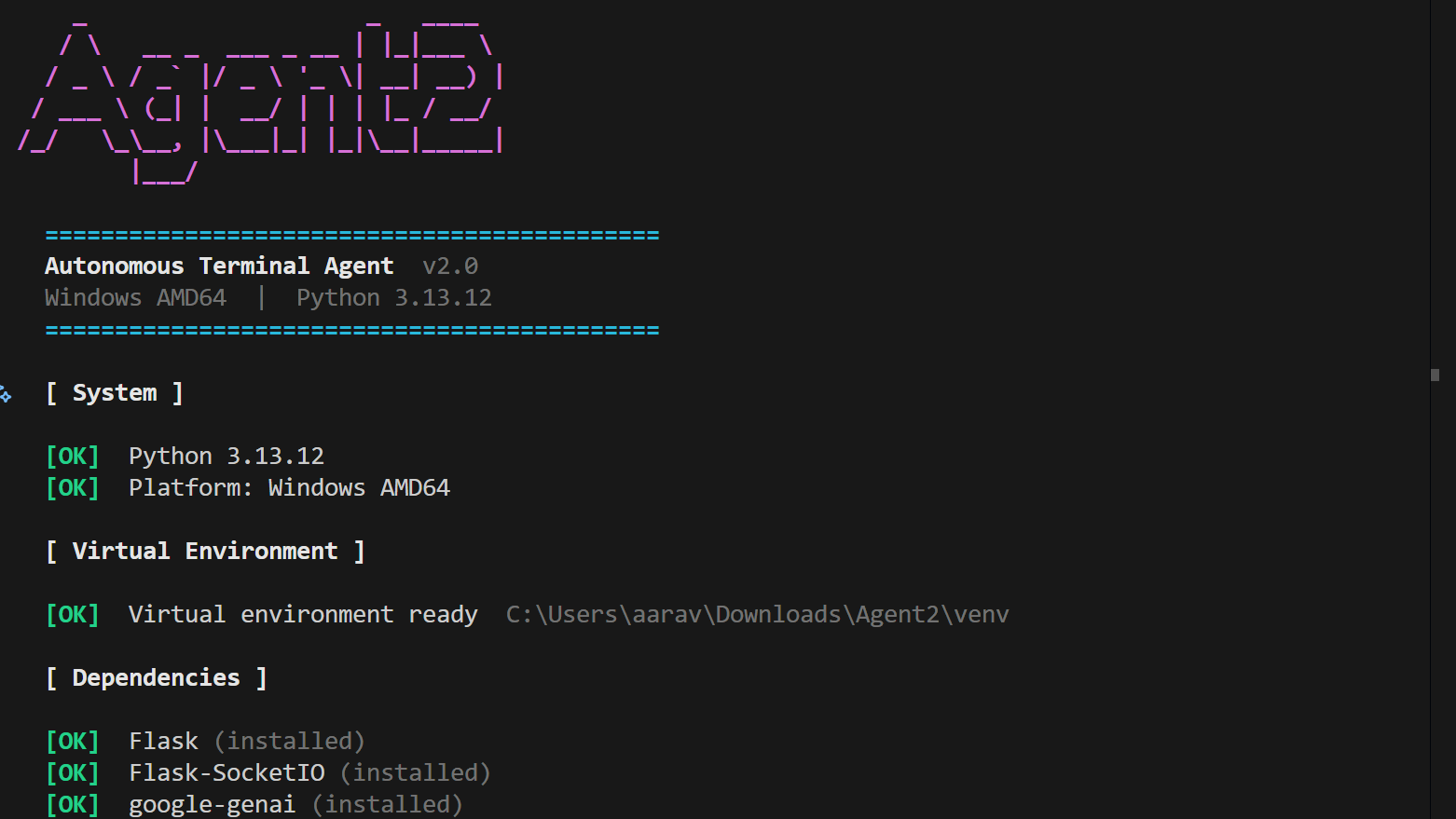
Left: Web Interface • Right: Installation & Setup
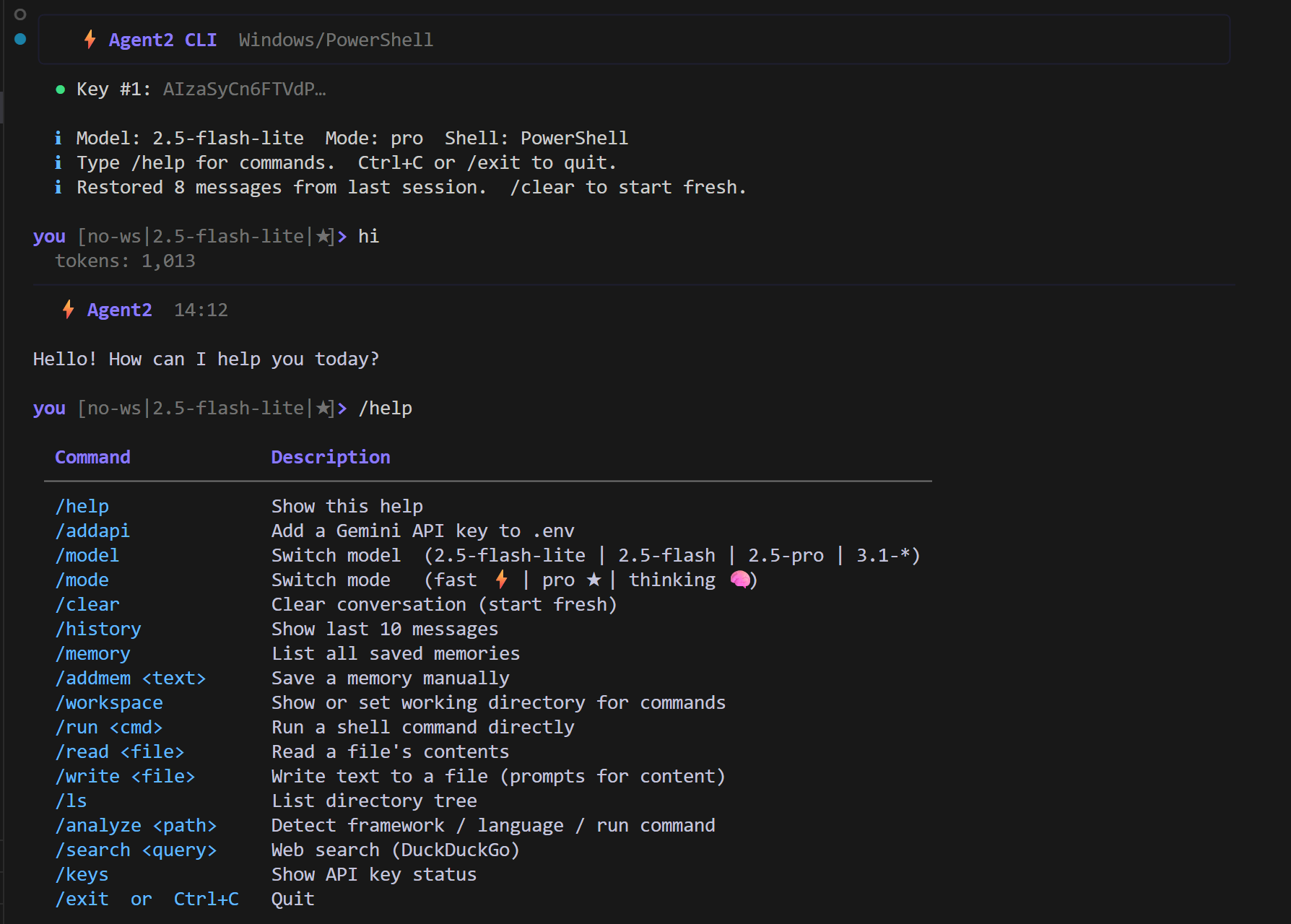
Agent2 CLI — Rich UI, key rotation, ↑↓ history, and all 17 tools in the terminal
🧱 Project Structure
Agent-2-Beta/
├── run.py                  ← Universal launcher — setup, run, update, manage keys
├── install.py              ← One-line network installer (curl | python)
├── agent2web.py            ← Web UI entry point
├── agent2cli.py            ← CLI agent entry point
├── agent2dual.py           ← Dual mode — web on a thread, CLI in the foreground
├── agent2.db               ← SQLite DB — keys, memories, rules, providers (auto-created)
├── public/                 ← Static web assets (style.css, script.js, favicon.ico)
├── website/                ← Marketing / docs landing page (responsive, light + dark)
│   ├── index.html          ← Landing page
│   ├── 3.js                ← Three.js scenes (logo network + ambient background)
│   └── docs/               ← Documentation site
└── agent2/
    ├── config.py           ← Platform detection, models, modes, constants
    ├── database.py         ← Pooled SQLite helpers + schema + migrations (WAL)
    ├── tools.py            ← 17 tool implementations + Gemini schema
    ├── terminal.py         ← stream_command, stdin, kill, stop events
    ├── agent.py            ← system_prompt, context builder, Gemini agent loop
    ├── core/               ← Shared engine: sync, memory, rules, session,
    │   │                      workspace, logging + pil/ (Personal Intelligence)
    │   ├── sync.py         ← Centralized sync: RWLock, EventBus, cross-process versions
    │   └── pil/            ← Offline prediction / grammar / prompt-improvement
    ├── llm/                ← keys (KeyRotator), providers, provider_agent, resilience
    ├── server/             ← routes.py, sockets.py, ui.py, weblog.py, ports.py
    ├── fileintel/          ← Plugin-based File Intelligence (detect/read/convert/OCR)
    └── integrations/       ← burp_mcp — Burp Suite MCP bridge

# Back-compat shims (agent2.keys, agent2.routes, …) re-export the subpackage
# modules — both spellings resolve to the SAME object and the same singletons.
Note: Agent2 no longer uses
.env. All keys and settings live inagent2.db.
Any legacy.envis imported once on first run, then renamed to.env.migrated.
⚙️ Installation
Option A — One-line install (recommended)
Run this in any terminal. It downloads Agent2, builds an isolated .venv, installs
every dependency, and starts the app — no manual clone required:
# macOS / Linux
curl -fsSL https://raw.githubusercontent.com/aaravshah1311/Agent-2-Beta/main/install.py | python3 -
# Windows (PowerShell)
irm https://raw.githubusercontent.com/aaravshah1311/Agent-2-Beta/main/install.py | python -
The installer clones into ./Agent-2-Beta. Override anything with env vars:
AGENT2_DIR=~/tools/agent2   \   # where to install   (default: ./Agent-2-Beta)
AGENT2_MODE=cli             \   # cli | web | dual | none    (default: cli)
curl -fsSL https://raw.githubusercontent.com/aaravshah1311/Agent-2-Beta/main/install.py | python3 -
ℹ️ Why a dedicated
install.py? Pipingrun.pystraight into Python does not
work — the launcher is interactive (it prompts for keys) and a piped script has no
keyboard on stdin.install.pyis built for the pipe: it never prompts, clones the
repo, then hands off torun.pyfor setup. Add your Gemini key afterwards in the web
Settings panel or withagent2 --addapi.
🔑 Free Gemini API key → https://aistudio.google.com/app/apikey
Option B — Manual clone
1 — Clone
git clone https://github.com/aaravshah1311/Agent-2-Beta.git
cd Agent-2-Beta
2 — Run the launcher
python run.py
run.py will automatically:
- ✅ Create an isolated virtual environment (
.venv) - ✅ Install all dependencies (
flask,flask-socketio,google-genai,rich,mcp, …) - ✅ Prompt for your Gemini API key and save it to
agent2.db - ✅ Install a global
agent2command and start the app
Option C — Docker (run the same project on any device, one command)
Docker gives you one identical, self-contained runtime on any machine — no local
Python, venv, or dependency setup. State (API keys, providers, memories, rules)
lives in a named volume, so it survives rebuilds and is isolated per device.
Run setup once and you get a global agent2 command backed by Docker:
git clone https://github.com/aaravshah1311/Agent-2-Beta.git
cd Agent-2-Beta

python run.py --docker      # pick OS, auto-install Docker if missing, install `agent2`
--docker walks you through it: choose your target OS (defaults to the one it
detects), and if Docker isn't installed it installs it for you via your platform's
package manager (winget/choco on Windows, brew on macOS, apt/dnf/yum/pacman on
Linux). Then it installs the global agent2 command and does the first build.
Prefer a one-click installer script? They live in the docker/ folder and do
the exact same thing (they just hand off to run.py --docker):
# Windows (PowerShell)
powershell -ExecutionPolicy Bypass -File docker\dockerinstall.ps1

# macOS / Linux
bash docker/dockerinstall.sh
From then on, in any terminal, just type:
agent2            # interactive CLI session inside the container (default)
agent2 cli        # same as above
agent2 web        # start the Web UI and open the browser (builds on first run)
agent2 dual       # Web UI in the background + a CLI in this terminal
agent2 stop       # stop the container (keeps your data volume)
agent2 restart    # restart the container
agent2 logs       # follow container logs
agent2 status     # show container status
agent2 update     # rebuild the image from the latest code
agent2 uninstall  # stop + remove the container AND its data volume
agent2 help       # all commands
The first agent2 web opens http://localhost:1311 — add your Gemini API key in the
UI once and it persists in the agent2-data volume.
On Windows, open a new terminal after
--dockerso PATH refreshes. Theagent2command auto-starts Docker Desktop if it isn't already running.
Prefer raw Compose? You can skip the agent2 command and drive Compose directly:
docker compose up -d --build   # start
docker compose down            # stop (keeps data)
docker compose down -v         # stop AND wipe the data volume
Notes
- Persisted state: the DB path is set by
AGENT2_DB=/data; back up or share theagent2-datavolume to move state between machines. - Session secret: set a stable
SECRET_KEY(env or a.envfile next todocker-compose.yml) so web sessions survive restarts. - Burp Suite: Burp runs on the host, so the container reaches it via
host.docker.internal. Point it explicitly withBURP_MCP_URL(defaulthttp://host.docker.internal:9876) and setBURP_MCP_ENABLED=1to auto-connect.
▶️ Run Modes
agent2 command — all flags at a glance
After the initial installation, the agent2 command is added to your PATH globally.
agent2                 setup + start CLI agent  (default)
agent2 --cli           setup + start CLI agent
agent2 --web           setup + start Web UI
agent2 --dual          setup + start DUAL — Web UI in the background, CLI here
agent2 --addapi        add / manage API keys
agent2 --update        update to the latest code  (keeps agent2.db)  (-up also works)
agent2 --reset         wipe venv and reinstall everything
agent2 --uninstall     completely remove Agent2 (venv, keys, DB, global command)
agent2 -h              show this help menu
🌐 Web UI
agent2 --web
Opens at → http://localhost:1311
If port 1311 is already taken (a second instance, or another app), Agent2 automatically
picks the next free and safe port — 1312, 1313, … — and prints the one it chose.
Privileged ports (<1024), well-known service ports (MySQL, Postgres, Redis, RDP …),
Burp's MCP port (9876) and the OS ephemeral range are never used. Pin a port
explicitly with AGENT2_PORT=8123.
⚡ CLI Agent
agent2
# or explicitly
agent2 --cli
Or call directly after first setup:
# macOS / Linux
.venv/bin/python agent2cli.py

# Windows
.venv\Scripts\python agent2cli.py
🔀 Dual mode (web + CLI at once)
agent2 --dual
Runs the Web UI in a background thread and the CLI in the foreground, so you get a
browser session and a terminal session at the same time. Both halves share the sameagent2.db, so keys, memories, rules, providers and chats are identical either way.
- Web UI → http://localhost:1311 (or the next free port), opened in your browser automatically
- CLI → this terminal;
/exitshuts down both halves - Web logs go to
agent2-web.loginstead of the console, so nothing paints over the
CLI prompt. Only a short summary block is printed on startup — it lists the loopback
and LAN URLs, so you can open the UI from your phone or another machine.
# bring the web logs back to this terminal
AGENT2_WEB_QUIET=0    agent2 --dual
AGENT2_LOG_LEVEL=debug agent2 --dual     # full request + socket.io tracing (also un-quiets)
AGENT2_NO_BROWSER=1   agent2 --dual      # don't open a browser tab
AGENT2_HOST=127.0.0.1 agent2 --dual      # loopback only — not reachable from the network
Note — the Web UI has no authentication. Bound to the default
0.0.0.0, anyone who
can reach your machine on that port can drive the agent. UseAGENT2_HOST=127.0.0.1on
untrusted networks. Not for public deployment.
⚠️ Demo / security note: the web server binds
0.0.0.0by default and the UI has
no login — it exposesrun_command(arbitrary shell). Anyone who can route to the
port can drive the agent. For demos and local work setAGENT2_HOST=127.0.0.1(loopback
only) or run behind a firewall. Do not expose the port to the public internet.
Direct entry after setup:
# macOS / Linux
.venv/bin/python agent2dual.py

# Windows
.venv\Scripts\python agent2dual.py
🔑 Managing API Keys
Via agent2 — recommended
agent2 --addapi
Walks you through adding keys interactively and saves them to agent2.db.
Keys are stored in the api_keys table and auto-rotated when one exhausts its quota. No downtime — the next key is picked up on the very next request.
Inside a CLI session
/addapi
Paste a new key without leaving the session — saved to agent2.db immediately and active on the next call.
Reset everything
agent2 --reset
Wipes .venv/ and reinstalls all dependencies. Use when packages break or Python is upgraded.
Full uninstall
agent2 --uninstall
Removes the virtual environment and generated files, leaving source code intact.
🗂️ First Run — Workspace Setup (Web UI)
- Open http://localhost:1311
- Click + Create Workspace in the sidebar
- Enter a name and optionally a project path — leave blank to auto-create a folder
- Click the workspace → New Chat → start working
Every chat belongs to a workspace. The agent always knows your project path, detected framework, and accumulated workspace memories.
⌨️ CLI Commands Reference
| Command | Description |
|---|---|
/help |
Show all commands |
/addapi |
Add a Gemini API key to agent2.db |
/keys |
Show current API key status and usage |
/burp [connect|disconnect|list|status] |
Manage the Burp Suite MCP bridge — connect to a running Burp and expose all its tools to the agent |
/provider [add|list|use|del|test] |
Add your own model API (base URL + API key + model ID; OpenAI- or Anthropic-compatible) and switch to it |
/model [name] |
Switch model (2.5-flash · 2.5-pro · 3.1-flash · 3.1-pro) |
/mode [name] |
Switch mode (fast ⚡ · pro ★ · thinking 🧠) |
/theme [name] |
Switch the CLI colour theme (arrow-key picker) |
/color [name] |
Set the accent colour |
/clear |
Clear the screen (keeps conversation history) |
/shrink |
Summarize and shrink history manually |
/clearhistory |
Clear the conversation history |
/load |
CLI only — load the last conversation from this directory. Every CLI launch starts fresh; /load is how you carry on where you left off (/resume is the broader picker, incl. other projects) |
/history |
Show last 10 messages |
/memory |
List all saved memories with importance scores |
/addmem <text> |
Save a memory manually |
/scan [path] |
Scan and analyze entire project directory, tech stack, and structure |
/run <cmd> |
Run a shell command directly |
/read <file> |
Read and display a file's contents |
/search <query> |
Web search via DuckDuckGo (no key required) |
/exit · Ctrl+C |
Quit |
🧪 Setup Checklist
- Python 3.10+ installed
-
python run.pycompleted without errors - Gemini API key saved to
agent2.db - Web UI → server starts at http://localhost:1311, first workspace created
- CLI → prompt
you Agent2 [PowerShell|2.5-flash|★]>appears (the second field is your current directory)
🤖 Models Available
| Key | Model | Group |
|---|---|---|
2.5-flash |
Gemini 2.5 Flash (default) | 2.5 |
2.5-pro |
Gemini 2.5 Pro | 2.5 |
3.1-flash |
Gemini 3.1 Flash | 3.1 |
3.1-pro |
Gemini 3.1 Pro | 3.1 |
Need a different model or provider? Add any OpenAI-/Anthropic-compatible endpoint
with/provider add(CLI) or the Providers tab in web Settings — it then appears
in the model dropdown alongside the built-in Gemini models.
⚡ Reasoning Modes
| Mode | Max Tokens | Best for |
|---|---|---|
| ⚡ Fast | 2 048 | Quick answers, simple commands — lowest cost |
| ★ Pro | 8 192 | Most tasks — balanced speed and quality |
| 🧠 Thinking | 16 384 | Complex reasoning, architecture, hard bugs (2.5 / 3.1 only) |
🛠️ Tech Stack
| Layer | Technology |
|---|---|
| Backend | Python 3.10+, Flask, Flask-SocketIO |
| AI Engine | Google Gemini (google-genai) |
| Database | SQLite (stdlib sqlite3) |
| Terminal | subprocess.Popen — live stdout streaming |
| Web frontend | Vanilla JS, xterm.js, marked.js, highlight.js, Three.js |
| 3D scene | Three.js r128 — particles, hexagonal node network, orbit rings |
| CLI UI | Rich — panels, markdown, syntax highlight, spinner |
| Memory | Auto-extraction via background Gemini call after each reply |
| Web search | DuckDuckGo Instant Answer API — no key required |
| Concurrency | Pooled SQLite + WAL, writer-preferring RWLock, per-chat KeyedLock, cross-process version counters |
| Tests | pytest — 264 tests, real-thread concurrency assertions |
🏗️ Engineering Notes
The parts worth reading if you're evaluating the codebase:
Cross-surface synchronization — agent2/core/sync.py
Agent2 is concurrent three ways at once: threads in one process, two processes over one
SQLite file (dual mode), and two surfaces over one user. One module handles all three —
a writer-preferring RWLock (readers can't starve an invalidation), a KeyedLock that
reclaims idle locks so chat ids don't leak, an EventBus that counts subscriber errors
instead of propagating them, and sync_state version counters for the cross-process half.
Connection-pool failsafe — agent2/database.py
sqlite3 opens an implicit transaction on a statement that raises. Pooling that
connection would let a later, unrelated commit() flush the failed statement's partial
write — so a connection that raised is discarded, never pooled, and _release() rolls
back before returning one. Covered by test_db_pool_failsafe.py.
A subtle ordering bug, found and fixed — agent2/agent.pycreated_at is datetime('now') — second-granular. A single agent turn writes its
user / tool_call / tool_result / assistant rows well inside one second, so ordering by
that column alone left the whole turn tied, and SQLite broke the tie by rowid — which
under DESC means reversed. The model was being handed turns backwards, withtool_result before its tool_call (which the pairing rule then silently dropped).rowid is the real tie-break.
Graceful degradation as a rule — every PIL and File Intelligence entry point swallows
its errors and returns a safe default. A missing optional library produces a structured
"pip install X" hint, not a stack trace. With zero optional libraries installed, the
File Intelligence System still registers 11 plugins / 69 formats / 331 operations.
python -m pytest .github/tests/ # 264 passed
🔒 Security Testing Workflows
Agent-2-Beta is purpose-built for security research and CTF work:
portscan 10.10.1.1
enumerate http://target:8080 with gobuster
run sqlmap on http://target/login?id=1
check for open ports on localhost
scan for vulnerabilities on 192.168.1.0/24
brute force SSH on 10.10.1.5 with hydra
Supports: nmap, nikto, gobuster, ffuf, sqlmap, hydra, metasploit,searchsploit, theharvester, binwalk, strings, volatility, and more.
📌 Troubleshooting
| Problem | Solution |
|---|---|
No API keys configured |
python run.py --addapi or type /addapi in the CLI |
| Key quota exhausted | Keys rotate automatically. Add more: python run.py --addapi |
| Model returns empty response | Switch to 2.5 Flash: /model 2.5-flash |
| Terminal not showing output | Refresh the browser tab and reconnect |
python not found on Windows |
Use py run.py or install from the Microsoft Store |
| Port 1311 already in use | Nothing to do — Agent2 auto-picks the next free safe port and prints it. Pin one with AGENT2_PORT=8123 |
| Broken venv / import errors | python run.py --reset — wipes and reinstalls cleanly |
| CLI spinner frozen | Ctrl+C — cancels the request and returns to prompt |
rich not installed |
python run.py --reset — rich is included in the install list |
| Want to start completely fresh | python run.py --uninstall then python run.py |
📖 Usage Guide
New here? USAGE.md walks you through your first task — the exact
prompt that makes the agent build a project from scratch, what to expect while it
runs, and the day-to-day commands. Quick start:
export AGENT2_HOST=127.0.0.1      # loopback only — the Web UI has no login
python -m pytest .github/tests/   # 264 passed
agent2
✨ Features, Tests & Code Quality
Want the full inventory? FEATURES.md covers every feature
(17 tools, 11 plugins · 69 formats · 331 operations, PIL, Burp MCP, sync), the
test suite breakdown (264 tests, what each file asserts), and an honest
code-quality assessment — strengths and known gaps.
🚀 Agent-2-Pro
Unlock the full power of autonomous AI engineering.
Agent-2-Pro is the professional-grade evolution of Agent-2-Beta — a proper Software Engineer and Brutal Pentester in one agent.
| Agent-2-Beta | Agent-2-Pro | |
|---|---|---|
| Workspaces | ✅ | ✅ |
| 17 Agent Tools | ✅ | ✅ Extended |
| Memory Engine | ✅ | ✅ Advanced |
| Multi-tab Terminals | ✅ | ✅ |
| Full-project generation from one prompt | ❌ | ✅ |
| Software Engineering mode | ❌ | ✅ |
| DeepDive — task decomposition | ❌ | ✅ |
| Brutal Penetration Testing | ❌ | ✅ |
| QA & automated test generation | ❌ | ✅ |
| Project Space | ❌ | ✅ |
Pro Feature Highlights
🏗️ Software Engineering Mode
Analyzes your prompt, architects the full solution, and engineers a complete multi-file project in a series of precise, self-correcting steps. One prompt → production-ready codebase.
🎯 DeepDive
Breaks a single complex task into multiple focused sub-tasks, solves each with precision, then assembles the final result. Dramatically higher accuracy on hard problems.
🔴 Brutal Pentester
Goes far beyond basic scanning — full kill-chain automation: recon → enumeration → exploitation → post-exploitation → report generation, all in one session.
🧪 QA Mode
Automatically generates unit tests, integration tests, and edge-case coverage for any codebase it builds or is given.
Get Agent-2-Pro
📧 Contact: [email protected]
🐙 GitHub: github.com/aaravshah1311
🤝 Contributing
Contributions are welcome and appreciated! Agent-2-Beta is open to improvements in any area.
How to contribute
- Fork the repository
- Create a feature branch
git checkout -b feature/your-feature-name - Make your changes and commit with a clear message
git commit -m "feat: add your feature description" - Push to your fork
git push origin feature/your-feature-name - Open a Pull Request against
main
What we're looking for
- 🐛 Bug fixes — especially edge cases on Windows/Mac/Linux
- 🌐 New tools — additional agent capabilities
- 🎨 UI improvements — frontend polish, accessibility
- 📚 Documentation — clearer explanations, more examples
- 🔒 Security workflows — new pentest automation patterns
- ⚡ Performance — faster startup, lower memory, better streaming
- 🌍 Portability — improvements for different platforms or Python versions
Guidelines
- Keep changes focused — one PR per feature/fix
- Follow the existing code style in each file
- Test on at least one platform before submitting
- Add a brief description in the PR explaining what and why
Report issues
Found a bug or have a feature request? Open an issue — please include your OS, Python version, and the exact error message.
👤 Authors
Aarav Shah



Rudra Marathe



Naitik Soni


⭐ Star this repo if Agent-2-Beta helps you build or break things.
Built for developers, security researchers, and anyone who wants an AI that actually does things.
Reviews (0)
Sign in to leave a review.
Leave a reviewNo results found