agentlogs
Health Pass
- License — License: NOASSERTION
- Description — Repository has a description
- Active repo — Last push 0 days ago
- Community trust — 172 GitHub stars
Code Pass
- Code scan — Scanned 12 files during light audit, no dangerous patterns found
Permissions Pass
- Permissions — No dangerous permissions requested
This tool captures and analyzes transcripts from AI coding agents, providing team observability into prompts and workflows. It integrates with Git to link AI sessions directly to the commits they produce.
Security Assessment
Overall risk: Medium. The application requires network requests to sync transcripts to a cloud instance or self-hosted server. The code scan of 12 files found no dangerous patterns, hardcoded secrets, or dangerous permission requests. However, because the core function involves capturing and transmitting developer keystrokes, prompts, and local code context, users must be highly cautious about where this data is routed. Self-hosting is recommended over the default cloud option to keep proprietary codebase data strictly internal.
Quality Assessment
The project is actively maintained, with its last push occurring today. It enjoys a solid baseline of community trust with 172 GitHub stars. The only notable drawback is that the repository license is marked as NOASSERTION. While the README claims it is open-source, the lack of a formally defined license means the legal terms for modification and distribution remain unclear.
Verdict
Use with caution; the code itself appears safe, but you must ensure your team's AI transcripts and proprietary code are synced only to a secure, trusted, or self-hosted destination.
Collaboration in the age of agentic engineering

AgentLogs
Coding agents, visible to your team.
Open-source and self-hostable. Track sessions, share prompts, and link every conversation to the commit it produced.
Website · Docs · Discord · Changelog
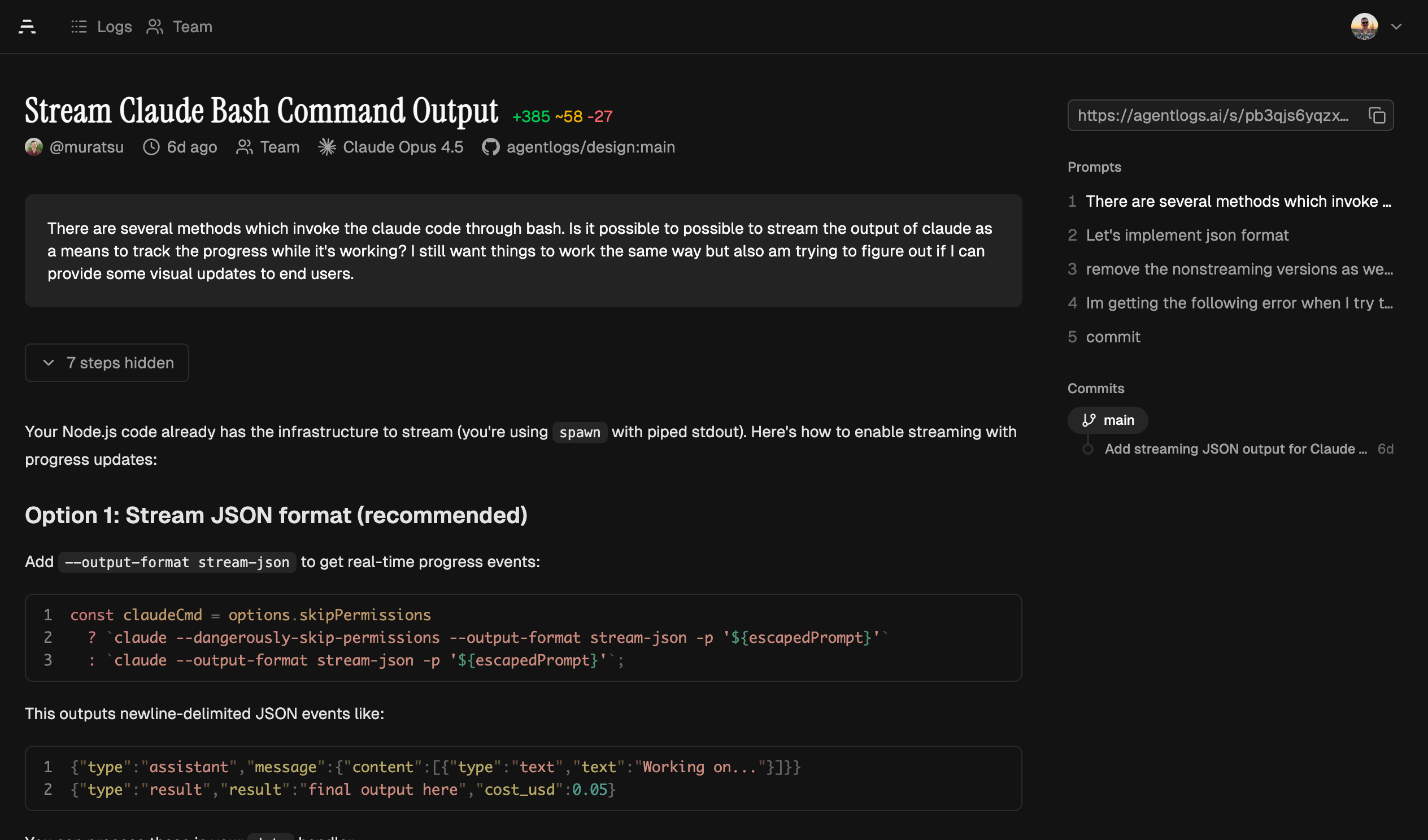
AgentLogs captures and analyzes transcripts from AI coding agents (like Claude Code, Codex, OpenCode, and Pi) to give your team visibility into how AI tools are used in their codebases.
See it in action → Example transcript
Why AgentLogs?
AI coding agents are becoming core to how teams write software. But right now, every session is a black box stored on the machine of the user. You can't see the context put into each session and there is no knowledge sharing between teammates.
AgentLogs fixes that:
- Team observability — Dashboard with activity metrics, agent & model usage, and per-member breakdowns
- Git integration — Links sessions to the commits they produced. See which transcript wrote which code
- Shared learning — Browse and share your team's sessions to discover effective prompts and workflows
| Team Dashboard | Git Integration | Session Browser |
|---|---|---|
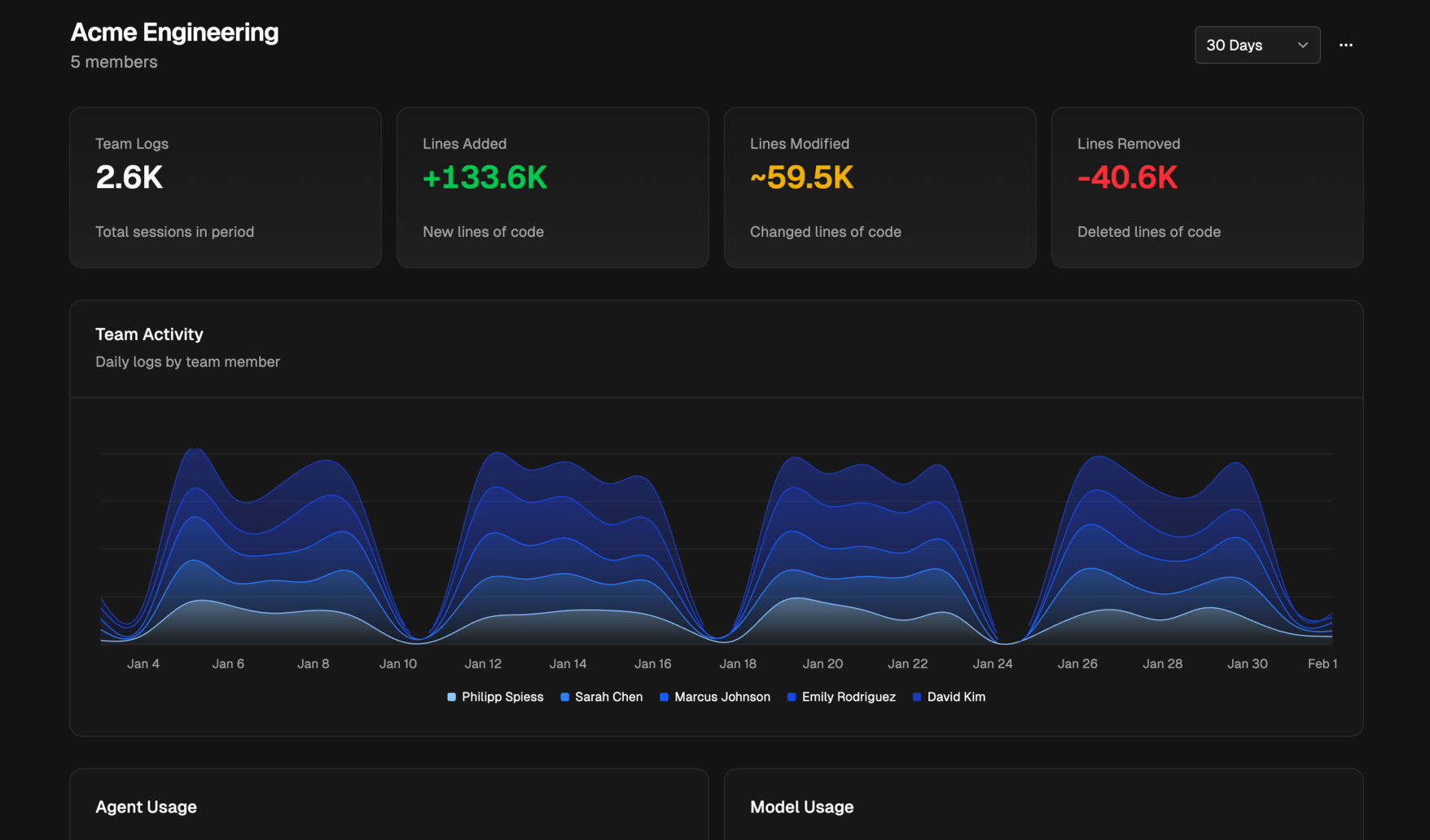 |
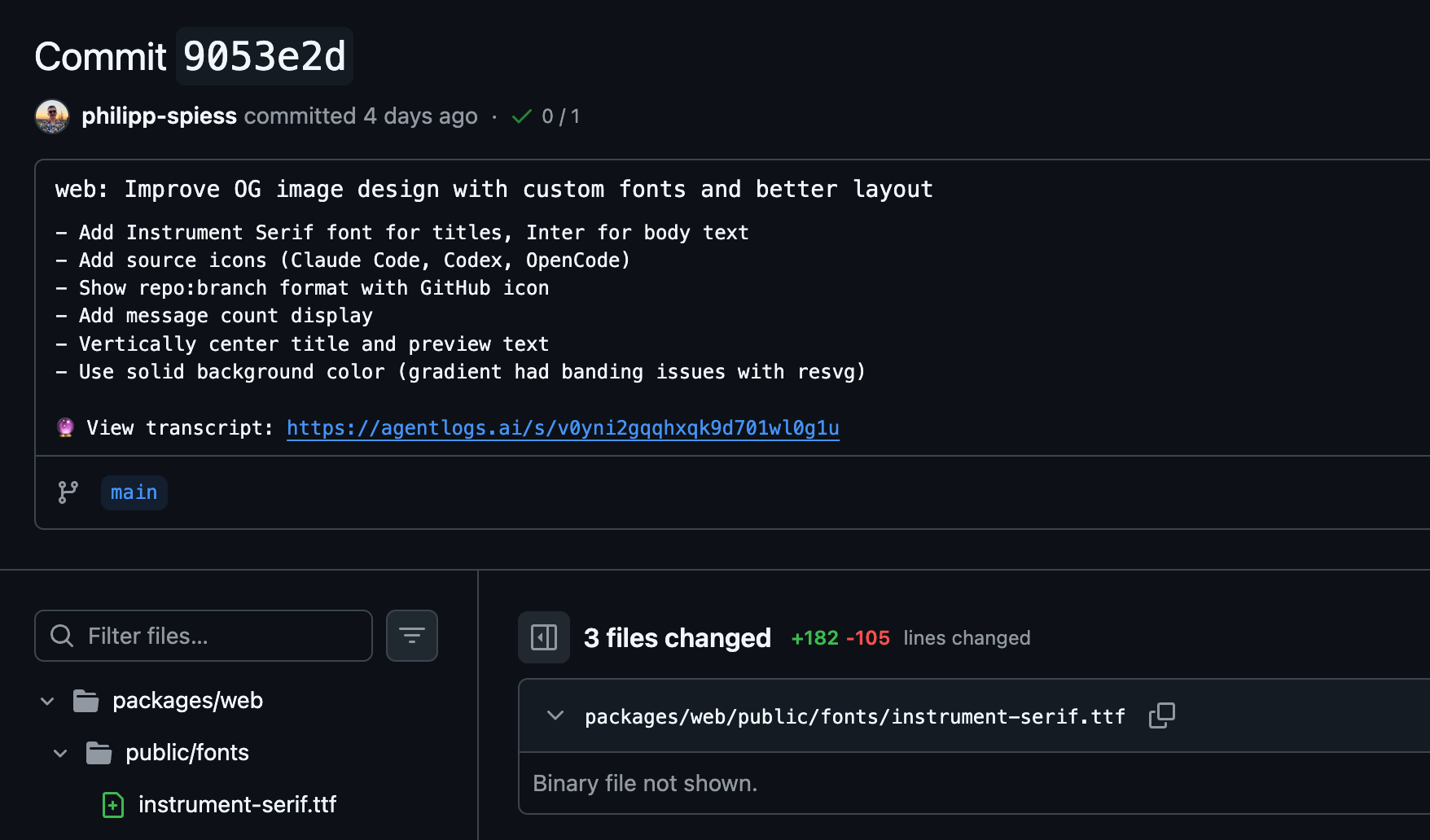 |
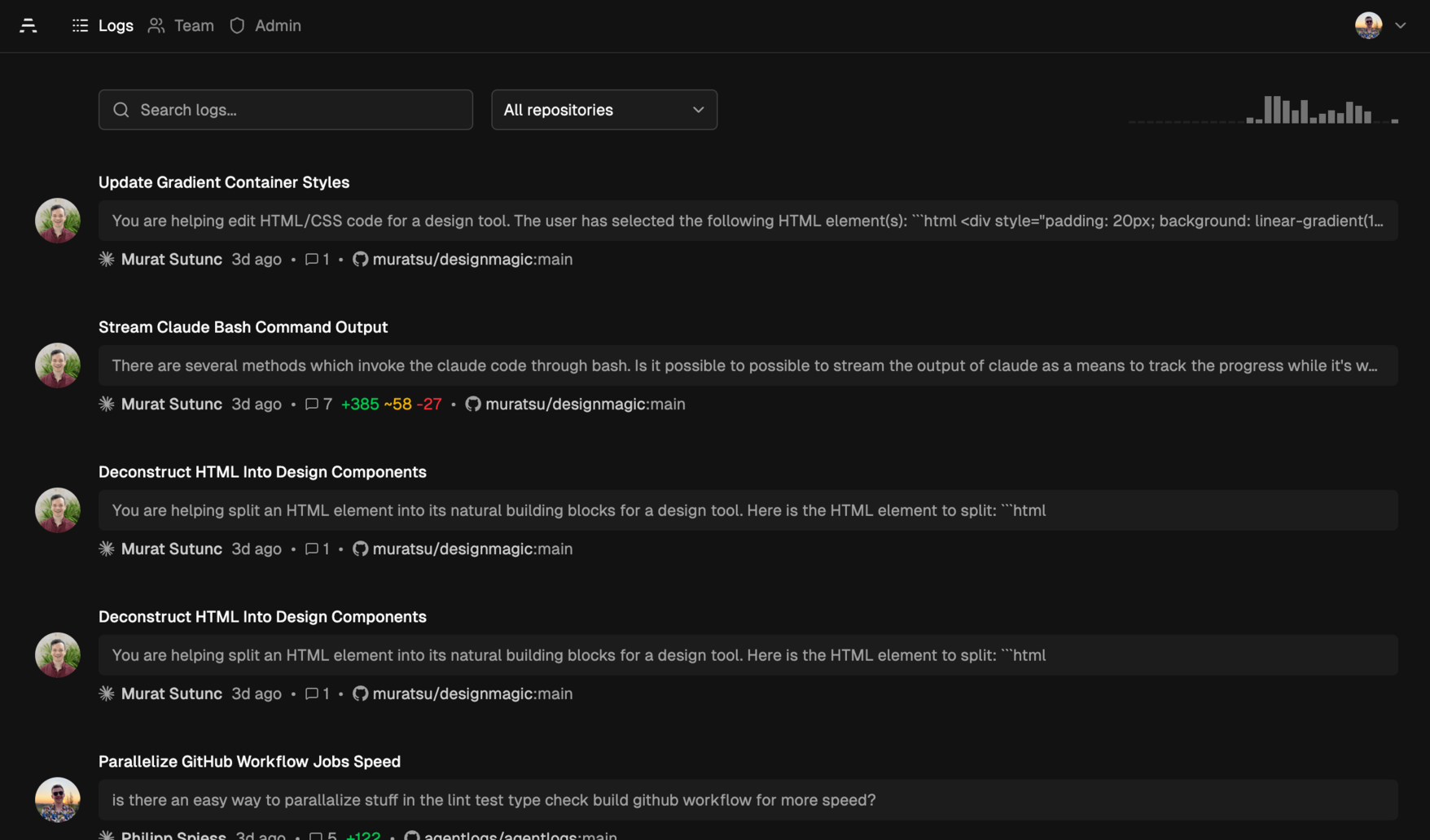 |
Supported Agents
| Agent | Transcripts | Auto-sync | Commit Tracking |
|---|---|---|---|
| Claude Code | ✓ | ✓ | ✓ |
| Cline (experimental) | ✓ | ✓ | ✓ |
| Codex | ✓ | ✓ | ✓ |
| OpenCode | ✓ | ✓ | ✓ |
| Pi | ✓ | ✓ | ✓ |
Quick Start (using AgentLogs Cloud)
1. Log in
npx agentlogs login agentlogs.ai
2. Install the plugin for your agent
Claude Code — inside Claude Code:
/plugin marketplace add agentlogs/claude-code
/plugin install agentlogs
Cline:
npx agentlogs cline install
Codex:
Run npx agentlogs codex install to write ~/.codex/hooks.json, enable Codex hook capture, and track git commits in AgentLogs.
Set AGENTLOGS_CLI_PATH='bun /absolute/path/to/packages/cli/src/index.ts' before starting Codex if you want hooks to use a local AgentLogs checkout while developing.
Codex does not currently let hooks rewrite the commit message body, so transcript URLs are not appended to commit messages automatically.
See the full setup guide: https://agentlogs.ai/docs/agents/codex
OpenCode — add to opencode.json:
{ "plugin": ["@agentlogs/opencode"] }
Pi — run inside Pi or from the terminal:
pi install npm:@agentlogs/pi
3. Use your agent as usual
Transcripts are captured and uploaded automatically. View them at agentlogs.ai.
CLI
The CLI can also be used standalone for manual uploads:
# Interactive picker, browse transcripts from all agents
npx agentlogs upload

# Upload most recent transcript
npx agentlogs upload --latest

# Sync all Claude Code transcripts
npx agentlogs claudecode sync

# Check auth status
npx agentlogs status
See the full CLI reference.
Hosting
AgentLogs is source-available and can be self-hosted.
You can deploy it either as:
- A container from
ghcr.io/agentlogs/agentlogs - A standalone
agentlogs-serverbinary from GitHub Releases
See the full guide at Hosting Docs.
Prerequisites
- GitHub OAuth App (create one)
- Homepage URL:
https://your-domain.example - Callback URL:
https://your-domain.example/api/auth/callback/github - For local development:
http://localhost:3000andhttp://localhost:3000/api/auth/callback/github
- Homepage URL:
Required Secrets / Env Vars
GITHUB_CLIENT_IDGITHUB_CLIENT_SECRETBETTER_AUTH_SECRET(generate withopenssl rand -base64 32)WEB_URL(public app URL, e.g.https://logs.example.com)
Local Development (From Source)
Requires Bun v1.3.10.
git clone https://github.com/agentlogs/agentlogs.git
cd agentlogs
bun install

# Configure environment
cp packages/server/.env.example packages/server/.env
# Edit packages/server/.env with:
#   GITHUB_CLIENT_ID=...
#   GITHUB_CLIENT_SECRET=...
#   BETTER_AUTH_SECRET=...  (openssl rand -base64 32)
#   WEB_URL=http://localhost:3000

# Initialize database
bun db:migrate

# Start
bun dev
Open http://localhost:3000.
Point the CLI at your local instance:
npx agentlogs login localhost:3000
Option A: Deploy With GHCR
docker run -d \
  --name agentlogs \
  -p 3000:3000 \
  -v agentlogs-data:/app/.data \
  -e GITHUB_CLIENT_ID=... \
  -e GITHUB_CLIENT_SECRET=... \
  -e BETTER_AUTH_SECRET=... \
  -e WEB_URL=https://logs.example.com \
  ghcr.io/agentlogs/agentlogs:latest
Option B: Deploy With A Single Binary
Download the correct binary for your OS/architecture from GitHub Releases:
chmod +x ./agentlogs-server
./agentlogs-server
By default, the standalone server applies embedded migrations before startup. Use --no-migrations to skip them or --only-migrations to run them and exit.
Connect Your Agents To Your Host
npx agentlogs login logs.example.com
Project Structure
packages/
├── cli/       — CLI tool (npx agentlogs)
├── server/    — Server package (TanStack Start web UI + API, standalone Bun binary + SQLite)
├── shared/    — Shared types, schemas, transcript parsing, secret redaction
├── pi/        — Pi extension (@agentlogs/pi)
├── opencode/  — OpenCode plugin (@agentlogs/opencode)
└── e2e/       — End-to-end tests
docs/          — Documentation (Mintlify)
Development
# Start the server package
bun dev

# Run CLI
bun agentlogs

# Type check, lint, format
bun run check

# Format code
bun run format

# Run e2e tests
bun run test:e2e

# Database commands
bun db:migrate       # Run migrations
bun db:generate      # Generate migrations from schema changes
bun db:studio        # Open Drizzle Studio
bun db:reset         # Reset local database
Tech Stack
- Web: TanStack Start + Bun standalone runtime
- Data: SQLite + local blob storage on disk
- ORM: Drizzle
- Auth: BetterAuth (GitHub OAuth + device flow)
- Styling: Tailwind CSS v4 + shadcn/ui
- CLI: Commander
- Quality: oxlint + oxfmt + tsgo
Contributing
We welcome contributions! Please:
- Fork the repo and create a branch
- Make your changes
- Run
bun run formatandbun run check - Open a PR
Acknowledgments
AgentLogs was inspired by and builds on ideas from:
- Amp Threads — team observability for AI coding agents
- Yaplog, Pi session sharing, OpenCode session sharing — public sharing of AI coding sessions
License
Reviews (0)
Sign in to leave a review.
Leave a reviewNo results found