wingbox
Health Warn
- License — License: MIT
- Description — Repository has a description
- Active repo — Last push 0 days ago
- Low visibility — Only 5 GitHub stars
Code Pass
- Code scan — Scanned 12 files during light audit, no dangerous patterns found
Permissions Pass
- Permissions — No dangerous permissions requested
No AI report is available for this listing yet.
Code graph and blast-radius analysis for AI coding agents. An agent skill for Claude Code and Codex: dependency graph, call flows, architecture boundaries and impact analysis before a change. Python, TypeScript, Rust, C#, Java, Go, Ruby. Local, deterministic static parsing.
Wingbox: Code Graph and Blast Radius Analysis for AI Coding Agents
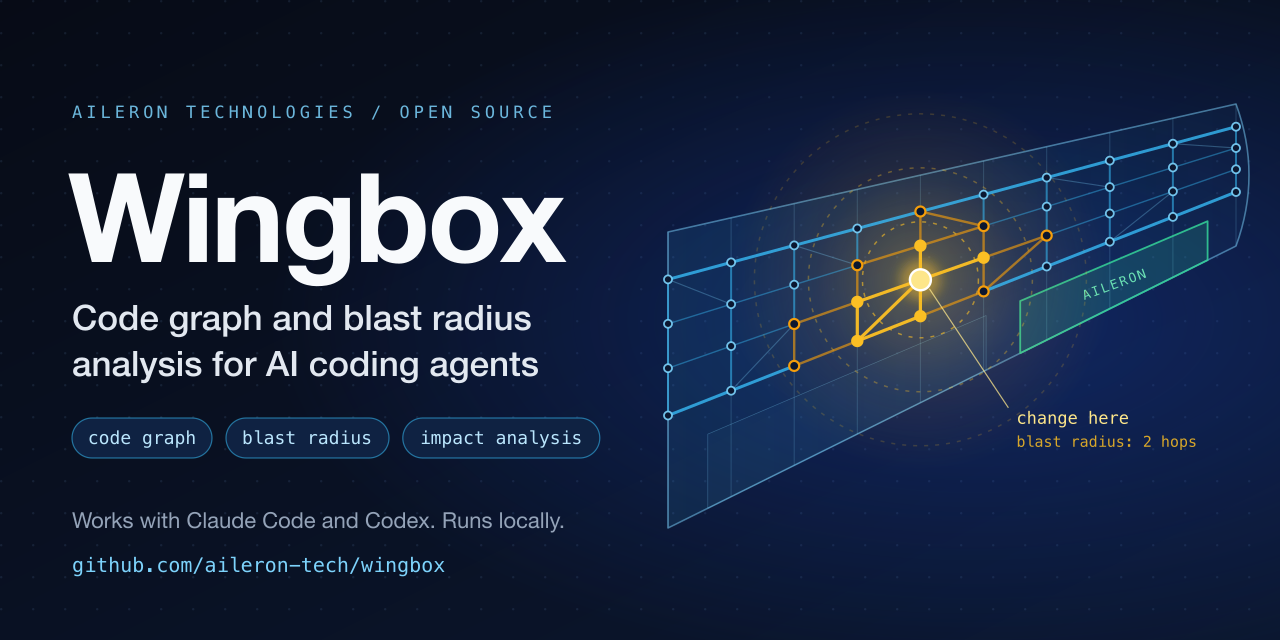
AI agents should know what their changes will break before editing code.
Wingbox builds a local code graph of your repository so that AI coding
agents and developers can see dependencies, call flows, architecture
boundaries and the blast radius of a change before editing code.
It works as an agent skill in Claude Code, Codex, Gemini CLI, Cursor and
GitHub Copilot, as an MCP server for any MCP client, and from the command
line. It supports Python, TypeScript, Rust, C#, Java, Go, Ruby, Rails, Free
Pascal, and Lazarus.Runs fully locally: no network access, no model, no telemetry. It can be
used inside a security perimeter and on a machine with no internet.Website: wingbox.dev: benchmarks with charts, a
sample report and the live map.Install:
pipx install wingbox && wingbox install| PyPI:
the command, then the skill, an always-on block and a search hook for every
coding assistant on the machine. Then type/wingboxin your agent.Skill only:
npx skills add aileron-tech/wingbox| skills.shRelease notes: Changelog
Note: Wingbox was formerly published as
codespaces. The skill, the
scripts and the generated files were renamed on 2026-11-15; see the
Changelog for the old and new names.
Understand a large codebase before you change it. Wingbox is an
architecture-aware code search and impact analysis tool for Python, TypeScript, TSX, Rust, C#,
Java, Go, Ruby, Ruby on Rails, Free Pascal, and Lazarus repositories. It helps
developers and AI coding agents find the right module, trace dependencies,
measure change impact, and read only the source files that matter.
Use it for codebase architecture discovery, dependency graph search, blast-radius
analysis, call-flow tracing, monorepo navigation, and safer AI-assisted coding.
Everything runs on your machine. The code graph is built by deterministic
static parsing: no LLM call, no embeddings, no vector database, and no network
access to build or query it.
Runs fully locally, inside your security perimeter
Wingbox is safe to run on code that must not leave the company:
- No network. Building and querying the graph open no network connection.
Run it with the network switched off to see for yourself:docker run --rm --network none -v "$PWD":/repo wingbox.
The one command that reaches the network iswingbox update, which runs
your package installer (pipx, uv or pip) when you ask it to. - No model, no account, no key, no telemetry. Nothing is sent to a model
or to a service, and nothing is collected about its use. - Your code is read, never run. Wingbox parses source files with its own
parsers and callsgitfor the ignore rules; it does not execute the code,
the tests or the build of the repository. The--lspoption, off by
default, starts a language server that is installed on the machine. - The results stay in the repository folder:
.code_graph.sexp,wingbox-out/REPORT.mdandwingbox-out/map.html. The map is one HTML
file that loads nothing from outside and opens offline. - Works on a machine with no internet. Fetch the package and its pinned
dependencies once (pip download wingbox -d wheels), carry the folder
inside, and install withpip install --no-index --find-links wheels wingbox. - Deterministic and open. The same code gives the same graph; the source
is MIT licensed and small enough to review.
Two tests of the repository keep this true: the package imports no module
that opens network connections, and the map page loads no outside resource.
See it in action
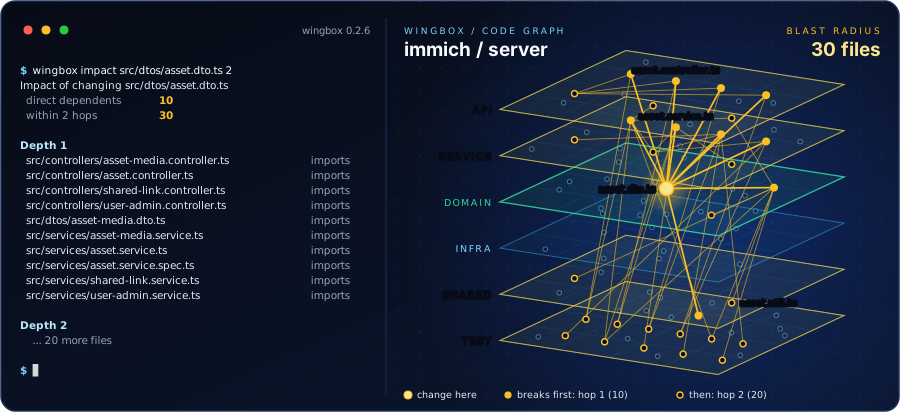
Once the graph is built, an agent asks what a change breaks before it edits
anything. Real output, Wingbox 0.2.6 on the server of
immich (commit e5d6eb7, 707 modules):
$ wingbox impact src/dtos/asset.dto.ts 2
Impact of changing src/dtos/asset.dto.ts
  direct dependents   10
  within 2 hops       30

Depth 1
  src/controllers/asset-media.controller.ts   imports
  src/controllers/asset.controller.ts         imports
  src/controllers/shared-link.controller.ts   imports
  src/controllers/user-admin.controller.ts    imports
  src/dtos/asset-media.dto.ts                 imports
  src/services/asset-media.service.ts         imports
  src/services/asset.service.ts               imports
  src/services/asset.service.spec.ts          imports
  src/services/shared-link.service.ts         imports
  src/services/user-admin.service.ts          imports

Depth 2
  src/controllers/index.ts                                 imports
  src/controllers/asset-media.controller.spec.ts           imports
  src/controllers/asset.controller.spec.ts                 imports
  ...
The answer is 30 files in about 600 tokens, and it is exact: a TypeScript
import resolver written separately from Wingbox finds the same 3,795
dependencies between the 707 modules, none extra and none missing.
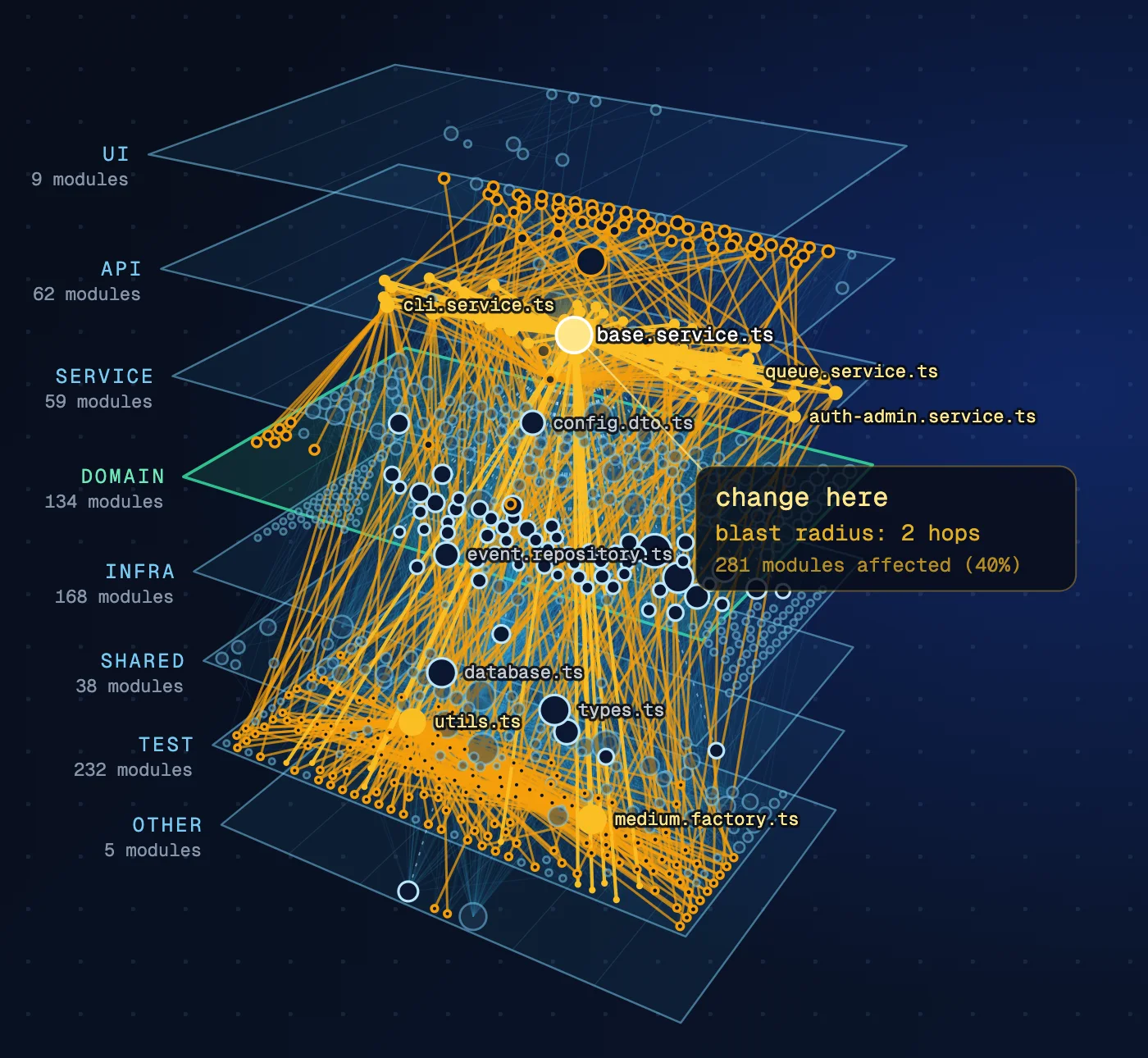
wingbox build also writes wingbox-out/map.html. Its layers view stacks the
architecture in 3D; click a file and its blast radius lights up across the
layers:
| One DTO changes: 30 files within two hops | The base service changes: 281 of 707 modules |
|---|---|
 |
 |
Benchmarks with charts, a sample report and the live map: wingbox.dev.
What can Wingbox answer?
- Where is authentication, billing, upload, or another feature implemented?
- Which modules depend on this service, class, function, or type?
- What could break if I change this file?
- Which two or three files should I read before fixing a bug?
- How does a request or data value move through the system?
- Does this dependency cross an architecture boundary?
- Which Rails models, services, jobs, mailers, concerns, and specs are affected?
- Can you draw a call-flow, data-flow, or sequence diagram from the code?
Instead of searching a repository one text match at a time, Wingbox turns code
into a queryable code graph of modules, entities, imports, references, call
relationships, architecture layers, and infrastructure connections.
What is a code graph?
A code graph describes a codebase as facts instead of text. Modules, classes,
functions and types are nodes; imports, references, data flows, calls and
architecture layers are edges. Wingbox writes the graph to .code_graph.sexp
as plain S-expression facts, so the bundled query tool and ordinary text search
can both read it.
What is blast radius analysis?
The blast radius of a change is everything that depends, directly or
transitively, on the code you are about to edit. Wingbox computes it from the
reverse dependencies in the code graph. impact path/to/file prints the
dependents by depth and the files to read first; rdeps and boundary give
the same facts as a tree and as a change boundary.
$ wingbox impact scripts/lang/treesitter.py

Impact of changing scripts/lang/treesitter.py
  direct dependents   4
  within 2 hops       11

Depth 1
  scripts/lang/csharp/parser.py   imports
  scripts/lang/go/parser.py       imports
  scripts/lang/java/parser.py     imports
  scripts/lang/ruby/parser.py     imports
...
The text form is for people. Agents add --sexp to get the same facts as
compact S-expressions.
Measured: 100 questions, with and without Wingbox
One hundred "which files depend on this file" questions, drawn at random with
a fixed seed in five public repositories (TypeScript, Rust, Python):
wingbox impactnames the complete list of dependent files, with nothing
outside it, in 100 of 100 questions (95 % interval 96 to 100 %). The lists
hold 1 to 503 files.- Claude Code answers 55 of the questions with its built-in search only, and
again with thewingboxcommand added:
| Setup | Complete answers | Tokens per answer | Cost per answer |
|---|---|---|---|
| With Wingbox | 55 of 55 | 32,183 | 0.031 USD |
| Built-in search only | 48 of 55 | 49,292 | 0.063 USD |
Tokens -35 % (95 % interval -47 % to -20 %), cost -51 % (-58 % to -43 %).
The saving is large on the Rust and Python repositories and absent on the
two TypeScript ones.
- Checked against every import statement of seven corpora (3,795 dependencies
in the largest), the graph has no wrong dependency and one missing: an
import of a vendored bundle, which Wingbox leaves out of the graph.
The reference lists come from resolvers that share no code with Wingbox. The
scripts, the lists and every result file are in
benchmarks/impact, with what the benchmark does
not show. Dockerfile.benchmark runs the tests that need no model in a clean
container and compares every result with the committed one:
docker build -f Dockerfile.benchmark -t wingbox-benchmark .
docker run --rm wingbox-benchmark
Wingbox and Graphify on the same tests
Graphify builds a knowledge graph
of a codebase, documents and images for coding agents. Wingbox is narrower: a
deterministic graph of the code alone, built without a model, and exact lists
of what depends on a file. Both were run on the same public repositories
(Wingbox 0.2.0, Graphify 0.9.110, no model on either side):
| Test | Wingbox | Graphify |
|---|---|---|
Exact list of dependent files, five questions (wingbox impact, graphify affected) |
5 of 5 | 1 of 5 |
| Dependencies against the 1,801 import pairs of FastAPI | 0 wrong, 0 missing | 22 wrong, 32 missing |
| Tokens a coding agent spends per answer (built-in search alone: 59,367) | 25,598 | 109,071 |
| Graph of FastAPI on a hosted runner | 2.2 s | 17.9 s |
graphify affected follows calls and references as well as imports, so it
answers a wider question than "who imports this file"; the report gives its
figures restricted to imports too. The scripts, the reference lists, every
result file and the token formula Graphify publishes are in
benchmarks/graphify.
Quick start for AI coding agents
Install the command and let it set up every coding assistant on the machine
(see Install into your coding assistants):
pipx install wingbox
wingbox install
In the agent, /wingbox builds the graph and summarizes the report,/wingbox path/to/file shows what a change to that file breaks. Or ask a
natural question:
Use the Wingbox skill before reading source.
Find where file uploads are handled, analyze that module, show its dependencies
and blast radius, then list only the boundary files needed for the change.
To install the skill alone, without the command's block and hook:
npx skills add aileron-tech/wingbox
MCP clients use wingbox mcp: see Use from an MCP client.
Quick start from the command line
Install the wingbox command (Python 3.11 or newer, macOS or Linux):
pipx install wingbox
Or run it without installing:
uvx wingbox --help
Build the code graph of a project, then ask what a change will break:
cd /path/to/project
wingbox build .
wingbox impact path/to/file.py
wingbox quick "file upload"
wingbox build [PATH] accepts the builder options described below, and every
query command in Common code searches is available aswingbox <command>. The command installs the parsers for all supported
languages and finds .code_graph.sexp in the current directory or its parents.
Install into your coding assistants
wingbox install                    # every assistant whose configuration folder exists
wingbox install --dry-run          # name every file it would write, change nothing
wingbox install --assistant codex  # only the named assistants (repeatable)
wingbox install --project          # into the current repository instead of the home folder
wingbox uninstall                  # remove exactly what install added
wingbox install puts three things in place for each assistant: thewingbox skill (so /wingbox exists), a short always-on block in the
instructions file the assistant reads in every session, and for Claude Code a
hook that runs before each search. Running it again changes nothing; after an
upgrade it refreshes the skill. Assistants are found by their folders in the
home directory: ~/.claude, ~/.codex, ~/.gemini, ~/.cursor,~/.copilot and ~/.agents.
Assistant (--assistant) |
Skill, global | Skill, --project |
Always-on block, global | Block, --project |
|---|---|---|---|---|
Claude Code (claude-code) |
~/.claude/skills/wingbox |
.claude/skills/wingbox |
~/.claude/CLAUDE.md |
CLAUDE.md |
Codex (codex) |
~/.agents/skills/wingbox |
.agents/skills/wingbox |
~/.codex/AGENTS.md |
AGENTS.md |
Gemini CLI (gemini) |
~/.gemini/skills/wingbox |
.gemini/skills/wingbox |
~/.gemini/GEMINI.md |
GEMINI.md |
Cursor (cursor) |
~/.cursor/skills/wingbox |
.cursor/skills/wingbox |
none (user rules live in the settings) | AGENTS.md |
GitHub Copilot, CLI and VS Code (copilot) |
~/.copilot/skills/wingbox |
.github/skills/wingbox |
~/.copilot/copilot-instructions.md |
AGENTS.md |
Shared Agent Skills folder of npx skills (agents) |
~/.agents/skills/wingbox |
.agents/skills/wingbox |
none | AGENTS.md |
- The block sits between
<!-- wingbox:begin -->and<!-- wingbox:end -->. It tells the agent to runwingbox quickorwingbox analyzebefore reading code,wingbox impact <file>before
changing a file, and/wingboxfor an overview. Text outside the markers is
never touched; a file that links to another one (CLAUDE.mdtoAGENTS.md)
gets one block. - The Claude Code hook is a
PreToolUseentry with the matcherGrep|Glob|Readin~/.claude/settings.json(.claude/settings.jsonwith--project) that runswingbox hook pre-search. When the project has a
graph, it adds a few lines of context to the search: the modules and
definitions that match the pattern with their direct dependents, or for a
file its dependents and the hint to runwingbox impact. It answers in
0.4 to 0.7 s on a graph of 8,000 files, Python start included, never blocks the tool, opens no
network connection, and says nothing in a project without a graph. Other
settings and hooks are kept; the file is backed up once tosettings.json.wingbox-bakbefore the first change. - A skill folder that another installer wrote (for example
npx skills add) is left as it is. Install records what it did in~/.wingbox/installed.sexp;wingbox updateandwingbox uninstallread
it. /wingboxwith no argument builds the graph when it is missing or
older than the code and summarizeswingbox-out/REPORT.md;/wingbox <file>runswingbox impact <file> 2;/wingbox <command> ...
runs that command. In Codex the skill is called as$wingbox.
Every result is a list of facts: --sexp prints them as S-expressions such as(install-wrote ~/.claude/skills/wingbox :what skill :assistant (claude-code) :version 0.2.6),
and the default output is the same facts as aligned text.
Update
wingbox update --check    # installed and latest version, nothing installed
wingbox update --dry-run  # the command it would run
wingbox update            # upgrade, then refresh what wingbox install put in place
wingbox update upgrades with the installer that installed Wingbox: pipx
(pipx upgrade wingbox), uv (uv tool upgrade wingbox) or pip of the Python
environment it runs in. A Docker image or an editable or local install cannot
update itself; the command says so and prints what to run instead. Wingbox
itself opens no network connection: only the installer reaches the package
index, and only when you run wingbox update.
The report and the map
wingbox build writes three things into the project:
| File | For whom | What it is |
|---|---|---|
.code_graph.sexp |
AI coding agents | The code graph in a compact form that the query commands read |
wingbox-out/REPORT.md |
People | Key findings, the most depended-on files, architecture layers, boundary violations, where to start reading |
wingbox-out/map.html |
People | An interactive map of the code graph: one file, opens in a browser, works without a network connection |
On the map, click a file to see its blast radius: the files that depend on it
move onto rings, one ring per hop. The layers view stacks the architecture
layers as planes in 3D and can be turned with the mouse. A link such asmap.html#select=src/app.ts opens the map on that file.
Both files are rewritten on every build. Add wingbox-out/ to .gitignore
unless you want them in the repository.
Run in Docker, with nothing installed
git clone https://github.com/aileron-tech/wingbox
docker build -t wingbox wingbox

cd /path/to/project
docker run --rm --network none -v "$PWD":/repo wingbox
docker run --rm --network none -v "$PWD":/repo wingbox impact path/to/file.py
The first docker run builds the code graph, the report and the map of the
mounted project; any other Wingbox command goes after the image name. The
container needs no network, and --network none shows it: nothing leaves the
machine. On Linux add --user "$(id -u):$(id -g)" so that the written files
belong to you.
Running the scripts from a clone
Clone the repository:
git clone https://github.com/aileron-tech/wingbox.git
cd wingbox
Build the code graph for an explicit project directory:
python3 scripts/build_code_graph.py --root /absolute/path/to/project
Exclude tracked source snapshots or generated fixture trees by directory name.
The option is repeatable and applies at any depth:
python3 scripts/build_code_graph.py \
  --root /absolute/path/to/project \
  --exclude-dir review-bundles \
  --exclude-dir generated-fixtures
When the target is inside a Git worktree, the builder also honors repository
ignore rules through Git itself. This applies to source files and language
configuration such as tsconfig.json, package.json, Cargo.toml, go.mod,
and LSP project discovery. Tracked snapshot paths that still match.gitignore are excluded as well.
Parser packages are loaded only for languages found in that project. Python
needs no extra parser package. If another detected language is not installed,
the builder stops before publishing and prints its exact install command, for
example:
python3 -m pip install -r requirements/typescript.txt
python3 -m pip install -r requirements/csharp.txt
python3 -m pip install -r requirements/ruby.txt
Install only the files for languages you use, then run the same build command
again. requirements.txt contains the separate infrastructure-topology
dependency.
Run a relevant search and get the first matching module with its full context:
python3 scripts/code_graph_search.py \
  --map /absolute/path/to/project/.code_graph.sexp \
  --root /absolute/path/to/project \
  quick "file upload"
The code graph is written to .code_graph.sexp. Wingbox does not modify the
source files it analyzes.
Use from an MCP client
wingbox mcp runs Wingbox as an MCP (Model Context Protocol) server: the
client starts the command, sends JSON-RPC requests on its standard input and
reads the answers on its standard output. The transport is stdio only: no
port, no network. Logs go to standard error.
wingbox mcp                         # serve the current directory
wingbox mcp --root /path/to/project
The server speaks protocol revision 2026-07-28 (requests with per-request_meta, server/discover) and the initialize handshake of revisions
2025-11-25, 2025-06-18, 2025-03-26 and 2024-11-05.
| Tool | What it answers |
|---|---|
build |
Build or refresh the code graph (full, exclude_dirs) |
impact |
Blast radius of a file, as text (target, depth, all) |
analyze, quick |
Full analysis of a module, or of the first module matching a keyword |
boundary, boundaries, layers |
Files to read for a change; layer violations; modules by layer |
deps, rdeps |
Dependency and reverse dependency trees |
entity, find_function, find_type |
Where a name is defined and used |
find_callers, find_calls, find_callchain |
Call graph questions |
diff_functions |
Functions changed since a git ref |
query |
A Scheme query on the graph |
Each tool returns the output of the wingbox command of the same name. A
query tool called before the graph exists answers that build must be called
first. Answers stop at 200 items; all: true lists everything. The graph is
read once and read again when .code_graph.sexp changes.
Claude Code, in the project directory:
claude mcp add wingbox -- wingbox mcp
--scope project writes the server into .mcp.json for everyone working on
the project; --scope user makes it available in all your projects.
Codex, in ~/.codex/config.toml (or codex mcp add wingbox -- wingbox mcp):
[mcp_servers.wingbox]
command = "wingbox"
args = ["mcp"]
cwd = "/path/to/project"
Cursor, in .cursor/mcp.json of the project (or ~/.cursor/mcp.json):
{
  "mcpServers": {
    "wingbox": {
      "command": "wingbox",
      "args": ["mcp", "--root", "${workspaceFolder}"]
    }
  }
}
Claude Desktop, in~/Library/Application Support/Claude/claude_desktop_config.json on macOS.
Claude Desktop starts servers in an undefined directory and with a reducedPATH, so give absolute paths for the command and the project (which wingbox
prints the first):
{
  "mcpServers": {
    "wingbox": {
      "command": "/absolute/path/to/wingbox",
      "args": ["mcp", "--root", "/absolute/path/to/project"]
    }
  }
}
Without installing, uvx wingbox mcp works in place of wingbox mcp
("command": "uvx", "args": ["wingbox", "mcp", ...]).
Common code searches
| Goal | Command |
|---|---|
| Find and analyze a feature | quick "payments" |
| Search for a module | search "payment.*service" |
| See full module context | analyze path/to/module |
| Find files needed for a change | boundary path/to/module --files-only |
| Trace dependencies | deps path/to/module 2 |
| See what a change will break | impact path/to/file.py |
| Measure blast radius as a tree | rdeps path/to/module 2 |
| Find a class, module, interface, enum, or type | find_type OrderService |
| Find a function or method | find_function createOrder |
| Find callers | find_callers createOrder 2 |
| Trace a call path | find_callchain handleRequest createOrder 5 |
| Search inside function bodies | grep_functions "validate.*input" |
| Check architecture boundaries | boundaries all |
| Check naming conventions | invariants all |
| Inspect changed functions | diff_functions HEAD~1 |
analyze and impact always print the complete counts and list at most 200
dependent files, nearest first; add --all for every file. boundaries reports
an import of TypeScript types only apart from the violations: the compiler
erases it, but a change of the type still reaches the importing file.
Pass --map and --root (see Running the scripts from a clone)
when the graph is outside the current directory and its parents.
Supported languages and projects
| Language | What is indexed |
|---|---|
| Python | Modules, imports, classes, functions, methods, inheritance, and references |
| TypeScript, TSX and JavaScript | Imports, re-exports, classes, interfaces, functions, types, decorators, aliases, and references |
| Rust | Cargo crates, modules, use dependencies, structs, traits, enums, functions, implementations, and methods |
| C# | Namespaces, types, interfaces, records, enums, methods, attributes, inheritance, and local type dependencies |
| Java | Packages, imports, classes, interfaces, records, enums, methods, annotations, inheritance, and local type dependencies |
| Go | Modules, packages, imports, structs, interfaces, functions, constants, variables, receiver methods, and local package dependencies |
| Ruby and Rails | Ruby classes, modules, instance and singleton methods, inheritance, requires, Zeitwerk constants, concerns, associations, callbacks, jobs, mailers, and impacted specs |
| Free Pascal and Lazarus | Units, programs, uses/includes, classes, records, interfaces, inheritance, methods, and routines |
Wingbox is designed for single repositories and monorepos. It understands
Python project roots, TypeScript configuration and package aliases, Cargo package
names and local Rust crate dependencies, .NET solutions and projects, Maven and
Gradle projects, Go modules and workspaces, and Rails application/autoload
roots with project acronyms.
Pascal dependencies resolve by case-insensitive unit identity and explicitUnitName in 'path.pas' paths, then by a unique same-directory unit. Other
ambiguous unit names remain unlinked, compiler conditionals are indexed
conservatively, and Pascal does not use LSP enrichment. Automatic Pascal copies
under Lazarus backup/ directories are excluded without excluding other
supported languages stored under the same path.
It can also map infrastructure relationships from Kustomize, Helm, and Terraform.
Ruby and Rails dependency search
Rails code often depends on constants without an explicit require. Wingbox
builds a project-local constant index and follows conservative Zeitwerk naming
rules, so changing a shared model, concern, service, job, or mailer can reveal
its likely callers and affected specs.
The default Ruby map does not boot Rails. Ambiguous reopened constants remain
unlinked, polymorphic associations stay open, and external or dynamic Ruby
calls are not guessed. This keeps blast-radius results useful without executing
application code.
A simple workflow
- Build the map for the exact repository you want to understand.
- Search for a feature, type, function, or module instead of guessing a path.
- Analyze the returned module to see dependencies, reverse dependencies, layers,
references, and the minimal boundary files. - Read only those files and make the change.
- Rebuild the map after structural changes and check boundaries again.
This keeps code exploration focused and gives AI coding agents less irrelevant
context, clearer ownership, and better evidence for implementation decisions.
Call graphs and diagrams
The default static analysis builds import, reference, data-flow, and architecture
edges. Add --lsp when supported language servers are installed to enrich the map
with precise call-site information:
wingbox build /path/to/project --lsp
You can then ask an agent to render Mermaid diagrams from the graph:
Use Wingbox to trace the file upload flow and render a Mermaid sequence diagram.
Base every participant and edge on the code-graph facts.
Accuracy and limits
Wingbox is an architecture and impact-analysis tool, not a compiler replacement.
The default map comes from deterministic static parsing. Optional LSP enrichment
adds call hierarchy and reference detail when the relevant language server is
available.
For generated imports, runtime dependency injection, reflection, or framework
behavior that is not explicit in source, verify the result against the running
application or the owning framework.
FAQ
Does Wingbox send my code anywhere?
No. The code graph is built and queried locally by deterministic static
parsing. Building and querying need no LLM, no embeddings, no vector database
and no network access.
Is Wingbox free?
Yes. It is open source under the MIT license, with no paid tier, no account
and no usage limit.
Can I run it fully offline?
Yes. Building and querying never use the network; wingbox update runs your
package installer (pipx, uv or pip) when you ask it to. On a machine with no internet,
install from wheels fetched once elsewhere (pip download wingbox -d wheels,
then pip install --no-index --find-links wheels wingbox), or run the Docker
image with --network none.
Does it use embeddings or a vector database?
No. The graph is built by parsers that read the source; a question is
answered by following recorded import, reference and inheritance edges, not
by retrieving text that looks similar.
How is Wingbox different from RAG or vector search?
RAG splits code into chunks, embeds them and returns the chunks that look
closest to a question. Wingbox resolves each import to the file it names and
answers from those edges, so impact returns the complete list of dependent
files with nothing guessed. The benchmark checks every list against resolvers
that share no code with Wingbox: benchmarks/impact.
My editor already has "go to definition" and "find usages". Why a graph?
The editor answers one symbol at a time, inside an open, resolved project. The
graph answers for a whole file or module at once (what depends on it within
two hops, which layer boundary a dependency crosses, which files to read
first), for a coding agent on the command line, with no language server and
no installed dependencies.
How is it different from Sourcegraph or ctags?
ctags lists where names are defined; it does not resolve imports or say who
depends on a file. Sourcegraph is a code search server; its precise navigation
needs an indexer per language run on a resolved project. Wingbox is one local
command that builds a dependency graph of the repository in seconds and keeps
it as a file next to the code.
Does the graph stay current as I change code?
Run wingbox build again: files whose content did not change are taken from
the cache, so a rebuild reads only what changed. diff_functions <ref> lists
the functions changed since a git ref.
Which AI coding agents does Wingbox work with?
Codex, Claude Code, Gemini CLI, Cursor, GitHub Copilot, and other clients
that support Agent Skills; wingbox install sets up the ones it finds on the
machine. Any MCP client (Claude Code, Codex, Cursor, Claude Desktop) can also
use it through wingbox mcp; see Use from an MCP client.
The scripts can also be run directly from the command line.
How is a code graph different from text search with grep or ripgrep?
Text search finds lines that match a pattern. A code graph answers structural
questions: which modules depend on this one, what a change can break, which
architecture boundary a dependency crosses, and which few files are worth
reading first.
Does Wingbox replace a compiler or a language server?
No. It is an architecture and impact-analysis tool. Optional LSP enrichment
adds call hierarchy and reference detail; behavior that is not explicit in
source, such as generated imports, runtime dependency injection or reflection,
must be verified against the running application.
Which languages are supported?
Python, TypeScript, TSX and JavaScript, Rust, C#, Java, Go, Ruby and Ruby on Rails, Free
Pascal and Lazarus, plus infrastructure relationships from Kustomize, Helm and
Terraform.
Where Wingbox comes from
Wingbox grew out of the paper
Theory of Code Space: Do Code Agents Understand Software Architecture?
by Grigory Sapunov (arXiv:2603.00601, February 2026; code,
the author's write-up).
It asks whether a coding agent that explores a repository under a budget of
files can build and keep a correct "belief map" of its architecture, and finds
that this depends on the model and that the map can collapse. The paper itself
carries over the framework of
Theory of Space (arXiv:2602.07055), which
measured the same failures in physical space.
Wingbox takes the opposite route: the agent does not build the map, a parser
does, from every file, without a model, and again after every change.
- March 2026: a script that writes the belief map from the syntax tree, first
as JSON, then as S-expressions, one fact per line, to save agent tokens. - June 2026: published as the
codespacesskill. - November 2026: renamed Wingbox; the belief map became the code graph.
The papers do not evaluate Wingbox; the link between them and this tool is
ours. The full story: wingbox.dev/story.
Project resources
- Website: wingbox.dev
- Skill workflow and complete command reference
- S-expression map format
- Composable query language
- Changelog
- Completion log
License
MIT
Reviews (0)
Sign in to leave a review.
Leave a reviewNo results found