ainsel
Health Warn
- License — License: Apache-2.0
- No description — Repository has no description
- Active repo — Last push 0 days ago
- Low visibility — Only 5 GitHub stars
Code Pass
- Code scan — Scanned 12 files during light audit, no dangerous patterns found
Permissions Pass
- Permissions — No dangerous permissions requested
No AI report is available for this listing yet.
AInsel







AInsel is a Kubernetes-native agent orchestrator: events go in, your AI
agents react — with whatever persona, skills, tools, and MCP servers you
give them.
Point it at anything that produces events: a code forge, a cron schedule,
a chat room, a home-automation hub, your own service's webhook. A trigger
decides which events wake which agent, the event becomes the agent's
prompt, and the agent acts back on that world through its tools.
Administrators own the models, prompts, and budgets; end users just see
results — a review comment, an issue label, a reply, a light switched on
— inside tools they already use.
- Any source. Webhooks from Forgejo and GitHub, cron schedules, and
console chat work out of the box. Anything else that can POST a signed
JSON webhook is configuration-only; sources that don't speak webhooks
are one small connector away. - Any capability. An agent is a persona plus skills plus tools. The
shipped runtime gives agents shell and git access out of the box; forge
operations — and every other domain — arrive as tool binaries on your
agent image or through any MCP server you register (chat platforms,
home automation, browsers, your own APIs). - Real ops. Agents, connectors, and runtime images are Kubernetes
CRDs deployed by a single Helm chart: queued tasks with retries,
queue-based autoscaling down to zero, group-based access control,
default-deny network policies, per-invocation cost tracking. - You stay in control. Self-hosted, your models (Ollama, any
OpenAI-compatible endpoint), your cluster. Nothing leaves it except
the LLM calls you configure.
What you can do
Every run is the same loop:
event ──▶ trigger (filters) ──▶ agent (persona · skills · tools · MCP) ──▶ acts back on the source
| You want | Event in | Agent reacts via | Status |
|---|---|---|---|
| PR reviews with file-level comments | forge webhook | forge tools | config only |
| Issue triage, labeling, comment Q&A | forge webhook | forge tools | config only |
| Issue → implementation → PR | forge webhook + label | git, shell, forge tools | config only |
| Nightly digests, stale-issue sweeps, health checks | cron trigger | any tools / MCP | bundled |
| Ad-hoc conversation with an agent | console chat | its tools | bundled |
| Home automation, IoT, CI alerts | signed JSON webhook (Node-RED, scripts, SaaS) | that domain's MCP server | config only |
| Bot in Matrix / WhatsApp / Slack | chat-platform events | that platform's MCP tools | write a connector |
| Polled API, proprietary event bus | your connector service | whatever you register | write a connector |
- bundled — works with what ships in this repo.
- config only — no AInsel code: register the generic
WebhookConnector
(paste its endpoint into the source; deliveries are HMAC-SHA256 signed,
header name configurable, filter on any path in the payload), and give an
agent its capabilities — the forge tools that power the forge rows above
come from theAgentImageyou register (tool binaries or an attached MCP
server), not from the shipped runtime image. Cron triggers and console
chat are bundled: their code ships in this repo and they work once
configured. - write a connector — sources that don't speak plain webhooks need a
small translator service. Agents, triggers, and personas stay the same;
see writing your own connector and the
connector tutorial.
A configured forge setup covers the full loop today: review newly opened
PRs with file-level feedback, classify and label incoming issues, answer
mentions in issue and PR comments, and pick up a labeled issue, branch,
implement the change, and open the PR back for review.
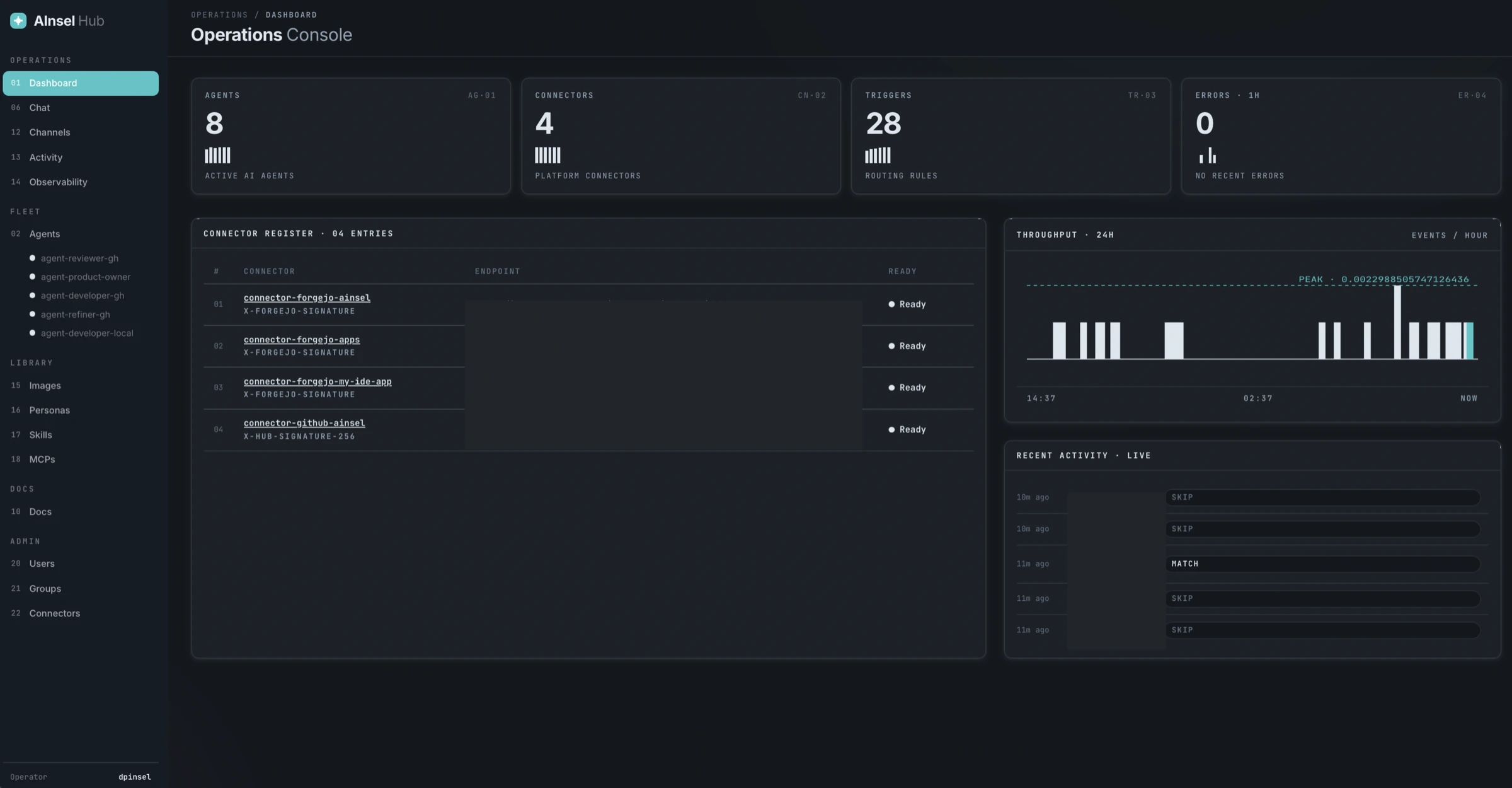
The operations console — every agent, connector and routing decision in one
place, with no separate chatbot UI for end users to learn.
Contents: Why a platform · How it works ·
Who this is for ·
Writing your own connector ·
Architecture · Repository layout ·
Quick start · Where to go next
Why a platform
Anyone can run one agent on a laptop. Running a fleet of them in
production — with budgets, guardrails, and access control — is an ops
problem, and that is the problem AInsel solves:
- Centralized expertise. Models, personas, prompts, skills, and tools
are configured once by the people who understand the AI; every team
benefits through the systems they already use. Nobody improvises alone,
and no end user ever faces a model picker. - Cost and quality guardrails. Every invocation is tracked with its
token spend; personas and shared skills keep output consistent; any
agent can be stopped, retuned, or scaled from one console. - Queued, elastic execution. Events land in a PostgreSQL-backed queue
with retry semantics; agents scale with queue pressure and can park at
zero containers when idle. - Security posture. Group-based access control on console and API,
default-deny network policies, egress-locked agent pods, secret
scanning in CI. Self-hosted: your cluster, your models, your data. - No tool migration. The payoff lands as normal artifacts — comments,
labels, replies, actions — in the systems your teams already use.
How it works
Every event — a webhook delivery from a connector, a tick from a
cron trigger, a message from a chat session — lands in a single
queue carrying the raw payload and headers, unnormalized. The hub
matches each event against admin-defined triggers: "when an event
from this source matches these filters, wake this agent with the event
as its prompt."
An agent is an AI worker — model, persona, skills, tools, and MCP
servers. Each task runs as a Kubernetes Job rendered by the agent
operator from the agent's zero-replica Deployment template (the
Deployment carries the pod spec; the Jobs are the running pods). It reads
the prompt, decides what to do, and acts back on
the source's domain through its tools: forge APIs, a chat MCP server, a
shell, whatever is registered. Connector gateways are managed by the
event-gateway operator, and a single Helm chart deploys the whole
platform. The frontend is the operations console where admins
manage everything and users chat with agents.
Administrators control the agents, triggers, and personas. End users see
only results — a comment, a label, a reply, an action — appearing in the
tool they were already using.
Who this is for
End users. People using whatever systems AInsel is wired into — a
code forge today, a chat room or ticket system once you connect one.
They don't have to know AInsel exists. They see normal artifacts: a
review comment on a PR, a label on an issue, a reply in a thread. They
never pick a model, never write a prompt, never see a token count.
Administrators. The locus of AI expertise for the organization.
They configure agents (model, persona, skills, tools, MCP servers),
define the triggers that decide when agents fire, and connect AInsel to
the source systems their teams use. They own cost management, quality
guardrails, and incident response. The
administrator guide is written for this
role.
Platform contributors. Engineers who extend AInsel itself — writing
new connectors, adding new tools, fixing operator behavior. Start withCONTRIBUTING.md and AGENTS.md; the
per-package READMEs under services/, operators/, shared/,pi/, chart/, and frontend/ describe each component in detail.
Writing your own connector
Connectors are the extension point for sources that don't speak plain
webhooks — chat protocols like Matrix, polled APIs, proprietary event
buses. The hub side never changes: events arrive as raw payload plus
headers (docs/event-schema.md), and triggers
filter on dot-paths into whatever shape that payload has, so there is no
normalization layer to satisfy. The agents, triggers, personas, and
skills stay the same; only the connector changes.
A new connector is two parts: a Kubernetes operator that watches a new
connector CRD and reconciles subscriptions + a Deployment, and a service
that translates the source's native event format into the event envelope
before POSTing to the hub. The webhook connector underservices/webhook-receiver/ andoperators/event-gateway/ is the reference
implementation. Writing one is a contributor task — seeCONTRIBUTING.md and the
connector developer tutorial.
Matrix, WhatsApp, Office365, and Jira are illustrative possibilities,
not commitments; the
issue tracker shows
what's in flight.
Architecture
graph TD
    FORGE[Forgejo Instance] -->|webhook POST| FC[services/webhook-receiver]

    subgraph "PostgreSQL Event Queue"
        EQ[(events + agent_tasks<br/>tables)]
    end

    FC -->|POST /internal/events| HUB[services/hub]
    HUB -->|insert| EQ
    EQ -->|poll + match| HUB
    HUB -->|enqueue tasks| EQ
    EQ -->|fetch by id| AR1[task Job: code-reviewer<br/>agent runtime pod per task]
    EQ -->|fetch by id| AR2[task Job: issue-triager<br/>agent runtime pod per task]
    AR1 -->|ACK/NACK| HUB
    AR2 -->|ACK/NACK| HUB

    AR1 -->|API calls| FORGE
    AR2 -->|API calls| FORGE

    subgraph "Kubernetes Control Plane"
        AO[operators/agent]
        CO[operators/event-gateway]
        K8s[(Kubernetes API<br/>CRDs)]
    end

    HUB -->|"publish due task ids on<br/>status.pendingTaskIds"| AO
    AO -->|watches Agent| K8s
    CO -->|watches WebhookConnector| K8s
    AO -->|"renders Job per task<br/>(from 0-replica template)"| AR1
    AO -->|"renders Job per task<br/>(from 0-replica template)"| AR2
    CO -->|manages Deployment| FC

    UI[frontend] -->|REST API| HUB
    HUB -->|CRUD| K8s
For the full data flow, derived event subjects, CRD relationships, and deployment
topology, see docs/architecture.md.
Repository layout
| Path | Language | Purpose |
|---|---|---|
frontend/ |
TypeScript | Operations console (React + Vite) |
services/hub/ |
Go | Control plane: event routing, REST API |
services/webhook-receiver/ |
Go | Generic webhook receiver — wraps deliveries into event envelopes |
services/mcp/ |
Go | MCP server registry |
operators/agent/ |
Go | K8s operator for the Agent CRD (task Jobs, 0-replica template Deployments, Services, persona ConfigMaps) |
operators/event-gateway/ |
Go | K8s operator for WebhookConnector CRD |
shared/api/ |
Go | Shared event schema, filter engine |
chart/ |
Helm | Single chart deploying the whole platform |
pi/ |
JavaScript | Pi-native agent runtime |
docs/ |
— | Architecture, CRDs, deployment |
Each top-level folder has its own README.md with package-specific details.
Quick start
Requires Node.js 24+, pnpm 9.15+, and Go 1.26+.
pnpm install                  # install frontend deps (workspace root)
pnpm --filter frontend dev    # frontend dev server
go build ./...                # build every Go module in the workspace
go test ./...                 # run every Go test
Go modules are joined via go.work. Each Go subdirectory has its
own go.mod; changes in shared/api/ are picked up by downstream modules
automatically at build time.
Where to go next
All documentation is also published at
ainsel-project.github.io/ainsel,
in the same style as the in-app Docs page.
For evaluators:
docs/quickstart.md— 5-minute orientation: building blocks, first agentdocs/architecture.md— full technical architecture, data flow, event routing
For administrators:
docs/administrator-guide.md— concepts, end-to-end journey, cookbookdocs/crd-reference.md— CRD specs (Agent,AgentImage,WebhookConnector;Trigger/CronTriggerdocumented there as DB-backed)docs/deployment.md— install the platform via the Helm chart
Features:
docs/chat.md— console chat sessions with agentsdocs/cron-triggers.md— scheduled prompts, no webhook neededdocs/skills.md— reusable prompt fragments shared across personasdocs/adding-memory.md— persistent agent memory via mem0
For platform contributors:
CONTRIBUTING.md— contributor guide (read before opening a PR)docs/writing-a-connector.md— tutorial for writing a new connector end-to-endAGENTS.md— short rule sheet for AI agents working in this repo
Reference:
docs/api-reference.md— hub REST API endpointsdocs/mcp.md— AInsel MCP server: connect a local agent to control the platformdocs/event-schema.md— event envelope and trigger matchingdocs/database-schema.md— the hub's Postgres tables: columns, indexes, retention, and what the migrations alone cannot tell you
AI full disclosure
AInsel is developed with extensive AI assistance. This project is itself
a platform for AI agents, and its own development runs on them: issues are
refined, implemented, tested, and code-reviewed by AI agents working under
the rules in AGENTS.md. Humans lead the ideas, architecture,
verification, and release decisions. We say this openly because it shaped
how the project was built, and because an AI platform should be honest
about using AI.
License
This project is licensed under the Apache License 2.0.
See NOTICE for project attributions and third-party license
elections — including the explicit Apache-2.0 election for
DOMPurify, which is dual-licensed
MPL-2.0 OR Apache-2.0. The complete, machine-generated listing of every
third-party dependency bundled into ainsel's distributed artifacts — name,
version, license, and license text — lives in
THIRD_PARTY_LICENSES.md andLICENSES/, and is kept in sync by.github/workflows/ci-licenses.yml — which also refuses a dependency whose
license may not ship in an Apache-2.0 product (the allowlist and the reviewed
copyleft exceptions live in scripts/check-license-policy.py). The frontend image
serves these files under <BASE_PATH>/legal/; the Go service and operator images
ship them under /legal/.
Reviews (0)
Sign in to leave a review.
Leave a reviewNo results found