overhuman
Health Pass
- License — License: MIT
- Description — Repository has a description
- Active repo — Last push 0 days ago
- Community trust — 16 GitHub stars
Code Pass
- Code scan — Scanned 3 files during light audit, no dangerous patterns found
Permissions Pass
- Permissions — No dangerous permissions requested
This tool is an always-on AI daemon that processes tasks through a multi-stage pipeline and dynamically generates unique visual interfaces for each response. It is designed to learn from repetitive tasks and auto-generate code skills to reduce future LLM API calls.
Security Assessment
The automated scan rated the overall risk as Low. Only 3 files were scanned during the light audit, but no dangerous patterns, hardcoded secrets, or excessive permissions were found. However, since this is a generative AI daemon, it inherently makes network requests to external LLM APIs. Additionally, the ability to generate code from scratch and visualize data implies that it will process whatever input you provide. Developers should be mindful not to feed highly sensitive data or secrets into the AI prompts.
Quality Assessment
The project is in active development with a recent push and has accumulated 16 GitHub stars, indicating early but existing community trust. It is properly licensed under the standard MIT license, which permits broad usage and modification. The repository includes comprehensive documentation and architecture specs, showing strong project organization.
Verdict
Safe to use, but keep external LLM data-sharing policies in mind when processing sensitive information.
Self-evolving AI daemon in Go with fully generative UI. LLM generates unique HTML/ANSI interfaces from scratch for every response — not templates, not component catalogs. 10-stage pipeline, 4-level reflection, fractal agents, auto-generated code skills, 6 input channels.
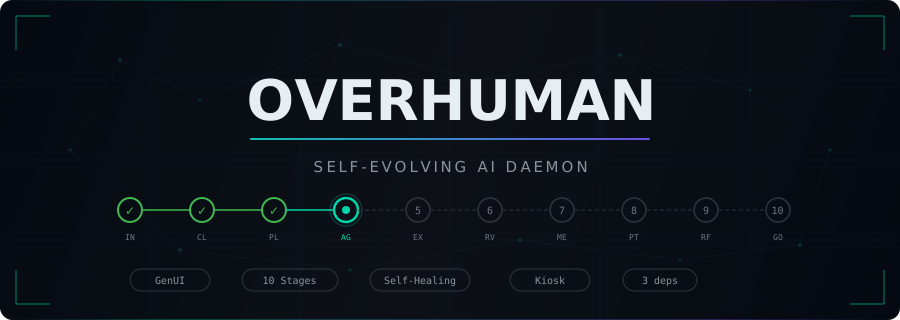




Overhuman is an always-on AI daemon that processes tasks through a 10-stage pipeline
and generates a unique visual interface for every response — not from templates, but from scratch.
It learns from repetition, auto-generates code skills that replace LLM calls,
and gets cheaper with every request.
Spec · GenUI Spec · Architecture · Phases · Quick Start
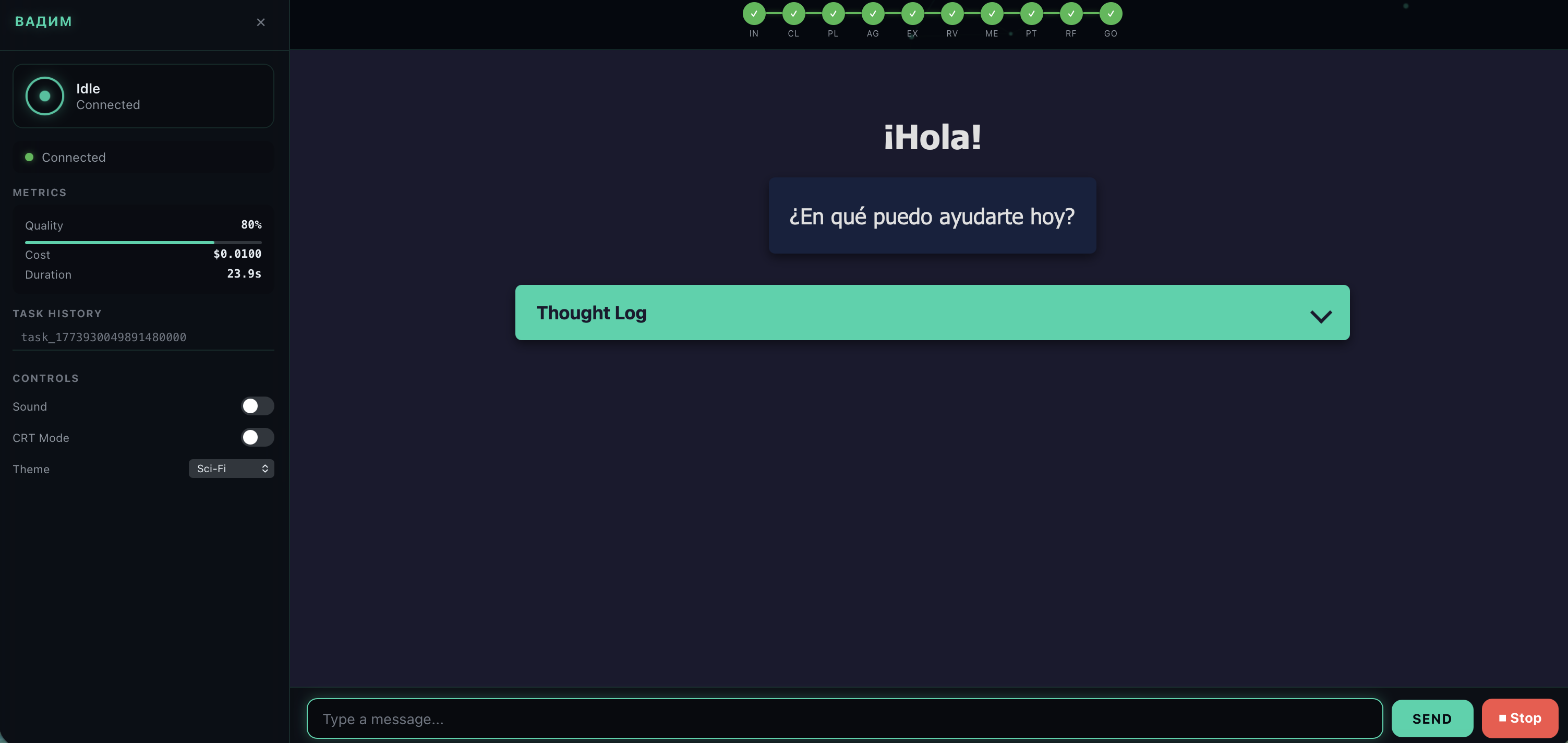
Kiosk companion display — pipeline HUD, neural canvas, metrics panel, theme controls. Pure Go, zero JS frameworks.
🎨 Generative UI — The Core Feature
Most AI assistants return plain text. Some pick from pre-built component catalogs. Overhuman generates complete UI from scratch for every response.
 "Analyze server logs"  →  Interactive dashboard with latency charts, error heatmap, filterable table
 "Compare Q1 vs Q2"     →  Side-by-side cards with sparklines and delta highlights
 "Draft an email"       →  Rich editor with tone slider and preview pane
 "Explain this code"    →  Syntax-highlighted walkthrough with collapsible sections
No component registry. No JSON schema. The agent decides the best visualization — charts, tables, forms, games, timelines — whatever fits the data.
Where Overhuman sits in the ecosystem
                        Agent Freedom
                             ▲
                             │
  Level 3 ─── Fully     ┌───┴────────────────────┐
  Generated              │  Cloud AI Generators   │
                         │  AI Sandbox Tools      │
                         │  ★ OVERHUMAN           │
                         └────────────────────────┘
                             │
  Level 2 ─── Declarative   │  Declarative JSON UI
                             │  Server-Driven UI
                             │
  Level 1 ─── Controlled    │  Component Libraries
                             │  Transport Layers
                             │
              ───────────────┴─────────────────────► Safety
                   Low                          High
[!NOTE]
Level 1-2 limit the agent to what a developer pre-built. Level 3 means infinite UI surface — the agent can create any visualization it can imagine. The tradeoff is sandboxing (solved) and non-determinism (solved via self-healing + reflection). Research confirms LLMs are effective UI generators, achieving ELO 1710 against human-crafted designs (paper).
Three rendering targets
|
🖥️ Terminal ANSI escape codes + box drawing CLI over SSH, no browser |
🌐 Browser HTML + CSS + JS via WebSocket Sandboxed iframe — no data leak |
📺 Kiosk Full-screen SPA on any screen Tablet / wall mount / desktop |
Kiosk: the companion display
A full-screen web app designed for a dedicated screen — tablet on your desk, monitor on the wall, or a browser window you keep open.
|
|
[!TIP]
Device-adaptive: phone → essentials only (no HUD, overlay sidebar) · tablet → control pad · desktop → full command center.
Self-healing UI
LLM generates HTML ──→ Render in sandbox ──→ Error?
                                              │
                            ┌─── Yes ─────────┤
                            │                  └─── No ──→ Track interactions
                            ▼                              (clicks, scrolls, ignores)
                    Feed error to LLM                              │
                    Retry (max 2)                                  ▼
                            │                         Feed back into generation
                      Still broken?                          │
                       ├─ Yes → Plain text fallback           ▼
                       └─ No  → Serve healed UI         Next UI is better
UI generation cost: ~$0.001 (gpt-4.1-nano). Skipped for short text answers.
⚙️ How It Works
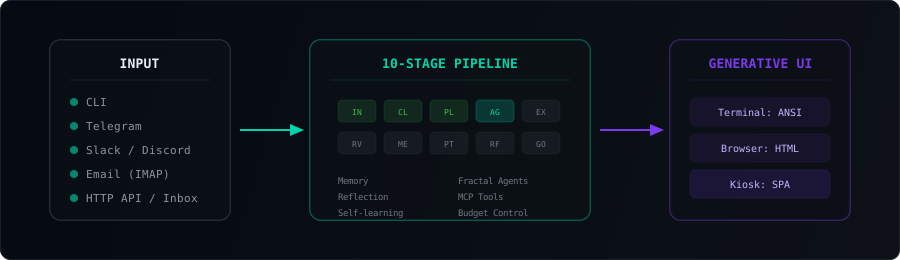
graph LR
    A[📡 Input] --> B[1 Intake]
    B --> C[2 Clarify]
    C --> D[3 Plan]
    D --> E[4 Agent]
    E --> F[5 Execute]
    F --> G[6 Review]
    G --> H[7 Memory]
    H --> I[8 Patterns]
    I --> J[9 Reflect]
    J --> K[10 Go Live]
    K --> L[🎨 GenUI]
    K --> M[💾 Skills]

    style A fill:#00d4aa,stroke:#333,color:#000
    style L fill:#7c3aed,stroke:#333,color:#fff
    style M fill:#3fb950,stroke:#333,color:#000
Every request passes through the full 10-stage pipeline. Stages 7-9 feed back into the system — this is how Overhuman learns:
|
🧠 Memory — stores results in short-term + long-term (SQLite FTS5) 🔁 Patterns — fingerprints recurring tasks 🪞 Reflection — 4 levels of self-improvement:
|
⚡ Self-learning — the killer loop: |
⚡ Features
|
📡 6 Input Channels 🤖 Any LLM Provider 🧠 Memory System 🔄 Self-Learning 🛠️ 20 Skills |
🌳 Fractal Agents 🪞 4-Level Reflection 🔐 Security-First ⏰ Always-On Daemon 🔌 MCP Tools |
🚀 Quick Start
# Build
go build -o overhuman ./cmd/overhuman/

# Configure (interactive wizard — provider, API key, model)
./overhuman configure

# Chat mode
./overhuman cli

# Or: daemon with HTTP API + WebSocket + Kiosk UI
./overhuman start
[!TIP]
Zero-config local mode — no API key needed:LLM_PROVIDER=ollama ./overhuman cli
Try it
# Start daemon
./overhuman start

# Send a task
curl -s http://localhost:9090/input/sync \
  -H "Content-Type: application/json" \
  -d '{"payload": "What is the capital of France?"}'

# Open Kiosk companion display
open http://localhost:9092
🖥️ Deployment
overhuman doctor       # diagnostics
overhuman install      # install as OS service
overhuman status       # check daemon
overhuman stop         # graceful shutdown
overhuman logs         # tail last 50 lines
overhuman update       # check & apply (SHA256 verified)
overhuman uninstall    # remove OS service
| Port | Service | Description |
|---|---|---|
9090 |
HTTP API | REST (/input, /input/sync, /health) |
9091 |
WebSocket | Real-time UI streaming (RFC 6455, pure stdlib) |
9092 |
Kiosk | Full-screen companion display |
File drop:
~/.overhuman/inbox/— daemon picks up automatically.
Logs: stdout +~/.overhuman/logs/overhuman.log.
🧩 Supported LLMs
| Provider | API Key | Models |
|---|---|---|
| OpenAI | Required | o3, o4-mini, GPT-4.1 |
| Anthropic Claude | Required | Claude Sonnet, Haiku, Opus |
| Ollama | — | Local models (llama3, mistral, etc.) Free |
| LM Studio | — | Local models via GUI |
| Groq | Required | Fast inference (Llama, open-source models) |
| Together AI | Required | Open-source models hosted |
| OpenRouter | Required | All models through a single key |
| Custom | Optional | Any OpenAI-compatible server |
🏗️ Technical Decisions
| Decision | Choice | Why |
|---|---|---|
| Language | Go | Daemon-first, goroutines, single binary 15MB, <10MB RAM |
| Storage | SQLite + files | Self-contained, FTS5 for search, human-readable |
| Dependencies | 3 total | google/uuid, modernc.org/sqlite, golang.org/x/term |
| Tools | MCP | Industry standard (Anthropic + OpenAI + Google + Microsoft) |
| Sandbox | Docker | Isolation for auto-generated code |
| Encryption | AES-256-GCM | Authenticated encryption for stored keys |
cmd/overhuman/       — entry point (daemon, CLI, configure, doctor)
internal/
├── soul/            — agent identity (markdown DNA, versioning)
├── agent/           — fractal agent hierarchy
├── pipeline/        — 10-stage orchestrator + DAG executor
├── brain/           — LLM integration, model routing, context assembly
├── senses/          — input channels (CLI, HTTP, Telegram, Slack, Discord, Email)
├── instruments/     — skill system (LLM/Code/Hybrid), code generator, Docker sandbox
├── memory/          — short-term + long-term memory + patterns + shared knowledge base
├── reflection/      — 4 levels of reflection
├── evolution/       — fitness metrics, A/B testing, skill culling
├── goals/           — proactive goal engine
├── budget/          — cost control, limits, budget-based routing
├── versioning/      — versioning with auto-rollback on degradation
├── security/        — sanitization, audit, encryption, validation
├── mcp/             — MCP client and registry (JSON-RPC 2.0)
├── storage/         — persistent KV store (SQLite, FTS5, TTL)
├── genui/           — generative UI (LLM → ANSI/HTML, self-healing, reflection)
├── deploy/          — PID management, OS service templates, auto-update
├── skills/          — 20 starter skills
└── observability/   — structured logs and metrics
ANTHROPIC_API_KEY   — Claude key
OPENAI_API_KEY      — OpenAI key
LLM_PROVIDER        — provider: openai, claude, ollama, groq, together, openrouter, custom
LLM_API_KEY         — key for any provider
LLM_MODEL           — default model
LLM_BASE_URL        — URL for custom/ollama
OVERHUMAN_DATA      — data directory (default ~/.overhuman)
OVERHUMAN_API_ADDR  — API address (default 127.0.0.1:9090)
OVERHUMAN_NAME      — agent name
🌐 HTTP API
# Async (fire-and-forget)
curl -X POST http://localhost:9090/input \
  -H "Content-Type: application/json" \
  -d '{"payload": "Analyze this CSV file", "sender": "user1"}'

# Sync (waits for response)
curl -X POST http://localhost:9090/input/sync \
  -H "Content-Type: application/json" \
  -d '{"payload": "Translate to French: Hello world"}'

# Health check
curl http://localhost:9090/health
🧪 Tests
go test ./...         # 981 tests, 21 packages
go test ./... -race   # race condition checks
All tests run with a mock LLM server — no API keys needed.
📚 Docs
| Document | Description |
|---|---|
docs/SPEC.md |
Full specification (700+ lines) |
docs/SPEC_DYNAMIC_UI.md |
Generative UI specification (1186 lines) |
docs/PHASES.md |
Implementation tracker |
docs/ARCHITECTURE.md |
Architecture overview |



MIT License · Contributing
Reviews (0)
Sign in to leave a review.
Leave a reviewNo results found