alamo_hub
Health Warn
- License — License: Apache-2.0
- Description — Repository has a description
- Active repo — Last push 0 days ago
- Low visibility — Only 5 GitHub stars
Code Pass
- Code scan — Scanned 12 files during light audit, no dangerous patterns found
Permissions Pass
- Permissions — No dangerous permissions requested
No AI report is available for this listing yet.
turn a learning goal into a runnable course - interactive board, lessons, graded homework, mastery unlocks, spaced review. Plus installable agent skills for Python memory repair, GitHub sync and subagent delegation. Scripts, not prompt packs.
Alamo Skill Hub



English | 简体中文
What Is In Here
| Package | Installs as | Solves | Entry point | Developed |
|---|---|---|---|---|
coursecoach |
1 skill | Turning a learning goal into a runnable course | /coursecoach |
2026-10-20 |
engineering_subagent_workflow_kernel |
5 skills | Exploration, architecture, review, simplification, test-gap analysis via host subagents | $code-explorer and siblings |
2026-10-20 |
github_sync_workflow_kernel |
1 skill | Finding the real repo, checking auth, scoping the commit, pushing, verifying | $github-sync-agent |
2026-07-21 → 07-22 |
memory_hotspot_repair_kernel |
4 skills | Python memory hotspots: find, fix, validate, review, stop | $memory-optimizer-agent |
2026-07-03 → 07-22 |
All four are Apache-2.0, pure Python 3.8+ standard library plus pyyaml, and carry no backend.
The Packages
coursecoach
The odd one out — it is not about code, it is a learning coach. Give it a topic and a daily time budget and it produces a course that runs: a dependency-ordered syllabus, a compiled interactive board you double-click, written lessons, gradable homework, mastery-gated unlocking, and spaced review.
It is subject-agnostic — programming, a foreign language, an instrument, accounting, an exam all work. What separates it from "ask a model for a study plan" is what happens after the plan: scores, unlocks and review dates live in the files, so a course survives across sessions, can be picked up by a different model, and can be zipped and handed to someone who just double-clicks the board.
Six things it does. All triggered in plain language, and every one has a matching button on the board that assembles the sentence for you:
- Start a course — say "I want to learn X, one hour a day." It asks about your goal, your current level and your real weekly capacity, offers three pace options (sprint / standard / long), then researches the field, builds the prerequisite graph over a dozen or so nodes, and compiles the board. Produces
syllabus.md(the only source of truth),课程主页.html, andresources/资料库.md. - Write lessons — click
📖 补这一章讲解(fill in this chapter) under any stage, or open a knowledge-point tag and pick生成讲解. Works per chapter or per single point. Produceslessons/stage3.mdorlessons/stage3--梯度下降.md; after a recompile the board grows a 📄 button that opens it typeset, with no Obsidian required. - Set homework — say "give me homework on stage 3", or click
📝 给这一章出作业. Writes the questions plus 3–6 rubric lines and leaves the answer section empty. Produceshomework/hw-*.md, always in three parts: prompt / answer / feedback. - Grade it — answer the questions, then say "grade hw-stage3-xxx." It judges each rubric line present / partial / absent with a reason (fixed rubric, and length earns nothing extra), converts that to mastery, writes it back, unlocks dependent nodes, and queues the work for review.
- Fix weak spots — say "I keep failing at X in stage 3." It reads which knowledge points repeatedly came back partial or absent, decides whether to add resources, split a node or introduce a new one, and writes targeted homework if that is what the gap needs. Changes go through
syllabus.py, never by hand-editing. - Review and export — "what's due today" returns items on the 1 / 3 / 7 / 16 / 35 / 75-day curve (postpone without corrupting the count); "export to Word" gives you the whole course as one document.
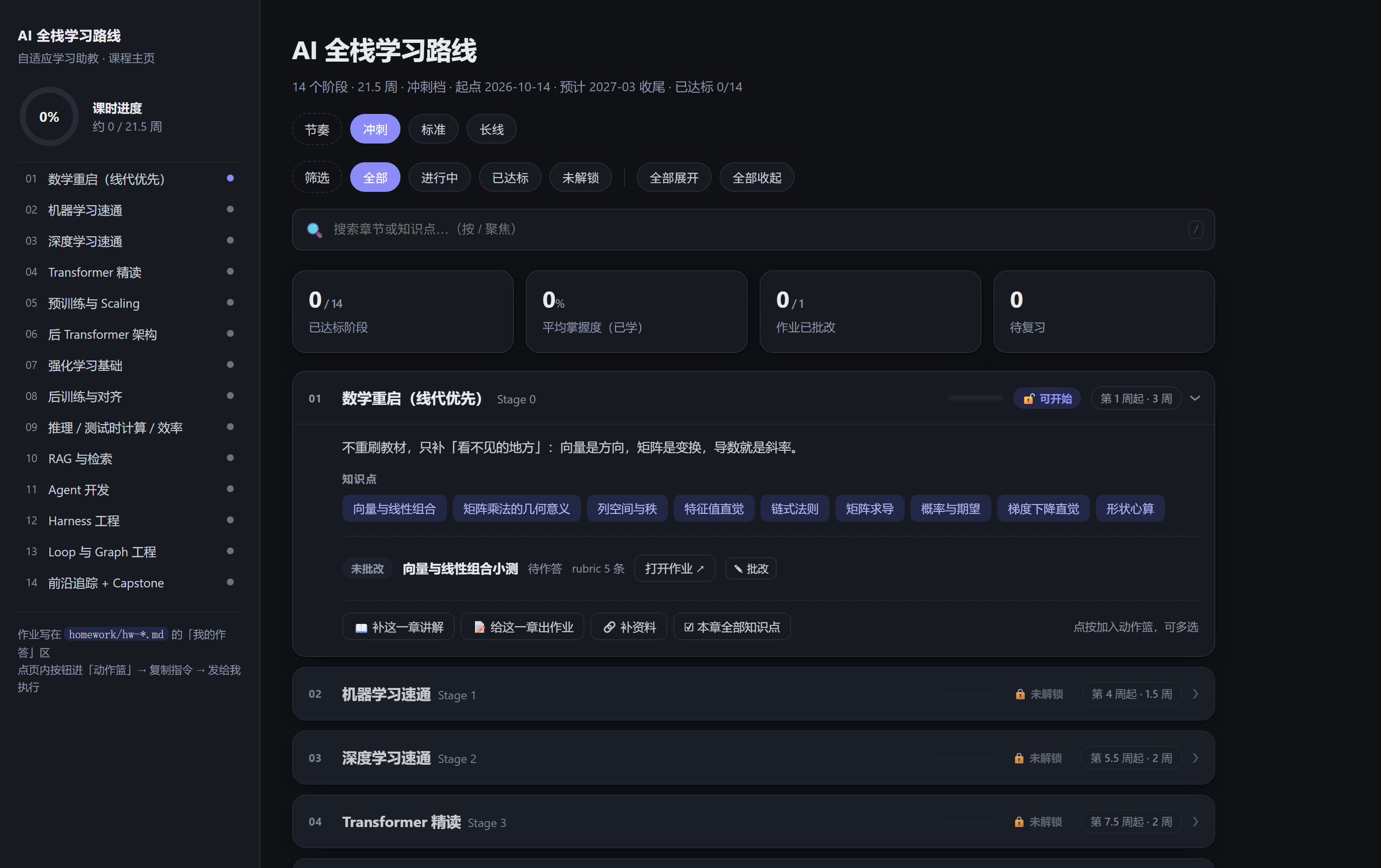
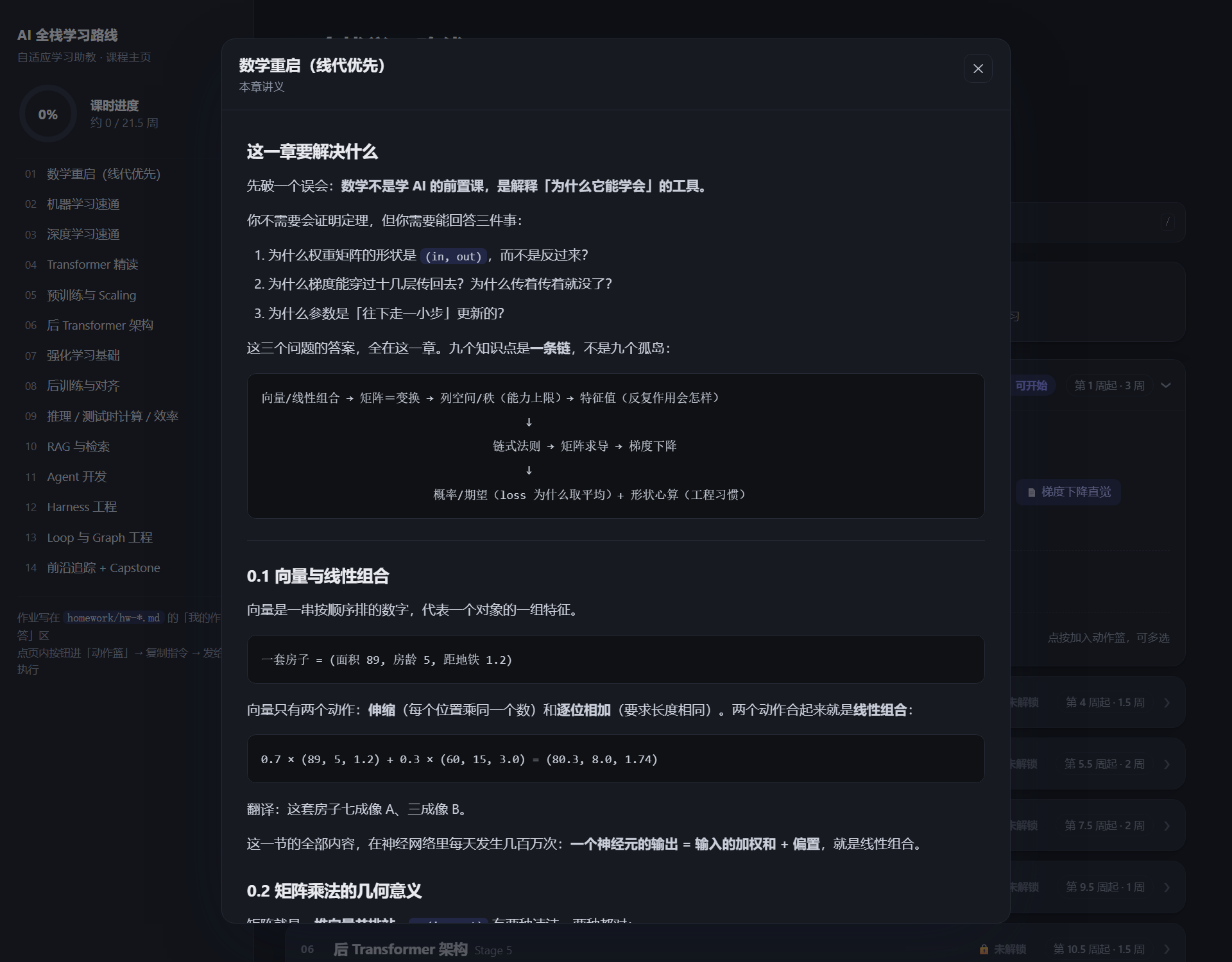
Not installing anything yet? The live demo is a real course compiled from the example snapshot, with five lessons inlined: expand a stage, open a lesson, try the search. Nothing to set up.
Install it (three steps, about a minute):
git clone https://github.com/Alamoooooooo/alamo_hub.git
cp -r alamo_hub/packages/coursecoach/coursecoach ~/.workbuddy/skills/coursecoach
pip install pyyaml
- The installable unit is the directory holding
SKILL.md, i.e.coursecoach/coursecoach/. Once copied, the folder name must becoursecoach— matching the skill's own name — or the slash command will not resolve. - On Windows the destination is
C:\Users\<you>\.workbuddy\skills\coursecoach\. Dropping it in a project's.workbuddy/skills/scopes it to that project instead. - Codex reads
$CODEX_HOME/skills; hosts without skill support can takeSKILL.mdplusreferences/straight into context and run the scripts by hand. - Requires Python 3.8+, and that interpreter must be able to
import yaml. Word export additionally needspip install python-docx. - Reopen the session before it is recognized. Then say "I want to learn X" or
/coursecoachdirectly.
Do not start with a real subject — the install guide includes a 15-minute trial course that shows the whole loop before you commit to anything.
Read: package README · 中文说明 · install and 15-minute trial · portable usage
engineering_subagent_workflow_kernel
Five development skills that delegate through the host's own subagent mechanism instead of an external runner binary: code-explorer, code-architect, code-reviewer, code-simplifier, pr-test-analyzer.
Each skill is self-contained — its role reference ships with it. It does not install helper binaries, spawn nested agent processes, choose a model, or weaken the host's approval and sandbox policy. Hosts without native subagents fall back to in-session execution and report fallback_in_session so the difference is visible.
Read: package README · portable usage
cd packages/engineering_subagent_workflow_kernel
python3 scripts/sync_to_codex_home.py --dry-run
python3 scripts/sync_to_codex_home.py
github_sync_workflow_kernel
For the step everyone gets wrong once: deciding which directory is the real repository, whether the remote and auth are actually working, which changes belong in this commit and which are line-ending noise, and whether the push landed.
github-sync-agent runs repository discovery, auth and remote inspection, commit-scope review, commit, push, and post-push verification as one workflow. The wiki documents the failure modes it was built against.
Read: package README · wiki · portable usage
cd packages/github_sync_workflow_kernel
python3 scripts/sync_to_codex_home.py
memory_hotspot_repair_kernel
For Python services whose RSS keeps climbing, batch jobs that spike during joins or model scoring, and pipelines where "chunking" still loads the whole dataset.
Four coordinated skills: memory-check inspects and ranks hotspots, memory-fix remediates the highest-value one, memory-review reviews the change independently, and memory-optimizer-agent orchestrates all four into one bounded loop with explicit stop conditions. The other three also run standalone.
Read: package README · long-form wiki · portable usage
cd packages/memory_hotspot_repair_kernel
python3 scripts/sync_to_codex_home.py
Pick Your Starting Point
| You want to | Install | Then say |
|---|---|---|
| Learn something properly | coursecoach |
I want to learn X, one hour a day. |
| Hand a broad task to a subagent | engineering_subagent_workflow_kernel |
Use $code-explorer to trace how feature X is wired. |
| Commit and push without guessing | github_sync_workflow_kernel |
Use $github-sync-agent to sync this repository. |
| Stop a Python job from OOM-ing | memory_hotspot_repair_kernel |
Use $memory-optimizer-agent to optimize memory hotspots in the current codebase. |
Install
Codex
git clone https://github.com/Alamoooooooo/alamo_hub.git
cd alamo_hub/packages/memory_hotspot_repair_kernel
python3 scripts/sync_to_codex_home.py
sync_to_codex_home.py copies into $CODEX_HOME/skills, or ~/.codex/skills when CODEX_HOME is unset. Add --dry-run to preview. The three kernel packages each have their own copy of this script; install only the ones you want.
WorkBuddy, CodeBuddy, Claude Code, or any host that reads SKILL.md
git clone https://github.com/Alamoooooooo/alamo_hub.git
cp -r alamo_hub/packages/coursecoach/coursecoach ~/.workbuddy/skills/coursecoach
The installable unit is always the directory that contains SKILL.md — coursecoach/coursecoach/, memory-optimizer-agent/, github-sync-agent/, and so on. pip install pyyaml is required by coursecoach; export.py --format docx additionally needs python-docx.
For hosts that understand neither skill installation nor $name tokens, read the relevant PORTABLE_USAGE.md: it explains how to feed the manual and run the scripts by hand.
Repository Layout
alamo_hub/
├── README.md                          English (this file)
├── README.zh-CN.md                    简体中文
├── AGENTS.md                          conventions for agents working on this repo itself
├── llms.txt                           machine-readable summary for AI crawlers
├── TODO_codex_plugin_marketplace.md   unfinished plan to ship these as a Codex plugin
├── LICENSE                            Apache-2.0
├── packages/                          ← the products
│   ├── coursecoach/
│   │   ├── coursecoach/               the skill itself (SKILL.md, references, scripts, examples)
│   │   ├── docs/                      board.png, lesson-reader.png
│   │   └── README.md  README.zh-CN.md  PORTABLE_USAGE.md  INSTALL.zh-CN.md  metadata.json
│   ├── engineering_subagent_workflow_kernel/
│   │   ├── code-explorer/  code-architect/  code-reviewer/
│   │   ├── code-simplifier/  pr-test-analyzer/
│   │   ├── scripts/
│   │   └── README.md  PORTABLE_USAGE.md  metadata.json
│   ├── github_sync_workflow_kernel/
│   │   ├── github-sync-agent/
│   │   ├── scripts/  wiki/
│   │   └── README.md  PORTABLE_USAGE.md  metadata.json
│   └── memory_hotspot_repair_kernel/
│       ├── memory-optimizer-agent/    orchestrator (primary entry point)
│       ├── memory-check/  memory-fix/  memory-review/
│       ├── references/  scripts/  wiki/
│       └── README.md  PORTABLE_USAGE.md  metadata.json
└── examples/                          ← optional, never required to install
    └── memory_hotspot_repair_kernel/
        └── partitioned_batch_pipeline/    one repo-specific adaptation: overlays + run configs
packages/ is the product. examples/ shows one adaptation of the generic memory package to a specific repository — useful when you write your own overlays, irrelevant if you do not.
Other Files
| File | What it is |
|---|---|
AGENTS.md |
Rules for an AI agent working on this repository: how to distinguish packages from examples, how to update docs and install paths. Not part of any product. |
llms.txt |
A flat summary of all four packages for AI crawlers and search. Same content as this README, optimised for machine reading. |
TODO_codex_plugin_marketplace.md |
An unimplemented plan to package the memory suite for the Codex plugin marketplace. Kept for reference; nothing here depends on it. |
metadata.json (per package) |
Machine-readable descriptor: entry point, keywords, supported hosts, script list. |
License
Apache-2.0. See LICENSE.
Reviews (0)
Sign in to leave a review.
Leave a reviewNo results found