git-courer
Health Pass
- License — License: MIT
- Description — Repository has a description
- Active repo — Last push 0 days ago
- Community trust — 28 GitHub stars
Code Pass
- Code scan — Scanned 12 files during light audit, no dangerous patterns found
Permissions Pass
- Permissions — No dangerous permissions requested
This tool is an MCP server that intercepts routine git operations (like generating commit messages, diffs, and changelogs) and processes them locally via Ollama. It is designed to save developers money by preventing AI assistants from burning expensive cloud API tokens on basic version control tasks.
Security Assessment
The server requires access to your local file system to read repository data and interact with Git. It executes shell commands to perform its core version control functions and interfaces directly with a local Ollama instance, meaning it does not make external network requests to third-party cloud APIs. No hardcoded secrets or dangerous permission requests were found. However, the automated rule-based scan flagged a recursive force deletion command (`rm -rf`) inside the `scripts/install.sh` file. While common in setup scripts for cleaning up temporary files, any `rm -rf` command warrants a quick manual review to ensure it doesn't accidentally target unintended directories. Overall risk is rated as Low to Medium.
Quality Assessment
The project is actively maintained, with its most recent push occurring today. It uses the standard, highly permissive MIT license, and has garnered 16 GitHub stars, indicating a small but present level of community trust. The repository is well-documented, featuring clear configuration instructions, architecture guidelines, and supported client lists.
Verdict
Use with caution — the tool is actively maintained and generally safe, but developers should quickly inspect the `install.sh` script before running it to verify the `rm -rf` deletion paths.
MCP server for Git with local Ollama — zero tokens for git operations


Issues & Bugs: @blak0p/git-courer/issues · Discussions: @blak0p/git-courer/discussions
Quick Links
| Doc | Description |
|---|---|
| Architecture | Codebase structure, patterns, and how to add features |
| Troubleshooting | Fix: Ollama not running, MCP not detected, permission errors |
| MCP Clients | All 14 supported clients, config formats, manual setup |
| Config Options | All ~/.config/git-courer/config.yaml and .git-courer/config.json settings |
| Commands | Complete reference for all 22 MCP tools |
| Models Guide | Tested models, token usage, and which one to pick |
| Contributing | Setup, running tests, and how to collaborate |
git-courer
The only MCP git server that understands your code before it commits.
Most tools wrap git diff | llm "write a commit". git-courer does something different: it parses your AST, builds a dependency graph, classifies the change type in Go without touching the LLM, and only calls the model to write the human-readable message.
One staged area = one commit. Always.
Why it's different
1. Commit type determined in Go, not by the LLM
git-courer uses go-enry and go-tree-sitter to parse your AST and apply deterministic rules — new public function, modified signature, deleted symbol, breaking change. The LLM writes the message, not the decision.
2. Dependency graph
Before committing, git-courer builds a graph of what your staged files affect across the codebase. Real scope, not just which files were touched.
3. Local + cloud working together
Go and the local LLM handle everything they can. Your cloud LLM receives structured commit context — WHY + WHAT — instead of raw code.
4. Commits as LLM context
A git-courer commit is a compressed, structured summary any LLM can consume directly. Better input, fewer tokens, fewer hallucinations.
5. Automatic backup on every mutation
Every write operation creates a backup before executing. One command undoes anything.
6. The complete git pack — one server, nothing else needed
Why install one tool for commits, another for releases, another for PR checks? git-courer covers the full cycle:
Read: status, diff, history, blame, pr-review
Write: commit, amend, revert, stage, reset, stash
Branch: branch, merge, rebase, cherry-pick, tag
Utility: sync, backup, undo, remotes, config
All returning structured JSON. No pager hangs, no text parsing, no extra tools.
Workflows
Commit
Preview the change → review proposed commits → apply. git-courer splits your staged files into atomic commits by dependency graph automatically.
Before any PR or merge
Call pr-review — a pre-PR gate that runs in one shot:
- Tests — runs
test_commandfrom.git-courer/config.json(e.g.go test ./...) - Conflicts — detects merge conflicts with the target branch and returns AST-annotated hunks (
[NEW_FUNC],[MOD_SIG ⚠BREAKING]) - Diff stats — files changed, additions, deletions
- Divergence — ahead/behind count, mergeable status
If it's not green, you don't merge. Set test_command via git-config SET_TEST_COMMAND or edit .git-courer/config.json directly.
Release (CLI)
Run git-courer release. The CLI reads commits from .git-courer/commits.json (captured during each git-commit APPLY on this branch) and groups them by the areas defined in .git-courer/config.json. If the branch store is empty, it falls back to git log since the last tag. Go calculates the version bump; the local LLM writes the human-readable changelog per area.
Undo
Every destructive operation has an automatic backup. One command restores the previous state.
How it works
You: "commit my changes"
        ↓
AI delegates to git-courer (via MCP)
        ↓
Go reads AST + dependency graph → classifies type deterministically
        ↓
Local LLM writes the human-readable message from the annotated diff
        ↓
Security scan (5 layers) → auto-backup → commit
        ↓
"✓ feat(auth): add OAuth2 token refresh"
For the full list of tools: docs/commands.md
For workflow details: docs/workflows.md
Install
curl -fsSL https://raw.githubusercontent.com/blak0p/git-courer/main/scripts/install.sh | sh
That's it. It installs the binary and auto-configures every AI tool it detects on your machine.
Requirements: Git · llm local
Homebrew (macOS / Linux):
brew install blak0p/tap/git-courer
Manual install:
# macOS / Linux
curl -fsSL https://github.com/blak0p/git-courer/releases/latest/download/git-courer_$(uname -s | tr '[:upper:]' '[:lower:]')_$(uname -m).tar.gz | tar -xz -C /usr/local/bin git-courer
chmod +x /usr/local/bin/git-courer
git-courer setup

# Windows (PowerShell)
irm https://github.com/blak0p/git-courer/releases/latest/download/git-courer_windows_amd64.tar.gz | tar -xz -o git-courer.exe
.\git-courer.exe setup

# Or with Go
go install github.com/blak0p/git-courer@latest
Supported Tools
| Tool | Auto-configured |
|---|---|
| Claude Code | ✓ |
| Cursor | ✓ |
| Windsurf | ✓ |
| OpenCode | ✓ |
| Cline | ✓ |
| Roo Code | ✓ |
| VS Code | ✓ |
| Claude Desktop | ✓ macOS/Win only |
| Continue | ✓ |
| Zed | ✓ |
| Codex | ✓ |
| Gemini CLI | ✓ |
| pi | ✓ |
| Antigravity | ✓ |
Run git-courer mcp setup to configure all detected tools at once, or git-courer mcp setup <client> for a specific one.
Interactive TUI
Run git-courer with no arguments to launch the interactive installer:
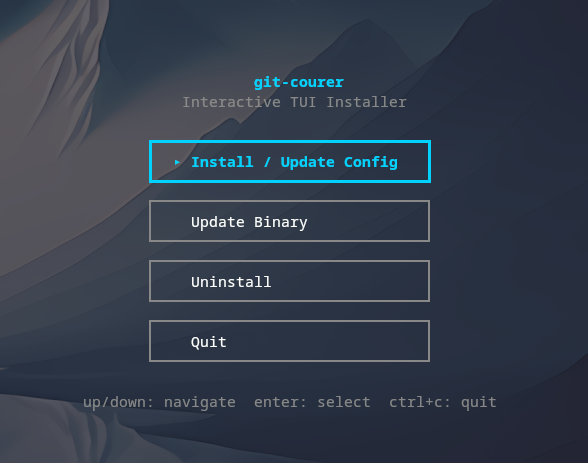
The TUI walks you through 4 steps:
- MCP Configuration — select which AI tools to configure (auto-detects installed clients)
- General Settings — configure your LLM backend, model, and project context
- Review — preview your config before saving
- Finish — config saved to
~/.config/git-courer/config.yaml
You can also update the binary or uninstall directly from the menu. Navigation: j/k or arrow keys, esc to go back.
Commands
git-courer runs as an interactive TUI when launched without arguments. It also provides MCP server and management commands:
| Command | Description |
|---|---|
git-courer |
Launch interactive TUI (requires terminal) |
git-courer mcp |
Run MCP server |
git-courer mcp setup |
Configure all detected AI tools |
git-courer mcp setup <client> |
Configure a specific tool (e.g. cursor) |
git-courer release |
Automated semver releases and changelogs (CLI only) |
git-courer remove |
Remove git-courer from the current project |
git-courer uninstall |
Uninstall the binary globally |
git-courer update |
Update to the latest version |
git-courer version |
Show current version |
MCP Tools
For the 22 MCP tools and their arguments, see docs/commands.md.
Configuration
git-courer uses two config levels:
Global (~/.config/git-courer/config.yaml) — personal settings: LLM backend, model.
Per-project (.git-courer/config.json) — committable, shared with team. Stores description, areas, test_command, excluded. Better results = edit this file per project.
All options: docs/config.md
Background Jobs
When you call git-commit PREVIEW, the server may return immediately (FAST) or start a background job (SLOW). In the SLOW case:
- PREVIEW returns
{status:"processing", job_id} - The agent must call
git-commit STATUSwith thatjob_idto poll - When STATUS returns
{status:"done"}, the plan is ready - Then call
git-commit APPLYwith the samejob_id
The agent continues working — it does NOT block waiting for the job.
Every successful commit via git-commit APPLY is captured to .git-courer/commits.json (branch-scoped under .git-courer/branches/<branch>/commits.json). When you later run git-courer release, the CLI reads those captured commits — grouped by the areas defined in .git-courer/config.json — to generate the changelog. No re-parsing git log.
Why this matters: Git history is frequently rewritten — PR squashes, rebases, force-pushes — destroying the real commit narrative. The CommitStore preserves every commit message as it was written, independently of what happens on the remote. Your release changelog survives git log being flattened into a single squashed commit. This is local documentation that outlives git history rewriting.
Troubleshooting
Having issues? Check docs/troubleshooting.md for:
- Ollama not running / model not configured
- MCP not detected by your AI tool
- Permission errors during install
- Secrets detected in commits (false positives)
MCP config file locations: docs/mcp-clients.md
FAQ
Who decides the commit type?
Go, via AST analysis. The LLM only writes the human-readable message.
Do I need Ollama?
You need some LLM backend. Ollama is the recommended default, but git-courer works with any OpenAI-compatible server: LM Studio, vLLM, LocalAI, or a custom endpoint. Without a configured backend, all AI operations (commits, releases, branch names, security auditor) fail. Basic git reads (status, diff, log) still work.
Is my code sent anywhere?
No. Everything runs on your machine — git-courer, Ollama, your data.
Who decides the version number in a release?
Go, not Ollama. Version is calculated from commit types (feat: → minor, feat!: → major). Ollama only writes the human changelog.
My tool isn't listed.
Open an issue: @blak0p/git-courer/issues. If it supports MCP, adding it is usually a few lines.
How do I mark a breaking change?
Use ! after the commit type (feat!:) or include BREAKING CHANGE: in the body. git-courer picks this up automatically for version bumping and changelog generation.
Contributing
Want to collaborate? Here's everything you need:
Architecture & Codebase
Read docs/architecture.md for:
- Directory structure and tech stack
- Hexagonal architecture patterns
- Key packages and their responsibilities
- How to add a new feature
- Testing approach
Reporting Bugs
Found a bug? Open an issue: @blak0p/git-courer/issues
Include:
- Your OS and git-courer version (
git-courer version) - AI tool you're using (Claude Code, Cursor, etc.)
- Steps to reproduce
- Relevant logs or error messages
How to Collaborate
- Read the docs: Start with docs/architecture.md and CONTRIBUTING.md
- Pick an issue: Check @blak0p/git-courer/issues for
good first issuelabels - Discuss: Use @blak0p/git-courer/discussions for questions or feature ideas
- Submit PR: Follow conventional commits (
feat:,fix:,chore:)
Adding a New MCP Client
If your AI tool supports MCP but isn't listed, adding it is usually 5 lines of code in internal/installer/mcp_config.go. See docs/mcp-clients.md for the format.
Reviews (0)
Sign in to leave a review.
Leave a reviewNo results found