murmur
Health Pass
- License — License: MIT
- Description — Repository has a description
- Active repo — Last push 0 days ago
- Community trust — 12 GitHub stars
Code Fail
- process.env — Environment variable access in dashboard/server.mjs
- crypto private key — Private key handling in dashboard/server.mjs
- crypto private key — Private key handling in deploy/kubernetes/agent-config.example.yaml
- rm -rf — Recursive force deletion command in deploy/production-file-deploy.sh
- crypto private key — Private key handling in examples/agent-runner/agent-config.example.json
- process.env — Environment variable access in examples/agent-runner/agent-runner.mjs
- crypto private key — Private key handling in examples/agent-runner/agent-runner.mjs
Permissions Pass
- Permissions — No dangerous permissions requested
No AI report is available for this listing yet.
Murmur — encrypted agent-to-agent messaging bus for AI coding agents. MCP-native, E2E encrypted (XChaCha20-Poly1305), NATS transport with optional JetStream durability, cross-host and cross-org federation + A2A interop. Connect Claude Code, Codex and friends across machines.

Murmur V2
Named after murmuration — the mesmerizing phenomenon where thousands of birds communicate and move as one.
Murmur V2 brings the same coordinated communication to AI agents.
Encrypted agent-to-agent messaging. Let your AI models talk to each other.
A secure multi-agent communication bus for Claude Code, Codex, and any MCP-capable agent — across machines, across organizations, end-to-end encrypted over NATS.
Install · Quick Start · How It Works · Features · MCP Tools · Deployment · Contributing






Why "Murmur"?
A murmuration is one of nature's most extraordinary phenomena — thousands of starlings flying as a single, fluid organism without any central coordinator. Each bird follows simple local rules: match your neighbors' speed, stay close, don't collide. From these simple interactions emerges breathtaking coordinated behavior.
Murmur V2 applies the same principle to AI agents. No central orchestrator. No human relay. Each agent communicates directly with its peers through encrypted channels — and from these simple peer-to-peer interactions, complex collaborative workflows emerge. Code reviews, research tasks, architectural decisions — all happening autonomously between Claude, GPT, Gemini, or any other model, while you sleep.
What's New in v2.4
- Scoped Channels & Session Affinity. A DB-backed session-ownership lease: for an addressed conversation, only the owning session of the addressed agent responds — every other session and agent stays silent. Kills the multi-session double-emit and stops native wake from spawning a competing thread on the wrong session. Behind
MURMUR_SCOPED_CHANNELS(default-OFF → fully backward-compatible). SessionLeaseStore— atomic single-owner claim. Its own SQLite file (separate WAL fromlocal_messages) with a single-statement compare-and-swapclaim_or_skip, leaseheartbeat, a per-turnisCurrentTokenfencing token checked at outbound, and asession_presenceregistry. OptionalpreemptPrefixlets a real chat session reclaim a channel from a fallback owner.- Native wake is now a lease-gated fallback. If a live interactive session is present for the agent, the daemon wake defers instead of competing; otherwise it claims as the cold-wake fallback (
createNativeLeaseGateinjected intoWakeMonitor). With the flag off,WakeMonitorbehaves exactly as before. - Phase N channel roster, addressing, and personalities.
ChannelRosterStorekeepschannelIddistinct from legacyconversationId, exposes shared reject/append/wake addressing decisions, and can opt-in Codex app-server wake to seedthread/startwith per-membermodel,personaId, and base-instruction metadata (MURMUR_CHANNEL_ROSTER, default-OFF). - Verified: one claim across all delivery paths. Foreground-push, cold-start, and in-session MCP-channel delivery all honor a single claim — N delivery sessions for one message resolve to exactly 1 emit, proven down to a real multi-process race.
What's New in v2.3
- Agent discovery — complete. Presence frames + candidate registry, signed presence over NATS (
announcePresence/subscribePresence), and an operator promote-flow (queryCandidates+promoteCandidate). Trust is always an explicit operator promotion — candidates are never auto-trusted. - Message streaming — complete. Chunked stream frames with out-of-order, idempotent, durable SQLite reassembly, backpressure (chunk + byte windows), and sha256 integrity.
- Auth/authz enforcement. A signed
subject(actor) in auth tokens, an optional signedauthTokenonEnvelopeV1(covered by the signature; byte-identical back-compat when absent),authorizeInbound(bindssubject === senderAgentId), and broker ingress enforcement behindMURMUR_ENFORCE_AUTH(default-OFF). Daemon end-to-end wiring is the remaining step. - Conformance + versioned protocol spec — all wire types. The Draft 2020-12 schema and the schema↔runtime-guard agreement matrices now cover envelope, ack, presence, and stream frames;
docs/protocol-v1.md+docs/protocol-compatibility.mddocument them. - Validated: real cross-host A2A. A fresh agent on a remote host (over the published
@murmurv2/*packages) exchanged bidirectional encrypt/verify/ACK traffic with the mesh over the live broker — agent-to-agent across real hosts and network. - Single canonical signing payload.
stableEnvelopePayloadis now one export in@murmurv2/core(was copy-pasted across 7 sites), golden-locked by test.
npm:
@murmurv2/core,@murmurv2/federation, and@murmurv2/broker-natsare published at0.2.0(the new API surface —stableEnvelopePayload,EnvelopeV1.authToken, stream guards,authorizeInbound);security/observability@0.1.1, the rest @0.1.0.
See CHANGELOG.md for the full list (incl. v2.2: npm publish, WebSocket adapter, roster auth tokens, JetStream durability, federation, A2A bridge, native wake).
Install
All packages are published on npm under the @murmurv2 scope (MIT):
# core types + SQLite stores, crypto, MCP server
npm install @murmurv2/core @murmurv2/security @murmurv2/mcp-server

# transports
npm install @murmurv2/broker-nats   # NATS core + optional JetStream durability
npm install @murmurv2/broker-ws     # WebSocket relay/client

# federation + bridges
npm install @murmurv2/federation @murmurv2/federation-nats
npm install @murmurv2/bridge-a2a @murmurv2/bridge-telegram
Prefer to run the full mesh from source? See Quick Start.
The Problem
AI agents today are isolated. Claude can't talk to GPT. Your coding assistant can't ask your research agent for context. When you try to make them collaborate, you end up as the human relay — copy-pasting messages between terminals.
Murmur V2 fixes this. It gives AI agents encrypted, direct communication over NATS — no human in the loop.
┌──────────────┐                        ┌──────────────┐
│  Claude Code  │                        │   GPT Agent   │
│  (Opus 4.8)   │   "Review this PR"    │  (GPT-5.5)    │
│               ├───────────────────────►│               │
│               │◄───────────────────────┤               │
│               │   "LGTM, 2 nits..."   │               │
└──────────────┘                        └──────────────┘
        │                                        │
        │  MCP stdio                    MCP stdio │
   ┌────┴────┐       core NATS        ┌────┴────┐
   │ daemon  │◄═══════════════════════►│ daemon  │
   │ encrypt │   E2E encrypted msgs    │ decrypt │
   └─────────┘                         └─────────┘
Quick Start
Connect two agents in 3 commands. No JSON editing.
Prerequisites
- Node.js 22+ (uses built-in
node:sqlite) - NATS server:
docker run -d --name nats -p 4222:4222 nats:2.10-alpine -js --auth YOUR_SECRET
Step 1 — Host generates invite
git clone https://github.com/alexfrmn/murmur.git && cd mur-mur-v2
npm install && npm run build

AGENT_ID=alice NATS_URL=nats://your-server:4222 NATS_TOKEN=YOUR_SECRET \
  node scripts/agent-config-init.mjs

node scripts/murmur-invite.mjs
# → Prints MURMUR:eyJ... blob — send it to your peer via any channel
Step 2 — Peer joins with the blob
git clone https://github.com/alexfrmn/murmur.git && cd mur-mur-v2
npm install && npm run build

AGENT_ID=bob NATS_URL=nats://your-server:4222 NATS_TOKEN=YOUR_SECRET \
  node scripts/murmur-join.mjs 'MURMUR:eyJ...'
# → Prints MURMUR-REPLY:eyJ... blob — send it back to host
Step 3 — Host adds peer
node scripts/murmur-add-peer.mjs 'MURMUR-REPLY:eyJ...'
Start the daemons (both sides)
node scripts/murmur-daemon.mjs
Optional: expose Prometheus metrics
npm run build
METRICS_PORT=9464 node scripts/prometheus-exporter.mjs
# scrape http://localhost:9464/metrics
Exporter metrics include outbox depth by status, oldest pending age, inbound/outbound message totals, ack latency (avg/p95), retry rows, and dead-letter rows.
Send your first message
Add Murmur as an MCP server in your AI client (e.g., Claude Code):
claude mcp add murmur -- node /path/to/mur-mur-v2/packages/mcp-server/dist/src/index.js
Then from your AI agent:
# Fire-and-forget
murmur_send(to: "bob", text: "Hello from Alice!")

# Or send-and-wait (blocks until reply arrives)
murmur_request(to: "bob", text: "Review this code please", timeout_ms: 300000)
That's it. Alice and Bob can now exchange encrypted messages — no human relay needed.
How It Works
sequenceDiagram
    participant A as Agent Alice (Claude)
    participant MA as Alice's MCP Server
    participant DA as Alice's Daemon
    participant NATS as core NATS
    participant DB as Bob's Daemon
    participant MB as Bob's MCP Server
    participant B as Agent Bob (GPT)

    A->>MA: murmur_request(to: "bob", text: "Review this code")
    MA->>MA: Encrypt (X25519 + XChaCha20)
    MA->>MA: Sign (Ed25519)
    MA->>DA: Enqueue to SQLite outbox
    DA->>NATS: Publish encrypted envelope
    NATS->>DB: Deliver to Bob's subject
    DB->>DB: Verify signature + decrypt
    DB->>MB: Store in local_messages
    Note over MA: Polling every 10s...
    B->>MB: Process + generate response
    MB->>DB: Enqueue reply to outbox
    DB->>NATS: Publish encrypted reply
    NATS->>DA: Deliver to Alice's subject
    DA->>MA: Store inbound reply
    MA->>A: Return reply (polling found it)
The Key Innovation: murmur_request
The biggest pain point with agent-to-agent messaging is the polling gap — after sending a message, agents forget to check for replies and ask the human to relay the response.
murmur_request solves this. It sends a message and automatically polls for the reply, blocking until a response arrives or timeout is reached:
Agent calls murmur_request("bob", "Review this PR")
  → Message encrypted, signed, enqueued
  → Polls inbox every 10s
  → ... 45 seconds later ...
  → Bob's reply arrives
  → Returns the reply directly to the agent
This enables fully autonomous overnight work — launch 2-3 agents, they collaborate without any human relay.
Features
Core Messaging
- E2E Encryption — X25519 key agreement + XChaCha20-Poly1305 AEAD
- Digital Signatures — Ed25519 for message authentication
- At-Least-Once Delivery — persistent SQLite outbox with ACK correlation
- Dead-Letter Queue — poison messages quarantined after 3 failed attempts
- Optional JetStream Durability — opt-in durable consumers with finite
max_deliver/ack_wait+ advisory → DLQ; default-OFF, SQLite outbox stays source of truth (v2.1) - Exponential Backoff — with jitter on retry, configurable per broker
Agent Integration
- MCP Server — 7 tools for any MCP-compatible AI client
murmur_request— send-and-wait: no more manual polling- Invite Flow — 3 commands to connect two agents, zero JSON editing
- Native Wake — live-session wake via Claude asyncRewake / Codex app-server UDS with self-healing thread re-seed (always-on dead-session wake is an out-of-repo reference-deployment sidecar) (v2.1)
- A2A Bridge — speaks the industry-standard A2A protocol into the Murmur mesh; live client→bridge→NATS→reply round-trip proven, real remote agent pending (v2.1)
- Telegram Notifications — get notified when agents talk
Operations
- SQLite WAL — concurrent reads, write-ahead logging, optimistic locking
- Core NATS + SQLite outbox — low-latency pub/sub with app-level at-least-once delivery, ACK correlation, DLQ, and unbounded dedupe
- WebSocket Transport Adapter — local relay + broker client with envelope delivery, ACK correlation, dedupe, and invalid-envelope NACKs (browser deployment pending)
- Systemd Ready — production service file included
- Docker Compose — one-command NATS setup
- Observability Dashboard — real-time message flow visualization
Security
- Security Policies — sender→recipient allow-lists, max payload size
- Roster-backed Auth Tokens — signed audience/scope tokens verified against the latest accepted federation roster (model/helper layer; transport/bridge enforcement pending)
- MLS Scaffold — group encryption interface ready (RFC 9420)
- No Plaintext — messages are always encrypted on the wire
Federation (v2.1)
- Org/Agent Addressing —
org/agentIdrouting; bare ids resolve to the local org (back-compat) - Signed Key Directory — per-org Ed25519-signed roster (agent → X25519 encrypt + Ed25519 verify keys), verified against a pinned org key
- NATS Subject Contract —
fed.*leaf-node/account export/import isolation; payload stays E2E-opaque across orgs - Account-Config Renderer — generate the per-org NATS accounts config (partner-scoped service exports, optional least-privilege leaf-user permissions) straight from the contract
- RosterStore — runtime trust + replay guard: pinned-key verification + monotonic-version enforcement (rejects stale/downgraded rosters) + key-rotation epoch
- Live-proven in isolation — cross-org sealed+signed delivery on real NATS accounts, the same over a leaf-node topology, and publish/subscribe permission boundaries (
integration/smokes; real partner org pending)
MCP Tools
Murmur V2 exposes an MCP server (JSON-RPC over stdio) with 7 tools:
Agent-to-Agent (require peer config)
| Tool | Description |
|---|---|
murmur_request |
Send message and wait for reply. Blocks until response or timeout. Best for autonomous workflows. |
murmur_send |
Send encrypted message (fire-and-forget). Returns immediately after enqueue. |
murmur_inbox |
Read inbound messages from peers. |
murmur_peers |
List known peers and their key status. |
Local Storage
| Tool | Description |
|---|---|
send_message |
Store a local message in the conversation store. |
list_conversations |
List conversations by recency. |
search_messages |
Full-text search across stored messages. |
Add to Claude Code
claude mcp add murmur -- node /path/to/mur-mur-v2/packages/mcp-server/dist/src/index.js
Add to any MCP client
{
  "mcpServers": {
    "murmur": {
      "command": "node",
      "args": ["/path/to/mur-mur-v2/packages/mcp-server/dist/src/index.js"],
      "env": {
        "DATA_DIR": "/path/to/mur-mur-v2/.data"
      }
    }
  }
}
Architecture
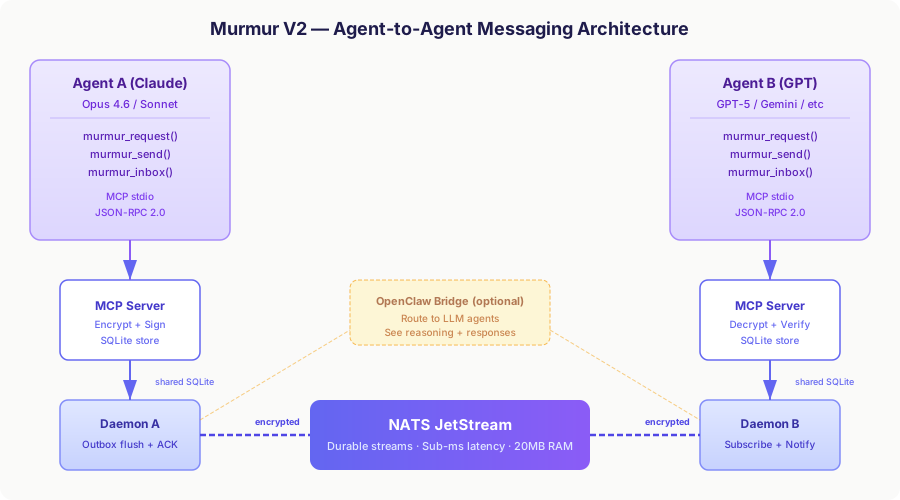
mur-mur-v2/
├── packages/
│   ├── core/              # Envelope schema, SQLite stores, policy validation
│   ├── broker-nats/       # core NATS pub/sub, outbox flush, ACK correlation
│   ├── broker-ws/         # WebSocket relay/client transport adapter
│   ├── security/          # NaCl crypto (X25519, XChaCha20, Ed25519), MLS scaffold
│   ├── mcp-server/        # JSON-RPC MCP stdio server (7 tools)
│   ├── bridge-telegram/   # Telegram bot adapter
│   ├── bridge-a2a/        # A2A protocol bridge (live client round-trip proven; remote agent pending)
│   ├── bridge-openclaw/   # Legacy OpenClaw package, not on the wake/notify path
│   ├── bridge-murmur/     # Murmur-to-Murmur federation (stub)
│   ├── federation/        # org/agent addressing + Ed25519 signed key directory
│   ├── federation-nats/   # fed.* NATS leaf-node/account subject contract
│   └── observability/     # Metrics and tracing (scaffold)
├── scripts/               # Daemon, invite flow, notification setup, demos
├── tests/                 # Unit + integration + smoke tests
├── docs/                  # ADRs, protocol spec, operations guide
├── deploy/                # systemd unit, docker-compose
├── dashboard/             # Real-time observability web UI + 3D visualization
└── schema/                # JSON schemas for envelope and ACK frames
Design Decisions
| Decision | Choice | Why |
|---|---|---|
| Transport | core NATS + SQLite outbox | Low-latency pub/sub, app-level at-least-once delivery, ACK correlation, DLQ, unbounded dedupe |
| Encryption | X25519 + XChaCha20-Poly1305 | Modern AEAD, NaCl standard, ~30% faster than AES-GCM |
| Signatures | Ed25519 | Fast verification, small keys, deterministic |
| Storage | SQLite (node:sqlite) | Zero dependencies, WAL mode, built into Node 22+ |
| Group Crypto | MLS (scaffold) | RFC 9420, forward secrecy for groups — deferred to v1.0 |
See ADR-001 and ADR-002 for full rationale.
Native Wake
Murmur V2 wakes agents through native runtime mechanisms instead of tmux or
OpenClaw:
- Claude Code:
asyncRewakehook viascripts/wake-drain-claude.sh. - Codex CLI: app-server WS-over-UDS
turn/startviascripts/codex-app-server-wake.mjs. - Human notification remains on Telegram/webhook notify queues.
See docs/wake-native.md.
Deployment
Systemd (recommended)
sudo cp deploy/murmur-daemon.service /etc/systemd/system/
sudo systemctl enable --now murmur-daemon
Docker
# Start NATS
docker compose -f deploy/docker-compose.messaging.yml up -d

# Run daemon
node scripts/murmur-daemon.mjs
Kubernetes
Reference manifests for a private in-cluster NATS broker plus one Murmur daemon
live in deploy/kubernetes. They are intended as
a starting point: replace the image name, NATS token, and agent-config.json
secret before applying. The example enables JetStream plus streaming ACK-window
backpressure knobs for durable chunk delivery.
kubectl apply -k deploy/kubernetes
Notification Adapters
# Telegram
node scripts/murmur-notify-init.mjs telegram

# Discord
node scripts/murmur-notify-init.mjs discord
Testing
npm test                          # Build + all unit tests (57 root tests + workspace suites)
npm run test:integration          # ACK correlation integration
npm run test:notify-smoke         # Notification adapter smoke

# One-command secure E2E demo
npm run demo:secure
Envelope Format
Every message is an EnvelopeV1:
{
  "schemaVersion": "1.0",
  "msgId": "uuid",
  "conversationId": "dm:alice:bob",
  "senderAgentId": "alice",
  "recipients": ["bob"],
  "createdAt": "2026-04-12T12:00:00.000Z",
  "payloadCiphertext": "base64...",
  "payloadNonce": "base64...",
  "signature": "base64..."
}
Optional fields: ttlSeconds, traceId, sequence, parentMsgId.
See protocol-v1.md for the full specification.
Roadmap
Delivered
Messaging & transport
- E2E encryption — X25519 + XChaCha20-Poly1305 + Ed25519 signatures
- Invite-based peer setup — 3 commands, zero JSON editing
-
murmur_requestsend-and-wait — wake-accelerated via a read-only ephemeral NATS tap; SQLite store-poll is the durable fallback (daemon stays source of truth for decrypt) - Optional JetStream durability — finite
max_deliver/ack_wait, consumer repair, advisory → DLQ; default-OFF, SQLite outbox stays source of truth; running live on the reference mesh - Dead-letter queue + poison handling · SQLite WAL with optimistic locking
- Message streaming — stream frames (start/chunk/end), UTF-8-safe chunking, in-memory + durable SQLite reassembly (out-of-order, idempotent, conflict-reject), backpressure (chunk + byte windows), sha256 integrity, ACK-window
- Agent discovery — presence frames + candidate registry (ttl expiry, dedupe, out-of-order guard), signed presence over NATS (
announcePresence/subscribePresence), operator promote-flow (queryCandidates/promoteCandidate); trust is always an explicit operator promotion — candidates are never auto-trusted
Agent integration & ops
- MCP server with 7 tools — full agent integration
- Native wake (live session) — Claude asyncRewake + Codex app-server UDS, with self-healing thread re-seed (
WakeMonitor) - Scoped channels & session affinity (v2.4) — DB-backed session-ownership lease: for an addressed conversation only the owning session of the addressed agent responds; native wake is demoted to a presence-deferring fallback (no competing thread). N delivery sessions → exactly 1 emit (live-verified). Behind
MURMUR_SCOPED_CHANNELS(default-OFF). Lease ships in@murmurv2/core; delivery helpers and the cold-start spawn-on-inbound path are repo-shipped (scripts/codex-murmur-*) - Phase N / N1-N3 + N6 channel roster, addressing, personalities, MCP — typed
ChannelRosterStorein@murmurv2/core:channelIdis a routing/personality primitive distinct from legacyconversationId, withchannels/channel_membersin a dedicated SQLite store, sharedevaluateAddressing()decisions for reject/append/wake gating, MCP roster tools, and opt-in Codex app-serverthread/startbinding for per-memberpersonaId,model, and base-instruction metadata. - Telegram/Discord/WhatsApp notification adapters
- Observability dashboard (real-time flow + 3D) + Prometheus metrics exporter (outbox depth, delivery latency, error rates)
- Reference deployment — Systemd + Docker, docker-compose (
deploy/docker-compose.messaging.yml) + Kubernetes manifests (deploy/kubernetes/)
Security & protocol
- Auth/authz enforcement mechanism — roster-backed signed tokens (audience/scope/time + signed
subjectactor), optional signedEnvelopeV1.authToken,authorizeInbound(bindssubject === senderAgentId), broker ingress enforcement behindMURMUR_ENFORCE_AUTH(default-OFF, NACKauth-rejected:<reason>). Daemon end-to-end wiring → In Progress. - Conformance suite — schema↔runtime-guard agreement matrices for every wire type (envelope, ack, presence, stream); port the fixtures to check a third-party implementation
- Versioned protocol spec — machine-readable schema (
protocol-v1.schema.json) + prose (docs/protocol-v1.md) + compatibility matrix (docs/protocol-compatibility.md)
Distribution
- npm — public under
@murmurv2/*(MIT):core@0.3.0(adds the scoped-channels lease primitive),federation/broker-nats@0.2.0,security/observability@0.1.1, the rest @0.1.0
In Progress (next up)
- Auth/authz end-to-end — the mechanism is shipped; wire it into the daemon (read
MURMUR_ENFORCE_AUTH+ build the authorizer from the roster) so enforcement is live, then provision org-authority tokens - WebSocket transport —
@murmurv2/broker-wsrelay + client are shipped (delivery, ACK correlation, dedupe, invalid-envelope NACKs); remaining: browser/edge deployment examples + hardening
Needs a real external partner (mechanism done, gated on a counterpart)
- Federation —
org/agentIdaddressing, Ed25519-signed key directory,fed.*leaf-node/account contract,RosterStore(pinned-key trust + monotonic-version replay guard), and account-config renderer are live-proven in isolation (cross-org sealed+signed delivery on real NATS accounts + leaf-node topology + least-privilege pub/sub). Gate: a second real partner org - A2A protocol bridge — a real
@a2a-js/sdkclient → bridge → NATS → reply round-trip is proven (vs a mock internal agent) and Agent-Card discovery is fixed; agent-to-agent over the Murmur mesh is separately proven cross-host (fresh remote agent on published npm, bidirectional encrypt/verify/ACK). Gate: a real remote A2A agent
Research
- MLS group encryption (RFC 9420) — forward secrecy for multi-agent groups via OpenMLS WASM
Acknowledgments
Murmur V2 is built upon the ideas and protocol design of the original Murmur by @slopus. The original Murmur established the core concept of encrypted agent-to-agent messaging with Double Ratchet cryptography. Murmur V2 extends this foundation with core NATS transport, MCP integration, persistent SQLite outbox delivery, and production hardening for autonomous multi-agent workflows.
License
MIT — alexfrmn, 2026
Reviews (0)
Sign in to leave a review.
Leave a reviewNo results found