wise-men-flash
Health Uyari
- License — License: MIT
- Description — Repository has a description
- Active repo — Last push 0 days ago
- Low visibility — Only 6 GitHub stars
Code Gecti
- Code scan — Scanned 12 files during light audit, no dangerous patterns found
Permissions Gecti
- Permissions — No dangerous permissions requested
Bu listing icin henuz AI raporu yok.
The fast tier of the wise-men council as its own skill: three Claude subagents down three reasoning paths, one checked decision memo in a third of the full council's time. Ships its own blind eval.




The fast tier of the wise-men council, as its own skill. Three Claude subagents answer your question in parallel, each down a different line of reasoning; one decision memo comes back, checked before you see it, with the strongest case against it kept intact. Four subagent calls, in about a third of the full council's time.
Beats every rival in a pre-registered blind head-to-head, run as installed: 23.4/25 against Warp's council 19.1, LifeOS Council 17.5, llm-council 16.8, a plain answer 16.8, superpowers brainstorming 16.3, ECC's council 15.5 and mattpocock grilling 14.9 — ahead of all seven on all eight new questions — and within 0.3 of the full wise-men council (23.6) in a third of its time: 16.7 minutes and four subagent calls a question
Eight new questions from a blind author, nine arms — every rival at its latest version, the full wise-men council and a plain answer — every answer new, three blind Opus judges per question under a judge prompt that lists every error before it scores. Round 4 had measured the same profile inside wise-men 3.13: 23.3 in 10.8 minutes. Charts, method and caveats.
/plugin marketplace add Ali-expandings/wise-men-flash
/plugin install wise-men-flash@wise-men-flash
Then: "flash council: should we move everyone to annual billing to cut churn?"
What you get, in two minutes
You ask (shortened): "My boss is retiring and offered to sell me the landscaping business I've worked at for eight years. It would take most of our savings plus a bank loan. I run the crews and know the clients, but I've never handled the books, the bidding or the cash flow. Is my leaning toward yes reasonable, and what would make you tell me to walk away?"
About fifteen minutes later, one memo comes back. It opens:
Recommendation — Your leaning is reasonable as a reason to pursue this deal. It is not yet a reason to sign. Don't answer the offer with a flat yes or no. Turn it into a staged purchase. Take over the bidding and the books under him for the coming season. Have an outside accountant rebuild the real earnings. Tie part of the price to the revenue that stays after he leaves. Write your walk-away conditions down before you see the final numbers.
and, further down, it keeps the best case against itself:
Strongest counter-position — Position: do not buy the client goodwill at all. "'Do diligence, then decide' assumes diligence can settle whether clients are loyal, and it cannot: loyalty shows itself only after he stops answering the phone, which is after you have paid." … The goodwill is partly your own eight years sold back to you. If it is really yours, starting your own outfit may cost little more than equipment.
In between: why, the first steps with a decision date, seven concrete walk-away conditions, the risks both ways and confidence per claim. The full memo is a real 0.2.0 run on a question from round 5.
Does it work?
Round 5 — complete, all eight questions (pre-registered in PREREG-5.md before its questions were written). This skill, run as installed, next to the full wise-men council (3.14.0) and every rival the wise-men study has tested — Warp's council, llm-council, LifeOS Council, ECC's council, superpowers brainstorming and mattpocock grilling, each at its latest version — plus a plain answer. Eight new questions from a blind author, one of each kind; every answer new; three blind Opus judges per question under the error-first judge. This is the standalone measurement the caveats below promised (it supersedes PREREG-1).
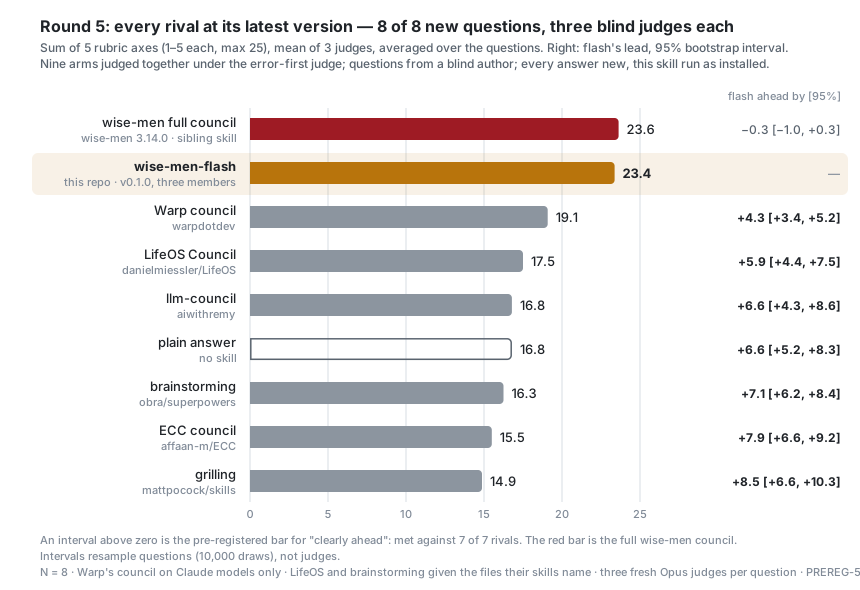
| round 5 (8 of 8 questions) | total /25 | correct | insight | practical | risk | dissent | median minutes | median calls | median list-price USD |
|---|---|---|---|---|---|---|---|---|---|
| wise-men 3.14.0 | 23.6 | 3.8 | 5.0 | 4.9 | 5.0 | 4.9 | 50.2 | 16 | 17.72 |
| wise-men-flash 0.1.0 | 23.4 | 3.8 | 5.0 | 4.9 | 4.8 | 5.0 | 16.7 | 4 | 3.95 |
| Warp council | 19.1 | 3.9 | 3.8 | 4.1 | 4.1 | 3.2 | 9.7 | 3 | 2.67 |
| LifeOS Council | 17.5 | 3.0 | 3.6 | 3.2 | 3.7 | 4.0 | 9.3 | 12 | 3.95 |
| llm-council | 16.8 | 2.9 | 3.9 | 3.2 | 3.7 | 3.2 | 15.5 | 11 | 5.28 |
| plain answer | 16.8 | 4.3 | 3.2 | 4.0 | 3.3 | 2.1 | 1.6 | 0 | 0.26 |
| superpowers brainstorming | 16.3 | 3.4 | 3.3 | 3.7 | 3.4 | 2.4 | 7.5 | 0.5 | 1.19 |
| ECC council | 15.5 | 3.3 | 3.0 | 3.1 | 3.2 | 3.0 | 5.1 | 3 | 1.40 |
| mattpocock grilling | 14.9 | 3.0 | 3.3 | 3.5 | 3.1 | 2.0 | 5.6 | 0 | 0.67 |
wise-men-flash 0.1.0 against wise-men 3.14.0: −0.3 [−1.0, +0.3], W–T–L 3–1–4 — behind, with an interval that includes zero.
wise-men-flash 0.1.0 against Warp council: +4.3 [+3.4, +5.2], W–T–L 8–0–0 — clearly ahead.
wise-men-flash 0.1.0 against llm-council: +6.6 [+4.3, +8.6], W–T–L 8–0–0 — clearly ahead.
wise-men-flash 0.1.0 against LifeOS Council: +5.9 [+4.4, +7.5], W–T–L 8–0–0 — clearly ahead.
wise-men-flash 0.1.0 against ECC council: +7.9 [+6.6, +9.2], W–T–L 8–0–0 — clearly ahead.
wise-men-flash 0.1.0 against superpowers brainstorming: +7.1 [+6.2, +8.4], W–T–L 8–0–0 — clearly ahead.
wise-men-flash 0.1.0 against mattpocock grilling: +8.5 [+6.6, +10.3], W–T–L 8–0–0 — clearly ahead.
wise-men-flash 0.1.0 against plain answer: +6.6 [+5.2, +8.3], W–T–L 8–0–0 — clearly ahead.
wise-men-flash 0.1.0: beats every rival — clearly ahead of all seven.
Axes, wise-men-flash 0.1.0: the highest dissent quality of the nine arms, tied for the highest practical use; above every rival on 4 of 5 axes.
Time and cost, wise-men-flash 0.1.0: median 16.7 min and $3.95 a question; faster than no rival council, cheaper than llm-council and LifeOS Council (by under a cent).
Judge agreement: mean SD of the three judges' totals 0.65.
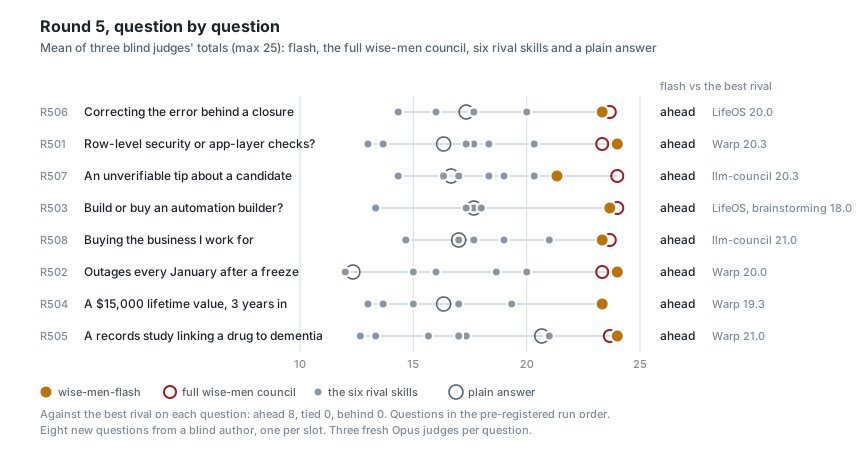
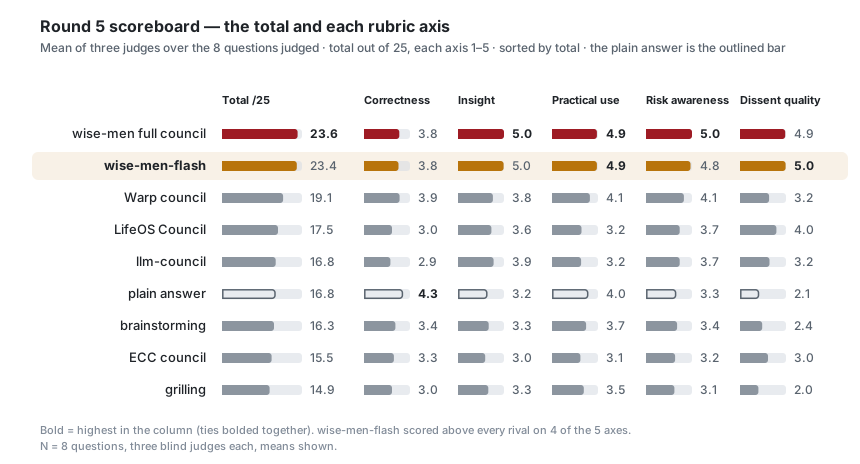
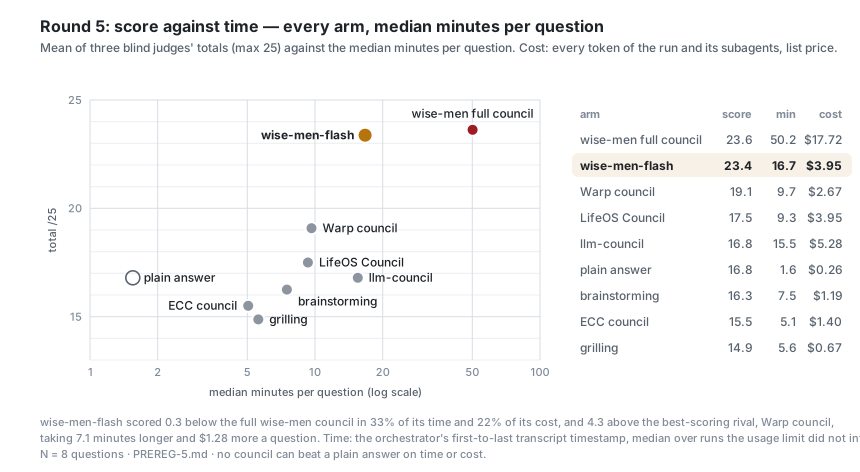
What it shows. Flash was clearly ahead of each of the seven rivals — every interval above zero — so under the wording fixed in PREREG-5 it beats every rival (H2 met); it was ahead of all seven rivals on all eight questions. Against the full wise-men council it finished 0.3 behind, −0.3 [−1.0, +0.3], ahead on 3, level on 1 and behind on 4 of the eight questions — not clearly behind, as pre-registered (H3 met). It took a median 16.7 minutes and $3.95 a question, against the full council's 50.2 minutes and $17.72 — 33% of the time and 22% of the cost. ECC's council, the quickest rival council, answered in 5.1 minutes for $1.40 and scored 7.9 lower. Correctness is its weakest showing: the plain answer (4.3) and Warp's council (3.9) score higher than flash (3.8). Per-question scores, run times, costs and disclosures: RESULTS-V5.md.
Round 4 — the round that first measured this profile, as an arm inside wise-men.
Round 4 of the wise-men head-to-head (pre-registered before any run) put five ways of answering against eight questions written for the round by an author that knew nothing about the skills being tested: the full wise-men council; its three-member --fast profile, which is the profile this skill ships; Warp's council, the most-installed general-purpose council skill, and llm-council; and a plain answer with no skill. For every question, three fresh Opus judges read the five answers under letters, each in its own sealed order, listed every error they could find, then scored five axes. The round was stopped at five of its eight questions to conserve usage.
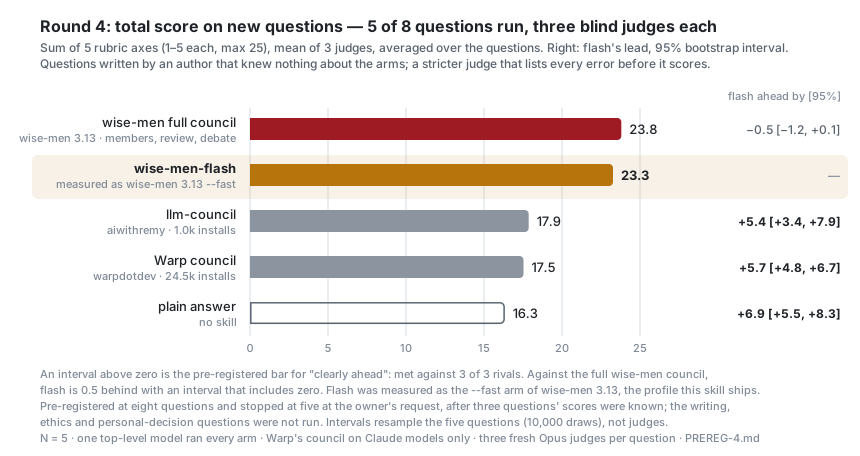
| round 4 (5 of 8 questions) | total /25 | correct | insight | practical | risk | dissent | median minutes | median calls | median list-price USD |
|---|---|---|---|---|---|---|---|---|---|
| wise-men 3.13 full council | 23.8 | 4.0 | 5.0 | 4.9 | 4.9 | 5.0 | 37.3 | 11 | 9.59 |
wise-men-flash (measured as wise-men 3.13 --fast) |
23.3 | 4.3 | 4.7 | 4.7 | 4.9 | 4.7 | 10.8 | 4 | 2.09 |
| llm-council | 17.9 | 3.1 | 3.9 | 3.3 | 3.8 | 3.7 | 18.0 | 11 | 6.43 |
| Warp council | 17.5 | 3.4 | 3.5 | 4.0 | 3.7 | 3.0 | 9.3 | 3 | 2.03 |
| plain answer | 16.3 | 3.9 | 3.5 | 4.2 | 2.9 | 1.8 | 1.8 | 0 | 0.27 |
wise-men-flash against Warp council: +5.7 [+4.8, +6.7], W–T–L 5–0–0 — clearly ahead.
wise-men-flash against llm-council: +5.4 [+3.4, +7.9], W–T–L 5–0–0 — clearly ahead.
wise-men-flash against plain answer: +6.9 [+5.5, +8.3], W–T–L 5–0–0 — clearly ahead.
wise-men-flash against wise-men 3.13 full council: −0.5 [−1.2, +0.1], W–T–L 1–0–4 — behind, with an interval that includes zero.
Axes: wise-men-flash had the highest correctness of the five arms, tied with the full council for the highest risk awareness, and scored above every rival on 5 of 5 axes; the full council led insight, practical use and dissent quality.
Time and cost, medians per question: the plain answer 1.8 min, $0.27; Warp council 9.3 min, $2.03; wise-men-flash 10.8 min, $2.09; llm-council 18.0 min, $6.43; the full wise-men council 37.3 min, $9.59. wise-men-flash was faster and cheaper than the full wise-men council and llm-council; Warp council was 1.5 min quicker and $0.06 cheaper, and scored 5.7 lower.
Judge agreement: mean SD of the three judges' totals 0.58.
Ahead by = mean per-question gap in total score, with a 95% bootstrap interval over questions (10,000 resamples, seed 20260919); W–T–L = questions won, tied and lost on the mean of the three judges. Minutes run from the orchestrator's first to last transcript timestamp; cost prices every token of the run and of every agent it spawned, at list price.
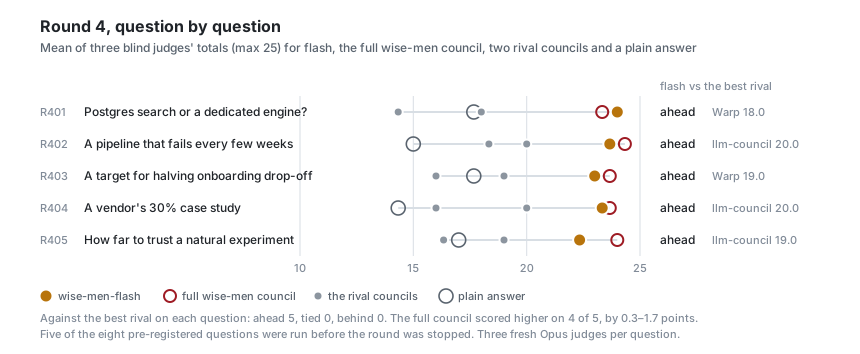
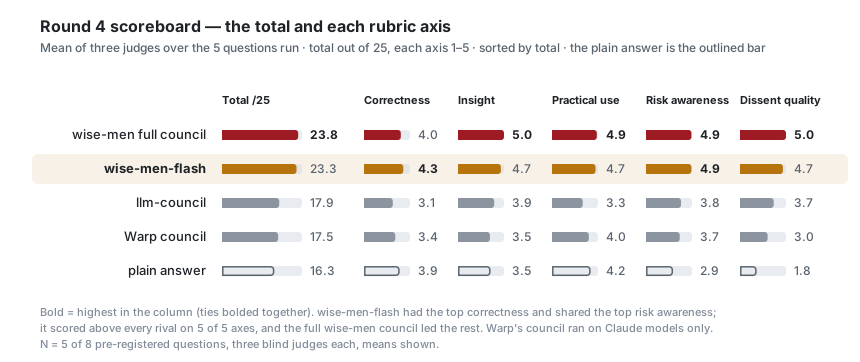
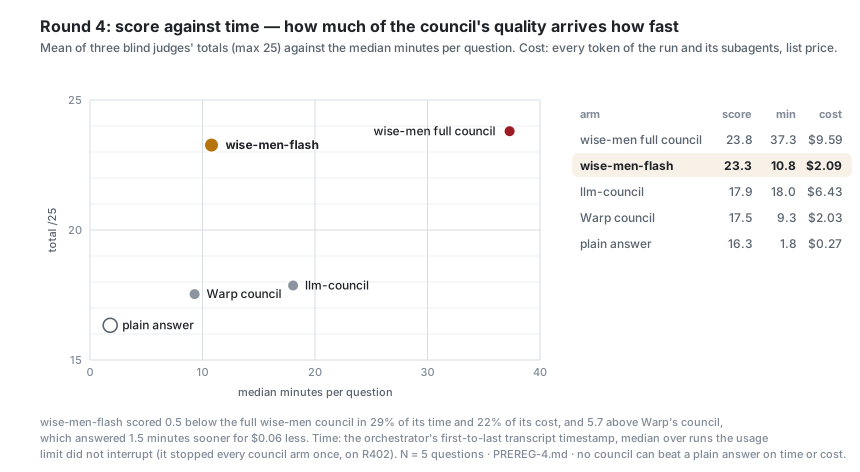
What it shows. Flash finished ahead of Warp's council, llm-council and the plain answer on every one of the five questions, by 5.4 to 6.9 points of 25 on average, and every interval excludes zero — under the wording fixed in the pre-registration, it beats every rival. It scored above every rival on all five axes and had the highest correctness of the five arms. Against the full wise-men council it was half a point behind, with an interval that includes zero: the full council scored higher on four questions, by 0.3 to 1.7 points, and flash higher on the first. It got there in 10.8 minutes and $2.09 a question against the full council's 37.3 minutes and $9.59; it was faster and cheaper than llm-council too, while Warp's council answered 1.5 minutes sooner and scored 5.7 points lower.
The caveats, plainly.
- Inherited, not re-measured. These numbers are the
--fastarm of wise-men 3.13.0, run inside wise-men before this repository existed. Flash 0.1.0 packages that profile with the rule wise-men added right after the round — nothing about how an answer was produced appears in it — and small changes to its domain seat and Devil's Advocate prompts (CHANGELOG). Round 5 (above) measured this skill, those changes included, as installed. - Five questions, three kinds missing. Pre-registered at eight and stopped at five at the owner's request, after three questions' scores were known — not a blind stop. The writing, ethics and personal-decision questions were never run.
- The scores carry a penalty this skill now prevents. Three of the five measured answers closed with a note about how they were produced, and the judges docked it as process residue.
- One model family. Every judge and every arm is a Claude model; there are no human grades. Warp's council ran on Claude models only, though its skill asks for a model-diverse council.
Per-question scores, run times, costs and every deviation: RESULTS.md. Raw answers, blinded packets, judgments and parsed scores: eval-data/. Reproduce with python3 eval-data/head-to-head/flash4.py report; verify rebuilds every packet the judges read from the raw answers, byte for byte, and re-parses every judgment.
Its own round
Round 5 (PREREG-5.md) is this skill's own measurement, run as installed, and it superseded the smaller round first planned in PREREG-1.md (Amendment 2). It fixed in advance what counts — clearly ahead of every rival, and not clearly behind the full council — and both held: clearly ahead of all seven rivals, and 0.3 behind the full council with an interval from −1.0 to +0.3. PREREG-1's third test — the 0.1.0 changes against the 3.13 --fast profile — needs the old profile re-run and was not part of round 5.
The caveats of round 5, plainly. Eight questions, so the intervals are real but not narrow. Every judge and every arm is a Claude model, and there are no human grades. Some arms used the web on some questions — flash on one, through its own verification step — and a few runs had a subagent refused by Claude Code's limit on concurrent subagents and retried; each case is disclosed in RESULTS-V5.md. Correctness is flash's weakest axis: the plain answer scored higher on it (4.3 to 3.8), as did Warp's council (3.9). Dollar figures follow the pre-registered rule, the 2026-07 price table in h2h5.py with a newer model priced at its tier's rate; at the per-model prices Anthropic lists on 2026-10-05 the same tokens cost less, medians flash $2.92, the full council $12.60, LifeOS Council $2.63, llm-council $3.51, Warp's council $1.98 and ECC's council $0.93. The order is unchanged except that flash is no longer cheaper than LifeOS Council.
What you get
A decision memo, and nothing else:
## Recommendation              the decision, in one to three sentences
## Why                         reasons from evidence, each said once
## What to do                  the first step, a time box, when to stop or escalate
## Risks of this plan          both directions, and how reversible following it is
## Strongest counter-position  the best case against the premise the answer leans on
## Confidence                  per load-bearing claim, from evidence — never from agreement
No "the panel agreed", no scores, no vote counts, no account of how the answer was made. A footer appears only when something real degraded — a member failed, the restricted agent was missing — when a fact was corrected against a source, or when the memo ships with a caveat about its content that could not be resolved.
Two real answers from round 4, verbatim, each with how the three blind judges scored every arm on that question: an engineering choice (24.0/25, the top score on its question) and how far to trust a vendor's number (23.3/25).
Install
Plugin (recommended — the member agent registers itself):
/plugin marketplace add Ali-expandings/wise-men-flash
/plugin install wise-men-flash@wise-men-flash
Or clone into your skills folder:
git clone https://github.com/Ali-expandings/wise-men-flash.git ~/.claude/skills/wise-men-flash
mkdir -p ~/.claude/agents && [ -f ~/.claude/agents/wise-member.md ] || cp ~/.claude/skills/wise-men-flash/agents/wise-member.md ~/.claude/agents/
Or with skills.sh (Claude Code and other coding agents):
npx skills add Ali-expandings/wise-men-flash -g
mkdir -p ~/.claude/agents && [ -f ~/.claude/agents/wise-member.md ] || cp ~/.claude/skills/wise-men-flash/agents/wise-member.md ~/.claude/agents/
The second line matters for the clone and skills.sh paths. wise-member is a tool-restricted agent — Read, Grep and Glob only; it cannot spawn agents, run commands or edit files — used for every member and for the checker, so a council cannot recurse or touch your files. The plugin install registers it as wise-men-flash:wise-member. If the full wise-men skill is already installed, its wise-member has the same boundary, so the line keeps it rather than overwriting it. Without either, the skill still runs and says so once: members are then only asked not to spawn.
Requires Claude Code. No API keys, no external services, no Python except to re-run the analysis. Restart Claude Code, then:
/wise-men-flash:wise-men-flash should we move everyone to annual billing to cut churn?
(/wise-men-flash with the clone install. Plain language — "flash council on…", "quick council" — works with both.)
Usage
/wise-men-flash <question>               # the one tier: anchor + domain lens + Devil's Advocate, one check
/wise-men-flash <question> --strong      # the domain member on the strong model too
/wise-men-flash <question> --cheap       # anchor and Devil's Advocate on mid: a weaker council, disclosed in the answer
Don't use it for lookups, one-liners, settled facts or choices you can reverse in minutes — it says so and answers directly. For an irreversible or high-blast-radius call, a compound question, or when you want scored peer review and a debate round, use the full wise-men — flash says that too, rather than quietly spawning a bigger council.
How it works
flowchart TB
    Q["<b>Your question</b><br/>one question? worth a council?<br/>current facts gathered once"]
    Q --> B["<b>Same verified facts</b><br/>one facts-only brief for all three"]
    B --> M1 & M2 & M3
    subgraph council["3 members · in parallel · read-only · no peeking"]
        M1["<b>Practitioner anchor</b><br/>strong model<br/>owns correctness<br/>and the first step"]
        M2["<b>Domain lens</b><br/>mid model<br/>the sharpest frame<br/>for this domain"]
        M3["<b>Devil's Advocate</b><br/>strong model<br/>attacks the premise<br/>never abstains"]
    end
    M1 & M2 & M3 --> D["<b>Validator</b><br/>five sections each · one retry"]
    D --> C["<b>Chairman</b> — the main thread<br/>one decision memo<br/>evidence over agreement"]
    C --> V["<b>Flagged facts checked</b><br/>a correction rewrites the sentence"]
    V --> K["<b>Independent check</b><br/>cheap model, one pass<br/>dissent · disclosure · claims · coverage"]
    K -.->|"fails: fix, or ship with its objection quoted"| C
    K --> A("<b>Your answer</b><br/>a decision memo · the first step<br/>strongest counter-position intact<br/>no council talk")

    classDef key stroke:#b8740c,stroke-width:2px
    class M1,M3,C,K key
Each piece exists to block a specific failure:
| Technique | Failure it prevents |
|---|---|
| Each member reasons by a different method — precedent, first principles, base rates, incentives or falsification | three answers that agree for the same wrong reason |
| One verified, facts-only brief, identical for every member | members arguing from different — or invented — facts |
| Members are read-only agents that never see each other's answers | groupthink, runaway subagents, a member editing your files |
| A practitioner seat on the strong model, named for the job the question belongs to | answers that skip the steps a professional would take |
| A Devil's Advocate on the strong model, aimed at the premise the answer leans on, never allowed to abstain | a token contrarian too weak to change the outcome |
| The answer is a decision memo with confidence per claim, and agreement between members never counts as evidence | council talk burying the answer; three members converging being mistaken for proof |
| Claims the members flagged are checked before the answer ships, and a correction rewrites the sentence | the reader acting on the overstated version |
| One fresh checker, on a cheap model so it always runs: dissent, disclosure, claims, coverage, consistency | the Chairman grading its own homework |
| A four-call ceiling | a "fast" council that quietly grows into a slow one |
Where the speed comes from, measured in round 4: no peer-review round, no debate, and a synthesis check that took 0.5–2.1 minutes on the cheap model against 9–11 minutes for the full council's six-item check.
Flash or the full council?
| wise-men-flash | wise-men | |
|---|---|---|
| round 5, total /25 | 23.4 | 23.6 |
| round 5, median minutes · calls · list-price cost | 16.7 · 4 · $3.95 | 50.2 · 16 · $17.72 |
| round 4, total /25 | 23.3 | 23.8 |
| round 4, median minutes · calls · list-price cost | 10.8 · 4 · $2.09 | 37.3 · 11 · $9.59 |
| members | 3: anchor, one domain lens, Devil's Advocate | 3–7, by tier |
| peer review | none | 3–7 graders, rubric-scored |
| debate | none | on a mechanical trigger at deep and paranoid |
| synthesis check | four items, cheap model | six items, mid model |
| tiers | one | solo · quick · standard · deep · paranoid |
| answer | the same decision memo | the same decision memo |
Reach for flash when the decision is real but does not justify an hour: most hard questions. Reach for the full council when the call is irreversible or high-blast-radius, when the question is compound, or when you want the scored peer review and the debate — in round 5 it bought back 0.3 of a point (half a point in round 4) at three times the time and four and a half times the cost.
How it compares
Against the two rival councils measured in both rounds (features from their READMEs and skill files, as surveyed in the wise-men landscape, 2026-09-16/17); round 5 also measured LifeOS Council, ECC's council, superpowers brainstorming and mattpocock grilling — all in the table under Does it work?:
| wise-men-flash | Warp council 24.5k installs | llm-council 1.0k installs | |
|---|---|---|---|
| round 5, total /25 | 23.4 | 19.1 | 16.8 |
| round 5, median minutes · calls · list-price cost | 16.7 · 4 · $3.95 | 9.7 · 3 · $2.67 | 15.5 · 11 · $5.28 |
| round 4, total /25 | 23.3 | 17.5 | 17.9 |
| round 4, median minutes · calls · list-price cost | 10.8 · 4 · $2.09 | 9.3 · 3 · $2.03 | 18.0 · 11 · $6.43 |
| members | 3: a practitioner anchor, one domain lens and a Devil's Advocate, each assigned a different reasoning method | 3 by default, one per model family | 5 advisors |
| peer review | none | none | "review each other", method unspecified |
| independent check of the synthesis | yes | no | no |
| members structurally unable to spawn, run or write | yes | read-only by instruction | not mentioned |
| dissent in the answer | strongest counter-position, aimed at the premise | consensus and disagreements | agree / clash sections |
| evidence in the repo | raw answers, judgments, scripts | none | none |
What they have that this doesn't: Warp's council is built for a model-diverse panel — one member per model family; here it ran on Claude models only — and offers an optional second-round critique; llm-council has its advisors review each other. Neither ships an eval.
Limits
- Single-model. Every member is Claude, so persona and method diversity approximates, but does not achieve, architectural diversity. Shared blind spots survive.
- The Chairman is the orchestrator. The same thread picks the roster and writes the memo; the one fresh checker mitigates that, it does not remove it.
- Members are offline. They cannot browse or run anything. Facts go in through the brief; claims they flag are checked by the orchestrator afterwards.
- No peer review, no debate. That is the trade for speed, and the reason the full council exists.
- Two rounds, one judge family. Round 5 measured this skill as installed on eight questions; round 4 measured its profile inside wise-men on five. Every judge and every arm is a Claude model, with no human grades — see the caveats above.
Repo layout
.claude-plugin/        plugin + marketplace manifests
SKILL.md               the whole protocol, self-contained (the only file Claude Code loads)
agents/wise-member.md  tool-restricted member agent — registered by the plugin install
examples/              two real round-4 answers, verbatim, with the judges' scores
eval-data/             rounds 4 and 5: raw answers, blinded packets, judgments, parsed scores,
                       flash4.py, h2h5.py, RESULTS.md, RESULTS-V5.md; PREREG-1 (superseded)
scripts/check.sh       consistency and reproduction checks — run before every commit
scripts/make_charts.py regenerates assets/*.svg (light + dark) from the data
assets/                banner + charts (hand-authored SVG)
CHANGELOG.md · AGENTS.md · CONTRIBUTING.md · SECURITY.md · requirements.txt · LICENSE
The skill itself has no runtime dependencies — it is markdown that Claude Code reads. Python and PyYAML are needed only to re-run the analysis and the charts.
Credits
The fast tier of wise-men, extracted into its own skill. Inspired by karpathy/llm-council. Design choices drew on — but are not validated by — Du et al. 2023 (multi-agent debate), Liang et al. 2024 (divergent thinking), Khan et al. 2024 (debate via persuasion), Zheng et al. 2024 (LLM-as-judge bias).
License
MIT — see LICENSE.
Yorumlar (0)
Yorum birakmak icin giris yap.
Yorum birakSonuc bulunamadi