ATV-Phoenix
Health Warn
- License — License: MIT
- Description — Repository has a description
- Active repo — Last push 0 days ago
- Low visibility — Only 5 GitHub stars
Code Pass
- Code scan — Scanned 12 files during light audit, no dangerous patterns found
Permissions Pass
- Permissions — No dangerous permissions requested
No AI report is available for this listing yet.
Self-healing, self-learning harness for intent engineering. Turns a one-line intent into a demonstrated outcome: formalize an objective check, self-heal failures, derive 'done' from a tamper-evident red->green trace — never self-reported. Wraps GitHub Copilot + Microsoft Scout. Silent failures 40%->0% live. Rust core, MCP + CLI, MIT.

ATV-Phoenix
Copilot proposes the code. Phoenix decides whether the evidence is good enough.
Phoenix is a verification and recovery harness for GitHub Copilot and Microsoft Scout. It runs real checks, recovers from failures, and records proof that the work went from failing to passing.



Journey | Install | Quick start | Features | Evidence | Docs
Phoenix replaces "the agent says it is done" with an external control loop:
- Define a runnable acceptance check.
- Observe the check fail.
- Let the agent edit and recover.
- Re-run the same check.
- Ship only when the hash-chained trace shows the check was red before the fix, turned green
afterward, and is still green on the final recheck.
Use Phoenix for bug fixes, refactors, PR work, and unattended jobs where a runnable check can define
the outcome.
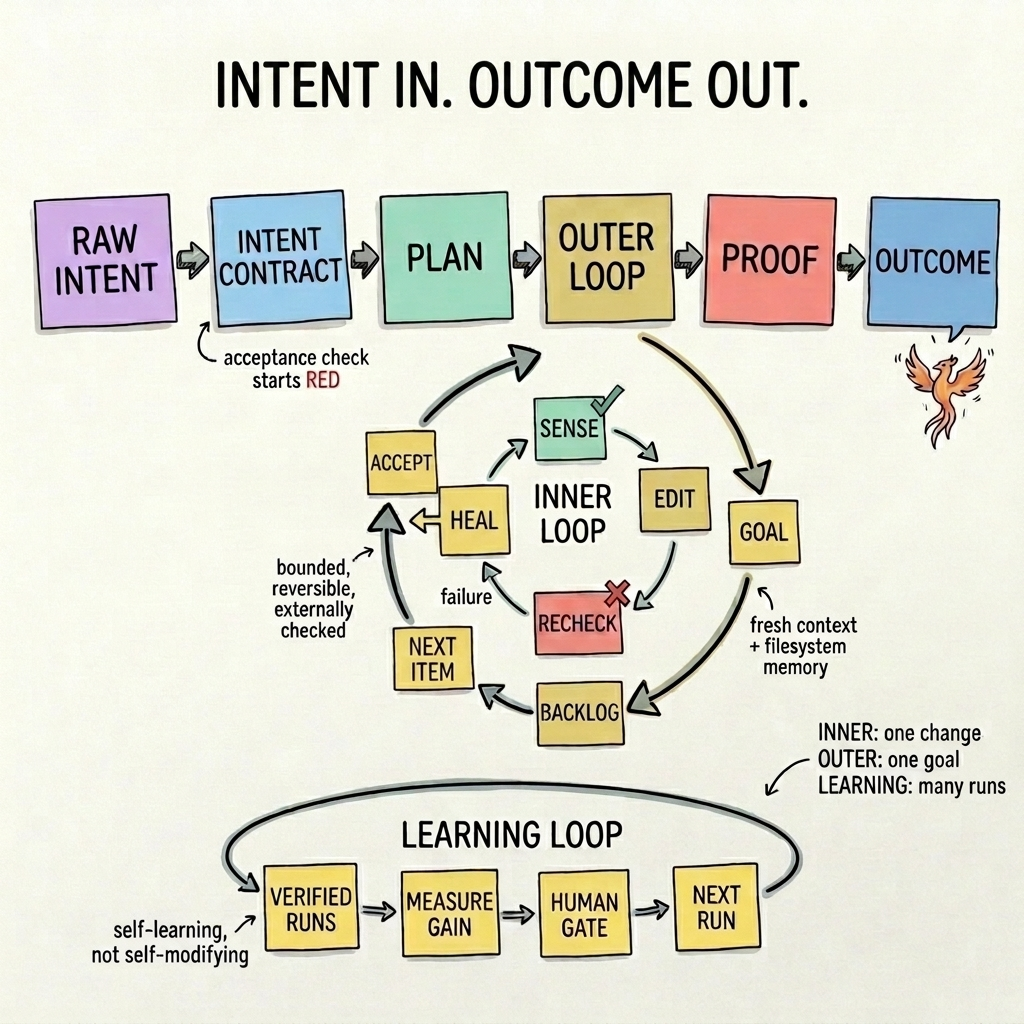
Intent engineering across three loops
Phoenix converts a raw request into an Intent Contract before implementation. phoenix-goal
formalizes one goal; phoenix-intent decomposes up to five related goals. Each gets a runnable
acceptance check that must be observed RED before code changes begin. phoenix-plan turns the
contract into checked backlog items. Changing the check later is an explicit re-scope and requires a
new RED baseline.
- Inner loop: self-healing - one change.
phoenix_sensechecks state,phoenix_snapshotsaves only
a passing baseline, andphoenix_healrolls back or retries up to three times. Recovery counts only
after an external recheck passes. - Outer loop: goal execution - one goal.
phoenix-autoselects the next lifecycle step whilephoenix-ralphworks the checked backlog across fresh contexts, filesystem memory, and fixed budgets.
The loop stops only whenphoenix_acceptproves the top-level check went RED to GREEN. - Learning loop: measured improvement - many verified runs.
phoenix_learnuses public data to
propose, development data to select, and a held-out private split to measure the selected candidate
once. Eligibility requires at least 20 held-out examples, a 10-point gain, +2 net correct, zero
regressions, and clean anti-gaming checks.
This is self-learning, not self-modifying. The gate decides eligibility; it never adopts. A human must
approve any skill or prompt change, which then needs its own failure-first Phoenix proof.
Install
Requires Git, GitHub Copilot CLI,
Python 3, and Rust.
git clone https://github.com/All-The-Vibes/ATV-Phoenix
cd ATV-Phoenix
python .copilot-plugin/skills/phoenix-setup/setup.py --repo .
The installer builds phoenix-mcp, registers the MCP server, installs the Phoenix agent and skill
pack, and runs an install-integrity check. It also attempts to install TokenMasterX, the maintainer's
graph-routing plugin. TokenMasterX requires graphify on PATH; setup prints the exact follow-up
command when that optional dependency is missing. Restart the Copilot CLI session after setup.
If an upgrade or host change breaks the install:
# Windows
.\target\release\phoenix-mcp.exe doctor --fix

# macOS / Linux
./target/release/phoenix-mcp doctor --fix
Quick start
Start Copilot with the Phoenix agent:
copilot --agent phoenix
This starts an interactive session. Phoenix acts on the task you give it; it does not start an
unattended loop by itself. If the agent does not load, run phoenix-mcp doctor --fix, restart
Copilot, and retry.
Give it a task with a concrete check:
Fix the failing test. Use `python -m pytest tests/test_widget.py -q` as the
acceptance check. Do not finish until phoenix_accept proves red to green.
Phoenix should:
- run the check and record the failing result;
- edit the smallest relevant surface;
- re-run the same check;
- recover or roll back if it stays red;
- call
phoenix_acceptonly after the trace proves the check went red to green.
The audit trail lives in .phoenix/trace.jsonl. Verify it directly with:
# Windows
.\target\release\phoenix-mcp.exe verify-trace

# macOS / Linux
./target/release/phoenix-mcp verify-trace
The MCP completion tool is phoenix_accept. Its direct phoenix-mcp accept CLI form is:
.\target\release\phoenix-mcp.exe accept @check.json
For a full first project walkthrough, see the
developer journey.
Core features
The proof stack
| Capability | What it does |
|---|---|
| 1. Intent engineering | phoenix-goal, phoenix-intent, and phoenix-plan convert direction into checked contracts and backlogs before implementation starts. |
| 2. Objective checks | phoenix_sense evaluates command exits, file hashes, regexes, prompt manifests, and UI behavior without asking an LLM to grade itself. |
| 3. Self-healing | phoenix_snapshot saves only passing state. phoenix_heal performs bounded rollback or retry, then confirms recovery with an external recheck. |
| 4. Proven completion | phoenix_accept refuses any check never observed failing, and returns success only when an intact trace proves failure first and success now. |
Beyond the core loop
| Capability | What it does |
|---|---|
| Long-horizon execution | phoenix-goal formalizes the finish line, phoenix-auto chooses the next lifecycle step, and phoenix-ralph persists across fresh-context iterations. |
| Graph-aware context | phoenix-context asks TokenMasterX for call relationships and change impact instead of repeatedly scanning whole directories. |
| Portable knowledge | phoenix-okf turns code and external knowledge into Open Knowledge Format (OKF) bundles: linked Markdown that can be validated, reviewed, and reused. |
| Measured learning | phoenix_learn evaluates candidate prompt and skill improvements on held-out outcomes; adoption remains human-gated. |
| Install integrity | phoenix-mcp doctor detects drift in the agent, skills, MCP registration, and binary freshness, then repairs it with --fix. |
| Multiple hosts | GitHub Copilot uses the MCP server and agent pack. Microsoft Scout uses the same Rust binary through the CLI adapter in dist/scout. |
Browse the documented lifecycle in docs/skills.md. Skill names use hyphens
(phoenix-goal); MCP and CLI tool names use underscores (phoenix_sense).
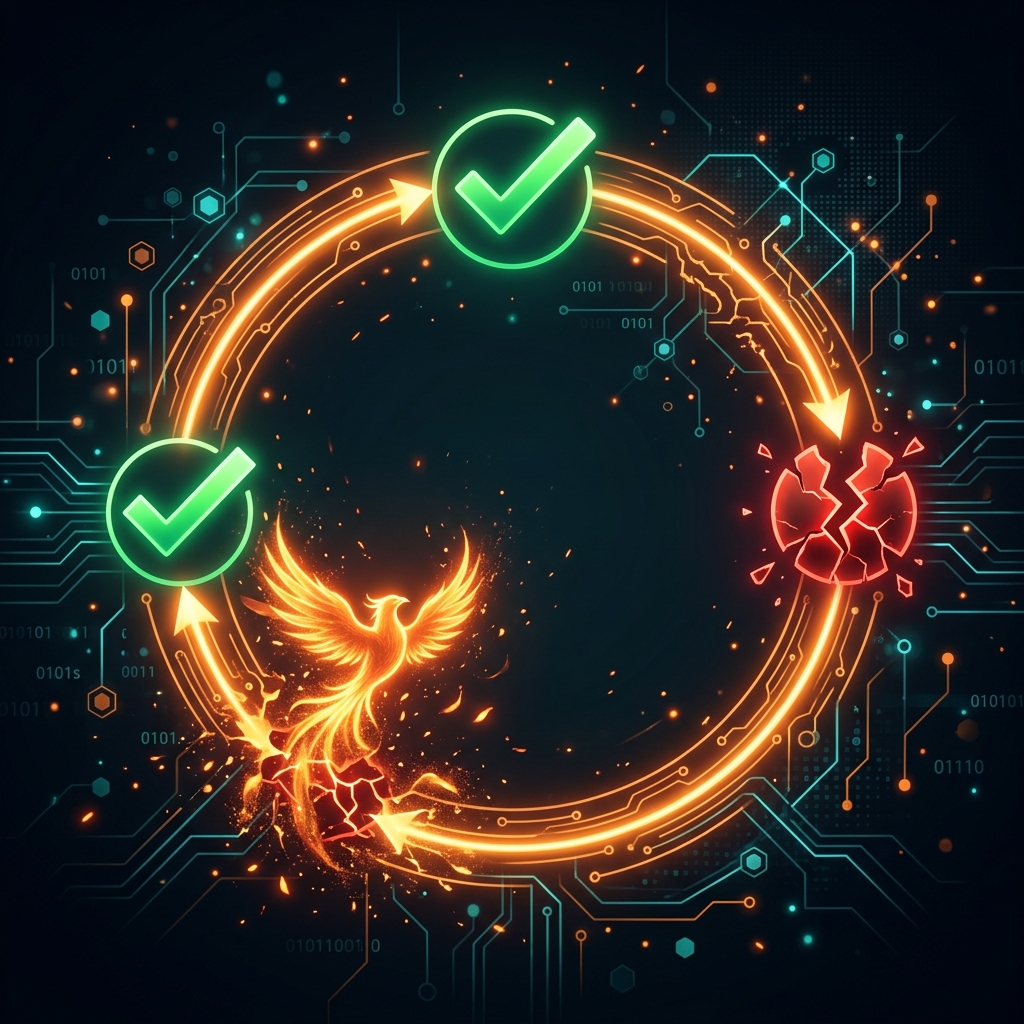
The trace, not the model's success message, is the source of truth.
Autonomous workflows
- Interactive:
copilot --agent phoenixworks on the task and permissions you provide. - Autonomous:
phoenix-goalformalizes the outcome,phoenix-autoroutes by objective state, andphoenix-ralphpersists across fresh contexts and fixed budgets.
See docs/autonomous-workflows.md for state files and drivers.
Evidence
Phoenix ships its evaluation inputs and outputs in the repository. The results are directional,
not universal claims.
| Evaluation | Result | Scope |
|---|---|---|
| Pinned paired harness | Phoenix 38/45 objective passes vs control 34/45; silent failures 7/45 vs 11/45 | 90 real gpt-5.6-sol calls, 9 tasks, 5 seeds, paired arms, independent sealed and adversarial checks |
| Silent-failure experiment | Silent failures 40% to 0%, with zero regressions | 20 live Copilot sessions, one older model/CLI configuration, deterministic checkers |
| SWE-bench-style evaluation | Overall resolved rate 78% to 100%; underspecified tier 50% to 100% | 9 constructed tasks, one repetition, explicit test gate in the Phoenix arm; not the official SWE-bench dataset |
| OKF evaluation | Index-first retrieval used 31x fewer tokens than raw graph.json |
50-file bundle. A cost measurement only: the eval counts tokens and assumes each strategy retrieves enough to answer. Sufficiency is not measured. Benefit is strongest across repeated and larger-context work |
| Measured-learning gate | Candidates need n >= 20, +10 percentage points, +2 net correct, and zero regressions | Deterministic offline gate; it decides eligibility and never auto-adopts |
The paired harness stores the exact source commit, model, runner, environment, task-set, seed,
verifier, and raw-run hashes. Inspectraw-runs.jsonl for every row.
What ships
- Rust MCP and CLI spine plus a verification-gated lifecycle skill pack.
- PowerShell and Bash Ralph drivers, Copilot setup/repair, and a Microsoft Scout adapter.
- Measured-gain learning gate plus TokenMasterX graph integration from the same maintainer.
- Reproducible tests, raw evidence, and the full
BUILDLOG.md.
Honest limits
- Phoenix proves the check you give it. A weak check can still prove the wrong outcome.
- A check can go red for the wrong reason. RED from a missing test file is not RED from a failing property, and the trace cannot tell the two apart.
tests/test_e2e_proof_is_not_vacuous.pyguards the end-to-end proof against that shape after it happened once. - The swe-bench-style gate has no headroom left. Phoenix resolves 9 of 9 on the constructed set and its own recorded baseline is also 9 of 9, so the gate can catch a regression and cannot show an improvement.
- Recovery is bounded rollback and retry, not general autonomous repair.
- Command timeouts are represented in checks but are not yet enforced in-process.
- The published evaluations use small constructed task sets and single models. Treat the deltas as evidence for these conditions, not as a universal ranking.
- Phoenix runs when you invoke the agent or CLI. It is not a background repository daemon.
- Self-learning is measured and human-gated. Phoenix does not rewrite or adopt its own instructions.
- Use
setup.pytoday. The Copilot CLI marketplace/plugin-install path is scaffolded but not yet verified end to end.
Documentation
- Developer journey: build a project from intent to demonstrated outcome.
- Autonomous workflows: goal, Ralph, state, budgets, and proof.
- Skill catalog: every lifecycle and craft skill.
- Intent to outcome: architecture, research questions, and design rationale.
- Changelog: shipped changes by release.
- Build log: the full engineering record, including failures and recoveries.

License
MIT. See LICENSE.
TokenMasterX is owned by the same maintainer and included under its MIT license invendor/token-master.
Reviews (0)
Sign in to leave a review.
Leave a reviewNo results found