mcp-migration-check
Health Warn
- License — License: MIT
- Description — Repository has a description
- Active repo — Last push 0 days ago
- Low visibility — Only 5 GitHub stars
Code Pass
- Code scan — Scanned 12 files during light audit, no dangerous patterns found
Permissions Pass
- Permissions — No dangerous permissions requested
No AI report is available for this listing yet.
Deterministic readiness checker for the MCP 2026-07-28 specification break - a graded web probe and an agent skill over one rule engine.
mcp-migration-check


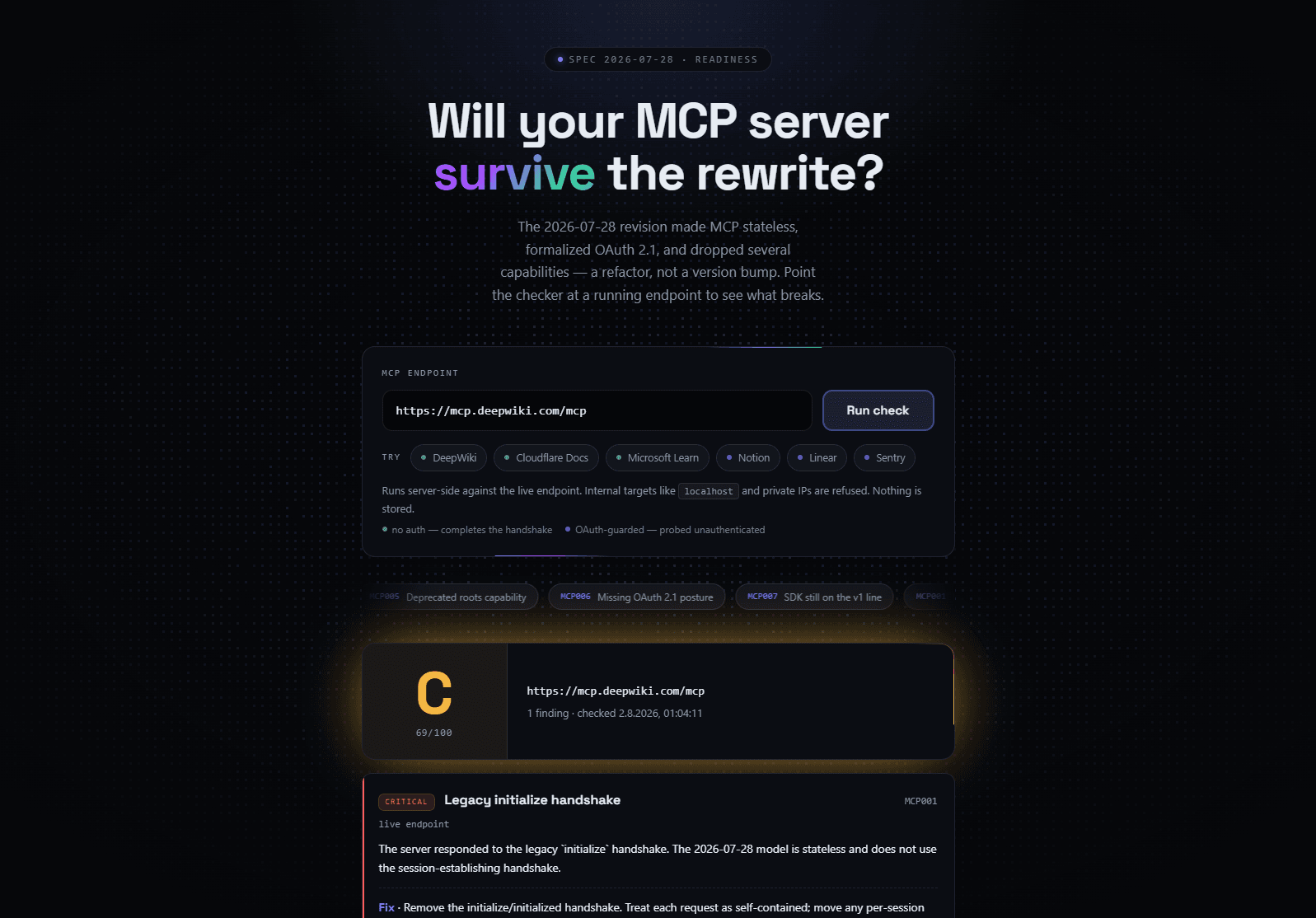
Will your MCP server survive the 2026-07-28 rewrite?
Try it → mcp-migration-check.alpaycelik.workers.dev
Paste an MCP endpoint, get a graded report. Nothing to install, nothing stored.
State of MCP migration — 2026-08-23 —
13,380 unique remote endpoints from the official registry probed; 10,890
returned enough protocol or authentication signal to grade. 60.1% serve the
legacy protocol only. A further 5.5% are dual-era — current and still
answering the old handshake, which the revision permits and this report does
not count against them. An earlier version of this snapshot could not tell
those two apart; see the postmortem.
The Model Context Protocol revision dated
2026-07-28 is the largest breaking change in the protocol's history: it
makes the transport stateless, formalizes OAuth 2.1 for remote servers,
and deprecates several capabilities. Migrating is a refactor, not a version
bump — and a large share of the thousands of public servers aren't actively
maintained.
mcp-migration-check is a small, deterministic readiness checker. It points
at a running MCP endpoint (or scans a repo) and reports, with a letter grade and
per-finding fixes, exactly what breaks. No LLM, no API key, nothing stored.
It ships as four surfaces over one core:
| Surface | Use it to… |
|---|---|
| Web demo | paste a URL, get a graded report — nothing to install |
| CLI | npx mcp-migration-check <url> — one command, no install |
| GitHub Action | keep a server from regressing, with a grade on every PR |
| Skill | hand an agent the diagnosis and the migration procedure |
The split is deliberate. The demo and the CLI see a server from the outside and
answer "am I broken?". The Action asks that question again on every commit.
The skill sees the code and answers "fix it" — which is the part that actually
takes a week.
Quick start
Web demo
Hosted at
mcp-migration-check.alpaycelik.workers.dev,
or run it yourself:
npm install
npm run dev:web   # http://localhost:3000
Paste an endpoint and read the graded report. Because the handler fetches a
user-supplied URL server-side, it enforces two things: an SSRF guard that
refuses localhost, private ranges and the cloud metadata address, and a
rate limit of 20 requests per minute per IP via Cloudflare's Workers
binding. See DEPLOY.md for why neither lives where you might
expect.
CLI
npx mcp-migration-check https://example.com/mcp   # probe a live endpoint
npx mcp-migration-check --source ./my-server      # scan a repository
npx mcp-migration-check --source . --json         # machine-readable
The published package is one generated file and a README, with an empty
dependency tree — the same bundled engine the skill carries. Exit codes are0 clean, 1 at least one critical finding, 2 inconclusive, so it works as
a CI gate on its own.
It is an ordinary package on the public registry, so whatever you already use
reaches it — only the run-it-once command differs:
pnpm dlx mcp-migration-check https://example.com/mcp
yarn dlx mcp-migration-check https://example.com/mcp
bunx mcp-migration-check https://example.com/mcp
GitHub Action
- uses: AlpayC/mcp-migration-check@v1
  with:
    source: .          # or: url: https://example.com/mcp
    fail-on: critical  # critical (default) | warning | never
It writes a graded table to the job summary and exposes grade, score,critical, warnings, findings, report-path and badge-url as step
outputs. No setup-node, no install: the engine ships pre-bundled in the
action. An endpoint that cannot be reached never fails the build — an outage is
not the same claim as an unmigrated server.
Badges. The self-updating one is the workflow's own status badge:
[](https://github.com/OWNER/REPO/actions/workflows/mcp-check.yml)
The badge-url output is a shields.io badge carrying the actual letter grade.
It is a snapshot of the run that produced it, so it only stays true if something
writes it back — a README commit, or a gist the badge reads from. Say which one
you mean; a stale A is worse than no badge.
Skill
In Claude Code, install it from this repository:
/plugin marketplace add AlpayC/mcp-migration-check
/plugin install mcp-migration@mcp-migration-check
Then ask it to migrate a server. /plugin marketplace update mcp-migration-check
picks up later changes — the skill is served from the repository rather than
copied out of it, so it cannot go stale against the rules it ships.
Or download mcp-migration.skill
from the latest release and install that. Or build it yourself:
npm install
npm run pack:skill   # → dist/mcp-migration.skill
The skill bundles a dependency-free copy of the rule engine, so the agent's
diagnosis step is deterministic rather than a guess from reading code — andreferences/ carries the per-rule remediation guidance for the part that
follows.
Not using Claude? The bundled checker is a single file that needs nothing
but Node, so any agent that can run a shell command — Codex, Cursor, whatever —
can use it directly. Unzip the .skill (it is a zip) and runscripts/mcpcheck.mjs, or take it from skill/mcp-migration/scripts/ in this
repo. references/remediation.md is plain Markdown and reads fine on its own.
Run the bundled checker directly if you want:
node skill/mcp-migration/scripts/mcpcheck.mjs --source ./my-server
node skill/mcp-migration/scripts/mcpcheck.mjs --local http://localhost:3000/mcp
What it checks
| Rule | Severity | Signal |
|---|---|---|
| MCP001 | critical | legacy-only: answers initialize, serves no modern surface |
| MCP002 | critical | Mcp-Session-Id minted for a modern request — the classic hazard |
| MCP003 | warning | deprecated logging capability |
| MCP004 | warning | deprecated sampling capability |
| MCP005 | warning | deprecated roots capability |
| MCP006 | critical | auth without RFC 9728 protected-resource metadata |
| MCP007 | warning | still on @modelcontextprotocol/sdk (the v1 line) |
| MCP008 | warning | modern server that does not implement server/discover |
| MCP009 | warning | Python mcp constrained to 1.x or importing the v1 FastMCP API |
| MCP101 | info | dual-era: current and still accepts the legacy handshake |
| MCP102 | info | session ids issued to legacy clients only |
Live checks observe runtime behavior over HTTP; source scans grep for the same
signals in code. For Python they also inspect pyproject.toml, requirements
files, Pipfile, and setup.cfg, including those in nested projects. Each
finding links the spec or official SDK migration page it derives from.
Backwards compatibility is not a finding. The MCP1xx rules are
observations and cost zero points. 2026-07-28 says a server that wants to
serve both kinds of client MAY implement both
behaviours,
picking its semantics from how each request opens — so a server that answersinitialize for the v1 clients still in the field is being compatible, not
drifted. The live probe therefore opens as a modern client
(server/discover with per-request _meta and the requiredMCP-Protocol-Version header) and only then tries the legacy handshake. Only
the absence of the modern surface is a defect.
Honest limitations
- These rules are not the whole revision. The 2026-07-28 changelog also makes
server/discovermandatory, requires aresultTypeon every result, replaces
the GET stream andresources/subscribewithsubscriptions/listen, removesping,logging/setLeveland SSE resumability, and requiresMcp-Method/Mcp-Nameheaders. A server can pass every rule here and still be broken.
This is a triage tool, not a conformance suite. - The source scan is heuristic. It greps for patterns, so it can miss
dynamically-built capability names and can over-match inside comments.
Treat source findings as signals to review, not proof. The live probe is
more authoritative for runtime behavior; the two complement each other. - The web demo only sees the outside. It probes over HTTP, so it cannot
reach the SDK rules: MCP007 needspackage.json, while MCP009 needs Python
project metadata or source. Use the skill or CLI for repository checks. - MCP001 proves absence, which is the weaker claim. It fires when the
legacy handshake answers and no modern signal did. A server whose modern
surface is hidden behind a WAF, a path-based gateway or an unfamiliar-method
filter lands there wrongly. The dual-era observation cannot fail the same
way — it needs a positive modern answer to fire at all. - SDK dependency checks currently cover TypeScript and Python. Go and C#
servers still get the language-neutral source signals, but no SDK-version
finding. Those SDKs moved differently, so do not apply the TypeScript or
Python migration advice to them.
Two rules that were wrong
Worth recording, because it shaped how the rest is verified.
MCP001 told servers to break their own users
The first version of MCP001 fired on any endpoint that answered initialize
and told the maintainer to "remove the initialize/initialized handshake".
Taking that advice would have cut off every v1 client still pointed at the
server, for no compliance gain — because 2026-07-28 never asked for it:
A server that wishes to support both legacy clients (which expect an
initializehandshake) and modern clients (which use per-request metadata)
MAY implement both behaviors.
— Versioning: Backward Compatibility
The probe made it worse by only ever speaking as a legacy client: it sent oneinitialize carrying protocolVersion: 2025-11-25 and reported the answer as
drift. It never asked the modern question at all, so a dual-era server — the
mark of a maintained one — was indistinguishable from an abandoned v1 server.
What changed:
- The probe opens as a modern client (
server/discoverwith per-request_metaand the required headers), falls back to a moderntools/list, and
only then tries the legacy handshake. -32601is explicitly not treated as modern evidence — every JSON-RPC
server emits it for an unknown method. Only the-32020…-32099range the
spec reserves for itself counts, along with a result carryingresultType.- "Still accepts legacy" (MCP101, info, zero points) is split from "only
accepts legacy" (MCP001, critical). Only the second is a finding. infofindings now cost nothing, so compatibility cannot pull a grade down.
Pinned by tests, including one asserting MCP001's fix text never says to remove
the handshake.
MCP007 named a version that never existed
MCP007 originally fired on @modelcontextprotocol/sdk below 2.0.0 and told
you to upgrade to ^2 and run "the official v1→v2 codemod". Both halves were
wrong in different ways, and neither was caught by reading the code — only by
checking against npm and the spec:
@modelcontextprotocol/sdkhas never published a 2.x. It tops out at
1.30.0. So the fix text named a version that does not resolve.- v2 exists, but as a package rename:
@modelcontextprotocol/server,/client,/core,/nodeand the HTTP adapters, all published 2026-07-27. - The codemod is real, and is its own package:
npx @modelcontextprotocol/codemod@latest v1-to-v2 .
The first correction overshot — the rule was deleted outright on the conclusion
that no v2 line existed at all, which is what the package rename makes it look
like from the sdk package alone. It was reinstated once the new names turned
up. It now keys on the presence of the v1 package rather than a version
threshold, because the package name is the actual signal.
Two tests exist so this cannot come back:
assert.ok(!/@modelcontextprotocol\/sdk[@^ ]*\^?2/.test(f.fix));  // no phantom 2.x
assert.ok(!rule.specRef.includes("#"));                          // no dead anchor
The second one guards a related defect found the same way: every rule'sspecRef pointed at …/2026-07-28#lifecycle and similar, but the spec is split
across subpages and has no such anchors — all seven links silently resolved to
the overview page. They are now verified subpage URLs.
Architecture
.claude-plugin           marketplace manifest — the skill, served from this repo
packages/core            pure, deterministic engine (rules · probe · scan · SSRF guard)
packages/core/test       node:test suite over the engine — no network, no disk
packages/cli             the npm package: nothing but the bundled engine
skill/mcp-migration      SKILL.md + bundled engine + per-rule remediation guide
web                      Next.js demo (App Router) over the same core
action.yml               composite GitHub Action over the bundled engine
scripts/bundle-engine.mjs one esbuild config, two generated copies of the engine
scripts/ecosystem-report.mjs registry-wide readiness snapshot
npm test              # node --test via tsx; 110 assertions, no network
npm run typecheck
npm run build:bundles # regenerate both copies of the engine; CI fails if stale
The suite leans on the seams the engine already had: rules are pure functions
over a RuleContext, and probeEndpoint takes a fetchImpl. The SSRF guard
gets the most coverage — it is a security control on a public handler, so each
blocked range is paired with the adjacent address that must still pass.
One core, four consumers — the rules live in exactly one place, and the skill's
and the CLI's copies of the engine are generated, never hand-edited. CI rebuilds
both and fails if either moved.
Tech
TypeScript · Node 22 · npm workspaces · Next.js 16 (App Router, Turbopack) ·
React 19.2 · Tailwind v4 · Magic UI · Cloudflare Workers via OpenNext.
No runtime LLM. MIT licensed.
Ecosystem report
npm run report:ecosystem -- --limit 500 --concurrency 6
Pulls the remote endpoints out of the
official MCP registry, probes each
one with the same engine, and writes an aggregate snapshot to reports/: how
many endpoints answered, which protocol era each serves, the grade
distribution, and how often each rule fires. --name-servers adds a per-server
table.
Dating the sample. A dead endpoint that still returns 200 is
indistinguishable from a maintained one that chose not to migrate — unless you
can date it, and the registry skews heavily toward servers listed once and
never touched again. So each row is dated: from the linked GitHub repository's
last push where there is one, and from the registry entry's own updatedAt
otherwise. The report cross-tabs protocol era against that date, and restates
the headline over the servers whose code has been touched since the revision
shipped — the ones that could have migrated. Set GITHUB_TOKEN for it to
cover more than 60 repositories an hour; without one the run dates what it can
and prints the coverage rather than guessing. --no-dates skips the pass,--active-window <days> moves the line (default 180).
The two dates are not the same claim and the report says which one each row
rests on: a push is evidence about the code, a registry timestamp only says
when somebody last published an entry.
Two things about it are deliberate.
The Markdown report counts servers, it does not name them. A public league
table of broken servers is a different project with a different ethics, and it
would poison the well with exactly the maintainers this tool exists to help.
The JSON alongside it does carry per-target detail, because it is a local file
rather than a publication — which is why reports/*.json is gitignored and the
Markdown is not.
Answering is not the same as being migrated. probeEndpoint setsreachable on any HTTP response, which is right for a checker aimed at one
endpoint you own. Across a few thousand strangers it is not: a 403 from a WAF, a
404 from a moved path and a captive proxy all answer with something that is not
MCP, and scored naively they come back as a clean A. A snapshot built on
that would report the exact opposite of the truth. Those land in ananswered, but showed no MCP behaviour bucket and stay out of the denominator.
Contributing
Corrections to rules are the most useful thing you can send — this project has
shipped one that was factually wrong, and the section above exists because of
it. See CONTRIBUTING.md for what a rule change needs, and
AGENTS.md for the invariants that CI enforces.
Found a way past the SSRF guard on the hosted demo? That one goes to
SECURITY.md, not to a public issue.
License
Reviews (0)
Sign in to leave a review.
Leave a reviewNo results found