enso-os
Health Pass
- License — License: MIT
- Description — Repository has a description
- Active repo — Last push 0 days ago
- Community trust — 28 GitHub stars
Code Pass
- Code scan — Scanned 12 files during light audit, no dangerous patterns found
Permissions Pass
- Permissions — No dangerous permissions requested
This tool is a lightweight, self-evolving harness for AI agents (like Claude Code) that automatically captures errors during terminal sessions and distills them into lessons, preventing the agent from repeating the same mistakes.
Security Assessment
The automated code scan completed successfully with no dangerous patterns detected, and the tool does not request any risky permissions. However, as a shell-based agent harness designed to monitor sessions, execute bash scripts, and manage agent behavior, it inherently runs local shell commands. The README highlights a strong security design philosophy, specifically noting that it uses immutable hooks to block the AI agent from editing its own memory. No hardcoded secrets were found. Overall risk is rated as Low.
Quality Assessment
The project is actively maintained, with its most recent push occurring today. It carries a permissive MIT license and has accumulated 28 GitHub stars, indicating a small but growing level of community trust. The codebase is exceptionally minimal and auditable at roughly 1,267 lines of code relying solely on bash and python3. Its transparent README provides a realistic breakdown of its capabilities compared to larger, more complex frameworks, which adds to its credibility.
Verdict
Safe to use.
Enso — A lightweight (1267 LOC) self-evolving harness that makes AI agents learn from mistakes. 10 Shell Hooks. Just bash + python3.



Quickstart • Comparison • How It Works • Forgetting • 中文
Your AI agent makes the same mistake twice. Enso makes sure there's no third time.
Install in 30 seconds. Just bash + python3 (pre-installed on macOS/Linux). Your agent starts learning automatically.
Quickstart
git clone https://github.com/amazinglvxw/enso-os.git
cd enso-os && bash install.sh
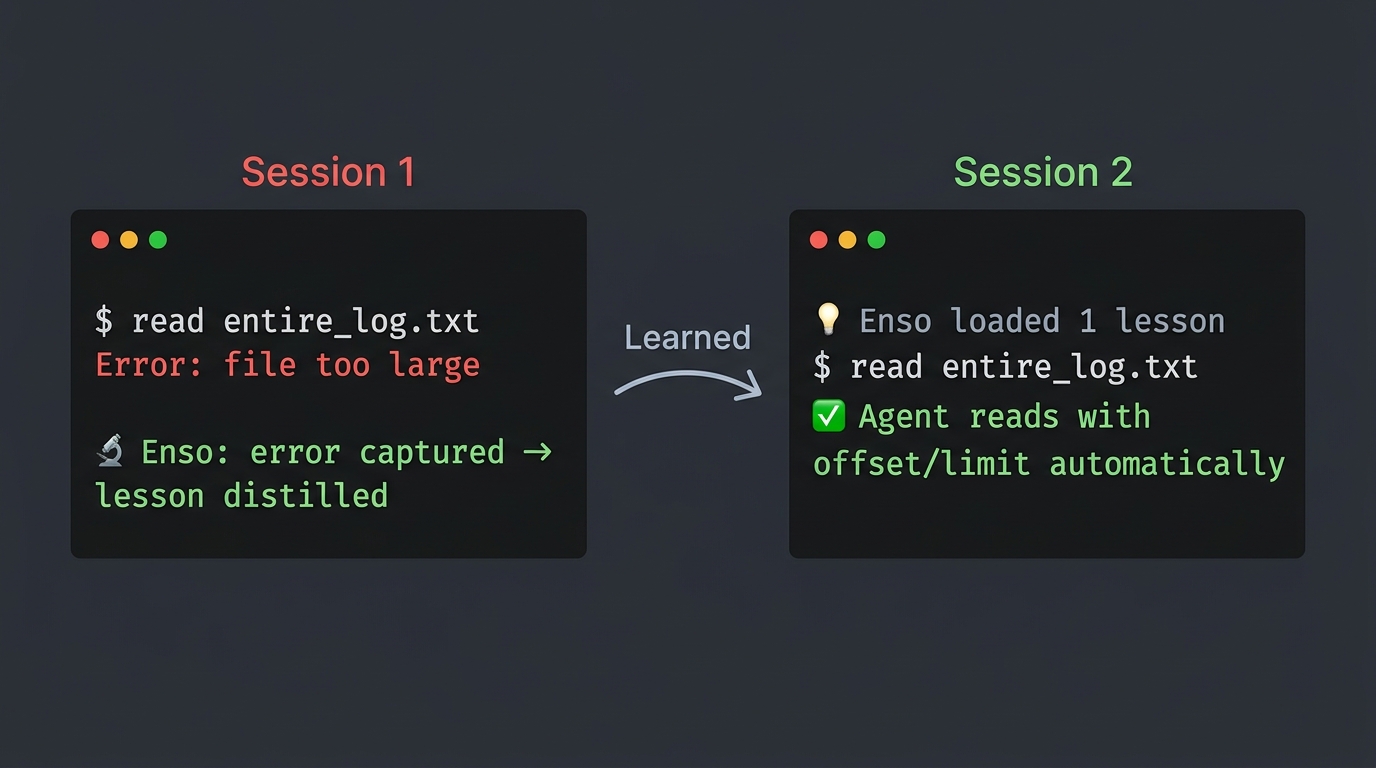
That's it. Start a new Claude Code session. Enso is active:
Session 1:  You hit an error → Enso captures it automatically
            Session ends → Enso distills 1-3 lessons from the error

Session 2:  Enso injects the lessons → Agent avoids the same mistake
            You didn't do anything. The system learned by itself.
Enso vs. The Big Three
We built Enso after studying how Claude Code, OpenClaw, and Hermes Agent handle memory and learning. Here's an honest comparison — what they do better than us, and what we do that they don't.
The Comparison
| Capability | Claude Code | OpenClaw | Hermes Agent (30K⭐) | Enso |
|---|---|---|---|---|
| Learns from errors | ❌ No | ❌ No | ✅ Auto-creates skills | ✅ Code-enforced |
| Forgetting | Silent truncation at 200 lines | ❌ No | ❌ Skills only grow | ✅ Stale decay + LRU + health checks |
| Context compression | ✅ 5-layer pipeline | ✅ Compaction | ❌ Basic | ❌ Relies on host agent |
| Dreaming / consolidation | ✅ AutoDream (4-phase) | ✅ Light→REM→Deep | ❌ No | Partial (DIKW distillation) |
| Multi-platform | Terminal only | Terminal + UI | 6 platforms | Terminal only (Claude Code) |
| Model support | Anthropic only | Multiple | 200+ providers | Any (harness is model-agnostic) |
| Self-protection | ❌ Agent can edit memory | ❌ No | ❌ No | ✅ Immutable hooks (agent blocked itself) |
| Knowledge quality checks | ❌ No | ❌ No | ❌ No | ✅ Weekly lint (orphans, duplicates, weak) |
| Install complexity | Built-in | npm + config | pip + API keys | bash install.sh (30 seconds) |
| Codebase size | ~512K lines TS | ~50K lines | ~50K lines Python | 1,267 lines Shell+Python |
| Dependencies | Node.js runtime | Node.js + plugins | Python + RL framework | bash + python3 |
What They Do Better (honestly)
Claude Code has the most sophisticated context management we've seen — a 5-layer compression pipeline (tool-result budgeting → snip-compact → micro-compact → context-collapse → auto-compact) that Enso doesn't attempt to replicate. Its AutoDream 4-phase memory consolidation (Orient→Gather→Consolidate→Prune) is production-grade. Enso relies on Claude Code's own compression; it doesn't add its own.
OpenClaw has the most elegant memory promotion system — its Dreaming mechanism uses 3 phases (Light→REM→Deep) with 6-signal weighted scoring to decide what becomes long-term memory. The staging buffer (Light/REM don't write to MEMORY.md, only Deep does) prevents memory fragmentation. Enso writes lessons more eagerly, which can cause duplication until the dedup catches it.
Hermes Agent goes furthest in self-improvement — its trajectory→RL training pipeline lets the agent fine-tune its own model from usage data. It also has a Mixture-of-Agents tool (4 frontier models in parallel) and a Skills Hub marketplace with security scanning. Enso doesn't modify model weights and has no marketplace.
What Enso Does That They Don't
1. Code-enforced learning (not optional)
Claude Code's Auto Memory, OpenClaw's Dreaming, and Hermes's skill creation are all agent-initiated — the model decides whether to remember. Enso's hooks are code-enforced — the agent literally cannot skip the capture/distill/inject loop. Our agent actually tried to modify its own safety hooks during a bug fix and got blocked by its own core-readonly hook.
2. Active forgetting with quality verification
All three major agents have memory that only grows (Claude Code silently truncates at 200 lines; Hermes skills accumulate; OpenClaw has no forgetting). Enso actively prunes: stale lessons decay after 37 days, LRU evicts beyond 50 entries, and weekly enso-lint checks for contradictions, orphans, and duplicates. A deleted-lessons-tracker flags when a deleted lesson's error recurs.
3. Immutable self-protection
None of the three agents prevent themselves from modifying their own rules. Enso's 3 immutable hooks are code-level constraints that cannot be overridden: physical verification (write→must read back), core read-only (agent can't modify hooks), and no-trace-no-truth (session-end audit).
4. Radical simplicity
1,267 lines of Shell + Python. No npm, no pip, no Docker, no database. The entire system is grep-searchable text files. You can read, edit, and understand every line. This is a deliberate trade-off: we sacrifice features (no multi-platform, no RL training, no context compression) for transparency and portability.
Where Enso Fits
Enso is not a replacement for Claude Code, OpenClaw, or Hermes Agent. It's a complementary layer — a harness that wraps around your existing agent to add learning, forgetting, and self-protection.
Your Agent (Claude Code / OpenClaw / any)
       ↕ every tool call passes through
┌──────────────────────────────────────┐
│           Enso Harness               │
│  🔒 Can't skip  🧠 Learns  🗑️ Forgets │
└──────────────────────────────────────┘
Currently optimized for Claude Code. Architecture is portable to any agent with lifecycle hooks.
How It Works
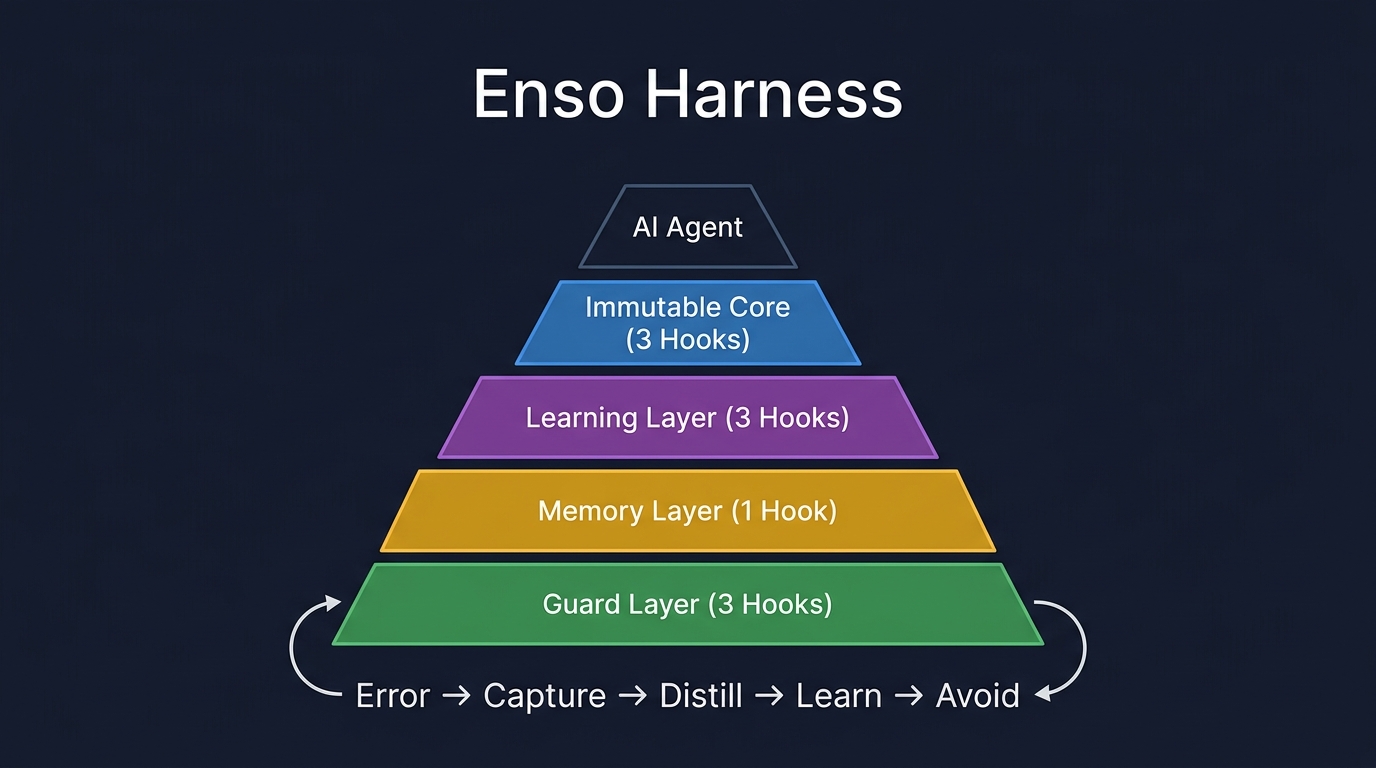
10 hooks, 4 layers. The agent can't skip what code enforces.
| Layer | Hooks | What they do |
|---|---|---|
| 🔒 Immutable | 3 | Write→must verify. Can't modify own rules. Session-end audit. |
| 🧠 Learning | 3 | Log every tool call. Capture errors. Distill lessons via LLM. |
| 💡 Memory | 1 | Inject lessons + knowledge + wisdom into next session. |
| 🛡️ Guard | 3 | Memory budget cap. Block secrets/injection. Auto-maintenance. |
The core loop:
Error → Capture (code-enforced) → Distill (async) → Store → Inject next session → Avoid
Forgetting
Most memory systems only grow. Enso actively forgets — because not forgetting is more dangerous.
| Mechanism | What it does |
|---|---|
| Stale decay | Lessons unused >37 days → deleted |
| LRU eviction | Over 50 lessons → oldest evicted |
| MEMORY.md downsink | Completed items → archived |
| Trace rotation | >14 days → deleted (daily cron) |
| Recovery safety net | Deleted lesson reappears as error → flagged |
Health Check
enso-lint.sh runs weekly — like CI/Lint for your knowledge base:
| Check | What it finds |
|---|---|
| Orphans | Lessons never used (hits:0, >7 days) |
| Duplicates | >60% keyword overlap between lessons |
| Weak lessons | No actionable verb — not useful |
| Budget | MEMORY.md capacity status |
Every distillation auto-rebuilds lessons/INDEX.md for fast routing.
Architecture
~/.enso/
├── core/                          # Shared modules
│   ├── env.sh                     # Paths, enso_parse(), enso_find_memory_file()
│   ├── parse-hook-input.py        # JSON parser for all hooks
│   ├── dikw-utils.py              # DIKW operations (7 subcommands)
│   ├── enso-lint.sh               # 🔍 Weekly health check
│   ├── rebuild-index.py           # 📇 Auto-rebuild INDEX.md
│   └── deleted-lessons-tracker.py # 🔄 Recovery safety net
├── hooks/                         # 10 lifecycle hooks
│   ├── pre-tool-use/              # 🔒🛡️ core-readonly, budget-guard, safety-scan
│   ├── post-tool-use/             # 🔒🧠 physical-verification, trace-emission
│   ├── post-tool-use-failure/     # 🧠 error-seed-capture
│   ├── stop/                      # 🔒🧠🛡️ audit, distill, maintenance
│   └── session-start/             # 💡 load-lessons
├── dikw/                          # DIKW distillation (Info → Knowledge → Wisdom)
├── traces/                        # Tool call logs + lint reports
└── lessons/                       # active.md + INDEX.md
Like biological evolution: DNA provides immutable constraints (protein folding physics), but within those constraints, life finds infinite creative solutions.
- 3 immutable hooks = the foundation (never changes)
- Everything else = free to evolve
- Active forgetting = prevents calcification
Built from 100+ papers analyzed over 5 months:
| Source | Key Insight |
|---|---|
| OpenAI Harness Engineering | Rules in code, not prompts |
| Agent Lightning (Microsoft) | Trace/Span + Hook/Emission dual layer |
| fireworks-skill-memory | 200 lines of hooks > 800 lines of prompt |
| SWE-agent (NeurIPS 2024) | Constrained interfaces reduce errors |
This project's GitHub metrics are its evolutionary fitness signal:
- ⭐ Stars = survival ("this is useful")
- 🍴 Forks = reproduction ("I'm building on this")
- 🐛 Issues = selection pressure ("improve this")
The agent maintaining this repo monitors these signals. If the system works, it thrives. If not, it dies.
FAQ
Q: What AI agents does this work with?
Claude Code (primary target, fully tested and dogfooded daily). Architecture is portable to any agent with lifecycle hooks, but install.sh currently targets Claude Code's settings.json.
Q: Where is my data stored?
100% local. ~/.enso/ on your machine. No cloud, no Docker, no database.
Q: How is this different from Mem0 or LangChain memory?
Those store facts. Enso learns from mistakes — and forgets what's no longer useful.
Q: What are the prerequisites?bash and python3 (3.6+). Both are pre-installed on macOS and most Linux distros. No pip install, no npm, no Docker.
Q: Do I need to configure anything after install?
No. bash install.sh registers all hooks. Next session, it starts learning.
Q: Why not just use Claude Code's built-in memory?
Claude Code's Auto Memory is great for storing facts. But it has a 200-line silent truncation limit, no learning from errors, no active forgetting, and no quality checks. Enso adds those missing layers on top.
Contributing
See CONTRIBUTING.md. Most impactful:
- 🐛 Bug reports with repro steps
- 💡 New hook ideas
- 🧪 Compatibility testing with other agents
License
MIT. See LICENSE.
The ensō is drawn in a single stroke — imperfect, incomplete, beautiful.
This system will never be perfect. But it will always be evolving.
Reviews (0)
Sign in to leave a review.
Leave a reviewNo results found