paperdelta
Health Warn
- License — License: MIT
- Description — Repository has a description
- Active repo — Last push 0 days ago
- Low visibility — Only 6 GitHub stars
Code Pass
- Code scan — Scanned 12 files during light audit, no dangerous patterns found
Permissions Pass
- Permissions — No dangerous permissions requested
No AI report is available for this listing yet.
Trace changed experiment results to the numbers, claims and figures in your LaTeX paper. Offline bilingual review, safe numeric patches and read-only MCP tools.

Review how experiment changes affect an existing research paper.







English · 简体中文 · Quick start · Releases · Feedback
An accuracy result changes from 84.1% to 80.9%. The abstract, table and
appendix still repeat the old number; a 3.1 percentage point improvement and
an outperforms baseline claim no longer hold. PaperDelta traces those statements
to declared CSV/JSON evidence and brings the affected locations together for review,
even when no LaTeX file changed.
Local Python CLI · LaTeX + optional Word/PDF · exact decimal arithmetic · offline HTML · optional MCP.
Checking needs no model key, GPU or TeX installation.
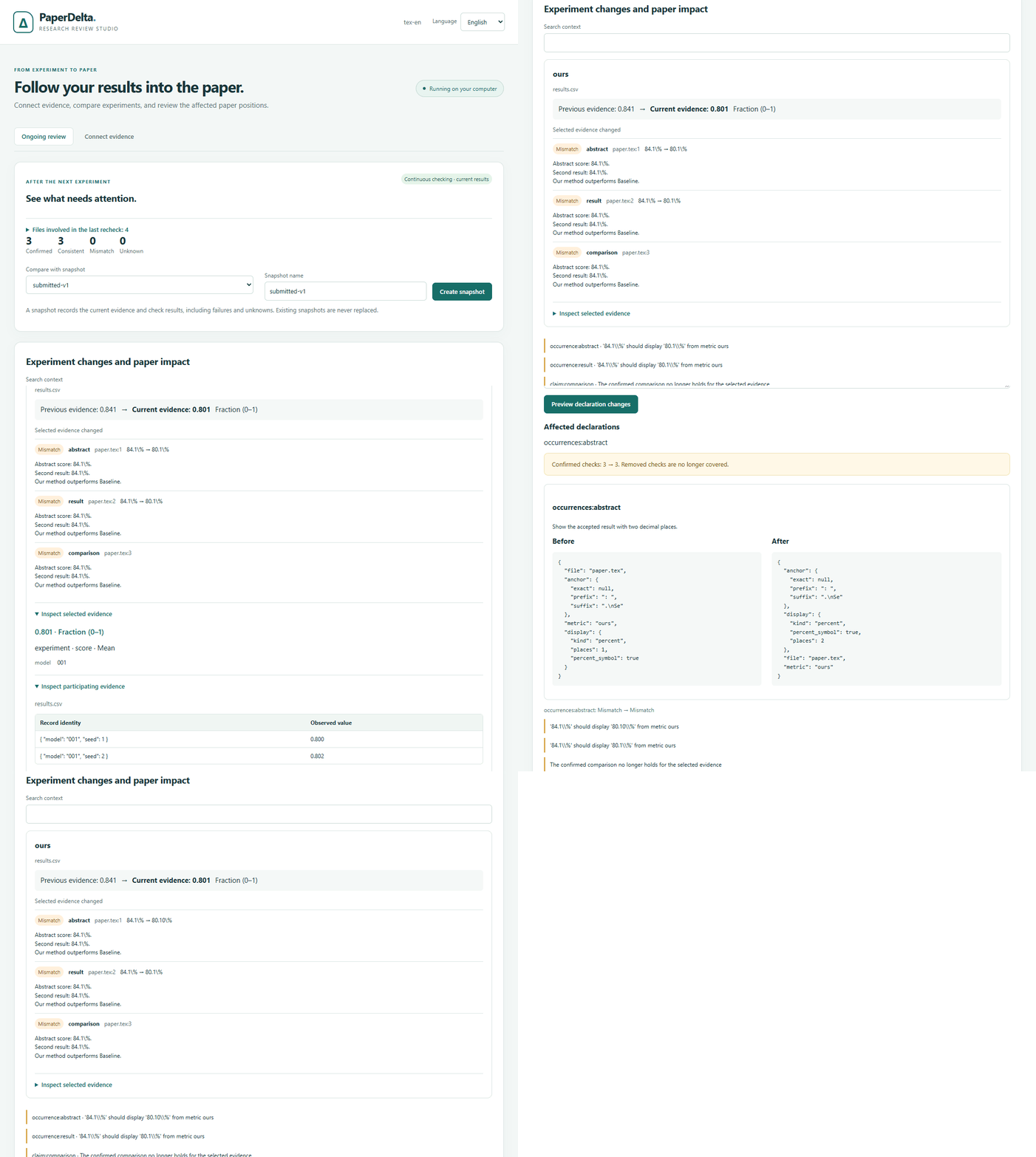
A 22-second walkthrough of real Studio screens: create a snapshot, change accuracy
from 84.1% to 80.1%, inspect the evidence, and preview a declaration edit.
Open the full-size animation ·
View the static screenshot.
0.7.0 brings ongoing review into Studio: compare experiments with snapshots,
inspect affected paper positions, maintain declarations and repair moved bindings.
Continuous checks and local draft recovery support the next editing session.
Run paperdelta studio to start. The interface supports English/Chinese throughout.
See the Studio guide and upgrade notes.
The project has received positive informal feedback from several users; it is
not presented as a measured usability study. Releases use normal version numbers.
Install and see the first report
For the source/PDF example, install paperdelta[pdf] and runpaperdelta demo --document pdf --out pdf-demo --open.
The report highlights original pages; PDF review is read-only and does not perform OCR.
For a Word example, install paperdelta[docx] and runpaperdelta demo --document docx --out word-demo --open.
Word review is read-only; supported structures and positions are explicit.
Use Python 3.11 or newer. In a virtual environment:
python -m pip install paperdelta
paperdelta demo --out paperdelta-demo --open
If needed, create the environment first with python -m venv .venv. Activate it
with .venv\Scripts\Activate.ps1 on Windows PowerShell orsource .venv/bin/activate on macOS/Linux (use python3 when creating it there).
The installed package includes the complete offline example. Openpaperdelta-demo/review/report.html if it does not open automatically. Choose
English or Chinese in the report. The default scenario intentionally finds stale
numbers, a false comparison and changed figure dependencies. Related numeric edits
are withheld until the conclusion is addressed. No paper changes are applied.
--scenario baseline shows unchanged evidence; --scenario safe-update prepares
four numeric edits and a readable diff. Each run needs a new --out directory.
The demo command returns 0 on successful creation; its report retains the actual
check result, normally 1 for the changed scenario. See demo details.
A wheel, source archive and separately licensed evaluation bundle are also
available from GitHub Releases.
Verify the wheel with the release's SHA256SUMS, then runpython -m pip install ./paperdelta-0.7.0-py3-none-any.whl.
Connect an existing paper
Run paperdelta studio in the paper folder to create a configuration, declare evidence,
select locations and explicitly confirm bindings in a local browser. No hand-written YAML
is needed for this workflow. Start with the workbench guide.
The CLI workflow remains available:
paperdelta init --paper paper/main.tex --data results/metrics.csv
paperdelta batch guide
paperdelta check --report build/paperdelta
init discovers inputs without accepting bindings. The batch guide reuses explicit
source, record identity, units, aggregation and seed choices across a CSV results
table. It suggests locations from context, lets you choose repeated occurrences,
and shows the final selection before accept. Equal numbers alone are not evidence
of identity. JSON sources and individual/derived metrics use paperdelta guide.
Start with a selected file or region through scope set; record a justified
non-result number through scope exclude. Both preview before --accept.
Changes to excluded text require review, and accepted failing bindings cannot be
hidden by changing scope. See batch binding and coverage,
guided binding and repairs, and the
complete JSON tutorial.
Use --lang zh-CN before a subcommand or save settings --language zh-CN.
Language preferences do not change scientific results or evidence identity.
Review the next experiment
paperdelta snapshot create submitted-v1
# Run experiments in your existing workflow.
paperdelta watch --baseline submitted-v1 --report build/paperdelta --open
Saving data, paper or configuration triggers a complete check after a short quiet
period. The report marks observed changes as pending until rechecked and
refreshes in the browser. Its review queue identifies evidence issues, broken
bindings, conclusions, numeric updates and figures. Stop with Ctrl+C.
A one-off check remains available with check --baseline submitted-v1.
paperdelta fix --report build/paperdelta/report.json --out changes.pdpatch.json
paperdelta apply changes.pdpatch.json --dry-run
paperdelta apply changes.pdpatch.json --write
Only verified numeric locations enter a patch. Changed inputs, ambiguous or
overlapping edits are refused; invalid related claims block numeric changes.
A transaction preserves original bytes. paperdelta recover TRANSACTION_ID
previews recovery; add --write to restore when no later author edits intervene.
The checker never runs experiment or plotting scripts.
The CI adapter compares the target commit and reports changes in
bindings, rules, scope and review declarations alongside consistency results.
Work with an Agent
python -m pip install 'paperdelta[mcp]'
paperdelta -C /path/to/paper-project mcp
Seventeen optional MCP tools provide checks, evidence, proposals and repairs.
Four batch-session tools let an Agent select candidate IDs while the program
assembles the proposal. Sessions are in memory, bounded and invalidated by changed
inputs. The tools do not accept mappings or write paper files. The
Agent guide includes the workflow and host configuration.
CLI JSON and schemas remain available without MCP.
Deterministic protocol tests verify tool behavior. Historical
Qwen3-8B trials did not produce complete valid
mappings; this release does not claim proven automatic mapping accuracy.
Supported scope
- Exit 0: required accepted checks agree with the supplied evidence.
- Exit 1: an accepted check fails.
- Exit 2: evidence, configuration or parsing is incomplete, no bindings exist,
or a live check is pending.
Reports keep unbound, excluded, outside-scope and unsupported content visible.require_complete_coverage can require numeric coverage in the declared scope;
existing bindings always run. Agreement is not certification of scientific truth.
Supported inputs include literal LaTeX input/include, declared literal macro
arguments, bounded literal table cells, CSV/JSON, explicit aggregation, derived
values with units, limited comparisons and figure provenance. Dynamic TeX,
arbitrary macro expansion, statistical inference and global SOTA verification
remain outside the supported contract. Word paragraphs and ordinary tables are supported
with paperdelta[docx]; revisions, fields and complex layouts remain unverified.
See rules and limits and the Word boundary.
Text PDFs use optional paperdelta[pdf], native page/box coordinates and explicit
extraction identities. Scanned pages and unreliable layouts remain unverified.
Multiple manuscripts share explicitly declared metrics, with optional source/export
relations. See the PDF boundary and workflow.
Cross-platform CI
covers Python 3.11–3.14 on Windows, Linux, Apple Silicon and Intel macOS.
Historical validation, native Mac evidence
and current release checks distinguish what each run established.
Development
git clone https://github.com/amos689/paperdelta.git
cd paperdelta
python -m pip install -e '.[dev,mcp]'
python tools/run_tests.py -q
python -m ruff check src tests tools
python -m ruff format --check src tests tools
python tools/check_docs.py
Contributing · Changelog ·
MIT license · Third-party notices ·
Security · Mac installation
Reviews (0)
Sign in to leave a review.
Leave a reviewNo results found