vaelor
Health Warn
- License — License: Apache-2.0
- Description — Repository has a description
- Active repo — Last push 0 days ago
- Low visibility — Only 5 GitHub stars
Code Pass
- Code scan — Scanned 12 files during light audit, no dangerous patterns found
Permissions Pass
- Permissions — No dangerous permissions requested
No AI report is available for this listing yet.
A memory of the codebase your AI agent can't get from grep: a persistent call graph, semantic search, and per-symbol review learnings over any repo. Self-hosted MCP server — Go, tree-sitter, Apache AGE.
Vaelor
Give your coding agent a memory of the codebase it can't get from grep.
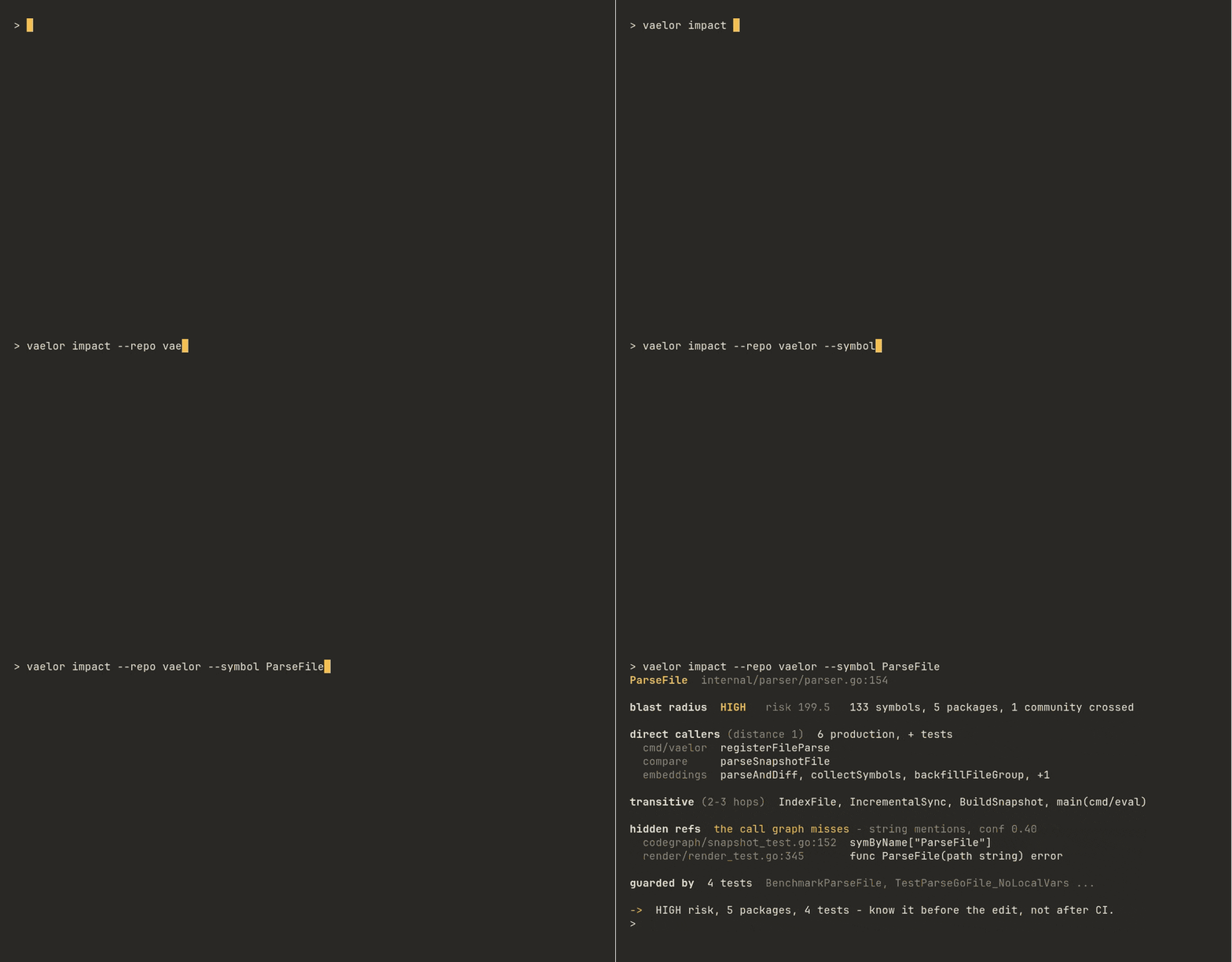
Vaelor is the open-source engine behind Krolik: a self-hosted MCP server that parses, graphs, and watches a codebase so an AI agent doesn't have to re-discover it every session. Tree-sitter AST parsing across 16 languages feeds a call graph with type-aware Go resolution (go/types), a persistent Apache AGE knowledge graph, and hybrid semantic search. review_pr remembers what broke last time a symbol was reviewed. debug_investigate correlates a Prometheus alert and a Jaeger trace back to the function that caused it.


Quick Start in three commands. If it's useful, a star helps the next person find it.
Why not just grep, or a code index?
Every code-search tool finds the function. Fewer tell an agent what else breaks when it changes, and fewer still remember your last review or your last production incident.
| Org-wide code search | Session-scoped agent tools | Hosted PR-review bots | Vaelor | |
|---|---|---|---|---|
| What it's for | full-text and symbol search across an indexed org, surfaced to agents as context | navigation and editing inside one agent session | automated review comments on a PR, as a hosted service | search, call graph, blast radius, and live incidents behind one MCP endpoint you run yourself |
Vaelor's Apache AGE graph carries PageRank, community, and surprise scores computed from your actual call graph, and those scores feed understand, prepare_change, and review_pr directly. review_pr also persists a verdict per symbol from the real GitHub review outcome, and understand surfaces it automatically the next time anyone touches that symbol, so a "this broke in review" fact travels with the code instead of living in someone's memory. debug_investigate goes further: it fuses a live Prometheus alert and a Jaeger trace with the same call graph into a ranked file:function hypothesis, so an incident resolves to code, not just a dashboard alert. An agent's sense of which change is risky comes from the shape of your actual codebase, recomputed on every graph update.
Quick Start
Docker (recommended)
docker build -t vaelor .
docker run -p 8897:8897 \
  -e LLM_API_BASE=http://host.docker.internal:8317/v1 \
  -e LLM_API_KEY=your-key \
  vaelor
From source
Requires Go 1.24+ and a C compiler (CGO for tree-sitter grammars).
make build    # → bin/vaelor
./bin/vaelor
Register as an MCP server
claude mcp add -s user -t http vaelor http://127.0.0.1:8897/mcp
Try it
No local clone needed: understand and call_trace take a GitHub repo directly and fetch it on the first call. That first call indexes the repo, so give it a few seconds; after that it's cached. Start with a small repo:
{
  "tool": "call_trace",
  "arguments": {
    "repo": "gorilla/mux",
    "symbol": "ServeHTTP",
    "direction": "callees",
    "depth": 2
  }
}
Walks Router.ServeHTTP through the routing path with cycle detection — no Docker volume mount and no DATABASE_URL required.
No LLM_API_KEY yet? Most tools still run: they skip only the narrative and ranking layer. See LLM dependency for exactly what degrades and what doesn't.
What it does
Understand a codebase
explore: fast, no-clone overview for remote repos. understand: symbol deep-dive covering callers, callees, complexity, dead-code score, and any prior review verdicts on that symbol. code_research: BM25F plus embeddings plus graph expansion for 10k+ file monorepos.
Know what a change will break
impact_analysis: configurable blast-radius depth (default 5), hotspots reordered by churn. prepare_change: impact analysis and dead-code check in one call. call_trace: bidirectional call chains with cycle detection and an LLM narrative.
Search by meaning, not keyword
semantic_search: pgvector plus hybrid RRF plus 1-hop graph expansion. symbol_search, code_search, github_code_search (no clone required).
Review and remember
review_pr / review_delta: differential blast radius between git refs, posting to GitHub and persisting a per-symbol learning on approval or rejection. code_compare: structural diff between two repos covering architecture, API design, quality. rewrite: structural AST search-replace across 16 languages, dry-run first.
Debug what's actually running, not just what's in the diff
debug_investigate: 7-phase incident root cause, from metric spikes and failed traces through symbol resolution, callgraph walks, LLM fusion, and runtime binary drift, ranked to a file:function. fleet_versions: diffs the image tags pinned in source against what's actually deployed. dataflow: taint tracking, dead stores, SQL/command-injection sinks. dead_code and code_health: an A-F grade covering complexity, test coverage, dependency freshness, OSV vulnerabilities.
Also worth knowing about
find_duplicates: finds near-duplicate symbols in a repo via semantic similarity (needs EMBED_URL + DATABASE_URL). suggest_reviewers: ranks reviewer candidates for a PR's file paths from authorship, co-change coupling, and recency.
That's the headline set, not the whole one. The table below documents what's stable; call tools/list on a running server for the complete, current one.
Tool Reference
The stable, documented set. The server exposes a few more; tools/list on a running instance is the authoritative, current list.
| Tool | Description |
|---|---|
repo_analyze |
Analyze a repository. Deep mode (AST + LLM), quick mode (GitHub Code Search), or issue/PR search |
repo_search |
Discover repos across forges via parallel web search + GitHub/GitLab API, LLM-ranked |
github_code_search |
Search code on GitHub via the Code Search API. Returns file paths and matching fragments |
file_parse |
Parse a single file with tree-sitter. Returns symbol table or raw AST |
code_compare |
Compare two repositories structurally: architecture, API design, code quality |
dep_graph |
Build a dependency graph. Output as Mermaid, Graphviz DOT, or JSON |
symbol_search |
Search symbols (functions, types, consts) by name pattern across a repo |
code_search |
Grep-like search with regex and path-glob filtering, context lines included |
call_trace |
Trace call chains: callees (forward) or callers (reverse), with depth control |
code_graph |
Query the persistent code knowledge graph in Apache AGE via natural language |
debug_investigate |
7-phase prod incident root cause: Prom spikes + Jaeger failed traces + symbol resolution + callgraph walks + LLM fusion + runtime binary drift, ranked to file:function |
semantic_search |
Hybrid RRF: BM25F + pgvector + 1-hop AGE graph expansion. Find by concept, not keyword |
understand |
Type-aware symbol deep-dive. Aggregates call_trace + symbol_search + complexity + tested_by + dead_code_score + prior learnings |
impact_analysis |
Configurable blast-radius depth (default 5). Direct callers, transitive callers, hotspot reordering by churn |
prepare_change |
Pre-change risk: impact analysis + dead-code check combined |
dead_code |
Confidence-scored unused-symbol detection, not a flat list |
dataflow |
IL/CFG taint tracking, dead stores, SQL/command-injection sinks |
rewrite |
Structural AST search-replace with $WILDCARDS across 16 languages, dry-run and apply |
review_pr |
Differential blast radius between git refs; persists per-symbol learnings |
review_delta |
Differential blast radius between two git refs |
code_research |
BM25F + embeddings + DAG expansion for 10k+ file monorepos |
design_search |
Find DESIGN.md systems by UI description (multilingual-e5-large, 1024-dim) |
resolve_frame |
Unminify a JS stack frame via source maps |
site_analyze |
Tech-stack and SEO audit, BFS crawler |
site_crawl |
BFS web crawler |
code_health |
Repo grade A-F: complexity, test coverage, dependency freshness, OSV vulnerabilities |
explore |
Fast repo overview, no LLM, no clone for remote repos |
fleet_versions |
Diff pinned container-image references in source against deployed runtime containers. Catches the "config aligned, source looks right, behavior wrong" bug class |
find_duplicates |
Find near-duplicate symbols in one repo via semantic similarity. Requires EMBED_URL + DATABASE_URL |
suggest_reviewers |
Rank reviewer candidates for a PR's file paths from authorship, co-change coupling, and recency |
remember_graph_insights |
Persist a learning so it surfaces in future understand calls |
wp_plugin_search |
Search the WordPress.org plugin directory |
Optional sidecars.
dead_codeandcode_healthsharpen from AST-only heuristics to confidence-scored results when ox-codes (Rust) is running alongside.semantic_searchneeds an embedding endpoint; ox-embed-server (ONNX embeddings, cross-encoder rerank, SPLADE) is the reference one. Neither is required to run Vaelor, and every tool without them still returns a real result, just a coarser one.
Learnings loop
review_pr (with dry_run=false) writes one learning per changed symbol on a completed GitHub review: APPROVE maps to good, REQUEST_CHANGES maps to bad, everything else is neutral. The dry-run path writes a risk_level on the same record. The next time anyone calls understand on that symbol, Store.Nearest looks up the closest prior learnings and attaches them as prior_learnings on the result, no extra call needed. The loop is gated on LEARNINGS_DATABASE_URL (falls back to DATABASE_URL); with neither set, it silently no-ops instead of erroring.
Graph signal ecosystem
Two graph representations cooperate through internal/graphx without either package knowing about the other, so every consumer below degrades to byte-identical output when there's no graph snapshot yet.
| Signal (AGE-computed) | Consumed by |
|---|---|
| PageRank, community | understand (graph_analytics), prepare_change (communities_crossed, high_pagerank_callers) |
| Surprise score | review_pr (high_surprise flag at ≥0.5) |
| Handles / fetches (cross-language routes) | call_trace (fetch nodes at +1 depth across service boundaries) |
| Tested-by | impact_analysis (tests_covering) |
Runtime version awareness
When a production bug lives at the deployed-binary level rather than in source (pinned tag drift, sibling-host divergence, a silent auto-update), Vaelor can probe running containers and diff them against what the indexed repo pins.
fleet_versions: the explicit tool. Passhost(defaults to the local Docker socket) and an optionalservicefilter. Returns a per-target diff:Match/TagDrift/DigestDrift/OnlySource/OnlyRuntime/Unresolved.debug_investigatePhase 7: runs automatically when an investigation starts withhostset. Drift enters the LLM prompt priority-capped at the top 20 non-Matchdiffs, sortedTagDrift>DigestDrift>Unresolved>OnlyRuntime>OnlySource.
SSH probe
Reaching a remote host uses the system ssh binary directly; Vaelor doesn't maintain its own SSH stack, so ~/.ssh/config (ProxyJump, agent, identities, port, known_hosts) is the single source of truth. The driver is off by default: enable with GOCODE_FLEET_SSH_ENABLE=true. Commands on the remote host are limited to an internal allowlist, exactly docker ps --no-trunc --format={{json .}}, with filter values regex-validated before any exec call.
| Env | Default | Purpose |
|---|---|---|
GOCODE_FLEET_DEFAULT_HOST |
"" |
Fallback host for debug_investigate Phase 7. Empty = skip |
GOCODE_FLEET_DOCKER_SOCKET |
/var/run/docker.sock |
Local Docker engine socket path |
GOCODE_FLEET_SSH_ENABLE |
false |
Must be true to use ssh:// targets |
GOCODE_FLEET_SSH_BINARY |
ssh |
System ssh binary, PATH-resolved by default |
GOCODE_FLEET_TIMEOUT |
10s |
Per-probe timeout |
Configuration
| Variable | Default | Description |
|---|---|---|
MCP_PORT |
8897 |
HTTP server port |
LLM_API_BASE |
http://127.0.0.1:8317/v1 |
OpenAI-compatible LLM endpoint |
LLM_API_KEY |
(optional) | See LLM dependency below |
LLM_MODEL |
cerebras-gpt-oss-120b |
Model name (fresh-deploy fallback; override per deployment) |
GITHUB_TOKEN |
(optional) | Higher API rate limits, private repos |
WORKSPACE_DIR |
/tmp/go-code-workspace |
Temp directory for cloned repos |
MAX_FILE_KB |
512 |
Max file size to parse (KB) |
MAX_REPO_MB |
200 |
Max repo size to accept (MB) |
REDIS_URL |
(optional) | Redis URL for the L2 parse/LLM cache |
DATABASE_URL |
(optional) | PostgreSQL DSN for the Apache AGE code graph (required for code_graph, the learnings loop, and the graph signals above) |
EMBED_URL |
(optional) | Embedding server endpoint (required for semantic_search) |
GITHUB_WEBHOOK_SECRET |
(optional) | Set to enable the /webhook/github PR-review receiver |
Full environment reference (SearXNG, GitLab, fallback-model chains, fleet SSH, indexing tuning): CLAUDE.md.
LLM dependency
LLM_API_KEY is optional. The server starts and most tools operate without it:
| Category | Tools | Behavior without LLM_API_KEY |
|---|---|---|
| Hard | code_graph (NL query), repo_search |
Returns an MCP error: "requires LLM_API_KEY to be set" |
| Soft | repo_analyze (quick/raw modes), issue/PR search |
Returns deterministic results plus an (LLM unavailable) marker |
| Augment | call_trace, dead_code, impact_analysis |
Full core output; narrative/augmentation fields are empty |
| Debug | debug_investigate |
Runs the deterministic phases (trace analysis, metric spikes, alert violations); LLM hypothesis ranking is skipped with LLMSkippedReason set |
Set LLM_API_BASE + LLM_API_KEY + LLM_MODEL to run every tool at full capability. Any OpenAI-compatible endpoint works: OpenAI, Anthropic via proxy, a local Ollama instance.
Architecture
cmd/vaelor/     : MCP server, tool handlers (one file per tool)
internal/
  parser/        : tree-sitter AST parsing, 16 language handlers
  ingest/        : repo cloning, file walking, gitignore filtering
  clean/         : code cleaning for LLM context
  render/        : rendering modes (signatures, skeleton, focused)
  analyze/       : analysis orchestration
  compare/       : structural diff engine
  callgraph/     : call chain tracing (BFS/DFS, bidirectional), type-aware for Go
  codegraph/     : Apache AGE knowledge graph
  embeddings/    : semantic search: pgvector store, embed pipeline, hybrid RRF, graph expansion
  learnings/     : pgvector-backed store for prior review findings
  investigate/   : Prometheus + Jaeger correlation for debug_investigate
  fleet/         : deployed-vs-source container image drift
  github/        : GitHub API (search code/issues/repos, metadata)
  llm/           : LLM client with retry and fallback keys
  cache/         : generic LRU cache with Redis L2
Analysis Modes
Deep mode (default). Clones the repo, walks the file tree, parses ASTs with tree-sitter, builds a symbol table, and answers questions via LLM. depth controls context size (overview/module/deep), mode controls rendering (signatures/skeleton/focused).
Quick mode (mode=quick). GitHub Code Search API, no cloning. Returns matching code fragments, optionally LLM-summarized. mode=raw skips the LLM step entirely.
Issues/PRs mode (type=issue or type=pr). Searches GitHub Issues/Pull Requests. Structured results with state, labels, author, and an LLM read on trends.
Webhook
POST /webhook/github on the MCP port (:8897) handles pull_request events (opened/synchronize/reopened). Requires X-GitHub-Event and X-Hub-Signature-256 headers and GITHUB_WEBHOOK_SECRET set. REVIEW_POST_ENABLED=true posts the review to GitHub; otherwise it dry-logs. Expose it through your existing tunnel and register it in the repo's webhook settings.
Transport
- HTTP (default): streamable HTTP on
MCP_PORT - Stdio:
./vaelor --stdiofor pipe/SSH access
Build
make build      # Build binary (CGO required)
make lint       # Run golangci-lint
make test       # Run tests
make deploy     # Docker build + deploy
License
Apache 2.0, Copyright 2026 Anatoly Koptev.
Contributing
See CONTRIBUTING.md for adding a new tool or a new language.
For security vulnerabilities, see SECURITY.md. Please don't open a public issue for those.
If Vaelor saves your agent from re-discovering the same fact about your codebase twice, a star helps the next person find it before they build a fifth MCP code-search server from scratch.
Reviews (0)
Sign in to leave a review.
Leave a reviewNo results found