session-warden
Health Warn
- License — License: MIT
- Description — Repository has a description
- Active repo — Last push 0 days ago
- Low visibility — Only 5 GitHub stars
Code Pass
- Code scan — Scanned 12 files during light audit, no dangerous patterns found
Permissions Pass
- Permissions — No dangerous permissions requested
No AI report is available for this listing yet.
Session supervisor and self-improvement loop for always-on Claude Code agent fleets. Auto-rotation, workspace-level memory that survives rotations and model switches, nightly lesson distillation, skill harvesting, model scorecards, memory evals. OpenClaw turnkey, Hermes partial, your own interface on top.
session-warden


Session supervisor and self-improvement loop for always-on Claude Code agent fleets.
The lifeguard half auto-rotates bloated Claude Code sessions and preserves agent memory across rotations, so agents pick up where they left off. The self-improvement half closes the learning loop on top of that memory: nightly lesson distillation, weekly skill harvesting, weekly model scorecards, weekly real-work reviews, and monthly memory evals.
Where it sits
A persistent agent fleet is a stack, and the warden is the layer under it:
you  ←→  interface        (Telegram, Discord, your own bot UI, ...)
         agent runtime    (the gateway that owns sessions: OpenClaw, Hermes, a custom wrapper)
         Claude Code CLI  (the long-running sessions doing the actual work)
         session-warden   (supervises those sessions; carries memory across them)
The warden doesn't care which interface you chat through — it supervises the Claude Code sessions underneath and writes memory at the agent-workspace level. That has a useful consequence: memory continuity survives not just session rotations but model switches too, because the workspace memory files are injected into whatever model the runtime boots next.
Runtime support
The supervision layer talks to the agent runtime (reading its session state, restarting its gateway, delivering recovery messages), so each runtime needs explicit support. Today:
| Runtime | Support | What works |
|---|---|---|
| OpenClaw | Turnkey (install.sh) |
Everything: rotation, stall reaper, burn firewall, handoff, model-switch, registry gate, channel parity, the full learning loop |
| Hermes | Partial | Handoff (state.db → memories/HANDOFF.md + CONTEXT.md), model-switch (edits config.yaml, restarts the gateway), weekly scorecard turns, nightly dream-cycle transcript ingest |
| Standalone Claude Code | Runtime-free | Snapshot (sessions → GBrain) and solo burn metering read ~/.claude/projects directly — no gateway involved |
| Anything else | Building blocks | lib/extract.sh, the generic halves of lib/memory.sh, bin/snapshot.sh, lib/gbrain.sh, lib/notify.sh are gateway-free; see docs/integrations.md for the exact contract a new runtime adapter needs |
There is no Codex CLI session support — the warden rotates and summarizes Claude Code sessions only. (Memory still survives a switch to an OpenAI model via a runtime's model chain, because the carry-over is workspace-level, not transcript-level.)
Want a simpler interface than a full gateway in front of your agents? That's the intended shape: the interface layer is yours to swap. docs/integrations.md spells out what the warden needs from whatever sits above it.
What you need
- An agent runtime — the turnkey install path requires OpenClaw (
install.shexits without it); Hermes homes (~/.hermes-<name>) are picked up by the modules that support them claudeCLI (required) — post-rotation summarization, reflector/harvester/scorecard/eval/review model callsjq(required) andcurl(required for alerts)- GBrain (optional) — a knowledge-graph CLI; needed for the dream cycle and the snapshot module's output (snapshot logs
GBRAIN UNAVAILABLEand skips cleanly without it). Every other module mirrors into GBrain when available and degrades gracefully when not - Telegram bot (optional) — token + chat ID for alerts and digests; leave unset to disable
- python3 (optional) — crash-buffer detection, fleet review's work harvester, rate guard, the contrib collectors
Platform: Linux-first. The rotation core leans on /proc, systemd user timers, and cron; the test suite targets Linux. On macOS, the solo burn sampler (launchd template) and the read-only CLI commands work; the supervision core does not.
The problem
Claude Code sessions accumulate tokens, turns, and JSONL file size over time. Eventually they hit limits — token bloat, context overflow, compaction loops — and the session dies. You're left with a dead session and no memory of what was happening.
Runtimes can make this worse. OpenClaw, for example, keeps a dead session ID pinned and resumes it on every new message, creating an infinite error loop. It's not a rate limit. It's a stale pointer.
How it works
A cron job runs every 30 seconds. When it finds a session that's failed or exceeds configurable thresholds (tokens, turns, compaction count), it runs a 4-step rotation:
- Detect — scan session state for bloat, failures, or zombies (dead CLI process with stale JSONL)
- Rotate — backup state, archive the JSONL (never deleted), clean up the stale session reference
- Summarize — extract the full conversation (text + tool actions), summarize with a fast model (Haiku), write it into the agent's memory files
- Restart — restart the runtime gateway so agents boot with full context already loaded
The agent comes back online in under a second, knowing what it was doing.
Module map
| Module | Entry point | Schedule | What it does |
|---|---|---|---|
| Scan + rotate | bin/scan.sh → bin/rotate.sh, bin/summarize.sh |
cron, 30s (install.sh) | detect bloated/failed/zombie sessions; archive, summarize into memory, restart |
| Stall reaper | bin/reap-stalls.sh |
cron, 30s (install.sh) | gateway-independent backstop that kills silently wedged turns |
| Doctor | bin/doctor.sh |
cron, 5 min (install.sh) | warden self-health + dead-man's switch |
| Snapshot | bin/snapshot.sh |
cron, 30 min (install.sh) | capture standalone Claude Code sessions into GBrain |
| Context sync | bin/context-sync.sh |
cron, 5 min (manual) | refresh MEMORY.md/CONTEXT.md from live sessions so restarts are always fresh |
| Archive cleanup | bin/cleanup-archives.sh |
cron, daily (manual) | bounded growth for archives, logs, queues, cooldowns, burn ledgers |
| Worktree GC | bin/reap-worktrees.sh + bin/wt |
cron, 15 min (manual) | ephemeral per-task git worktrees for agents, garbage-collected |
| Burn firewall | lib/burn.sh (in scan) + bin/burn-report.sh |
with scan / on demand | meter per-agent token burn; alert or enforce on spikes, budgets, retry loops |
| Burn solo | bin/burn-solo-sample.sh |
launchd/cron (manual) | meter standalone Claude Code usage outside any gateway |
| Dream cycle | bin/dream-cycle.sh |
nightly 03:30 (deploy/dream-cycle.timer) |
GBrain maintenance: ingest runtime transcripts, embed stale pages, doctor, daily digest |
| Reflector | bin/reflect.sh |
nightly 04:10 (deploy/reflect.timer) |
distill verified lessons per agent, staged for human review |
| Skill harvester | bin/harvest-skills.sh |
weekly Sun 05:00 (deploy/harvest.timer) |
mine repeated workflows into staged SKILL.md drafts |
| Model scorecard | bin/scorecard.sh |
weekly Sat 06:00 (deploy/scorecard.timer) |
fixed benchmark across models, blind-judged |
| Fleet review | bin/fleet-review.sh |
weekly Sat 06:30 (deploy/fleet-review.timer) |
judge each roster agent's real week of work: 0-100 role-fit score + insight |
| Memory evals | bin/eval-memory.sh |
monthly 1st 07:00 (deploy/eval-memory.timer) |
replay fixed cases against current memory; pass-rate delta is the regression signal |
| Rate guard | bin/rate-guard.sh |
every 2 min (deploy/rate-guard.timer) |
demote rate-limited providers fleet-wide until reset; handoff before rewrite; one Telegram alert |
| Model-switch handoff | bin/handoff.sh, bin/model-switch.sh |
on demand | checkpoint live work to memory + GBrain before changing models; rate-guard uses the same primitive |
| MCP supervisor | bin/mcp-supervisor.sh |
manual / cron | keep heavy MCP servers alive across rotations |
| Fleet board | contrib/fleet-live/collect.py |
cron, 2 min (manual) | static public status board: live sessions, spend, recurring loops, skills learned |
install.sh wires the cron entries marked (install.sh). Rows marked (manual) need a crontab line you add yourself (shown in each section below); the timer-based rows are systemd user units you copy from deploy/ (see Quick start).
Session memory
Rotation without memory means the agent starts from scratch. The warden writes memory at two levels on every rotation (and every 5 minutes for live sessions, via context-sync):
Claude Code project memory. The full conversation — not just text messages, but every tool action (files edited, commands run, branches created) — is extracted from the archived JSONL and summarized by a fast model (WARDEN_SUMMARY_MODEL, default Haiku) into a structured entry: what was happening, actions taken, decisions made, pending work, lesson candidates, and entity wikilinks. It lands as a per-channel file under the agent's Claude Code project memory dir (~/.claude/projects/<agent-project>/memory/session_<channel>.md), indexed in that dir's MEMORY.md. Each channel's file is replaced on rotation — no unbounded growth — and compacted by a second model call if it exceeds WARDEN_MEMORY_MAX_BYTES.
Workspace injection — the load-bearing layer. The same summary is written into the agent's workspace: CONTEXT.md, and a marker-delimited block in the workspace MEMORY.md (<!-- SESSION-WARDEN-START/END -->). The runtime injects workspace memory into the agent's prompt at boot — context is injected, not voluntarily loaded — which is why continuity survives model switches. The warden's block is deliberately placed after the agent's own content so the prompt-cache prefix stays warm, and writes are skipped when content is unchanged so the file stays byte-identical.
Carry-over is explicit: the previous memory is fed back into each new summarization with instructions to carry forward unresolved pending items, so a task survives any number of rotations. The recovery message that wakes the agent additionally inlines CONTEXT.md, a GBrain cross-session briefing, and any crash buffer. If the previous turn died early (failed, zombie, stalled) or summarization timed out, that text starts with INCOMPLETE: so the next agent cannot read a transcript tail as a finished report.
Agent-side discipline completes the picture: agents are instructed via CLAUDE.md to proactively write important context to memory during the session, so even an unexpected death loses little.
Session boundaries become invisible.
Model-switch handoff
Changing an agent's model (or rate-guard demoting a provider) used to kill mid-work working memory: the transcript often survived on disk, but nothing durable said what the agent was doing. Use the warden — don't edit the runtime's config by hand.
# Checkpoint only (safe before a manual restart)
session-warden handoff baymax
session-warden handoff zara --reason model-switch

# Checkpoint then change primary model
session-warden model-switch zara google/gemini-3.6-flash
session-warden model-switch baymax gemini-3.6-flash
What it does:
- Detects the runtime per agent — OpenClaw (
~/.openclaw/agents/<id>) or Hermes (~/.hermes-<id>) - Waits out mid-turn / active work (best-effort)
- OpenClaw: graceful flush + transcript extract → Claude memory + CONTEXT.md
- Hermes: extract from
state.db→memories/HANDOFF.md+ CONTEXT.md - Upserts GBrain
session-warden/handoff/<agent>-<channel>and points the live page at it model-switchapplies the new primary (OpenClaw hot-reloads; Hermes restarts its gateway) and queues a wake/recovery that tells the agent to read the handoff first
Rate-guard demote/restore calls the same handoff for every agent whose primary model would change. If handoff fails for an agent, that agent's chain is left unchanged (partial demotion) and Telegram gets an alert — no silent amnesia.
Snapshot (standalone Claude Code sessions)
Rotation and memory cover gateway-managed agent sessions. But you also run plain Claude Code sessions yourself — in repos, in your home dir, anywhere. The snapshot module (bin/snapshot.sh) captures those into GBrain so they become permanent, searchable, linked memory too. It reads ~/.claude/projects directly — no gateway involved.
Every WARDEN_SNAPSHOT_INTERVAL_MINUTES (default 30) it:
- Scans
~/.claude/projects/**/*.jsonlmodified in the lastWARDEN_SNAPSHOT_WINDOW_MINUTES(default 120) - Skips gateway-managed agent sessions (path matches the OpenClaw agents pattern) — those are already handled by context-sync (live) and rotation, so there's no double-ingestion
- Extracts the transcript (
lib/extract.sh), summarizes it with Haiku, and writes a typed GBrain page atsessions/<date>/<agent>-<shortid>(tags[session, snapshot, <agent>]), linkedperformed_byto its agent and withmentionsedges to any entities the summary names - Tracks
{last_mtime, last_turn_count}per session instate/snapshot/state.json, re-summarizing only when the file changed and at leastWARDEN_SNAPSHOT_MIN_TURNS(default 4) new turns accrued — so most runs are cheap no-ops and Haiku only fires on real activity
The agent each session is attributed to is resolved from its working directory (lib/agent-attribution.sh): OpenClaw agents by their agents directory, your home dir as home, everything else unknown. To attribute your own repos or project paths to named agents, add glob rules to config/agent-paths.env (copy config/agent-paths.env.example); without it, non-gateway paths just resolve to unknown.
GBrain is what this module writes to — without the gbrain CLI the run logs GBRAIN UNAVAILABLE and exits cleanly having done nothing. GBrain is the canonical cross-session knowledge graph; snapshot writes there only (Claude Code's own auto-memory already handles local per-project persistence).
Config lives in config/thresholds.env (WARDEN_SNAPSHOT_*). Install adds a cron entry; deploy/snapshot.{service,timer} are the systemd alternatives.
Dream cycle (nightly GBrain maintenance)
GBrain's value compounds only if the graph is maintained while idle. The dream cycle (bin/dream-cycle.sh) does the maintenance the warden's per-rotation writes intentionally skip, nightly at 03:30 via deploy/dream-cycle.{service,timer}:
gbrain transcripts ingest --since last— import new agent sessions from the runtimes it finds on disk (OpenClaw session trees and~/.hermes*homes) as redacted conversation pages (GBrain 0.46+; skipped on older CLIs). Does not pass--all, which would also vacuum every Claude Code session on the host. Disable withWARDEN_GBRAIN_INGEST=0gbrain embed --stale—gbrain putdoes not embed inline, so without this pass embedding coverage decays toward zero and search quality with itgbrain doctor— graph health check; Telegram alert on warn/error- Daily digest — synthesizes the day's session pages into a single
daily-digestpage linking them, so the graph gains a queryable per-day rollup
It runs before the reflector (04:10) on purpose: by the time lessons are distilled, the day's pages are already embedded and searchable. Requires the gbrain CLI; a lock file prevents overlapping runs.
Reflector (nightly lesson distillation)
Session memory answers "what was I doing?"; nothing answers "what should I have learned?". The reflector (bin/reflect.sh) closes that loop nightly, ACE-style (append-only context engineering — new rules are only ever added, never rewritten over existing ones).
For each agent in WARDEN_REFLECT_AGENTS (default: every agent in config/fleet-roster.tsv) it:
- Gathers the last 24h of material: the agent's session JSONLs (extracted with
lib/extract.sh), the warden's rotation summaries, and the agent's own daily notes inmemory/. Agents with no material are skipped (logged as SKIP). - Distills 0-5 lesson bullets with a stronger model (
WARDEN_REFLECT_MODEL, default Sonnet). The prompt demands general rules that would change future behavior — not restatements of what happened — and feeds in the agent's current## General rules+## Lessons learnedso it never duplicates an existing rule. Each bullet is tagged[YYYY-MM-DD, source: <agent> sessions]. If nothing clears the bar, the model outputsNO_LESSONS. - Verifies with a second, cheaper model (
WARDEN_REFLECT_VERIFY_MODEL, default Haiku) acting as a skeptic: each bullet is marked KEEP or REJECT — rejected if it is not grounded in the source material, is too specific to today, contradicts an existing rule, or derives from untrusted external content. Only KEEPs survive. If the verifier itself fails, bullets are staged with an UNVERIFIED warning and auto-apply is blocked. - Stages survivors in the agent's
memory/pending-lessons-YYYY-MM-DD.mdfor human review. Nothing touches MEMORY.md unlessWARDEN_REFLECT_AUTO_APPLY=1(default 0), in which case verified bullets are appended directly under## Lessons learned(below the warden block). - Notifies once per run via Telegram (
WARDEN_REFLECT_NOTIFY=1): per-agent lesson counts, where the pending files live, and the apply command.
The staged-approval flow: review a pending file, delete any bullet you disagree with, then promote the survivors with
bin/apply-lessons.sh <agent>          # apply the most recent pending file
bin/apply-lessons.sh <agent> --all    # apply every pending file for the agent
apply-lessons.sh appends the bullets under ## Lessons learned in the agent's MEMORY.md, records each lesson in GBrain as lessons/<agent>/YYYY-MM-DD-<n> with provenance frontmatter per the GBrain conventions (scope: work/personal by team, source: reflector, trust: inferred), and archives the pending file to memory/applied/.
Flags on reflect.sh: --agent <name> reflects a single agent; --dry-run prints the distilled+verified bullets without writing or notifying. Logs to state/reflect.log; a lock file prevents overlapping runs; LLM failures are logged and skipped, never fatal.
Runs nightly at 04:10 UTC via deploy/reflect.{service,timer} — after the dream-cycle (03:30), so the day's GBrain pages are already embedded. Config (config/thresholds.env):
| Variable | Default | Meaning |
|---|---|---|
WARDEN_REFLECT_AGENTS |
fleet roster | space-separated agents to reflect on; unset = every agent in config/fleet-roster.tsv |
WARDEN_REFLECT_MODEL |
claude-sonnet-4-6 |
distillation model |
WARDEN_REFLECT_VERIFY_MODEL |
claude-haiku-4-5-20251001 |
skeptic/verifier model |
WARDEN_REFLECT_AUTO_APPLY |
0 |
1 = skip staging, append verified lessons straight to MEMORY.md |
WARDEN_REFLECT_NOTIFY |
1 |
one Telegram digest per run |
WARDEN_REFLECT_WINDOW_MINUTES |
1440 |
lookback window for material |
Skill harvester (weekly skill mining)
The reflector distills one-line lessons; nothing captures repeated workflows. The skill harvester (bin/harvest-skills.sh) closes that loop weekly: if an agent did the same multi-step thing twice this week, that procedure should become a skill, not stay tribal knowledge in session summaries.
For each agent in WARDEN_HARVEST_AGENTS (default: every agent in config/fleet-roster.tsv) it:
- Gathers the week's material (
WARDEN_HARVEST_WINDOW_DAYS, default 7): the warden's rotation summaries, the agent's own daily notes inmemory/, and lessons already applied inmemory/applied/. Agents with no material are skipped (logged as SKIP). - Lists existing skills — the agent's own, the shared fleet skills dir, and anything already staged — and feeds the names to the model so it never proposes a duplicate (a belt-and-braces name check enforces this even if the model ignores the instruction).
- Mines with one strong-model call per agent (
WARDEN_HARVEST_MODEL, default Sonnet): identify workflows performed 2+ times this week that no existing skill covers, and emit a completeSKILL.mddraft for each — YAML frontmatter (name,descriptionwith trigger conditions) plus a body with steps, known failure modes, and anti-patterns, all grounded in the week's material. At most 2 proposals per agent per run. If nothing clears the bar, the model outputsNO_SKILLS. - Stages each draft in a pending-skills dir (
skills-pending/<agent>/<skill-name>/SKILL.md) — it never writes into a live skills dir. - Notifies once per run via Telegram (
WARDEN_HARVEST_NOTIFY=1): per-agent proposal counts and names, where the drafts live, and the promote command. With a Discord bot configured (below), each staged skill additionally gets an interactive Discord card with Promote / Promote shared / Reject / View draft buttons.
The staged-approval flow: read a draft, edit it if needed, then promote it with
bin/promote-skill.sh <agent> <skill-name>            # into the agent's own skills dir
bin/promote-skill.sh <agent> <skill-name> --shared   # into the shared fleet skills dir
promote-skill.sh moves the pending dir into the live skills dir (refusing to overwrite an existing skill) and records the skill in GBrain as skills/<skill-name> with provenance frontmatter per the GBrain conventions (scope: work/personal by team, source: skill-harvester, trust: inferred).
Flags on harvest-skills.sh: --agent <name> harvests a single agent; --dry-run prints the proposed drafts without writing or notifying. Logs to state/harvest.log; a lock file prevents overlapping runs; LLM failures are logged and skipped, never fatal.
Runs weekly, Sunday 05:00 UTC, via deploy/harvest.{service,timer} — after that night's reflector (04:10) so the week's lessons are already staged. Config (config/thresholds.env):
| Variable | Default | Meaning |
|---|---|---|
WARDEN_HARVEST_AGENTS |
fleet roster | space-separated agents to harvest; unset = every agent in config/fleet-roster.tsv |
WARDEN_HARVEST_WINDOW_DAYS |
7 |
lookback window for material |
WARDEN_HARVEST_MODEL |
claude-sonnet-4-6 |
skill-mining model |
WARDEN_HARVEST_NOTIFY |
1 |
one Telegram digest per run |
WARDEN_DISCORD_BOT_TOKEN |
(unset) | Discord bot for interactive proposal cards (dedicated-bot path) |
WARDEN_HARVEST_DISCORD_ACCOUNT |
(unset) | OpenClaw Discord account that posts cards (fleet-native path) |
WARDEN_HARVEST_DISCORD_CHANNEL_ID |
(unset) | channel the cards are posted to |
WARDEN_DISCORD_ALLOWED_USER_IDS |
(unset) | who may click the buttons — empty = nobody |
WARDEN_HARVEST_NOTIFY_DISCORD |
1 |
0 = skip Discord cards even when configured |
Interactive Discord proposals
Instead of copy-pasting promote-skill.sh commands from a text digest, you can act on proposals directly in Discord. When WARDEN_HARVEST_DISCORD_CHANNEL_ID is set along with either WARDEN_HARVEST_DISCORD_ACCOUNT (OpenClaw path) or WARDEN_DISCORD_BOT_TOKEN (dedicated-bot path), the harvester posts one card per staged skill with Promote, Promote shared, Reject, and View draft buttons.
OpenClaw path (preferred on fleets that already run Discord via OpenClaw): set WARDEN_HARVEST_DISCORD_ACCOUNT (the OpenClaw Discord account name). Cards are posted with openclaw message send --presentation; clicks are handled by the harvest-skill-actions OpenClaw plugin — no second Discord bot or gateway.
Dedicated-bot path: set WARDEN_DISCORD_BOT_TOKEN and run contrib/discord-harvest-actions via bin/harvest-actions.sh / deploy/harvest-actions.service.
Promote runs promote-skill.sh (with --shared for the fleet-wide variant), Reject moves the draft to a rejected dir (never deletes), View replies ephemerally with the SKILL.md. Handled cards drop their buttons. Clicks are gated to the WARDEN_DISCORD_ALLOWED_USER_IDS allowlist and refused otherwise (default-deny: your agents live in these channels too).
Model scorecard (weekly A/B benchmark)
When several experimental agents run the same fleet role on different models, nothing measures which model is actually better at the fleet's work. The model scorecard (bin/scorecard.sh) closes that loop weekly with a fixed, committed benchmark across the Hermes agents you list in WARDEN_SCORECARD_AGENTS. (This module runs turns through the Hermes CLI, so it currently benchmarks Hermes-hosted agents only.)
Each run it:
- Runs the task set —
config/scorecard-tasks.jsonl, 8 fixed tasks spanning factual reasoning, summarization, structured extraction (JSON), writing in a constrained style, planning, a GBrain-grounded question (tests MCP tool use, for agents with the gbrain server), a clarify-before-acting judgment check, and a logic puzzle. Every agent answers every task as a real non-interactive Hermes turn (HERMES_HOME=<home> hermes chat -Q -q <prompt>,WARDEN_SCORECARD_TURN_TIMEOUT180s). Raw answers land instate/scorecard/<date>/<agent>/<task-id>.txt; a dead turn is recorded verbatim and scored 0. - Judges blind — one call per answer to the claude CLI (
WARDEN_SCORECARD_JUDGE_MODEL, default Sonnet): task prompt + rubric + answer, score 0-10 with a one-line justification. The judge is never told which agent or model produced the answer — model names appear only in the report, added after judging. - Reports —
state/scorecard/<date>/REPORT.md: per-task/per-category scores and a totals row per agent, plus every judge justification. Mirrored to GBrain asscorecards/YYYY-MM-DD(scope: personal,source: scorecard,trust: verified— scores are measured against a fixed rubric, not asserted). - Notifies once per run via Telegram (
WARDEN_SCORECARD_NOTIFY=1): the totals table.
Because the task set is committed and fixed, week-over-week totals are comparable — a model/config regression in one agent shows up as a falling total, not vibes. Change the task set deliberately and rarely; history resets when you do.
Flags: --agent <name> benchmarks a single agent; --task <id> runs a single task; --dry-run prints answers + scores without writing the report or notifying. Logs to state/scorecard.log; a lock file prevents overlapping runs.
Runs weekly, Saturday 06:00 UTC, via deploy/scorecard.{service,timer}. Config (config/thresholds.env):
| Variable | Default | Meaning |
|---|---|---|
WARDEN_SCORECARD_AGENTS |
(unset) | experimental Hermes agents (homes at ~/.hermes-<name>) — set your own |
WARDEN_SCORECARD_JUDGE_MODEL |
claude-sonnet-4-6 |
blind judge |
WARDEN_SCORECARD_TURN_TIMEOUT |
180 |
seconds per agent turn before it's scored 0 |
WARDEN_SCORECARD_NOTIFY |
1 |
one Telegram digest per run |
WARDEN_HERMES_BIN |
~/hermes-agent/venv/bin/hermes |
Hermes CLI (shared venv, per-agent via HERMES_HOME) |
Fleet review (weekly real-work quality review)
The scorecard benchmarks experimental agents on synthetic tasks; it says nothing about how your production agents perform their real jobs. The fleet review (bin/fleet-review.sh) closes that gap weekly: for every agent in config/fleet-roster.tsv it harvests the work the agent actually did over the window (lib/harvest-work.py, over the agent's session transcripts), then a judge (WARDEN_FLEET_JUDGE_MODEL, default Sonnet) scores that real output against a role-aware quality bar: a 0-100 score, a one-line insight, and one recommended action per agent.
Dormant agents (no sessions in the window) are recorded as idle, not scored or penalised. An agent that correctly does nothing — say, a filter agent returning NO_REPLY on marketing mail — is good filtering: the harvester collapses those runs so the judge sees the substantive work, and the judge is told as much.
Outputs land in state/fleet-review/<date>/: review.json (machine-readable), REPORT.md (per-agent score, delta vs last run, insight), and <agent>.sample.txt (the harvested sample, for audit). Mirrored to GBrain as fleet-review/YYYY-MM-DD; one Telegram digest per run.
Flags: --agent <name> reviews a single agent; --dry-run prints scores without writing or notifying. Requires python3 and jq. Runs weekly, Saturday 06:30 UTC, via deploy/fleet-review.{service,timer} — after that morning's scorecard. Config (config/thresholds.env):
| Variable | Default | Meaning |
|---|---|---|
WARDEN_FLEET_JUDGE_MODEL |
claude-sonnet-4-6 |
scores each agent's real work against its role |
WARDEN_FLEET_WINDOW_DAYS |
7 |
look-back window for harvested work |
WARDEN_FLEET_MAX_SAMPLE_CHARS |
12000 |
per-agent work-sample cap fed to the judge |
WARDEN_FLEET_JUDGE_TIMEOUT |
150 |
seconds per judge call |
WARDEN_FLEET_NOTIFY |
1 |
one Telegram digest per run |
Memory evals (monthly regression)
The reflector writes memory; nothing checked whether the memory files actually carry the knowledge an agent needs. The memory eval (bin/eval-memory.sh) closes that loop monthly for the agents in WARDEN_EVAL_AGENTS (default: the fleet roster): a fixed set of eval cases per agent, replayed against the agent's current MEMORY.md + AGENTS.md, with the pass-rate delta against the previous run as the regression signal.
Generating cases (one-time per agent, --generate <agent>): reads the agent's MEMORY.md below the warden block plus its GBrain lessons pages (gbrain search "lessons/<agent>"), and asks the claude CLI (WARDEN_EVAL_GEN_MODEL, default Sonnet) for 10-15 cases into the agent's evals/cases.jsonl — each {"id", "question", "expected"} where question is a realistic situation in which the agent should apply a stored rule/fact and expected is the rule/fact a correct answer must surface. Cases test application, not parroting: the question never names the rule. Lines are validated individually; a batch under 5 valid cases refuses to overwrite. Keep cases fixed between runs — deltas are only meaningful against a stable set.
Running (default mode), for each agent with a cases file:
- Answers each case with the claude CLI (
WARDEN_EVAL_MODEL, default Sonnet) with the agent's currentMEMORY.md(below the warden block) +AGENTS.mdpiped in as context — we're testing whether the memory files carry the knowledge, not burning live agent sessions. - Judges each answer with a cheap model (
WARDEN_EVAL_JUDGE_MODEL, default Haiku): does it reflect the expected rule/fact? PASS/FAIL + one-line note. Paraphrase passes; ignoring or contradicting fails. - Reports —
state/evals/<date>/REPORT.md: per-agent pass rates with a per-agent delta vs the previous run'srates.tsv(the regression signal), plus every failure with its judge note. Raw answers instate/evals/<date>/<agent>/<case-id>.txt. Mirrored to GBrain asevals/YYYY-MM-DD(scope: shared,source: eval-memory,trust: verified). - Notifies once per run via Telegram (
WARDEN_EVAL_NOTIFY=1): pass rates + failure count.
A falling pass rate means memory quality regressed — a lesson got lost in a rewrite, a migration to GBrain dropped context the agent still needs, or MEMORY.md bloated past usefulness.
Flags: --agent <name> evaluates a single agent; --generate <agent> (re)generates that agent's case set and exits; --dry-run prints per-case verdicts without writing the report or notifying. Logs to state/evals.log; a lock file prevents overlapping runs.
Runs monthly, 1st 07:00 UTC, via deploy/eval-memory.{service,timer}. Config (config/thresholds.env):
| Variable | Default | Meaning |
|---|---|---|
WARDEN_EVAL_AGENTS |
fleet roster | space-separated agents under eval; unset = every agent in config/fleet-roster.tsv |
WARDEN_EVAL_MODEL |
claude-sonnet-4-6 |
answers each case with the agent's memory attached |
WARDEN_EVAL_JUDGE_MODEL |
claude-haiku-4-5-20251001 |
PASS/FAIL judge |
WARDEN_EVAL_GEN_MODEL |
claude-sonnet-4-6 |
--generate case writer |
WARDEN_EVAL_NOTIFY |
1 |
one Telegram digest per run |
Stall reaper (silent-hang backstop)
OpenClaw-specific: this module reads OpenClaw's on-disk session schema and process markers.
OpenClaw's gateway runs an in-process watchdog that kills a turn whose CLI child stops making progress. It's fast and precise, but it shares a failure domain with the gateway: it lives in the compiled runtime (a string patch that no-ops after npm update openclaw) and it needs the gateway's own event loop healthy enough to fire. When either fails, an agent turn hangs forever and the channel goes silent with no reply.
The stall reaper (bin/reap-stalls.sh) is the independent backstop. It reads gateway state from disk and /proc only — never an RPC — so it keeps working even when the gateway loop is wedged or the patch was wiped by an upgrade.
A turn is STUCK when, for a session, all hold:
status == "running"in the on-disksessions.json(the gateway believes a turn is in flight — a live process alone can't tell you this, since idle sessions keep a persistent CLI process too)- no forward progress —
max(updatedAt, session JSONL mtime)is older thanWARDEN_STALL_HARD_CAP_SECONDS(default 900s / 15 min). A healthy turn, however long, keeps appending its transcript; a network-stalled one can't write anything.
The cap sits well above the in-gateway watchdog, so the reaper only fires when the fast layer didn't — it never touches healthy long turns. Process liveness is not part of the verdict; it decides the action:
- live wedged child found →
SIGTERM→SIGKILLit directly (kill(2), fully gateway-independent). The gateway sees the child exit and fails the turn. - no live child (turn already died, gateway never cleared
running) → clear the stale state on disk + hand off to recovery, without disrupting the other agents. - still stuck on the next tick after we acted → the gateway event loop itself isn't reacting →
openclaw gateway restart(shared cooldown withscan.sh).
Either way the killed session is marked failed and the reaper delivers the "you're back" nudge itself (openclaw agent --deliver, backgrounded), rather than depending on scan.sh's drainer being scheduled — independence is the whole point.
Process identity is safety-gated: a pid is only ever killed if its cmdline carries the session's --session-id and its /proc/<pid>/environ has the runtime's agent-ID marker for that agent — so a human's own claude session is never touched. Honors WARDEN_DRY_RUN=1.
Contract self-check. The reaper reads the gateway's on-disk sessions.json schema. If a future upgrade reshapes that file, detection would silently return nothing and the reaper would no-op — quietly reintroducing the silent hang. So each run validates the schema and, on drift (entries present but none expose status / cliSessionIds / updatedAt, or the file won't parse), logs loud and fires a Telegram alert (throttled hourly) instead of failing silent. This is the one piece that keeps it honest across gateway versions: the disk + CLI contracts are far more stable than the compiled-JS patch's anchors, but a major version bump can still move them — and when it does, you get pinged, not silence.
Runs on its own cron tick every 30s. Config: WARDEN_REAP_ENABLED, WARDEN_STALL_HARD_CAP_SECONDS, WARDEN_STALL_KILL_GRACE_SECONDS.
Channel/plugin parity (silent-channel backstop)
OpenClaw-specific: guards an OpenClaw packaging failure mode.
Some OpenClaw upgrades unbundle a channel plugin from core. The gateway then boots "healthy", starts the channels whose plugins survived, and silently ignores an enabled channel that has no provider — no error, no log line, no health alert. The channel just goes dark. (Real incident, 2026-06-11: a release unbundled Discord; every Discord agent was deaf for ~14 hours before anyone noticed.)
contrib/openclaw-patches/channel-parity.sh enforces the invariant: every channel enabled in openclaw.json must have an installed, enabled plugin that provides it.
channel-parity.sh check— report parity; exit 0 in-parity, 1 on mismatch.channel-parity.sh heal— for each missing channel, install the official@openclaw/<id>plugin (that scope only — never community code), schedule one gateway restart, and alert via the warden's Telegram. Loop-guarded: at most one heal attempt per channel perCHANNEL_PARITY_COOLDOWN_SECONDS(default 6h).
It's wired at three layers so a gap can't slip through any single one:
- boot —
deploy/20-channel-parity.confadds anExecStartPostthat runshealafter every gateway start (leading-+ backgrounded, so it never blocks or fails startup). - cron —
doctor.shrunscheckon its existing 5-min cadence and reports an unhealthy verdict on mismatch. - upgrade — the update flow runs
checkbefore blessing a new OpenClaw version.
Missing prerequisites (no jq, no config) bail soft, never breaking gateway startup. Config: OPENCLAW_CONFIG, OPENCLAW_BIN, CHANNEL_PARITY_COOLDOWN_SECONDS, CHANNEL_PARITY_STATE_DIR.
Burn firewall (subscription-window protection)
Always-on agents run on the Claude subscription you already pay for — and one
agent in a retry loop can quietly drain a 5-hour usage window before you
notice. The burn firewall is the warden's answer: it meters what every agent
consumes, tells you what ate your window, and (opt-in) steps in before a
runaway loop costs you your whole plan.
Ledger (lib/burn.sh) — every scan samples per-channel token counters into
an append-only ledger (state/burn/<agent>.jsonl). Records are cumulative
snapshots deduped on change, so idle fleets stay ledger-quiet and a missed
sample never corrupts history. Retention via cleanup-archives.sh
(WARDEN_BURN_RETENTION_DAYS).
Report (bin/burn-report.sh) — session-warden burn answers "what ate my
usage": tokens per agent/channel inside the current window (default 5h),
rotation resets handled, --json for scripts, --agent to filter, budget
percentage when a budget is set.
Detection (alert-only by default, throttled Telegram alerts):
BURN— a channel consumed more thanWARDEN_BURN_SPIKE_TOKENS_5Mwithin
5 minutes.BUDGET— an agent crossedWARDEN_BURN_WARN_PCT(warn) or 100% (breach)
ofWARDEN_BURN_WINDOW_BUDGETtokens per window.LOOP— the retry-loop signature: the lastWARDEN_LOOP_REPEATStool calls
in the transcript are identical. This is the silent 5-10x budget killer.
Enforcement (WARDEN_BURN_ENFORCE=1, default off):
- Budget breach → the agent is paused until the window resets. Only idle
CLI processes are stopped — a turn actively writing its transcript always
finishes. - Confirmed retry loop → the looping turn is killed (env-matched pid,
never a human'sclaude; one kill per channel per cooldown) and recovery
rides the normal rotate-and-summarize pipeline, so the agent reboots with
context and a note about why.
Digest — one Telegram summary per day (WARDEN_BURN_DIGEST_HOUR, default
21:00): fleet consumption for the last 24h plus firewall event counts. Events
live in state/burn/events.jsonl.
Solo mode (standalone Claude Code)
Session Warden Solo covers the usage that never passes through a gateway:
plain Claude Code sessions under ~/.claude/projects. The sampler
(bin/burn-solo-sample.sh, logic in lib/burn-solo.sh) writes the same
cumulative burn-ledger shape to state/burn/solo.jsonl, with each standalone
session reported as its own channel (project:sid). Gateway-managed agent
transcripts are excluded because the normal burn firewall already meters them.
This is subscription-window protection for the Claude plan you already pay for;
it is not API cost accounting. The point is to answer "what is eating my
Claude window?" across both always-on agents and manual Claude Code work.
On macOS, schedule solo sampling with the launchd template:
mkdir -p ~/Library/LaunchAgents && \
sed "s#__WARDEN_HOME__#$HOME/session-warden#g" \
  ~/session-warden/deploy/com.session-warden.burn-solo.plist.example \
  > ~/Library/LaunchAgents/com.session-warden.burn-solo.plist && \
launchctl load ~/Library/LaunchAgents/com.session-warden.burn-solo.plist
Then inspect standalone usage:
session-warden burn --solo
Set WARDEN_BURN_PLAN_BUDGET to the token budget for your whole subscription
window when you want session-warden burn to answer "how much of my plan
window is left?" across agents plus solo sessions. The plan line is separate
from WARDEN_BURN_WINDOW_BUDGET, which remains the per-agent budget signal.
Solo mode follows a hard safety rule: it never pauses, kills, or signals a
human-owned Claude Code process. It only samples, reports, and sends throttled
spike alerts (WARDEN_BURN_SPIKE_TOKENS_5M) via Telegram and, on macOS,
desktop notifications (WARDEN_BURN_DESKTOP_NOTIFY=1, default).
Historical transcripts are not backfilled. The first time the solo sampler sees
an existing session file, it records the current byte offset as the baseline and
starts metering from the next append. That keeps setup fast even if~/.claude/projects already contains months of history.
Quick start
git clone https://github.com/Ani-HQ/session-warden.git ~/session-warden
cd ~/session-warden
bash install.sh
The installer targets the OpenClaw runtime and will:
- Check dependencies (
jq,claudeCLI,curlrequired;python3andgbrainoptional —gbrainis needed for the snapshot module's output and the dream cycle) - Detect your OpenClaw installation path (it exits if OpenClaw isn't installed — on another runtime, use the building blocks per docs/integrations.md instead)
- Create a config file from the example, then stop and ask you to review it — edit
config/thresholds.env, then runbash install.sha second time - On the second run: install cron entries (rotation scan + stall reaper every 30 seconds, doctor every 5 minutes, snapshot every 30 minutes)
The nightly/weekly modules (dream cycle, reflector, harvester, scorecard, fleet review, evals) are systemd user timers, installed separately:
cp deploy/*.service deploy/*.timer ~/.config/systemd/user/
systemctl --user daemon-reload
systemctl --user enable --now dream-cycle.timer reflect.timer harvest.timer \
  scorecard.timer fleet-review.timer eval-memory.timer rate-guard.timer
Only enable the timers whose modules you actually use (the dream cycle requires GBrain; the others mirror into GBrain when it's available). deploy/snapshot.{service,timer} is the systemd alternative to snapshot's cron entry. Rate guard needs the Anthropic OAuth usage signal (~/.claude/.credentials.json) and pairs with contrib/openclaw-plugins/fleet-rate-guard enabled in openclaw.json.
CLI
After install, use the session-warden CLI:
# show session health across all agents
~/session-warden/bin/session-warden status

# dry run — see what would be rotated
~/session-warden/bin/session-warden scan --dry-run

# manually rotate a specific session
~/session-warden/bin/session-warden rotate my-agent discord-general

# what ate my usage window?
~/session-warden/bin/session-warden burn

# checkpoint an agent's live work before a manual restart or model change
~/session-warden/bin/session-warden handoff my-agent

# tail the log
~/session-warden/bin/session-warden logs -f

# verify the warden itself is alive and correctly wired
~/session-warden/bin/session-warden doctor

# show version
~/session-warden/bin/session-warden version
Optionally, add ~/session-warden/bin to your PATH for shorter commands.
Verify
# one command: checks cron wiring, loop heartbeats, gateway, deps, state hygiene
~/session-warden/bin/session-warden doctor

# dry run
~/session-warden/bin/session-warden scan --dry-run
cat ~/session-warden/state/scan.log

# test telegram alerts (optional)
source ~/session-warden/config/thresholds.env
source ~/session-warden/lib/notify.sh
notify_test
Configuration
All config lives in config/thresholds.env. Key settings:
| Setting | Default | Description |
|---|---|---|
WARDEN_MAX_TOKENS |
2,000,000 | Rotate when session exceeds this token count |
WARDEN_MAX_TURNS |
500 | Rotate when session exceeds this many turns |
WARDEN_MAX_COMPACTIONS |
10 | Rotate after this many compaction cycles |
WARDEN_MAX_CONSECUTIVE_FAILURES |
3 | Back off after N consecutive rotation failures |
WARDEN_COOLDOWN_SECONDS |
600 | Skip re-rotating same session within this window |
WARDEN_GATEWAY_RESTART_COOLDOWN_SECONDS |
300 | Minimum seconds between gateway restarts |
WARDEN_SUMMARY_MODEL |
claude-haiku-4-5-20251001 | Model for summarization (any Claude model works) |
WARDEN_SCAN_AGENTS |
(empty) | Space-separated agent allowlist. Empty = scan all |
WARDEN_ARCHIVE_RETENTION_DAYS |
7 | Delete archived JSONL files older than this |
WARDEN_DRY_RUN |
0 | Set to 1 to log without rotating |
WARDEN_TELEGRAM_BOT_TOKEN |
(empty) | Telegram bot token for rotation alerts |
WARDEN_TELEGRAM_CHAT_ID |
(empty) | Telegram chat ID for rotation alerts |
WARDEN_NOTIFY_ROTATIONS |
0 | Post a chat alert on every routine rotation. Off by default — routine threshold rotations recover silently (logged only); crash and stall recoveries always notify regardless |
All WARDEN_* variables can be overridden via environment (env takes precedence over the config file). The table above is the short list — config/thresholds.env.example is the complete, commented reference for every variable the scripts read, including all the per-module (reflector/harvester/scorecard/fleet-review/eval) settings and advanced knobs. Secrets (bot tokens, API keys) belong in ~/.config/session-warden/secrets.env (chmod 600), which the config sources if present.
Architecture
session-warden/
├── bin/
│   ├── session-warden       # CLI entrypoint (scan, status, rotate, burn, handoff, model-switch, doctor, logs)
│   ├── scan.sh              # cron entry point (every 30s)
│   ├── reap-stalls.sh       # independent stall backstop (disk + /proc only)
│   ├── reap-worktrees.sh    # GC for ephemeral agent worktrees (cron, 15 min)
│   ├── wt                   # agent worktree helper
│   ├── rotate.sh            # fast-path: backup, archive, cleanup
│   ├── summarize.sh         # extract transcript, summarize, write memory
│   ├── status.sh            # show session health across all agents
│   ├── context-sync.sh      # periodic context capture for active sessions
│   ├── snapshot.sh          # standalone Claude Code sessions → GBrain
│   ├── dream-cycle.sh       # nightly GBrain maintenance + daily digest
│   ├── reflect.sh           # nightly lesson distillation
│   ├── apply-lessons.sh     # promote staged lessons into MEMORY.md + GBrain
│   ├── harvest-skills.sh    # weekly skill mining
│   ├── promote-skill.sh     # promote a staged SKILL.md draft
│   ├── harvest-actions.sh   # Discord button listener (dedicated-bot path)
│   ├── scorecard.sh         # weekly blind model benchmark (Hermes agents)
│   ├── fleet-review.sh      # weekly real-work quality review (roster agents)
│   ├── eval-memory.sh       # monthly memory-quality regression
│   ├── handoff.sh           # checkpoint live work (CLI over lib/handoff.sh)
│   ├── model-switch.sh      # handoff, then change an agent's primary model
│   ├── rate-guard.sh        # demote/restore rate-limited providers
│   ├── burn-report.sh       # "what ate my usage" report (session-warden burn)
│   ├── burn-solo-sample.sh  # sample standalone Claude Code usage
│   ├── doctor.sh            # warden self-health + dead-man's switch
│   ├── backfill-gbrain-links.sh  # one-shot graph-edge backfill for old pages
│   ├── cleanup-archives.sh  # bounded growth for archives/logs/queues (cron daily)
│   └── mcp-supervisor.sh    # keep MCP servers alive across rotations
├── lib/
│   ├── detect.sh            # threshold + zombie detection
│   ├── extract.sh           # Claude Code JSONL → transcript (gateway-free)
│   ├── extract-hermes.py    # Hermes state.db → the same transcript shape
│   ├── memory.sh            # summarize + write memory files (per-runtime writers)
│   ├── handoff.sh           # runtime detection + checkpoint primitive
│   ├── burn.sh              # burn ledger, detection, enforcement
│   ├── burn-solo.sh         # standalone-session burn sampling
│   ├── rate-guard.{sh,py}   # provider demotion/restore logic
│   ├── notify.sh            # Telegram alerts (+ Discord cards)
│   ├── gbrain.sh            # bounded GBrain CLI wrappers
│   ├── registry.sh          # runtime agent registry (agents.list) gate
│   ├── roster.sh            # config/fleet-roster.tsv reader
│   ├── agent-attribution.sh # working dir → agent name resolution
│   ├── harvest-work.py      # collapse a week of transcripts into a work sample
│   ├── portable.sh          # GNU/BSD stat helpers
│   ├── reap.sh              # stall detection + safe kill logic
│   ├── channel-history.sh   # fetch recent Discord/Telegram messages
│   ├── detect-unprocessed.py  # identify unprocessed messages after crash
│   └── write-crash-buffer.py  # write crash buffer JSON
├── hooks/
│   └── post-summary/       # extensible: drop .sh scripts here
│       └── 01-gbrain.sh    # ingest memory into GBrain
├── contrib/
│   ├── openclaw-patches/   # optional OpenClaw JS patches (version-specific)
│   ├── openclaw-plugins/   # OpenClaw plugins: fleet-rate-guard, harvest-skill-actions, error-humanizer
│   ├── discord-harvest-actions/  # dedicated-bot Discord listener for skill proposals
│   ├── costs/              # token spend vs. subscription cost model
│   ├── timers/             # recurring-loop collector (systemd timers + crontab)
│   └── fleet-live/         # static public fleet board
├── deploy/                 # systemd user units, logrotate policy, launchd template
├── docs/
│   └── integrations.md     # what a new runtime/interface integration needs
├── tests/                  # test suite (bash tests/run-tests.sh)
├── config/
│   ├── thresholds.env.example       # complete config reference
│   ├── agent-paths.env.example      # optional path-glob → agent attribution map
│   ├── fleet-roster.tsv.example     # agent roster + board presentation
│   ├── timers-labels.json.example   # recurring-loop labels
│   ├── cost-rates.json              # API list prices + subscription plans
│   ├── scorecard-tasks.jsonl        # fixed scorecard benchmark task set
│   └── thresholds.env, fleet-roster.tsv, timers-labels.json   # yours (gitignored)
├── state/                  # runtime state (gitignored)
├── install.sh
└── LICENSE
Data flow
cron (30s)
  └─ scan.sh
       ├─ detect.sh → find bloated/failed/zombie sessions
       ├─ rotate.sh → backup, archive JSONL, cleanup session reference
       │    └─ channel-history.sh → capture unprocessed Discord messages
       ├─ summarize.sh (synchronous, before restart)
       │    ├─ extract.sh → JSONL → human-readable transcript
       │    ├─ memory.sh → Haiku summarization → memory files
       │    └─ hooks/post-summary/*.sh (background)
       ├─ burn.sh → sample ledger, check spike/budget/loop
       ├─ gateway restart
       └─ send recovery messages to agents
Hooks
Drop executable .sh scripts in hooks/post-summary/ to extend the warden. They run after each session is summarized, with these environment variables:
| Variable | Description |
|---|---|
WARDEN_AGENT |
Agent name |
WARDEN_CHANNEL_KEY |
Full channel key |
WARDEN_SESSION_ID |
Claude CLI session ID |
WARDEN_MEMORY_FILE |
Path to the generated memory file |
WARDEN_TRANSCRIPT_FILE |
Path to the extracted transcript |
WARDEN_ARCHIVED_JSONL |
Path to the archived JSONL |
Scripts run in alphabetical order. Failures are logged but don't block other hooks or the gateway restart.
Example hooks you could write:
- Ingest memory into a knowledge base (the included
01-gbrain.shdoes this for GBrain) - Post rotation summaries to Slack or Discord
- Archive transcripts to S3 or GCS
- Write to a Postgres audit log
Extra tools
MCP supervisor
Keeps heavy MCP servers (like Notion) running as persistent HTTP processes that survive CLI session rotations. Define your servers in config/mcp-servers.env (create it — no .example ships) or edit the defaults in the script.
bash ~/session-warden/bin/mcp-supervisor.sh start
bash ~/session-warden/bin/mcp-supervisor.sh status
bash ~/session-warden/bin/mcp-supervisor.sh ensure  # idempotent, good for cron
Archive cleanup
Bounded growth for everything the warden writes: archived JSONLs, scan.log
(size-based rotation, WARDEN_LOG_MAX_BYTES), stale recovery/summary queue
items, expired cooldown markers, and burn ledgers. Run daily via cron.
# add to crontab
30 3 * * * ~/session-warden/bin/cleanup-archives.sh
Log rotation (logrotate)
Weekly rotation for every log under state/ (scan.log, reflect.log,harvest.log, ...): keep 4 generations, compressed, copytruncate so the
append-only writers never notice. Install the policy system-wide:
sudo cp deploy/session-warden.logrotate /etc/logrotate.d/session-warden
# dry-run to verify
sudo logrotate -d /etc/logrotate.d/session-warden
Replace YOUR_USER in the file (path and su directive) with your username
first — the header comment has a sed one-liner. The size-based rotation incleanup-archives.sh (WARDEN_LOG_MAX_BYTES) stays on as a backstop for
sudden log floods between weekly runs; dateext keeps the two schemes'
filenames from colliding.
Doctor (self-health + dead-man's switch)
The warden monitors agents; doctor monitors the warden. It derives the
expected wiring and diffs it against reality — cron entries, loop heartbeats,
gateway state, dist patches (opt-in), dependencies, disk, queue backlogs.
# manual check — exit 0 healthy, 1 unhealthy
session-warden doctor

# installed by install.sh: every 5 min, Telegram alert on failure (throttled 1/h)
*/5 * * * * ~/session-warden/bin/doctor.sh --alert
Doctor also guards the skills prompt budget on OpenClaw fleets: the runtime
renders every live skill's name and description into every prompt, capped atmaxSkillsPromptChars (default 18,000 chars) — past the cap it silently drops
skills. Doctor warns at 80% of the budget and fails above it, per agent
(WARDEN_SKILLS_PROMPT_BUDGET / WARDEN_SKILLS_MAX_COUNT to tune).
Set WARDEN_HEARTBEAT_URL (e.g. a healthchecks.io
check) and doctor pings it on every fully-healthy run. If the host dies or
doctor itself gets unwired, the pings stop and the external service alerts you
— covering the one failure no on-host check can report.
Agent registry gate
The warden supervises the agents the runtime declares (OpenClaw'sagents.list), not every directory under its agents dir. This matters because
supervising an agent is what keeps it running: a rotation ends in a recovery
message that wakes it. Discovery by directory glob therefore made a retired
agent self-perpetuating — it kept its session files, so the warden kept
rotating and recovering it long after it was meant to be gone.
Retiring an agent is removing it from the registry. The warden then leaves it
alone, and doctor.sh fails if an undeclared agent is still running, so a
half-finished retirement is loud rather than silent.
| Variable | Default | Meaning |
|---|---|---|
WARDEN_UNMANAGED_AGENTS |
claude claude-code main |
Session directories the runtime owns for subagent spawns. Never supervised, never reported. |
WARDEN_STRAY_ACTIVE_MAX_AGE |
86400 |
How recently an undeclared agent must have run for doctor to call it a live leak rather than leftover files. |
A missing or unreadable runtime config means "no opinion": the warden scans
everything, as it did before. A config that fails to parse must never switch
supervision off for the whole fleet.
Fleet board (contrib)
A static, public-safe status board for the fleet — live example: fleet.ani.computer.
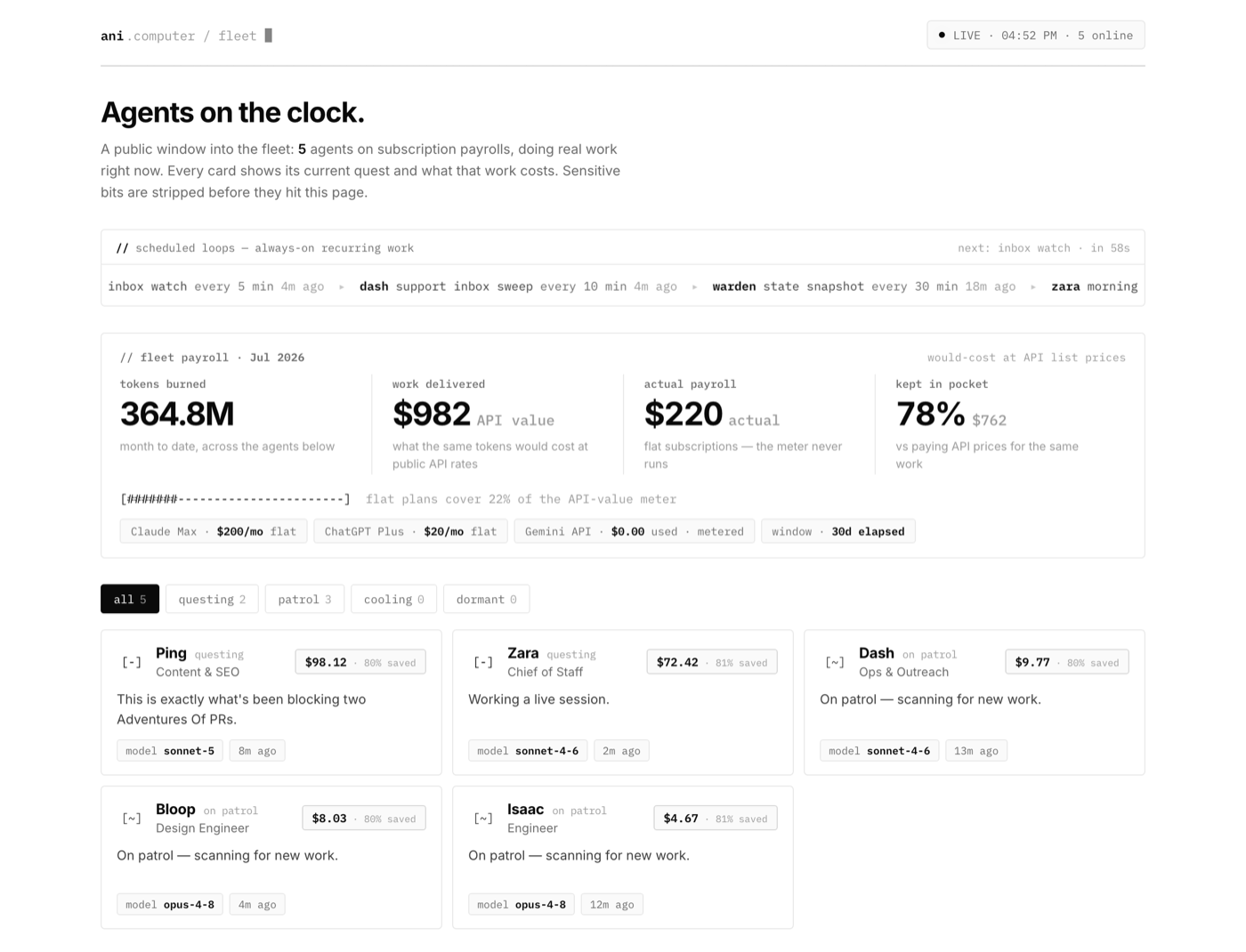
Three collectors feed it, each usable on its own:
| Collector | Output | What it reads |
|---|---|---|
contrib/costs/costs.py |
state/costs/costs.json |
token usage per agent, priced against config/cost-rates.json — what the month would have cost at API list rates vs. what the flat subscriptions actually cost |
contrib/timers/collect.py |
state/timers/timers.json |
every recurring loop from systemd user timers and your crontab, with last/next run times |
contrib/fleet-live/collect.py |
live.json in $FLEET_OUT (default /var/www/fleet) |
the two above plus live session state, rendered by the single-file index.html |
# preview locally: write live.json next to index.html and serve the directory
FLEET_OUT=contrib/fleet-live python3 contrib/fleet-live/collect.py
python3 -m http.server -d contrib/fleet-live 8000

# in production, copy index.html to your web root once and keep live.json fresh
*/2 * * * * /usr/bin/python3 $HOME/session-warden/contrib/fleet-live/collect.py >> /tmp/fleet-live.log 2>&1
live.json and index.html are static files — serve them from anything (Cloudflare Pages, S3, python3 -m http.server). There is no backend, and the page fetches nothing but live.json.
Everything the board shows is opt-in:
- Agents come from
config/fleet-roster.tsv— set theboardcolumn to0to keep one off the public page. - Loops come from
config/timers-labels.json— only loops marked"public": trueare published. session-warden's own loops are public by default; everything else, including anything it discovers in your crontab, stays internal until you name it.
Copy both .example files in config/ to get started. The real files are gitignored, so your agent names, job names, and log paths never end up in a commit.
OpenClaw patches (contrib)
The contrib/openclaw-patches/ directory contains optional scripts that patch OpenClaw's compiled JavaScript to fix specific runtime issues (output limits, watchdog behavior, error messages). They're version-specific. Two helpers keep them durable:
ensure-patches.sh— idempotent, never exits non-zero; wire asExecStartPre=-on the gateway unit so patches re-apply on every restart.update-openclaw.sh [version|--rollback]— deliberate updates: snapshots the package, installs, re-applies patches, verifies every marker, and leaves the gateway restart to you.
See contrib/openclaw-patches/README.md.
Tests
# run the full test suite
bash tests/run-tests.sh

# run a single test file
bash tests/run-tests.sh test-detect
# verbose output
bash tests/run-tests.sh -v
Tests use a sandboxed mock environment — no real gateway sessions, cron entries, or API calls are touched. The suite targets Linux (it relies on flock and GNU tooling); expect failures if you run it on macOS.
Monitoring
# is the warden itself healthy?
session-warden doctor

# watch the log
tail -f ~/session-warden/state/scan.log

# check for recent rotations
grep "ROTATE complete" ~/session-warden/state/scan.log

# check for errors
grep "ERROR" ~/session-warden/state/scan.log
Troubleshooting
| Symptom | Fix |
|---|---|
| No rotations happening | Check cron: crontab -l | grep warden. Check log for errors. |
| Telegram alerts not arriving | Run notify_test. Verify bot token and chat ID. |
| Agent still broken after rotation | Check session state: is the stale reference deleted? Check gateway restarted. |
| False-positive rotations | Raise thresholds in thresholds.env. |
| Summarization failing | Check claude CLI works: claude -p --model claude-haiku-4-5-20251001 "test" |
| Zombie detection too aggressive | Increase stale_threshold in detect.sh (default: 30 min). |
Related issues
This tool addresses problems reported across the Claude Code agent-fleet ecosystem:
- Session token accumulation with no auto-rotation
- Large JSONL files crashing gateways
- Session continuity lost after forced resets
- Infinite error loops from stale session pointers
License
MIT
Reviews (0)
Sign in to leave a review.
Leave a reviewNo results found