skills
Health Warn
- License — License: Apache-2.0
- Description — Repository has a description
- Active repo — Last push 0 days ago
- Low visibility — Only 7 GitHub stars
Code Fail
- exec() — Shell command execution in skills/codebase-recon/scripts/build-typed-cpg.sh
- rm -rf — Recursive force deletion command in skills/codebase-recon/scripts/merge-jsp.sh
- exec() — Shell command execution in skills/codebase-recon/scripts/new-query-workspace.sh
Permissions Pass
- Permissions — No dangerous permissions requested
No AI report is available for this listing yet.
Modernizr: agent skills for investigating legacy software with code property graphs, graph algorithms, and symbolic analysis.
ani-skills
A Claude Code plugin marketplace. One plugin covers one domain, and each plugin carries its own skills.
modernizr
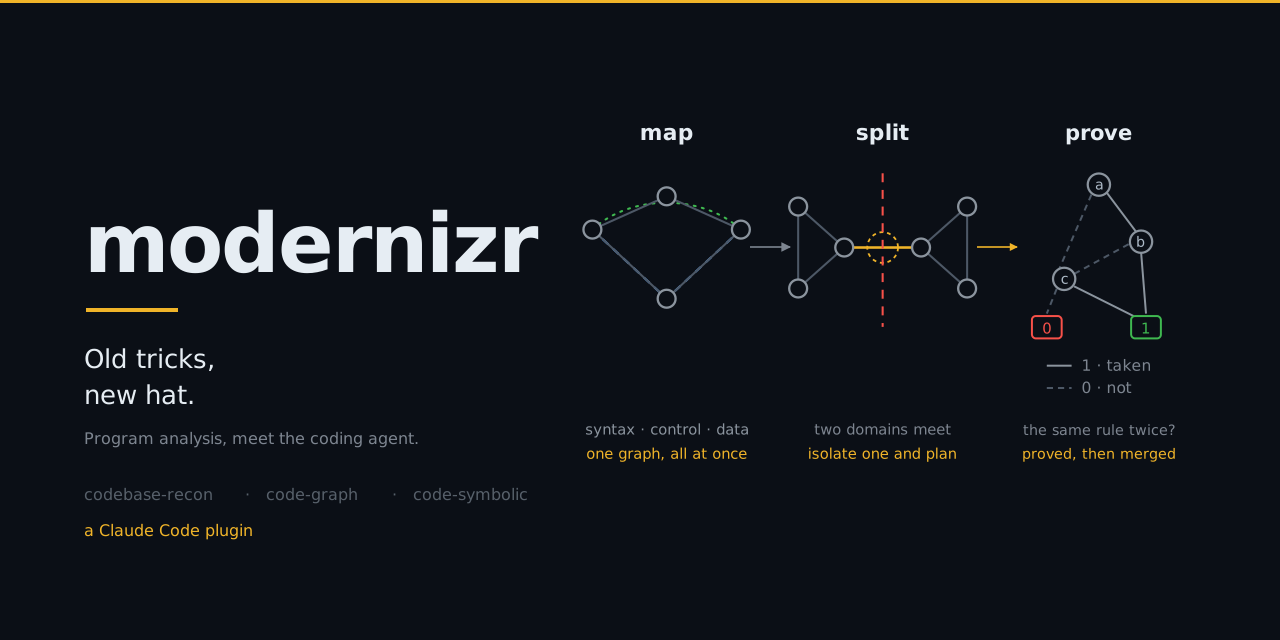
An agent reads files. Some questions are not in any file.
- Is this method genuinely unused?
- Which modules are really coupled?
- Where can this system split?
- Can this business rule ever fire?
Those answers live between files, or in the XML, SQL and templates that are not code at all.
So: build a code property graph once, then point 1970s tooling at it.
- Graph algorithms → where the domains divide, so you plan around a real boundary.
- Formal proof and computer algebra → when two rules are the same rule, when a threshold is already implied, what the merged form is.
The agent decides what to ask and what the answer means.
Some of it is deliberately unorthodox:
- Compile the JSP pages → the presentation layer becomes ordinary methods in the graph.
- Read a framework's bytecode → what its config attributes do.
- Replay the migrations → a schema that no file holds.
The move is always the same: find something that already knows the answer, and get it into the graph.
Three skills, by the shape of the answer you need
| Skill | You need | The answer looks like |
|---|---|---|
| codebase-recon | to locate or enumerate — what does this do, what calls it, what is dead, what does the config actually wire | a list of methods, files and lines |
| code-graph | to split or isolate — where the domains actually divide, how small the interface between them is, what you can plan around | a boundary you can isolate one side of |
| code-symbolic | to prove and simplify — are these two rules the same rule, is this threshold already implied, can these be merged | a proof, and the merged form |
Start with codebase-recon. It:
- builds a code property graph worth trusting
- joins that graph to the XML, SQL, properties and templates the graph cannot see
- tells you, as often as not, that a CPG is the wrong tool and ripgrep already answers your question
The other two skills read its exports.
The plugin also ships hooks. They:
- block a
curlto the Joern server, which silently answers about a different codebase - advise on several trap-shaped queries
scale-engineering
When the same shape repeats N times, do not scope it N times.
Pages, forms, rules, endpoints, reports, migration targets. Scoped one per ticket, each engineer pays a strong model to think the same thoughts again, and AI cost tracks headcount.
scale-engineering moves the unit of work to the class:
- Find the families → group instances by how they vary; a human confirms each family, and the leftovers are the long tail.
- Split slot from slottable entity → build the shared part once, keep only what varies as configuration.
- Verify first → differential tests for a migration, per-family specs for new work.
- Write the generator → AI writes the codemod, deterministic tools run it.
- Fix the generator, never one output → rerun on every instance.
It also sizes the work (foundation + generator + cost per instance × N + long tail, then the break-even N) and says when to skip the approach: small N, parity work nobody needs, weak verification, unconfirmed families.
It is pure method and needs nothing installed. On a legacy codebase, modernizr can find the families for it.
Coming next (modernizr)
Not built yet. Both read the same graph and exports, so the evidence is the same — only the audience changes.
- Test case and test plan generation → what a change can reach, what no test covers, and the cases that close the gap.
- Product and rollout planning → what ships first, what it blocks, and how wide the blast radius is per stage.
Names are not fixed.
Install
/plugin marketplace add aniruddha-adhikary/skills
/plugin install modernizr@ani-skills
/plugin install scale-engineering@ani-skills
modernizr installs three skills and the hooks. scale-engineering installs one skill.
For local development, symlink every skill into ~/.claude/skills:
./scripts/link-skills.sh
- each entry is a symlink into this repo, so a
git pullkeeps installed skills current - re-run it after you add or rename a skill
What the skills expect on your machine
Nothing, to read them. To run them:
| For | You need |
|---|---|
| building and querying a graph | Joern and a JDK |
| resolving dependencies first — do this, it decides whether your answers are real | Maven, or the jars by any other route |
| type-checked query authoring (optional) | Coursier, scala-cli, Metals |
code-graph |
Python and networkx |
code-symbolic |
Python, z3-solver, sympy, dd |
| merging generated code into the graph (optional) | the generator your project uses. The bundled JSP example gets Jasper with Coursier |
Repo conventions
See CLAUDE.md, also readable as AGENTS.md. The short version:
- skills stay thin, and route to reference files
- syntax comes from the tool, not from a copy inside the skill
- a pattern ships only after somebody measured it on a real codebase, where it beat both ripgrep and plain reading
Two rules the content follows, both learned the hard way:
- A number belongs in a skill only if you act on its magnitude — a threshold, a parameter.
Otherwise give the mechanism: "a container is a registry, not a restriction" beats the percentage that proved it. - Measured negatives are content. Betweenness centrality, community detection and MC/DC measurably fail on real code.
Knowing that saves more time than any capability, so the skills document it as carefully as what works.
Reviews (0)
Sign in to leave a review.
Leave a reviewNo results found