phleet
Health Pass
- License — License: MIT
- Description — Repository has a description
- Active repo — Last push 0 days ago
- Community trust — 11 GitHub stars
Code Warn
- fs module — File system access in entrypoint.sh
- process.env — Environment variable access in src/Fleet.Agent/codex-bridge.mjs
Permissions Pass
- Permissions — No dangerous permissions requested
This is an open-source, self-hosted multi-agent AI platform. It uses Docker containers to orchestrate AI-driven agents via Temporal workflows, enabling them to interact with your local codebase and coordinate tasks through Telegram.
Security Assessment
The tool operates with a medium overall security risk. By design, it processes highly sensitive data, including GitHub App private keys, AI provider credentials, and Telegram bot tokens. It actively executes shell commands and scripts, such as the setup wizard, and interacts with the local file system to manage configurations. The platform also makes external network requests to provider APIs (Claude, GitHub, Telegram). The automated scan flagged a warning for environment variable access in a bridge script and file system operations in the entrypoint. Fortunately, no hardcoded secrets were detected, and the manifest does not request inherently dangerous permissions. However, because the agents run locally with your credentials and direct repository access, a compromised or misconfigured agent could expose your code or keys.
Quality Assessment
The project appears actively maintained, with its most recent code push happening today. It uses the permissive MIT license, which is excellent for open-source adoption. Community trust is currently in its early stages, reflected by a modest 11 GitHub stars.
Verdict
Use with caution: while the code is actively maintained and properly licensed, giving autonomous Docker agents direct access to your credentials and local repositories requires strict local security practices.
Open-source autonomous multi-agent AI platform. Dockerized agents driven by Claude or Codex, orchestrated with Temporal workflows and coordinated via Telegram.
Phleet — Autonomous Multi-Agent Platform
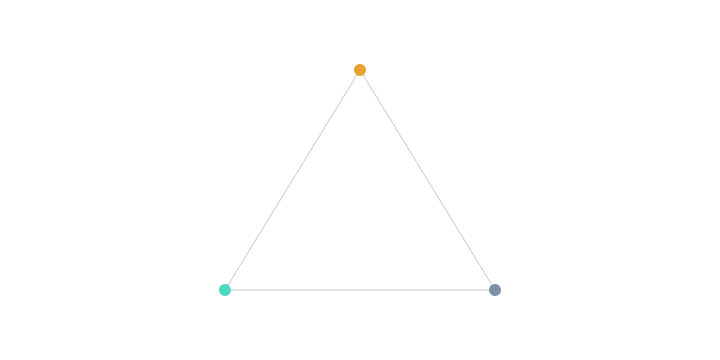
Phleet is an open-source, self-hosted multi-agent AI platform built on .NET 10, coordinated by a central orchestrator backed by Temporal workflows.
Your credentials, your repos, your infrastructure. Agents run as Docker containers on your host, use your Claude or Codex credentials, and hit your repos through your own GitHub App. Control plane, runtime state, workflow history, and memory stay on infrastructure you control; external traffic goes only to the providers you configure — Claude/Codex, GitHub, and Telegram.
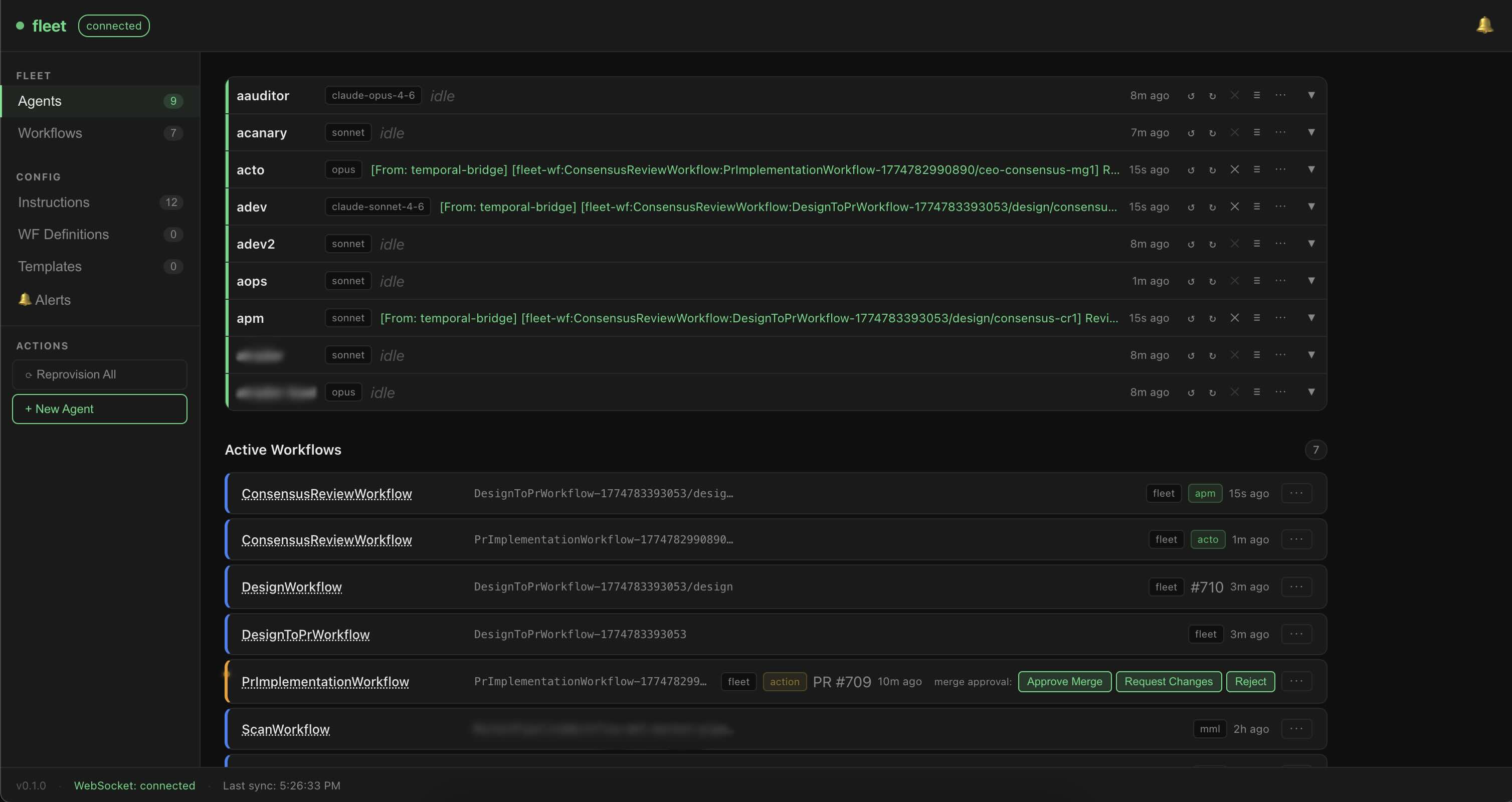
The fleet dashboard — live agent status, model assignment, and in-flight Temporal workflows.
See it in action
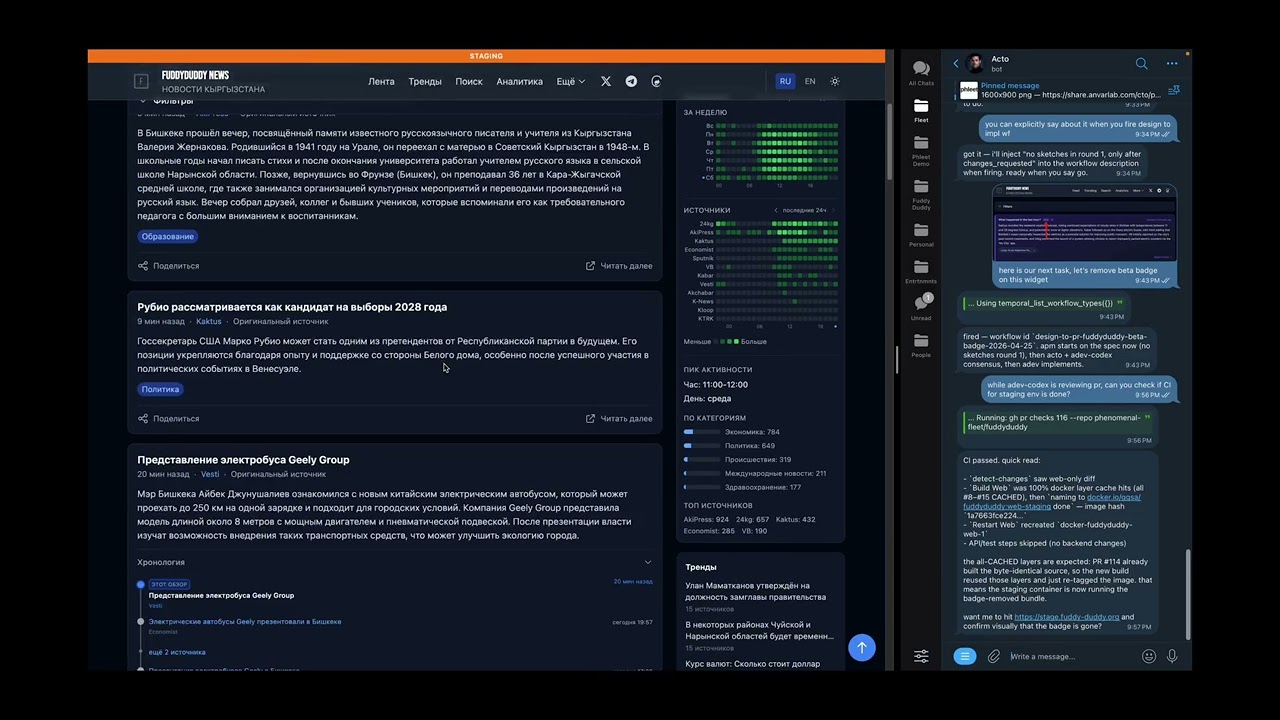
Watch a one-line request go from idea to merged PR — multi-agent design, consensus review, and prod deploy in ~5 minutes.
Quickstart
1. Prerequisites
Docker + Docker Compose (Docker 24+ recommended)
~8 GB RAM and ~20 GB free disk for the full stack (MySQL, Qdrant, Temporal Postgres, MinIO, agent containers)
Two Telegram bots created via @BotFather:
- a CTO bot — dedicated to the co-CTO agent's DMs with you (
TELEGRAM_CTO_BOT_TOKEN) - a notifier bot — shared by every other agent for DMs and group-chat relay (
TELEGRAM_NOTIFIER_BOT_TOKEN)
A single token works if you only ever run the co-CTO, but once a second agent exists you need the split — Telegram allows only one long-poller per token (see Troubleshooting).
- a CTO bot — dedicated to the co-CTO agent's DMs with you (
A Telegram group (optional) for observing agent activity. Create a group, add both bots as members, then forward any message from the group to @userinfobot — it replies with the group's negative integer ID. Paste it into
.envasFLEET_GROUP_CHAT_ID. Leaving it blank disables group routing.A GitHub App with repo access (create one). You'll need its App ID and a downloaded private key (
.pemfile) —setup.shasks for the path, base64-encodes the key, and stores it asGITHUB_APP_PEMin./fleet/.env. Containers decode it to/tmp/github-app-key.pemat runtime; there's no persistent key file on the host outside.env.
2. Run the setup wizard
git clone https://github.com/anurmatov/phleet.git
cd phleet
./setup.sh
setup.sh prompts for the tokens and GitHub App details as it runs — keep this page open while it asks. It creates a ./fleet/ subdirectory next to the repo and puts all runtime state there: .env, seed.json, generated docker-compose.yml, workspaces/, memories/, credentials, MinIO, and MySQL backups. The whole dir is gitignored — to fully reset, stop containers and rm -rf fleet/.
3. Open the dashboard
Once setup finishes, the dashboard is live at:
Auth is controlled by ORCHESTRATOR_AUTH_TOKEN in ./fleet/.env — setup.sh generates it for you.
4. Create your co-CTO agent
seed.example.json ships with no agents. Your first agent — the co-CTO — is created interactively via the dashboard's SetupBanner. Click the CTO template card and follow the prompts. Once the co-CTO is up, DM it in Telegram and ask it to grow the rest of the fleet for you.
Start/stop the stack later
setup.sh starts the services for you. To start/stop them later:
cd fleet
docker compose up -d
docker compose down
All stateful services bind-mount their data under ./fleet/ — no named Docker volumes. Back up or wipe the whole installation by archiving or removing that single directory.
Upgrade after pulling new code
./upgrade.sh              # rebuild all images + restart
./upgrade.sh --no-cache   # force clean rebuild (no Docker layer cache)
upgrade.sh skips all prompts — it stops services, regenerates docker-compose.yml, rebuilds every image, and restarts. Use it after git pull instead of re-running the full setup.sh.
What you get after setup
After ./setup.sh you have a single agent running: the co-CTO. It is the only agent in the orchestrator granted the full agent-lifecycle and workflow-authoring toolset. You don't spin up more agents by editing JSON and restarting containers — you grow the fleet by talking to the co-CTO in Telegram, in plain English.
| You say | What happens |
|---|---|
"Create a new developer agent on sonnet, call it alice, give it Read/Edit/Bash and fleet-memory." |
The co-CTO calls create_agent → manage_agent_* → provision_agent. Container is up within a minute. |
| "We don't need the research agent anymore, stop it and clean up the workspace." | stop_agent / deprovision_agent. Container gone, workspace archived on request. |
"Update the developer role to always run dotnet test before committing." |
create_instruction with a new version, manage_agent_instructions to swap it in. Old version kept for rollback. No redeploy. |
| "Draft a workflow that spawns a design review, waits for my approval, then runs implementation." | create_workflow_definition produces a versioned JSON definition you can run immediately — or open in the visual editor and tweak. |
"Start a PR implementation workflow on issue #123 using agent alice." |
temporal_start_workflow. The co-CTO pings you at the human-review gate; you reply approved / changes_requested / rejected. |
| "Memorize that we use Conventional Commits in this repo." | Stored in fleet-memory (Qdrant + embeddings), searchable by every agent from any future session. |
| "Keep an eye on the fleet while I'm away." | The co-CTO maintains an active task-tracker memory, reviews production-risk changes proposed by worker agents before they run, and facilitates the shared Telegram coordination group. |
The rest of this README is the plumbing — configuration, deployment, troubleshooting. The point of the co-CTO is that after setup you mostly don't need to touch any of it.
What runs
setup.sh provisions the following services, all on the fleet-net Docker network:
rabbitmq— message brokerfleet-mysql— agent config + task historyqdrant— vector store for Fleet Memorytemporal-postgresql— Temporal persistencetemporal-server+temporal-ui— workflow enginefleet-minio(+fleet-minio-init) — S3-compatible store for inter-agent file sharingfleet-memory— semantic memory MCP serverfleet-playwright— browser automation MCP serverfleet-orchestrator— agent registry + lifecycle managerfleet-temporal-bridge— Temporal workflow runnerfleet-bridge— RabbitMQ relayfleet-dashboard— web UI at http://localhost:3700
Platform support
| Platform | Provider | Status |
|---|---|---|
| macOS (Apple silicon) | Claude | ✅ Tested end-to-end — actively run on Mac Studio |
| Linux | Claude / Codex | ⚠️ Expected to work (all containers are linux/amd64 or linux/arm64); untested at release |
| Windows | Claude / Codex | ⚠️ Docker Desktop + WSL2 is the intended path. Unverified |
| Any | Codex | ⚠️ Code paths ship in seed.example.json, but Claude has seen far more wall-clock time in real workflows |
If you run Phleet on Windows, on a Linux host, or with Codex as the primary provider and hit something broken — PRs and issue reports are very welcome. Small fixes and "it works on my box" confirmations are just as valuable as new features here.
Architecture
src/
├── Fleet.Agent/         — core agent process (Telegram + multi-provider AI executor)
├── Fleet.Orchestrator/  — agent registry, lifecycle management, REST/WebSocket/MCP API
├── Fleet.Temporal/      — Temporal workflow engine + bridge (universal workflow runner)
├── Fleet.Bridge/        — RabbitMQ relay for inter-agent messaging
├── Fleet.Memory/        — semantic memory MCP server (Qdrant + ONNX embeddings)
├── Fleet.Telegram/      — outbound Telegram MCP server (per-agent bot routing, notifier fallback)
├── Fleet.Shared/        — shared utilities
└── fleet-dashboard/     — React SPA for monitoring and managing agents
Dockerfile               — agent image (multi-stage, .NET 10)
Dockerfile.temporal      — temporal bridge image
entrypoint.sh            — container init script
gh-auth.sh               — GitHub App JWT utility
How It Works
- The orchestrator bootstraps agents from
seed.jsoninto MySQL on first start. - Each agent container starts, authenticates via a GitHub App JWT, and launches a persistent AI process (
claude -por Codex SDK bridge). - Agents receive tasks via Telegram DM or RabbitMQ and stream responses back.
- Temporal workflows orchestrate multi-step, multi-agent tasks.
- Fleet Memory provides shared semantic memory across all agents (search, store, retrieve).
Visual Workflow Editor
Workflows can be authored as versioned JSON definitions through the dashboard's visual editor — no code, no redeploy. Control-flow primitives (sequence, parallel, loop, branch), agent delegation, child-workflow spawning, and signal-waiting compose into Temporal workflows that run on the same engine as compiled ones.
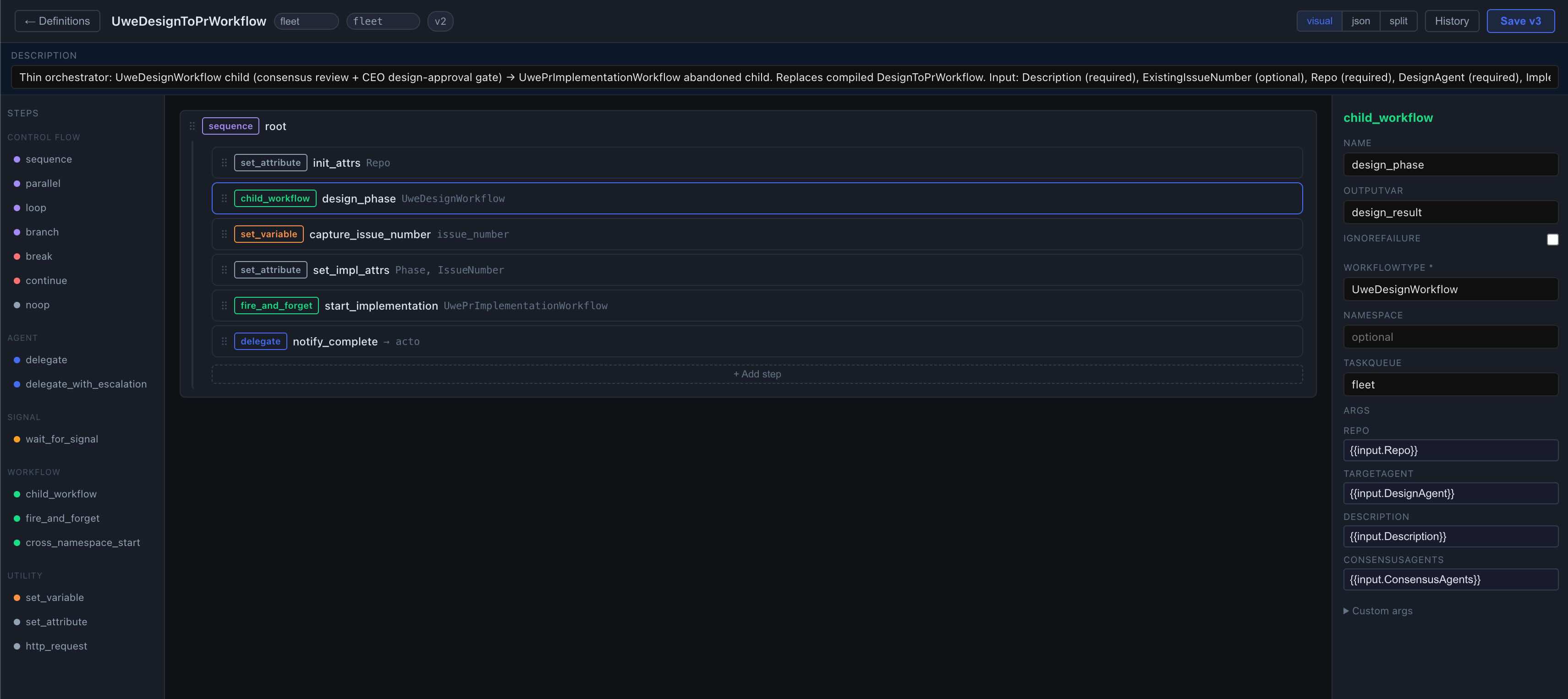
Editing a workflow definition — steps, arguments, and live JSON/visual/split views.
Build
# Build the full solution
dotnet build

# Build Docker images from repo root
docker build -t fleet:agent .
docker build -t fleet:orchestrator -f src/Fleet.Orchestrator/Dockerfile .
docker build -t fleet:memory -f src/Fleet.Memory/Dockerfile .
docker build -t fleet:temporal-bridge -f Dockerfile.temporal .
docker build -t fleet:bridge -f src/Fleet.Bridge/Dockerfile .
docker build -t fleet:dashboard \
  --build-arg VITE_AUTH_TOKEN=your-token \
  -f src/fleet-dashboard/Dockerfile .

# Dashboard dev server
cd src/fleet-dashboard && npm install && npm run dev
Tests
dotnet test
# With output:
dotnet test --logger "console;verbosity=normal"
Configuration
Agent config is database-driven (MySQL via EF Core). On first run, the orchestrator seeds from seed.json.
| File | Purpose |
|---|---|
./fleet/.env |
Secrets and environment overrides (generated by setup.sh, never commit) |
./fleet/seed.json |
Initial agent definitions for DB bootstrap (never commit production configs) |
./fleet/docker-compose.yml |
Generated from docker-compose.example.yml with fleet-dir-relative build contexts |
./fleet/workspaces/ |
Per-agent git workspaces |
./fleet/memories/ |
Per-agent memory files |
./fleet/.claude-credentials.json, ./fleet/.codex-credentials.json |
AI provider credentials (chmod 600) |
GITHUB_APP_PEM (in ./fleet/.env) |
GitHub App private key, base64-encoded; decoded inside containers at runtime |
src/Fleet.Orchestrator/appsettings.json |
Orchestrator defaults |
src/Fleet.Agent/appsettings.json |
Agent image defaults |
The tracked repo root stays clean — only source, .env.example, seed.example.json, and docker-compose.example.yml live there. All runtime state is under ./fleet/.
See .env.example for all required variables with descriptions.
Agent config fields
Each agent entry in seed.json (or created via the co-CTO's create_agent flow) has these key fields:
name— unique identifierrole— maps tosrc/Fleet.Orchestrator/roles/{role}/system.md(seeded into theinstructionstable on first boot)model— e.g.claude-opus-4-7,claude-sonnet-4-6,claude-haiku-4-5shortName— displayed in group messages whenprefixMessagesis ontools— whitelist of tool names the agent may call (built-ins + MCP tool IDs)mcpEndpoints— MCP servers the agent can reach (fleet-memory,fleet-temporal, etc.)envRefs— names of env vars the container is allowed to read (e.g.TELEGRAM_NOTIFIER_BOT_TOKEN,GITHUB_APP_ID)networks— docker networks to attach (typicallyfleet-net)telegramUsers/telegramGroups— who may DM the agent / which groups it listens togroupListenMode—off/mention/alltelegramSendOnly— must betrueon every non-CTO agent that shares a Telegram bot token with others (otherwise Telegram returns 409 Conflict — only one long-poller per token)prefixMessages— when multiple agents share a bot token, settrueso outgoing group messages are prefixed with the agent'sshortName(e.g.[Developer] ...)
Troubleshooting
Agents start returning "unauthorized" from Claude / Codex
OAuth tokens in ./fleet/.claude-credentials.json and ./fleet/.codex-credentials.json expire. When they do, every agent backed by that provider starts failing mid-task with an auth error. There is no in-container refresh path — you refresh on the host, then push the new file in.
- Re-authenticate on your host with the vanilla CLI (
claudeorcodex). This is the same CLI login flow you used during initial setup. - Copy the refreshed credentials into the fleet dir, overwriting the old file:
# Claude — file location varies by platform: # Linux: ~/.claude/.credentials.json # macOS: stored in the login keychain as "Claude Code-credentials" # (setup.sh handles the keychain extraction; for a manual refresh, # the easiest path is to re-run ./setup.sh) cp ~/.claude/.credentials.json ./fleet/.claude-credentials.json chmod 600 ./fleet/.claude-credentials.json # Codex cp ~/.codex/auth.json ./fleet/.codex-credentials.json chmod 600 ./fleet/.codex-credentials.json - Reprovision every affected agent so each container picks up the new file. From the dashboard: click Reprovision on each agent. From the CLI:
TOKEN=$(grep '^ORCHESTRATOR_AUTH_TOKEN=' ./fleet/.env | cut -d= -f2)
for name in $(curl -s -H "Authorization: Bearer $TOKEN" http://localhost:3600/api/agents | jq -r '.[].name'); do
  curl -s -X POST -H "Authorization: Bearer $TOKEN" "http://localhost:3600/api/agents/$name/reprovision"
done
Re-running ./setup.sh also works — it re-copies the credentials and leaves the stack running.
Telegram returns 409 Conflict at startup
Telegram allows only one long-poller per bot token. If two or more agents share a bot token and more than one tries to poll, Telegram rejects them all with 409. Fix: set telegramSendOnly: true on every non-CTO agent that shares a token — they'll still send messages through the bot but won't poll for incoming updates. Only the CTO agent (or whichever single agent owns DMs for that token) should poll. After editing seed.json or the DB, reprovision the affected agents.
Temporal workflow types list looks empty right after a restart
temporal_list_workflow_types populates lazily on first call after fleet-temporal-bridge starts. Immediately after a restart it may return only the hardcoded built-ins and none of the seeded UWE workflow definitions. Wait a few seconds and call it again, or start any workflow once to warm the cache.
License
MIT — see LICENSE.
Contributing
See CONTRIBUTING.md.
Reviews (0)
Sign in to leave a review.
Leave a reviewNo results found