Castor
Health Warn
- License — License: AGPL-3.0
- Description — Repository has a description
- Active repo — Last push 0 days ago
- Low visibility — Only 9 GitHub stars
Code Pass
- Code scan — Scanned 12 files during light audit, no dangerous patterns found
Permissions Pass
- Permissions — No dangerous permissions requested
No AI report is available for this listing yet.
The Universal 245K Agent Microkernel for Local LLMs.
Castor
The Universal 245K Agent Microkernel & MCP Pair-Programming Harness.







Castor is a model-agnostic serving harness and in-process agent microkernel written in Rust and exposed as a standard Model Context Protocol (MCP) server. It pairs high-reasoning cloud orchestrators (Google Antigravity, Gemini 3.8 Flash, Claude Code) with locally-served execution models (Qwen3.8-27B, Ollama, vLLM, llama.cpp) across any repository.
The Ultimate API Bill Cutter: The cloud orchestrator handles high-level architecture, task decomposition, and supervisory steering. The local coworker ingests repository context, executes structural AST refactoring, runs test loops, and mutates code at $0 token cost. Zero cloud token hoarding. 90%+ API cost reduction.
System Architecture
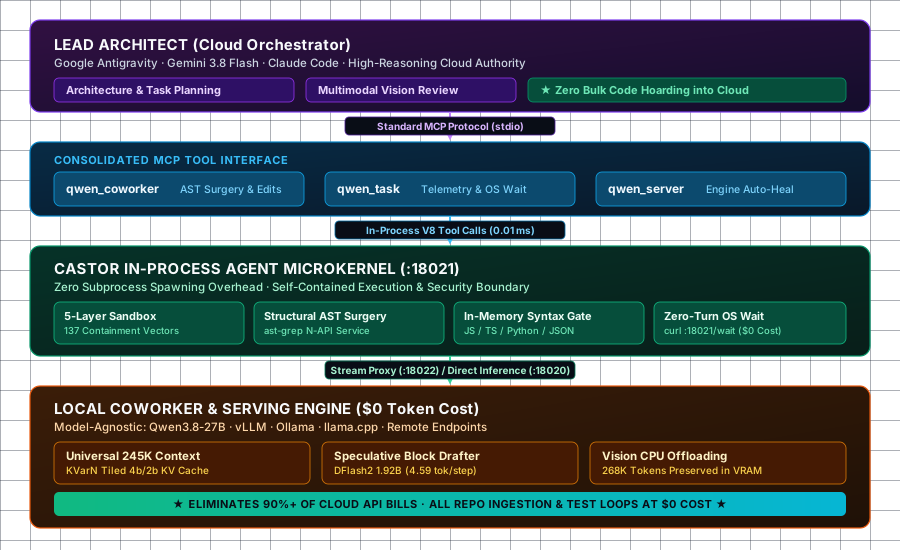
The Asymmetric Division of Labor
- Cloud Orchestrator (Lead Architect): Focuses strictly on architecture, formal interface specification, multimodal vision review, and supervisory steering. Never hoards raw codebase files into paid prompt context.
- Local Coworker (Hands-on Execution @ $0): Ingests repositories, analyzes traces, performs AST surgery (native
ast-grep), and verifies code locally inside the in-process Castor microkernel. - Zero-Turn Reactive Wait: Long-running background dispatches yield an OS-level wait hook (
curl :18021/task/<id>/wait). The cloud orchestrator blocks at $0 token cost and wakes reactively the moment the coworker completes.
Consolidated MCP Interface
Castor exposes three stdio-pure MCP tools to any client:
castor_coworker: Primary execution interface.- Accepts
prompt,cwd,session_id,reasoning_effort(xhigh|medium|low), and optional MCPextensions. - Executes with Universal 245K context and test-time deliberation.
- Accepts
castor_task: Background task management & telemetry.- Actions:
status,cancel,cancel_all,list,stats,extend_lease. - Returns real-time cumulative token counts, generation throughput, cache hit rates, and financial savings.
- Actions:
castor_server: Inference engine lifecycle supervisor.- Actions:
status,start,stop. - Manages engine boot, health canaries, wedge detection, and auto-healing.
- Actions:
Core Capabilities
- In-Process Microkernel & AST Surgery: File operations and structural AST replacements (native
ast-grep) execute in-process (<0.1 ms dispatch) without subprocess overhead. - In-Memory Syntax Gates: Pre-validates modifications in-memory (TypeScript, JavaScript, Python, JSON) before committing to disk, preventing corrupted files.
- Dual Multimodal Vision Authority: Cloud orchestrators (Gemini 3.8 Flash) and local Qwen both support image inputs. Vision-tower CPU offload retains the complete 268K+ KV cache in GPU VRAM.
- Multi-Provider Web Research: Native
web_searchandweb_fetchrouting across SearXNG, Brave Search, and DuckDuckGo with HTML-to-markdown extraction. - Automated State Pruning (
castor clean): Automatic retention policy over~/.castor/(14-day max age, 200-session count, 50MB ceiling,.tmp_*cleanup) with active session immunity and 24-hour startup throttling. - Cooperative Landing: Dispatches reaching their turn budget conclude gracefully with mandatory deliverable synthesis under
completed_budget_exhaustedinstead of arbitrary process kills.
Zero-Trust Sandboxed File Operations
Castor implements a 5-layer defense-in-depth boundary ensuring neither the coworker nor external agents can escape the workspace root:
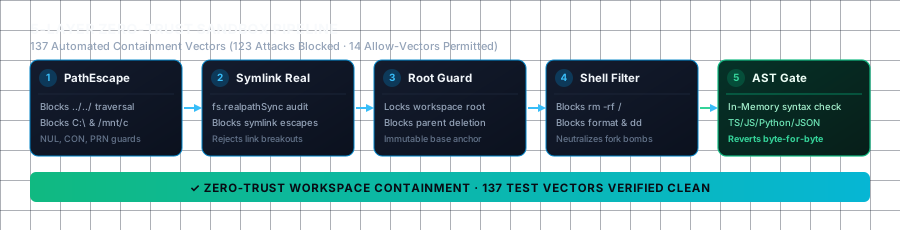
- PathEscape Normalizer: Rejects directory traversal (
../../), raw drive letters (C:\), and device namespaces (NUL,CON,PRN). - Symlink Realpath Containment: Resolves real canonical paths to block symlink breakouts.
- Workspace Root Overwrite Guard: Protects the workspace root and parent directories from deletion or replacement.
- Dangerous Shell Filter: Neutralizes destructive commands (
rm -rf /,format, fork bombs,dd). - AST In-Memory Syntax Gate: Validates syntactical integrity before disk commit; rolls back on parse errors.
Verified by a 137-vector automated containment suite (src/tools/sandbox.rs: 123 attack vectors blocked, 14 allow vectors permitted).
Quickstart
1-Command Setup (via npm / npx)
# Register with Claude Code & Antigravity IDE automatically
npx -y mcp-castor install --client all

# Or install globally
npm install -g mcp-castor
castor install --client all
Building from Source (Rust)
git clone https://github.com/ApatheticMioz/Castor.git
cd Castor

# Build the Rust binary
cargo build --release

# Run unit and integration tests (243 tests, ~7s)
cargo test

# Register with Claude Code and Antigravity IDE
./target/release/castor install --client all
Running the MCP Server
# Directly via compiled binary
./target/release/castor mcp

# Or via cross-platform Node distribution shim
node bin/castor.js mcp
CLI Command Reference
Complementing castor --help:
| Command | Action | Key Options |
|---|---|---|
castor mcp |
Launch standard Model Context Protocol stdio server | (default subcommand) |
castor install |
Auto-register server in Claude (.claude.json) and Antigravity (mcp_config.json) |
--client <all|claude|antigravity> |
castor config |
Inspect resolved configuration hierarchy (CASTOR_* env > config.json > defaults) |
(prints effective values & sources) |
castor server |
Manage serving engine lifecycle (boot, canary health, shutdown) | <status|start|stop> |
castor clean |
Prune stale sessions, leases, and tasks per retention policy | --yes (dry-run by default) |
castor proxy |
Run stateful SSE UTF-8 stream sanitizer proxy (:18022 $\to$ :18020) |
--port, --engine-port |
castor status |
Run zero-turn long-poll HTTP wait endpoint (:18021) |
--port |
castor evo |
Run offline batch evaluations and view lineage DAG | <run|status> |
Repository Structure
Castor/
  Cargo.toml                # Root crate manifest
  Cargo.lock                # Deterministic dependency lockfile
  package.json              # Distribution manifest for npm shim
  bin/castor.js             # Cross-platform distribution shim
  skills/                   # Reusable SKILL.md workflow recipes
  src/
    main.rs                 # CLI entry point (clap dispatch, worker runner)
    config.rs               # Unified serde configuration loader
    platform.rs             # Cross-OS path translation and process management
    skills.rs               # agentskills.io SKILL.md indexer
    telemetry.rs            # JSONL event ledger & derived statistics
    pruner.rs               # State dir retention pruner
    mcp/                    # rmcp stdio transport, schemas, and worker
    task/                   # Task registry, long-poll HTTP wait, semaphore
    proxy/                  # Stream proxy, SSE sanitizer, repetition breaker
    engine/                 # vLLM / OpenAI client, lifecycle, health canary
    runner/                 # Autonomous agent loop, loop detection, events
    tools/                  # Sandboxed FS, AST search/replace, shell, web
    evo/                    # Offline evolutionary optimizer & lineage DAG
  evals/                    # Tier A offline replay and golden test tasks
License & Commercial Dual-Licensing
Licensed under the GNU Affero General Public License v3 (AGPL-3.0) — Castor Contributors.
- Open Source & Copyleft: Free and open-source software under AGPLv3. Network use requires complete source distribution of modified versions.
- Commercial Dual-Licensing: Available for proprietary embedding without copyleft obligations. Inquiries:
[email protected].
Acknowledgments
Reviews (0)
Sign in to leave a review.
Leave a reviewNo results found