rightsize
Health Pass
- License — License: MIT
- Description — Repository has a description
- Active repo — Last push 0 days ago
- Community trust — 26 GitHub stars
Code Fail
- rm -rf — Recursive force deletion command in .claude/settings.json
- exec() — Shell command execution in plugins/rightsize/hooks/cachelife.ts
Permissions Pass
- Permissions — No dangerous permissions requested
No AI report is available for this listing yet.
Make every Claude token count. A Claude Code plugin that picks the model and effort for every prompt.
rightsize
Make every Claude token count.
rightsize sends each prompt to the cheapest model and effort that does the job, raises effort only when Claude is actually stuck, and keeps your cache and context from costing more than they should. No profiles, no tuning: one rule set, two switches.
claude plugin marketplace add archid21/rightsize
claude plugin install rightsize@archid21 --scope user
Status: 0.14.0. Keep warm only while it pays, a Wrap up button, handoff-style compacts, and an opt-in warning for big turns. See New in 0.14.0.
MIT license · works with a Claude subscription (Pro, Max, Ultra) or an API key · Open an issue
Why use it
Same outcome, lower cost from an Opus start. Routine work goes to Haiku or Sonnet helpers and lower effort; Opus keeps the work that needs it. On our coding benchmark it matched Opus at up to 30% lower cost (API-equivalent).
Effort follows evidence, not guesses. A rating never raises effort on Opus or Fable at prompt time. Effort goes up mid-turn only when the turn shows trouble: repeated failures, a loop, or two fixes in a row that leave the tests red. You stop paying for high effort that buys nothing.
Stronger reviews from a Sonnet start. Reviews switch to Opus for that one turn and come back. You get Opus-grade review without switching models yourself. If your default is Sonnet you may spend more: on our coding benchmark, about 1.4x to 2x what Sonnet alone costs, almost all of it from reviews. Your cost depends on how many reviews you run.
It learns which routes to trust. Every hand-off, lowering, test run and thumbs rating scores the rater per kind of work and model. A model that misses on reviews stops getting reviews until your own outcomes say otherwise.
Cut cache and compact costs. Keeps the cache warm only while your own record says that is cheaper than coming back cold, stops if the cache misses, warns as your context fills, steps aside for Claude's idle compact, and compacts only when the saving beats the cost.
rightsize works better with whatsnext. rightsize decides when a compact pays. whatsnext decides what to keep: it saves a handoff note first, so a compact retains the details that matter. rightsize asks it for that handoff before the cache goes cold and uses its compact text for Compact now. rightsize works on its own too: when whatsnext isn't installed or set up in the project, it compacts with its own handoff-style text, and a Wrap up press or a typed wrap up compacts instead of saving a note.
The problem: one model for every prompt
Claude Code runs every prompt on the model you picked, at the effort you picked. So you pay one of two prices:
- Opus on everything. Renaming a variable costs as much as reviewing a pull request. On Pro you hit your 5-hour limit before lunch; on Max and Ultra you still run into the weekly cap.
- Sonnet on everything. Your usage lasts, but the work that needs Opus most, reviews and hard bugs, gets a weaker answer.
Switching by hand with /model works until you forget, which is most of the time.
What you get
| Feature | What it delivers | How to use it |
|---|---|---|
| Smart routing | Routine work on cheaper models, Opus where it counts | Automatic. Ask before changing in /config makes it ask first. |
| Effort control | Lower effort for routine prompts; raised mid-turn only when Claude is stuck | Automatic. The Lowering and Raising rows set ask, automatic or never. |
| Cheaper helpers | Big routine edits handled at lower cost | Automatic from Opus or Fable sessions. Press Run on your model on the band to undo one. |
| Opus reviews | Stronger reviews without switching models | Automatic. The Stronger model row sets ask first or always send. |
| Watch only | See what rightsize would save before it changes anything | Set Mode to watch only, then run /rightsize report after a week. |
| Keep warm | Avoid paying to rewrite a cold cache | Automatic (while it pays). Or set Before the cache goes cold to keep warm for a set time, save a handoff, compact, ask or off; or pick a time when the band offers it. |
| Wrap up | End a session with a handoff note, or a compact if whatsnext is not set up | Press Wrap up on the countdown row, or type wrap up. |
| Big-turn warning | A heads-up before and during an unusually expensive turn | Off by default. Set Big-turn warning under Advanced. |
| Context-size warning | Compact before the conversation gets costly | Appears at 40–90% full. Press Compact now. |
| Compact before your 5-hour limit | Save usage after a window reset | Press Compact now when the band advises it. |
| Handoff before a compact ★ | A compact that retains the details that matter | Install whatsnext. rightsize asks it automatically, before the cache goes cold and before Compact now. |
| Cost report | Measured savings, spend and return rate | Run /rightsize report. |
| Band and settings | See and change every decision | Use the band's buttons and ⋯ menu, /config, or /rightsize settings. |
★ Needs whatsnext.
Routing in action
Screenshots from a real session, with captions added.
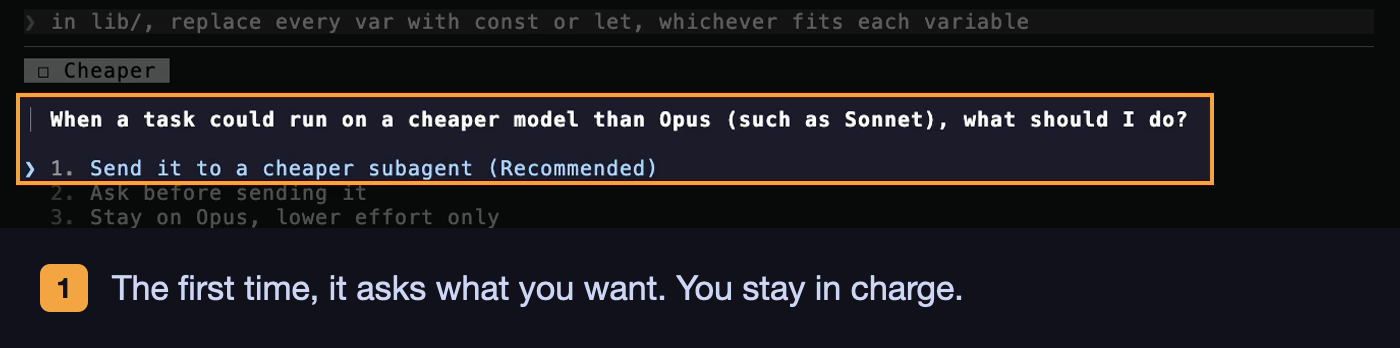
1. The first time, it asks what you want. You stay in charge.
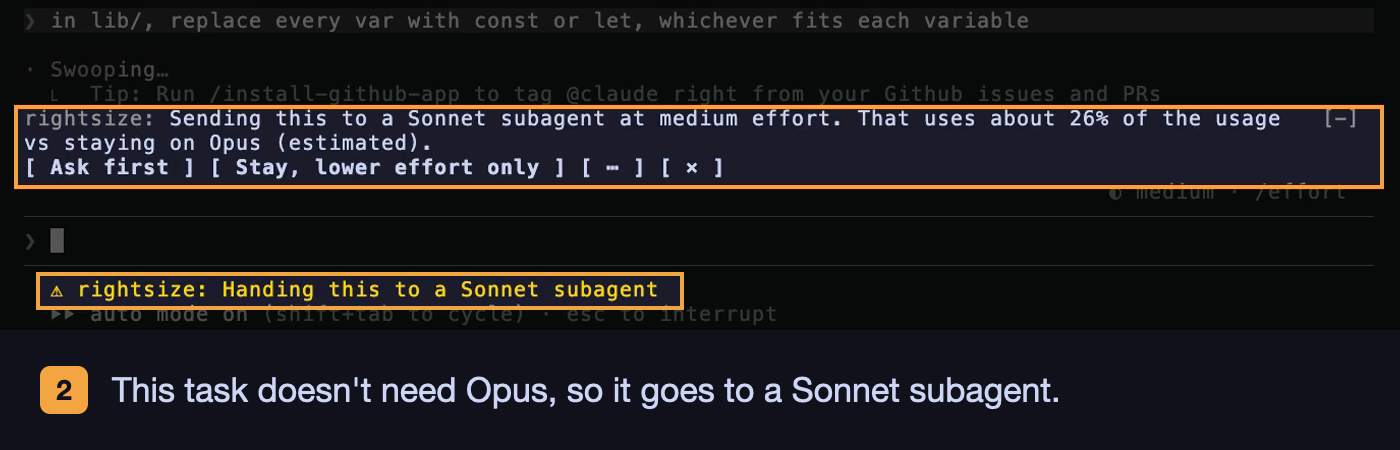
2. This task doesn't need Opus, so it goes to a Sonnet subagent.
3. Done by Sonnet: $0.18 instead of about $2.41 on Opus (estimated).

The cache and compact bands
Each row sits above the prompt. The figures are examples; yours come from your own sessions and prices.
In the desktop app, the same rows are labelled and the buttons are drawn as buttons. This is a mock-up of the layout.
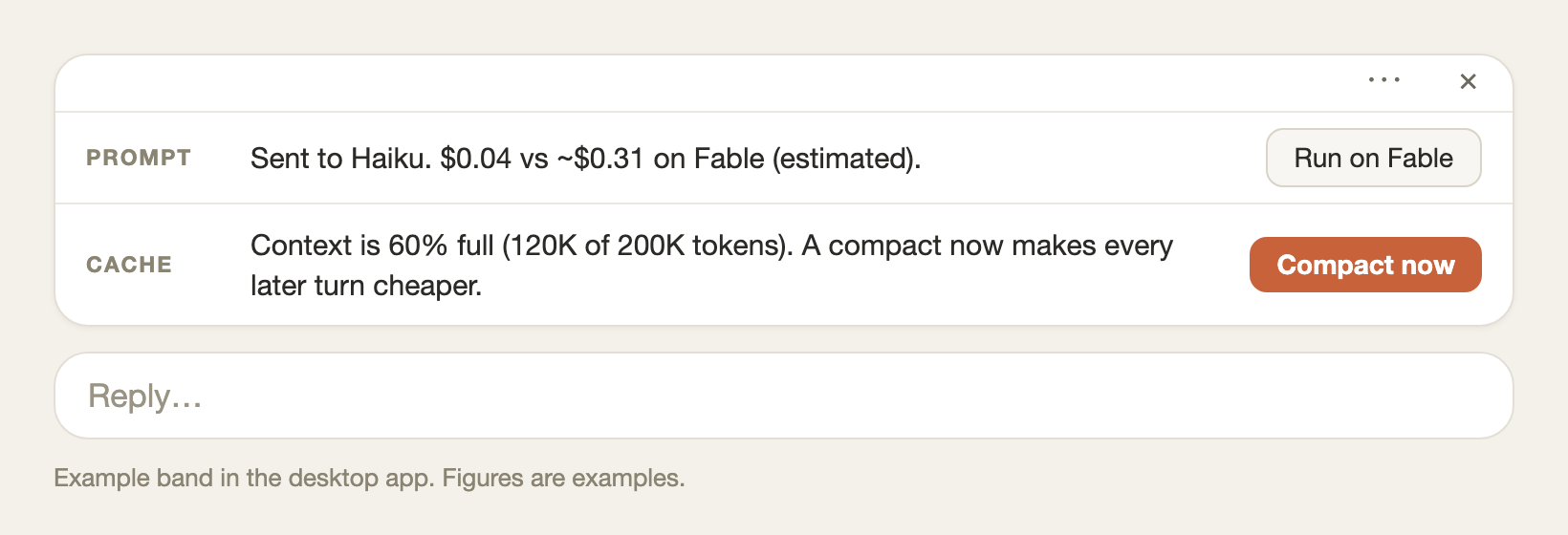
In the terminal, each row is one line with its buttons below.
Keep warm offer. The cache will go cold soon, and coming back would cost this much.

Context-size warning. The conversation reached the next step of the window.

Advice to compact before your 5-hour limit.

See it run
A routine edit stays on Sonnet; a review switches to Opus for one turn; the band shows what each cost.
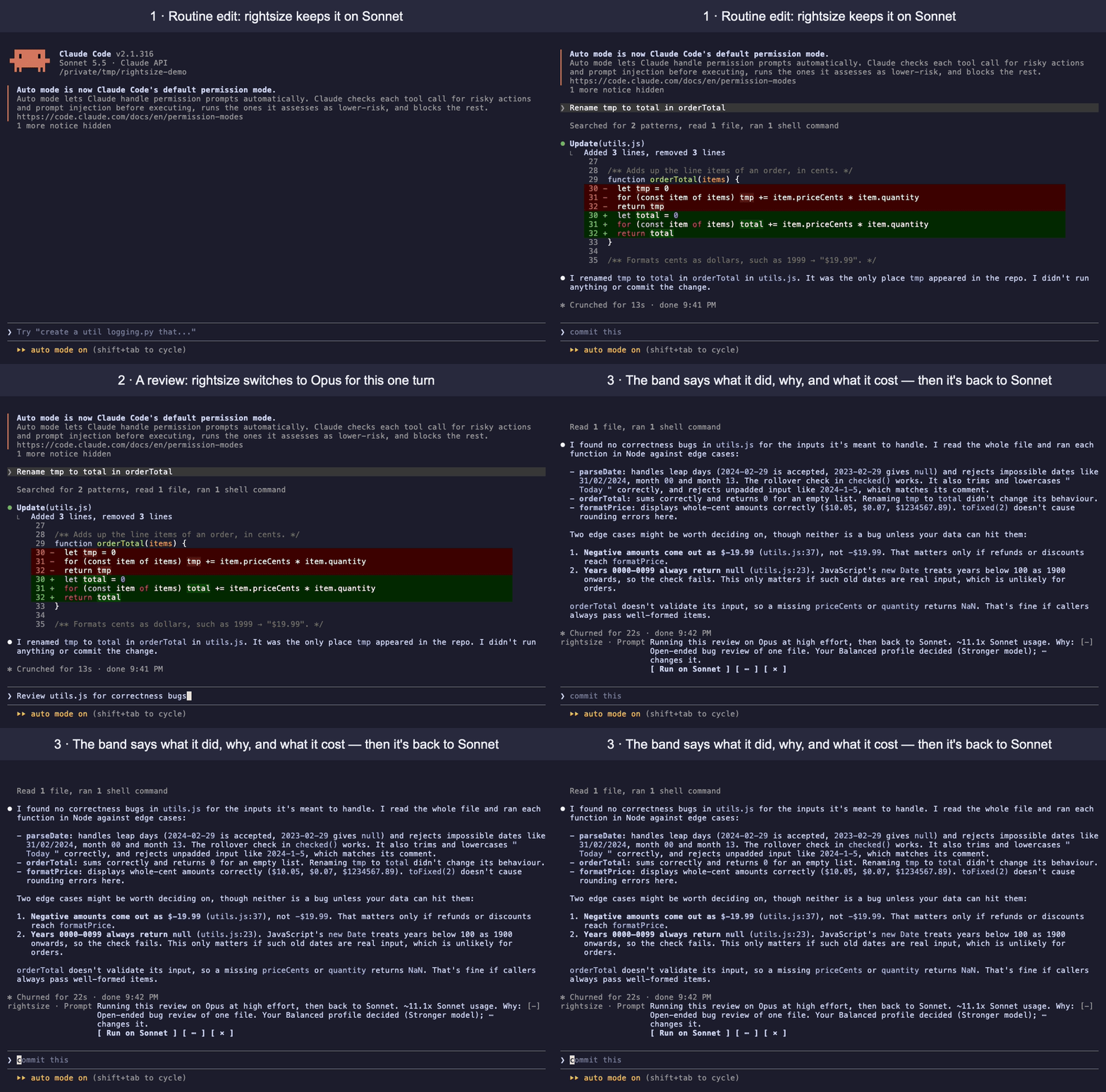
Opus results, without Opus prices. Before each prompt runs, a quick rating decides what kind of work it is. Routine work stays on Sonnet. Reviews switch to Opus at high effort for that one turn, then your chat goes back.
More from your plan. On Pro, Max and Ultra, rightsize watches your usage windows (weekly, and 5-hour where your plan has one) and saves harder as you run low. Opus allowance goes to the work that needs it.
Big routine jobs, done cheaper. Working on Opus? A large, mechanical job such as the same edit across many files can go to a Haiku helper. Your main chat writes the brief, checks the result against it, and sends it back if anything is off. On our benchmark these hand-offs passed as often as Opus at a bit under half the cost. rightsize hands off only when the brief and the check still leave a saving, so from a Sonnet session it never does.
Come back to a warm session. A long session is cheap only while its prompt cache (the stored copy of your conversation) is warm. Step away past the cache's life (an hour on a subscription, 5 minutes on an API key) and your next prompt pays to rebuild it. rightsize keeps a big session warm while you are away only when your own record of how long you stay away says it pays, and never past the point where coming back cold would be cheaper. When no keep-warm request is due, it compacts if that pays, and otherwise saves a whatsnext handoff note.
| Coming back to a 150k-token Opus session | Cost at API prices |
|---|---|
| Cold: the conversation is written to the cache again | About $1.20 |
| Kept warm for 8 hours: one cheap cache read per hour | About $0.25 |
On a subscription, a keep-warm request draws a small share of your usage window, far less than rebuilding the cache; the band shows the running share. The band shows Warm until 8:30 · ~0% used, with a Stop button.
Compact before it costs you. As a conversation fills the window, the band says so at 40, 50, 60, 70, 80 and 90%, skipping any point where Claude Code would compact by itself. Near your 5-hour limit it advises a compact while the cache is warm. Nothing compacts until you press the button.
Leave a thread cheaper to come back to. Before the cache goes cold, rightsize can keep it warm, or save a whatsnext handoff and compact, whichever costs less. It acts only on the choice you made, and it never compacts a closed thread on its own.
Cost you can see. A band above the prompt says what rightsize did and why. /rightsize report shows what each choice cost against staying on your own model, including the times it cost more. The report also shows how many sessions came back to a cold cache and what a compact could have saved on each.
Safe to try. Watch-only mode rates every prompt and changes nothing, so you can see its calls on your own work first.
| Opus on everything | Sonnet on everything | Sonnet + rightsize | |
|---|---|---|---|
| Results on our benchmark | Baseline | Fewer tasks passed | Matched Opus |
| Cost | Highest | Lowest | About 30% less than Opus |
| Reviews | Opus | Sonnet | Opus, for that turn |
| Remembering to switch | You | You | rightsize |
Benchmark: real tasks from open-source repositories, each graded by hidden tests the model never sees. Your results depend on your work and settings. Method: docs/METHOD.md.
New in 0.14.0
- Keep warm only while it pays. The default of Before the cache goes cold now sends a keep-warm request only when your own record of idle breaks says it covers its cost. It stops on a cache miss, and a value you set yourself still wins.
- Wrap up. A button on the countdown row, or typing
wrap up, saves a whatsnext handoff note, or compacts when whatsnext is not set up. - Handoff-style compacts. A bare
/compactand Claude Code's automatic compact use rightsize's handoff text; text you type after/compactis never replaced. - Big-turn warning (opt-in). Warns before a prompt that looks unusually expensive, and during a turn that is heading there, with Keep going and Finish up. Nothing is sent or stopped for you.
- How each task ended. Tasks get an outcome, and the report shows how each route did and what lowered turns stepped back up from.
- Fast mode is priced, and estimates now learn in dollars, so expensive turns count for more.
Every change: CHANGELOG.md. Every feature: docs/FEATURES.md.
New in 0.13.0
- The report leads with a checked saving: the overall saving as a range, checked against what staying really costs, with prompts you overrode left out.
- A spend limit for helpers instead of a flat call count, with a new Long helpers row. An unanswered question never loses a helper's work.
- Cache-life advice. Once a month the band prices a 5-minute and a 1-hour cache for how you work and asks once whether to switch.
- Did it work? The report measures each setting change against the days before it.
- Watch only ends with a row after 7 days that shows what rightsize would have saved.
- Six plain rows in settings. Question wait, Price check and Rater are fixed values now.
Every change: CHANGELOG.md. Every feature: docs/FEATURES.md.
Quickstart
You need Claude Code 2.1.287 or newer (2.1.286 in the desktop app) and a Claude subscription or API key. The handoff compact text also needs python3 (on a Mac it comes with the Xcode command line tools, as git does); without it a compact uses Claude Code's own summary.
Install:
claude plugin marketplace add archid21/rightsize
claude plugin install rightsize@archid21 --scope user
Start a new session and type
/rightsize. If the settings pane opens, it works.On an Opus start, the band offers Switch: /model sonnet once. Press it, then Enter. rightsize never changes your model by itself.
Work as usual. After a few sessions, run
/rightsize report.Optional: install whatsnext for compacts that retain better information.
Want to watch first? In /config, set Mode to watch only.
How it works
- Rate. When you send a prompt, a hook asks Sonnet at low effort what kind of work it is and which models would do it well. This takes about a second.
- Route. rightsize keeps the prompt on your model, changes the effort level, switches to Opus for one turn, or hands the work to a helper subagent on a cheaper model. It acts only when its estimate says the choice pays.
- Check. After the turn it records what happened: rework, a failing test, a reply you correct, your 👍 or 👎. A route that keeps missing for a kind of work is paused for that kind of work.
- Watch the cache and context. At the end of a turn, rightsize checks the conversation's size and how long the cache will live. It can keep the cache warm, warn that the context is filling, or advise a compact. It acts only when its estimate says the choice pays, and it compacts only when you press a button.
What leaves your machine. Nothing goes to the author. The rating runs through Claude Code with your own sign-in, like any other prompt. Logs stay in ~/.claude/mods-logs/rightsize/. rightsize's web requests are a monthly fetch of Anthropic's pricing page (Price check, can be turned off) and a GitHub star check through your own gh sign-in (at most once a session, only after rightsize has saved you something, until you answer the star ask): docs/PRIVACY.md.
What it costs to run. Each rating adds about one second and a small Sonnet call before the prompt. The report counts that cost against the savings, so the totals you see are after rightsize's own cost.
What it never does. It never changes your model for you, never approves a tool call, never changes a permission, and never touches your project files. Hooks and file paths: docs/WHAT-IT-TOUCHES.md.
What it runs, writes and sends. It runs mkdir, chmod, rm and rmdir on its own log folders and, with whatsnext installed, git rev-parse and whatsnext's own script. It also runs git rev-parse --is-inside-work-tree, to know whether to suggest whatsnext init. When you type exactly wrap up and whatsnext isn't set up in the project, it drops that prompt and compacts instead. For the star ask it runs gh api (and open or xdg-open when starring fails). The script's commands read what to compact and whether a handoff is missing; rightsize writes none of whatsnext's settings or files. It writes only under ~/.claude/mods-logs/rightsize/, its own store, its own prices.json, and ~/.config/archid21/stars.json (shared with whatsnext). Its web requests go to platform.claude.com (Anthropic's pricing page, monthly, sends nothing of yours) and, for the star ask, to GitHub through your own gh; it sends nothing to the author. It sets only its own rightsize.* settings, submits only the fixed text wrap up, reads no credential, and its tool.call hook only ever denies, never approves. The full list, checked against the code: What it runs, writes and sends.
Make it yours
One rule set, two switches. Hand-offs turns helper subagents off (effort still changes). Ask before changing makes every move ask first. The rest is fixed or has an Advanced row you can set.
| Default | Row | |
|---|---|---|
| Moves to a cheaper model when | The rating says it fits and the helper costs under 70% of staying | Cheaper model (the 70% bar is fixed) |
| Lowers effort when | Every prompt on Opus or Fable but a review runs at low; elsewhere when the rating says the lower level fits | Lowering |
| Reviews on Opus | Yes, highest effort | Stronger model |
| Keeps the cache warm while you're away | Only while your own record says it pays | Before the cache goes cold |
When keeping warm over your usual idle time would cost at least 3 times a compact, keep warm becomes a compact instead. A Before the cache goes cold row you set yourself always wins.
Recipes
- Opus reviews, but no helper subagents: set Hand-offs to off.
- Just effort, no model changes: set Stronger model to stay and Cheaper model to stay.
- Ask before anything changes: set Ask before changing to on, or set any of the four rules to ask me.
Routing, Hand-offs and Cache each turn one feature off. Every setting, with its options and default: docs/SETTINGS.md. Every rule and number: docs/HOW-IT-DECIDES.md. Every feature, how it works, its value and the release that added it: docs/FEATURES.md.
Commands
| Command | What it does |
|---|---|
/rightsize |
Settings pane |
/rightsize report |
What you saved, what rightsize did, and what to change |
/rightsize report details |
Accuracy, turns not counted, time and whole tasks |
/rightsize welcome |
What rightsize does, as a table (also shown once after install) |
/rightsize tips |
Show the tips again |
/rightsize status |
What is in use and the settings you changed |
/rightsize retry |
Runs the last lowered prompt at normal effort |
/mods |
Turns rightsize on or off |
All commands: /rightsize help.
Update, pause, remove
claude plugin update rightsize@archid21
- Pause:
/mods, orclaude plugin disable rightsize@archid21(keeps your settings). - Remove:
claude plugin uninstall rightsize@archid21, thenrm -r ~/.claude/plugins/store/rightsize_*.json ~/.claude/mods-logs/rightsize*to delete its data.
Limits
- Older models are priced by their own row. Haiku 5.5, Sonnet 5.5, Opus 5.5 and Fable 5.2 are each family's newest model. Older versions, such as Opus 4.8 or Fable 5.1, cost more, so
prices.jsonholds a row for each version the pricing page lists, and rightsize prices a main chat on an older version by its row. An effort change there writes the whole conversation again, so it is priced that way. A version with no row pauses rightsize: the band says so once, and/rightsize pricesfetches the current list. - The rating is a model's estimate. It can be wrong on a single prompt; miss tracking corrects it over time.
- Hand-offs take longer than staying, because the helper adds a brief and a check. The band says so.
- If you already use Sonnet for everything, rightsize costs more than you pay now. What you get for it is Opus on reviews.
- Handoff notes before a compact need whatsnext. Without it, rightsize compacts with its own handoff-style text.
- rightsize compacts only the open session, and only when you press a button or set a row to compact. It does not compact closed threads.
- The effort picker in the app does not move; the status line shows the level in use.
Get involved
- ⭐ Star the repo if it saves you usage.
- Found a bad call? Open an issue with the band text and
/rightsize status. - Using it, and want to say how it went? Send feedback: what you use, what it did well or got wrong, and optionally your
/rightsize report. - Pull requests are welcome: CONTRIBUTING.md.
Made by Archi Dubey. An independent project, not made or endorsed by Anthropic. MIT © 2026.
Reviews (0)
Sign in to leave a review.
Leave a reviewNo results found