blink-query
Health Warn
- License — License: MIT
- Description — Repository has a description
- Active repo — Last push 0 days ago
- Low visibility — Only 5 GitHub stars
Code Fail
- execSync — Synchronous shell command execution in benchmark/bench.ts
- execSync — Synchronous shell command execution in benchmark/run-all.ts
- spawnSync — Synchronous process spawning in benchmark/run-all.ts
- execSync — Synchronous shell command execution in benchmark/setup.ts
- execSync — Synchronous shell command execution in examples/llm-wiki/benchmark/grep-baseline.ts
- execSync — Synchronous shell command execution in examples/llm-wiki/benchmark/harness.ts
- process.env — Environment variable access in examples/llm-wiki/benchmark/harness.ts
Permissions Pass
- Permissions — No dangerous permissions requested
This is a knowledge resolution library and MCP server for LLM agents. It allows AI tools to search, resolve, and retrieve information from local Markdown files using a local SQLite database, without requiring cloud access or embeddings.
Security Assessment
The overall security risk is Low. The tool does not request any inherently dangerous permissions or contain hardcoded secrets. The automated security scans flagged several instances of synchronous shell execution and process spawning, along with environment variable access. However, all of these code executions are strictly isolated within benchmarking, testing, and example scripts. They are entirely absent from the core library code, meaning the tool will not arbitrarily execute system commands during standard operation.
Quality Assessment
The project uses the permissive and standard MIT license. It appears to be actively maintained, with repository activity as recent as today. The README is highly detailed, includes straightforward documentation, and references a robust suite of passing tests. The primary weakness is a lack of community visibility; with only 5 GitHub stars, it is very early in its lifecycle and has not yet received widespread peer review or community trust validation.
Verdict
Use with caution — the core library appears safe and well-structured, but the project is very new and lacks established community trust.
A typed wiki for LLMs — markdown on disk, resolution in the library.
blink-query
A typed wiki for LLMs — markdown on disk, resolution in the library.



blink-query is a knowledge resolution library for LLM agents. Markdown files stay on disk where you can read and edit them; the library adds typed records, title-weighted BM25 search, deterministic path resolution, and an MCP server — all in a SQLite file next to your notes. No cloud, no embeddings, no daemon.
Features
- 5 typed record types —
SUMMARY,META,SOURCE,ALIAS,COLLECTION— each carries a consumption instruction for the agent (read the summary / parse JSON / fetch the source / follow the redirect / browse children) - Namespaces — slash-delimited paths group records by topic (e.g.,
wiki/concepts,decisions/auth,people/arpit); each record has a stable path atnamespace/slug-of-title - Title-weighted BM25 over FTS5 — title matches ranked 10× over body summary, with per-type rank offsets that promote canonical pages
- Hub-vs-leaf default classifier — automatically promotes
index/README/Homefiles in hub directories toSUMMARY, no per-corpus tuning - Path resolution — deterministic O(1) lookup by namespace/slug, with
NXDOMAIN/STALE/ALIAS_LOOPstatuses - MCP server with 11 tools — drop-in for Claude Desktop, Claude Code, Cursor, Codex
- Query DSL — Peggy-parsed:
wiki where type = "SUMMARY" and tags contains "auth" limit 10 - Multi-source ingestion — markdown directories, PostgreSQL rows, GitHub Issues, git repos, web URLs
- Zones — top-level namespaces with default TTL and required-tag policies
- [[wikilink]] extraction — auto-creates
ALIASrecords on ingest
Quick start
npm install -g blink-query
blink init                 # auto-detect agent (Claude Desktop, Code, Cursor, Codex) and write MCP config
blink wiki init my-wiki    # scaffold + ingest a wiki directory
blink doctor               # verify install
Or use it as a library:
npm install blink-query
import { Blink } from 'blink-query';

const blink = new Blink({ dbPath: './wiki.db' });
await blink.ingestDirectory('./my-wiki');
const results = blink.search('how to configure auth');
Step-by-step walkthroughs:
- Using blink-query in your project — install, ingest, query, common patterns, custom derivers, troubleshooting
- Connecting to your agent — Claude Desktop / Code / Cursor / Codex per-agent setup, verification, troubleshooting
Benchmark
One command. Three public markdown corpora. One library configuration.
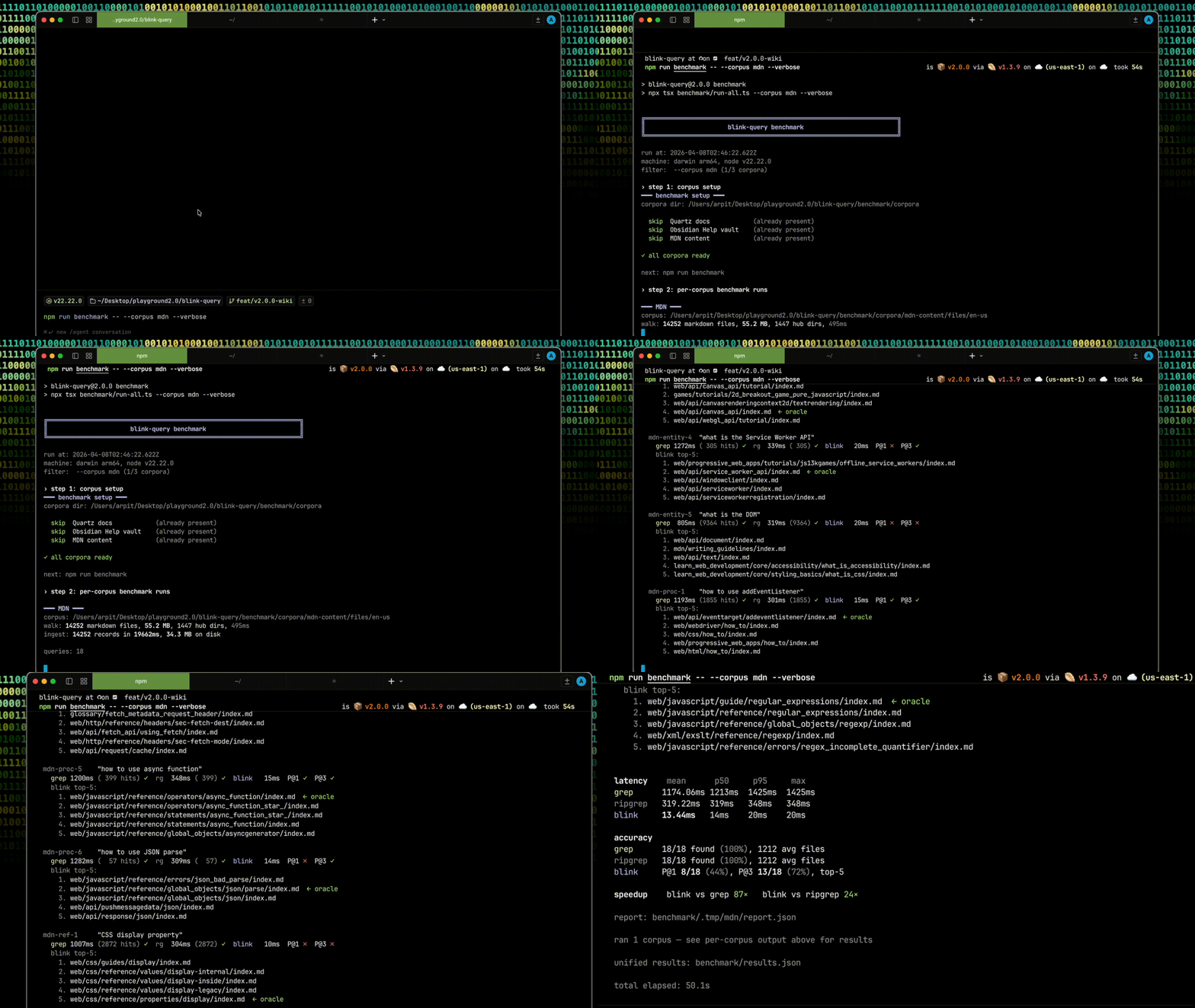
npm run benchmark
| Corpus | Files | grep mean | ripgrep mean | blink mean | vs grep | vs ripgrep |
|---|---|---|---|---|---|---|
| Quartz docs | 76 | 8.9 ms | 11.1 ms | 0.36 ms | 25× | 31× |
| Obsidian Help | 171 | 15.9 ms | 11.9 ms | 0.56 ms | 28× | 21× |
| MDN content | 14,251 | 891 ms | 249 ms | 9.83 ms | 91× | 25× |
blink-query is 25x–91x faster than grep across 3 corpora, 21x–31x faster than ripgrep. Speed gap widens with corpus size — blink scales sub-linearly, grep scales linearly.
On the 14k-file MDN corpus, grep returns an average of 1,212 unranked files per query (because common terms like "Promise" appear in 1,314 files, "DOM" in 9,363). blink returns top-5 ranked. The agent reads ~242x fewer files to find the answer.
Accuracy across the 3 corpora: P@3 = 79% average (88% on Obsidian, 79% on Quartz, 72% on MDN). Verifiable regex oracles for every query in benchmark/bench.ts. Methodology, caveats, and reference numbers in benchmark/README.md.
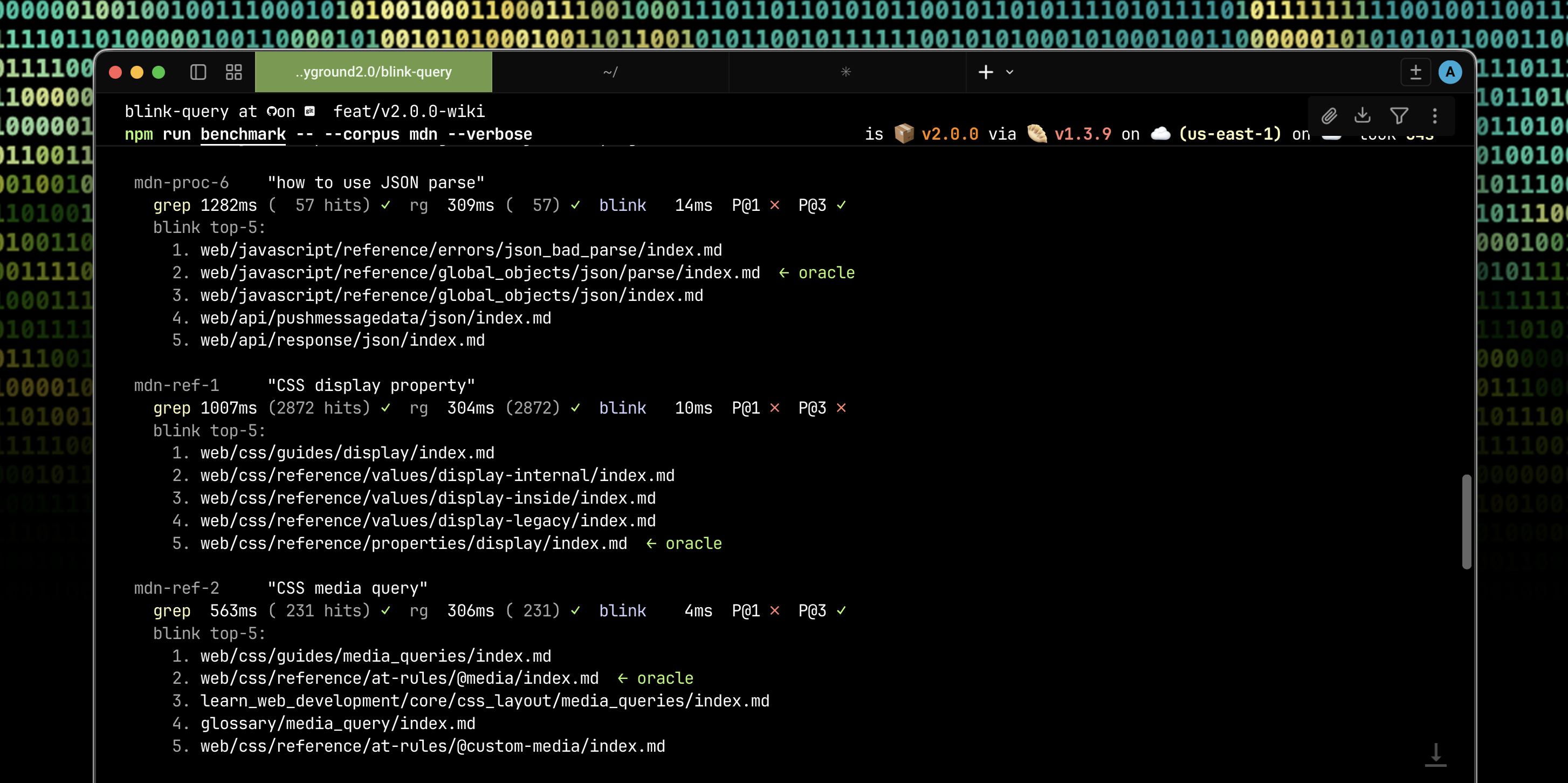
The bench script auto-clones the corpora into benchmark/corpora/ (gitignored, ~270 MB on first run), runs blink + grep + ripgrep on the same file set with the same query set, and prints a unified comparison. No --mode flag. No per-corpus tuning. No presets.
What this is, and isn't
blink-query is a library, not a framework. It's additive on top of plain markdown:
- Your files stay where they are. Markdown in
sources/,entity/,topics/,log/<date>/. You can grep them, open them in any editor, commit them to git, nothing about them is opaque. - The library adds an index, types, and a query interface. Think of blink-query as a deterministic faster path on top of the same files.
- No embeddings. BM25 / FTS5 only. If you want semantic retrieval, run a vector store alongside and pick whichever answer is better for the query.
- No cloud. SQLite file on disk. MCP server over stdio. Runs entirely on your machine.
- No magic. Ingestion is rule-based derivers you can override. Classification is based on filename + frontmatter you control. The query DSL is a Peggy grammar you can read.
If you want raw markdown + grep, the files still work that way. If you want typed records with an index, install the library.
Five record types
The type is a consumption instruction — it tells the agent how to use the record, not what it's about. Content carries the domain semantics.
SUMMARY — read the summary directly, you have what you need.
Use for processed wiki pages, entity descriptions, topic overviews. The agent doesn't need to fetch anything else.
META — structured data (JSON content field).
Use for configuration, log entries, session state, entity attributes. The agent parses content as JSON.
SOURCE — summary here, fetch the source if you need depth.
Use for references to external documents: papers, URLs, git files, API specs. Summary gives enough to decide whether to fetch.
ALIAS — follow the redirect to the target record.
Use for cross-linking. [[wikilinks]] in your markdown auto-extract to ALIAS records on ingest.
COLLECTION — browse children, pick what's relevant.
Use for namespace indexes. Auto-generated when you resolve a namespace path that has no direct record.
Install in your agent
The easy path:
npx blink-query init
This auto-detects Claude Desktop, Claude Code, Cursor, and Codex. It handles the nvm + absolute-node-path gotcha on macOS/Linux, wraps npx in cmd /c on Windows, and merges into your existing MCP config — it never overwrites other servers (if the JSON fails to parse it backs up to .bak and warns).
Run blink doctor afterwards to verify.
Manual config
Claude Desktop — ~/Library/Application Support/Claude/claude_desktop_config.json (macOS) or %APPDATA%\Claude\claude_desktop_config.json (Windows):
{
  "mcpServers": {
    "blink": {
      "command": "npx",
      "args": ["-y", "blink-query", "mcp"],
      "env": { "BLINK_DB_PATH": "~/.blink/blink.db" }
    }
  }
}
Claude Code:
claude mcp add-json blink --scope user '{"type":"stdio","command":"npx","args":["-y","blink-query","mcp"]}'
Cursor — ~/.cursor/mcp.json (same shape as Claude Desktop, key mcpServers).
Codex — ~/.codex/config.toml:
[mcp_servers.blink]
command = "npx"
args = ["-y", "blink-query", "mcp"]

[mcp_servers.blink.env]
BLINK_DB_PATH = "~/.blink/blink.db"
nvm users: if your agent can't find npx, run blink init --absolute-node to write the absolute path to your node binary instead. Avoids the "agent doesn't source shell rc" issue.
Runtime capabilities
Once connected, the agent can resolve, search, save new records, move or delete existing ones, create new zones with required-tag policies, and ingest fresh markdown — all via MCP tool calls at runtime. No restart, no re-deploy, no re-ingest. The knowledge base grows under the agent's own hands.
The MCP server exposes 11 tools, grouped by what they do:
Read
| Tool | Does |
|---|---|
blink_resolve |
Deterministic O(1) path lookup with NXDOMAIN / STALE / ALIAS_LOOP statuses |
blink_get |
Get a single record by exact path (no resolution) |
blink_search |
Title-weighted BM25 search, returns top-K ranked records |
blink_query |
Peggy DSL query: structured filters, sort, limit, offset |
blink_list |
Browse a namespace, sort by recent / hits / title |
Write
| Tool | Does |
|---|---|
blink_save |
Create or update a record — the agent authors new knowledge at runtime |
blink_move |
Move a record from one path to another |
blink_delete |
Delete a record by path |
blink_ingest |
Ingest a directory of markdown files into typed records |
Zones
| Tool | Does |
|---|---|
blink_zones |
List all registered zones with their metadata |
blink_create_zone |
Create a new zone with description, default TTL, and required tags — the agent carves out namespaces on demand |
Drop BLINK_WIKI.md into your project root (or paste it into your agent's system prompt) so the agent knows how to use the wiki pattern.
CLI
# Wiki workflows
blink wiki init my-wiki          # scaffold + ingest
blink wiki ingest ./my-wiki      # re-ingest after changes
blink wiki lint                  # find STALE, NXDOMAIN, broken aliases

# Core operations
blink resolve wiki/mcp-protocol  # deterministic O(1) lookup
blink search "tool call protocol"
blink query 'wiki where type = "SUMMARY" limit 10'
blink list wiki --limit 20

# Agent setup
blink init                       # write MCP config for detected agent
blink doctor                     # post-install diagnostic

# Data management
blink ingest ./docs --prefix wiki
blink move wiki/old wiki/new
blink delete wiki/outdated
blink zones
All commands support --json for machine-readable output and --db for a custom database path.
Library API
import { Blink, extractiveSummarize } from 'blink-query';

const blink = new Blink({ dbPath: './wiki.db' });

// Ingest a directory of markdown files
await blink.ingestDirectory('./my-wiki', {
  summarize: extractiveSummarize(500),
  namespacePrefix: 'wiki',
});

// Resolve — deterministic O(1) path lookup
const response = blink.resolve('wiki/mcp-protocol');
if (response.status === 'OK') console.log(response.record.summary);

// Search — title-weighted BM25 over typed records
const results = blink.search('tool call protocol');

// Query DSL
const summaries = blink.query(
  'wiki where type = "SUMMARY" order by hit_count desc limit 10',
);

// Save a new record (idempotent on path — upserts by namespace + slug-of-title)
blink.save({
  namespace: 'wiki/concepts',
  title: 'OAuth Flow',
  type: 'SUMMARY',
  summary: 'OAuth 2.1 flow for first-party apps — PKCE, refresh tokens, session scoping.',
  tags: ['auth'],
});

// Create a zone with a required-tag policy
blink.createZone({
  namespace: 'decisions',
  description: 'Architecture decision records',
  defaultTtl: 31536000,    // 1 year, inherited by saves into this zone
  requiredTags: ['adr'],   // save() throws if missing
});

blink.close();
All CRUD operations are synchronous (resolve, get, save, delete, move, search, list, query, createZone, zones). Only ingestion is async.
Schema doc for your agent
BLINK_WIKI.md is the document your LLM agent reads to understand how to use blink-query as a wiki. It covers namespace conventions, all five record types with examples, ingest/query/log/lint workflows, and four worked example sessions.
Drop it in your project root or paste it into your agent's system prompt.
Example
examples/llm-wiki/ is a complete end-to-end example: a 30-file MCP ecosystem corpus ingested, queried, and benchmarked against grep.
Scope
blink-query handles:
- Markdown and plain text (primary)
- PostgreSQL tables (via
loadFromPostgres) - Web URLs (via
loadFromURL) - Git repositories (via
loadFromGit) - GitHub Issues (via
loadFromGitHubIssues)
It does not do:
- Vector embeddings — BM25/FTS5 only. Layer a RAG system on top if you need semantic similarity.
- Sync or replication — single SQLite file, local. Sync the markdown source via git and re-ingest.
- Hosted storage — no cloud, no accounts. Your data lives in a
.dbfile you own. - Agent orchestration — blink-query resolves knowledge. It doesn't plan tasks or coordinate agents.
Development
npm install
npm run build       # builds parser + library + CLI
npm test            # 524 tests
npm run benchmark   # universal benchmark on 3 public corpora
Status
v2.0.0 — published on npm as blink-query. MIT license.
npm install blink-query        # library
npm install -g blink-query     # CLI + blink init
Issues and PRs welcome.
Reviews (0)
Sign in to leave a review.
Leave a reviewNo results found