orbit
Health Warn
- License — License: Apache-2.0
- Description — Repository has a description
- Active repo — Last push 0 days ago
- Low visibility — Only 5 GitHub stars
Code Pass
- Code scan — Scanned 12 files during light audit, no dangerous patterns found
Permissions Pass
- Permissions — No dangerous permissions requested
No AI report is available for this listing yet.
Your backlog drives your agents. Linear, Claude Code and code review in one native macOS app. Fork it and make it yours.

Orbit
Your backlog drives your agents. You review and decide.
A native macOS app for product engineers: Linear, Claude Code and code review in one window.
install · why orbit · the clone · make it yours · cloud agents · features





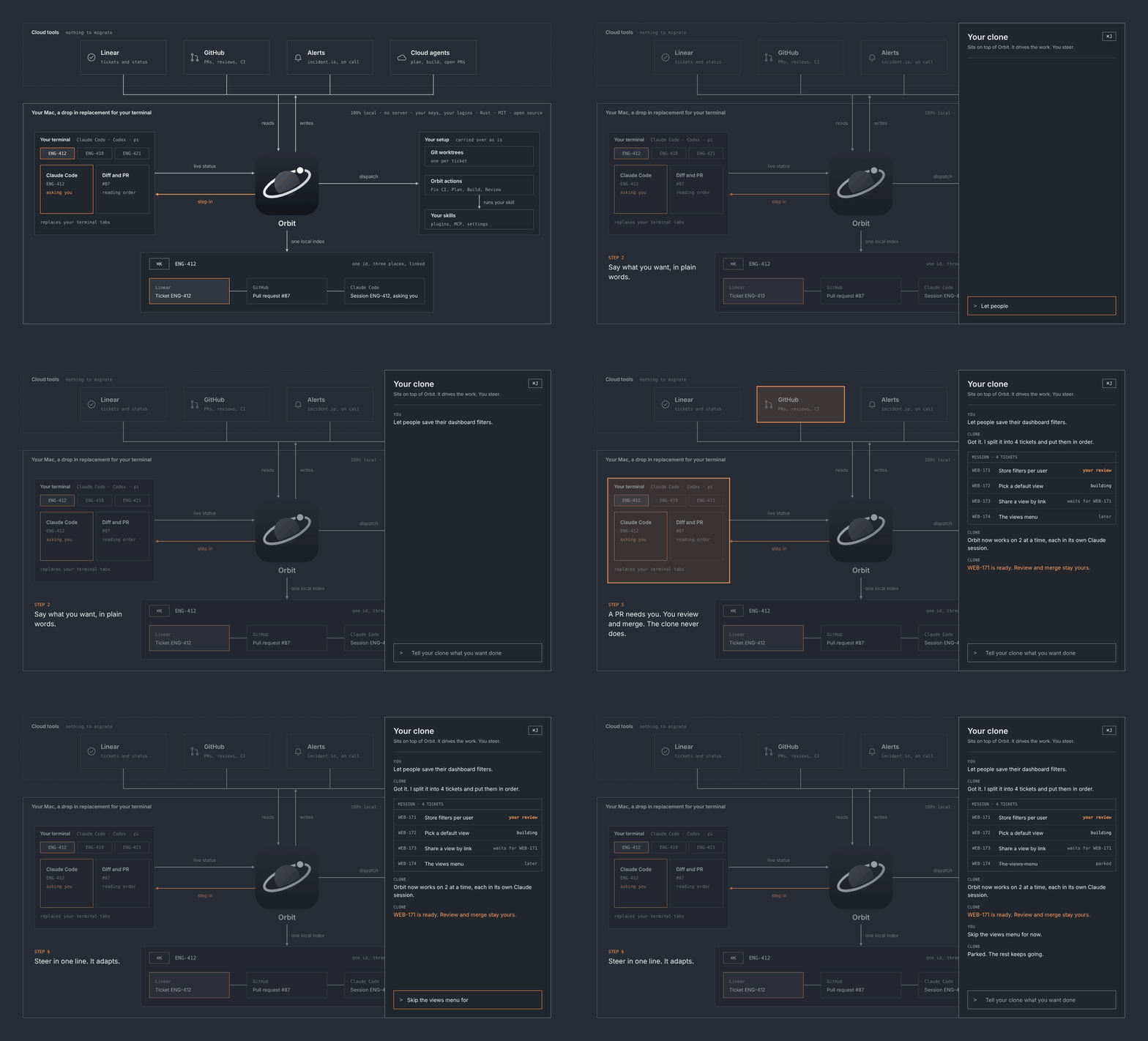
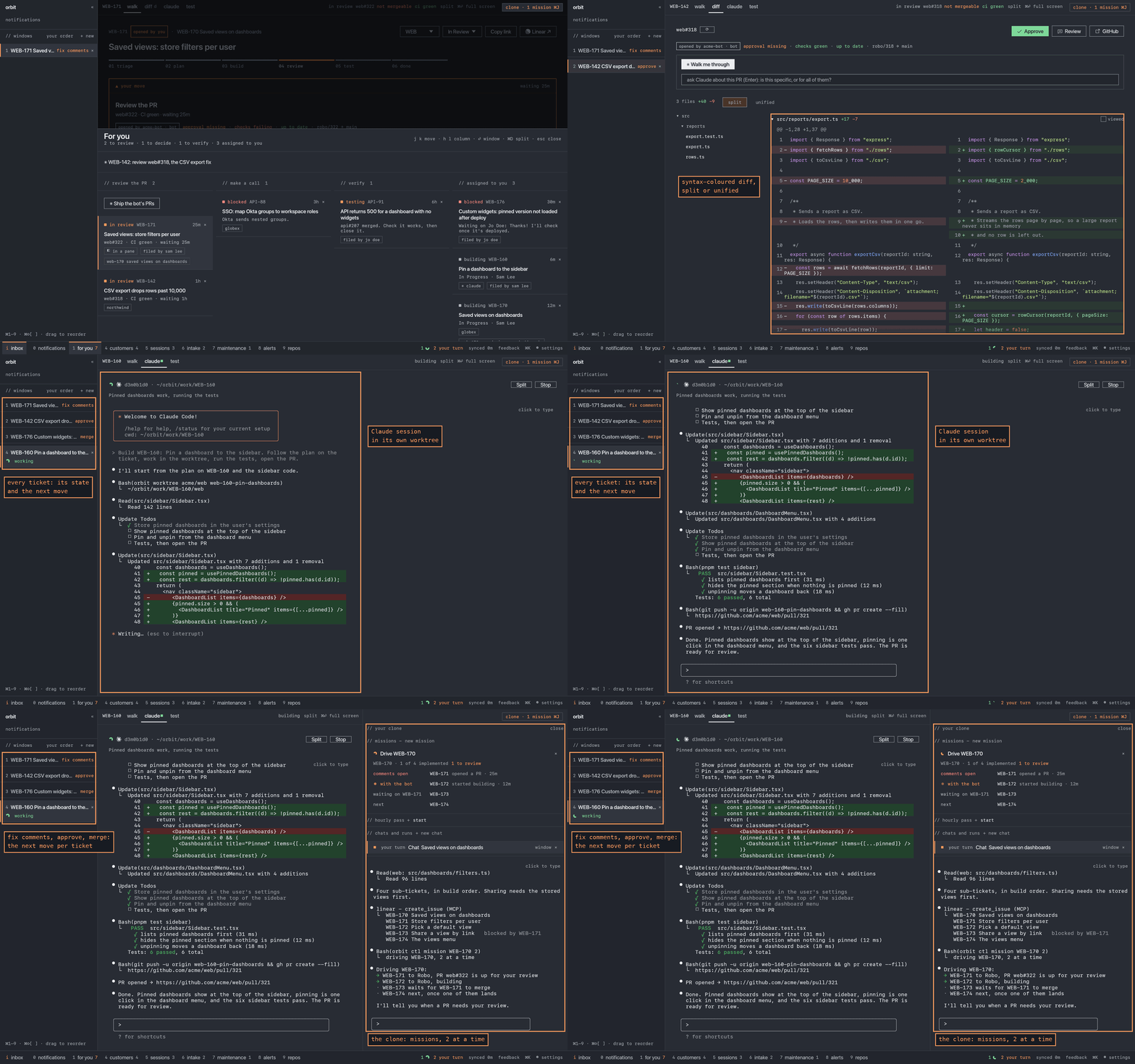
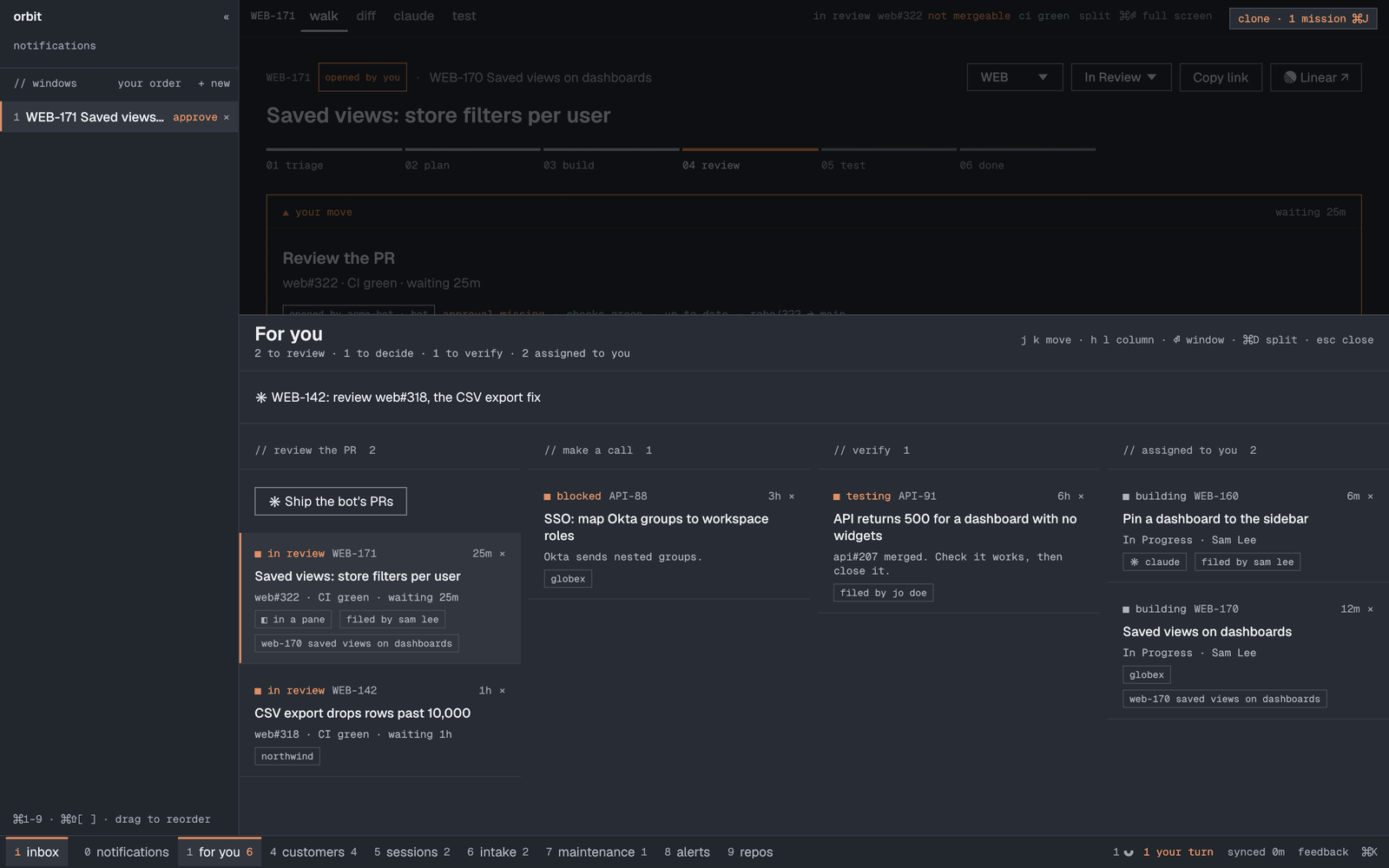
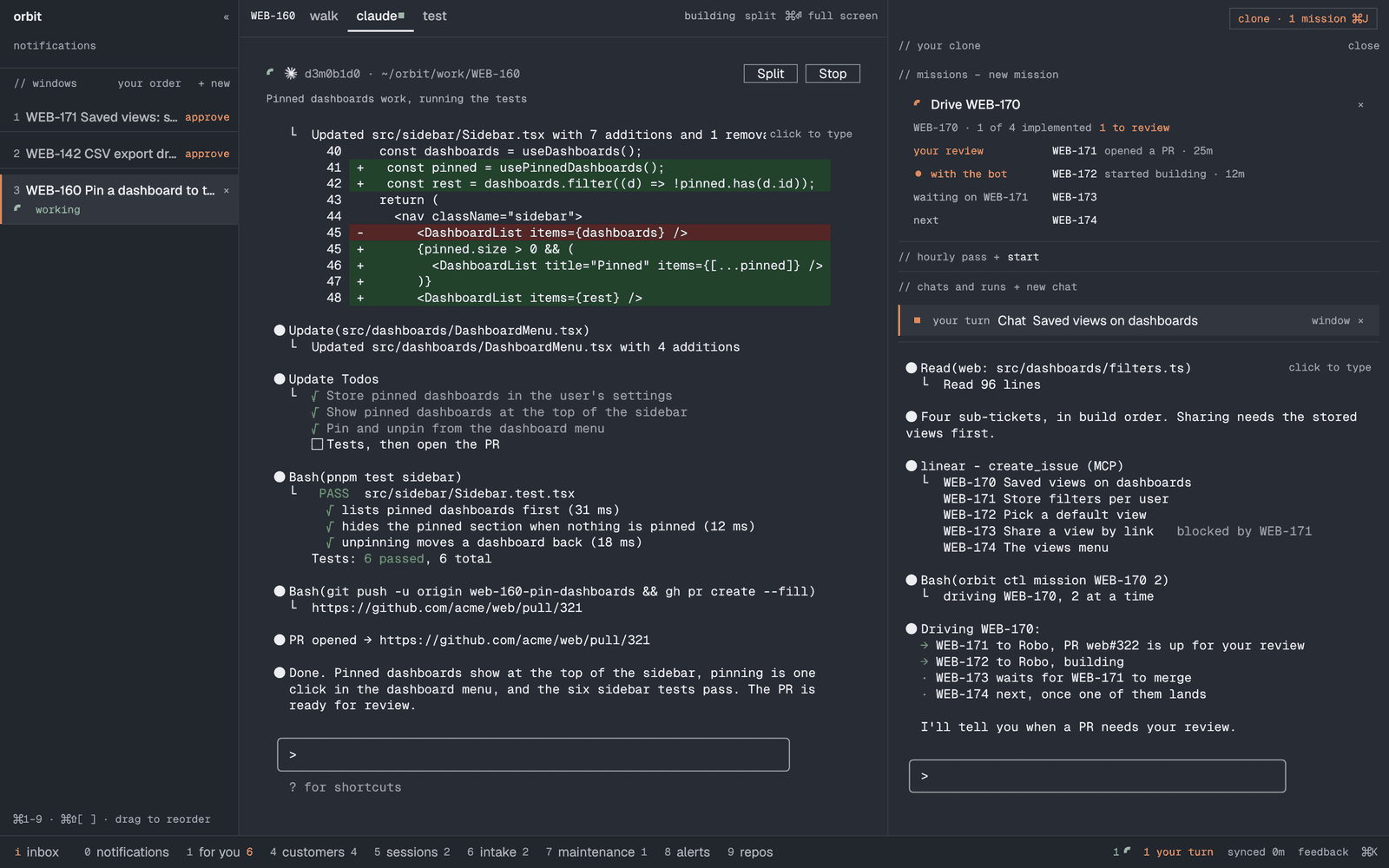
Left: every ticket with its state and next move (fix comments, approve, merge). Middle: its Claude session. Right: the clone, driving a goal of many tickets.
How it fits together
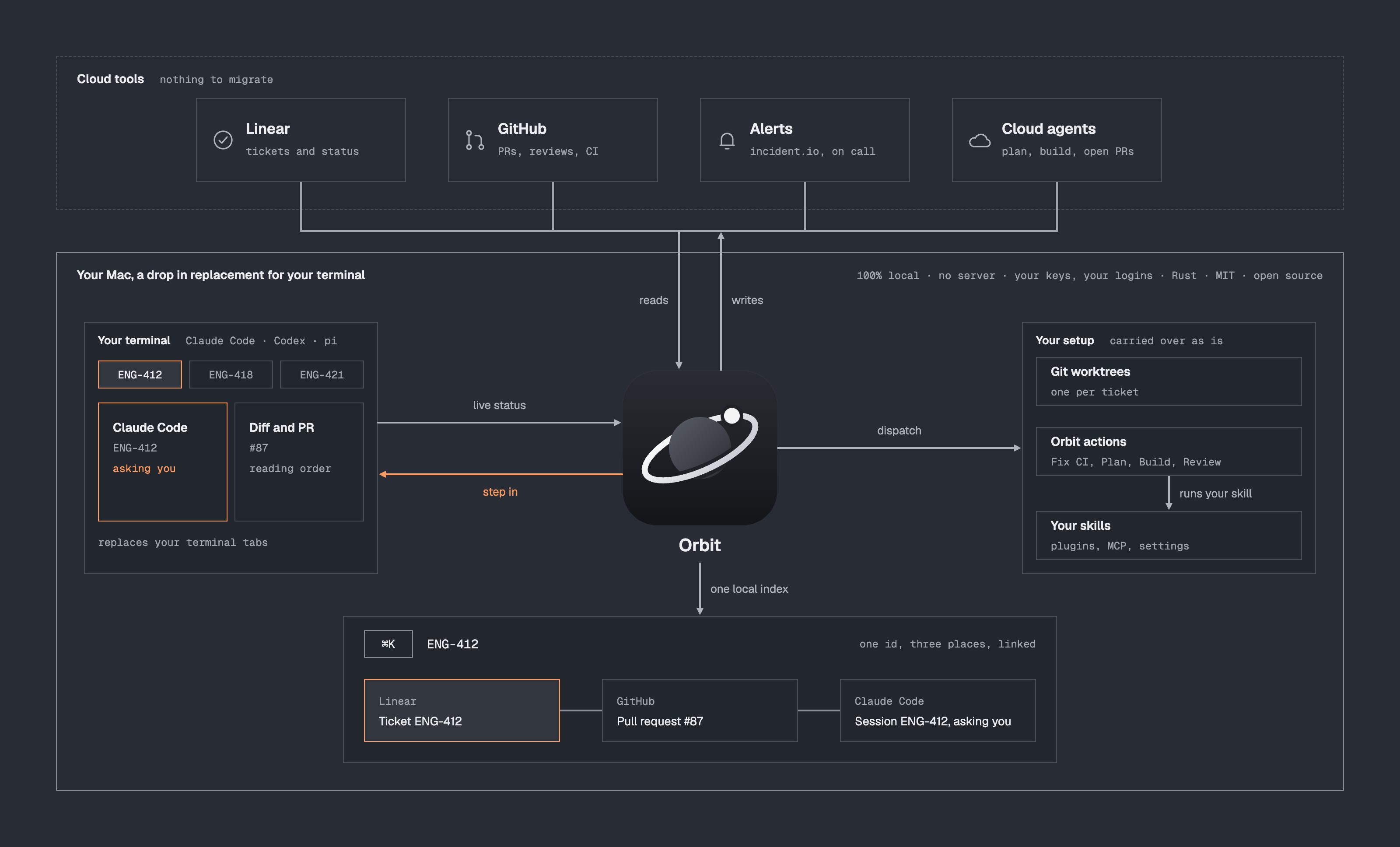
Orbit is a native Rust app on your Mac. There is no Orbit server and nothing to
migrate: it talks to the tools your team already uses, with your own keys and
logins, and keeps everything else on your machine.
- Cloud tools, read and written in place. Linear holds tickets and their
state, GitHub holds PRs, reviews and CI, incident.io holds alerts and on-call,
and cloud agents plan, build and open PRs. Orbit keeps them fresh in the
background and writes back only what you did: a state change, a comment, an
approve or a merge on your click. - Your terminal, with live status. Each ticket gets its own Claude Code,
Codex or pi session in a terminal pane. Orbit starts every session with hooks
that report what it is doing, so you see who is working, who is asking you
and who is done, and step into the one that needs you. - Your setup, carried over. Each session runs in its own git worktree on
the ticket's branch. Orbit actions (Fix CI, Plan, Build, Review) dispatch a
session that runs your skills, with your plugins, MCP servers and Claude Code
settings as they are. Your team's workflow lives in a profile, not in the code. - One local index. A ticket, its PR and its session share one id. Cmd+K
finds any of them from a word you remember, and the other two are one click
away.
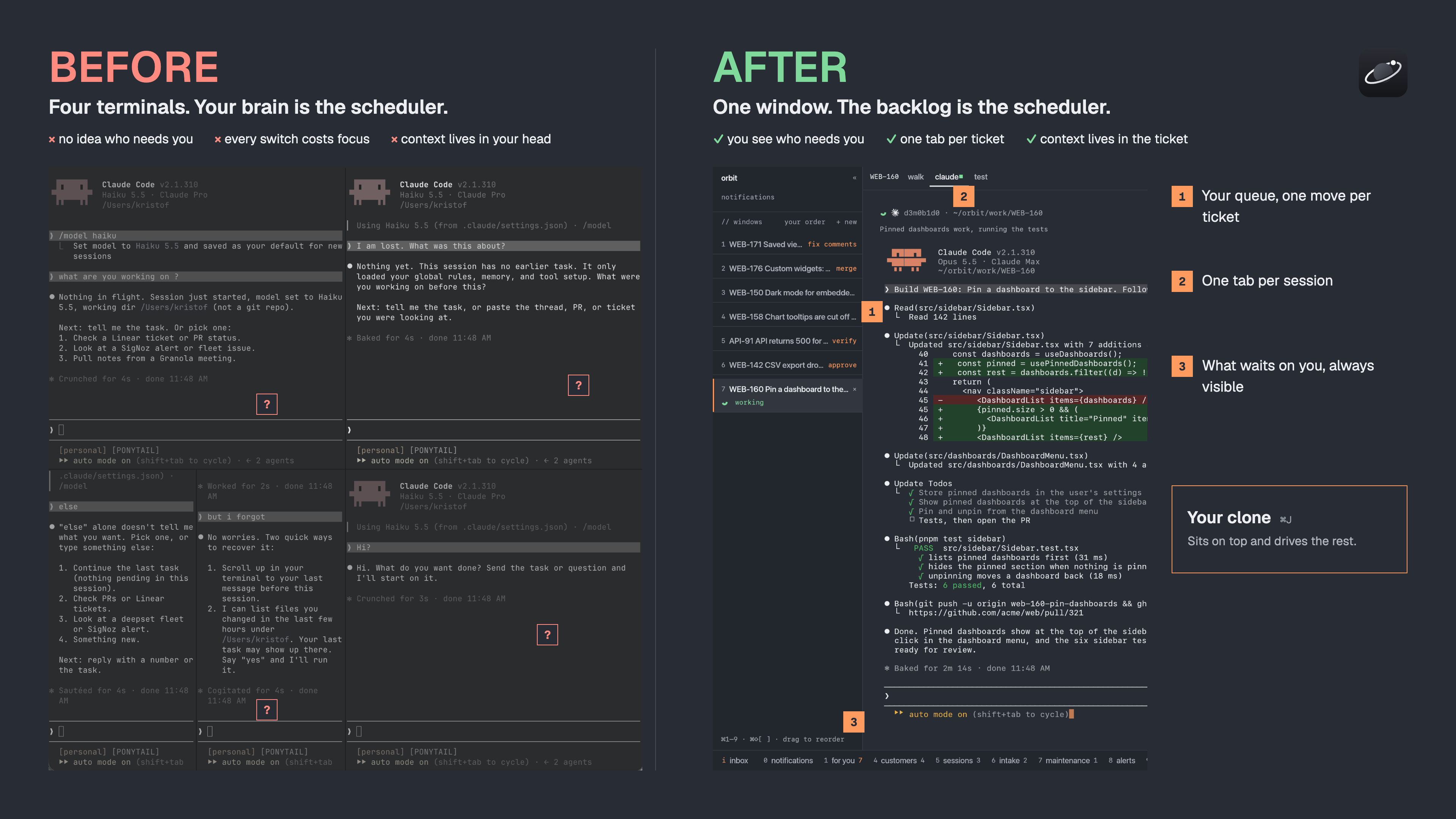
Agent tools give you more terminals. Orbit gives your agents a backlog.
Every ticket shows its stage and the one move it needs. Every ticket gets its
own agent session in a clean git worktree. Every PR comes back as a walkthrough
you can question line by line. You make the calls: approve, merge, ship.
Linear stops being the place you click around in. It becomes the API your
agents work from.
Why not herdr, a plain shell, or Xirp?
They run agents well. None of them knows what your agents should work on,
or why.
| plain shell | herdr | Xirp | Orbit | |
|---|---|---|---|---|
| Many agents in one window, see who needs you | – | ✓ | ✓ | ✓ |
| A clean git worktree per task | by hand | – | ✓ | ✓ |
| Work starts from the ticket, not from a prompt | – | – | – | ✓ |
| Triage → plan → build → review → test on the ticket | – | – | – | ✓ |
| Your team's workflow as config and skills | – | – | rules | ✓ |
| PR walkthrough: ask the diff, approve, merge | – | – | – | ✓ |
| Fork it and own it | – | ✓ | – | the point |
The long version, including what each one does better: docs/why.md.
Three tools in one
1. The backlog is the interface. Orbit reads Linear and shows only what
waits on you: a PR to review, a call to make, a merged fix to verify. The
rest is your agents' work. Like firstmate,
it talks to you in outcomes. Unlike it, the queue is your team's real backlog.
2. Agents, split and orchestrated. Triage, Plan, Build and Fix run in each
ticket's own Claude Code (or Codex, or pi) session, in the background, in its own
worktree. Panes, tabs, and status from Claude Code's hooks tell you who is
working, who is asking and who is done. Run the board works the whole
backlog unattended and reports back. herdr's multiplexing, but every pane
knows its ticket.
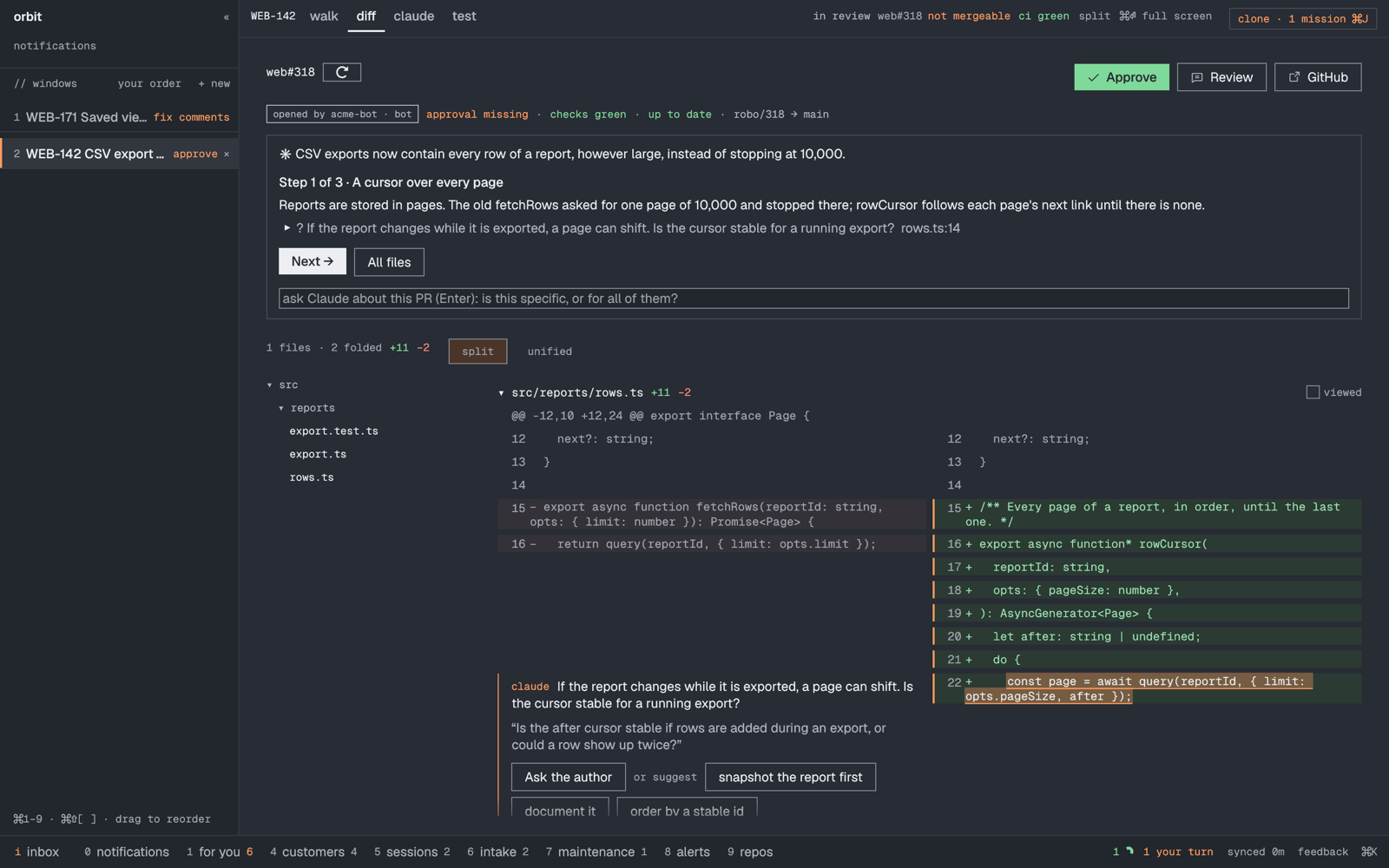
3. Review, without the bot noise. The diff becomes steps in reading order,
each with what to check. Your questions get answered from the diff and the
ticket, and suggested comments land on the right line. Approve and merge happen
only on your click, bound to the commit you read. Think CodeRabbit, minimal,
with you in charge instead of commenting at you.
Also in the window
- Plan my day reads your goals for the week and ranks the day. Sessions start
the work they can do alone: a red PR fixed, a noisy alert tuned. - Run the board works the backlog unattended: lands approved PRs, fixes red
ones, grooms Triage. The autopilot repeats it hourly and switches itself off. - Testing gives merged work a short test plan. One click closes the ticket.
- Claude Code, Codex or pi per ticket, six themes, and no Linear needed to
start: Continue without Linear keeps sessions, shells and GitHub PRs.
The clone: one goal, many agents
Say what you want in your words. Your clone (a Claude Code chat, Cmd+J) files
it as a parent with sub-tickets in blocker order. Then Orbit drives them: two
at a time, blockers merged first, each to the cloud bot or a local session in
its own worktree. You hear only about a PR to review, a block, a merge. The
clone coordinates and never writes code; approve and merge stay yours.
How it works: docs/clone.md.
And if that is not enough: ⌘K beats github.com
Not everything is the clone's job. For the rest, Orbit is simply the fastest
way through GitHub and Linear.
- Cmd+K, paste a PR link. It opens here, at once, on its diff. No tabs, no
spinners, no "Load diff" buttons. - Or type what you remember: a word from the title, the ticket, the repo.
Enter. You are on it. - Then ask. Every PR gets its own Claude Code session with the PR, its
ticket and the code as context: why this change, what could break, is this
the thing the ticket asked for?
Fewer clicks, less waiting, and the context comes with you.
Make it yours
Orbit is not meant to be used as is. It is meant to be forked.
Agents write whatever code you ask for. So the tool that runs your agents
should work the way your team works, not the way a vendor guessed. Everything
company-specific in Orbit is configuration: a profile with your bot, its
commands, your routing and your skills. The rest is plain Rust that Claude Code
reads and changes in minutes.
- On Jira? Not supported, but one prompt away: the Linear client is one file.
- Something annoys you? Press Cmd+Shift+F. A Claude session changes Orbit in a
worktree, runs the checks and opens a PR on your fork. - Your team's way of working? Put it in
profiles/<team>/: one JSON file and a fewSKILL.mds. A full example:tests/profiles/acme.
It takes little maintenance, and it's fun. docs/make-it-yours.md
Cloud agents
Orbit is local first: every agent runs on your Mac. If your team also runs a
bot in the cloud that plans and builds from Linear comments, Orbit follows it.
You see its plan on the ticket and its PR on the rail, and a ▼ hands it the next
step. docs/cloud-agents.md
Roadmap?
There is none. Orbit works well today, and anything you are missing is a
prompt away in your fork. Why plan features for months when you can have them
now?
What we do have is a direction: agents that need less of you, in three steps.
- Make coding agents do what you want. Done. Every ticket gets its own
agent, briefed with the ticket and your team's skills, in its own worktree. - Make them autonomous, and orchestrate many of them. Here today. The
clone drives a goal of many tickets, and Run the board works your backlog
unattended. You still approve and merge. - Make them know what you want. Not there yet. Agents that learn your
context and get richer with every day you work with them. How we get there?
We'll see, but Merkwerk is part
of it.
Install
gh release download --repo ArzelaAscoIi/orbit --pattern '*-macos.zip'
unzip -q *-macos.zip && mv Orbit.app /Applications
xattr -dr com.apple.quarantine /Applications/Orbit.app   # not notarized yet
Open it, click Sign in with Linear and pick your teams. Later releases install from Settings → about. Then press Cmd+K and choose
Start the tutorial for a two-minute tour of every feature. No Linear? Continue without
Linear keeps Claude sessions, shells and GitHub PRs; tickets need it.
Needs Claude Code, Codex or pi,gh auth login, and Apple silicon. An Anthropic key (Settings) turns on
walkthroughs, briefs and test plans.
From source:
make run      # release build; sign in with Linear (or LINEAR_API_KEY in .env)
make watch    # rebuilt and restarted on every save
make check    # fmt + clippy + tests
Docs
- Why Orbit: the problem, and an honest comparison
- Make it yours: fork it, write a profile and skills, add Jira
- The clone: one goal, many agents, driven in blocker order
- Cloud agents: a team bot that works from Linear comments
- Features: every view, key and button
- Decisions: every product decision, each one guarded by a test
- Contributing · Security
License
Either of, at your option:
- MIT (LICENSE-MIT)
- Apache License, Version 2.0 (LICENSE-APACHE)
Unless you say otherwise, any contribution you submit for inclusion in Orbit
is licensed the same way, without any additional terms.
Built with Claude Code, for people who build with Claude Code.
Third-party licenses ship in Orbit.app/Contents/Resources/THIRD_PARTY_LICENSES.html; CI fails on a dependency outside deny.toml's list (MIT, Apache-2.0, ISC, Zlib, Unicode-3.0).
Fonts: Orbit ships none. It uses Geist and Geist Mono if you have them installed, else the Mac's SF Pro and SF Mono.
Reviews (0)
Sign in to leave a review.
Leave a reviewNo results found