weave
Health Warn
- License — License: MIT
- Description — Repository has a description
- Active repo — Last push 0 days ago
- Low visibility — Only 5 GitHub stars
Code Warn
- network request — Outbound network request in .github/ISSUE_TEMPLATE/bug_report.yml
Permissions Pass
- Permissions — No dangerous permissions requested
No AI report is available for this listing yet.
Let your LLM agent write one short Python-like script instead of a dozen tool calls. A Rust runtime runs the independent calls in parallel. Works with OpenAI, LangChain and MCP.
Weave
Your agent writes one short script. Weave checks it, shows you every call and write it can make, then runs the calls in parallel where it can.


Quickstart · Plan preview · How it compares · Getting started · Benchmarks · Paper · Production · Full reference
Try it in your browser: the real parser, check and scheduler compiled to WebAssembly, with mock tools. Nothing to install.

With native function calling, every round of tool calls costs a model round trip, and every raw result goes back
into context. With Weave, the model writes one script in a restricted Python subset (loops, comprehensions,
helpers). A Rust runtime runs the script's independent reads together, orders writes by their declared effects, and
returns only what the script printed.
pip install weave-lang
Say the model is asked which of three cities is warmest. Instead of three tool calls and three round trips, it sends
one script:
temps = {c: get_weather(c) for c in ["Paris", "Tokyo", "Lima"]}
warmest = max(temps, key=lambda c: temps[c])
print(warmest, temps[warmest])
Weave runs the three get_weather calls at the same time and hands back one line: Tokyo 22.
The whole script is checked before the first call runs: unknown tools, a misspelled keyword
(get_weather(cty="Paris") gets "did you mean city?"), a missing argument, or for MCP tools a
literal that doesn't match the tool's JSON schema. So a typo on the last line stops the script before
the first line's write happens. What the check covers.
Declare what a tool returns (weave.declare(returns='{"temp_c": int, "sky": str}')) and the check follows its
results too: get_weather("Paris")["temp"] gets "did you mean 'temp_c'?" before any call goes out. Replaying the
6,653 scripts from our recorded BFCL runs, it flagged 50: 45 had really failed at run time on that line (29 after an
earlier call had already run), and 3 were false alarms from a learned shape that missed a variant.
How it works and what it skips.
See the plan before anything runs
Because the script is plain data flow over declared tools, Weave can tell you what it will do without running
it. tool.plan(source) (or weave plan on the CLI, or weave_plan over MCP) lists every tool call, how many
times it can run, where each argument comes from, and what it may write. Say the model sends this:
tickets = [get_ticket(t) for t in ["T-1", "T-2", "T-3"]]
for t in tickets:
    if t["stale"]:
        refund(t["order"])
The plan, before a single call:
plan: 3 to 6 tool calls, 2 dependent stages, strongest effect irreversible
  #1 line 1: get_ticket('T-1' | 'T-2' | 'T-3') read x3 stage 1
  #2 line 4: refund(<#1>) irreversible x0-3 stage 2, writes payment:{0|order_id} (filled at run time)
So you know up front: three reads in parallel, then up to three refunds whose order ids come from get_ticket
results. Pass approve= and Weave asks you once per script, before anything runs:
def approve(plan):
    if any(c["effect"] == "irreversible" for c in plan["calls"]):
        return "refunds need a person"   # the model gets "[not approved] Nothing ran ..." with this reason
    return True

tool = weave.WeaveTool([get_ticket, close_ticket, refund], approve=approve)

Read-only scripts run without asking. When the targets are literals, the plan resolves them
(close_ticket('T-1' | 'T-3') ... writes ticket:T-1, ticket:T-3). The counts and sources are upper bounds checked
against real runs on tens of thousands of random scripts; anything it can't know statically shows up as unknown,
never guessed. Full example: examples/plan_preview.py,
details in the reference.
Does it help? On a pre-registered fan-out suite against real services it passed 40/40 tasks vs 27/40 for plain
function calling, at about half the cost. It's not a win everywhere though: on BFCL multi-turn it was a small,
not significant gain in one round (159/378 vs 140/378), a clear loss with GPT-5.4 mini in another (18/60 vs 27/60),
and a draw on tau-bench. Details below.
Try it, break it, and tell us what went wrong. Issues and PRs are very welcome.
Results
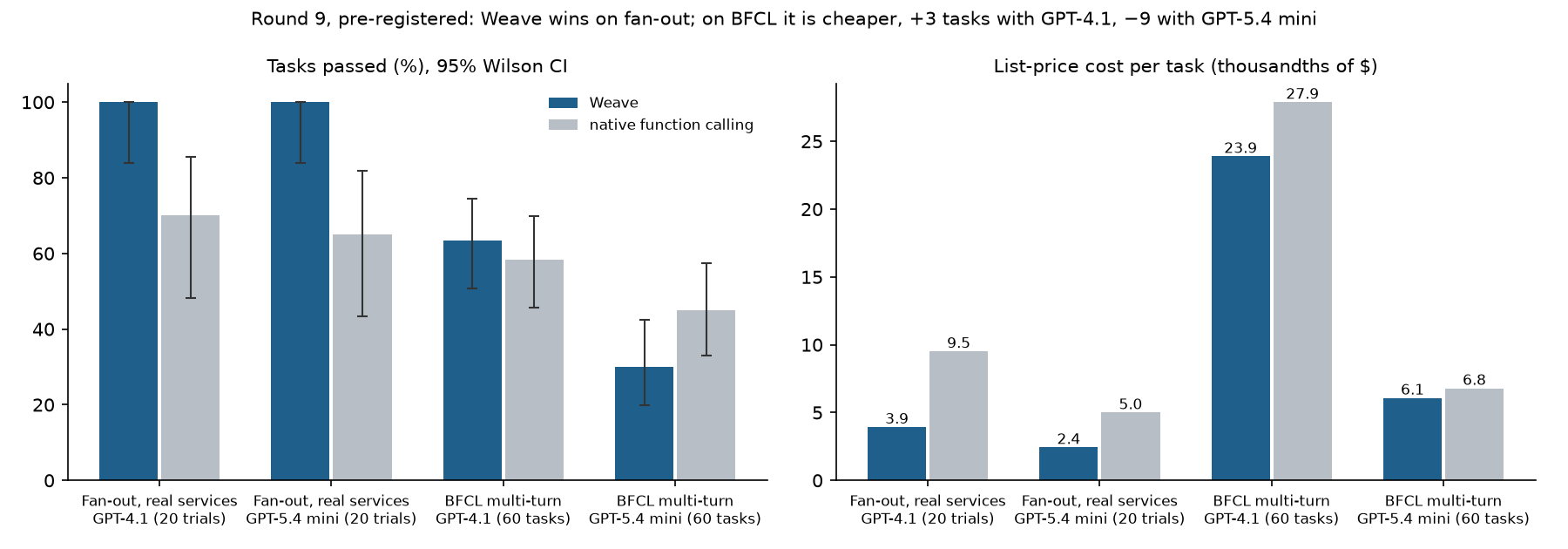
Pre-registered, on fresh tasks, against native function calling with the same model, tools and settings
(paper §5.17–5.19, all rounds):
- Fan-out on real services (SQLite, git, files, HTTP, PyPI): 40/40 vs 27/40 passed, 2.1–2.7 s vs 4.3 s per
task, at 0.45–0.50× the cost (GPT-4.1 and GPT-5.4 mini). - BFCL v4 multi-turn (round 9, public tasks and grader): 0.86× the cost and 25 % fewer tokens. Success: +3 tasks with
GPT-4.1 (38 vs 35 of 60), but −9 with GPT-5.4 mini (18 vs 27), a significant loss. - BFCL multi-turn, fresh confirmation with the write gate (round 11; 63 unused scenarios × base, miss_param,
miss_func): 159/378 vs 140/378 passed (p = 0.07, not significant) at 0.91× the cost. GPT-4.1 92 vs 81 and
GPT-5.4 mini 67 vs 59, each not significant on its own; run on Azure deployments of the same model versions. - BFCL miss_param / miss_func with the write gate (round 10,
write_gate="choice"): GPT-5.4 mini 30/105 vs
24/105 (not significant) at equal cost; GPT-4.1 3/16 vs 5/16, a loss (5/20 vs 7/20 with the pairs
completed on Azure). - tau-bench retail (a conversation, one confirmation per write): a draw.
Round 9 used WeaveTool(compact=True); rounds 10–11 added write_gate="choice". Both ship in 1.1.0. The chart shows round 9.
Use Weave for fan-out (the same lookup over many items), chains of dependent lookups, and filtering results before
the model sees them. Skip it when each step waits for a person, or when a small model must think after every result.
How it compares
Letting the model write code instead of one JSON call at a time is not new, and Weave builds on that work.
What's different is where the code runs and what you know before it does.
| the model writes | runs where | parallel calls | known before the first call | |
|---|---|---|---|---|
| Native function calling | one JSON call per tool | your app | several per turn if the model asks | this round's calls, one round at a time |
| LLMCompiler | a DAG of calls | your app | yes, from the DAG | the DAG (no loops or branches) |
| CodeAct, smolagents | full Python | a Python executor or a sandbox | if the code does it | the code; bad tool calls fail at run time |
| Anthropic programmatic tool calling | Python | Anthropic's code execution container | if the code uses async | the code |
| OpenAI programmatic tool calling | JavaScript | OpenAI's hosted V8 | if the code uses promises | the code (their docs suggest direct calls for writes) |
| Cloudflare Code Mode | TypeScript | a V8 isolate on Workers | if the code uses promises | the code |
| Weave | a Python subset | a Rust runtime in your process | automatic, from data flow and declared effects | tool names, arguments, schemas and declared result keys checked, plus a plan of every call and write you can approve |
When to pick something else: the hosted options need no runtime on your side, and full Python can import
libraries, which Weave's subset can't. And if a small model has to think after every single result, plain
function calling can do better (that's our GPT-5.4 mini loss above).
Install
pip install weave-lang
# or a GitHub release wheel:  curl -fsSL https://raw.githubusercontent.com/AtharvRaotole/weave/main/scripts/install.sh | sh
# or from source (needs Rust):  pip install "git+https://github.com/AtharvRaotole/[email protected]"
The package is weave-lang (import weave). Python 3.9–3.13, Linux, macOS and Windows.
More options: getting started.
Quickstart
import weave
from openai import OpenAI

@weave.declare(effect="read", arity=1)
def order_total(order_id: str) -> int:
    """Return an order's total in dollars."""
    return {"o1": 12, "o2": 30, "o3": 7}[order_id]

tool = weave.WeaveTool([order_total])   # one tool: run_weave(source)
client = OpenAI()
messages = [{"role": "user", "content": "What do orders o1, o2 and o3 add up to?"}]
while True:
    msg = client.chat.completions.create(model="gpt-4.1", messages=messages,
                                         tools=[tool.chat_tool()], **tool.request_options).choices[0].message
    messages.append(msg)
    if not msg.tool_calls:
        break
    messages += [tool.handle(call) for call in msg.tool_calls]
print(msg.content)
No API key? python examples/demo.py, python examples/quickstart.py and python examples/plan_preview.py run offline.
Works with
| stack | how |
|---|---|
| OpenAI Chat Completions / Responses | tool.chat_tool(), tool.responses_tool() |
| OpenAI Agents SDK | Agent(tools=[tool.agents_tool()]) |
| LangChain / LangGraph | tool.langchain_tool() |
| Claude Desktop, Cursor, VS Code, Claude Code | weave mcp-config --client claude --config tools.json --write (or cursor, vscode, claude-code) |
Rust hosts, the weave CLI |
runtime reference, CLI |
Learn more
- Getting started: recipes for each stack, chat assistants, MCP servers.
- Running in production: guarantees with their tests, isolation, budgets, privacy.
- Benchmarks and the paper: every round, every loss, pre-registrations.
- Full reference: the long-form guide. Architecture, roadmap,
contributing, security, citation. - Want to help? Start with issues labeled
good first issue.
MIT. The speculative cache draws on Nichols et al.,
Optimizing Agentic Language Model Inference via Speculative Tool Calls.
Reviews (0)
Sign in to leave a review.
Leave a reviewNo results found