cc-copilot
Health Warn
- License — License: MIT
- Description — Repository has a description
- Active repo — Last push 0 days ago
- Low visibility — Only 5 GitHub stars
Code Pass
- Code scan — Scanned 12 files during light audit, no dangerous patterns found
Permissions Pass
- Permissions — No dangerous permissions requested
No AI report is available for this listing yet.
A cockpit for AI coding agents — read-only supervision for Claude Code & Codex: re-entry recaps, safety verdicts, grounded chat, every claim cited.
CC-Copilot



CC-Copilot helps you stay aligned with AI coding agents.
Cockpit is the primary TUI experience: a live supervision layer for ongoing
agentic work, shared context, and next decisions.
Ask questions across one session, selected sessions, or an entire project
without injecting supervision chatter into the main Claude Code or Codex
workflow.

Above: coming back to an agent session — the /since re-entry recap of what
happened while you were away, a streamed citation-pinned answer to "is it safe
to merge?", and the two-level model picker.
Quick Start
cc-copilot cockpit
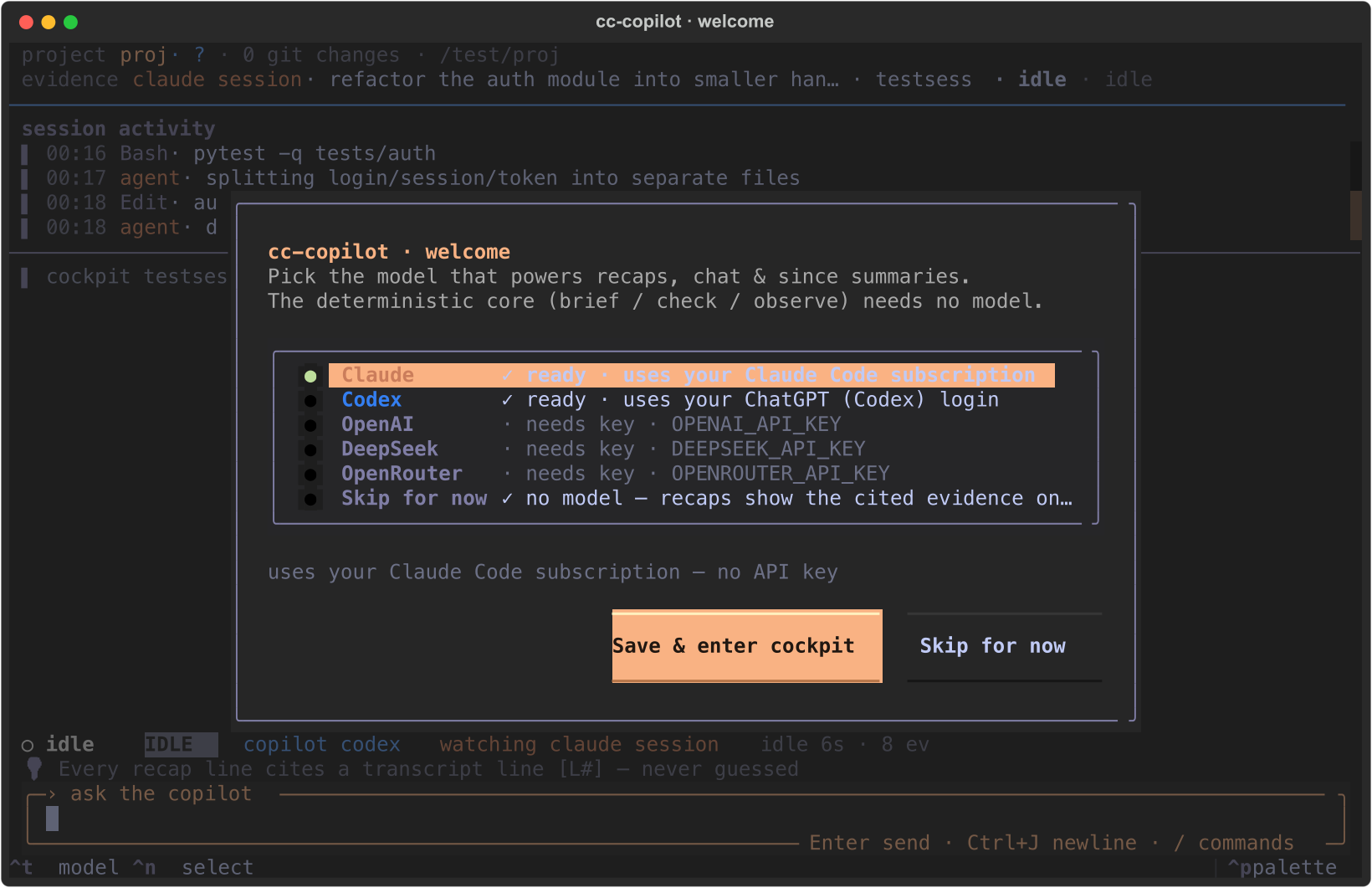
The first launch greets you with a one-time welcome screen to pick the model
that powers recaps, chat, and since — Claude or Codex (uses the
agent's own login, no API key) or an API provider (OpenAI / DeepSeek /
OpenRouter, key captured inline). It only shows once; reopen it anytime with/init, or run cc-copilot init in a plain terminal (handy over SSH). The
deterministic core (brief / check / observe) needs no model at all.
Inside Cockpit:
/sessions   choose one or more agent sessions (incl. your own live session)
/here       observe the session you're running inside of
/observe    attention queue and next human decision
/since      recap since you last looked (or 30m / 2h; --raw = cited delta)
/handoff    shareable Markdown handoff (brief + what changed)
/brief      deterministic recap with citations
/check      safety / off-track verdict
/diff       changes since last turn
/model      choose backend/model
/init       reopen the model picker (Claude / Codex / an API key)
/resume     resume a Cockpit Session
Install
One command, no clone — install it as an isolated tool:
uv tool install "cc-copilot[tui]"      # recommended (https://docs.astral.sh/uv/)
# or
pipx install "cc-copilot[tui]"
Then:
cc-copilot cockpit
Or run it without installing anything:
uvx --from "cc-copilot[tui]" cc-copilot cockpit
Requirements: Python 3.9+. The CLI core is dependency-free; the Cockpit TUI
pulls in the optional [tui] extra (Textual) — drop it (cc-copilot instead ofcc-copilot[tui]) if you only want the command-line briefs.
pip / from source
pip install "cc-copilot[tui]"                         # from PyPI
# from a clone (development):
pip install -e ".[tui]"
On fresh Debian/Ubuntu servers pipx/venv may need:
sudo apt-get update && sudo apt-get install -y python3-venv python3-pip pipx
Why CC-Copilot
Past copilots reduced the cognitive burden of understanding code.
Agentic coding creates a new burden: understanding what agents are doing over
time. Long-running Claude Code, Codex, and multi-agent workflows produce
continuous context, decisions, tool calls, errors, and partial progress.
CC-Copilot gives humans a separate supervision layer. You can inspect, ask,
compare, and realign without interrupting the working agent or forcing yourself
to reconstruct context manually.
What Makes It Different
Read-only supervision
CC-Copilot observes agent transcripts and project context without editing
files, issuing agent actions, or interfering with the working agent.Separate Cockpit workflow
Ask supervision questions outside the main agent conversation, so the
agent's working context stays clean.Evidence-grounded answers
Answers are grounded in transcript lines, tool results, project facts, git
state, and file evidence.Multi-session awareness
Follow one session, selected sessions, or an entire project from one
interface.Attention-first UI
Cockpit surfaces status, risk, progress, and the next human decision instead
of forcing you to read the whole transcript.Model-flexible
Use Codex, Claude, OpenAI-compatible APIs, DeepSeek, OpenRouter, Ollama,
Gemini, or custom CLI backends.Terminal-native
Keyboard-first TUI with mouse support, designed for side-window and
CMUX-style workflows.Resumable Cockpit Sessions
Your supervision conversation is independent from the agent session and can
be resumed later.
Usage
cc-copilot cockpit                 # open the TUI
cc-copilot sessions                # list project sessions
cc-copilot status                  # fleet board, neediest first
cc-copilot observe                 # attention queue
cc-copilot brief                   # deterministic recap
cc-copilot check                   # safety verdict
cc-copilot since                   # grounded LLM recap since you last looked
cc-copilot since 30m               # …or within a time window
cc-copilot since --raw             # the deterministic cited delta, no model call
cc-copilot handoff --out h.md      # shareable Markdown handoff
cc-copilot watch --notify          # desktop alert when the agent needs you
cc-copilot ask "what changed?"     # one-shot grounded Q&A
cc-copilot chat                    # plain terminal chat mode
cc-copilot resume                  # resumable Cockpit Sessions
Scope options:
cc-copilot cockpit                 # one agent session by default
cc-copilot cockpit --scope multi   # selected/all sessions in this project
cc-copilot cockpit --scope project # project-level evidence context

cc-copilot ask --scope multi --scope-sessions a1b2c3d4,b5c53c29 "compare these"
cc-copilot observe --scope project
Session discovery spans every coding agent with sessions on this machine:
${CLAUDE_CONFIG_DIR:-~/.claude}/projects/<encoded-cwd>/<session>.jsonl   # Claude Code
${CODEX_HOME:-~/.codex}/sessions/YYYY/MM/DD/rollout-*.jsonl              # Codex
A project's sessions from both agents appear on one board, grouped by project
cwd and tagged with their agent. Restrict the set with --agent claude,--agent codex, $CC_COPILOT_AGENTS, or [agents] enabled in the config.
By default, commands report on the most recent session other than the current
one, so running CC-Copilot from inside a live agent session watches the agent
you want to supervise. To watch your own current session instead, use--here (e.g. cc-copilot cockpit --here) or /here inside the cockpit — it is
also always listed in /sessions as "your live session", even across projects.
See docs/cross-model-adapters.md.
Cockpit
Cockpit is the main product surface.
It gives you:
- Status header for project, evidence range, Cockpit Session, backend, and risk.
- Live activity strip from the observed session(s).
- Attention queue and next human decision via
/observe. - Grounded chat over one session, selected sessions, or project evidence.
- Context HUD showing estimated input context, output estimate, and evidence
split across raw transcript, project facts, chat, memory, and summary index. - Background alerts when the agent stalls, errors, or goes off track.
- Checkbox session picker with
[ ]/[x]multi-select. - Resumable Cockpit Sessions via
/resume.
Keyboard is primary; mouse works too. Click anywhere to return focus to the
composer. Enter sends, Ctrl+J inserts a newline, / opens command
suggestions, and Ctrl+P opens the command palette. Shift+↑ / Shift+↓ resize
the activity timeline (the chat fills the rest); the height is remembered across
launches.
While You Were Away
The hardest part of supervising long-running agents is re-entry: you stepped
away, the agent kept working, and now you have to reconstruct what happened.
sinceanswers "what changed since I last looked" — by default a short
LLM recap narrated from the deterministic, cited diff of new asks, agent
messages, commands, failures, changed files, and any status/safety transition
(the model sees only that cited delta and keeps its[L…]citations;--raw
or no backend gives the deterministic delta itself). cc-copilot remembers where
you last looked (a
small marker under$CC_COPILOT_STATE_DIR, never under~/.claude/~/.codex);
the cockpit stamps it when you leave and greets you with "⟳ N new since you last
looked" when you return. Or scope by time:since 30m,since 2h.handoffturns the current state into a shareable Markdown document — the
brief plus an optional "while you were away" section — to paste into a ticket
or hand to a teammate. Every line keeps its[L…]citation.watch --notifypings you (desktop notification, terminal-bell fallback)
only when a session crosses into needing you — a fresh intervene verdict, a
slide into stalled, or a new failure — so you can step away without missing the
moment it actually needs a human.
All three are LLM-free and work across Claude Code and Codex sessions.
Evidence Context
v0.7 introduced the Evidence Context Engine.
For model-backed ask, chat, and Cockpit answers, CC-Copilot now retrieves
primary evidence first:
- raw assistant messages
- raw human prompts
- tool calls and tool results
- cited line windows
- recent transcript tail
- selected multi-session records
- read-only project facts
- git/file evidence
- Cockpit conversation memory
Summaries still exist, but they are navigation aids and UI surfaces, not the
only source of truth. See docs/evidence-context-engine.md.
Models
cc-copilot backends
cc-copilot cockpit --backend codex
cc-copilot cockpit --backend claude
cc-copilot ask "what matters next?" --backend openai --model gpt-4o
Supported backend families:
| backend | authentication | notes |
|---|---|---|
codex |
your codex login |
default; local agent CLI |
claude |
your Claude Code login | claude -p; no API key |
gemini / llm |
the CLI's own config | if installed on PATH |
deepseek |
DEEPSEEK_API_KEY |
deepseek-v4-flash default (-chat is deprecated 2026-07-24) |
openai |
OPENAI_API_KEY |
gpt-5.4 default |
openrouter |
OPENROUTER_API_KEY |
any OpenRouter model |
moonshot |
MOONSHOT_API_KEY |
Kimi (kimi-k2.6) |
zai |
ZAI_API_KEY |
GLM (glm-5.1) |
qwen |
DASHSCOPE_API_KEY |
Qwen via DashScope; mainland endpoint via DASHSCOPE_API_BASE |
groq |
GROQ_API_KEY |
fast open-weights hosting |
xai |
XAI_API_KEY |
Grok (grok-4.3) |
gemini-api |
GEMINI_API_KEY |
Google's OpenAI-compat endpoint (≠ the gemini CLI) |
ollama |
none | local server at http://localhost:11434 |
custom |
CC_COPILOT_API_BASE or CC_COPILOT_LLM_CMD |
proxy/API/CLI escape hatch |
Each API provider ships a small curated model list (see cc-copilot backends --models): the /model picker offers them two-level — backend, then model —
and typed fast-paths work too: /model deepseek-v4-pro (model only),/model deepseek:deepseek-v4-pro (both at once), or any free-form id.
Answers stream as the model produces them (claude: token deltas; the HTTP
backends: SSE; codex: whole message + exact usage), and when the backend
reports exact token usage it replaces the HUD's ~ estimate — including the
turn's real cost for claude. CC_COPILOT_STREAM=0 opts out of streaming.
Set defaults once — the guided way (pick a model, capture an API key):
cc-copilot init # interactive wizard (also runs on the first cockpit launch)
Or scaffold/inspect the file directly:
cc-copilot config --init  # write a commented starter ~/.cc-copilot.toml
cc-copilot config         # show the effective backend
Example ~/.cc-copilot.toml:
backend = "codex"
# model = "..."

[history]
enabled = true
Precedence: explicit flags > environment variables > config file > built-in
default.
Read-Only Contract
CC-Copilot is an observer.
It reads:
- agent transcripts
- session metadata
- read-only project facts
- git status
- cited file excerpts
- saved Cockpit conversation state
It does not:
- mutate the observed agent session
- edit project files
- run tools on behalf of the observed agent
- write under
~/.claude - inject supervision chatter into Claude Code or Codex
Deterministic commands work without an LLM:
cc-copilot brief
cc-copilot observe
cc-copilot check
cc-copilot status
Interactive /diff is available inside Cockpit and cc-copilot chat.
LLM-backed answers receive bounded cited evidence context, not tool access or
ambient repo access.
Cockpit Sessions
A Cockpit Session is separate from an agent session.
It stores:
- your supervision Q&A
- backend/model selection
- project cwd
- selected evidence sessions
- durable compacted memory for older Q&A
Changing evidence with /sessions changes what the current Cockpit reads; it
does not switch to another Cockpit Session.
Saved state lives under:
${CC_COPILOT_STATE_DIR:-~/.local/state/cc-copilot}
Directories are 0700, files are 0600. Disable persistence with:
cc-copilot cockpit --no-persist
or:
[history]
enabled = false
How It Works
sources/        agent adapters: discover sessions + parse a transcript
  base.py         the AgentSource contract + registry/dispatch
  claude.py       Claude Code (~/.claude/projects/**)
  codex.py        Codex (~/.codex/sessions/**/rollout-*.jsonl)
transcript.py   the normalized record model Claude Code parses into
state.py        fold records into deterministic session state
assess.py       classify stalls, failures, retry loops, and safety signals
brief.py        render deterministic cited recaps
since.py        "what changed since you last looked" (cited diff)
lastlook.py     remember where the human last looked (per session)
handoff.py      a shareable Markdown handoff artifact
notify.py       conservative away-alerts (desktop / terminal)
observe.py      rank attention and next human decision
scope.py        collect session, multi-session, and project evidence
context.py      retrieve raw evidence for model-backed answers
store.py        persist resumable Cockpit Sessions and compacted memory
backends.py     call Codex, Claude, OpenAI-compatible APIs, Ollama, etc.
tui.py          Cockpit, the Textual TUI
Agent specifics live entirely in sources/. Each adapter supplies just two
things — discovery and parse — and emits the same normalized records, so state,
assessment, briefing, context, and cockpit are agent-agnostic. One cockpit can
watch Claude Code and Codex sessions side by side, grouped by project. Adding
another agent (Gemini CLI, Aider, …) is a new sources/ adapter, not a rewrite.
Development
git clone https://github.com/Audiofool934/cc-copilot.git
cd cc-copilot
pip install -e ".[tui]"          # editable install with the Cockpit extra

python3 -m unittest discover     # stdlib-only test suite
cc-copilot cockpit
Core tests are stdlib-only. Textual is optional and lazy-imported by Cockpit.
Releases publish to PyPI automatically on a v* tag — seedocs/RELEASING.md.
Roadmap
- Homebrew tap + a
curl | shone-line installer - deeper project evidence retrieval and file ranking
- additional transcript parsers beyond Claude Code
- hook-driven push alerts for unattended runs
Rust migration is tracked separately in docs/rust-migration.md.
Philosophy
The main agent conversation should stay focused on doing the work.
Supervision is a different job: inspect what happened, compare evidence, ask
what matters, preserve decisions, and decide whether to intervene. Mixing that
into the working agent thread creates noise and changes the very context you
are trying to observe.
CC-Copilot keeps supervision outside the main workflow. Cockpit is where the
human can regain situational awareness without contaminating the agent's own
conversation.
Reviews (0)
Sign in to leave a review.
Leave a reviewNo results found