aurora
Health Warn
- License — License: Apache-2.0
- Description — Repository has a description
- Active repo — Last push 0 days ago
- Low visibility — Only 6 GitHub stars
Code Fail
- Hardcoded secret — Potential hardcoded credential in configs/config.example.yaml
Permissions Pass
- Permissions — No dangerous permissions requested
No AI report is available for this listing yet.
The Fastest enterprise AI gateway — route LLM traffic across OpenAI, Anthropic, Gemini, Groq & 30+ providers via a single API. Self-hosted, no vendor lock-in. ( 55x faster than litellm )

Aurora - The Fastest AI Gateway






One API for every AI provider. Self-hosted. No vendor lock-in.
14 provider types • OpenAI & Anthropic compatible • Go • Apache 2.0 • Built for raw speed
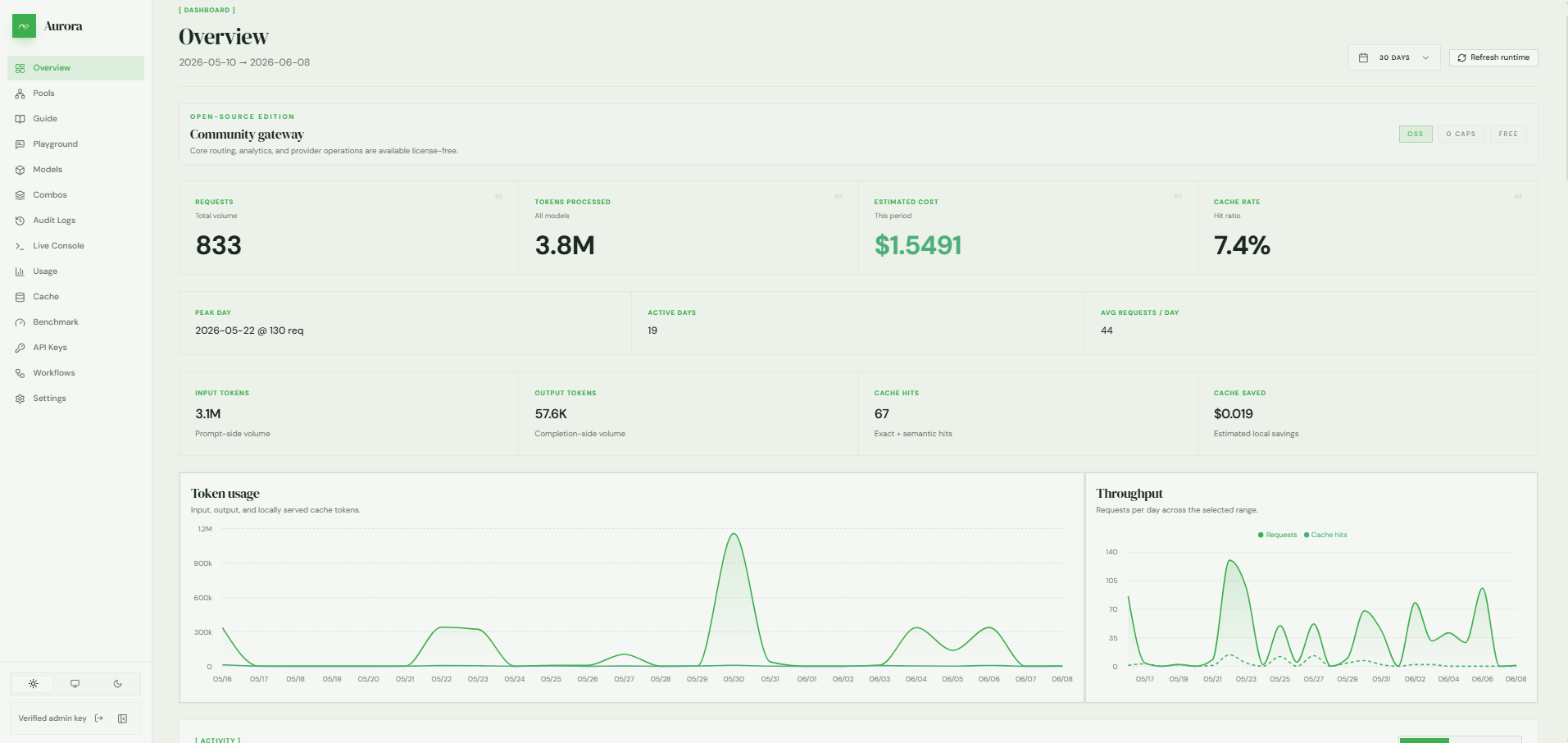
What Aurora Does
Aurora sits between your app and LLM providers. Your app sends requests using the standard OpenAI or Anthropic SDK — Aurora routes them to whichever provider you've configured. One format handles everything — you dont need to worry about provider-specific formats.
# Before: hardcoded provider
client = OpenAI(base_url="https://api.openai.com/v1", api_key="sk-...")

# After: Aurora Gateway
client = OpenAI(base_url="http://localhost:8080/v1", api_key="your-aurora-key")
No SDK changes. No format changes. Just swap the base_url.
Features
Routing & Providers
- 14 provider types — OpenAI, Anthropic, Gemini, Groq, DeepSeek, OpenRouter, xAI, Z.ai, MiniMax, Azure OpenAI, Oracle, Ollama, vLLM, Jina
- Auto-discovery — set an API key as an env var, restart, provider + all its models appear automatically
- Provider pools — group multiple keys/endpoints, load-balance with round-robin or weighted distribution, health-aware failover
- Model aliases — rename/remap any model to a custom identifier across the entire gateway
- Model overrides — enable or disable specific models per user path, persisted via dashboard or
user_pricing.yaml - Fallback — automatic failover on 5xx/429, or manual rules (from config or external JSON) mapping failed provider+model to backups
- Resilience — exponential backoff with jitter, circuit breaker per provider (closed → open → half-open), per-provider override of global retry/circuit-breaker settings
- Multiple instances — run
OPENAI_EAST_API_KEYandOPENAI_WEST_API_KEYas separate providers - Custom base URLs — override any provider's endpoint (corporate proxies, regional endpoints)
- Passthrough —
/p/{provider}/*for full upstream API access (not just chat completions); filter which provider types get passthrough routes - Config-driven workflows — per-request routing, caching, guardrail, audit, usage, budget, and fallback behavior controlled by persisted workflow documents
API Surface
- OpenAI-compatible —
/v1/chat/completions,/v1/embeddings,/v1/rerank,/v1/models,/v1/files,/v1/batches - Responses API —
/v1/responseswith full CRUD, cancel, input items, compact - Anthropic-compatible —
/v1/messages,/v1/messages/count_tokens(native Anthropic wire format); optional dedicated ingress at/v1/messages - Streaming — SSE streaming for all endpoints, preserved end-to-end
- Keep-only-aliases mode — hide raw provider models from
/v1/modelsand expose only aliased names - Configured provider models mode —
fallback(add listed models to auto-discovered) orallowlist(only serve explicitly listed models)
Caching
- Exact cache — SHA-256 hash match on request, Redis-backed, async writes
- Semantic cache — vector similarity with configurable threshold, supports Qdrant, pgvector, Pinecone, Weaviate
- Prompt cache — forwards
cache_controlto Anthropic/OpenAI/Gemini native prompt caching; configurable modes (auto,manual,off), component toggles, and minimum token threshold - Model registry cache — local filesystem + Redis, offline-safe; supports vendored JSON snapshots with per-field user pricing overrides
Security & Guardrails
- Master key — top-level gateway auth
- Managed API keys — scoped, rate-limited, per-key model authorization, usage stats
- Rate limiting — per-key rate limiting backed by in-memory or Redis
- PII redaction — email, phone, SSN, credit card detection and masking
- Prompt injection blocking — detects and blocks injection attempts
- System prompt protection — inject, override, or decorate system prompts
- Regex blocking — custom pattern matching with block or sanitize actions
- Length limits — character/token count enforcement on requests
- LLM-based altering — guardrail that rewrites message content via an auxiliary LLM call (anonymization, custom prompts)
- Guardrail direction & ordering — run before provider dispatch (
input), after response (output), or both; same-order guardrails run in parallel - Batch guardrails — apply configured guardrails to inline items in
/v1/batchesrequests
Observability
- Audit logging — full request/response capture, buffered writes, configurable retention (body/header logging, buffer size, flush interval), live SSE stream
- Usage analytics — per-model token counting, cost tracking, daily aggregation by model/user-path, pricing recalculation action
- Prometheus metrics —
aurora_requests_total,aurora_request_duration_seconds,aurora_requests_in_flight, plus gateway phase timing - Admin dashboard — React SPA built into the Go binary: providers, pools, models, aliases, guardrails, cache, usage, audit, auth keys, workflows, console, playground
- pprof endpoints — Go runtime profiling at
/debug/pprof/*(heap, goroutine, mutex, block, threadcreate) - Structured logging — configurable format (JSON/text), level (debug/info/warn/error), source info, service metadata
Cost Control
- Token saver — policy-driven output compression (profiles: concise, caveman, ultra, wenyan); scoped to specific models/providers via include/exclude filters; configurable on-error behavior (allow/block)
- Pricing management — per-model pricing overrides, recalculation, import/export
- Usage budgets — per-key usage tracking and limits, per-request budget enforcement via workflow feature flags
Developer Experience
- Single binary —
npm install -g iauroraordocker pull aurorahq/aurora - CLI —
aurora init,aurora models sync/diff/show,aurora update,aurora uninstall - CLI tools API — admin REST endpoints for CLI configuration sync, gated separately
- Swagger docs —
/swagger/index.html(build-tag gated) - Config profiles — pre-built configs for local, local-power, and team deployments
- 3-layer config — code defaults → config.yaml → env vars (env vars win)
- Helm chart — deploy on Kubernetes with pre-built Helm chart
- Docker Compose — full infrastructure stack: Redis, PostgreSQL, Qdrant, Prometheus, Grafana
- Grafana dashboard — pre-configured panels for request rate, errors, latency, in-flight requests, per-model breakdown
Quick Start
Start routing AI traffic in 60 seconds.
Option A — CLI (npm)
npm install -g iaurora
mkdir my-gateway && cd my-gateway
aurora init        # creates config.yaml, .env, data/
Set your provider keys in .env:
# ── REQUIRED ──────────────────────────────────────────────
AURORA_MASTER_KEY="your-secure-key"

# ── PROVIDER API KEYS (at least one) ─────────────────────
OPENAI_API_KEY="sk-..."
ANTHROPIC_API_KEY="sk-ant-..."
GEMINI_API_KEY="..."
GROQ_API_KEY="gsk_..."
DEEPSEEK_API_KEY="..."
OPENROUTER_API_KEY="..."
XAI_API_KEY="..."
ZAI_API_KEY="..."
MINIMAX_API_KEY="..."
AZURE_API_KEY="..."
ORACLE_API_KEY="..."
OLLAMA_API_KEY="..."
VLLM_API_KEY="..."
JINA_API_KEY="..."

# ── OPTIONAL FEATURE TOGGLES (set true to enable) ────────
LOGGING_ENABLED=true                  # Audit logging to storage
METRICS_ENABLED=true                  # Prometheus /metrics endpoint
GUARDRAILS_ENABLED=true               # Content safety filters
TOKEN_SAVER_ENABLED=true              # Output compression to cut token use

# ── PRODUCTION STORAGE ───────────────────────────────────
# STORAGE_TYPE=postgresql
# POSTGRES_URL=postgres://user:pass@localhost:5432/aurora

# ── REDIS CACHE (model cache + response cache) ──────────
# REDIS_URL=redis://localhost:6379
# RESPONSE_CACHE_SIMPLE_ENABLED=true
aurora
Option B — inline env vars (no .env needed)
Linux / macOS
AURORA_MASTER_KEY=your-secure-key \
  OPENAI_API_KEY=sk-... \
  ANTHROPIC_API_KEY=sk-ant-... \
  GEMINI_API_KEY=... \
  GROQ_API_KEY=gsk_... \
  DEEPSEEK_API_KEY=... \
  OPENROUTER_API_KEY=... \
  XAI_API_KEY=... \
  ZAI_API_KEY=... \
  MINIMAX_API_KEY=... \
  AZURE_API_KEY=... \
  ORACLE_API_KEY=... \
  OLLAMA_API_KEY=... \
  VLLM_API_KEY=... \
  JINA_API_KEY=... \
  LOGGING_ENABLED=true \
  METRICS_ENABLED=true \
  GUARDRAILS_ENABLED=true \
  TOKEN_SAVER_ENABLED=true \
  aurora
$env:AURORA_MASTER_KEY="your-secure-key"; `
$env:OPENAI_API_KEY="sk-..."; `
$env:ANTHROPIC_API_KEY="sk-ant-..."; `
$env:GEMINI_API_KEY="..."; `
$env:GROQ_API_KEY="gsk_..."; `
$env:DEEPSEEK_API_KEY="..."; `
$env:OPENROUTER_API_KEY="..."; `
$env:XAI_API_KEY="..."; `
$env:ZAI_API_KEY="..."; `
$env:MINIMAX_API_KEY="..."; `
$env:AZURE_API_KEY="..."; `
$env:ORACLE_API_KEY="..."; `
$env:OLLAMA_API_KEY="..."; `
$env:VLLM_API_KEY="..."; `
$env:JINA_API_KEY="..."; `
$env:LOGGING_ENABLED="true"; `
$env:METRICS_ENABLED="true"; `
$env:GUARDRAILS_ENABLED="true"; `
$env:TOKEN_SAVER_ENABLED="true"; `
aurora
set AURORA_MASTER_KEY=your-secure-key ^
  && set OPENAI_API_KEY=sk-... ^
  && set ANTHROPIC_API_KEY=sk-ant-... ^
  && set GEMINI_API_KEY=... ^
  && set GROQ_API_KEY=gsk_... ^
  && set DEEPSEEK_API_KEY=... ^
  && set OPENROUTER_API_KEY=... ^
  && set XAI_API_KEY=... ^
  && set ZAI_API_KEY=... ^
  && set MINIMAX_API_KEY=... ^
  && set AZURE_API_KEY=... ^
  && set ORACLE_API_KEY=... ^
  && set OLLAMA_API_KEY=... ^
  && set VLLM_API_KEY=... ^
  && set JINA_API_KEY=... ^
  && set LOGGING_ENABLED=true ^
  && set METRICS_ENABLED=true ^
  && set GUARDRAILS_ENABLED=true ^
  && set TOKEN_SAVER_ENABLED=true ^
  && aurora
Option C — Docker
docker run -d --name aurora -p 8080:8080 \
  -e AURORA_MASTER_KEY="your-secure-key" \
  -e OPENAI_API_KEY="sk-..." \
  -e ANTHROPIC_API_KEY="sk-ant-..." \
  -e GEMINI_API_KEY="..." \
  -e GROQ_API_KEY="gsk_..." \
  -e DEEPSEEK_API_KEY="..." \
  -e OPENROUTER_API_KEY="..." \
  -e XAI_API_KEY="..." \
  -e ZAI_API_KEY="..." \
  -e MINIMAX_API_KEY="..." \
  -e AZURE_API_KEY="..." \
  -e ORACLE_API_KEY="..." \
  -e OLLAMA_API_KEY="..." \
  -e VLLM_API_KEY="..." \
  -e JINA_API_KEY="..." \
  -e LOGGING_ENABLED=true \
  -e METRICS_ENABLED=true \
  -e GUARDRAILS_ENABLED=true \
  -e TOKEN_SAVER_ENABLED=true \
  aurorahq/aurora
Option D — Kubernetes (Helm)
# Quick dev — Groq, no Redis, no auth
helm install aurora ./helm \
  --namespace aurora --create-namespace \
  --set image.repository=aurorahq/aurora \
  --set image.tag=latest \
  --set providers.groq.apiKey="gsk_your_key_here" \
  --set providers.groq.enabled=true \
  --set redis.enabled=false \
  --set auth.masterKey=""
# Production — multiple providers, auth, Redis
helm upgrade --install aurora ./helm \
  --namespace aurora --create-namespace \
  --set image.repository=aurorahq/aurora \
  --set image.tag=latest \
  --set auth.masterKey="your-secure-key" \
  --set providers.openai.apiKey="sk-..." \
  --set providers.openai.enabled=true \
  --set providers.anthropic.apiKey="sk-ant-..." \
  --set providers.anthropic.enabled=true \
  --set providers.gemini.apiKey="..." \
  --set providers.gemini.enabled=true \
  --set providers.groq.apiKey="gsk_..." \
  --set providers.groq.enabled=true \
  --set providers.deepseek.apiKey="..." \
  --set providers.deepseek.enabled=true \
  --set redis.enabled=true
Full Helm docs: helm/README.md
Test your gateway
# OpenAI format
curl http://localhost:8080/v1/chat/completions \
  -H "Content-Type: application/json" \
  -H "Authorization: Bearer your-master-key" \
  -d '{"model":"groq/llama-4-scout-17b-16e-instruct","messages":[{"role":"user","content":"Hello!"}]}'

# Anthropic format with streaming
curl http://localhost:8080/v1/messages \
  -H "Content-Type: application/json" \
  -H "Authorization: Bearer your-master-key" \
  -H "anthropic-version: 2023-06-01" \
  -d '{
    "model": "anthropic/claude-sonnet-5-20260630",
    "max_tokens": 1024,
    "stream": true,
    "messages": [{"role": "user", "content": "Hello!"}]
  }'

# Embeddings
curl http://localhost:8080/v1/embeddings \
  -H "Content-Type: application/json" \
  -H "Authorization: Bearer your-master-key" \
  -d '{"model":"openai/text-embedding-3-small","input":"Hello world"}'

# Reranking (Jina)
curl http://localhost:8080/v1/rerank \
  -H "Content-Type: application/json" \
  -H "Authorization: Bearer your-master-key" \
  -d '{"model":"jina/jina-reranker-v2-base-multilingual","query":"test","documents":["doc1","doc2"]}'
Dashboard: http://localhost:8080/admin/dashboard
Docs: aurorallm.online/docs · Website · npm · Docker · GitHub
Providers
Providers are auto-discovered from environment variables. Set any provider's _API_KEY and restart — the provider and its default models appear automatically.
Security note: The env var names below are documentation references. Actual secrets go into your
.envfile (in.gitignore) or your deployment secrets manager — never commit them.
| Provider | Env var | Default base URL | Requires base URL | API key required | Default models |
|---|---|---|---|---|---|
| OpenAI | OPENAI_API_KEY |
https://api.openai.com/v1 |
No | Yes | gpt-5.6-sol, gpt-5.6-luna |
| Anthropic | ANTHROPIC_API_KEY |
https://api.anthropic.com/v1 |
No | Yes | claude-sonnet-5, claude-fable-5 |
| Google Gemini | GEMINI_API_KEY |
https://generativelanguage.googleapis.com/v1beta/openai |
No | Yes | gemini-3.1-pro, gemini-3.5-flash |
| Groq | GROQ_API_KEY |
https://api.groq.com/openai/v1 |
No | Yes | llama-4-scout-17b, llama-4-maverick-17b, qwen3-32b |
| DeepSeek | DEEPSEEK_API_KEY |
https://api.deepseek.com |
No | Yes | deepseek-v4-pro, deepseek-v4-flash |
| OpenRouter | OPENROUTER_API_KEY |
https://openrouter.ai/api/v1 |
No | Yes | 300+ models |
| xAI (Grok) | XAI_API_KEY |
https://api.x.ai/v1 |
No | Yes | grok-4.5, grok-4.3 |
| Z.ai | ZAI_API_KEY |
https://api.z.ai/api/paas/v4 |
No | Yes | glm-5.2 |
| MiniMax | MINIMAX_API_KEY |
https://api.minimax.io/v1 |
No | Yes | minimax-m3 |
| Azure OpenAI | AZURE_API_KEY |
— | Yes | Yes | Your deployments |
| Oracle | ORACLE_API_KEY |
— | Yes | Yes | cohere.command-r-plus |
| Ollama | OLLAMA_API_KEY |
http://localhost:11434/v1 |
No | No (optional) | Any local model |
| vLLM | VLLM_API_KEY |
http://localhost:8000/v1 |
No | No (optional) | Any served model |
| Jina (reranker) | JINA_API_KEY |
— | Yes | Yes | jina-embeddings-v3 |
Per-provider configuration
Every provider supports *_MODELS to override auto-discovered models:
OPENAI_MODELS=gpt-5.6-sol,gpt-5.6-terra,gpt-5.6-luna
Custom base URL:
OPENAI_BASE_URL=https://my-corp-openai-proxy.example.com/v1
Multiple instances of the same provider (underscores become hyphens in the provider name):
OPENAI_EAST_API_KEY=sk-...     # → provider: openai-east
OPENAI_WEST_API_KEY=sk-...     # → provider: openai-west
Azure requires API version:
AZURE_API_VERSION=2024-10-21
OpenRouter extras:
OPENROUTER_SITE_URL=https://github.com/aurorallm/aurora
OPENROUTER_APP_NAME=Aurora Gateway
Configuration
The gateway loads settings in this priority order (later wins):
code defaults → config.yaml → .env / environment variables
Generated by aurora init, every section of config.yaml is documented inline:
| Section | What it controls |
|---|---|
server |
Port, base path, master key, passthrough, Anthropic ingress |
admin |
Dashboard API and UI |
models |
Discovery, overrides, allowlisting |
storage |
SQLite (default), PostgreSQL, or MongoDB |
logging |
Audit logging of requests/responses |
usage |
Token tracking, pricing, retention |
metrics |
Prometheus endpoint |
guardrails |
Content safety filters |
cache |
Model cache, response cache (exact + semantic) |
combos |
Multi-model combo definitions |
token_saver |
Output compression |
fallback |
Provider failover rules |
resilience |
Retry + circuit breaker |
workflows |
Policy-based request routing |
Config profiles
Pre-built configs in configs/editions/:
| Profile | File | Use case |
|---|---|---|
| OSS | oss.env.example |
Minimal local — SQLite, no Redis |
| OSS Local Power | oss.local-power.env.example |
SQLite + Redis exact cache |
| OSS Team | oss.team.env.example |
Postgres + Redis + Qdrant — full team deployment |
export AURORA_CONFIG_PATH=configs/editions/oss.team.example.yaml
Complete env var reference
Server & Security| Env var | Default | Description |
|---|---|---|
PORT |
8080 |
HTTP listening port |
BASE_PATH |
/ |
URL path prefix to mount under |
AURORA_MASTER_KEY |
"" |
Master API key for auth |
BODY_SIZE_LIMIT |
10M |
Max request body size |
SWAGGER_ENABLED |
false |
Enable Swagger UI at /swagger/index.html |
PPROF_ENABLED |
false |
Enable pprof at /debug/pprof/ |
ENABLE_PASSTHROUGH_ROUTES |
true |
Provider-native passthrough at /p/{provider} |
ALLOW_PASSTHROUGH_V1_ALIAS |
true |
Allow /p/{provider}/v1/... alias routes |
ENABLED_PASSTHROUGH_PROVIDERS |
openai,anthropic,openrouter,zai,vllm |
Provider types for passthrough |
ENABLE_ANTHROPIC_INGRESS |
false |
Expose /v1/messages for native Anthropic clients |
DISABLE_REQUEST_LOGGING |
false |
Turn off request logging |
DISABLE_REQUEST_BODY_SNAPSHOT |
false |
Don't snapshot request bodies |
DISABLE_PASSTHROUGH_SEMANTIC_ENRICHMENT |
false |
Disable semantic enrichment on passthrough |
| Env var | Default | Description |
|---|---|---|
HTTP_TIMEOUT |
600 |
Upstream request timeout (seconds) |
HTTP_RESPONSE_HEADER_TIMEOUT |
600 |
Timeout for upstream response headers |
HTTP_PROXY |
— | HTTP proxy URL for upstream calls |
HTTPS_PROXY |
— | HTTPS proxy URL |
NO_PROXY |
— | Hosts to exclude from proxy |
| Env var | Default | Description |
|---|---|---|
STORAGE_TYPE |
sqlite |
Backend: sqlite, postgresql, or mongodb |
SQLITE_PATH |
data/aurora.db |
SQLite database file path |
POSTGRES_URL |
— | PostgreSQL connection string |
POSTGRES_MAX_CONNS |
10 |
PostgreSQL connection pool max |
MONGODB_URL |
— | MongoDB connection string |
MONGODB_DATABASE |
aurora |
MongoDB database name |
| Env var | Default | Description |
|---|---|---|
MODEL_LIST_URL |
https://raw.githubusercontent.com/aurorallm/aurora/refs/heads/main/docs-assets/assets/models.json |
External model metadata registry |
MODEL_LIST_LOCAL_PATH |
data/models.local.json |
Local model registry snapshot path |
MODEL_LIST_USER_OVERRIDES_PATH |
data/user_pricing.yaml |
User pricing override file |
MODELS_ENABLED_BY_DEFAULT |
true |
Default enabled state for provider models |
MODEL_OVERRIDES_ENABLED |
true |
Allow per-model overrides |
KEEP_ONLY_ALIASES_AT_MODELS_ENDPOINT |
false |
Hide provider models, show only aliases |
CONFIGURED_PROVIDER_MODELS_MODE |
fallback |
fallback or allowlist |
Model cache:
| Env var | Default | Description |
|---|---|---|
CACHE_REFRESH_INTERVAL |
3600 |
Model registry cache refresh (seconds) |
AURORA_CACHE_DIR |
.cache |
Local filesystem cache directory |
REDIS_URL |
— | Redis connection URL (enables Redis-backed model cache) |
REDIS_KEY_MODELS |
aurora:models |
Redis key for model cache |
REDIS_TTL_MODELS |
86400 |
Redis model cache TTL (seconds) |
Response cache (exact match):
| Env var | Default | Description |
|---|---|---|
RESPONSE_CACHE_SIMPLE_ENABLED |
false |
Enable Redis exact-response cache |
REDIS_KEY_RESPONSES |
aurora:response: |
Redis key prefix for responses |
REDIS_TTL_RESPONSES |
3600 |
Response cache TTL (seconds) |
Semantic cache (vector similarity):
| Env var | Default | Description |
|---|---|---|
SEMANTIC_CACHE_ENABLED |
false |
Enable semantic cache |
SEMANTIC_CACHE_THRESHOLD |
0.92 |
Similarity threshold (0-1) |
SEMANTIC_CACHE_PROMPT_SIMILARITY |
0.90 |
Prompt similarity threshold |
SEMANTIC_CACHE_TTL |
3600 |
Entry TTL (seconds) |
SEMANTIC_CACHE_MAX_CONV_MESSAGES |
3 |
Recent conversation messages to embed |
SEMANTIC_CACHE_EXCLUDE_SYSTEM_PROMPT |
false |
Exclude system prompt from cache key |
SEMANTIC_CACHE_EMBEDDER_PROVIDER |
openai |
Embedder provider name |
SEMANTIC_CACHE_EMBEDDER_MODEL |
text-embedding-3-small |
Embedder model |
SEMANTIC_CACHE_VECTOR_STORE_TYPE |
qdrant |
Backend: qdrant, pgvector, pinecone, weaviate |
SEMANTIC_CACHE_QDRANT_URL |
http://localhost:6333 |
Qdrant URL |
SEMANTIC_CACHE_QDRANT_COLLECTION |
aurora_semantic |
Qdrant collection name |
SEMANTIC_CACHE_QDRANT_API_KEY |
— | Qdrant API key |
SEMANTIC_CACHE_PGVECTOR_URL |
— | pgvector connection string |
SEMANTIC_CACHE_PGVECTOR_TABLE |
aurora_semantic_cache |
pgvector table name |
SEMANTIC_CACHE_PGVECTOR_DIMENSION |
1536 |
pgvector embedding dimension |
SEMANTIC_CACHE_PINECONE_HOST |
— | Pinecone host URL |
SEMANTIC_CACHE_PINECONE_API_KEY |
— | Pinecone API key |
SEMANTIC_CACHE_PINECONE_NAMESPACE |
— | Pinecone namespace |
SEMANTIC_CACHE_PINECONE_DIMENSION |
1536 |
Pinecone embedding dimension |
SEMANTIC_CACHE_WEAVIATE_URL |
— | Weaviate URL |
SEMANTIC_CACHE_WEAVIATE_CLASS |
AuroraSemanticCache |
Weaviate class name |
SEMANTIC_CACHE_WEAVIATE_API_KEY |
— | Weaviate API key |
| Env var | Default | Description |
|---|---|---|
LOGGING_ENABLED |
false |
Enable audit log to storage |
LOGGING_LOG_BODIES |
true |
Log request/response bodies |
LOGGING_LOG_HEADERS |
true |
Log headers (sensitive headers redacted) |
LOGGING_ONLY_MODEL_INTERACTIONS |
true |
Skip health/metrics/admin endpoints |
LOGGING_BUFFER_SIZE |
1000 |
In-memory queue capacity |
LOGGING_FLUSH_INTERVAL |
5 |
Flush interval (seconds) |
LOGGING_RETENTION_DAYS |
30 |
Auto-delete after N days (0 = forever) |
| Env var | Default | Description |
|---|---|---|
USAGE_ENABLED |
true |
Enable token usage tracking |
USAGE_PRICING_RECALCULATION_ENABLED |
true |
Allow admin pricing recalculation |
ENFORCE_RETURNING_USAGE_DATA |
true |
Add stream_options.include_usage=true to streaming requests |
USAGE_BUFFER_SIZE |
1000 |
In-memory queue capacity |
USAGE_FLUSH_INTERVAL |
5 |
Flush interval (seconds) |
USAGE_RETENTION_DAYS |
90 |
Auto-delete after N days (0 = forever) |
| Env var | Default | Description |
|---|---|---|
GUARDRAILS_ENABLED |
false |
Enable content safety filters globally |
ENABLE_GUARDRAILS_FOR_BATCH_PROCESSING |
false |
Apply guardrails to /v1/batches items |
| Env var | Default | Description |
|---|---|---|
METRICS_ENABLED |
false |
Enable Prometheus /metrics endpoint |
METRICS_ENDPOINT |
/metrics |
Metrics endpoint path |
| Env var | Default | Description |
|---|---|---|
TOKEN_SAVER_ENABLED |
false |
Enable output compression |
TOKEN_SAVER_ENDPOINTS |
chat_completions |
Endpoints to apply it to |
TOKEN_SAVER_APPLY_STREAMING |
true |
Apply to streaming responses |
TOKEN_SAVER_OUTPUT_ENABLED |
false |
Enable output style/profile |
TOKEN_SAVER_OUTPUT_PROFILE |
concise |
Profile: concise, caveman, ultra, wenyan |
TOKEN_SAVER_MODELS_INCLUDE |
— | Models to include (comma-separated) |
TOKEN_SAVER_MODELS_EXCLUDE |
— | Models to exclude |
TOKEN_SAVER_PROVIDERS_INCLUDE |
— | Providers to include |
TOKEN_SAVER_PROVIDERS_EXCLUDE |
— | Providers to exclude |
TOKEN_SAVER_ON_ERROR |
allow |
Behavior on error: allow or block |
TOKEN_SAVER_EMIT_HEADERS |
true |
Emit token-saver headers in response |
TOKEN_SAVER_AUDIT_ENABLED |
true |
Log token-saver actions |
| Env var | Default | Description |
|---|---|---|
RETRY_MAX_RETRIES |
3 |
Upstream retry count |
RETRY_INITIAL_BACKOFF |
1s |
Initial backoff duration |
RETRY_MAX_BACKOFF |
30s |
Maximum backoff duration |
RETRY_BACKOFF_FACTOR |
2.0 |
Exponential backoff multiplier |
RETRY_JITTER_FACTOR |
0.1 |
Random jitter fraction |
CIRCUIT_BREAKER_FAILURE_THRESHOLD |
5 |
Failures before circuit opens |
CIRCUIT_BREAKER_SUCCESS_THRESHOLD |
2 |
Successes before circuit closes |
CIRCUIT_BREAKER_TIMEOUT |
30s |
Time before half-open retry |
| Env var | Default | Description |
|---|---|---|
FEATURE_FALLBACK_MODE |
manual |
Fallback mode: auto, manual, or off |
FALLBACK_MANUAL_RULES_PATH |
— | Path to manual fallback rules JSON |
| Env var | Default | Description |
|---|---|---|
ADMIN_ENDPOINTS_ENABLED |
true |
Enable /admin/api/v1/* REST endpoints |
ADMIN_UI_ENABLED |
true |
Enable /admin/dashboard UI |
COMBOS_ENABLED |
true |
Enable combo model calls |
CLI_TOOLS_ENABLED |
true |
Enable CLI tools integration |
CLI_TOOLS_APPLY_ENABLED |
false |
Allow admin/API to apply tool changes |
WORKFLOW_REFRESH_INTERVAL |
1m |
Workflow refresh interval from storage |
EDITION |
— | Edition identifier (Enterprise use) |
| Env var | Default | Description |
|---|---|---|
AURORA_CONFIG_PATH |
configs/config.yaml |
Override path to config YAML |
CLI Reference
Installed via npm install -g iaurora.
| Command | Description |
|---|---|
aurora |
Start the gateway server (default port 8080) |
aurora init |
Scaffold config.yaml, .env, data/ in current directory |
aurora update |
Self-update via npm install -g iaurora@latest |
aurora uninstall |
Remove via npm uninstall -g iaurora |
aurora models sync |
Download upstream model registry to local file |
aurora models diff |
Show pricing diff between upstream and local snapshot |
aurora models show |
Print effective pricing for a model after merging overrides |
aurora -version |
Print version information |
aurora -help |
Show all CLI options and config reference |
aurora -help-json |
Dump env var schema as JSON |
Repository Structure
aurora/
├── apps/              # Application entrypoints
├── internal/          # Core packages (providers, gateway, storage, guardrails, etc.)
├── dashboard-ui/      # React admin dashboard (Vite)
├── configs/           # Configuration profiles and examples
├── docs-assets/       # Images, models.json, assets
├── helm/              # Kubernetes Helm charts
├── monitoring/        # Prometheus + Grafana configs
├── npm/               # npm CLI wrapper
├── bench-results/     # Benchmark data
├── release/           # Release scripts
└── scripts/           # Build and utility scripts
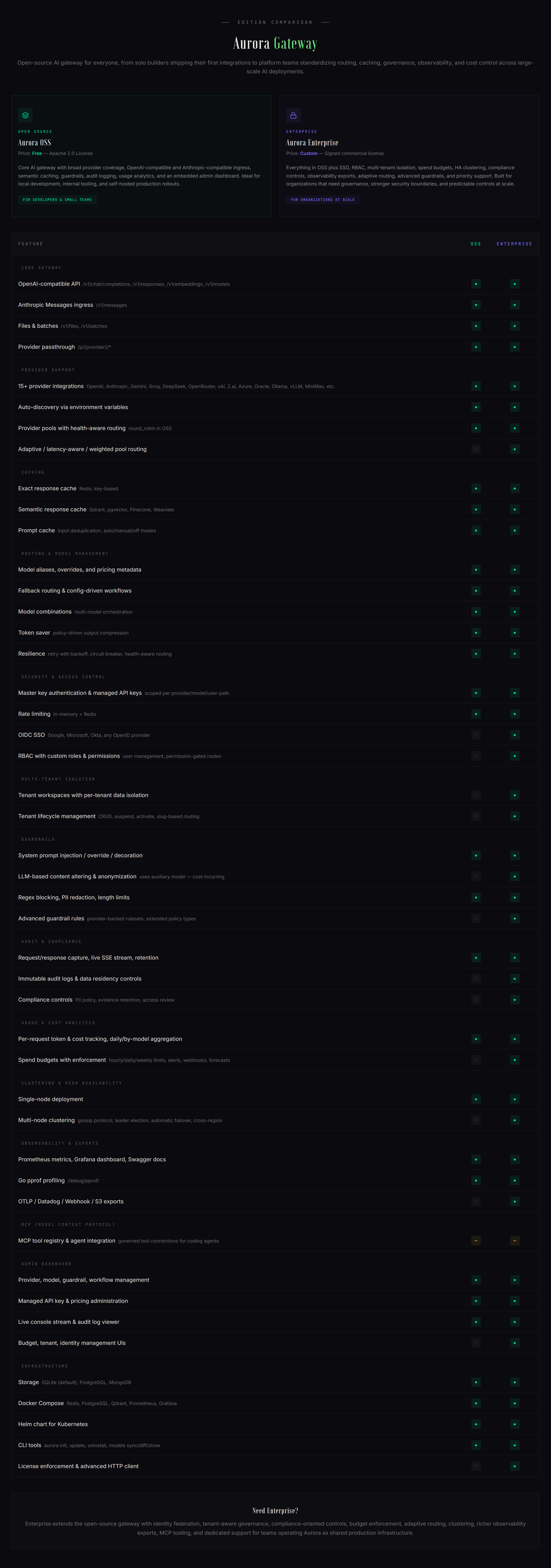
Enterprise Deployments
Aurora supports enterprise-grade deployments for teams running production AI systems at scale.
In addition to private networking, custom security controls, and governance, Aurora Enterprise unlocks advanced capabilities including SSO, RBAC, tenant isolation, budget enforcement, compliance workflows, and production support.
The Enterprise edition is a separate distribution with a signed license.

Documentation
- aurorallm.online/docs — full documentation
- aurorallm.online/docs/getting-started/quickstart — quickstart guide
- aurorallm.online/docs/guides — provider and integration guides
- aurorallm.online/docs/api/overview — API reference
- aurorallm.online/benchmarks — performance benchmarks
Need Help?
Join our Discord for community support, setup help, and discussions.
License
This project is licensed under the Apache 2.0 License — see the LICENSE file for details.
Built by the Aurora team.
Reviews (0)
Sign in to leave a review.
Leave a reviewNo results found