finding-unknowns-skill
Health Warn
- License — License: MIT
- Description — Repository has a description
- Active repo — Last push 0 days ago
- Low visibility — Only 5 GitHub stars
Code Pass
- Code scan — Scanned 3 files during light audit, no dangerous patterns found
Permissions Pass
- Permissions — No dangerous permissions requested
No AI report is available for this listing yet.
A Claude Code skill for discovering your unknowns (unknown unknowns / unknown knowns) before, during, and after implementation.





Surface your unknowns before they get expensive — and keep your judgment when agents hand the work back.
The map is not the territory. The quality of long-horizon work is bounded by how well you clarify your unknowns.
Get started · How it works · Commands · Docs · 中文
Quick Start
Step 1: Install
Plugin marketplace (recommended). These are Claude Code slash commands — enter them one at a time:
/plugin marketplace add baizhiyuan/finding-unknowns-skill
Then:
/plugin install finding-unknowns@finding-unknowns-skill
Prefer a clone? install.sh installs both skills, references/, the four agents, and the slash commands:
git clone https://github.com/baizhiyuan/finding-unknowns-skill.git
cd finding-unknowns-skill && bash install.sh
No install at all? Copy CLAUDE.md into a project root for lightweight, always-on guidance.
mkdir -p ~/.claude/skills/finding-unknowns/references ~/.claude/skills/keep-the-reasoning
cp skills/finding-unknowns/SKILL.md ~/.claude/skills/finding-unknowns/
cp skills/finding-unknowns/references/*.md ~/.claude/skills/finding-unknowns/references/
cp skills/keep-the-reasoning/SKILL.md ~/.claude/skills/keep-the-reasoning/
Step 2: First use
/finding-unknowns "add a usage dashboard to the admin app"   # locate the unknown, announce the route, run the technique
/blindspot "src/auth"                                        # read-only recon: landmines, hidden context, expert questions
/change-quiz main..HEAD                                      # change report + must-pass comprehension quiz before merge
Not Sure Where to Start?
If the task is vague, or you're new to the domain or codebase:
/finding-unknowns "I want to …"
Phase 0 places the gap on the quadrant map, captures your prior, and routes to the cheapest technique that clears it — or says plainly that there are no significant unknowns.
- High stakes (hard to reverse, wide blast radius, unfamiliar territory + long horizon) →
/cartographer --deep "…" - Work is done, the risk is accepting it →
/keep-the-reasoning "…"
Updating
Update the same way you installed. Latest release: v4.0.0.
/plugin marketplace update finding-unknowns-skill
/plugin update finding-unknowns@finding-unknowns-skill
Clone — install.sh overwrites in place, so it doubles as the updater:
cd finding-unknowns-skill && git pull origin main && bash install.sh
Manual copy — overwrite the same files. references/ carries the Cartographer protocol and the Workflow templates and must be updated too; v4 also adds the keep-the-reasoning skill.
cd finding-unknowns-skill && git pull origin main
mkdir -p ~/.claude/skills/finding-unknowns/references ~/.claude/skills/keep-the-reasoning
cp skills/finding-unknowns/SKILL.md ~/.claude/skills/finding-unknowns/
cp skills/finding-unknowns/references/*.md ~/.claude/skills/finding-unknowns/references/
cp skills/keep-the-reasoning/SKILL.md ~/.claude/skills/keep-the-reasoning/
cp agents/*.md   ~/.claude/agents/
cp commands/*.md ~/.claude/commands/
Verify:
grep '"version"' ~/.claude/plugins/*/finding-unknowns*/.claude-plugin/plugin.json 2>/dev/null \
  || ls ~/.claude/skills/finding-unknowns/references/cartographer.md ~/.claude/skills/keep-the-reasoning/SKILL.md
# expect: 4.0.0 (plugin) — or both files listed (they exist only from v4.0.0 on)
Why finding-unknowns?
- The map is not the territory — the map is what you give Claude (prompt, context, skills); the territory is the codebase and the real world. Every gap between them forces the model to guess your intent. Capability is no longer the bottleneck on long-horizon work; clarity is.
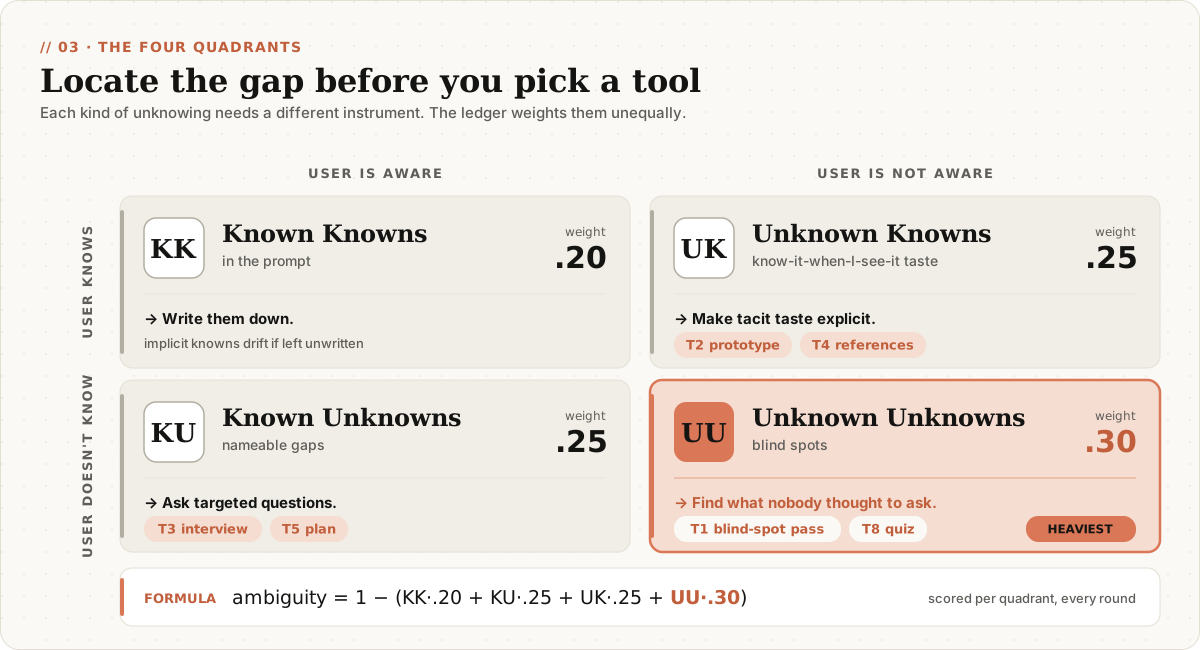
- Route by quadrant, not by habit — blind spots need reconnaissance, tacit taste needs prototypes, nameable gaps need targeted questions, comprehension needs examination. One uniform interview under-serves all four.
- Coverage-gated Cartographer mode — for high stakes: a regret-ordered unknowns ledger, clarity scores shown every round, and a seven-condition gate that won't let implementation start while the territory is unmapped.
- Irreversibility floor — gate on blast radius, not confidence. An unknown guarding an irreversible step always reaches you, however confident the evidence looks.
- Keep the reasoning at the handoff — an evidence-first packet that says what each check did NOT prove and what went unchecked, so accepting agent work never slides into cognitive surrender.
- Independent judgment — the author never self-approves. Discovery, scoring, and examination run in contexts that did not do the implementing.
- Zero dependencies — plain Markdown. Agents and Workflow scripts add depth; every technique also runs fully inline.
Attribution. The techniques and their names come from Thariq Shihipar's essay "A Field Guide to Fable: Finding Your Unknowns" (@trq212); credit for the underlying ideas belongs to the original author, and this repository packages them as an installable Claude Code plugin.
keep-the-reasoningis distilled from Addy Osmani's "Critical thinking when agents do the work" (source): across many handoffs the human slides from offloading (delegate, keep ownership) → deferral (the output becomes the next input) → cognitive surrender (the output quietly becomes your own).
Features
The two skills
| Skill | What it is | Use for |
|---|---|---|
finding-unknowns |
Phase 0 quadrant routing → eight techniques → optional Cartographer mode | Before and during work: surfacing the unknowns that would otherwise become guesses |
keep-the-reasoning |
Stakes triage, "verified" defined up front, a fixed-order handoff packet | The handoff: accepting agent work without surrendering judgment |
finding-unknowns hands over to keep-the-reasoning at the end of Phase 3 and of the Cartographer execution bridge.
The eight techniques
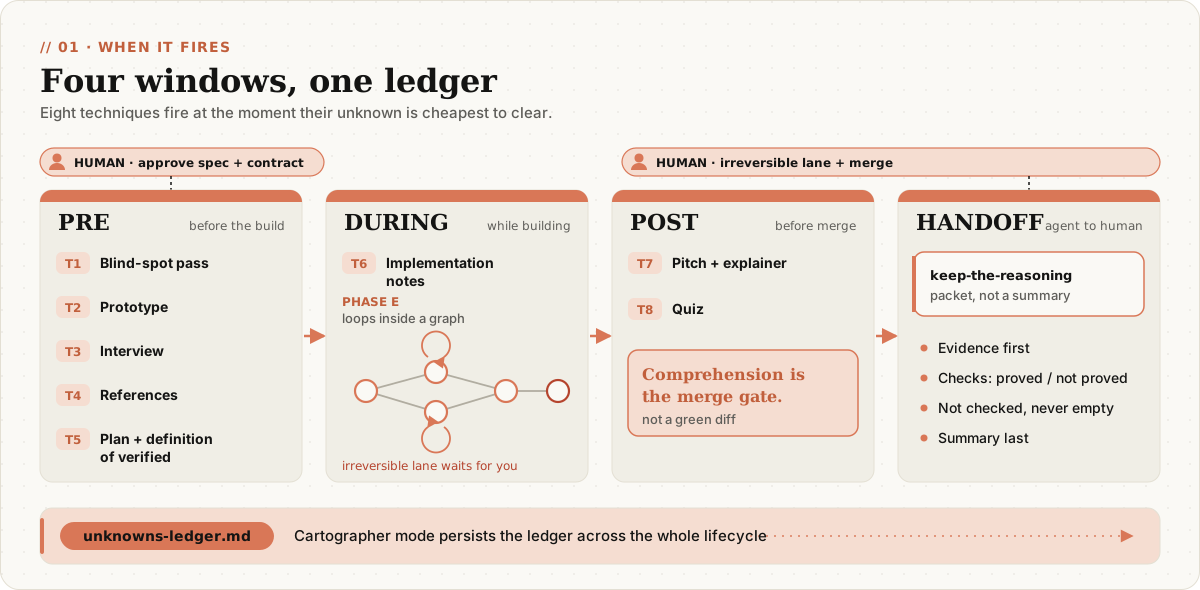
Phase 0 is blocking: classify the gap, capture your prior in one line, announce the route — then run a technique.
| Technique | Phase | Quadrant | Use for |
|---|---|---|---|
| 1 · Blind-spot pass | Pre | UU | Unknown unknowns in a new domain or codebase |
| 2 · Brainstorm & prototype | Pre | UK | "I'll know it when I see it" |
| 3 · Interview | Pre | KU | Nameable gaps — up to 3 independent questions per round; dependent questions wait for the next round |
| 4 · References | Pre | UK | When you can't describe it — point at code |
| 5 · Implementation plan | Pre | KU | Expensive-to-change decisions first, plus a definition of "verified" |
| 6 · Implementation notes | During | — | Deviations and edge cases, logged as they happen |
| 7 · Pitch & explainer | Post | — | Buy-in and approvals |
| 8 · Quiz | Post | UU (post-hoc) | Comprehension check before merge |
Known knowns just get written down before they drift. Full procedures: SKILL.md.
Cartographer mode
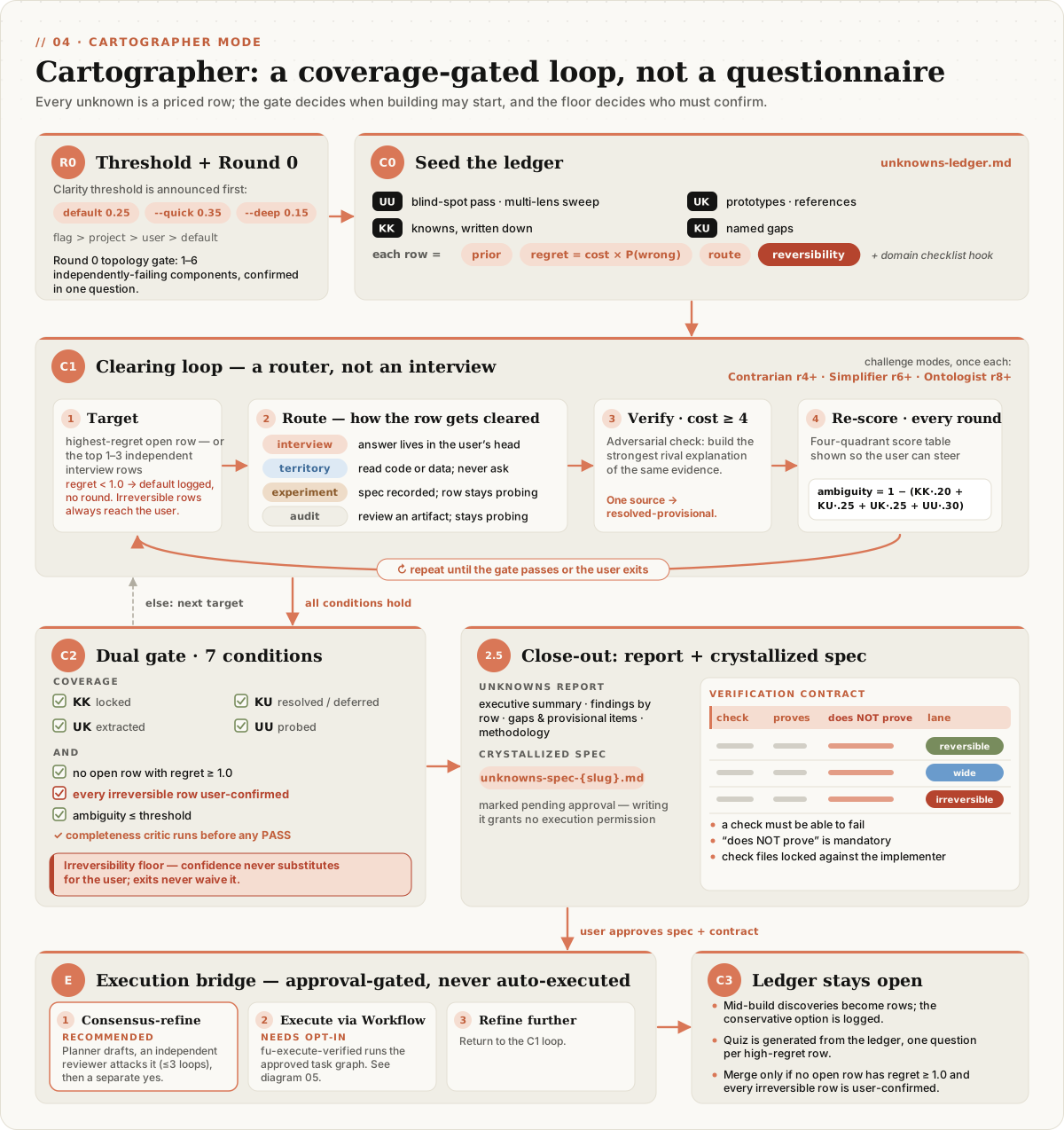
The rigorous escalation for high-stakes work. Full protocol: references/cartographer.md, read on demand.
| Part | What it is | Use for |
|---|---|---|
| Unknowns ledger | Rows with quadrant, prior, regret = cost-if-wrong × P(wrong), route (interview · territory · experiment · audit), reversibility (reversible · wide · irreversible) |
Ordering the work; it is the resume state |
| Clearing loop | A router, not an interview: clear the highest-regret open row by its route; adversarially verify cost ≥ 4 resolutions | Never asking the user what the territory can answer |
| Clarity scores | ambiguity = 1 − (KK×0.20 + KU×0.25 + UK×0.25 + UU×0.30), re-scored every round, threshold 0.25 by default |
Letting you see and steer how clear the map is |
| Dual gate | Coverage (every quadrant probed) AND clarity, plus the irreversibility floor; completeness critic before any PASS | Refusing to build on an unmapped territory |
| Execution bridge | Approval-gated: independent planner + reviewer consensus, or Workflow execution | Building from a crystallized, pending-approval spec |
Flow: threshold announced → Round 0 topology (1–6 components) → C0 seed from all four quadrants + a domain checklist → C1 clear by route → C2 dual gate → C2.5 close-out report + crystallized spec → E execution bridge → C3 the ledger stays open through the build and feeds the quiz.
New in v4.0.0
- Irreversibility floor — regret contains P(wrong), a confidence estimate. For
irreversiblerows confidence never substitutes for the user: never silently defaulted under the regret bar, resolved only with recorded user confirmation. The seventh gate condition; no exit waives it. - Priors and surprises — each row records the expectation held before evidence-based scoring; contradictions surface as surprises.
- Verification contract — per criterion: a failable check, its artifact, what it proves, what it does NOT prove, and its lane. Locked against the implementer.
- Phase E execution rules — the loop lives inside a task, the graph between tasks; edges name what crosses; failures return
UNIT · VERDICT · REASON · EVIDENCE · SCOPE; an attempt cap turns a task into a plan-suspect row; a learning edge feeds derived constraints forward; tasks close by reversibility lane on results from a separate check-runner. The human sits at both ends — spec, contract, and task graph at the front; irreversible lane and merge at the back.
Execution & orchestration
When the host exposes Claude Code's Workflow tool and you opt in, the fan-out-heavy operations run as deterministic scripts from references/workflows.md.
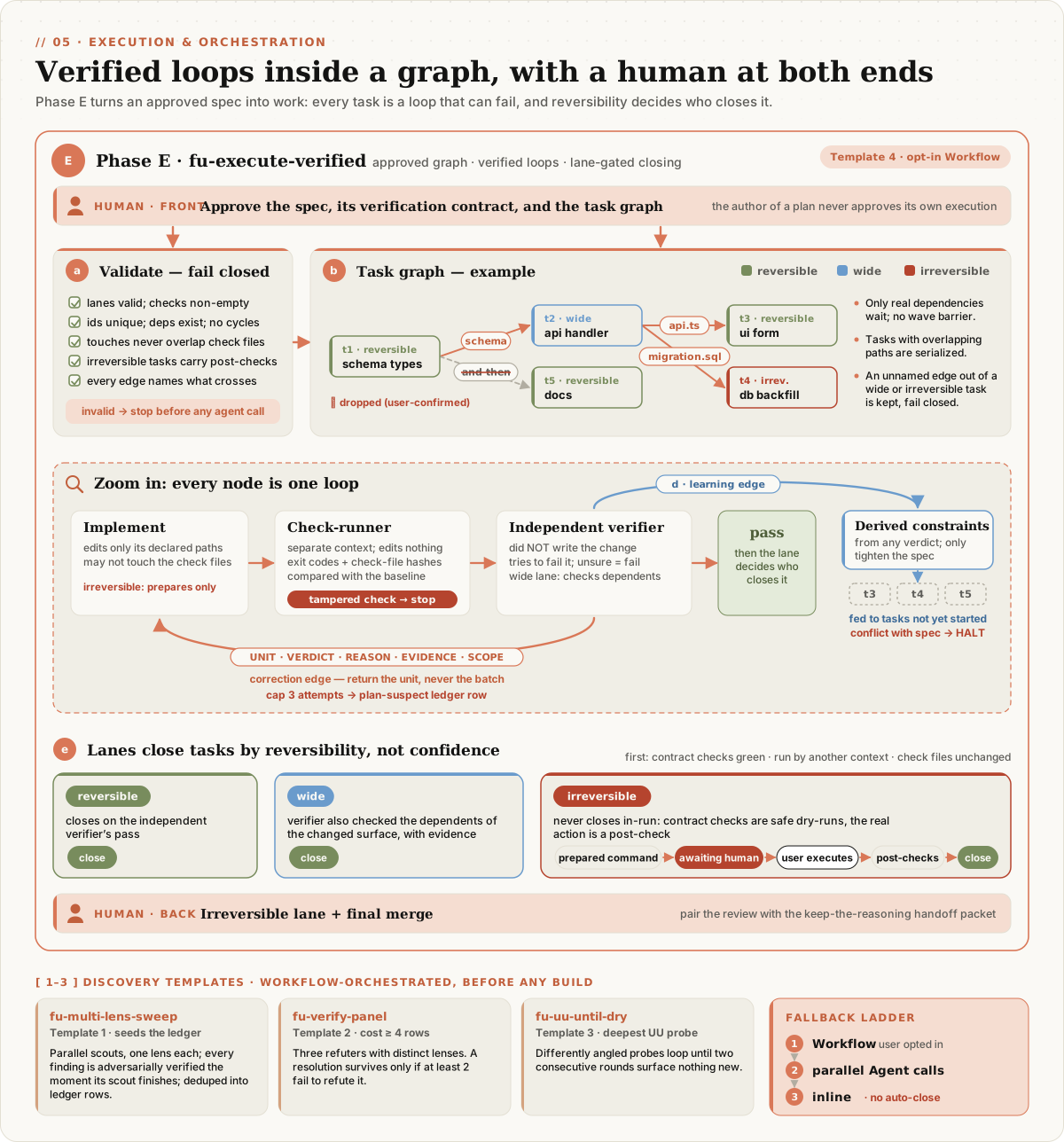
| Template | What it is | Use for |
|---|---|---|
fu-multi-lens-sweep |
Parallel lens scouts; each finding adversarially verified as its lens completes (no barrier); schema-validated ledger rows | Seeding UU rows at high stakes |
fu-verify-panel |
Three refuters: alternative explanation / evidence independence / reproduction | Cost ≥ 4 resolutions |
fu-uu-until-dry |
UU probe loop that stops after two consecutive dry rounds | Probing the shallowest quadrant — bounded by information, not a count |
fu-execute-verified |
Approved execution under Phase E rules; every implementer paired with an independent refute-framed verifier | Running the approved task graph |
Fallback ladder: Workflow → parallel Agent calls → fully inline. The logic is normative; the mechanism is not. With no subagents at all, implementer and verifier would share a context, so no lane closes automatically — every task comes to you as awaiting-human.
Enforced in code vs by prompt — stated honestly.
In fu-execute-verified |
Enforcement |
|---|---|
| Fail-closed argument validation; no silent edge drops; per-task scheduling; path locks (paths normalized, globs rejected); lane-based closing; check results matched to contract checks by exact string | code |
| Out-of-scope writes stop the run; check-file hashes compared against a pre-run baseline; tampered check files stop the task | code compares — the check-runner's report is prompted |
| Concurrent tasks' edits attributed to the right task; implementer never executes irreversible actions; runner refuses irreversible checks | prompted |
| Verifier independence | structural |
Keep the reasoning
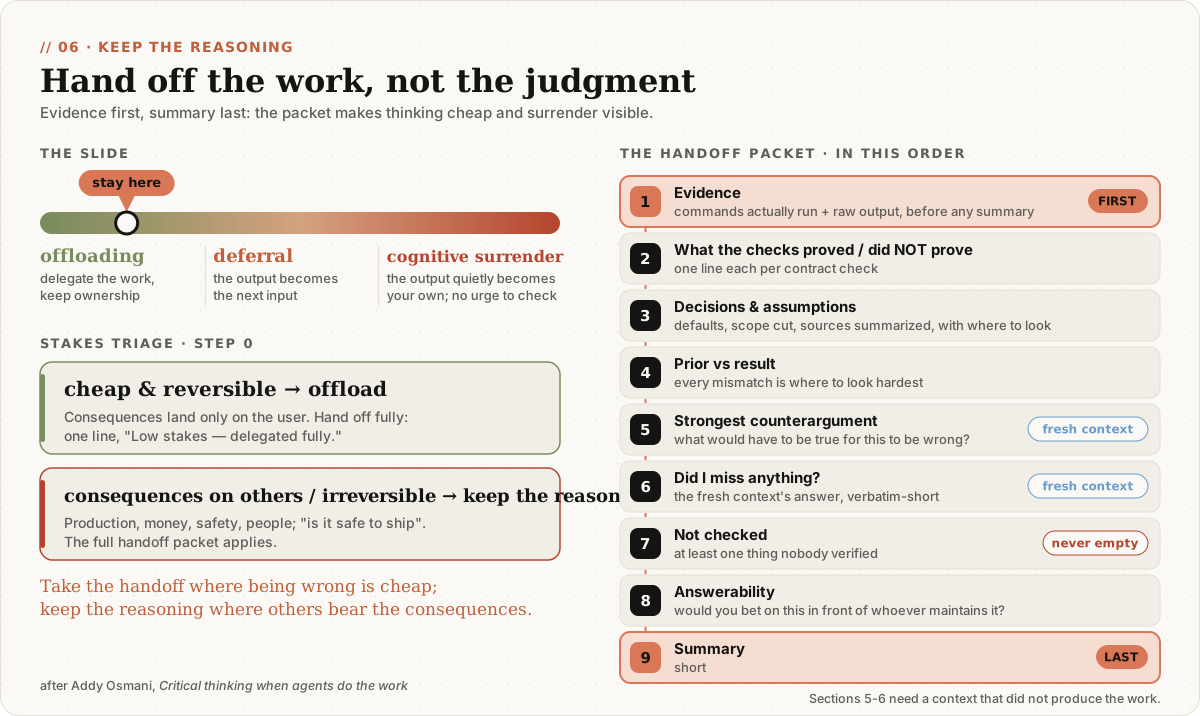
| Step | What it is | Use for |
|---|---|---|
| Stakes triage | offload (cheap, reversible, lands only on you) vs keep-the-reasoning (lands on others, hard to reverse) |
Scaling the packet to consequence, not effort |
| Before the work | Capture your hypothesis; define "verified" — a check must be able to fail | Making any outcome un-rationalizable after the fact |
| Handoff packet | Evidence first → what checks proved / did NOT prove → decisions & assumptions → prior vs result → fresh-context counterargument → never-empty "not checked" → summary last | Accepting work with your judgment intact |
| After the handoff | A rejection becomes a rule (test, hook, lint rule); surrender signals named once, without moralizing | Making taste compound |
When finding-unknowns already ran, keep-the-reasoning reuses its priors, verification contract, and the quiz-master's Decisions & assumptions instead of repeating them.
Agents & model routing
Commands dispatch, skills decide, agents execute, documents persist. Procedure lives in one place per skill; commands and agents are enhancements, not dependencies.
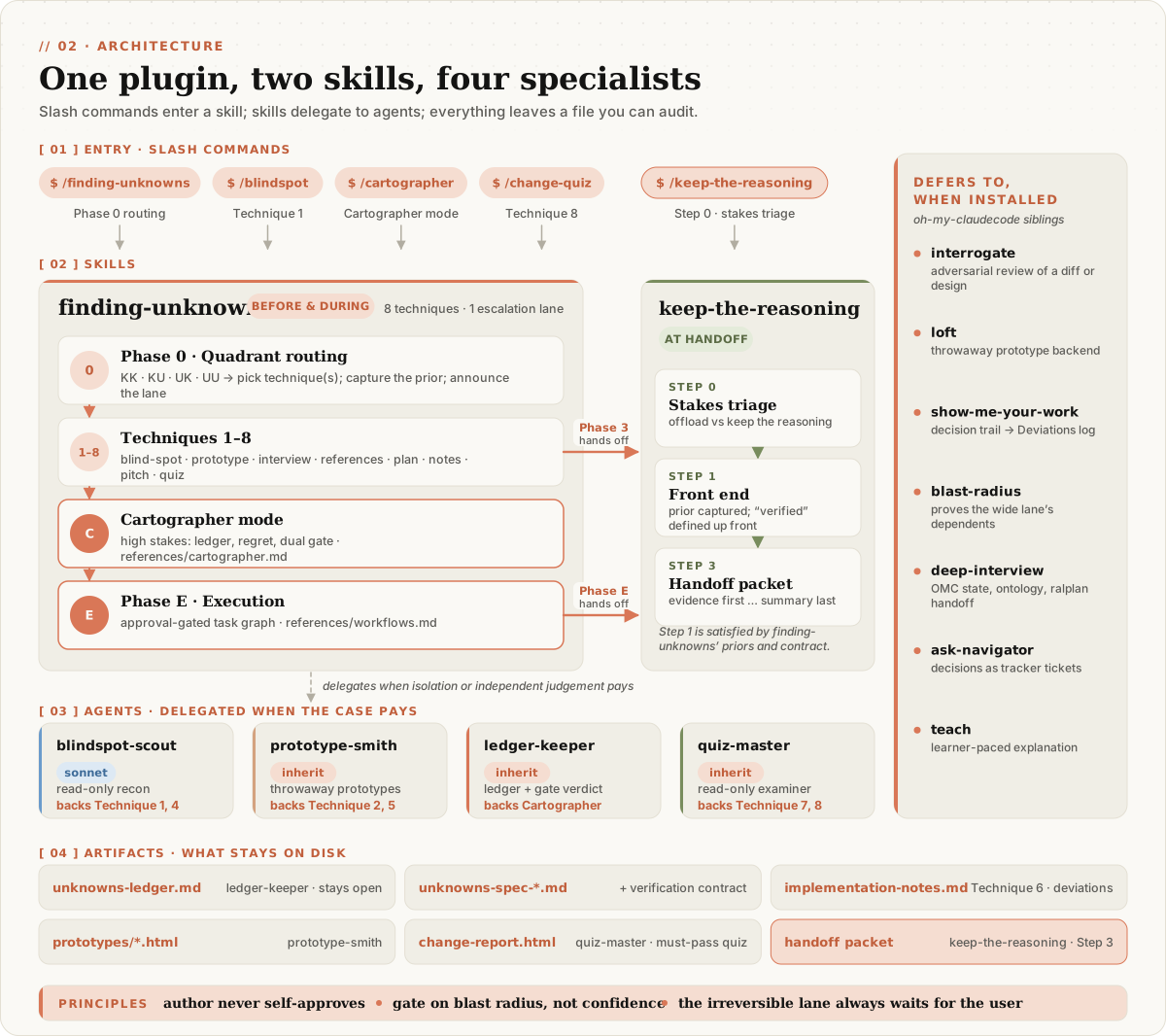
| Agent | Model | Tools | Backs | Why isolated |
|---|---|---|---|---|
blindspot-scout |
sonnet | read-only | Blind-spot pass, References | Wide recon in its own context window; structurally cannot implement |
prototype-smith |
inherit | writes throwaway files only | Prototype, Plan | N genuinely divergent directions in one pass, sandboxed from the real app |
ledger-keeper |
inherit | ledger file only | Cartographer | Regret, clarity scores, and the gate verdict — without grading its own interview |
quiz-master |
inherit | read-only + report | Pitch, Quiz | Fresh-eyes examiner that did not author the change; flags unlogged deviations |
Model routing — judgment and creative agents use model: inherit, so they run at the session's own strength and are never downgraded. blindspot-scout is the one deliberate cost tier (sonnet) because recon fans out in parallel; set it to inherit for single-lens passes. Follows OMC's role tiers and Deep Research's "strongest model at the synthesis centre, cheaper fan-out" — with the top tier inherited rather than pinned.
Commands
These run inside a Claude Code session. Each command is a thin dispatcher into a named skill section.
| Form | Kind | Effect | Example |
|---|---|---|---|
/finding-unknowns |
Slash command → Phase 0 | Locate the unknown, announce the route, run the matching technique | /finding-unknowns "add a usage dashboard" |
/blindspot |
Slash command → Technique 1 | Read-only blind-spot pass | /blindspot "src/auth" |
/cartographer |
Slash command → Phase C | Ledger, scored clearing loop, dual gate, execution bridge | /cartographer --deep "migrate billing" |
/change-quiz |
Slash command → Technique 8 | Change report + must-pass comprehension quiz | /change-quiz main..HEAD |
/keep-the-reasoning |
Slash command → keep-the-reasoning Step 0 (Step 3 if the work is done) |
Stakes triage, then the handoff packet | /keep-the-reasoning "ship the migration?" |
finding-unknowns / keep-the-reasoning |
Skill tool | The same skills, no plugin commands needed | invoke via the Skill tool |
| plain language | Prompt | Request one technique directly | "do a blind-spot pass", "interview me", "brainstorm four directions" |
Notes:
- The slash commands need the plugin or a manual copy of
commands/; the skills alone load through the Skill tool. - Depth flags set the Cartographer threshold:
--quick0.35 ·--standard0.25 (default) ·--deep0.15. - Copy-paste, end-to-end prompts:
EXAMPLES.md.
Override the clarity threshold per project or per user in .claude/settings.json (flag > project > user > default); Cartographer announces the resolved threshold and its source on entry.
{ "findingUnknowns": { "ambiguityThreshold": 0.25 } }
Other defaults — prototype directions (4), regret question bar (1.0, never applied to irreversible rows), quiz size and rounds, Cartographer round caps (soft 10 / hard 20), execution attempt cap (3) — live in the Defaults table in SKILL.md and can be overridden in plain language.
Demo
Illustrative transcripts, written to the output templates in the two
SKILL.mdfiles andreferences/cartographer.md— not recordings of real sessions.
Phase 0 routing — announced before any technique runs, so you can veto it.
> /finding-unknowns add a usage dashboard to the admin app

Prior: "a few charts over the existing usage table"
Routing: UU + UK → blind-spot pass, then 4-direction prototype — you're new to this
subsystem (UU) and the dashboard layout is know-it-when-you-see-it (UK).
Round 3 complete.

Ledger: 4 open | 1 probing | 6 resolved | 2 deferred
Top regret: U2 (2.0) — which auth path to extend [route: interview]

| Quadrant      | Score   | Weight        | Gap                                        |
|---------------|---------|---------------|--------------------------------------------|
| KK            | 0.90    | 0.20          | clear                                      |
| KU            | 0.50    | 0.25          | auth path (U2) undecided                   |
| UK            | 0.70    | 0.25          | session-UX criteria not yet confirmed      |
| UU            | 0.70    | 0.30          | two scout lenses run; not yet dry          |
| **Ambiguity** | **31%** | threshold 25% | KU × auth middleware — U2 sets the design  |

Coverage gate:
[x] KK locked          [ ] KU resolved/deferred
[x] UK extracted       [x] UU probed
[ ] no open row with regret ≥ 1.0
[x] every irreversible row user-confirmed
[ ] ambiguity 31% ≤ threshold 25%

Next target: U2 — highest-regret open row; a wrong guess forces a rewrite of the
middleware layer.
Handoff lane: keep-the-reasoning — schema migration on a shared production table.
1. Evidence: `pytest tests/migrations -q` → 14 passed; `alembic upgrade head --sql` →
   plan at artifacts/upgrade.sql (ALTER + backfill, 2 statements)
2. Proved: upgrade SQL applies cleanly to an empty schema. NOT proved: runtime on the
   41M-row table; lock behaviour under write load. Tests written in this session.
3. Decisions: backfill default = 'unknown' (spec silent); downgrade drops the column
   (data loss) — see migrations/0042.py:31
4. Your prior: "a quick additive change". Mismatch: the backfill rewrites every row.
5. Counterargument (fresh subagent): if writes continue during backfill, the table lock
   stalls checkout. Not checked.
6. Missed: the replica lag alert threshold.
7. Not checked: lock duration at production size; replica lag.
8. Would you bet on this in front of the on-call? If not: run it on the staging snapshot.
9. Summary: migration is correct on small data; production behaviour unverified.
The anti-pattern it replaces: "Done! The migration is ready and all tests pass ✅."
How it Compares
finding-unknowns is a lightweight orienting layer, not an execution engine. Use it to locate an unknown, then escalate to the right specialist.
| Property | finding-unknowns | Deep Interview (OMC) | OMC execution (autopilot / ralph / team) | Superpowers |
|---|---|---|---|---|
| Altitude | Meta / orienting | One phase: requirements | Execution & delivery | Discipline primitives |
| Lifecycle | Pre · During · Post | Pre only | During · Post | Mostly single-phase |
| Rigor | Flexible | Ambiguity gating | Verification-gated | Checklist-driven |
| State | Stateless (Cartographer: ledger file) | Persisted, resumable | Persisted, multi-agent | Varies |
| Best when | You don't yet know your unknowns | You need a validated spec | The spec is clear | You need one disciplined move |
Deep Interview (as of OMC 5.8.1) is approval-gated; its --frontier mode is the closest analogue of batched independent questions plus territory routing. Cartographer adopts its transparency machinery — clarity scores with a threshold, Round 0 topology, challenge modes — and keeps the axes a clarity-scoring interview alone does not cover.
Defer, don't duplicate. When a sibling is installed, finding-unknowns uses it for the mechanism it owns and keeps the unknowns lens — quadrant routing, regret-priced rows, route-typed clearing, the reversibility floor, lifecycle persistence.
| Need | Sibling (when installed) |
|---|---|
| Accepting agent output without surrendering judgment | keep-the-reasoning (this repository) |
| Ontology tracking, OMC state, ralplan/autopilot handoff | oh-my-claudecode:deep-interview |
| Fog test and decision tickets on a tracker | oh-my-claudecode:ask-navigator |
| Adversarial review of a diff or design | oh-my-claudecode:interrogate |
| Throwaway prototype to settle a design | oh-my-claudecode:loft |
| Decision trail for autonomous work | oh-my-claudecode:show-me-your-work |
| Prove a change's blast radius | oh-my-claudecode:blast-radius |
| Restate the brief before starting | oh-my-claudecode:in-your-own-words / sharpen |
| Learner-paced explanation | oh-my-claudecode:teach |
| Axis | Deep Interview | Cartographer mode |
|---|---|---|
| Gate criterion | Ambiguity ≤ threshold (goal/constraint/criteria) | Dual: coverage (all four quadrants probed, blind-spot pass required) AND per-quadrant weighted ambiguity ≤ threshold, plus the irreversibility floor |
| Blind spots (UU) | Not modelled | First-class; heaviest weight (0.30) |
| Lifecycle | Ends at the specification | One ledger, seeded pre, appended during, closed post |
| Prioritisation | Fixed dimension weights | Regret orders rows; ambiguity scores quadrants |
| Clearing instrument | Socratic Q&A | Route-typed per unknown: interview / territory / experiment / audit |
| Execution | Approval-gated handoff into OMC pipelines | Approval-gated bridge: planner + reviewer consensus, or Workflow execution with per-task refute-framed verification |
finding-unknowns  (orient: which quadrant is this unknown in?)
        ├─ a light reframe is sufficient            → the eight techniques
        ├─ high-stakes, want a coverage gate         → Cartographer mode
        ├─ want ambiguity gating + resumable state   → OMC Deep Interview
        ├─ divergent option generation               → superpowers:brainstorming
        ├─ a rigorous written plan                   → superpowers:writing-plans / omc-plan
        ├─ the specification is already concrete     → OMC autopilot / ralph / team
        └─ the work is done, the risk is the handoff → keep-the-reasoning
Design Notes
What field tests and reviews changed:
- Field test → the route column (v3.3.0). In a quant × deep-learning research task, the three highest-regret unknowns all had non-interview routes. The loop became a router: territory rows are never asked of the user; pending experiments suspend the loop instead of spawning empty rounds.
- A strong result is not a resolved one (v3.4.0). A strong RankIC looked like it settled "is the signal real?" — but leakage produces the same IC. Cost ≥ 4 rows now need an adversarial check and two independent sources.
- Field test → visible clarity scoring (v3.6.0). Discovery was strong, but work drifted into a fuzzy zone the user could not steer. Fix: per-quadrant scores every round, scored in one call from ledger evidence only, with "score drift" named as a failure mode.
- Confidence vs blast radius (v4.0.0). Regret multiplies by P(wrong) — the input most prone to optimism — so a confident agent could silently default an irreversible step. Hence the irreversibility floor.
- Three review rounds of
fu-execute-verified(v4.0.0).- Round 1 — an independent adversarial review found 1 CRITICAL and 6 HIGH, reproduced against a stubbed runtime, including argument validation that let an unknown or missing lane through. Validation now fails closed.
- Round 2 — closed the remaining fail-open edges: paths normalized and globs rejected before locking, mandatory check files for
wide/irreversibletasks, writes outside every declared path stop the run. - Round 3 — fixed the scope check's false halts: paths already dirty before the run are baselined and excluded.
- Exercised by a 50-scenario harness against a stubbed agent runtime, plus the reviewer's own adversarial scenarios.
- Deliberately not adopted. "Approve only the last step" — a human reviewing only a final artifact they never framed is rubber-stamping. "Confidence is the only input the model can influence" — agents can also edit their own checks, hence the locked contract.
Roadmap
Not done yet:
- Run
fu-execute-verifiedin a live Workflow runtime — so far exercised only against a stubbed agent runtime. - Move the remaining prompted guarantees into code where the runtime allows.
- Chinese-language diagram variants — README.zh.md reuses the English SVGs.
- Ontology / entity-convergence tracking — consciously deferred in v3.6.0 because the Round 0 topology gate covers convergence more cheaply; to revisit if component drift shows up in tests.
Documentation
- Architecture — layers, artifact contracts, design principles
- finding-unknowns SKILL.md — routing, the eight techniques, Cartographer summary, defaults
- Cartographer protocol — the normative ledger, gate, close-out, and Phase E rules
- Workflow templates — the four scripts, code-vs-prompt table, fallback ladder
- keep-the-reasoning SKILL.md — stakes triage, handoff packet, surrender signals
- Examples — copy-paste, end-to-end prompts
- Changelog — release history
- AGENTS.md — repository guide and invariants for coding agents and contributors
- Contributing — workflow and local validation; contributions welcome
Requirements
- Claude Code — the CLI, desktop app, or an IDE extension.
- No runtime, no dependencies — skills, agents, and commands are plain Markdown; nothing is compiled.
- Optional, all degrade gracefully — the four companion agents and the Workflow tool; every technique also runs inline.
bash— only forinstall.sh.
Project Layout
Repository treefinding-unknowns-skill/
├── .claude-plugin/ Plugin and marketplace manifests (/plugin install)
├── commands/ Slash-command entry points (thin dispatchers)
│ ├── finding-unknowns.md /finding-unknowns — Phase 0 routing
│ ├── blindspot.md /blindspot — blind-spot pass
│ ├── cartographer.md /cartographer — Cartographer mode
│ ├── change-quiz.md /change-quiz — report + merge quiz
│ └── keep-the-reasoning.md /keep-the-reasoning — the handoff
├── skills/
│ ├── finding-unknowns/
│ │ ├── SKILL.md Routing, eight techniques, Cartographer summary
│ │ └── references/
│ │ ├── cartographer.md Full Cartographer protocol (normative), read on demand
│ │ └── workflows.md Workflow templates + fallback ladder
│ └── keep-the-reasoning/
│ └── SKILL.md Stakes triage, handoff packet
├── agents/ blindspot-scout (sonnet) · prototype-smith · ledger-keeper · quiz-master (inherit)
├── docs/ARCHITECTURE.md Design reference: layers, contracts, principles
├── assets/ README diagrams (SVG)
├── AGENTS.md Repository guide for coding agents and contributors
├── EXAMPLES.md Copy-paste, end-to-end prompts
├── CLAUDE.md Passive single-file drop-in
├── install.sh Installer (skills + references + agents + commands)
├── CONTRIBUTING.md · CHANGELOG.md · LICENSE (MIT)
└── README.md (English, canonical) · README.zh.md (简体中文)
License & Credits
Released under the MIT License.
- Technique ideas and names: Thariq Shihipar, "A Field Guide to Fable: Finding Your Unknowns" (@trq212).
keep-the-reasoningand the verification contract: Addy Osmani, "Critical thinking when agents do the work" (source).- Phase E execution rules: Anthropic's "Building effective agents" (evaluator-optimizer, orchestrator-workers) and @hanakoxbt's "Loops and Graphs" (source).
- Cartographer's ambiguity gating, topology gate, and challenge modes are adapted from the deep-interview skill in oh-my-claudecode; the comparison also references Superpowers.
Disclaimer. This is an independent community project. It is not affiliated with, authorised by, or endorsed by Anthropic.
Reviews (0)
Sign in to leave a review.
Leave a reviewNo results found