mcp-attest
Health Warn
- License — License: MIT
- Description — Repository has a description
- Active repo — Last push 0 days ago
- Low visibility — Only 5 GitHub stars
Code Pass
- Code scan — Scanned 12 files during light audit, no dangerous patterns found
Permissions Pass
- Permissions — No dangerous permissions requested
No AI report is available for this listing yet.
Conformance and attestation harness for MCP agent access control: prove that a policy actually enforces.
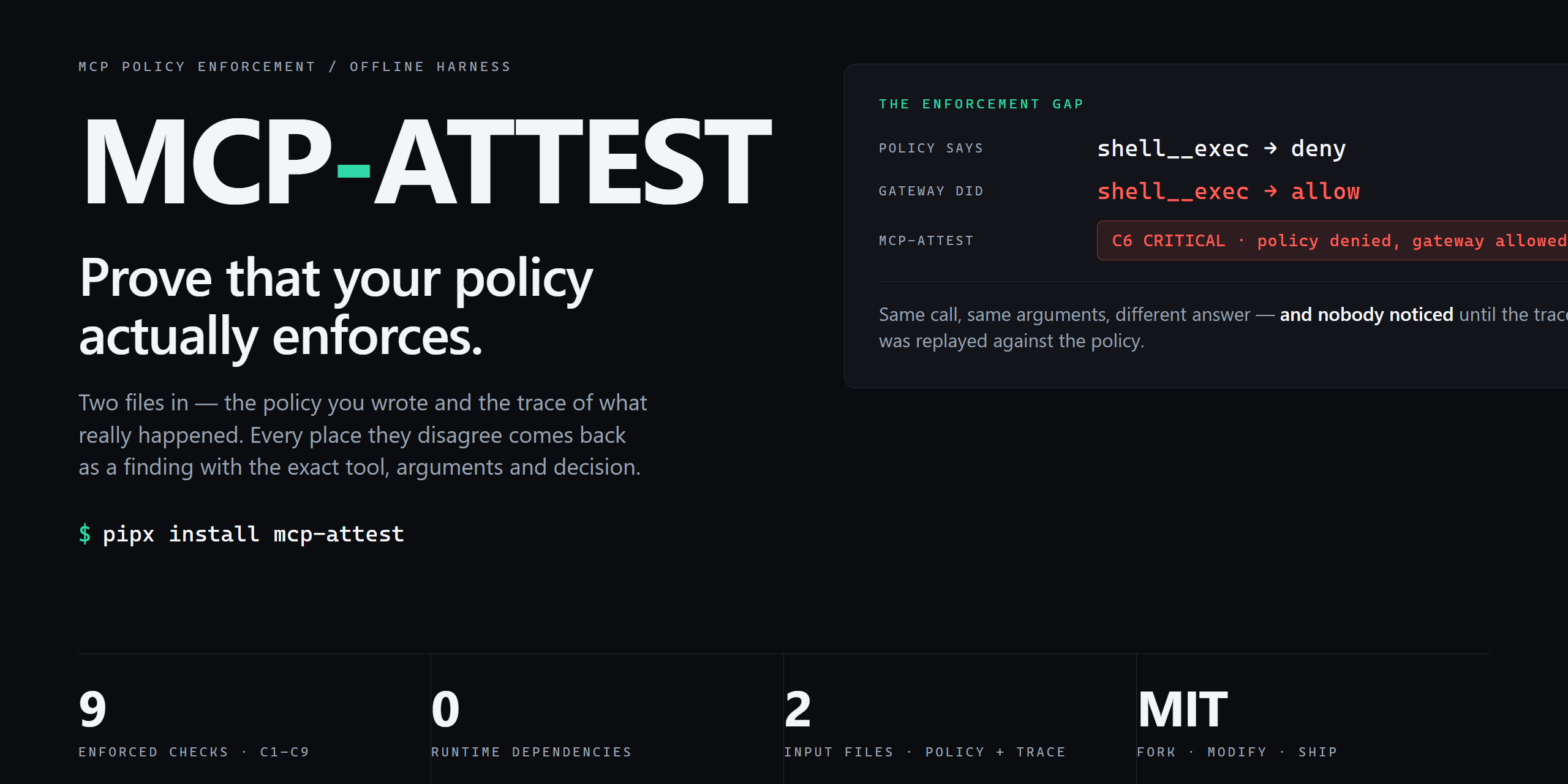
Prove that your MCP policy actually enforces.
Two input files · nine checks · zero runtime dependencies · MIT
Install · Run it · The nine checks · CI · Specification · Website · Русский


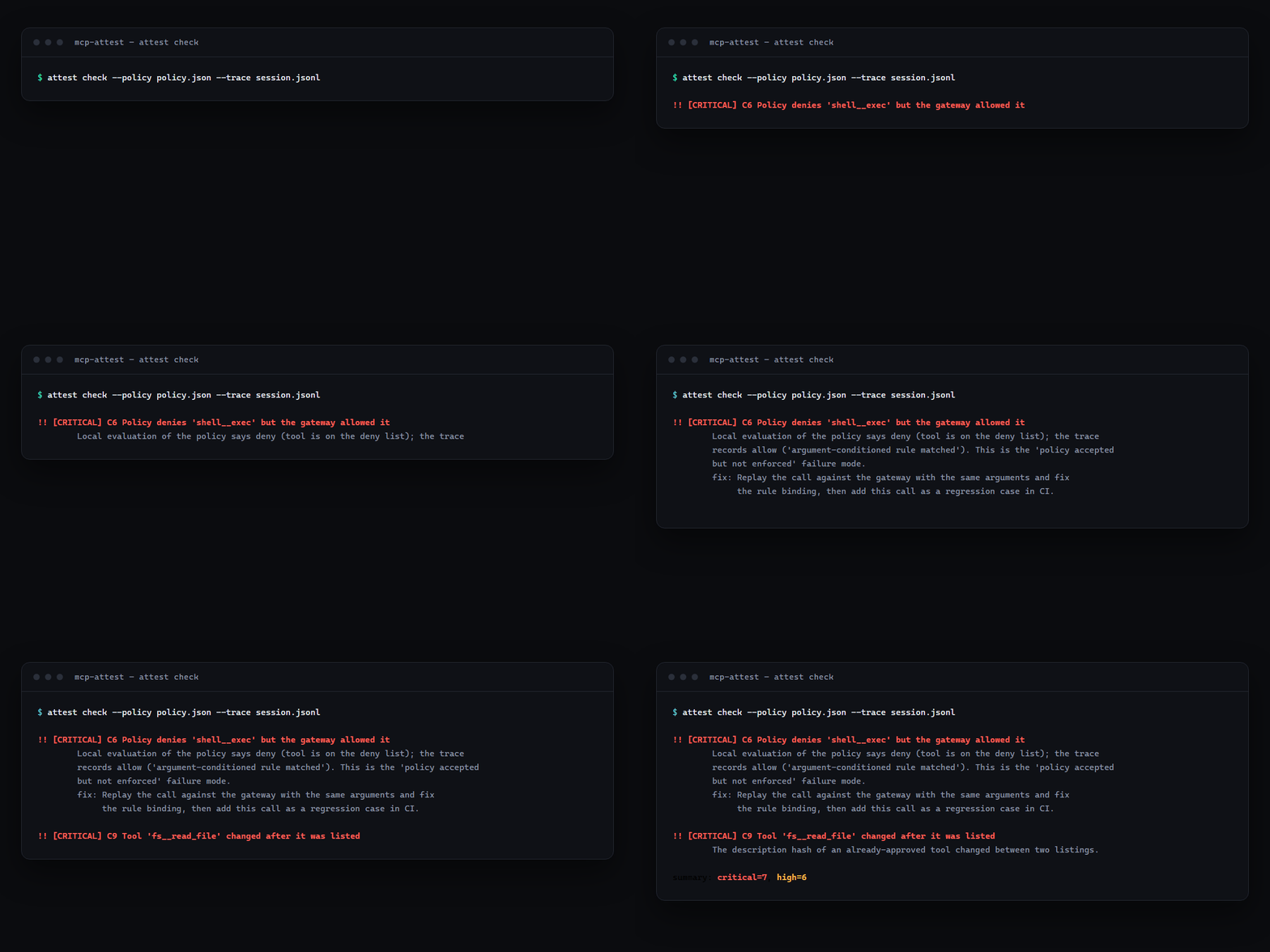
Real output from examples/session.jsonl. Exit code 1 means a blocking finding. Examples · Why this exists.
mcp-attest is a conformance harness for MCP agent access control. It takes the policy you wrote and the trace of what actually happened, and reports every point where they disagree.
It is not a gateway. It does not sit on the request path, and it never holds a credential for the upstream server. It reads evidence that already exists.
Why mcp-attest?
- It catches the accepted-but-not-enforced rule. C6 re-evaluates your policy locally against every recorded call. A call your policy denies but the gateway allowed is invisible in every dashboard, because dashboards show what the gateway believed.
- Evidence, not opinion. Every finding carries the exact tool, arguments and decision that produced it, and the fix.
- Offline by construction. No network calls, no telemetry, no account. Traces carry payloads and stay where they are.
- Exit codes, not vibes.
0clean,1blocking finding,2bad input. It is a CI gate without a wrapper script. - Zero dependencies. Python 3.10+ and the standard library.
- Tamper-evident receipts. Optional hash-chained, HMAC-signed receipts for every allowed call.
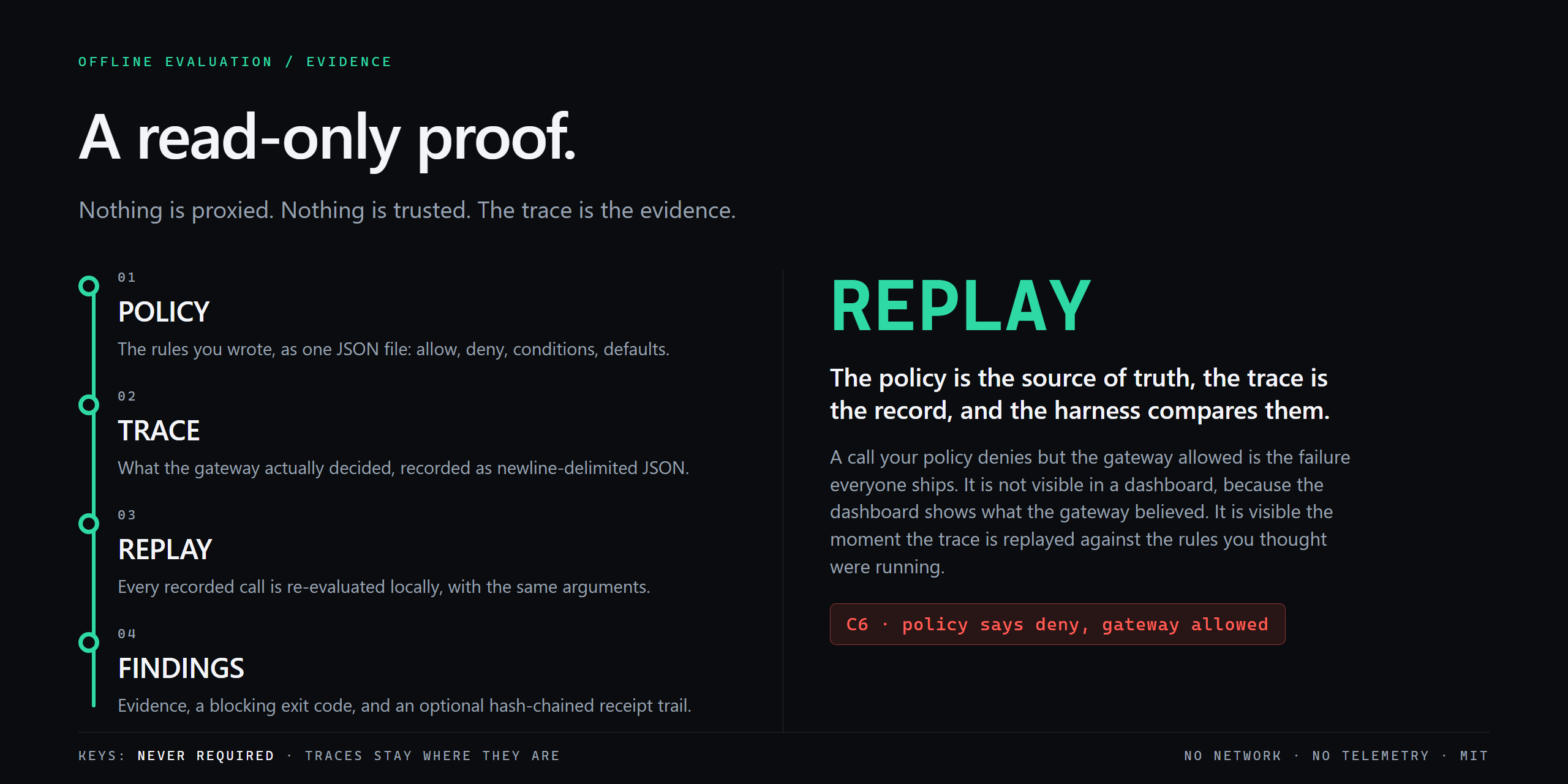
Nothing is proxied. The trace is the evidence. Full specification.
Website · Specification · Research notes · MIT license
Install
pipx install mcp-attest          # isolated CLI
uvx mcp-attest check --help      # one-shot
pip install mcp-attest           # into a virtualenv
From source:
git clone https://github.com/Balanov/mcp-attest.git
cd mcp-attest
python -m pip install -e ".[dev]"
python -m unittest discover -s tests -v
Run it
attest init                                            # write a starter policy
attest check --policy examples/policy.json --trace examples/session.jsonl
!! [CRITICAL] C6 Policy denies 'shell__exec' but the gateway allowed it
          Local evaluation of the policy says deny (tool is on the deny list); the trace
          records allow ('argument-conditioned rule matched'). This is the 'policy accepted
          but not enforced' failure mode — a rule that is registered but never applied.
          fix: Replay the call against the gateway with the same arguments and fix
               the rule binding, then add this call as a regression case in CI.

summary: critical=7, high=6
Exit code 1 means a blocking finding exists. --json prints machine-readable findings; --strict treats high findings as blocking as well.
| Command | Purpose |
|---|---|
attest init |
Write a starter policy |
attest check |
Check a trace against a policy |
attest receipts |
Build and verify a hash-chained receipt trail |
attest shadow |
List the servers an agent can reach outside the gateway |
attest rules |
List the enforced rules |
The nine checks
| ID | Rule | The failure it catches |
|---|---|---|
| C1 | default-deny | An unset allowlist silently meaning "allow everything" |
| C2 | list/call parity | A tool hidden from tools/list but callable by name |
| C3 | narrowing only | A per-request control widening a client's grant |
| C4 | credential separation | The client's token replayed upstream verbatim |
| C5 | fail closed | A call allowed because the policy check errored |
| C6 | enforcement parity | The policy says deny, the gateway allowed it |
| C7 | shadow MCP | A server the agent can reach outside the gateway |
| C8 | receipt chain | Allowed calls with no verifiable receipt, or a broken chain |
| C9 | description integrity | A tool definition changed after approval (rug pull) |
Input files
Policy
{
  "version": 1,
  "default_decision": "deny",
  "clients": {
    "ci-bot": {
      "tools": {
        "allow": ["fs__read_file", "fs__list_directory"],
        "deny": ["fs__write_file", "fs__delete_everything"],
        "conditional": [
          {
            "tool": "fs__write_file",
            "allow_when": { "path": { "starts_with": "./out/" } },
            "action": "allow",
            "reason": "writes are allowed only inside ./out/"
          }
        ]
      },
      "egress_hosts": ["api.internal.example.com"]
    }
  },
  "gateway": { "mode": "routed", "fail_closed": true, "passthrough_credentials": false },
  "receipts": { "required": true, "key_env": "MCP_ATTEST_KEY" }
}
Condition operators: eq, not_eq, starts_with, ends_with, contains, in, not_in, gt, gte, lt, lte, glob, regex. A bare string ending in / is a prefix; a bare string containing * is a glob.
Trace
Newline-delimited JSON, one event per line. Any proxy, agent harness or CI step can produce it.
{"type":"tools_list","actor":"ci-bot","tools":[{"name":"fs__read_file","description_sha256":"a1b2…"}]}
{"type":"tool_call","actor":"ci-bot","tool":"fs__read_file","args":{"path":"/srv/README.md"},"decision":"allow","upstream":true,"reason":"tool is on the allow list"}
{"type":"client_servers","client":"claude-code","servers":["fs","git"]}
{"type":"gateway_route","server":"fs","tools":["read_file","list_directory"]}
Full specification: SPEC.md.
Receipts
export MCP_ATTEST_KEY=…
attest receipts --trace examples/session.jsonl --out receipts.jsonl
# chain: ok (6 receipts, key=yes)
Each receipt commits to the previous one, so removing or reordering a receipt breaks the chain. With MCP_ATTEST_KEY set, every receipt is additionally signed with HMAC-SHA256, so an auditor can detect edits without access to the gateway.
This is deliberately not a PKI. It answers the question an incident responder actually asks: did this session really contain these calls, in this order, and has anything been altered since?
Use it in CI
- uses: Balanov/mcp-attest@v0
  with:
    policy: .attest/policy.json
    trace: .attest/trace.jsonl
The action fails the job on any critical or high finding, so "our agent policy is enforced" becomes something the pipeline proves instead of something a security questionnaire asks about.
What mcp-attest is not
- Not a gateway, proxy or enforcement point. It cannot block a call.
- Not a scanner. It does not connect to your MCP server and sends no probe traffic.
- Not a PKI. A receipt chain and an HMAC prove order and integrity, not identity.
- Not a policy editor. It reads the policy you already have.
- Not a hosted service. No account, no network calls, no telemetry.
Development
python -m pip install -e ".[dev]"
python -m unittest discover -s tests -v
CI runs the suite on Python 3.10–3.13 and publishes the package to PyPI from a tagged release through trusted publishing, with no API token in the repository.
License
MIT. Fork it, modify it, embed it, ship it.
Reviews (0)
Sign in to leave a review.
Leave a reviewNo results found