Refine-Cycle-for-Hermes-Agent
Health Warn
- License — License: MIT
- Description — Repository has a description
- Active repo — Last push 0 days ago
- Low visibility — Only 5 GitHub stars
Code Fail
- rm -rf — Recursive force deletion command in install.sh
Permissions Pass
- Permissions — No dangerous permissions requested
No AI report is available for this listing yet.
Self-improvement loop for Hermes Agent: reads its own trajectory, proposes and applies the smallest skill/memory edit (create/patch), journaled with rollback. /refine command, refine_run tool, on_session_end hook.
Refine Cycle for Hermes Agent

Your agent keeps repeating one mistake. This makes it stop.
Refine Cycle looks across recent sessions, finds those repeating problems, and
saves one small lesson when the evidence is strong enough. Later, it checks
whether the same problem came back.
Cross-session by design. Hermes can learn from the conversation in front of
it, but some problems return across different sessions: the same failed command,
the same wrong assumption, the same workaround you have to explain twice.
Underneath: errors are fingerprinted into comparable shapes, recurrence is
counted within and across sessions, and every mutation is journaled before it
runs.
It adapts the /refine concept from
Prime Intellect's Prime Agent
(Continual Harness) to the Hermes plugin system.
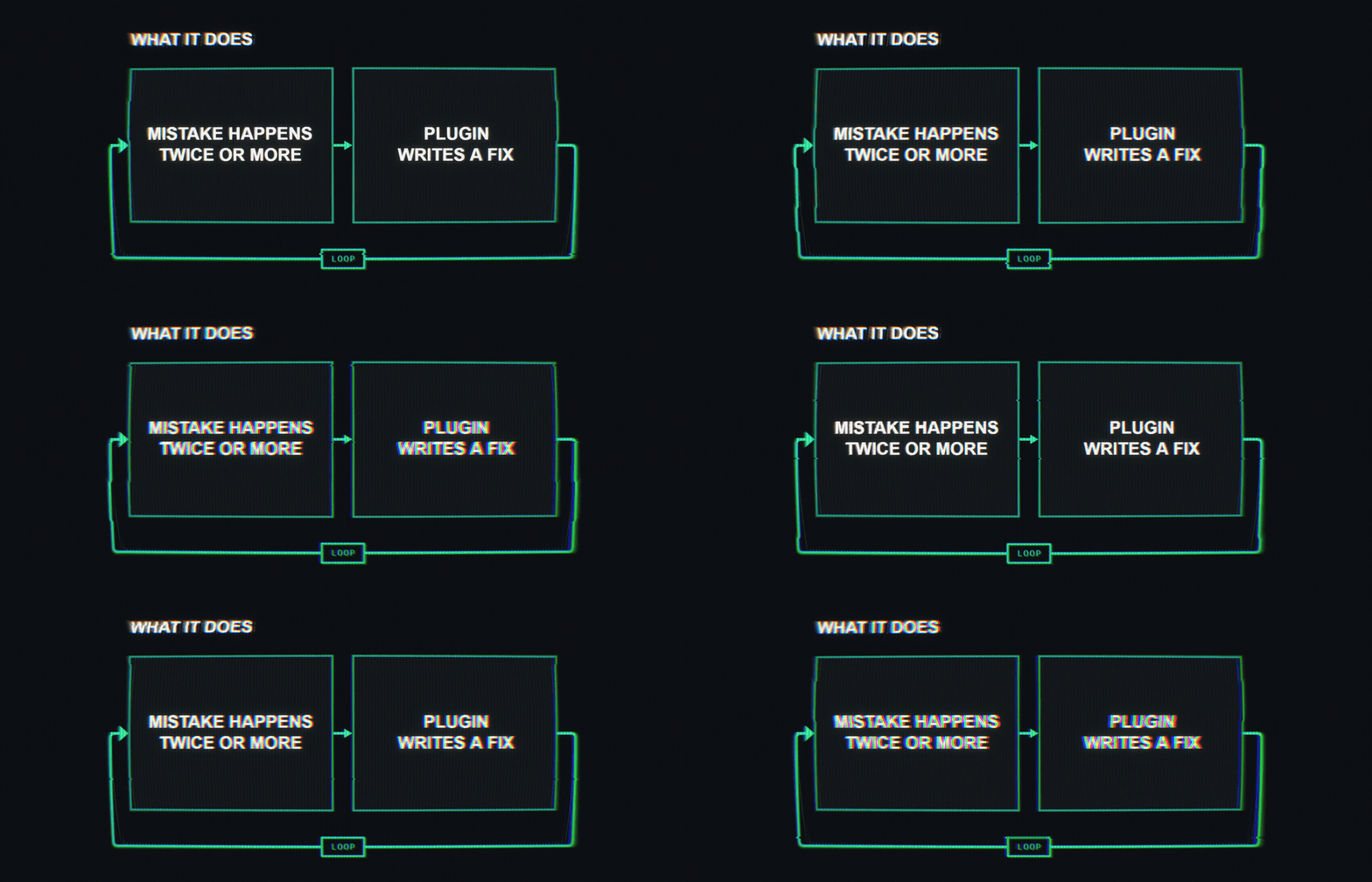
A simple three-step loop
- Notice what keeps going wrong. One bad result may be noise. A problem seen
in two sessions or five times is a pattern worth examining. - Save the smallest useful lesson. It can add a short memory,
create or improve a reusable skill, or add a focused note for future turns. - Check the result. It watches later sessions and reports whether the lesson
appears to be working, unused, unreliable, or too new to judge.
You stay in control
- It makes no more than three changes per day.
- Every change is recorded. When it can be safely undone, it gives you one
command to reverse it. - It never rewrites Hermes's base instructions or deletes your skills.
- API keys and other credentials are removed before conversation evidence is
sent to the model. - If the evidence, model reply, or Hermes state is unclear, it stops instead of
pretending that a lesson was applied.
Before you install
Refine Cycle does more than report problems: it can change what Hermes
remembers. The full installer connects Refine Cycle to the AI model already
serving your Hermes session and increases the space available for long-term
memory. When the plugin starts, it also attempts to turn off Hermes's manual
memory and skill approval queues so lessons do not remain pending forever.
Those changes are disclosed, backed up where applicable, and reversible throughpython install.py --rollback. See Installation for the exact
files, commands, and host-version checks before you run it.
Technical documentation starts here. The sections below describe the signal
and application gates, journal states, host patch, privacy boundaries, rollback,
and test evidence.
How it works
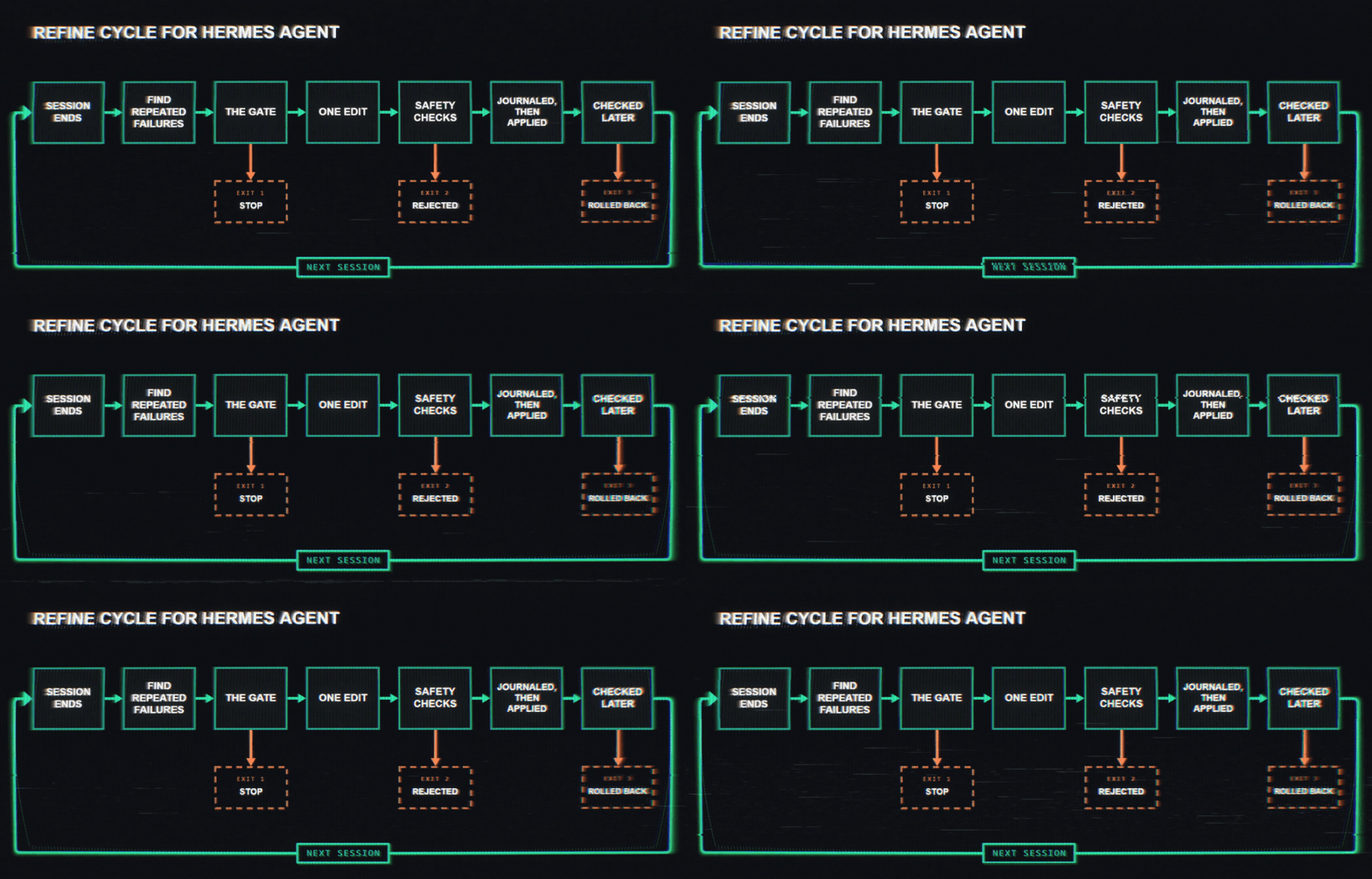
trajectory (state.db) → scrub → fingerprint + aggregate → signal gate
                                                  ├→ reviewer decline → journaled no_op
                                                  └→ proposal → guardrails + prepare
                                                              → apply → finalized outcome
                                                                      → usefulness ledger
| Stage | What happens |
|---|---|
| 1. Collect evidence | Reads the last N messages of the selected session from <HERMES_HOME>/state.db with mode=ro. Credentials are redacted before downstream use. |
| 2. Aggregate | Normalizes errors to invariant shapes, records complete 12-character fingerprints, and counts recurrence within and across sessions. |
| 3. Signal gate and reviewer | Repeated patterns or explicit corrections reach the proposal model. If neither exists, a substantial session may receive one small, conservative reviewer call; a decline is a sanitized, journaled no_op. |
| 4. LLM proposal | Requests one structured create, patch, or no_op proposal with an optional one-sentence, falsifiable expected_outcome. Kinds are skill, memory, and prompt. A proposal may instead carry an edits array of inseparable edits under one shared reason, expected_outcome, and summary. Every model-bound field is sanitized. The proposal output budget is derived locally from the shared 15,000-character content limit and scales with max_edits_per_proposal; the reviewer remains separately capped at 2,400 tokens. A cut-off, malformed, or reasoning-only reply is journaled as llm_incomplete rather than presented as a normal no_op. Skill patches receive the current complete SKILL.md only when it is unchanged by scrubbing and no larger than 15,000 characters. |
| 5. Guardrails | Enforces agent-created patch targets, fresh create names, content/frontmatter, prompt-note policy shape, size limits, daily budget, and recent-duplicate rejection. Every check runs per edit, so a later edit of a transaction is measured against the edits already applied before it. |
| 6. Prepare | Captures a skill's pre-edit content as both a journal snapshot and a readable .bak file, or memory/prompt-note recovery metadata, then appends and fsyncs a prepared journal record before mutation. |
| 7. Apply and reconcile | Runs the standard host API for skills/memory (patch maps to host edit) or atomically writes the plugin-owned prompt-note store. It proves target state and records applied, pending_approval, conflict, or error. A conflict occurs when a skill patch was planned against content that changed before apply, disappeared, or can no longer be read reliably; the budget is not consumed and the edit is not advertised as reversible. Host pending approvals reconcile lazily before later runs, audit, or rollback. |
| 8. Rollback | Journals rollback_prepared before a rollback side effect. A rollback is finalized only after target-state proof; staged host rollbacks remain pending_rollback until approval reconciliation. |
How this differs from Hermes's built-in self-improvement
Hermes ships its own background review: after a turn or a session it looks at the
current conversation and saves what is worth keeping — a useful tactic, a user
preference, a correction. It answers "is there something here worth
remembering?"
Refine Cycle answers a different question, over a different window, and then
checks its own work:
| Hermes background review | Refine Cycle | |
|---|---|---|
| Trigger | anything worth keeping | proposal signal at 2 repeats; application only at 2 sessions or 5 occurrences |
| Window | the current session | many sessions |
| Evidence | the conversation as written | errors normalized to invariant shapes and fingerprinted, so HTTP 429 for /users/8821 and HTTP 429 for /users/9134 count as one failure |
| Threshold | qualitative judgement | a cheap proposal gate followed by an application bar: distinct-session count or occurrence count |
| After the edit | — | grades it: working, did not help, unused, churning — or names honestly why no verdict exists yet (too early, no recurrence window, unreliable) |
| Blast radius | host policy | 3 edits/day, dedup window, cooldown, per-edit journal, per-edit rollback |
The two are complementary, not alternatives. Hermes captures fresh experience;
Refine Cycle hunts chronic failures and measures whether its own fixes held.
Both can write to the same skills and memory, so the plugin is built to notice
that: a skill patch is refused outright when the target changed after planning,
and /refine audit reports when an entry it created was modified by something
else — because an effectiveness verdict on a file someone else edited is not a
verdict worth trusting.
Why
An agent that fixes the same problem every week is not learning. The hard part is
not noticing a failure — it is knowing which failures are chronic, and knowing
whether a fix worked.
The table above says what the difference is; the part worth spelling out is why
fingerprinting carries it. Raw error strings never repeat exactly, so volatile
parts — ids, paths, ports, timestamps — have to collapse before "again" means
anything, while genuinely different errors must stay apart. Those two
requirements pull against each other, and every serious defect in this plugin so
far has been one of them winning too hard. An edit is then treated as a
hypothesis with a falsifiable expected_outcome, which is what makes a verdict
afterwards possible at all.
Ambiguous trajectories can still receive one conservative reviewer pass rather
than silently ending at the mechanical gate. Reviewer-approved proposals are
journaled as advisory reviewer_only outcomes and are never applied without the
normal recurrence evidence.
The base system prompt is never touched. Only agent-created skills and
memory entries are editable; built-in, pinned, and hub-installed skills remain
off-limits. Prompt notes live only in Refine Cycle's own store, never in host
memory or a skill.
Implementation details
Why fingerprinting
"The same failure happened again" is a question about shapes, not strings.HTTP 429 for /users/8821 and HTTP 429 for /users/9134 are one failure, not
two. Normalizing volatile parts and hashing the result turns a flat list of
error text into countable patterns.
A pattern that appears in several different sessions is stronger evidence
than one repeated twice inside a conversation. Interactive prompts remain
bounded, while /refine audit evaluates recurrence over the complete available
post-edit period.
Provider compatibility
The proposal is requested via json_schema structured output, with an automatic
fallback to json_mode and then raw-text JSON salvage for providers that rejectresponse_format.type=json_schema.
Proposer path
Two arms produce the proposal. The subagent arm is the default: a read-only
child that can open skill bodies (skills_list/skill_view) before deciding,
which measurably produces fewer unusable proposals than judging from
name+description alone. It requires a bound parent turn — on hosts or in call
forms where the subagent route is unavailable (no parent turn bound, launch
refused, answer unparsable), the run falls back to the structured call,
which judges from bounded name+description overviews. The structured path is a
documented fallback, not the primary route: on long sessions it does not keep
up (in paired measurement it timed out twice out of five passes at the 4,000-row
scan cap), so hosts whose integrations never bind a parent turn get materially
worse proposals on long sessions. Structured proposal and reviewer calls each
have a 180-second timeout; the subagent wait is separately configurable viaproposer_subagent_timeout_seconds (default 180).proposer_subagent_strict (default false) makes a subagent failure a
journaled error (subagent_strict_error) instead of a downgrade.
Hermes version support
Read this before installing. A green test suite and a passing hermes plugins doctor do not prove that proposals are available. Proposal support also
requires install.py --status to recognize a compatible invocation-route patch
and an invocation-bound smoke test to reach the proposer.
| Hermes | Installs | Loads, registers | status / audit / rollback | New proposals |
|---|---|---|---|---|
| 0.19.0 | yes | yes | yes | yes, with the route patch |
| 0.20.1 | yes | yes | yes | yes, with the route patch |
| 0.20.2 | yes | yes | yes | yes, with the route patch (subagent path verified end to end) |
| 0.21.0 | yes, after confirming a caution scan |
yes | yes | yes, with invocation-route-v0.21.0.patch |
| 0.21.1 | yes, after confirming a caution scan |
yes | yes | yes, with the same invocation-route-v0.21.0.patch |
A Hermes update removes the route patch
Updating Hermes rewrites its checkout, and that puts every patched file back to
stock and takes .refine-install with it. Nothing warns you, and hermes plugins doctor still passes, because the plugin itself is untouched — only the host
capability it depends on is gone. New proposals then fail closed withllm_invocation_unavailable until the patch is reapplied.
This is not specific to any one release. Expect it after every Hermes update:
python install.py --status      # says `stock` again if the patch was removed
python install.py --patch-only  # reapplies it
--status is also what tells you the bundled patch no longer fits a new host: it
reports incompatible and names the patch bases it tried, rather than forcing a
patch onto a topology it was not built for.
Measured on the 0.21.0 → 0.21.1 update: the checkout came back clean, the marker
directory was gone, and the bundled 0.21.0 patch then applied unchanged to the
new base — same eight files, its 37 host tests passing, and a proposal run
afterwards reaching the session's own model in one request with no substitution.
What is verified on 0.21.0
Measured on a clean Windows checkout of Hermes 0.21.0 at693641aa8b4359c602283bdbbc14041e03bc47bc, using disposable clones andHERMES_HOME directories rather than the real profile:
- the real Hermes scanner reports
cautionwith 153 findings and zero critical
findings on the tracked plugin tree;--forcemay confirm this verdict; install.py --statusreportsstock — clean base 693641aa8b; invocation-route-v0.21.0.patch applies;- the installer transitions the disposable host from
stocktopatched, and
status then finds all eight route markers; - the patch's host test file passes all 37 tests;
- an invocation-bound synthetic proposer smoke reaches the installed proposer
exactly once through the captured active client; - OpenAI-shaped chat,
anthropic_messages, andcodex_responsestransports are
route-locked without rebuilding the active client; async calls use that same
captured client and still issue one physical request; - rollback removes the patch-created host test and restores an empty tracked host
diff; - the plugin suite passes 1,203 tests, with 11 Windows-only skips for Bash-based
install.shcoverage.
Since then the same host has been exercised with a live model rather than a
smoke. On a Linux checkout of the same commit, in a disposable HERMES_HOME
with its own journal, four /refine-cycle runs over real recorded sessions each
reached the model and each recorded the same route facts:
target_source      : invocation_bound     ← the route came from the host, not config
requested / reported: openai-codex/gpt-5.6-luna-900k  (identical)
model_substituted  : false
primary_attempts   : 1                    ← one physical request, no retry, no fallback
That is the whole contract the patch exists to provide, and it holds on 0.21.0.
What those runs did not show is an applied edit. All four ended no_op:
three because the reviewer judged the trajectory (benchmark output, exploratory
searches) to carry no durable lesson, one because the signal gate never opened.
That is the plugin declining on merit, not failing — but it means the apply path
itself is still evidenced by the test suite and by 42 applied entries on 0.20.x,
not by a fresh 0.21.0 run. The apply path is downstream of the route and no
patched file takes part in it.
The smoke uses synthetic input and does not start or restart the real gateway. The exact commands and the distinction
between the original failed baseline and the corrected result are recorded indocs/FRESH-INSTALL-HERMES-0.21.0-2026-09-07.md.
On many hosts the command is /refine-cycle, not /refine
Hermes ships its own built-in /refine (a background review fork), andregister_command silently drops a plugin command that collides with a built-in.
The plugin detects this at registration and takes /refine-cycle instead, so
every subcommand stays reachable:
/refine-cycle status
/refine-cycle audit
/refine-cycle dry-run
/refine-cycle session <session_id>
/refine-cycle rollback <id>
This matters more than a renaming usually would: typing /refine on such a
host does not fail — it reaches Hermes's own command and answers, so it is easy
to believe you are talking to this plugin when you are not.
Do not assume this is new. Confirmed on Hermes 0.21.0 and on 0.20.x
(v2026.8.31), so treat /refine-cycle as the likely name and check rather than
guess. /refine-cycle status names the command that answered; so does:
python -c "import refine; print(refine._built_in_command_exists('refine'))"
True means this plugin answers to /refine-cycle. Every /refine … example
below is written for hosts without the built-in.
Why patch selection remains strict
Each bundled patch owns its marker table and target topology. Hermes 0.21.0 movedgateway/run.py to gateway/run_inbound.py and run_agent.py toagent/turn_facade.py; treating every host as the old topology would call a
correctly patched host partial. Backup, compilation, and rollback scope are
therefore derived from the selected patch headers, and an existing backup cannot
be rebound to another topology.
The installer uses clean git apply only. It does not use git apply -3 or
reduce context to make a patch land: a semantic merge can compile while silently
breaking exact-client, one-request, or no-fallback guarantees. An unsupported
host fails closed with llm_invocation_unavailable rather than borrowing an
ambient route.
A note on plugins.scan_on_install
Do not disable install scanning for this plugin. The tracked release tree now
receives a confirmable caution verdict rather than an unoverrideabledangerous verdict. plugins.scan_on_install: false remains documented only as
an earlier diagnostic; it disables scanning for the whole profile.
Installation
Note: this is a plugin for Hermes Agent. It needs the plugin API available since Hermes 0.17.0 and does not run standalone. Install, registration, the full test suite,
/refine status, and/refine auditare verified on Hermes 0.20.1 through 0.21.0. Only new proposals additionally require the matching host route patch; Hermes 0.21.0 usesassets/invocation-route-v0.21.0.patch. See Hermes version support.
The plugin lives in <HERMES_HOME>/plugins/refine/ — ~/.hermes/plugins/refine/
on Linux and macOS, and %LOCALAPPDATA%\hermes\plugins\refine\ on Windows.
Under a Hermes profile it follows that profile; the plugin resolves the location
through hermes_constants.get_hermes_home().
Runtime data location. The default
journal_diris<HERMES_HOME>/refine, separate from plugin source. On startup, an install
still using the former<HERMES_HOME>/plugins/refinedefault is migrated under
a cross-process lock: all artifacts are staged first, a completion marker is
published last, and the old directory is renamed rather than deleted. If any
copy or publication step fails, the intact legacy directory remains the active
store for that process and/refine statusreports the fallback. An explicitly
configured non-emptyjournal_diris never migrated automatically.
Install the repository, run the disclosed full installer from the installed
plugin directory, then enable and restart:
hermes plugins install Bergschloss/Refine-Cycle-for-Hermes-Agent
# Run the next command from <HERMES_HOME>/plugins/refine:
python install.py
hermes plugins enable refine
hermes gateway restart
hermes plugins install clones the repository into<HERMES_HOME>/plugins/refine/. The following python install.py applies and
verifies the matching invocation-route patch and raises the two memory-limit
targets described below; when run from the installed directory, the plugin copy
step is an idempotent no-op. plugins enable registers the plugin, and the
restart activates both plugin and host changes.
To keep Hermes source untouched, omit python install.py or usepython install.py --plugin-only from a separate checkout. The plugin can then
provide status, audit, rollback, and journaling, but proposal runs stop withllm_invocation_unavailable; the full two-target memory-floor change is not
made.
The plugin works inside the running gateway. The LLM invocation route is
bound by the live gateway process, so in a bare command-line processrefine_runreturnsllm_invocation_unavailableby design (and/refine statusnames that blocker directly). Automatic refinement, proposals, and
apply/rollback all run inside the gateway — test with a real session or the
restart above, not with a one-shot script.
Then, optionally, configure it in config.yaml:
plugins:
  enabled:
    - refine
  entries:
    refine:
      journal_dir: "<HERMES_HOME>/refine-data"   # keep data separate from plugin source
      llm:
        allow_model_override: false
        allow_provider_override: false
plugins enable manages the enabled list itself; the entries block holds
the plugin's own settings, and journal_dir keeps runtime data separate from
plugin source (see "Runtime data location" above).
Restart Hermes after any config change:
hermes gateway restart
Verify:
hermes plugins list
# refine  1.2.0  Measurement layer ...  enabled
Then check that automatic refinement can actually run:
/refine status
# auto: on
# turn interval: 25
# min messages: 15
# cooldown: 20 min
# edits today: 0/3
# model: your-cheap-model @ your-provider (source: live)
# journal: /home/you/.hermes/refine-data (does not exist yet, will be created on first write)
# blockers: none — automatic refinement is active
blockers lists every reason a pass would not start; warnings lists what does
not stop it but will cost you later, such as runtime data sitting in the plugin
directory, or a journal directory that could not be inspected at all.
Status is read-only: it creates no directory — not even the journal directory it
reports on — writes no journal record, spends no budget, and calls no model. It
does not reconcile pending approvals, so an unresolved staged edit still counts
toward the budget it reports.
Host route patch — required for new proposals
The plugin asks the LLM through Hermes's active invocation route: the same
model binding that the user's live session uses, so that a proposal costs the
host's own provider creds and never a hardcoded key. Stock Hermes does not
expose that binding to plugins. The installer ships one patch per Hermes base:
assets/invocation-route-v2026.8.16.patchassets/invocation-route-v2026.8.31.patchassets/invocation-route-v0.21.0.patch
Each patch carries its own marker table and target topology. The 0.21.0 topology
uses gateway/run_inbound.py and agent/turn_facade.py where the older hosts
used gateway/run.py and run_agent.py.
Which patch fits a host is decided by trying each candidate withgit apply --check, not by trusting a version string. This avoids accepting a
partially matching patch after upstream moves code while preserving hosts where
a patch still applies exactly.
- Without the patch:
/refine status,/refine audit,/refine rollback,
journaling, and the test suite all work. A proposal run stops honestly withllm_invocation_unavailableand journals the record. - With the patch: proposal runs reach the exact active route (subject to the
configured trust policy).
Both installers require a clean patch and never weaken context or use a
three-way merge after git apply --check fails. install.sh then verifies route
symbols, rejects conflict markers, compiles every touched Python file, and
imports the core module. install.py performs those checks and additionally runs
a synthetic invocation-bound proposer smoke in a disposable HERMES_HOME. If a
check fails, the pre-patch state is restored. Backups are bound to the selected
patch and topology so a later run cannot reuse them for a different host
transaction.
# from the plugin directory
./install.sh            # apply and verify the host route patch, with backup
install.sh has no command-line mode flags; use install.py --patch-only when
installing through the Python entry point. On hosts that already carry a complete
known route, the installer reports patched and makes no route change. Useinstall.py --rollback to restore the recorded pre-install state.
The memory budget the install raises
install.py raises Hermes's memory character limit to a floor of 4400. This
is deliberate and it is for the plugin's sake, so it is stated here rather than
left to be discovered in a diff.
Stock Hermes ships memory_char_limit: 2200 — roughly 800 tokens. That number was
chosen when the models driving Hermes were smaller and shorter-context; a compact
store was the right trade then. It is no longer the constraint it was, and current
models carry 4400 characters of durable memory without difficulty.
For this plugin the stock size is actively too small. Refine's whole output is
lessons written into that store, and it accumulates: on a real install, six applied
edits consumed about a third of the stock budget in a single day. A plugin that
fills the store it depends on is not usable at 2200.
Two files are changed, because neither alone reaches everybody:
<HERMES_HOME>/config.yaml— Hermes writesmemory_char_limitinto the
generated config, so for anyone who has already run Hermes this file is what
decides, and the code default is never consulted.hermes_cli/config_defaults.pyin the Hermes checkout — what a user who
installs the plugin before Hermes has ever generated a config will get.--plugin-onlyskips this one, since that flag promises no writes into the host
checkout, and says so at the time.
The rule is a floor, not an override:
| Current value | What happens |
|---|---|
| below 4400 (including the stock 2200) | raised to 4400 |
| exactly 4400 | nothing |
| above 4400 | left alone — your number wins |
So a limit you chose yourself is never overwritten and never lowered, and
running the installer twice changes nothing the second time. --rollback reverses
it by putting each file's own previous number back — not a blanket 2200, so a host
that installed at 3000 returns to 3000. It reverses one integer rather than
restoring a file copy, because config.yaml is a live file you edit and a restored
copy would silently discard everything else you changed since.
The plugin itself never hardcodes 4400. It reads whatever limit the host reports
and shows it to you at every write (for example memory 1443/4400), so raising the limit
further is a host decision the plugin follows rather than fights.
Usage
What to expect
A pass on quiet data is a no_op — that is the normal, correct result, not a
failure. The outcome families are no_op, applied, rejected,pending_approval, conflict, llm_incomplete, llm_invocation_unavailable,
and failed, plus the rollback and grading terms in /refine audit.
A real 90-day history (the long-running install this README was tested
against) shows eight refine-created entries whose effectiveness verdicts
distribute between too early, rolled back, rejected, andunreliable — with unreliable meaning someone else modified the artifact
after refine touched it, so no verdict is possible. Expect exactly that mix:
most passes doing nothing, some edits reverting, and very few edits surviving
to a working verdict.
Manual
The examples below use /refine. If the Hermes host already owns a built-in
command with that name, the plugin registers as /refine-cycle instead; the
registration warning and command help show which name is active.
/refine
/refine focus on Gmail API failures
/refine audit
/refine status
/refine dry-run
/refine dry-run focus on Gmail API failures
/refine dry-run session <session_id>
/refine session <session_id>
/refine model
/refine model your-cheap-model
/refine model your-provider/your-cheap-model
/refine model auto
/refine rollback 1f2a3b4c5d6e
audit, status, dry-run, model, session <session_id>, androllback <12-character-id> are exact subcommands. status reports whether
automatic refinement is active, which session and database source would be
analyzed, configured source skips, what blocks refinement, which model it will
use, and the active journal/migration state. dry-run [reason] runs the normal
proposal path and journals the preview without applying an edit or consuming the
daily edit budget. dry-run session <session_id> previews one exact historical
session after confirming it through the read-only Hermes sessions table.
model shows or sets the model refine asks for. Bare model prints the
effective target and whether host trust allows it; model <name> ormodel <provider>/<name> pins one; model auto removes the override. auto
returns to the next source in the priority order, which is the configuredplugins.entries.refine.llm value when there is one, and the live Hermes model
only when there is not. The override is stored in model_override.json insidejournal_dir — refine does not put its own settings in the Hermes config. It
writes there exactly once, for one key that is not its own: see below.
Both stores are validated the same way: a provider must be a single token, a
model id may be namespaced, and a value matching a credential pattern is refused
rather than stored. A configured value that fails either rule is dropped and
reported in /refine status and /refine model.
In the command, the first slash is always the provider separator and every
later one belongs to the model id: /refine model openrouter/deepseek/deepseek-chat
pins provider openrouter and model deepseek/deepseek-chat. There is therefore
no command form for a namespaced model with no provider — setplugins.entries.refine.llm.model for that. And a pinned provider only reaches
the host when allow_provider_override is true, which /refine model reports.
Other text is passed to the proposal model as the manual reason. That includes
text beginning with a subcommand word, with one deliberate exception: aftermodel, a single token shaped like an identifier (deepseek-v4, a/b) is
treated as a target, so /refine model drift pins a model rather than asking for
a refinement about drift. Use /refine drift or /refine model auto to undo.
Automatic refinement
Automatic refinement is enabled by default (auto_enabled: true). After
enabling the plugin and restarting Hermes, it begins analyzing sessions and
proposing improvements without additional configuration. To disable it, setauto_enabled: false in plugins.entries.refine.
post_llm_call counts the assistant messages in the history Hermes supplies and
starts at most one background refinement attempt once that count has grown byauto_turn_interval since this session's previous attempt. It compares a delta
rather than an exact multiple, because a single tool-using turn appends several
assistant messages and would otherwise step straight over the boundary. The hook
itself does not mutate or queue work. It skips an attempt when another pass owns
the lock, and derives its cooldown from durable journal records, so the cooldown
is visible across processes. on_session_end remains a background fallback based
on the minimum message count.
plugins:
  entries:
    refine:
      auto_enabled: true
      auto_min_messages: 15
      auto_turn_interval: 25
      auto_cooldown_minutes: 20
Automatic and manual runs share a cross-thread and cross-process mutation lock,
then recheck the daily budget inside that lock.
Reviewer fallback
When min_signal_required is enabled but the mechanical gate finds neither a
repeated pattern nor an explicit correction, a substantial session can receive
one structured reviewer call (max_tokens: 2400, timeout 180 seconds). It asks
only whether there is a durable lesson worth persisting. The reviewer has its
own cooldown.
A reviewer decline, malformed verdict, or reviewer error never reaches the
proposal call. Declines are recorded as sanitized no_op journal entries so
they can be audited. An approval supplies narrow instructions to the normal
proposal flow but remains advisory: it is journaled as reviewer_only and is
never applied without the ordinary recurrence evidence.
Prompt notes and scope
A prompt proposal creates a short conditional policy in<journal_dir>/prompt_notes.json. Valid notes contain one or two policy lines
beginning with When <specific condition>, <one action>.; they are not skills,
memories, procedures, or system-prompt replacements.
pre_llm_call returns a self-labelled Refine notes: context block. Hermes
adds that ephemeral context to the current turn; Refine Cycle never reads or
writes the base system prompt. Injection is bounded byprompt_notes_max_count and prompt_notes_max_chars; when necessary it drops
whole oldest notes, never partial text. Empty, unavailable, unsafe, or
out-of-scope note stores inject nothing and do not raise on the user path.
Injection prefers the mutation lock but does not depend on it: the store is only
ever replaced atomically, so a running refine pass never costs a turn its notes.
New prompt notes use prompt_notes_default_scope:
global(the default) is injected in every session.sessionstores the session identifier resolved while readingstate.dband
injects only when the hook receives that same identifier. Session notes are
removed from the plugin-owned store afteron_session_endoron_session_resetfor that session.
Cleanup runs on the host's callback thread, so it waits only briefly for the
mutation lock instead of the full lock timeout. If a refine pass still owns the
lock, the note is left in place — it can no longer be injected, because its
session is gone — and it is removed at the next end or reset for that id.
That expiry is itself journaled, so a crash cannot turn "the note landed and was
then cleaned up" into "the note never landed": the entry moves applied (orprepared, for a note that landed before its own finalization completed) →cleanup_prepared, fsynced before the store changes, and only reachescleanup_resolved once the exact note is proven absent from a fresh read. Both
states count against the daily budget, because the edit really happened — normal
session expiry is not a refund and not rollback evidence. Consequently a
session-scoped note stops being reversible once its session ends: /refine rollback <id> then reports the entry as not reversible, since the artifact it
would remove is already gone. Ledger rows for the two states read session
cleanup pending and session note expired.
Cleanup removes only a note whose id, content, scope, and session still match
the intent recorded in the journal. A note that was hand-edited or moved to
another scope or session is retained and reported by id, and an entry already
at cleanup_prepared stays there until the store is repaired. That is
deliberate — refine does not delete what it cannot prove it owns — but it does
not clear itself; see Known integration gaps.
The prompt-note store is plugin-owned, so there is no host approval gate for
these notes. Creation, target-state proof, audit rows, and conflict-aware
rollback are still journaled; host approval remains in force for host-managed
skills and memory.
Host write approval is turned off on load
If memory.write_approval or skills.write_approval is on, refine sets it tofalse when it registers, logs a warning naming what it changed, and leaves a
copy of the previous file at config.yaml.refine-bak.
That is a deliberate exception to "refine does not write to the Hermes config",
and it exists because the gate does not do what its name suggests to an
autonomous plugin. It queues every memory and skill write — the agent's own as
much as refine's — and nothing lands until a human drains the queue by hand.
Nothing reports that. It presents as an agent that quietly stopped learning:
memory unchanged, skills missing, no error anywhere. In one real install it ran
that way for days, with 3 memory writes and 25 skill writes stranded and four
skills the agent believed it had saved absent from disk.
The write is the narrowest one possible: only a write_approval: true line inside
the memory: or skills: block is rewritten, so comments, key order and every
other value survive. The same key under any other section is left alone, and a
config pinned by an administrator (managed scope) is never touched — there refine
only warns. /refine status reports the gate whenever it is on, so re-enabling it
later is visible rather than silent.
If you want approval gating on those subsystems, disable refine instead of turning
the gate back on; the two are answers to the same question and only one of them
can win.
How a memory entry is identified for rollback, and one disclosed gap
Adding a memory entry goes through the host's gated memory tool, so withmemory.write_approval enabled it stages as pending_approval like any other
gated write. Removing it does not go through that gate, and that is a
deliberate trade rather than an oversight.
The host's removal identifies an entry by substring, and pops a single match
even when that match is a strict superstring of the text it was given. Under the
gate a removal is staged and replayed later, so between staging and approval the
entry can be replaced or extended — and the replay would then delete the user's
entry. That is a delete of something refine never created, which this plugin may
never do, and it would outrank the value of the gate.
So refine removes its own append itself: it re-reads under the host's per-file
memory lock, proves the entry is its own — exact content, at or after the position
recorded when the edit was planned, with everything before that position pinned by
a digest — and deletes only that entry, all inside the lock. If its exact text is
no longer there, rollback refuses and removes nothing, and the entry stops being
advertised as reversible. A longer entry that merely contains refine's text is not
a problem: identification is by exact content, not substring.
Two consequences worth knowing:
- A memory rollback is not reviewable through
memory.write_approval. Skill
rollback does stage underskills.write_approval— but note that staging does
not make it safer in this respect: the host replays a staged skill delete by
name, without re-checking content, so a skill edited during the approval window
is deleted as approved. Rolling back a refine-created skill while skill write
approval is on is best done promptly, or not at all if the skill has since been
edited by hand. - With the gate on and an interactive prompt registered, the forward memory
write can block on that prompt while the refine pass holds the shared mutation
lock, so a concurrent/refinewaits out its lock timeout and the automatic
session-end pass skips that round.
One ambiguity remains and is not solvable from the host API: an entry written by
something else that is byte-identical to refine's own. The host refuses exact
duplicates, so this requires another writer reproducing refine's scrubbed text
verbatim.
Multi-edit transactions
Some lessons are not one edit. A new skill and the memory entry that says when to
reach for it are inseparable: applied separately, the state between them is
inconsistent. A proposal may therefore carry an edits array under one shared
reason, expected_outcome, and summary, capped by max_edits_per_proposal.
Durably, nothing new was invented. Each edit still gets its own journal record,
its own recovery metadata, and its own rollback ID, tied together only by an
additive group field (id, index, size, summary, and dropped when
edits were discarded). That is what keeps /refine rollback <id>, approval
reconciliation, dedup, and the ledger working exactly as before — and it is why
the daily budget counts edits rather than proposals.
Edits apply in order and the run stops at the first failure. A partial
transaction is never reported as clean:
- Applied and reserved edits are
applied/pending_approvalas usual. - An edit whose host write landed but whose journal finalization failed still
owns a recovery ID and is listed as one. - Edits the daily budget refused, and edits not attempted after an earlier
failure, are journaled asrejected, which consumes no budget. - Edits discarded while shaping the proposal — past the cap, unusable, or
repeating a target already claimed in the same proposal — are counted, block acompletedverdict, and are reported ingroup.dropped.
So which edits of a transaction landed is readable from the journal alone, not
only from a message that automatic runs discard.
There is no delete action: a transaction can only create or patch.
Auditing what refine wrote
/refine audit reports whether refine-created entries were used and whether the
failure fingerprint recurred after the edit. Timestamp-aware host counts are
preferred. If the host exposes only an all-time aggregate, the report labels itall: and does not claim post-edit use from it. Pending approvals remain marked
as pending rather than applied. On the next audit, run, or rollback request, the
plugin checks the host pending store and actual skill or memory target: an exact
target match becomes applied, an unresolved host record stays pending, and a
removed host record without a target match becomes rejected.
Refine-created entries (3):

  name                           age  ver     uses  recurred  verdict
  gmail-scope-fix                12d   v2        5        no  working
      expects: Gmail sends stop returning insufficient_scope
  prisma-migrate-note             9d   v1       ~0         —  too early
      expects: —
  bash-path-hint                  3d   v3        2       yes  did not help
      expects: PATH errors stop appearing before shell commands

Candidates for removal:
  bash-path-hint — /refine rollback 8c1d2e3f4a5b
The audit deletes nothing. It prints a rollback command only for recorded
candidates. Skill rows keep their plain names; memory and prompt-note rows usememory: / prompt: prefixes so same-named entries remain distinguishable.
Every row shows the model's sanitized expected outcome (— when omitted)
alongside its observed result. Later edits of the same entry advance a version;
version 3 or later is labelled churning only when the normal verdict would
otherwise be unclear. Skills that remain unused are fed into later proposals
as negative examples.
Two honesty rules behind the verdicts:
no recurrence window— the pattern table had no post-edit rows at all
(typically after a restored or rebuiltstate.db). An empty scan cannot
tell "the failure stopped" from "the evidence was lost", so the row names
the gap instead of drifting intounclearor claimingworking.- Recurrence horizon (
refine.audit_recurrence_horizon_days, also accepted
asrefine.recurrence_horizon_days, default 3).
On the reference journal, the median gap between recurrences of a chronic
failure is minutes and the 95th percentile is 2.17 days — so silence shorter
than the horizon is indistinguishable from a pause. Fingerprintless rows
(no recurrence signal at all) earnworkingonly afterage >= horizon;
edits younger than that staytoo early. Raise the key only if your
failures genuinely pause longer than that; the default is measured, not
guessed. This horizon governs recurrence verdicts only —unused_skills'
separatemin_age_days(14) answers a different question ("has the skill
been left idle") and is unchanged. - A kind with no usage counter still earns
working— on recurrence alone.
The host counts uses only for skills, sousesis structurally unavailable for
memory entries and prompt notes. Until recently that madeworkingunreachable
for them: the branch requireduses > 0, so the edit kind refine produces most
often could never be reported as successful however long it held, and the column
readunclearforever. Recurrence now carries the verdict alone for those kinds,
under the same bar the usage path uses and not a lower one — the silence must be
measured (recurredfalse, never unmeasured), a fingerprint must exist (with
neither a fingerprint nor a counter there is no evidence at all, and the row staysunclear), and the edit must be older than the recurrence horizon. The row still
printsusesas—, so it stays visible which evidence carried the verdict. The
gate is on kind, not onusage_scope: a skill whose usage lookup merely
failed also reportsunavailable, and that is an unmeasured dimension rather
than an absent one, so it does not borrow this path. - Memory rows check presence, not usage. The host keeps no usage counter
for memory entries, so the only checkable fact for an applied memory edit is
whether the exact content refine appended is still in the store. Exact
membership cannot tell an edit from a removal — both make the string
disappear — so when the content is gone the verdict isunreliable — no longer present as applied, never "was deleted". If the
host memory state cannot be read at all, the row saysunreliable — target state unavailablerather than guessing.
Agent-invocable tool
The agent gets a refine_run tool (toolset refine) and may trigger the same
serialized flow with an optional reason. It also accepts session_id for one
exact historical session and dry_run: true to preview without applying. The
handler validates an explicit session against the read-only sessions table
before any model call and forwards all three arguments to core.refine_run.
The tool must run inside an active Hermes gateway turn: it reuses the
host-provided ctx.llm, which carries that turn's active runtime routing. An
external script that constructs PluginLlm(plugin_id="refine") is not
equivalent; outside a gateway turn it can fall back to a configured provider
instead of the active model.
Which model refine uses
By default refine inherits the user's live main model. Hermes resolves the
model inside its own call_llm: with no explicit provider/model it takes theauto path, whose first step is "main provider + main model", and the main
model is read from a process-local runtime override that the agent refreshes at
the top of every turn. So a model switched mid-session is intended to apply to
refine as well, without any plugin-side plumbing.
One caveat is worth knowing, and it depends on the Hermes version. On Hermes
builds older than 2026-07-17, auxiliary clients are cached under a key that does
not include the resolved model; a plugin call passes no live-runtime dict, so
the key is constant and the first cached client keeps supplying the model
captured when it was built, outliving a mid-session switch until the entry is
evicted or the process restarts. Upstream closed this in 73057ed16
("scope runtime state to each turn") and fdc6c32d7 ("isolate runtime cache by
live context"), both dated 2026-07-17 — verified by reading the Hermes repository,
not from this one, so re-check against your own checkout before relying on it.
Never a refine bug either way; on an older host, restarting the gateway clears it.
/refine model reports which source refine resolved, and with source: live
the value it read from the host at that moment. It cannot report which model a
cached host client will actually use, so on an older host it is not a way to
confirm a mid-session switch took effect. Restart the gateway, or pin the target.
Pinning refine's own target sidesteps all of that and makes the choice
deterministic:
plugins:
  entries:
    refine:
      llm:
        allow_provider_override: true   # required for `provider` below
        allow_model_override: true      # required for `model` below
        provider: your-provider
        model: your-cheap-model
Model availability depends on provider, account, and region. A 403 RegionError
means the provider received the request and refused that model — commonly an
account or region restriction that needs an explicit opt-in with the provider.
Because refine inherits the live main model, a restricted main model makes refine
fail for as long as the main model does; the fix is to opt in or select an
available model with hermes model, not to pin refine elsewhere. Checkllm_meta.reported_provider and reported_model to see which target was
actually refused.
Both allow_* flags are fail-closed in Hermes: with them off, a pinned value is
refused rather than applied. Leave provider/model unset to inherit the live
main model as described above. Every path — the /refine command, therefine_run tool, and both automatic triggers — shares the one host-provided
client and honors this setting identically.
Configuration
All keys live under plugins.entries.refine:
| Key | Type | Default | Description |
|---|---|---|---|
auto_enabled |
bool | true |
Enable automatic turn and session-end attempts. Forced off when the Hermes config cannot be read. |
auto_min_messages |
int | 15 |
Minimum messages for session-end auto-analysis. |
auto_turn_interval |
int | 25 |
Assistant messages added since this session's last automatic attempt; 0 disables only the turn trigger. |
auto_cooldown_minutes |
int | 20 |
Minimum durable journal-derived gap between automatic attempts. |
notify_enabled |
bool | true |
Notify the active chat after an edit is applied; notification failure never changes the refine outcome. |
notify_target |
str | unset | Explicit Hermes delivery target used when no active chat is available. There is deliberately no implicit platform target. |
max_edits_per_run |
int | 1 |
Maximum proposal passes per run. |
max_edits_per_proposal |
int | 3 |
Maximum inseparable edits one proposal may apply as a single transaction. 1 disables transactions. |
max_edits_per_day |
int | 3 |
Maximum applied, pending, prepared, rollback-prepared, or pending-rollback edits per UTC day. This is the blast-radius limit and is re-checked before every edit. |
only_agent_created |
bool | true |
Only patch agent-created skills. |
journal_dir |
path | <HERMES_HOME>/refine |
Journal, lock, ledger, backups, prompt notes, and the /refine model override. An empty value uses this default. |
overview_max_entries |
int | 40 |
Existing skills and memory snippets listed per kind in a proposal prompt. |
overview_max_chars |
int | 240 |
Maximum characters in each structured overview or history line. |
history_max_entries |
int | 20 |
Recent create/patch outcomes fed back into a proposal prompt. |
min_signal_required |
bool | true |
Require a signal before the proposal call; may enable reviewer fallback. |
min_pattern_count |
int | 2 |
Repeats before a failure counts as a mechanical signal. |
apply_min_sessions |
int | 2 |
Distinct sessions required before a proposed edit may be applied. |
apply_min_occurrences |
int | 5 |
Failure occurrences required before a proposed edit may be applied. |
reviewer_fallback_enabled |
bool | true |
Allow one reviewer call when the mechanical gate finds nothing; its approved proposal is advisory and is never applied. |
reviewer_min_messages |
int | 20 |
Minimum session size for reviewer fallback. |
reviewer_cooldown_minutes |
int | 60 |
Minimum durable gap between reviewer decisions. |
proposer_subagent_enabled |
bool | true |
Produce proposals via a read-only subagent that can open skill bodies before deciding. Requires a bound parent turn; without one the structured call is the fallback either way. |
proposer_subagent_strict |
bool | false |
Make a subagent failure a journaled subagent_strict_error instead of silently downgrading to the structured call. |
proposer_subagent_timeout_seconds |
int | 180 |
Wall-clock bound on the subagent proposal wait (minimum 5). The structured-call and reviewer timeouts are constants in llm.py (_PROPOSAL_TIMEOUT_SECONDS, _REVIEW_TIMEOUT_SECONDS, both 180 s) and are not configurable. All three describe the same piece of work and are deliberately the same number. |
prompt_notes_enabled |
bool | true |
Permit prompt proposals and note injection. |
prompt_notes_max_count |
int | 5 |
Maximum active notes injected into one turn. |
prompt_notes_max_chars |
int | 600 |
Maximum characters in the complete injected note block. |
prompt_notes_default_scope |
str | global |
Scope for newly created prompt notes: global or session; invalid values fall back to global. |
cross_session_enabled |
bool | true |
Aggregate failures across recent sessions. |
skip_session_sources |
list[str] | ["cron"] |
Skip matching session sources before any trajectory messages are read; each skip is journaled without consuming edit budget. |
cross_session_days |
int | 7 |
Interactive cross-session look-back window. |
cross_session_max_sessions |
int | 25 |
Interactive session scan cap. |
cross_session_max_rows |
int | 4000 |
Maximum trajectory rows scanned by an interactive cross-session pass. |
dedup_window_days |
int | 7 |
Refuse an edit identical to a recent applied, pending, or prepared edit. |
audit_recurrence_horizon_days |
int | 3 |
Days of post-edit silence after which /refine audit reads "no recurrence" as fixed rather than paused. Also accepted as recurrence_horizon_days; the explicit audit_ key wins when both are set. |
LLM trust policy (plugins.entries.refine.llm):
llm:
  allow_model_override: false
  allow_provider_override: false
Known integration gaps
No plugin-level post-compaction hook: Hermes exposes no normal plugin hook
forsession:compress; that event is gateway-only.on_session_resetis
used to expire session-scoped notes, not as a claim that refinement runs after
context compaction. The only plugin-side compaction registration,register_context_engine, replaces Hermes's built-inContextCompressorand
permits only one engine per install. Taking it over would make Refine Cycle
responsible for the agent's whole compaction strategy and conflict with any
real context-engine plugin. A safe integration needs an observer-onlyVALID_HOOKSmember fired at the compaction boundary.No plugin-level reasoning-effort control: Hermes's structured plugin call
exposes no provider reasoning/thinking setting. A model that returns only
reasoning and no final text is reported asllm_incomplete; pin a
non-reasoning model for refine withplugins.entries.refine.llm(model/provider) under the existing trust policy when that mitigation is needed.A model switch can be masked by Hermes's auxiliary client cache, on older
hosts only: plugin calls resolve through theautopath, which prefers the
live main model, but before73057ed16/fdc6c32d7(both 2026-07-17) the
client cache key omitted the resolved model and a plugin call supplied no
live-runtime dict, so the key never changed and a cached client kept its
original model until eviction or restart. Refine cannot close this from the
plugin side and does not try, and it cannot detect which host version it runs
on, so/refine modelcannot tell you whether you are affected. On a current
host it is fixed; otherwise restart the gateway or pinllm.model/llm.provider.The live main model is read through a private host API:
live_main_target()
imports_read_main_provider/_read_main_modelfromagent.auxiliary_client. Hermes exposes no public accessor. Both names were
confirmed present in a real installation, but a private name can move without
notice, so the import is guarded and simply yields no live value on failure —/refine modelthen reportssource: host_defaultrather than claiming a
target it does not have.Text-only trust boundary:
PluginLlmTextInputaccepts text but no typed
trust level. Refine wraps and scrubs untrusted trajectory content, which is a
mitigation rather than hard separation; a guarantee requires a typed
trust-level input from Hermes.Approval terminal states are not exported: the plugin can observe pending
writes and reconcile the target, but Hermes does not expose distinctaccepted,rejected, andcancelledterminal states.Exact timestamped usage is unavailable: existing SQL and host counters are
approximate. Reliableworking/unusedconclusions require timestamped
usage events from Hermes.PrimeIntellect comparison was not completed during the audit: access to
the required network/source material was blocked, so no equivalence claim is
made.Production frequency and storage growth are unmeasured: the audit did not
read the realstate.db; it therefore makes no claim about production event
frequency or long-term storage growth.No host approval for the prompt-note store: it is a plugin-owned atomic
file, not a host memory or skill write. Host-managed skill and memory changes
still respect staged approvals and reconciliation.A session note that stops matching its cleanup intent has no terminal
state: if the note store is hand-edited or a note is moved to another scope
or session aftercleanup_preparedwas journaled, the note is retained and
the entry stayscleanup_prepared— non-terminal, and not reversible, because
the artifact rollback would remove is not the one the entry describes. Every
later end or reset of that same session id reports it again by note id. A
terminal state would have to keep counting against the daily budget (the edit
did happen) and needs its own crash-ordering matrix, so it is deliberately
left as a design decision rather than approximated. Repairing or removing the
offending entry inprompt_notes.jsonby hand clears it.Rollback is not modeled as an ordinary proposal: rolling back a skill
createmeans deleting it, and the no-delete guardrail rejects any proposal
carrying a delete. Routing rollback through the proposal path would therefore
need a privileged bypass of that guardrail. It would also replace therollback_prepared/pending_rollback/rolled_backtransitions that
approval reconciliation and/refine rollback <id>idempotence depend on, and
break rollback for every record written before the change. Rollback keeps its
own path; what it gained is journal snapshots, so it no longer depends on a
file surviving on disk.hermes plugins removefails on Windows for git-managed plugins (host
defect, not this repo's code): the CLI removes the directory with a bareshutil.rmtreethat does not handle read-only files, and git marks.git/objects/*read-only. Removal aborts midway withWinError 5, leaving a
half-deleted directory; runtime data andconfig.yamlare untouched.
Workaround: delete the directory from PowerShell
(Remove-Item -Recurse -Force) or clear the read-only attribute first. An
upstreamonerrorhandler that clears the bit and retries would fix it
properly.
Rollback
A successful mutation returns a rollback command only when its journal record is
actually reversible:
/refine rollback <journal_id>
Create rollback deletes a skill only if current content still exactly matches
the refine proposal. Patch rollback refuses to overwrite a later change before
restoring its pre-edit content. Memory rollback removes only the exact appended
entry and preserves unrelated later entries. Prompt-note rollback removes only
its exact unchanged note and preserves later notes; a changed or missing note is
a conflict and is left untouched.
Where the restored content comes from
A skill patch records its pre-edit content twice: as a snapshot inside the
journal record, and as a .bak file under journal_dir/backups. Both come from
one host read, so they cannot disagree. Rollback prefers the snapshot, so losing
the backup file no longer costs the rollback.
Credential scrubbing needs two layers here, because the journal redacts
credentials from everything it writes — including a snapshot. The first layer is
the proposal path: a skill whose current SKILL.md is changed by scrubbing is
never patched at all, and the patch becomes a no_op before the model is
called. The second is a SHA-256 digest of the real pre-edit content stored beside
the snapshot. If the stored text no longer matches that digest, the snapshot is
refused and the raw .bak file is used instead, so redacted text is never
written over a skill.
is_reversible asks the restore path the same question rollback does, so an
entry is never advertised as reversible when neither source survives. In that
case rollback refuses with an explicit error and changes nothing, and a staged
rollback whose state cannot be proven stays pending_rollback rather than being
declared rejected.
Records written before snapshots existed carry only backup_path and keep
rolling back from it unchanged.
Rolling back a transaction
Each edit of a multi-edit transaction owns its own journal record and its own
rollback ID; there is no transaction-level undo. Recovery IDs are listed
newest first, which is the order to follow: memory recovery is positional, so
undoing an earlier append before a later one shifts the later entry and its
rollback fails closed as a conflict.
If mutation succeeded but journal finalization failed, the returned recovery ID
points to the durable prepared record. Pending forward approvals consume budget
but are not advertised as reversible until the target exactly matches the
proposal. Rollback intent is journaled before its side effect; a staged rollback
returns a pending ID and is not called rolled back until the target change is
confirmed. A rejected rollback returns the entry to applied, so it can be
retried.
Tests
cd <HERMES_HOME>/plugins/refine
python -m tests.run_tests
The regression suite uses only the Python standard library and a fake Hermes
host. It installs that fake host before importing the plugin.
Every database, journal, backup, skill, memory file, ledger, and lock lives
under a fresh TemporaryDirectory; running the suite cannot touch live Hermes
or profile state. It covers proposal completion, host action mapping,
backup/journal failures, create/patch/memory/prompt rollback conflicts, secret
sanitation, approval reconciliation, automatic triggers and cooldowns, reviewer
fallback, prompt-note injection and scope cleanup, append-only journal recovery,
and full-history aggregation.
The suite also starts two real Python processes against one temporary Hermes
root using a filesystem rendezvous and bounded timeouts. Withmax_edits_per_day: 1, it proves exactly one mutation is applied, one budget
slot is consumed, and one ledger/skill record survives.
Repository layout
Runtime modules and installation assets live at the repository root; the
installer copies the shipped plugin subset to <HERMES_HOME>/plugins/refine/.
Refine-Cycle-for-Hermes-Agent/
├── plugin.yaml          # Hermes plugin manifest
├── __init__.py          # command, tool, and hook registration
├── config.py            # plugins.entries.refine config reader
├── core.py              # evidence, guardrails, serialized apply orchestration
├── sanitization.py      # recursive credential redaction
├── patterns.py          # normalization, fingerprints, aggregation, signal gate
├── ledger.py            # timestamp-aware usefulness ledger and audit report
├── llm.py               # structured proposal, reviewer, and patch regeneration
├── journal.py           # append-only journal, lock, notes, recovery, rollback
├── notify.py            # failure-isolated applied-edit notification delivery
├── refine_trace.py      # synthetic trace helper shipped with the plugin
├── install.py           # cross-platform full installer, status, and rollback
├── install.sh           # Linux host-route patch helper only
├── assets/              # bundled invocation-route patches and README media
└── tests/
    └── run_tests.py     # hermetic regression and cross-process proof
What gets sent to the model
Refine sends sanitized aggregated error patterns, explicit correction excerpts,
a bounded structured overview of existing skills (name, description, category,
and a known local version) and memory snippets, the optional manual
reason/prior-pass note, and up to 8,000 characters of sanitized recent
trajectory to the configured provider. Each overview line is bounded byoverview_max_chars; each kind is capped by overview_max_entries, with a
visible +N more marker. It also sends up to history_max_entries of its own
most recent create/patch outcomes, including expected outcomes, so prior results
can inform the next proposal. Empty history sends no history block; the existing
negative examples for unused skills remain separate.
If the mechanical signal gate has no signal, the reviewer receives only the
bounded sanitized trajectory and returns a tiny verdict. When a skill patch is
selected, a second structured request receives the target's current completeSKILL.md only if it is safe and no larger than the shared 15,000-character
input/output limit. The proposal budget derives from that limit locally because
Hermes exposes no model output-limit capability. Unsafe or oversized current
skill content becomes no_op; it is never redacted, truncated, or used to
generate a destructive replacement.
Credentials are redacted first, but remaining content is ordinary conversation
or skill content. Automatic analysis is on by default; setauto_enabled: false if model-bound session analysis must be manually
initiated.
Safety & limits
- Credential scrubbing covers evidence, reasons, proposals, reviewer
verdicts, host errors, prompt notes, and recursively nested journal fields. - Stale-plan guard — a skill patch proposal carries a SHA-256 baseline
digest captured at planning time. Before backup, and again against the
recovery snapshot captured for rollback, the plugin re-reads the live host
state and refuses the edit with a non-budget-consumingconflictjournal
outcome when the literal content has already changed, disappeared, or cannot
be read reliably. Host preprocessing is disabled for these reads so inline
shell directives are not executed and cannot alter the baseline. Transaction
preflight applies zero edits when any target is stale at that point.
Proposals without a baseline (manually assembled or legacy) bypass this check
unchanged. Hermes does not expose an atomic compare-and-write operation:
another process can still race the final check and host write, and an approved
staged write can race changes made while approval is pending. A transaction
can therefore become partial if a target changes after preflight. - Signal gate and reviewer reject one-off noise; reviewer failures and
malformed output decline safely without a proposal call. - Incomplete model replies are visible: a malformed, token-limited, or
reasoning-only reply becomes a non-budget-consumingllm_incompletejournal
outcome, never a false "nothing to propose" result. - Shared proposal limit: the proposal token budget derives from the
15,000-character content guardrail, while the reviewer uses its independent
2,400-token cap (raised from 300 after measurement: a reasoning model spent
the whole 300 thinking and returned no verdict at all). - Agent-created skills only for patches; creates require a free normalized
name and cannot use the reservedhermes-prefix. - No autonomous skill delete — skill deletion is used only by an explicit
rollback of an unchanged skill created by refine. - Bounded ephemeral prompt context is labelled, sanitized, whole-note
bounded, scoped, and never changes the base system prompt. - Serialized budget counts applied, pending-approval, and unresolved
prepared records after acquiring the process-safe mutation lock. Lock
acquisition is bounded for both in-process and cross-process contention, so a
contended run reports a timeout instead of hanging its caller. - Durable append journal writes one locked, fsynced JSON line per state
transition without rewriting history. A corrupt trailing line is skipped and
isolated before the next valid record; backup, ledger, and note-store writes
are atomic. - Conflict-aware rollback preserves later skill, memory, and prompt-note
changes. - Host approval reconciliation handles staged skill and memory writes when a
managed or re-enabled gate remains active. By default, registration attempts
to turn both host write-approval gates off; plugin-owned prompt notes never use
a host approval queue. - Read-only trajectory —
state.dbis opened withmode=ro. - No system prompt access — the base prompt stays immutable.
- Host support. Uses the plugin API available since Hermes 0.17.0
(register_tool,register_command,register_hook,ctx.llm). Verified on
0.19.0 (server, patched core), 0.20.1 (desktop, stock core), and
0.20.2 (subagent proposal path end to end). New
proposals additionally need the host route patch (see Installation); without it
they fail loudly withllm_invocation_unavailable, which is the intended honest
gate. The manifest format cannot express a host requirement, so this is enforced
at runtime rather than at install time. On 0.21.0 the plugin installs, loads,
registers, and proposes:assets/invocation-route-v0.21.0.patchapplies, and
four proposals on a real 0.21.0 host reached the session's own model — see
Hermes version support.
What the testing shows
Refine Cycle has not been through a single validation pass. It has been through a
long programme of them: synthetic scenario matrices run and re-run across many
configurations, replays over corpora of real recorded conversations, ablations
that put the shipped defaults against wider alternatives, and clean installs on
both Linux and Windows hosts. That work is what the design rests on.
It does not damage anything. Sessions where writing nothing is the correct
behaviour receive no writes. Every rollback restores its target byte for byte.
Live memory, journal and configuration are untouched by the runs themselves,
verified by hashing before and after rather than assumed.
It refuses instead of guessing. When the evidence is thin, the reply is
malformed, or a proposal is not grounded in a real recurring failure, the run
ends in a journaled refusal. Nothing is ever reported as applied that was not
applied.
It reaches the right model, and the loop closes. On both a Linux and a
Windows host, live runs went to the exact model of the active session — one
request each, no substitution, no silent fallback to something cheaper. On a
current desktop host the whole cycle then ran end to end: the recurrence gate
opened on a real session, the model proposed one grounded edit, and the journal
recorded prepared and then applied with the recovery metadata a rollback
needs.
The defaults are set by evidence, not by taste. Ablations compared the
shipped configuration against wider ones. Showing the proposer every eligible
failure pattern instead of the strongest few made it measurably worse, so the
narrower default stayed.
It was audited continuously, not signed off once. Review ran the length of
the project rather than at the end of it: numbered rounds into the teens, each
finding reproduced and specced before anything was changed, and the fourFINDING-*.md documents in docs/ are the ones still worth keeping after their
fixes landed. Fifty-two of this repository's first 539 commits carry a finding,
audit, review or round in their subject line.
Most of those audits were run by agents that had also written the code, which is
the weakest kind. So one was deliberately handed to a model with no part in
writing it and no access to the authors' reasoning: it produced five hypotheses,
all five held on inspection, and all five are fixed with regression tests proven
to fail on the parent commit and pass after — seedocs/INDEPENDENT-REVIEW.md. Two of them (a
poisoned timestamp consuming the whole query budget; a session-scoped rule
enforced against every session) had survived every self-review before it.
It holds under its own suite. The full plugin suite passes on Linux and
Windows across supported Python versions, on every commit.
Where confidence rests on tests rather than field use
Everything above describes what the testing establishes. This section is about
the remaining edges — where confidence rests on construction and tests rather
than on accumulated use in the field.
- Crash behaviour is tested by its consequences, not by killing a process.
Partial journal tails (including a crash inside the plugin's own append, between
the bytes landing andfsyncreturning), interrupted staging, stuckprepared
records, abandoned rollbacks, and stale cross-process locks left by a dead owner
all have tests. What has never been done is pulling power from a real host
mid-write and observing recovery on the resulting state.
That is not a known defect. It is simply the place where the evidence is tests
rather than mileage, named here rather than left for a user to find.
License
MIT © 2026 Taras Boiko
Reviews (0)
Sign in to leave a review.
Leave a reviewNo results found