agent-hub
Health Warn
- License — License: MIT
- Description — Repository has a description
- Active repo — Last push 0 days ago
- Low visibility — Only 6 GitHub stars
Code Warn
- process.env — Environment variable access in plugins/super-team/hooks/session-start.mjs
Permissions Pass
- Permissions — No dangerous permissions requested
No AI report is available for this listing yet.
One AI engineering team for Claude Code. Install once — every project gets a full-stack specialist team that auto-specializes to its stack.
One AI engineering team. Every repo. Auto-specialized.
A project-aware multi-agent super-team for Claude Code.
Install once — then every project gets a full-stack team that adapts to that project's
stack, commands, and conventions.





🌐 Website · Install · How it works · The roster · Contribute
✨ The idea
You don't want a different assistant per project. You want one great team that knows
which project it's in.
Open Claude Code in a backend repo → the team thinks in your backend stack.
Open it in a web repo → the same team thinks in your frontend stack.
Same roster. Different brain. Zero manual switching.
The magic is a tiny per-project file the whole team reads before acting. Claude Code
auto-loads it when you open the project — so specialization is automatic.
~/my-service  ❯ "add rate limiting to the login endpoint"
   tech-lead reads .claude/agent-hub/profile.yml  → your stack · framework · pkg manager
   ├─ architect    designs the guard + token-bucket store
   ├─ backend-eng  implements it in your framework
   ├─ security     checks auth bypass & lockout edge cases
   └─ code-review  signs off
🎬 See it
/onboard detects the stack, then tech-lead routes the work to the right specialists.
🚀 Install
/plugin marketplace add berkcangumusisik/agent-hub
/plugin install super-team@agent-hub
That's it — the team is now available in every project on your machine.
🧭 Use it in a project
From inside any project directory:
/onboard # detects your stack, scaffolds the project profile
This writes .claude/agent-hub/profile.yml + .claude/CLAUDE.md. Review the detected
values, fix anything wrong, and you're done. From then on, just describe what you want —tech-lead routes the work to the right specialists.
/team         # show the roster and who's active for this project
/review       # full team review of your diff (correctness + security + tests + design)
/decide       # record an architectural decision to the team's memory (ADR)
/handoff      # summarize where we are for the next session
When you open Claude Code in a project that has a profile, a SessionStart hook
auto-loads it — so the team is oriented to your stack before you type a word.
🧠 How it works
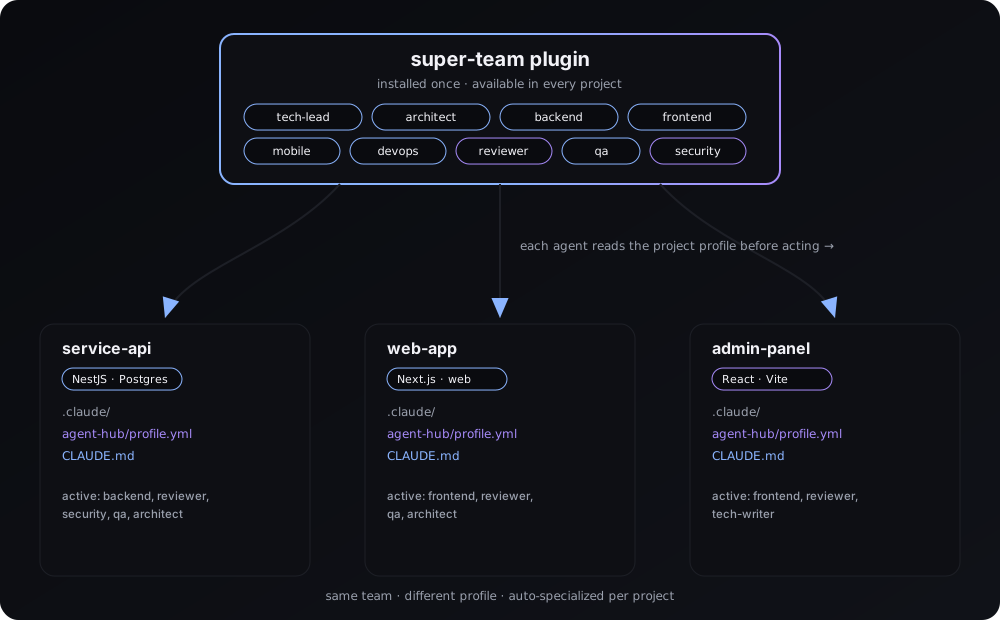
Two layers:
- The super-team (this repo, a Claude Code plugin) — a roster of specialist
subagents. Installed once, present everywhere. - The project profile (per project) — a
.claude/agent-hub/profile.yml+CLAUDE.mddescribing the project's stack, commands, and conventions.
Every agent runs a Profile-first protocol: read the profile before doing anything, then
act in that project's idioms. Because Claude Code auto-loads a project's CLAUDE.md when
you open it there, switching projects switches the team's behavior — automatically.
👥 The roster
| Agent | Role | Model |
|---|---|---|
tech-lead |
Orchestrator — decomposes work, routes to specialists | opus |
architect |
System design, data models, API contracts, trade-offs | opus |
backend-engineer |
APIs, business logic, persistence, integrations | sonnet |
frontend-engineer |
Web UI, state, accessibility, performance | sonnet |
mobile-engineer |
Native / cross-platform mobile | sonnet |
devops-engineer |
CI/CD, infra, containers, observability | sonnet |
data-engineer |
Pipelines, ETL, schema/warehouse modeling, migrations | sonnet |
ux-designer |
User flows, IA, interaction & accessibility specs | opus |
code-reviewer |
Correctness, bugs, maintainability review | sonnet |
qa-tester |
Test plans and test code | haiku |
security-reviewer |
Vulnerabilities, authz/authn, secrets (defensive) | opus |
tech-writer |
Docs, READMEs, changelogs | haiku |
Models are tuned per role for a quality/cost balance — override any of them in the agent's
frontmatter.
📄 The profile
.claude/agent-hub/profile.yml is the single source of truth a project hands the team:
project:
  name: my-service
  type: backend
stack:
  language: TypeScript
  framework: NestJS
  database: PostgreSQL
  packageManager: pnpm
commands:
  install: pnpm install
  test: pnpm test
team:
  active: [tech-lead, architect, backend-engineer, code-reviewer, security-reviewer]
conventions:
  - Use the repository pattern for data access
doNot:
  - Never expose entities directly in API responses
A starter template lives in templates/project-profile/ —
or just run /onboard and let the team fill it from your codebase.
🗂 Repo layout
agent-hub/
├── .claude-plugin/marketplace.json     # marketplace manifest
├── plugins/super-team/                 # the plugin
│   ├── .claude-plugin/plugin.json
│   ├── agents/                         # the 12 specialists
│   ├── skills/                         # agent-hub-init, load-profile, handoff, decision-log
│   ├── commands/                       # /onboard, /team, /review, /decide, /handoff
│   └── hooks/                          # SessionStart: auto-load the project profile
├── templates/project-profile/          # per-project .claude/ starter
├── templates/profiles/                 # ready profiles (Spring, Django, Next, Flutter, Go, Expo)
├── site/                               # marketing site (Vite + React + Tailwind)
└── scripts/validate.mjs                # zero-dep CI validation
❓ FAQ
Do I have to fill the profile by hand?No. /onboard inspects your repo (package.json, pom.xml, pubspec.yaml, CI config…)
and fills the profile for you. You just confirm.
Plain subagents are global and stack-agnostic. agent-hub makes one team project-aware:
the same roster reads each project's profile and adapts, so you don't maintain a separate
set of agents per repo.
Yes — per project via team.active in the profile, or globally by editing the roster.
See CONTRIBUTING to add a new specialist.
It's stack-agnostic — the agents derive everything from your profile. Node, Java, Python,
Dart, Go… if Claude Code can read it, the team can work in it.
🛣 Roadmap
-
/handoffcommand to summarize state for the next session -
data-engineerandux-designerspecialists - Starter templates for popular stacks (Spring Boot, Django, Next, Flutter, Go, Expo)
-
/revieworchestrated multi-agent review - Team memory — decision log (
/decide+ ADRs) - SessionStart hook that auto-loads the project profile
- Profile linting in
/onboard - Per-package profiles for monorepos
Have an idea? Open an issue or a PR.
🤝 Contributing
PRs of every size are welcome — a sharper agent prompt, a new specialist, an example
profile. Run node scripts/validate.mjs before pushing. See CONTRIBUTING.md.
⭐ Like it?
If agent-hub saves you time, star the repo — it helps others find it and motivates the
roadmap.
📝 License
Reviews (0)
Sign in to leave a review.
Leave a reviewNo results found