AITP-Research-Protocol
Health Warn
- License — License: MIT
- Description — Repository has a description
- Active repo — Last push 0 days ago
- Low visibility — Only 5 GitHub stars
Code Warn
- process.env — Environment variable access in research/adapters/openclaw/plugin/aitp-openclaw-runtime/index.ts
Permissions Pass
- Permissions — No dangerous permissions requested
No AI report is available for this listing yet.
AITP Research Charter and Protocol: a charter-first protocol, contract, and adapter surface for AI-assisted theoretical physics research.

AITP Research Charter and Kernel
Protocol-first infrastructure for building an AI Theoretical Physicist that behaves like a disciplined research participant rather than a free-form chat agent.
Quick Start · User Journey · Research Model · Usage · Runtime Support · Docs
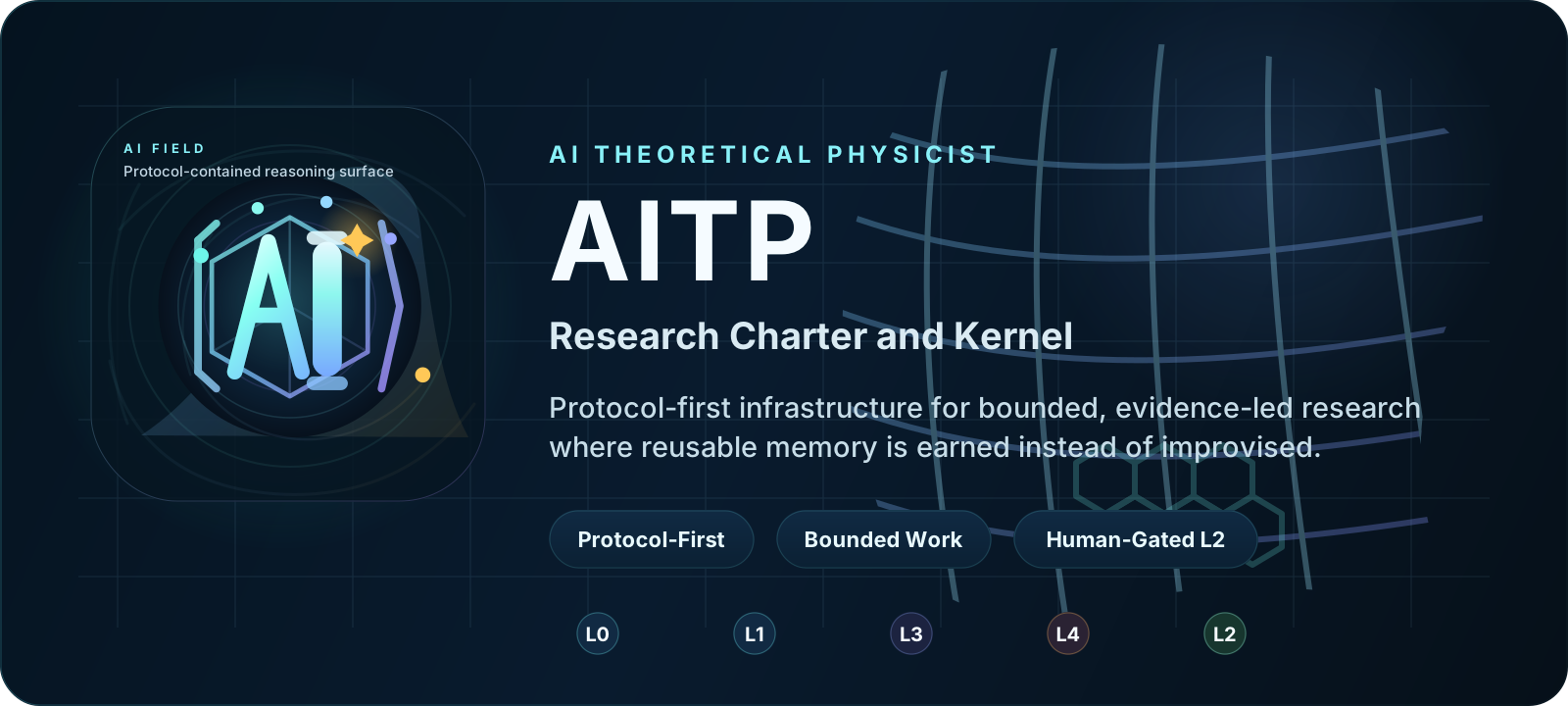



Charter above runtime. Protocol above heuristics. Agents are executors, not the source of truth.
AITP stabilizes the research protocol, not one frozen implementation. Agents
may use different scripts, prompts, and task decompositions, but they must
preserve the layer model, durable artifacts, evidence boundaries, and governed
promotion gates that make the work auditable and reusable.
AITP is not trying to make an AI sound like a physicist. It is trying to make
an AI work more like a theoretical physicist:
- source-grounded before confident;
- explicit about assumptions, gaps, and validation debt;
- able to continue a real topic over time instead of improvising per chat;
- accountable to a human research partner who still owns direction and novelty.
Why AITP
Large models can already write research-sounding prose. That is cheap.
AITP exists to enforce the parts that are not cheap:
- evidence stays separate from conjecture;
- bounded steps replace hidden freestyle workflows;
- reusable memory is earned instead of assumed;
- failed attempts and uncertainty remain visible;
- humans stay legitimate at high-impact decision points.
Core Idea
AITP is an AI Theoretical Physicist research protocol.
In product terms:
AITP = Superpowers-style interaction layer + layered theoretical-physics research kernel + native agent execution capabilities
The intended workflow is not:
- human throws prompts over the wall;
- AI returns polished research-sounding text;
- everyone pretends this is a research process.
The intended workflow is:
- the human proposes or steers the research idea;
- the AI executes bounded research work inside a durable protocol;
- the human guides direction, standards, and innovation at the points that
matter; - both can resume the same topic without reconstructing context from chat.
The relationship is closer to research collaborator + advisor + operator
than to user + tool.
If you want to see what that should feel like for a real topic, read:
In other words, AITP wants the AI to behave like a disciplined junior or
mid-level theoretical-physics collaborator whose work is inspectable, whose
state is durable, and whose authority stops at explicit human gates.
Why The UX Looks Like Superpowers
AITP now deliberately converges on the same outer-install shape as
Superpowers:
- Codex: native skill discovery
- OpenCode: plugin bootstrap
- Claude Code: SessionStart bootstrap
That convergence is about user experience, not identity.
Superpowers' core lesson is correct: the agent should enter the right workflow
before it starts doing substantial work, and the user should not need to learn
a front-door command language first.
AITP keeps that outer principle, but its inner target is different. Superpowers
is a general coding workflow framework. AITP is a theory-research protocol with
layered memory, promotion gates, gap recovery, and explicit scientific trust
boundaries.
What You Get
| Surface | What it does | Where it lives |
|---|---|---|
| Charter | Defines what counts as disciplined AI-assisted theoretical-physics work | docs/CHARTER.md, docs/AGENT_MODEL.md |
| Protocol contracts | Defines durable artifacts, promotion gates, and trust boundaries | contracts/, schemas/ |
| Standalone kernel | Ships the public L0-L4 runtime, audits, and CLI/MCP surfaces |
research/knowledge-hub/ |
| Research-flow guardrails | Forces explicit research contracts, bounded action packets, and anti-proxy verification rules | research/knowledge-hub/RESEARCH_EXECUTION_GUARDRAILS.md |
| Adapters | Makes Codex, OpenClaw, Claude Code, and OpenCode enter through AITP | adapters/, docs/INSTALL_*.md |
Quick Start
The fastest useful path is still the Codex path:
git clone https://github.com/bhjia-phys/AITP-Research-Protocol.git
cd AITP-Research-Protocol

python3 -m pip install -e research/knowledge-hub
aitp doctor
On Windows-native, the repo-local launchers work without WSL:
scripts\aitp-local.cmd doctor
Then install the platform surface you actually use:
- Codex: follow
./.codex/INSTALL.md - OpenCode: follow
./.opencode/INSTALL.md - Claude Code: follow
docs/INSTALL_CLAUDE_CODE.md - OpenClaw: follow
docs/INSTALL_OPENCLAW.md
If you want the clearest picture of the intended user experience before you
install anything, start with:
If your system Python is externally managed:
python3 -m pip install --break-system-packages --user -e research/knowledge-hub
aitp install-agent still exists, but it is now the compatibility and
workspace-seeding path. The public default is the same shape as Superpowers:
skill discovery for Codex, plugin bootstrap for OpenCode, and SessionStart
bootstrap for Claude Code.
If you previously installed AITP from an older private workspace checkout,
converge your machine first:
If you are choosing from scratch:
- use
Codexwhen you want the cleanest current end-to-end AITP experience; - use
OpenCodewhen you want plugin-based natural-language routing; - use
Claude Codewhen you want the same gatekeeper model through
SessionStart; - use
OpenClawwhen you explicitly want bounded autonomous loop execution.
Research Model
AITP keeps research state in layers instead of flattening everything into one
chat transcript.
| Layer | Purpose | Typical contents |
|---|---|---|
L0 |
Source acquisition and traceability | papers, notes, source maps, upstream code references |
L1 |
Provisional understanding | analysis notes, derivation sketches, concept structure |
L3 |
Exploratory but not yet trusted outputs | candidate claims, explanatory notes, tentative reusable material |
L4 |
Validation and adjudication | baseline runs, trust audits, implementation checks, operator decisions |
L2 |
Long-term trusted memory | promoted knowledge, reusable workflows, topic-skill projections, stable backends |
The default non-trivial route is:
L0 -> L1 -> L3 -> L4 -> L2
L2 is intentionally last. Exploratory work does not become reusable memory
just because an agent sounds confident.
flowchart LR
    A[Research question] --> B[aitp bootstrap]
    B --> C[L0 source traces]
    C --> D[L1 provisional analysis]
    D --> E[L3 candidate outputs]
    E --> F[L4 validation and trust audit]
    F --> G{Human approval gate}
    G -->|approved| H[L2 reusable memory]
    G -->|not yet| E
How You Actually Use It
AITP currently has four public workflows that matter.
Before choosing a workflow, keep one routing rule explicit:
- use
AITPfor topic-governed research work - use
GSDfor implementing or maintaining this repository itself
The detailed coexistence rule lives at:
What A Real Topic Should Feel Like
The target experience is:
- the user starts in natural language;
- AITP only asks short route-changing questions when it must;
- ordinary topic work stays in a light runtime profile;
- only benchmark mismatches, scope changes, promotion, or exit audit force the
runtime to expand; - the user can later ask what happened, why a route was chosen, and what is
still open.
That journey is described in:
1. Codex With Native Skill Discovery
Use this when you want a normal codex conversation, but you want theory work
to route through AITP automatically.
# one-time install
git clone https://github.com/bhjia-phys/AITP-Research-Protocol.git ~/.codex/aitp
python -m pip install -e ~/.codex/aitp/research/knowledge-hub

# expose the skills
mkdir -p ~/.agents/skills
ln -s ~/.codex/aitp/skills ~/.agents/skills/aitp
Expected behavior:
codexdiscoversusing-aitpas the conversation-level gatekeeper;codexloadsaitp-runtimeonly after AITP claims the task;- natural-language requests such as
继续这个 topic,方向改成 Xroute through the current-topic-first AITP entry path; - it reads the runtime bundle before continuing;
- outputs stay in
L1,L3, orL4until a human approvesL2promotion.
Manual fallback:
aitp session-start "<task>"
The user experience target is natural language first. The user should not need
to remember wrappers or front-door shell commands.
AITP should also stay light by default. In ordinary topic work the runtime
should only require the minimum topic surfaces needed to continue safely, and
only expand into the full runtime bundle when something important happens.
2. OpenCode With Plugin Bootstrap
Use this when you want OpenCode to feel natural-language first, but still enter
AITP before substantive theory work.
# add the plugin to opencode.json
{
  "plugin": ["aitp@git+https://github.com/bhjia-phys/AITP-Research-Protocol.git"]
}
Expected behavior:
- the plugin registers the AITP
skills/directory; - the plugin injects
using-aitpthroughexperimental.chat.system.transform; - natural-language requests route through the same current-topic-first AITP entry path used by Codex;
- outputs stay in
L1,L3, orL4until a human approvesL2promotion.
Manual fallback remains aitp session-start "<task>", but the public default
is plugin bootstrap rather than /aitp command bundles.
3. Claude Code With SessionStart Bootstrap
Use this when you want Claude Code to enter AITP at conversation start instead
of relying on explicit slash commands.
Install the AITP Claude plugin or the compatibility hook bundle described indocs/INSTALL_CLAUDE_CODE.md.
Expected behavior:
- Claude Code receives
using-aitpthrough SessionStart bootstrap; - research requests route into AITP before any substantial response;
- current-topic continuation and steering updates stay natural-language first;
runtime_protocol.generated.mdremains the first runtime checklist after routing succeeds.
4. OpenClaw For Bounded Autonomous Research
Use this when you want bounded autonomous progress under heartbeat or
control-note constraints, without giving the runtime permission to invent its
own protocol.
# one-time user install
aitp install-agent --agent openclaw --scope user

# do one bounded step
aitp loop --topic-slug <topic_slug> --human-request "<task>" --max-auto-steps 1
If you want a workspace-local OpenClaw skill surface:
aitp install-agent --agent openclaw --scope project --target-root /path/to/openclaw-workspace
On Windows-native, the equivalent entrypoints are:
scripts\aitp-local.cmd install-agent --agent openclaw --scope project --target-root D:\openclaw-workspace
scripts\install-openclaw-plugin-local.cmd --target-root D:\openclaw-workspace
Expected behavior:
- OpenClaw re-enters through
aitp loop; - it refreshes runtime state and decision surfaces;
- it performs one bounded next step and writes human-readable artifacts;
- anything destined for
L2still waits for explicit human approval.
Core Runtime Commands
If you remember only one command block, remember this one:
# install a runtime adapter
aitp install-agent --agent codex --scope user

# open a new topic
aitp bootstrap --topic "<topic>" --human-request "<task>"

# open a new topic with an explicit shell contract
aitp new-topic --topic "<topic>" --question "<bounded question>" --mode formal_theory

# materialize natural-language routing at session start
aitp session-start "<task>"

# do one bounded unit of work
aitp loop --topic-slug <topic_slug> --human-request "<task>" --max-auto-steps 1

# inspect the shell before continuing
aitp status --topic-slug <topic_slug>
aitp next --topic-slug <topic_slug>

# run one bounded shell-driven step
aitp work --topic-slug <topic_slug> --question "<task>" --max-auto-steps 1

# switch the active validation lane
aitp verify --topic-slug <topic_slug> --mode proof

# assess topic-completion and follow-up return debt
aitp complete-topic --topic-slug <topic_slug>

# let a child topic publish its return packet before parent reintegration
aitp update-followup-return --topic-slug <child_topic_slug> --return-status recovered_units --return-artifact-path <artifact>

# reintegrate a bounded child follow-up topic
aitp reintegrate-followup --topic-slug <parent_topic_slug> --child-topic-slug <child_topic_slug>

# export Lean-ready declaration packets
aitp lean-bridge --topic-slug <topic_slug> --candidate-id <candidate_id>

# continue an existing topic without re-bootstrap
aitp resume --topic-slug <topic_slug> --human-request "<task>"

# move mature material toward L2 only after approval
aitp request-promotion --topic-slug <topic_slug> --candidate-id <candidate_id> --backend-id <backend_id>
aitp approve-promotion --topic-slug <topic_slug> --candidate-id <candidate_id>
aitp promote --topic-slug <topic_slug> --candidate-id <candidate_id> --target-backend-root <backend_root>
Operating rule:
bootstrapopens the topic shell;new-topic,status,next,work, andverifyexpose a GPD-like command shell without changing the AITP layer model;loopandresumedo the actual bounded work;update-followup-returnrecords the child-side return contract before parent reintegration;complete-topicnow reports an explicit regression manifest and completion-gate checks;lean-bridgenow exports declaration packets together with proof-obligation and proof-state sidecars;- the runtime queue now also auto-appends refresh actions for topic completion, Lean bridge, and child-follow-up reintegration when those shell surfaces go stale;
L3andL4are normal destinations for exploratory output;L2requires an explicit approval artifact.
Every materialized topic now also refreshes a small set of durable shell
surfaces under runtime/topics/<topic_slug>/:
research_question.contract.{json,md}validation_contract.active.{json,md}topic_dashboard.mdpromotion_readiness.mdgap_map.mdtopic_completion.{json,md}lean_bridge.active.{json,md}followup_reintegration.{jsonl,md}
These surfaces are not decorative notes. They are the bounded shell that tells
an agent what the active question is, what must be validated, whether the topic
is promotion-ready, what the current semi-formal trust boundary is, and whether
the honest next move is to return to L0 for missing sources or prior-work
recovery.
They also expose whether child follow-up topics have been reintegrated and what
the current downstream formalization or Lean-export debt looks like.
One Protocol, Three Research Lanes
AITP is deliberately general. The same kernel can drive different categories of
theoretical-physics work.
| Lane | Typical L0 inputs |
Typical L4 work |
Typical L2 output |
|---|---|---|---|
| Formal theory and derivation | papers, definitions, prior claims, notebook traces | derivation review, proof-gap analysis, consistency checks, trust-boundary audits | semi-formal theory objects, trusted derivation notes, optional downstream Lean-ready packets |
| Toy-model numerics | baseline papers, model specs, observables, scripts | controlled runs, convergence checks, benchmark comparison | validated workflows, benchmark notes, reusable operations |
| Code-backed algorithm development | upstream codebases, papers, existing methods | reproduction, trust audit, implementation validation | trusted methods, reusable operation manifests, backend writeback |
Code-backed work inside AITP is not a detached coding task.
The outer user experience should still feel like a Superpowers-style natural
language workflow, but the resulting code, benchmark evidence, validation
state, and reusable method outputs still belong to the active AITP topic and
its promotion gates.
For theory-heavy work, the default target is the semi-formal layer described in:
research/knowledge-hub/SEMI_FORMAL_THEORY_PROTOCOL.md
AITP aims first for source-grounded, gap-honest, reusable theorem and
derivation packets.
Lean export remains a governed downstream bridge rather than the minimum bar
for every L2 theory artifact.
AITP, TPKN, And The Workspace
AITP is not the public knowledge base itself.
In the current multi-repo setup, the roles are:
AITP-Research-Protocol- the protocol kernel;
- owns
L0-L4routing, runtime state, gap recovery, validation, promotion, and backend bridges.
theoretical-physics-knowledge-network- the public typed knowledge backend;
- owns canonical
sources/,units/,edges/, retrieval indexes, and the human-facingportal/.
Theoretical-Physics- the active private development workspace;
- owns the Obsidian vault, working mirrors, Share_work handoff notes, and staging code that may later publish into the public backend.
Operationally, the intended direction is:
AITP runtime -> validated output -> TPKN backend
The workspace exists to do active development and mirror work without forcing
the public backend repo to become the only editable surface.
Windows Handoff
If development moves to another Windows machine, the recommended mental model is
still three sibling repositories rather than one monorepo:
AITP-Research-ProtocolTheoretical-Physicstheoretical-physics-knowledge-network
Windows-native AITP is now supported directly. WSL is optional rather than the
default path.
Recommended bootstrap order:
- clone
AITP-Research-Protocoland getaitpworking first; - clone
Theoretical-Physicsas the active workspace; - clone
theoretical-physics-knowledge-networkas the clean public-backend publish target.
Recommended first commands on a fresh Windows clone:
scripts\aitp-local.cmd doctor
scripts\aitp-local.cmd install-agent --agent codex --scope project --target-root D:\theory-workspace
That project install now writes both:
.agents/skills/aitp-runtime/.agents/skills/using-aitp/
so a Windows workspace can re-enter AITP without depending on a copied WSL shim.
The key boundary to preserve on Windows is this:
- AITP decides how research flows and when material is ready.
- TPKN is where trusted, typed knowledge lands.
- The private workspace is where iterative editing and mirror work can stay messy without polluting the public backend history.
Runtime Support Matrix
| Runtime | Public install path | Enforcement surface |
|---|---|---|
| Codex | .codex/INSTALL.md |
Native skill discovery + using-aitp gatekeeper |
| OpenClaw | aitp install-agent --agent openclaw |
Skill + MCP bridge setup note |
| Claude Code | docs/INSTALL_CLAUDE_CODE.md |
SessionStart hook + using-aitp bootstrap |
| OpenCode | .opencode/INSTALL.md |
Plugin bootstrap + using-aitp injection |
Current maturity is not uniform:
Codex,OpenCode, andClaude Codenow converge on the same outer model: one gatekeeper skill plus native bootstrap.aitp install-agentremains the compatibility path for seeded workspaces and manual fallbacks.OpenClawkeeps the bounded autonomous loop path and MCP bridge notes, whileCodexremains the most opinionated end-to-end execution surface.
Current automation target:
- high-automation research collaboration, not fake full autonomy;
- the human still owns direction, novelty, expensive route choices, and final
trusted promotion decisions; - AITP should do as much bounded execution work as possible before it asks.
Install And Remove
For platform-specific install steps, see:
To remove adapter assets or the editable runtime install, see:
Design Boundaries
AITP is protocol-first. Python does not get to quietly decide the science.
The runtime is trusted to:
- materialize protocol and state artifacts;
- build deterministic projections;
- run conformance, capability, and trust audits;
- execute explicit handlers;
- expose a thin
aitpCLI and optionalaitp-mcpsurface.
It is not trusted to:
- redefine the charter;
- silently merge evidence, derivation, and conjecture;
- silently redefine scope, observables, or deliverables mid-run;
- substitute polished prose or missing execution evidence for declared checks;
- promote material into
L2without an explicit gate.
Repository Map
AITP-Research-Protocol/
├── README.md
├── AGENTS.md
├── docs/
├── contracts/
├── schemas/
├── adapters/
├── reference-runtime/
└── research/
    ├── adapters/
    │   └── openclaw/
    └── knowledge-hub/
        ├── LAYER_MAP.md
        ├── ROUTING_POLICY.md
        ├── COMMUNICATION_CONTRACT.md
        ├── AUTONOMY_AND_OPERATOR_MODEL.md
        ├── L2_CONSULTATION_PROTOCOL.md
        ├── INDEXING_RULES.md
        ├── L0_SOURCE_LAYER.md
        ├── setup.py
        ├── schemas/
        ├── knowledge_hub/
        ├── source-layer/
        ├── intake/
        ├── canonical/
        ├── feedback/
        ├── consultation/
        ├── runtime/
        └── validation/
Read Next
Core charter and architecture:
docs/CHARTER.mddocs/AGENT_MODEL.mddocs/CONTEXT_LOADING.mddocs/architecture.mddocs/LESSONS_FROM_GET_PHYSICS_DONE.md
Kernel contract surface:
research/knowledge-hub/LAYER_MAP.mdresearch/knowledge-hub/ROUTING_POLICY.mdresearch/knowledge-hub/COMMUNICATION_CONTRACT.mdresearch/knowledge-hub/AUTONOMY_AND_OPERATOR_MODEL.mdresearch/knowledge-hub/L2_CONSULTATION_PROTOCOL.mdresearch/knowledge-hub/INDEXING_RULES.md
Install guides:
docs/MIGRATE_LOCAL_INSTALL.mddocs/INSTALL_CODEX.mddocs/INSTALL_OPENCLAW.mddocs/INSTALL_CLAUDE_CODE.mddocs/INSTALL_OPENCODE.mddocs/AITP_GSD_WORKFLOW_CONTRACT.mddocs/UNINSTALL.md
Protocol objects:
contracts/research-question.mdcontracts/candidate-claim.mdcontracts/derivation.mdcontracts/validation.mdcontracts/operation.mdcontracts/promotion-or-reject.md
Current Status
The repository is already more than a static protocol archive:
- it ships a standalone installable kernel under
research/knowledge-hub; - it exposes fixed
L0-L4research surfaces plusconsultation/,runtime/, andschemas/; - it exposes Superpowers-style outer installs for Codex, OpenCode, and Claude Code;
- it includes an explicit human approval gate before
L2promotion; - it can bridge into the standalone
Theoretical-Physics-Knowledge-Networkformal-theory backend without hard-wiring one private knowledge base as the only destination.
Still in progress:
- OpenClaw still uses a different bounded-loop surface than the three bootstrap-first chat runtimes;
- the compatibility installer should keep shrinking as native platform installs become sufficient;
- multi-runtime smoke testing should keep expanding.
See Also
Reviews (0)
Sign in to leave a review.
Leave a reviewNo results found