TaskWraith
Health Warn
- License — License: Apache-2.0
- Description — Repository has a description
- Active repo — Last push 0 days ago
- Low visibility — Only 5 GitHub stars
Code Fail
- spawnSync — Synchronous process spawning in build/validate-native-modules.cjs
- fs.rmSync — Destructive file system operation in build/validate-native-modules.cjs
- process.env — Environment variable access in build/validate-native-modules.cjs
- fs module — File system access in build/validate-native-modules.cjs
Permissions Pass
- Permissions — No dangerous permissions requested
No AI report is available for this listing yet.
Local-first desktop control room for coding agents. Run Codex, Claude Code, Cursor, Grok, and local models together — each with its own role, permission posture, and receipts. Multi-agent ensembles in one thread, diff review, on-device history. macOS, Windows, Linux.
TaskWraith



TaskWraith is a local-first desktop workbench for running and reviewing AI coding
agents against developer workspaces. Its Electron app ships for macOS, Windows,
and Linux; macOS has the deepest native integrations and hosts the optional iOS
companion. TaskWraith keeps its orchestration, local history, and workspace
authority on the user's machine; prompts and run context still go to whichever
cloud provider the user selects.
Read POSITIONING.md for the concise product promise, claim
boundaries, topology decision guide, and recommended small Ensemble panels.
iOS companion status: TaskWraith for iPhone/iPad is in TestFlight beta.
It is a Mac companion — it pairs with TaskWraith on macOS over an
end-to-end-encrypted connection to monitor runs, approve actions, and reply
from the phone; it is not a standalone AI app. Remote actions are governed by
the Mac's workspace allowlists and approval policy. Relay/APNs infrastructure
may see routing/status metadata (including aggregate added/deleted line
counts), not plaintext prompts, commands, diff contents or hunks, or model
output. Live Activities are the explicit exception to the ordinary encrypted
task projection: ActivityKit must decode their push state, so Apple receives
only an allowlisted coarse phase, provider names, start time, change counts,
bounded seat states, layout/palette, and an opaque per-card reference—never
task text, titles, paths, workspace/repository names, or run/chat ids. No
privacy-sensitive value may ever be seeded into that state; expanding the
allowlist requires a fresh privacy and security review. Testers can also build
it from this repository with their own Apple Developer team. Push
notifications are opt-in after pairing and require APNs credentials on the
Mac (seeios/TaskWraithApp/README.md).
Ensemble Threads
TaskWraith's most experimental surface is Ensemble Threads: shared work
sessions where multiple AI agents participate in the same conversation instead
of living in separate tabs. A thread can include up to thirty named participants
across Codex, Claude, AntiGravity, Kimi, Cursor, Grok, Pi, Mistral Vibe, and
local Ollama, each with its own model, role, order, and permission posture.
Kimi seats additionally require runtime admission: structural checks (stable
binary identity, bounded probes, the ACP-only posture) that are always
enabled, packaged builds included. While the reviewed qualification roster is
empty, admitted runs are labelled unattested-development; that labelling
cannot qualify a release.
Cursor is in the user-approved live set. Its current Path-B route signs in
with cursor-agent and works in solo chats, Ensembles, and delegated work.
Cursor can use its native tools alongside TaskWraith tools, with the selected
permission posture and workspace Tool Grants applying wherever TaskWraith
mediates. The provider-native boundary is explained in
Trust & Safety.
This is not just provider switching. Ensemble participants see the same
transcript, can build on each other's work, hand off deliberately, run
turn-bound or continuous rounds, and fan out in parallel. Qualified tool-capable
participants can use TaskWraith's workspace tools under the same local approval
and audit model. In practice, a
single thread can hold a planner, implementer, adversarial reviewer, docs writer,
and local-model scout without losing the workspace timeline or review trail.
Ensembles are designed for work that benefits from disagreement and role
separation: code review, architecture critique, bug hunts, migration planning,
release checks, and "one agent implements while another watches the diff" flows.
They pair with Multiview, Workflows, slash commands, MCP tools, and the activity
viewport so multi-agent work remains inspectable rather than becoming a hidden
background process.
Normal top-level chats no longer need to be recreated just to change shape.
You can now switch provider, model, and reasoning on an existing single-provider
thread after it has history, and if a turn is already running those changes queue
and apply at turn end. Top-level idle chats can also flip in place between
single-provider and Ensemble mode on the same thread, preserving transcript
history; the ensemble toggle stays disabled until the current turn finishes.
Trust, Safety, and First Runs
|
|
Start with low-risk work. TaskWraith is designed to keep permissions visible and auditable, but it still coordinates powerful local tools. Use a scratch repo and read-only posture first, then widen trust only after the behavior is familiar. |
TaskWraith has a broad optional permissions surface: provider CLIs, local models,
workspace file tools, shell/git actions, iOS remote control, collaborator
sharing, Screen Watch, Canvas/browser-like tools, media tools, and creative-app
automation. The default expectation is explicit user control: select a workspace,
choose a run posture, review approvals, inspect activity, and check diffs before
committing generated work.
New users should start with a scratch repository in Read-only/Recon or Plan
workflow. Plan workflow is not general write access: it can save a narrow
markdown plan artifact under a validated workspace path for the proposed-plan
handoff, but ordinary file edits, shell commands, and tool writes still require a
higher permission posture or explicit approval. Do not enable remote pairing,
Screen Watch, Canvas/browser automation, creative app bridges, unattended
workflow grants, or full-workspace/yolo permissions until the app has earned
trust through several low-risk sessions.
Read TRUST_AND_SAFETY.md for the safe-first-run guide,
capability matrix, storage locations, provider data boundaries, release
verification steps, and known limits. Optional features that require outside
accounts, local services, or macOS permissions are covered in
ADVANCED_OPTIONAL_SETUP.md. SAFETY.md
and SECURITY.md contain the engineering guardrails and release
baseline.
Electron builds configured with TaskWraith's first-party activity endpoint
leave privacy-minimised product observation off until you affirmatively choose
Share during first launch or under Settings → Safety & Privacy. The
choice is optional, sends only the fixed no-content contract, can be withdrawn
at any time, and never affects app features. Builds without an endpoint send
nothing. PRIVACY.md explains platform aggregates, retention,
user choices, and the exact data boundary.
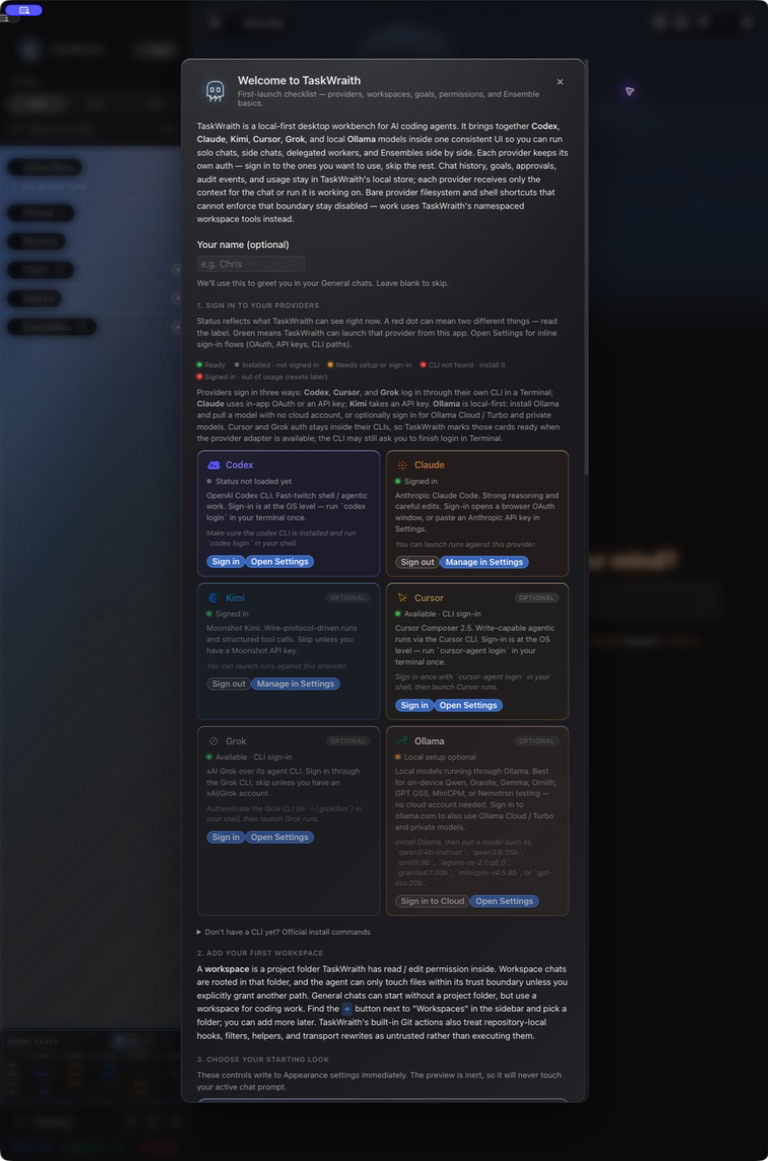 Welcome & provider setup |
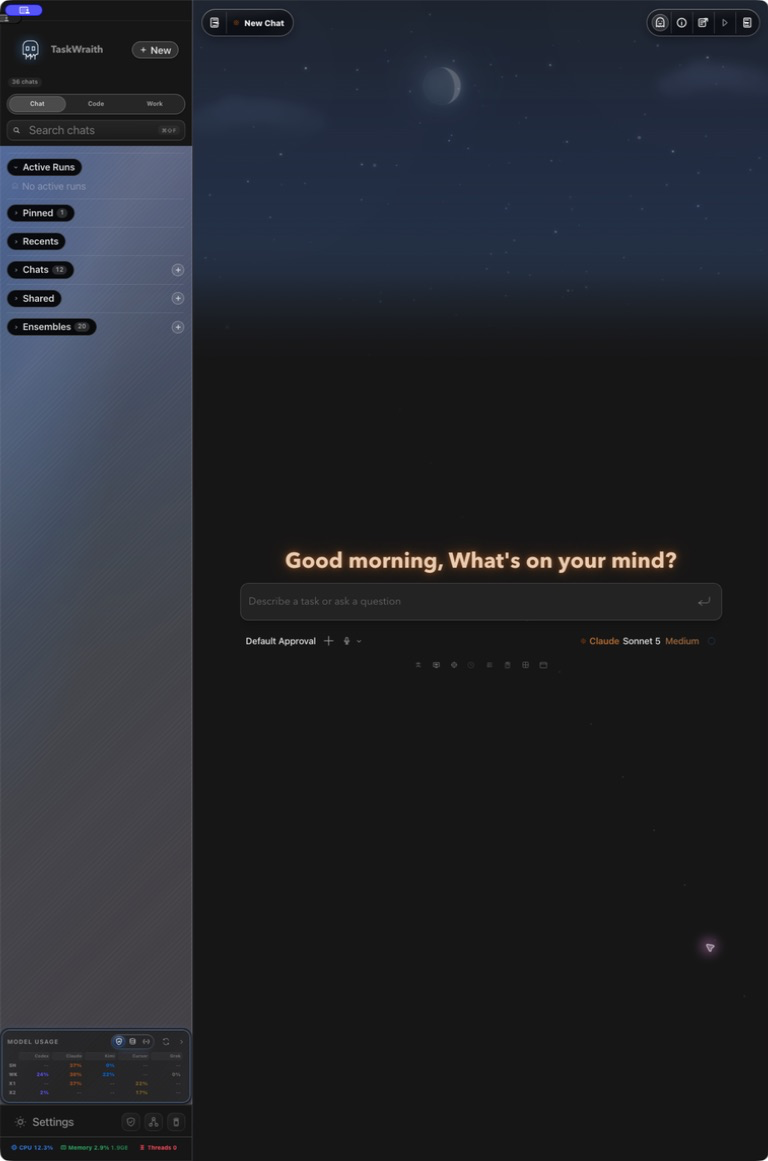 General App Layout |
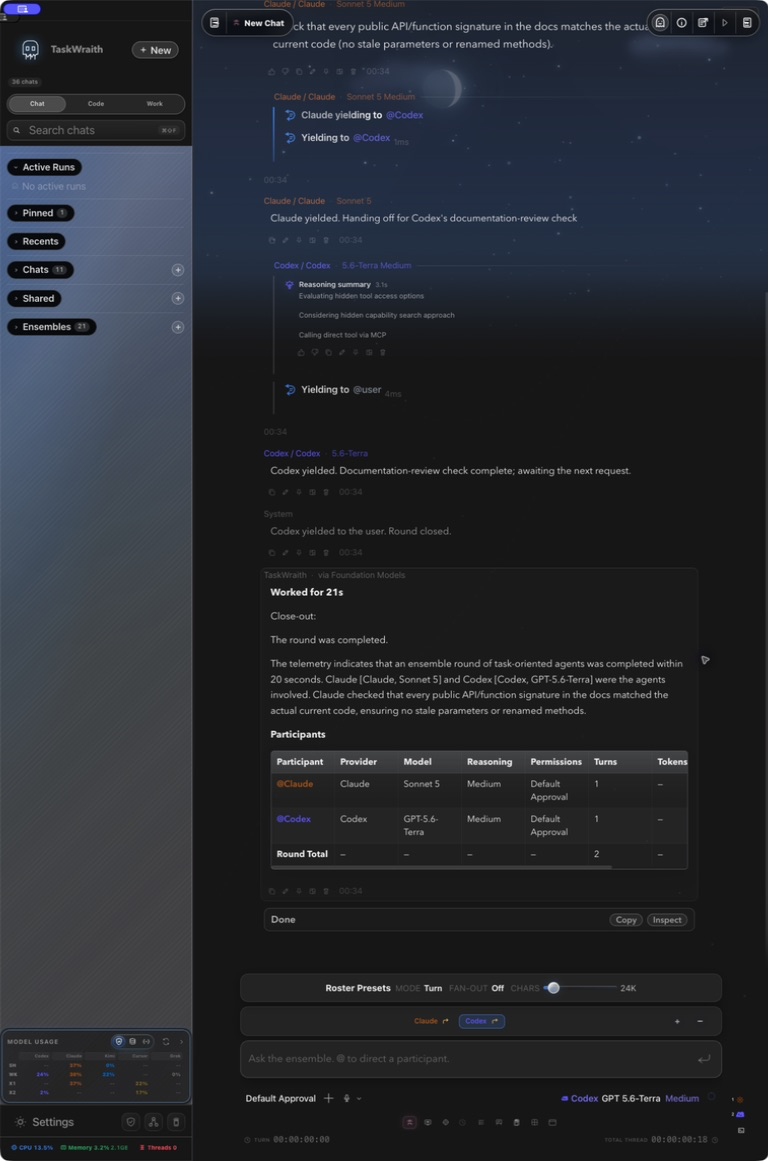 A live Ensemble run |
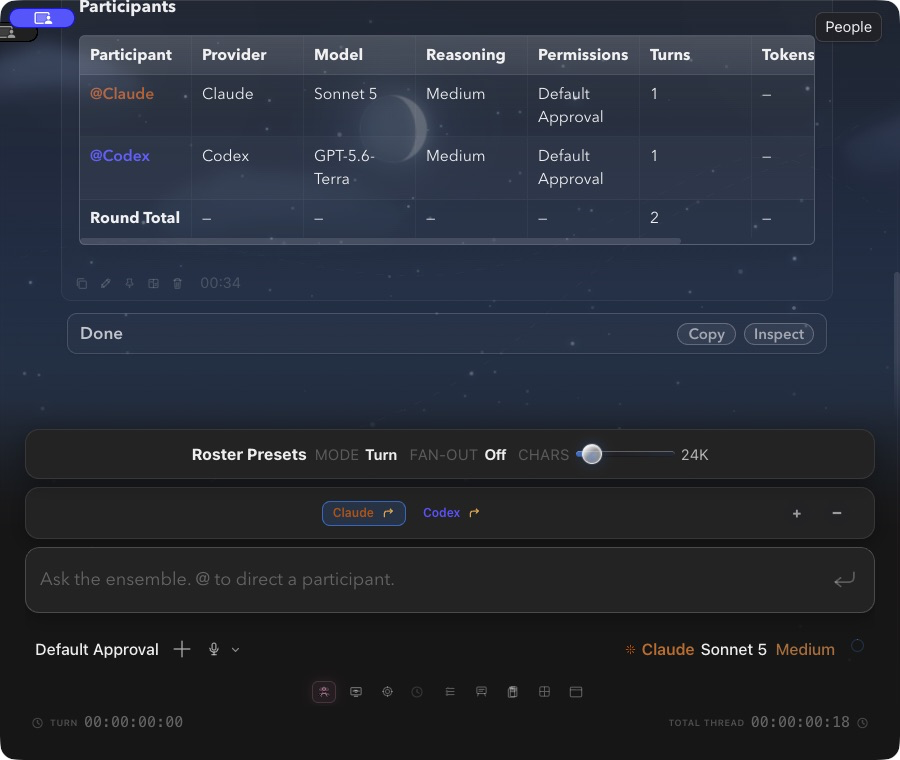 Pop-Out Chat |
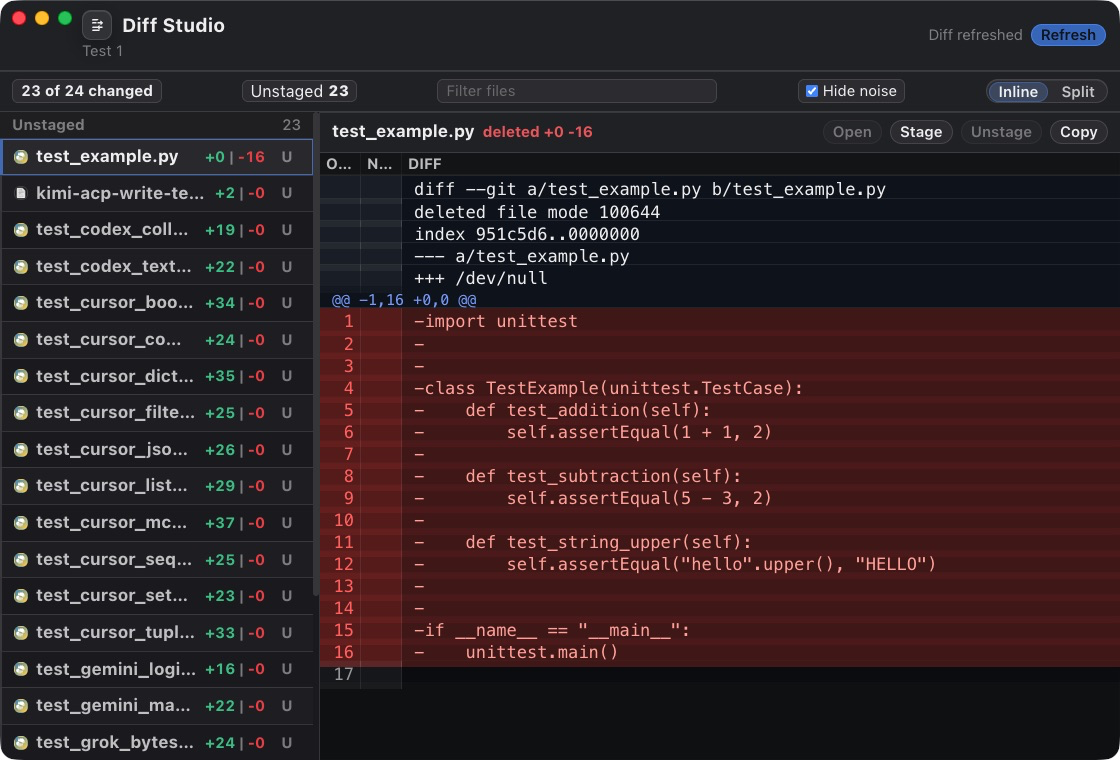 Diff Studio |
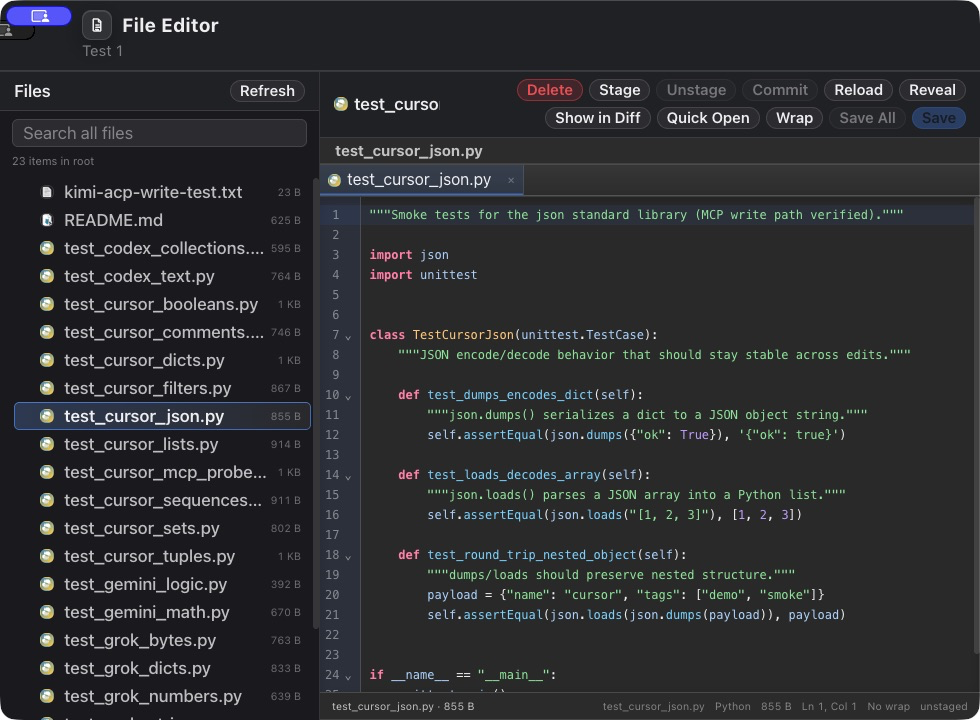 File Editor |
Features
- Workspace Safety: Workspace selection, trust-state visibility, approval
modes, and run-scoped safety state before agents operate on local files. - Provider Runs: Integrated run surfaces for Codex, Claude, AntiGravity
(bring-your-own Gemini API key), Kimi, Cursor, Grok, Pi, Mistral Vibe, and
local Ollama (curated Qwen, Gemma, GPT-OSS, and Poolside presets).
Kimi's integrated surface is admission-dependent: every build applies
structural identity, bounded-probe, and ACP-posture checks. The current
source-ahead reviewed roster is empty, so structurally admitted runs are
labelledunattested-development; credentials or a visible picker row alone
do not bypass structural admission.
Cursor's current Path-B route signs in normally and works in solo chats,
Ensembles, and delegated runs with native tools plus TaskWraith tools. The
historical standalone Gemini provider remains readable but retired for new
runs; it is distinct from the live, opt-in AntiGravity integration.
Run management is provider-neutral: the lifecycle inventory covers all ten
stable provider identities and every admitted turn crosses the shared signed
posture boundary. Availability remains a separate product decision; missing
broker, provenance, or scheduled-seal evidence is reported as a limited or
unsealed run and does not by itself remove a provider.
Provider names describe compatible integrations only — CLIs and accounts stay
user-installed. See the Model Catalogue
for the curated model rows, reasoning controls, and Fast-tier semantics. - Multiview and Workflows: Split the workbench into live panes, and run
Workflows as first-class chat/run objects with scheduled recovery, dedicated
sidebar space, and optional ensemble execution where enabled. - Thread-isolated Worktrees: Selection-required runtime profiles allocate
and persist a per-thread worktree before dispatch, then route the run and
Diff Studio review through that effective workspace instead of the base
checkout. - Chat / Code / Work navigation: Use Chat for general conversations,
Code for workspace-scoped threads, workflows, boards, and local servers,
and Work for Projects. Projects build cross-workspace folder trees with
customizable icons and hues, plus drag-and-drop and add-menu organization.
Each project can designate, open, or start a Project Home thread, and keep a
metadata-only library of relevant files, folders, and links. Library entries
do not grant agent access or inject content into a run. - Thread Goals: Set a persistent objective with
/goal <objective>or the
composer goal control. Codex uses native goal state when the installed runtime
exposes it; qualified tool-capable providers get a TaskWraith-managed fallback
with explicit complete/blocked lifecycle tools. - Composer Shells: Provider-aware and task-oriented composer variants give
each working mode its own affordances—including the ChatGPT shell—without
changing the safety model. See COMPOSER_VARIANTS.md
for the Electron shell gallery. - Plan Workflow: Plan runs keep the provider in a read-only execution
posture while allowing a product-managed markdown plan file to be written under
validated workspace paths. Read-only/Recon runs do not get that artifact-write
carve-out. - Ensemble Threads: Multi-agent shared work sessions with named provider
participants, role/order control, turn-bound or continuous orchestration,
optional parallel fan-out, cross-provider handoffs, a shared Blackboard for
cross-agent notes and rich polls (composer quick-access popover plus full
management in the Notes pane), and TaskWraith MCP tools shared among qualified
tool-capable seats under one auditable workspace policy. - Agent Pool: Save reusable agents in Settings, each with a linked
provider/model/reasoning configuration and running contribution stats (runs,
threads, tokens, tool calls, work time), then drag them into ensemble rosters.
A welcome-dashboard leaderboard ranks pool agents by contribution. - Audit Runs:
/auditcan coordinate provider-backed review passes with
live progress, structured findings, verdicts, and dismissible run banners. - Local Ollama: Full TaskWraith tool-surface parity where local capability is
available, optional live web search/fetch, per-model context engineering, and
session memory across runs — all governed by the same permission roles and
policy gates as cloud providers. - Custom MCP Servers: User-defined MCP servers can be managed, validated,
imported, exported, and attached to compatible provider runtimes with
provider-specific JSON/TOML snippets and readiness checks. Cursor JSON
import/export remains useful for configuration interchange. Managed Cursor
can use both its native tools and TaskWraith's governed tools; provider- or
account-owned MCP remains a separate trust boundary. - Activity Review: Live activity viewport for in-flight tools and thinking,
compact timelines, durations, and raw event inspection. - AI Close-Out Summaries: Run and ensemble-round close-out cards show
readable prose plus a pass/fail line instead of quoting an agent's last
message verbatim. On Macs with Apple Foundation Models available, that prose is
generated on-device (badged "via Foundation Models") behind a prompt-injection
guard; a deterministic summary is the fallback everywhere else. - Diff Studio: File-list and diff-detail review for run-scoped changes and
current workspace changes, including previews for newly created text files. - GitHub PR & CI Awareness: When the workspace has a GitHub remote, an icon
row above the composer shows live PR lifecycle and CI status; hovering opens a
popover with fuller detail (including failing-check logs). A per-chat
Watch this PR opt-in can post deduplicated status transitions after
revalidating the current PR head, while Notify thread remains available
for an immediate Blackboard or transcript post. - Local History and Usage: Local-only chat, run, usage, approval-ledger, and
audit state for repeat work without a hosted backend. - iOS Companion: TestFlight companion surfaces Demo Mode, Workflows,
first-launch/provider readiness, usage snapshots, approvals, questions,
transcript streaming, thread renaming, inline images, remote file/diff
inspection, home search and pin/rename/archive, scheduled sending, and
transcript export. Source-ahead builds also offer configurable completion
banner presets and Live Activities for in-flight runs on the Lock Screen and
Dynamic Island, with the separately disclosed coarse APNs state above. - Release Tooling: Security, dependency, packaging, and signing hooks for
reproducible local release work.
Download installers from the
latest GitHub Release
(see Try a packaged build). See
CHANGELOG.md for release notes. This checkout may contain
repository work newer than the latest tag; the changelog's top source-ahead
entry describes those changes only. They are not shipped until a new tag and
matching artifacts are published.
Managed Enterprise Boundary
TaskWraith has local safety controls, local audit evidence, redacted export
surfaces, and partial managed-policy support. It does not currently claim SSO,
SCIM, SIEM integration, WORM or append-only audit export, organization-wide
retention, or a complete MDM/enterprise control plane. Treat enterprise-readiness
notes as claim boundaries and implementation tracking, not a compliance
attestation.
Public Source Boundary
TaskWraith source code is licensed under Apache-2.0. Provider product names are
used nominatively to describe interoperability with user-installed tools and
accounts. A narrowly scoped set of first-party provider PNG marks is bundled
for factual identity labels; provenance and source-specific rights notes live
in design-assets/provider-logos. Those marks
remain the property of their respective owners and do not imply endorsement.
The repository does not intentionally bundle API credentials, signing material,
or proprietary provider fonts.
Users are responsible for installing and authenticating the provider CLIs, SDKs,
or accounts they choose to use. TaskWraith does not bypass provider authentication,
quotas, rate limits, approval flows, or terms of service.
Built with AI Agents
TaskWraith is developed the way it is meant to be used — with AI coding agents in
the loop. Day-to-day work pairs OpenAI Codex and Anthropic Claude:
planning, implementation, multi-agent review passes, and large refactors run
through the agents. Agent output is reviewed by a human before merge, and release
work is gated by dependency checks, typecheck, tests, native bridge tests on
macOS, packaged-app smoke tests, signing/notarization validation where
credentials are available, and secret-bundle guards. Commits carryCo-Authored-By trailers for the agents that contributed.
Try a packaged build
If you want to run TaskWraith without building from source, use the installers
on the
latest GitHub Release.
Verified artifacts on each release (names match the uploaded files exactly, with<version> standing in for that release's version):
| Platform | Artifact |
|---|---|
| macOS (Apple Silicon + Intel, universal) | TaskWraith-<version>-universal-mac.dmg (also .zip) |
| Windows x64 | TaskWraith-<version>-win-x64-setup.exe |
| Windows arm64 | TaskWraith-<version>-win-arm64-setup.exe |
| Linux | TaskWraith-<version>.AppImage or taskwraith_<version>_amd64.deb |
Checksums for those files are listed in SHA256SUMS-<version>.txt on the same
release page. Prefer the checksum-listed filenames over similarly named CI or
side-channel builds.
After install. On first launch, TaskWraith opens a short Welcome sheet
covering providers, adding a workspace, appearance, permission posture, usage,
Ensemble basics, and power-user shortcuts. It shows once (dismissal is stored
locally); reopen it anytime with the ? help pill in the main pane. That sheet
is onboarding only — the empty-chat starter cards are a separate surface.
Providers still need their own setup. Packaged TaskWraith does not install
provider CLIs or accounts for you. Claude can sign in from Settings; Codex,
Cursor, Grok, and most other seats need the matching CLI installed and a
terminal login first. Ollama is local (install Ollama, then ollama pull a
model) and does not require a cloud account for local runs. Start with a
scratch repo and a read-only posture — see Trust, Safety, and First
Runs and TRUST_AND_SAFETY.md.
Development Setup
For contributors building from this repository:
- Install Node.js 20 or newer.
- Install any provider CLI you intend to use separately.
- Run
npm ci. - Run
npm run dev.
Use npm ci for clean installs so npm follows the committed lockfile exactly.
Run npm run security:deps before release work or after dependency changes.
Discord Context
Discord Context is optional and read-only: it attaches recent messages from
bot-accessible channels as untrusted context and does not post back to Discord.
Setup requires a Discord bot token, at least one guild/server ID, and channel
read permissions; see
Advanced Optional Setup - Discord Context
for the environment variables and packaged-app config path.
Useful Commands
npm run security:deps
npm run typecheck
npm run test
npm run test:swift:bridge   # macOS only — see note below
npm run validate:release    # release-readiness wrapper; see note below
npm run build
npm run test:swift:bridge runs the native macOS bridge daemon's Swift test
suite in swift/TaskWraithBridge. The bridge gates native macOS actions
(Screen Watch, creative-app, and editor helpers), so its tests run
automatically in two places: the macOS legs of CI, and the build:mac /build:mac:notarized release recipes (as a pre-flight gate, so a release
build fails fast on a bridge regression). It requires macOS with the Xcode
Swift toolchain and is not part of the cross-platform npm run ci.
npm run validate:release is the broad local release-readiness wrapper. It runs
the TypeScript gates, dependency/security checks, tests, package smoke checks,
platform-specific packaging validation (build:unpack on macOS, build:win:nopublish
on Windows, build:linux:nopublish on Linux), and the bundled-secret guard. It is
not a substitute for a credentialed notarized release build, update-feed
validation, SBOM generation, or platform-specific artifact signing.
Project Layout
src/main: Electron main process, provider orchestration, persistence, and
workspace safety services.src/preload: Narrow IPC bridge exposed to the renderer.src/renderer: React UI, provider review surfaces, settings, and visual
system.swift: macOS bridge daemon sources used by local release builds.scripts: Build, security, validation, signing, and packaging utilities.
See CHANGELOG.md for release history, and TRUST_AND_SAFETY.md,ADVANCED_OPTIONAL_SETUP.md, SESSION_AND_WORKSPACE.md, THREAD_INTROSPECTION.md,COMPOSER_VARIANTS.md, ARCHITECTURE.md, SAFETY.md, SECURITY.md, andPRIVACY.md, and TERMS_NOTES.md for more detail.
Reviews (0)
Sign in to leave a review.
Leave a reviewNo results found