self-host
Health Pass
- License — License: Apache-2.0
- Description — Repository has a description
- Active repo — Last push 0 days ago
- Community trust — 129 GitHub stars
Code Pass
- Code scan — Scanned 12 files during light audit, no dangerous patterns found
Permissions Pass
- Permissions — No dangerous permissions requested
No AI report is available for this listing yet.
Fast, isolated machines for AI agents and dev teams, self-hosted in your own cloud. Use them as agent sandboxes, dev environments or servers, on GCP, AWS or bare metal.
boxd self-host
Run a complete boxd cluster in your own Google Cloud
project or AWS account, or on servers you already run. You get microVMs
that boot in 4 ms and can be forked and snapshotted, each with its own SSH
and HTTPS, along with the console, DNS and automations. Everything is set by
one config file and installed by one command. The only thing to install on
your machine is Docker.
Install on GCP
| Install on AWS
| Install on bare metal
| Reference
| Operations
| Releases
How to run
Choose the cloud you already use, or bring your own hosts.
| Run it on | You need | The command | Install |
|---|---|---|---|
| GCP | a Google Cloud project with billing | ./boxd-install apply |
Install on GCP |
| AWS | an AWS account | ./boxd-install apply |
Install on AWS |
| Bare metal | Ubuntu 24.04 hosts you prepare: ssh, a private network, KVM on workers | ./boxd-install apply |
Install on bare metal |
Wherever you run it, you also need a DNS zone whose parent zone you can add
records to, such as boxd.example.com under example.com. Set aside about
an hour: most of it is apply, which runs on its own for 20–40 minutes. Each
guide ends with you signed in to your cluster's console and starting your
first VM.
INSTALL-PROMPT.md has Claude Code take you through the
same install one step at a time.
What runs in your cloud
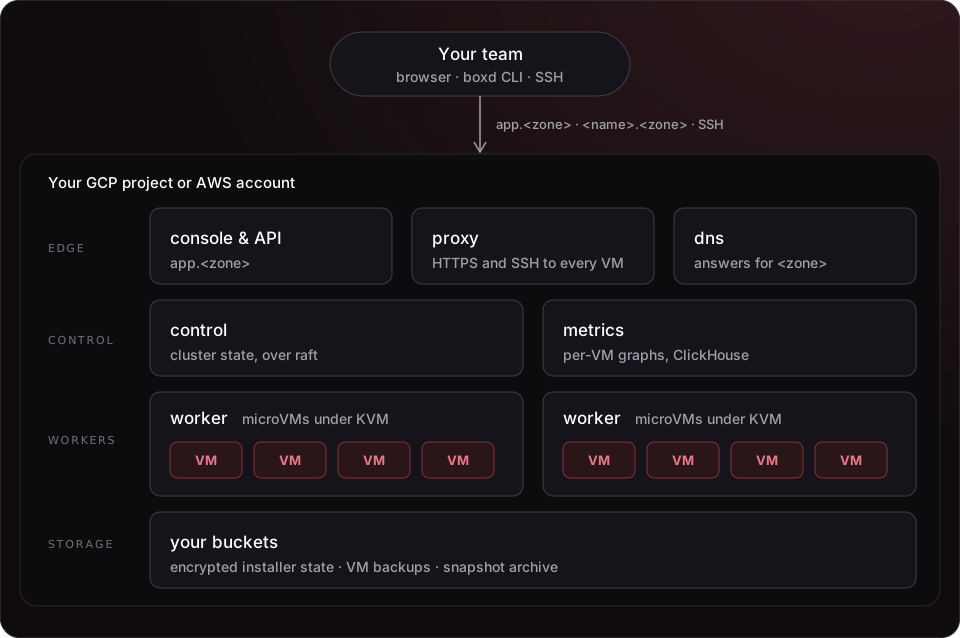
A cluster is made of a few node roles. The control nodes run the
cluster's state over raft. The workers run the microVMs under KVM, on
boxd's own host kernel. The proxy connects every VM to the internet athttps://<name>.<zone> and over SSH. The console serves the web console,
the API and a CLI already set up for your cluster. A dns node answers for
your zone. A metrics node stores the graphs the console shows for each VM.
One node can have several roles. The examples put every role except the worker
on a single control node and add one worker.
Every install is driven by cluster.toml. Its state, including TLS keys, node
identities and provider secrets, is encrypted in a bucket you own (on bare
metal, a file next to cluster.toml), under a key that only you hold.
Binaries, the console, the CLI, the host kernel and the VM image come in a
release bundle that boxd signs. With a license key,
the installer downloads the releases boxd publishes for that key. It checks
the signature against release-keys/ before it unpacks
anything.
What you get
- Fast microVMs. They boot in 4 ms, can be forked and snapshotted, and come
in the sizes you pick. - Every VM on the network. Each one is reachable over HTTPS at
https://<name>.<zone>and over SSH. You can also give it custom domains
and raw TCP or UDP ports. - The console and the CLI.
app.<zone>serves the console and aboxdCLI that already
points at your cluster. It's the same CLI thatdocs.boxd.shdocuments, and
it comes with an agent skill for Claude Code, Codex and OpenCode. - Your own sign-in. People sign in with Google or GitHub, or with
single sign-on through Entra ID,
Okta, Google Workspace or Keycloak. - Certificates handled for you. They come from Google Trust Services on
GCP and ZeroSSL on AWS and bare metal. Inside a corporate network, they
can come from your own CA
instead. - Private if you need it. With private ingress
on AWS, no node has a public IP and people reach the cluster over your VPN. - Backups. The installer creates a bucket for
VM disk backups and can create one for a
snapshot archive. - Docker is the only requirement.
./boxd-installruns terraform,
ansible, gcloud and the aws CLI inside a Docker image, at versions boxd has
tested. You don't need the boxd source tree.
Quick start
On GCP or AWS, below. On bare metal there is no cloud to sign in to and no
bucket: follow Install on bare metal.
- Sign in to your cloud. Use
./boxd-install gcloud …or./boxd-install aws …, which run the CLI in Docker. If you already havegcloudorawsinstalled, you can sign in with that instead. See
GCP or AWS. - Make your state key, once. It encrypts the cluster's state, and only
you hold it. See Your state key. - Create the state bucket. See GCP or
AWS. - Fill in
cluster.tomland apply. These commands are the same on
either cloud:
cp cluster.example.toml cluster.toml      # change every value marked CHANGE
./boxd-install providers edit             # the console's sign-in (step 6)
./boxd-install apply 2>&1 | tee apply.log
cluster.example.toml is the GCP example. On AWS, copyexamples/aws/cluster.toml instead. Each step is explained in full in
docs/INSTALL.md.
Once apply is done
At the end, apply prints the NS and glue records for your zone. Add them to
the parent zone at your DNS provider. The cluster requests its certificates
once the delegation resolves, which takes a few minutes. Then sign in athttps://app.<zone> before anyone else does: the first person to sign in owns
the cluster's org. The steps are in
After apply.
When 16 vCPUs is not enough
Without a license key, a cluster runs on the free tier: its worker hosts
can have up to 16 vCPUs in all. That counts the logical CPUs of the worker
hosts, not the vCPUs the VMs get. A cluster over the limit keeps running and
keeps its machines, but refuses new ones. A license key
from boxd lifts the limit. You can add a key at any time:
put it in a file next to cluster.toml and run apply again.
Limitations
- GCP, AWS or hosts you prepare. On GCP and AWS a cluster runs in one
zone of one region. On bare metal
the installer creates nothing: you provide Ubuntu 24.04 hosts with ssh, a
private network inside10.0.0.0/8, public IPs for the proxy and dns
nodes, and KVM and a data disk on workers. - Workers need hardware virtualization. On GCP, use N2 (recommended) or
N1; AMD, Arm and E2 machines can't run VMs. On AWS, use C7i/M7i/R7i or
C8i/M8i/R8i with nested virtualization, or any*.metaltype. The guides
have the details. - The cluster runs DNS for its zone. You need a zone you can delegate.
With private ingress, you add a conditional forwarder on your internal DNS
instead. - Telemetry. Each cluster sends boxd one usage report an hour, with counts
only and no personal data. Only a license key with telemetry opt-out lets
you turn it off. With a usage-billing license
key, the cluster also reports every 5 minutes which instance types it runs
on and when, which is what it is billed on; telemetry then stays on.
Documentation
| File | What it's for |
|---|---|
docs/INSTALL.md |
the install, step by step, on GCP, AWS or bare metal |
docs/REFERENCE.md |
configuration, upgrades, day-2 operations, troubleshooting |
OPERATIONS.md |
running the cluster day to day (boxd-ctl) |
INSTALL-PROMPT.md |
the same install, with Claude Code |
cluster.example.toml, examples/{gcp,aws,metal}/cluster.toml |
your starting config; copy it to cluster.toml, which git ignores |
SECURITY.md |
how to report a security problem |
Contributing
Issues and pull requests are welcome. Pull requests go to dev; main holds
the latest release. CONTRIBUTING.md says how to run the
tests. Report security problems privately, as SECURITY.md
describes, not in a public issue.
License
This repository is licensed under the Apache License 2.0. See
NOTICE. The license covers this repository only. The boxd software
the installer downloads and runs on your cluster (the binaries, console, CLI,
host kernel and VM images in the release bundle) is licensed separately under
the Boxd Binary License and isn't covered by it. You
may use it for personal use and your company's internal business operations.
You may not redistribute it, or decompile, disassemble or reverse engineer it,
except where the law allows it.
Reviews (0)
Sign in to leave a review.
Leave a reviewNo results found