multiagents-workflow
Health Pass
- License — License: MIT
- Description — Repository has a description
- Active repo — Last push 0 days ago
- Community trust — 54 GitHub stars
Code Fail
- fs.rmSync — Destructive file system operation in hooks/ui-screenshot-gate.mjs
- process.env — Environment variable access in skills/dev-delivery/scripts/verify-model.mjs
- network request — Outbound network request in skills/dev-delivery/scripts/verify-model.mjs
- spawnSync — Synchronous process spawning in tests/boundary-check.test.mjs
- fs.rmSync — Destructive file system operation in tests/boundary-check.test.mjs
- spawnSync — Synchronous process spawning in tests/claims-lint.test.mjs
- fs.rmSync — Destructive file system operation in tests/claims-lint.test.mjs
- spawnSync — Synchronous process spawning in tests/dispatch-ledger.test.mjs
- fs.rmSync — Destructive file system operation in tests/dispatch-ledger.test.mjs
- spawnSync — Synchronous process spawning in tests/report-lint.test.mjs
- fs.rmSync — Destructive file system operation in tests/report-lint.test.mjs
- spawnSync — Synchronous process spawning in tests/ui-screenshot-gate.test.mjs
- fs.rmSync — Destructive file system operation in tests/ui-screenshot-gate.test.mjs
- exec() — Shell command execution in tools/gates/claims-lint.mjs
Permissions Pass
- Permissions — No dangerous permissions requested
No AI report is available for this listing yet.
seanswarm: multi-agent workflow pack for coding agents (Claude Code / Codex / Cursor) - evidence-governed research fan-out, dual-read docs, dev delivery with independent review, and visual acceptance gates.
seanswarm
A lightweight multi-agent workflow pack for mainstream coding agents — Claude Code, Codex, Cursor, ZCode, and other compatible hosts.
Turn your coding agent into a supervised small team: research fan-out with evidence governance, dual-channel document reading, and dev delivery with independent review and visual acceptance.
What this is
A pack of agent skills + role templates that install into mainstream coding agents (Claude Code, Codex, Cursor, ZCode). No runtime, no server, no framework — the host agent executes the protocols; the skills describe how to organize the work.
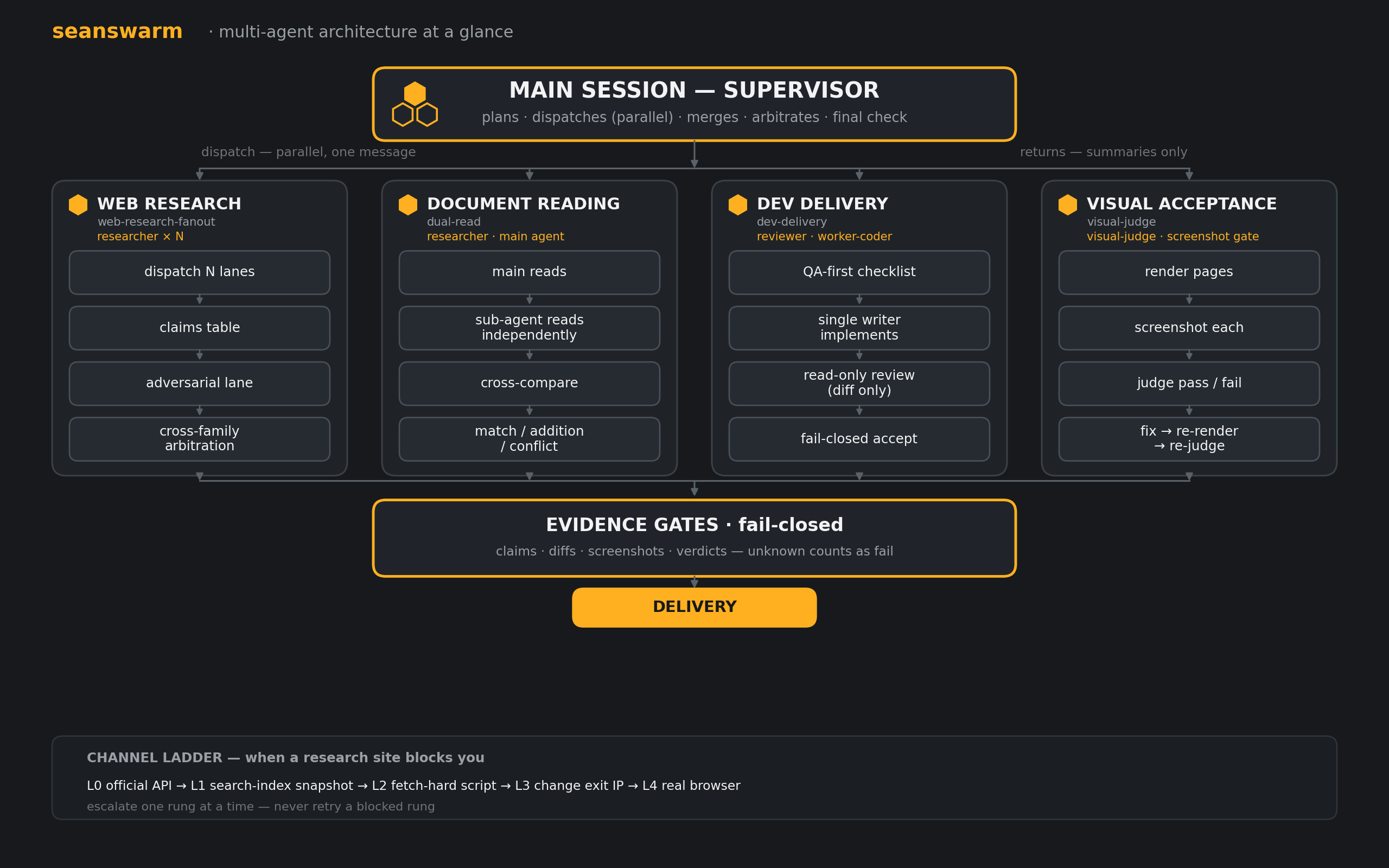
It covers four recurring scenarios:
| Scenario | Piece | Pattern |
|---|---|---|
| Web research | skills/web-research-fanout |
fan-out lanes → claims table → adversarial lane → cross-family arbitration → anti-scrape ladder (L0–L4) |
| Document reading | skills/dual-read |
two independent channels read the same document, then cross-compare (match / addition / conflict) |
| Dev delivery | skills/dev-delivery |
QA-first acceptance list → single writer → independent read-only review (diff-only) → fail-closed acceptance → fixes go back to the single writer; disjoint modules run as parallel workstreams |
| Visual acceptance | agents/visual-judge.md + hooks/ui-screenshot-gate.mjs |
render → screenshot → per-page verdict → fix → re-render; a mechanical hook bounces "done" without screenshot evidence |
| Evidence enforcement | tools/gates/ + tools/ledger/ + REPORT-CONTRACT.md |
mechanical, zero-dependency checks: claims-table lint, file-boundary check, report-contract lint; append-only dispatch ledger with three-way fault attribution |
Role templates live in agents/: researcher, reviewer, worker-coder, visual-judge.
Architecture
Design principles
- Evidence over consensus. Claims need sources; conflicts are resolved by arbitration, never by majority vote. Independent-source count > vote count; primary > secondary; newer > older.
- Role separation, not one super-agent. A zero-write reviewer, a single writer, and a dedicated adversarial lane that hunts for counter-evidence.
- Clean-context review. The reviewer receives the diff + requirements — never the conversation history.
- Fail-closed acceptance. "Unknown" counts as failed; an empty diff needs an explicit waiver.
- finder ≠ fixer. The reviewer only finds; fixes go back to the single writer; one repair round, no recursion.
- One writer per workstream. Modules whose files are disjoint run as parallel workstreams — each still goes through the full gated pipeline, and the main session owns integration.
- Verification before completion. No "done" without fresh run output.
- Judgment belongs to exit codes, not self-reports. Every workstream declares one command whose exit code decides pass/fail; a subagent reporting "tests pass" is a claim, the exit code is the evidence. Ported from watching deterministic gate runners: the model answers questions, the command renders verdicts.
- Frozen briefs, recorded knobs. A dispatch's invariant brief never changes after dispatch — gaps are handled by adding lanes, not editing briefs — and tunable parameters (budget, model, tier) are recorded in the ledger, not embedded in the prompt. Every conclusion stays traceable to the parameter set that produced it.
- Faults are attributed, not just retried.
failed-transport(host/provider layer — wait),failed-protocol(contract broken — re-dispatch once, narrower),failed-definition(the task itself was wrong — never re-dispatch; void downstream and re-specify). One flat "retry once" rule conflates three opposite situations. - Cheap gates beat clever prompts. The mechanical hook exists because prose alone is not enforcement — v0.2 extends the idea from one hook to a gate suite (see below).
Install
Manual (any host with skills support)
# skills → your skills directory
cp -r skills/* <skills-dir>/
# roles → your agents directory
cp agents/*.md <agents-dir>/
Common locations: ZCode ~/.agents/skills + ~/.zcode/agents; Claude Code ~/.claude/skills + ~/.claude/agents; Codex ~/.codex/skills. See adapters/ for per-platform notes.
Plugin (ZCode)
The repo ships a plugin manifest at .zcode-plugin/plugin.json. Add the repo as a plugin source and enable it.
Hook (optional)
hooks/ui-screenshot-gate.mjs is a Stop-event hook: when UI files were edited in a turn that produced no screenshot evidence, it sends the turn back to collect evidence. Wiring instructions in hooks/README.md.
Mechanical gates & ledger (new in v0.2)
tools/ ships the mechanical layer of the protocols — deliberately dumb (no LLM, no judgment, just bookkeeping), zero npm dependencies, Node 18+:
| Command | Gate | Fails when |
|---|---|---|
node tools/gates/claims-lint.mjs <lane-output.md> |
research claims table | a row lacks a public URL / date / primary-secondary marker / counter-evidence; a conflict never reached an arbitration section |
node tools/gates/boundary-check.mjs --boundary <patterns> --git-base <ref> |
dev-delivery file boundaries | a changed file falls outside the workstream's declared boundary |
node tools/gates/report-lint.mjs <report.md> |
the five-section report contract (REPORT-CONTRACT.md) |
a required section is missing; a "skipped" check is disguised as blocked; a Verified item carries no evidence marker |
node tools/ledger/dispatch-ledger.mjs append|mark|status |
dispatch bookkeeping | (not a gate) — append-only JSONL answering "which conclusions are not yet verified", with failed-transport / failed-protocol / failed-definition attribution |
All gates: exit 0 pass · 1 violation · 2 cannot-judge; --json for machines; --strict promotes warnings. 175 tests cover the suite (node tests/*.test.mjs).
Quick start
- Research: "Research X across official docs, GitHub, and community — fan out, then verify."
- Document: "Read this contract with a second independent pass and cross-compare."
- Dev delivery: "Implement feature Y: QA-first, single writer, independent review. Unknown counts as failed."
- Visual acceptance: "Render the deck to PNGs and run the visual judge page by page; fix fails and re-judge."
Skills trigger on these kinds of requests; you can also name them explicitly.
Design notes
Orchestration vs channels. The pack separates how work is organized (lanes, tiers, contracts, arbitration) from how data is actually fetched (APIs, search-index layer, direct fetch, browsers). Many failures people blame on "the model" are channel failures.
Why fan-out isn't cloning. N agents with the same question pick the same pages and reinforce the same error. Lanes must differ in at least one dimension: source type, language, stance, or model family.
Output shape. Every workstream reports in the same five sections — Conclusion / Findings / Verified / Not covered / Skipped — so merging becomes bookkeeping instead of prose-reading. See REPORT-CONTRACT.md; the claims-table contract every lane must return is shown in examples/claims-table-sample.md.
Cost, measured (4-lane run — the low end of the standard tier — single host): ≈0.56M tokens total, ≈5 min wall clock (parallel) + ≈1 min arbitration. Heavy tier (10–20 lanes): 1.5–4M tokens per round. Details in FIELD-NOTES.md.
Related work & differences
The surrounding ecosystem is active. None of this pack claims to be first — the value is in the combination and the field-tested playbooks.
| Project | What it is | How this pack differs |
|---|---|---|
| Socialpranker/deepdive | Research pipeline: parallel sub-agents, claims ledger, 5-role red team, fetch ladder | Closest neighbour on the research side; this pack adds cross-family arbitration + dual-channel document reading, and stays a lightweight skill pack rather than a scripted pipeline |
| obra/superpowers | Agentic skills framework & software-development methodology | Same direction on the dev side; this pack adds the visual gate + mechanical screenshot hook and ships a much smaller surface |
| Weizhena/Deep-Research-skills | Structured deep-research skill, human-in-the-loop, multi-platform | This pack's research skill adds adversarial lanes, arbitration and an anti-scrape ladder |
| mvanhorn/last30days-skill | Social-platform research skill (single-agent checkpoint architecture) | Different architecture; see its channel engineering for social platforms |
| zhjai/agent-arena | Cross-model debate / review protocol | Same "heterogeneous models" idea applied to code review; this pack applies it to research conflicts and bans majority voting explicitly |
| eforge-build/eforge | Spec-to-verified-code build system, blind adversarial review | This pack borrows the fail-closed acceptance rule and keeps it as a portable skill |
| lucasfcosta/backpressured | Skills for long unattended coding sessions (incl. Playwright visual review) | Similar visual-gate idea; this pack adds a mechanical (non-LLM) screenshot hook |
Ideas borrowed with gratitude: diff-only review input (superpowers); fail-closed acceptance (eforge); circuit breaker + dispatch ledger + model-substitution check (ai-cross); human plan gate + minority-counsel roles (deepdive); adversarial-behaviour testing (last30days).
Status & roadmap
v0.2.0. Skills ship in English (SKILL.md) with Chinese translations alongside (SKILL.zh.md); agent role templates carry bilingual descriptions. Codex/Cursor adapters are drafts pending verification.
- v0.3: machine-checkable evals (including an adversarial-lane behaviour test); cross-round claim reconciliation on top of the dispatch ledger.
License
MIT — see LICENSE.
Reviews (0)
Sign in to leave a review.
Leave a reviewNo results found