zetetic-team-subagents
Health Warn
- License — License: NOASSERTION
- Description — Repository has a description
- Active repo — Last push 0 days ago
- Low visibility — Only 5 GitHub stars
Code Pass
- Code scan — Scanned 12 files during light audit, no dangerous patterns found
Permissions Pass
- Permissions — No dangerous permissions requested
No AI report is available for this listing yet.
97 reasoning patterns from history's greatest minds — as Claude Code agents. Curie to Toulmin. Engineering to humanities. Every claim cites its source. Every commit is checked. The only agent system where "I don't know" is a feature.
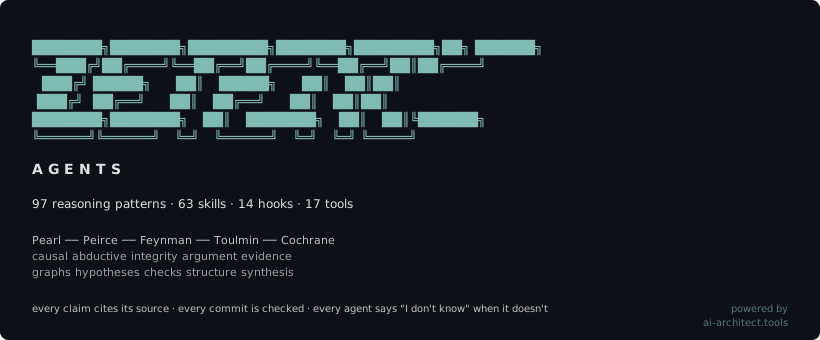




Claude Code agents whose commits are blocked when constants lack source citations.
97 genius reasoning agents (plus 19 team-role agents = 116 total) each citing their primary paper and documenting their refusal conditions, paired with a pre-commit hook that blocks any floating-point constant with 3+ significant digits that lacks asource:annotation.
Not a prompt library. A methodology with commit-time enforcement.
The system enforcing its own standard
$ git commit -m "tune retry backoff"

UNSOURCED   (error)    retry.py:1: # It always works
MAGIC_NUMBER (error)    retry.py:2: DELAY = 2.741592

Profile: strict  (staged mode)
Errors:   2  (blocking)
Warnings: 0  (informational — promoted to errors when profile=strict)
FAILED: 2 blocking violation(s).

BLOCKED: Zetetic violations in staged files.
Composite output: lines 1–2 are verbatim from tools/zetetic-checker.sh --staged; the closing BLOCKED: line is the wrapper from hooks/pre-commit-zetetic.sh that returns exit 2 to git. Reproduce on your machine: echo "DELAY = 2.741592" > /tmp/x.py && cd /tmp && git init -q && git add x.py && ZETETIC_PROFILE=strict bash <repo>/tools/zetetic-checker.sh --staged.
The commit re-runs once each flagged line carries a # source: comment, a benchmark reference, or a measured-on note.
Why this exists
Every AI agent system ships a role prompt. "You are a senior engineer." The agent sounds confident. It invents numbers, cites papers it hasn't read, and ships code with conviction inversely proportional to its correctness.
Zetetic Agents are different in one specific way: they can say "I don't know."
97 reasoning patterns drawn from primary sources — Dijkstra's correctness discipline, Curie's residual-with-a-carrier method, Hamilton's fault-tolerance protocol, Cochrane's evidence synthesis — routed automatically to your problem by shape, not by field. Every output is sourced. Every commit is checked. The standard is not a prompt. It is a gate.
What you type → what happens
/paper-vs-code-audit arxiv:2401.12345 ./src/
→ Extracts every claim → finds corresponding code → flags mismatches → traceability matrix

/autoresearch-loop "optimize beam search for abstention"
→ Hypothesis → implement → commit → benchmark → keep/revert → iterate until diminishing returns

/deep-research "transformer attention alternatives 2024-2026"
→ Plans search → parallel researchers → synthesizes → verifies citations → writes cited brief + provenance sidecar

/incident-investigation
→ Forensic timeline → three-timescale decomposition → common vs special cause → structural root cause → remediation

/genius route "p99 latency exceeds the sum of profiled components"
→ Routes to the reasoning procedure that fits the problem shape
These aren't prompts dressed up as commands. Each is a multi-step pipeline that names the procedure used, surfaces blind spots in its output, and refuses to ship if a step fails. See docs/EXAMPLES.md for full session transcripts.
Install
claude plugin marketplace add cdeust/zetetic-team-subagents
claude plugin install zetetic-team-subagents
That's the whole install. The plugin's installer copies agents, skills, hooks, and tools into ~/.claude/. Manual install + advanced config: docs/INSTALL.md.
What you actually get
| Capability | What it gives you (concretely) |
|---|---|
| 97 documented refusals | Each genius agent's body documents conditions under which it refuses (when to stop, what to cite, when to hand off). Refusal conditions are intent statements, not enforced contracts. |
| 63 multi-step workflows | Type one slash command, get a sourced research brief / debugging trace / ADR. Each agent in the chain produces output and declares what it could not verify. |
| Commit-time gates | pre-commit-zetetic.sh blocks commits with UNSOURCED keywords (always/never/obviously) at any profile. MAGIC_NUMBER floats (3+ decimals without source:) and TODO_NO_REF warn at default profile, block under ZETETIC_PROFILE=strict. Active only when git commit is invoked through Claude Code's hook system. |
| 650+ problem-shape triggers | agents/genius/INDEX.md maps natural-language problem descriptions to reasoning methods. |
Reasoning procedures, not personas
Most AI agent libraries ship "pretend to be Einstein." This ships Einstein's method — gedankenexperiment, operational definitions, equivalence-principle reasoning — with the citations, the canonical moves, the documented blind spots, and the conditions under which the agent must refuse.
A small sample, by problem shape:
| Domain | Agents | Example trigger |
|---|---|---|
| Measurement & Signal | Curie, Ekman, Wu | "the measurement exceeds what known parts predict" |
| Causal & Abductive | Pearl, Peirce, Snow/Hill | "does X cause Y, or is it confounded?" |
| Formal & Correctness | Dijkstra, Lamport, Pāṇini, Gödel, Turing | "can we prove this correct?" |
| Failure & Resilience | Hamilton, Taleb, Carnot, Boyd | "what happens when everything goes wrong?" |
| Decision & Bias | Kahneman, Schön, Roger Fisher, Simon | "is this decision driven by bias?" |
| Ethics & Justice | Rawls, Arendt, Le Guin, Ostrom | "who benefits and who bears the cost?" |
Full routing table — 400+ triggers, pairings, composition chains — in agents/genius/INDEX.md.
Compose chains — multi-agent pipelines
The most powerful skills chain reasoning procedures in sequence:
/performance-investigation     fermi → curie → knuth
  Bracket expected → measure actual → profile hot 3%

/incident-investigation        ginzburg → braudel → deming → peirce → hamilton
  Forensic trace → three timescales → common/special cause → root cause → remediation

/anomaly-to-explanation        mcclintock → curie → shannon
  Notice → isolate the carrier → formalize

/deep-research                 peirce → cochrane → feynman → toulmin
  Hypothesize → synthesize evidence → integrity check → structure argument

/autoresearch-loop             peirce → fisher → curie → laplace → schön
  Hypothesize → design experiment → measure → compare → detect diminishing returns
Each chain is a procedure. Each step is sourced. Each output declares what it was unable to verify.
The Zetetic Standard
Every agent, skill, and hook inherits the same epistemic gates. Not optional.
| Pillar | Question |
|---|---|
| Logical | Is it consistent? |
| Critical | Is it true? |
| Rational | Is it useful? |
| Essential | Is it necessary? |
The rules:
- No source → say "I don't know" and stop
- Single source = hypothesis. Cross-reference required
- Read the actual paper, not the blog post
- No invented constants. Cite the equation or the data
- Benchmark every change. No regressions accepted
- "I don't know" preserves trust. Confident wrong answers destroy it
- Actively seek disconfirming evidence
Zetetic (adj.): proceeding by inquiry; admitting nothing without proof.
What this system does not do
The same standard applied to itself. Honest limits:
- Citation presence ≠ citation validity.
// source: Knuth 1998satisfies the checker whether or not Knuth 1998 exists or supports the constant. The hook enforces that a citation IS THERE, not that it's true. - Hooks fire only inside Claude Code's invocation path. Direct terminal commits, CI scripts, and other editors bypass the gates. A developer who works outside Claude Code is unaffected.
- Refusal conditions are intent, not contract. Each genius agent documents conditions under which it should refuse — these are prompt-level guidance, not runtime guarantees. An agent can name a blind spot in its own description and exhibit it anyway.
- The checker has a narrow scope. It flags absolute-claim keywords in comments, floats with 3+ decimals lacking
source:annotations, and TODOs without issue references. It does not check code correctness, architectural soundness, or whether the reasoning in agent output is logically valid. - Integer constants are not flagged by design.
batch_size=128,timeout=30,max_retries=3pass unchecked — too many false positives. Only floating-point constants with 3+ significant digits are gated.
These are documented because the gates are real, the limits are real, and overclaiming either undermines the standard the agents are supposed to enforce.
Memory that survives sessions
Ships a local replica of Anthropic's memory_20250818 tool with scope-based ACL: agents persist decisions, lessons, and project context to /memories/<scope>/<file> and recall them on every spawn. 241 tests passing across functional, ACL, concurrency, stale-lock, MCP, and PII suites.
A pre-tool-secret-shield hook blocks any agent from reading .env, .aws/credentials, *.pem, *.key, or shell-history files — credentials the agent can never need to read. Full architecture: docs/MEMORY-MCP.md, contract: memory/contract.md.
A visible, enforced context budget
Every agent here follows a per-model token-budget protocol (agents/orchestrator.md → <token-budget>): checkpoint at ~180K tokens (Opus 4.8 / Sonnet 4.6) or ~120K (Haiku 4.5), with a 200K session soft cap. Left to prose, that protocol is easy to ignore. This plugin ships it as a status line you can see and a hook that enforces it — both from the companion session-optimizer repo (MIT).
statusline-command.sh— a persistent two-line status bar. The context progress bar, percentage, and token count are colored green → yellow → red on the exact per-model threshold above, with a⚠ save+recallmarker once you cross 200K. It also shows model, effort, git branch + dirty flag, worktree, PR badge, session cost, duration, and 5h/7d rate-limit usage — so the cost of not checkpointing is always on screen.hooks/stop-context-guard.py(included here, registered as aStophook) — reads the live token usage from the transcript and acts when you cross the line: at the checkpoint threshold it captures mechanical state (branch, last commit, modified files) for free, with no model tokens spent; at the 200K soft cap it blocks the stop exactly once and injects the checkpoint procedure, so the agent persists a scopedmemory-tool.shcheckpoint and tells you to/clearand resume viacortex:recall. Loop-safe and non-fatal by construction.
Together they close the four failure modes of a long session — context poisoning (stale accumulation stops growing), session poisoning (a clean reset boundary is forced), quota poisoning (the 5h/7d budget isn't burned on oversized turns), and runaway cost (the largest-context turns are the most expensive). Install both from session-optimizer; the Stop hook is wired into this plugin's hooks/hooks.json out of the box.
Adopt in an existing project (gradual)
If your codebase has historical magic numbers and orphan TODOs, running --staged on every commit would be painful. The plugin supports a transition profile:
# .zetetic.conf at repo root
ZETETIC_PROFILE=permissive    # everything informational; never blocks
                              # → graduate to standard → strict over weeks
Full migration path: docs/MIGRATION.md.
Companion projects
| Project | Role |
|---|---|
| Cortex | Local persistent memory + cognitive profiling — pre-loads your reasoning patterns at session start |
| automatised-pipeline | Codebase-intelligence MCP — agents query a property graph instead of grep -r |
| prd-spec-generator | TypeScript MCP that turns a feature description into a 9-file PRD with multi-judge verification using these agents |
| session-optimizer | Context-budget status line + Stop guard hook — makes the per-model checkpoint protocol visible and self-enforcing |
Documentation
docs/EXAMPLES.md— real session transcripts (bug caught, refusal fired, ADR generated)docs/COMPARE.md— vs vanilla Claude Code, Aider, Cline, Continue, Cursor agentsdocs/INSTALL.md— manual install, advanced config, model overridesdocs/MIGRATION.md— adopting in an existing non-compliant projectdocs/MEMORY-MCP.md— memory tool architecture + MCP serverdocs/AGENT-INTERNALS.md— agent file shape, frontmatter, routingagents/genius/INDEX.md— 400+ problem shapes → agent routing tablerules/coding-standards.md— the engineering standard agents enforce
License
MIT — see LICENSE.
Built by cdeust. All 116 agent files pass the structural auditor. The system enforces source-citation discipline on the constants in its own commits.
Reviews (0)
Sign in to leave a review.
Leave a reviewNo results found