deepseek-harness-anatomy
Health Warn
- License — License: MIT
- Description — Repository has a description
- Active repo — Last push 0 days ago
- Low visibility — Only 8 GitHub stars
Code Pass
- Code scan — Scanned 12 files during light audit, no dangerous patterns found
Permissions Pass
- Permissions — No dangerous permissions requested
No AI report is available for this listing yet.
A progressive source-study tutorial of DeepSeek Harness (dsh): 17 chapters from a minimal agent-loop to multi-agent delegation, compaction, permissions and cross-process RPC, with runnable teaching code. Zh/En.
DeepSeek Harness (dsh) Source-Study Tutorial
18 chapters. One mechanism at a time. Every chapter runnable. Deconstruct the DeepSeek Harness engineering skeleton — from the minimal agent loop "one message in, one reply out" all the way to multi-agent delegation, context compaction, human collaboration, and cross-process RPC, closing with a cross-cutting telemetry channel chapter.
A progressive set of source-study documents: across 18 chapters, dsh is built up from the minimal closed loop of "how one message becomes one reply", chapter by chapter, into the complete end-to-end form of "multi-agent delegation + context compaction + human collaboration + cross-process RPC", then closed on the observation plane with "the telemetry channel".
Version anchor: all citations and line numbers in this book are based on upstream deepseek-harness HEAD
8bd0733(dsh-v0.2.2-alpha.3, 2026-11-03).
Quick Start (3 minutes)
git clone https://github.com/ChenYu1991ppak/deepseek-harness-anatomy.git
cd deepseek-harness-anatomy
python3 ch02/code/main.py
No dependencies, no API keys — Python 3 standard library only. You'll see one full turn of "a question in, a reply out":
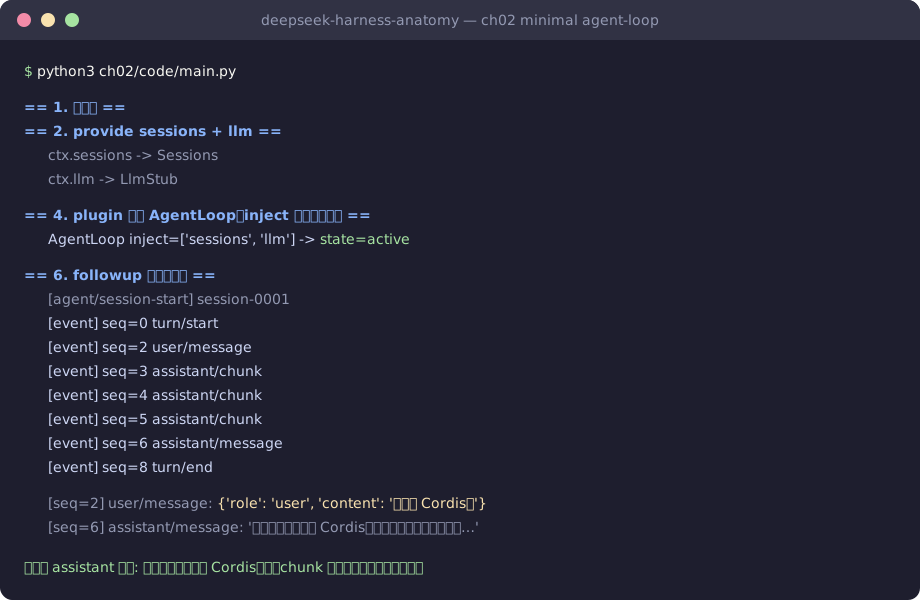
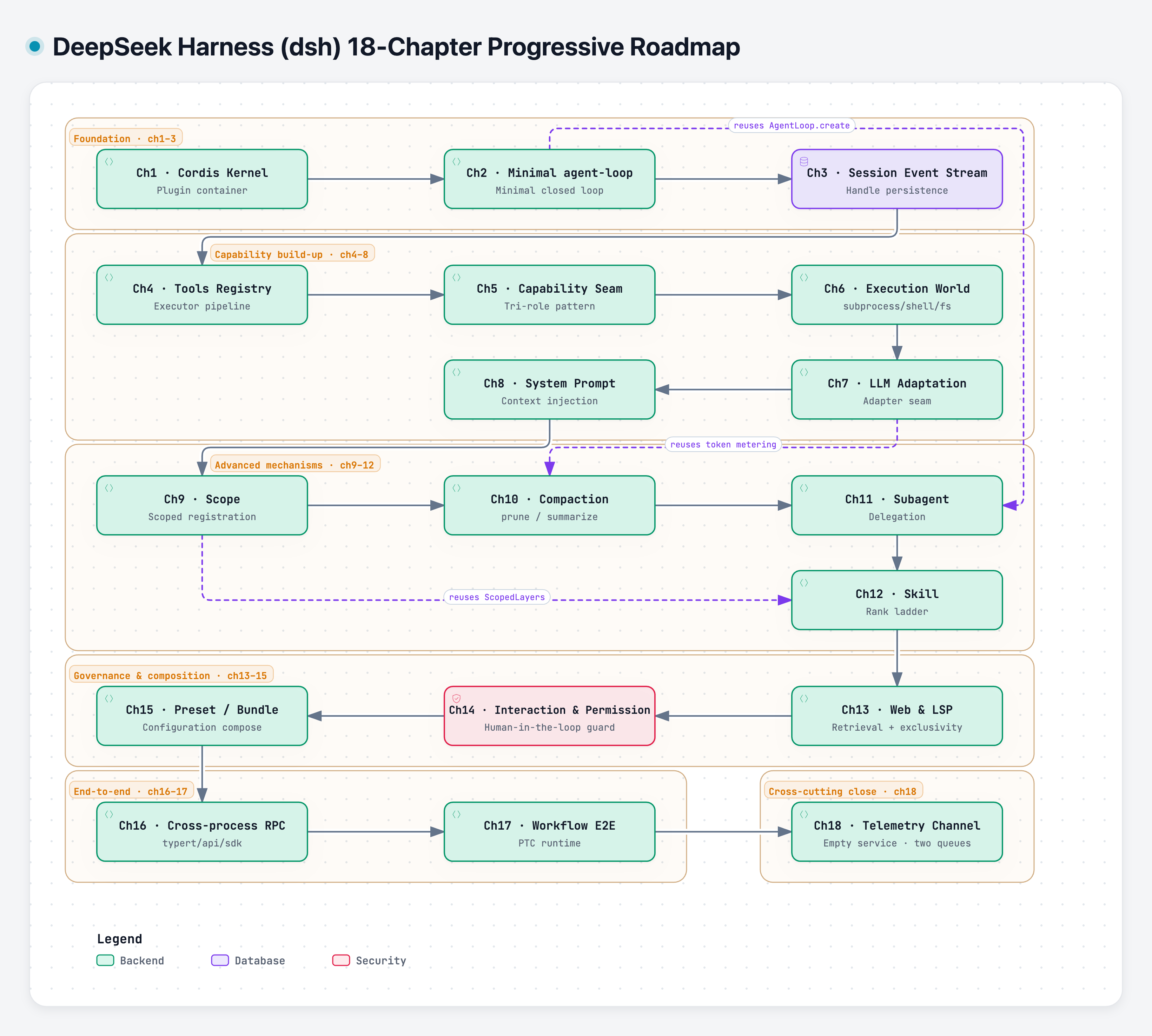
Then open Chapter 2 and thicken the loop chapter by chapter along the roadmap:
Who Should Read This
- You're building your own agent framework and want to reference DeepSeek's design decisions — the seam triple-role, event-stream persistence, and Cordis plugin container are explained mechanism by mechanism
- You read the dsh source but couldn't get a grip — this tutorial provides an 18-chapter progressive map with
file:linesource references - You're a Python developer who doesn't want to read TypeScript source — every chapter has runnable Python teaching code (standard library only)
- You teach or write about agent architecture — each chapter is a self-contained module with runnable demos, ready to be cited or adapted
What This Tutorial Is
DeepSeek Harness (command dsh) is an agent harness open-sourced by DeepSeek AI — the entire engineering skeleton outside the model: session logging, tool execution, context compaction, subagent delegation, permission guards, persistence... Its core philosophy is "everything is a plugin", driven underneath by the vendored Cordis framework.
Reading source code of this scale head-on is hard to get a grip on, so this tutorial breaks it down into a set of progressive chapters:
- 18 strictly progressive chapters: each chapter adds exactly one mechanism on top of the previous one; each chapter ends with a preview of the next, and cross-chapter dependencies are explicitly marked "see Chapter X";
- Each chapter comes with runnable Python teaching code:
chNN/code/is self-contained and uses only the standard library; runpython3 chNN/code/main.pydirectly — reproduce the output first, then read the mechanism breakdown; - Mechanism-level narrative rather than API-usage level: it explains "why it is designed this way"; every teaching simplification is marked
[teaching simplification]; each chapter ends with afile:linemapping table to the real source.
The entire tutorial was produced by the Source Decomposition Expert Team (a multi-role AI collaboration framework): the architect builds the map, the explorer reads the source chapter by chapter to produce material, the writer writes, and the reviewer nitpicks and revises chapter by chapter.
What You Get from Reading This Tutorial
- A complete mental model of the agent harness: starting from the minimal closed loop of "how one message becomes one reply", thickening chapter by chapter into the end-to-end full picture of multi-agent delegation, context compaction, human collaboration, and cross-process RPC;
- The "why" behind design decisions: mechanism-level narrative — why "everything is a plugin", why the seam splits into three roles, why persistence is done via an event stream; see the design thinking of a first-class framework, not just a feature list;
- Landing points from concept to implementation: each mechanism comes with runnable teaching code (reproduce the output first, then read the breakdown) and a chapter-end
file:linesource mapping table; you can always go back and verify against the real source; - A unified concept vocabulary: the terminology naming table and each chapter's quick-reference table align the naming of concepts like seam, scope, and compaction, so afterwards — reading source, looking things up, or discussing with others — you no longer get stuck on terms.
What Else It's Useful for Beyond Reading
- Use it directly as a template: each chapter's teaching code is a self-contained, standard-library-only minimal agent framework — from the minimal closed loop of
ch02to the end-to-end form ofch17, take it and turn it into your own toy agent or internal tool skeleton, no need to build from scratch; - Design reference for building your own harness: patterns like the seam triple-role (definition/implementation/consumption), event stream + persistence projection, scope, and the guard pipeline can all be borrowed directly into your own project;
- Concept quick-reference manual: the terminology naming table in ch00/outline_en.md + each chapter's appendix quick-reference table + the chapter-end source mapping tables can serve as a dictionary of agent-domain concepts, ready to look up anytime.
dsh Overview
In one sentence: agent = model + harness. The model only produces "the next step"; the harness handles orchestration and side effects such as session logging, tool execution, scoping, persistence, and guards; a running dsh is a Cordis plugin tree assembled layer by layer at startup — the model adapter, the tool registry, the session log, and the agent loop itself are all plugins, all replaceable via configuration.
The most macroscopic layered view:
flowchart TB
  ENTRY["Entry layer · CLI / Web UI / SDK"]
  COMPOSE["Composition layer · bundle / preset / boot (assemble the plugin tree per configuration)"]
  CORE["Core skeleton · session event log / agent-loop / tools registry & executor / system-prompt / scope"]
  SEAMS["Capability seams · llm / subprocess / shell / fs / sandbox / subagent / skill / compaction … (swap the provider, swap the behavior)"]
  KERNEL["Cordis kernel · ctx / inject / effect / emit (everything is a plugin, no privileged kernel)"]
  ENTRY --> COMPOSE --> CORE --> SEAMS --> KERNEL
Four core design philosophies run through the entire tutorial: everything is a plugin, no privileged kernel; agent = model + harness; registration is effect (installation is reversible and rollback-able); the seam triple-role (swap one provider, swap the entire behavior).
Chapter Navigation
| Chapter | Topic | Key Concepts |
|---|---|---|
| 0 | Progressive outline of the whole book | Terminology naming table |
| 1 | The Cordis container kernel | Everything is a plugin |
| 2 | The minimal agent-loop closed loop | One message in, one reply out |
| 3 | Session event stream & handle persistence | Event stream, handle contract, format migration v0→v4 |
| 4 | The tools registry & executor pipeline | tools registration, executor seam, guard execution |
| 5 | The capability seam | Definition/implementation/consumption triple-role |
| 6 | The execution world | subprocess / shell / fs / sandbox / SSH remote |
| 7 | LLM adaptation | Adapter seam, streaming output |
| 8 | system-prompt and context | Prompt assembly, context injection |
| 9 | scope scoped registration | Minting/lineage/shadowing/dispatch |
| 10 | Context compaction | compaction, token pressure |
| 11 | subagent delegation | Multiple transport providers |
| 12 | skill loading | Rank ladder, layered shadowing |
| 13 | web / lsp and exclusive capabilities | Web retrieval, lsp code semantics, single-slot exclusive registry |
| 14 | Interaction and governance | interaction / permission / goal / plan |
| 15 | Configuration composition | preset / bundle / profile, revision binding |
| 16 | Cross-process RPC | typert / api / sdk |
| 17 | Workflow and end-to-end | workflow / PTC runtime, python end-to-end chain |
| 18 | The telemetry channel | Empty-definition seam, two queues, channel ownership |
Chapters 1–2 were split from the original s01 (which carried both the "container kernel" and the "agent-loop closed loop" mechanism clusters); Chapters 3–17 correspond to old Chapters 2–16, with chapter numbers shifted by one overall; the old drafts have been cleaned up and rewritten chapter by chapter following ch00/outline_en.md; Chapter 18 was added in the 2026-11 update against upstream v0.2.2-alpha.3.
Recommended Reading Order
- Read the map first: ch00/outline_en.md shows the progressive arc of the 18 chapters and the terminology naming table — build the global mental model.
- Read chapter by chapter in order:
ch01→ch18, strictly progressive — each chapter opens by picking up the mechanism added in the previous chapter and closes with a preview of the next; cross-chapter dependencies are marked "see Chapter X". Skipping chapters is not recommended (ch18 is the cross-cutting close: observing the system ch17 got running). - Read and run: each chapter's teaching code lives in
chNN/code/(ch02–ch18enter viamain.py;ch01viahello.py), andpython3 chNN/code/main.pyruns directly; first reproduce the chapter-end "full run output", then read the mechanism breakdown.
Companion Files
| File | Purpose |
|---|---|
ch00/ |
The outline directory: outline_en.md is the progressive outline of the 18 chapters (topic / new mechanisms / source modules / prerequisite chapters) + the terminology naming table; outline_zh.md is the corresponding Chinese version |
ch01/ … ch18/ |
One directory per chapter: chNN-*_en.md is the chapter's final body text (epigraph / questions this chapter answers / body / full run output / source mapping / summary & preview / appendix quick-reference table), chNN-*_zh.md is the corresponding Chinese version, and code/ is the chapter's runnable Python teaching code (accumulated incrementally per chapter) |
Architecture Comparison
How dsh compares to other agent frameworks
| Dimension | DeepSeek Harness (dsh) | LangChain | CrewAI | AutoGen |
|---|---|---|---|---|
| Philosophy | Everything is a plugin | Chain composition | Role-based agents | Multi-agent conversation |
| Core container | Cordis (plugin kernel) | No kernel | No kernel | No kernel |
| Seam/replaceability | Triple-role (def/provider/consumer) | Components | Limited | Limited |
| Agent loop | Built-in react loop | Custom chains | Built-in | Built-in |
| Context compaction | Built-in (threshold-triggered) | External | External | External |
| Session persistence | Append-only event log + projections | Manual | Limited | Limited |
| Token metering | Real provider-returned usage | Estimates | Estimates | Estimates |
| Plugin isolation | Scoped layers (per-agent) | No | No | No |
| Cross-process RPC | Built-in (SDK / ACP) | No | No | No |
| Learning curve | Steep (full-featured) | High (many abstractions) | Medium | Medium |
| Best for | Production agent systems | Rapid prototyping | Role-based tasks | Research experiments |
Why this tutorial focuses on dsh
dsh is unique among agent frameworks in that it has a real plugin kernel (Cordis) rather than a library of components. This means every capability — model calls, tool execution, session logging, compaction — is a plugin that can be swapped, composed, and scoped. Understanding this architecture gives you a mental model that applies beyond dsh: it's the same pattern used by VS Code, Kubernetes controllers, and webpack.
This tutorial is the only resource that deconstructs dsh mechanism by mechanism, from the minimal agent loop to the full end-to-end system. The companion pydsh project provides a runnable Python implementation of the same architecture.
Reviews (0)
Sign in to leave a review.
Leave a reviewNo results found