paul
Health Pass
- License — License: MIT
- Description — Repository has a description
- Active repo — Last push 6 days ago
- Community trust — 581 GitHub stars
Code Fail
- os.homedir — User home directory access in bin/install.js
- process.env — Environment variable access in bin/install.js
- fs module — File system access in bin/install.js
Permissions Pass
- Permissions — No dangerous permissions requested
No AI report is available for this listing yet.
Plan-Apply-Unify Loop — Structured AI-assisted development for Claude Code. Quality over speed-for-speed's-sake.
PAUL
Plan-Apply-Unify Loop — Structured AI-assisted development for Claude Code.



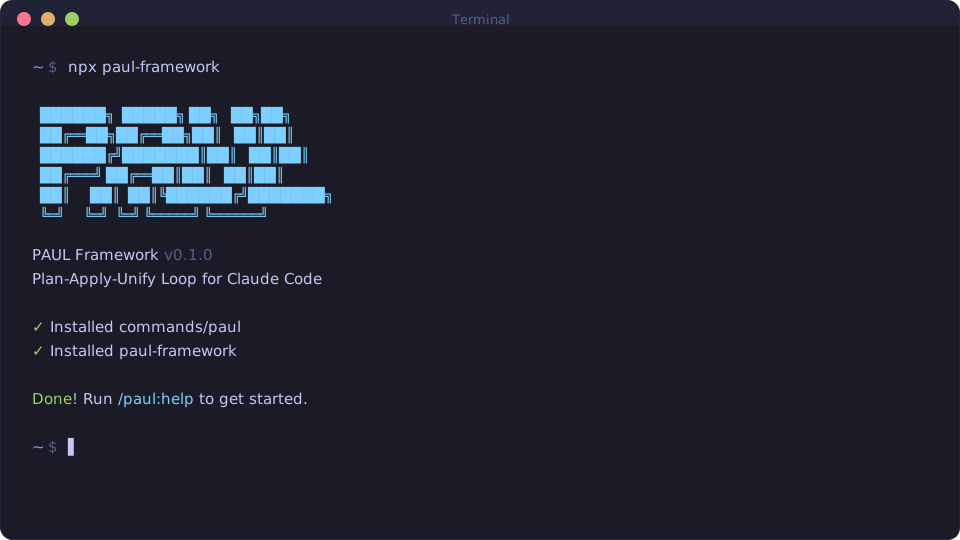
npx paul-framework
Works on Mac, Windows, and Linux.
"Quality over speed-for-speed's-sake. In-session context over subagent sprawl."
Why PAUL · Getting Started · The Loop · Commands · How It Works
Why PAUL
I build with Claude Code every day. It's incredibly powerful — when you give it the right context.
The problem? Context rot. As your session fills up, quality degrades. Subagents spawn with fresh context but return ~70% quality work that needs cleanup. Plans get created but never closed. State drifts. You end up debugging AI output instead of shipping features.
PAUL fixes this with three principles:
Loop integrity — Every plan closes with UNIFY. No orphan plans. UNIFY reconciles what was planned vs what happened, updates state, logs decisions. This is the heartbeat.
In-session context — Subagents are expensive and produce lower quality for implementation work. PAUL keeps development in-session with properly managed context. Subagents are reserved for discovery and research — their job IS to gather context.
Acceptance-driven development — Acceptance criteria are first-class citizens, not afterthoughts. Define done before starting. Every task references its AC. BDD format:
Given [precondition] / When [action] / Then [outcome].
The complexity is in the system, not your workflow. Behind the scenes: structured state management, XML task formatting, loop enforcement. What you see: a few commands that keep you on track.
Who This Is For
Builders who use AI to ship — software, campaigns, workflows, automations, anything that benefits from structured execution.
PAUL isn't just for code. It manages marketing campaigns, funnel builds, email sequences, and automation workflows with the same rigor it brings to software development.
You describe what you want, Claude Code builds it, and PAUL ensures:
- Init gathers real requirements — type-adapted walkthrough produces a populated project brief, not empty placeholders
- Plans have clear acceptance criteria
- Every task is qualified against the spec — not just executed and assumed correct
- Execution stays bounded with explicit scope control
- Every unit of work gets closed properly
- State persists across sessions
- Decisions are logged for future reference
No sprint ceremonies. No story points. No enterprise theater. Just a system that keeps AI-assisted development reliable.
Getting Started
npx paul-framework
The installer prompts you to choose:
- Location — Global (all projects) or local (current project only)
Verify with /paul:help inside Claude Code.
Quick Workflow
# 1. Initialize PAUL in your project
#    Walks through type-adapted requirements (app, campaign, workflow)
#    Produces a populated PROJECT.md — not empty placeholders
/paul:init

# 2. Create a plan for your work
#    Auto-detects scope: quick-fix, standard, or complex
#    Validates coherence against project context before approval
/paul:plan

# 3. Execute the approved plan
#    Each task goes through Execute/Qualify loop
#    Escalation statuses: DONE, DONE_WITH_CONCERNS, NEEDS_CONTEXT, BLOCKED
/paul:apply

# 4. Close the loop (required!)
/paul:unify

# 5. Check progress anytime
/paul:progress
Staying Updated
npx paul-framework@latest
npx paul-framework --global   # Install to ~/.claude/
npx paul-framework --local    # Install to ./.claude/
The Loop
Every unit of work follows this cycle:
┌─────────────────────────────────────┐
│  PLAN ──▶ APPLY ──▶ UNIFY          │
│                                     │
│  Define    Execute    Reconcile     │
│  work      tasks      & close       │
└─────────────────────────────────────┘
PLAN
Create an executable plan with scope-adaptive ceremony:
- Quick-fix (1 file, 1 change) — Compressed: objective + 1 task + 1 AC. Full loop, minimal ceremony.
- Standard (2-5 tasks) — Full plan with boundaries, multiple ACs, verification checklist.
- Complex (6+ tasks) — Full plan + actively recommends splitting.
All plans include:
- Objective — What you're building and why
- Acceptance Criteria — Given/When/Then definitions of done
- Tasks — Specific actions with files, verification, done criteria
- Boundaries — What NOT to change (standard/complex only)
- Coherence validation — Auto-checked against project context before approval
APPLY
Execute the approved plan with built-in quality enforcement:
- Tasks follow an Execute/Qualify loop — after execution, each task is independently verified against the spec and linked acceptance criteria before moving on
- Escalation statuses give nuance beyond pass/fail: DONE, DONE_WITH_CONCERNS, NEEDS_CONTEXT, BLOCKED
- Checkpoints pause for human input when needed — with diagnostic failure routing that classifies issues as intent, spec, or code before attempting fixes
- Anti-rationalization enforcement prevents false completion claims
UNIFY
Close the loop (required!):
- Create SUMMARY.md documenting what was built
- Compare plan vs actual
- Record decisions and deferred issues
- Update STATE.md
Never skip UNIFY. Every plan needs closure. This is what separates structured development from chaos.
Commands
PAUL provides 26 commands organized by purpose. Run /paul:help for the complete reference.
Core Loop
| Command | What it does |
|---|---|
/paul:init |
Initialize PAUL with type-adapted requirements walkthrough |
/paul:plan [phase] |
Create an executable plan (auto-routes quick-fix/standard/complex) |
/paul:apply [path] |
Execute an approved plan |
/paul:unify [path] |
Reconcile and close the loop |
/paul:help |
Show command reference |
/paul:status |
Show loop position (deprecated — use progress) |
Session
| Command | What it does |
|---|---|
/paul:pause [reason] |
Create handoff for session break |
/paul:resume [path] |
Restore context and continue |
/paul:progress [context] |
Smart status + ONE next action |
/paul:handoff [context] |
Generate comprehensive handoff |
Roadmap
| Command | What it does |
|---|---|
/paul:add-phase <desc> |
Append phase to roadmap |
/paul:remove-phase <N> |
Remove future phase |
Milestone
| Command | What it does |
|---|---|
/paul:milestone <name> |
Create new milestone |
/paul:complete-milestone |
Archive and tag milestone |
/paul:discuss-milestone |
Articulate vision before starting |
Pre-Planning
| Command | What it does |
|---|---|
/paul:discuss <phase> |
Capture decisions before planning |
/paul:assumptions <phase> |
See Claude's intended approach |
/paul:discover <topic> |
Explore options before planning |
/paul:consider-issues |
Triage deferred issues |
Research
| Command | What it does |
|---|---|
/paul:research <topic> |
Deploy research agents |
/paul:research-phase <N> |
Research unknowns for a phase |
Specialized
| Command | What it does |
|---|---|
/paul:flows |
Configure skill requirements |
/paul:config |
View/modify PAUL settings |
/paul:map-codebase |
Generate codebase overview |
Quality
| Command | What it does |
|---|---|
/paul:verify |
Guide manual acceptance testing |
/paul:plan-fix |
Plan fixes for UAT issues |
How It Works
Project Structure
.paul/
├── PROJECT.md           # Project context and requirements
├── ROADMAP.md           # Phase breakdown and milestones
├── STATE.md             # Loop position and session state
├── config.md            # Optional integrations
├── SPECIAL-FLOWS.md     # Optional skill requirements
└── phases/
    ├── 01-foundation/
    │   ├── 01-01-PLAN.md
    │   └── 01-01-SUMMARY.md
    └── 02-features/
        ├── 02-01-PLAN.md
        └── 02-01-SUMMARY.md
State Management
STATE.md tracks:
- Current phase and plan
- Loop position (PLAN/APPLY/UNIFY markers)
- Session continuity (where you stopped, what's next)
- Accumulated decisions
- Blockers and deferred issues
When you resume work, /paul:resume reads STATE.md and suggests exactly ONE next action. No decision fatigue.
PLAN.md Structure
---
phase: 01-foundation
plan: 01
type: execute
autonomous: true
---

<objective>
Goal, Purpose, Output
</objective>

<context>
@-references to relevant files
</context>

<acceptance_criteria>
## AC-1: Feature Works
Given [precondition]
When [action]
Then [outcome]
</acceptance_criteria>

<tasks>
<task type="auto">
  <name>Create login endpoint</name>
  <files>src/api/auth/login.ts</files>
  <action>Implementation details...</action>
  <verify>curl command returns 200</verify>
  <done>AC-1 satisfied</done>
</task>
</tasks>

<boundaries>
## DO NOT CHANGE
- database/migrations/*
- src/lib/auth.ts
</boundaries>
Every task has: files, action, verify, done. If you can't specify all four, the task is too vague.
CARL Integration
PAUL has a companion: CARL (Context Augmentation & Reinforcement Layer).
CARL is a dynamic rule injection system. Instead of bloating your context with static prompts, CARL loads rules just-in-time based on what you're doing:
| Trigger | Rules Loaded |
|---|---|
Working in .paul/ directory |
PAUL domain activates |
| Writing code | DEVELOPMENT rules load |
| Managing projects | PROJECTS rules load |
PAUL-specific rules CARL enforces:
- Loop enforcement (PLAN → APPLY → UNIFY — no shortcuts)
- Boundary protection (DO NOT CHANGE sections are real)
- State consistency checks at phase transitions
- Verification requirements for every task
- Skill blocking (required skills must load before APPLY)
The PAUL domain contains 14 rules that govern structured AI development. They load when you're in a PAUL project, disappear when you're not. Your context stays lean.
Without CARL: You'd need massive static prompts in every session.
With CARL: Rules activate when relevant, disappear when not.
Quality Enforcement
PAUL doesn't just plan and execute — it verifies. These systems work together to catch problems early, before they compound.
Execute/Qualify Loop
Every task in the APPLY phase goes through an E/Q loop:
Execute → Report Status → Qualify Against Spec → (fix gaps) → Next Task
The Qualify step independently re-reads what was actually produced and compares it against the task spec and acceptance criteria. This catches drift, missing requirements, and false completions that would otherwise pass unnoticed until UNIFY — when it's too late.
Escalation Statuses
Tasks report one of four statuses instead of binary pass/fail:
| Status | Meaning |
|---|---|
| DONE | Completed, no concerns |
| DONE_WITH_CONCERNS | Completed, but flagged doubts for review |
| NEEDS_CONTEXT | Can't complete — missing information |
| BLOCKED | Can't complete — structural impediment |
This surfaces uncertainty honestly instead of silently swallowing it.
Diagnostic Failure Routing
When a checkpoint fails or UAT finds issues, PAUL classifies the root cause before attempting any fix:
- Intent issue — Need to build something different → re-plan the phase
- Spec issue — Plan was missing/wrong → fix the spec before patching code
- Code issue — Plan was right, code doesn't match → standard fix-in-place
This prevents the common failure mode of patching code when the plan itself was wrong.
Coherence Check
Before presenting any plan for approval, PAUL automatically validates it against:
- PROJECT.md constraints
- Accumulated decisions in STATE.md
- Files modified in recent plans
- ROADMAP.md phase scope
Issues get flagged before approval. Clean plans pass silently with zero friction.
Philosophy
Acceptance-Driven Development (A.D.D.)
Acceptance criteria aren't afterthoughts — they're the foundation:
- AC defined before tasks — Know what "done" means
- Tasks reference AC — Every task links to AC-1, AC-2, etc.
- Verification required — Every task needs a verify step
- BDD format — Given/When/Then for testability
In-Session Context
Why PAUL minimizes subagents for development work:
| Issue | Impact |
|---|---|
| Launch cost | 2,000-3,000 tokens to spawn |
| Context gathering | Starts fresh, researches from scratch |
| Resynthesis | Results must be integrated back |
| Quality gap | ~70% compared to in-session work |
| Rework | Subagent output often needs cleanup |
When PAUL does use subagents:
- Discovery/exploration — Codebase mapping, parallel exploration
- Research — Web searches, documentation gathering
For implementation, PAUL keeps everything in-session with proper context management.
Loop Integrity
The loop isn't optional:
PLAN ──▶ APPLY ──▶ UNIFY
  ✓        ✓        ✓     [Loop complete]
- No orphan plans — Every PLAN gets a SUMMARY
- State reconciliation — UNIFY catches drift
- Decision logging — Choices are recorded for future sessions
Configuration
Optional Integrations
PAUL supports modular integrations configured in .paul/config.md:
| Integration | Purpose |
|---|---|
| SonarQube | Code quality metrics and issues |
| Future | Linting, CI/CD, test runners |
SPECIAL-FLOWS
For projects with specialized requirements, .paul/SPECIAL-FLOWS.md defines skills that must be loaded before execution:
## Required Skills

| Skill | Work Type | Priority |
|-------|-----------|----------|
| /frontend-design | UI components | required |
| /revops-expert | Landing pages | required |
APPLY blocks until required skills are confirmed loaded.
Troubleshooting
Commands not found after install?
- Restart Claude Code to reload slash commands
- Verify files exist in
~/.claude/commands/paul/(global) or./.claude/commands/paul/(local)
Commands not working as expected?
- Run
/paul:helpto verify installation - Re-run
npx paul-frameworkto reinstall
Loop position seems wrong?
- Check
.paul/STATE.mdfor current state - Run
/paul:progressfor guided next action
Resuming after a break?
- Run
/paul:resume— it reads state and handoffs automatically
Comparison
vs. Ad-hoc AI Coding
| Ad-hoc | PAUL |
|---|---|
| No structure | Explicit planning gates |
| State drifts | STATE.md tracks everything |
| No closure | Mandatory UNIFY |
| Decisions lost | Decisions logged |
vs. GSD
PAUL takes a different approach from GSD:
| Aspect | GSD | PAUL |
|---|---|---|
| Execution | Parallel subagents | In-session context |
| Loop | Optional closure | Mandatory UNIFY |
| Criteria | Embedded in tasks | First-class AC section |
| Rules | Static prompts | CARL dynamic loading |
Same comprehensive coverage, different philosophy. PAUL prioritizes quality over speed-for-speed's-sake. See PAUL-VS-GSD.md for full comparison.
vs. Traditional Planning
| Traditional | PAUL |
|---|---|
| Documentation-first | Execution-first |
| Human-readable specs | AI-executable prompts |
| Separate from code | Colocated in .paul/ |
Ecosystem
PAUL is part of a broader Claude Code extension ecosystem:
| System | What It Does | Link |
|---|---|---|
| AEGIS | Multi-agent codebase auditing — diagnosis + controlled evolution | GitHub |
| BASE | Builder's Automated State Engine — workspace lifecycle, health tracking, drift prevention | GitHub |
| CARL | Context Augmentation & Reinforcement Layer — dynamic rules loaded JIT by intent | GitHub |
| PAUL | Project orchestration — Plan, Apply, Unify Loop | You are here |
| SEED | Typed project incubator — guided ideation through graduation into buildable projects | GitHub |
| Skillsmith | Skill builder — standardized syntax specs + guided workflows for Claude Code skills | GitHub |
| CC Strategic AI | Skool community — courses, community, live support | Skool |
License
MIT License. See LICENSE for details.
Author
Chris Kahler — Chris AI Systems
Building tools for AI-assisted development.
Claude Code is powerful. PAUL makes it reliable.
Reviews (0)
Sign in to leave a review.
Leave a reviewNo results found