CloakLLM
mcp
Warn
Health Pass
- License — License: MIT
- Description — Repository has a description
- Active repo — Last push 0 days ago
- Community trust — 13 GitHub stars
Code Warn
- Code scan incomplete — No supported source files were scanned during light audit
Permissions Pass
- Permissions — No dangerous permissions requested
No AI report is available for this listing yet.
Open-source PII cloaking + tamper-evident audit logs for LLM API calls
README.md



CloakLLM
Cloak your prompts. Prove your compliance.
Open-source PII protection middleware for LLMs. Detect sensitive data, replace it with reversible tokens, and maintain tamper-evident audit logs — all before your prompts leave your infrastructure.
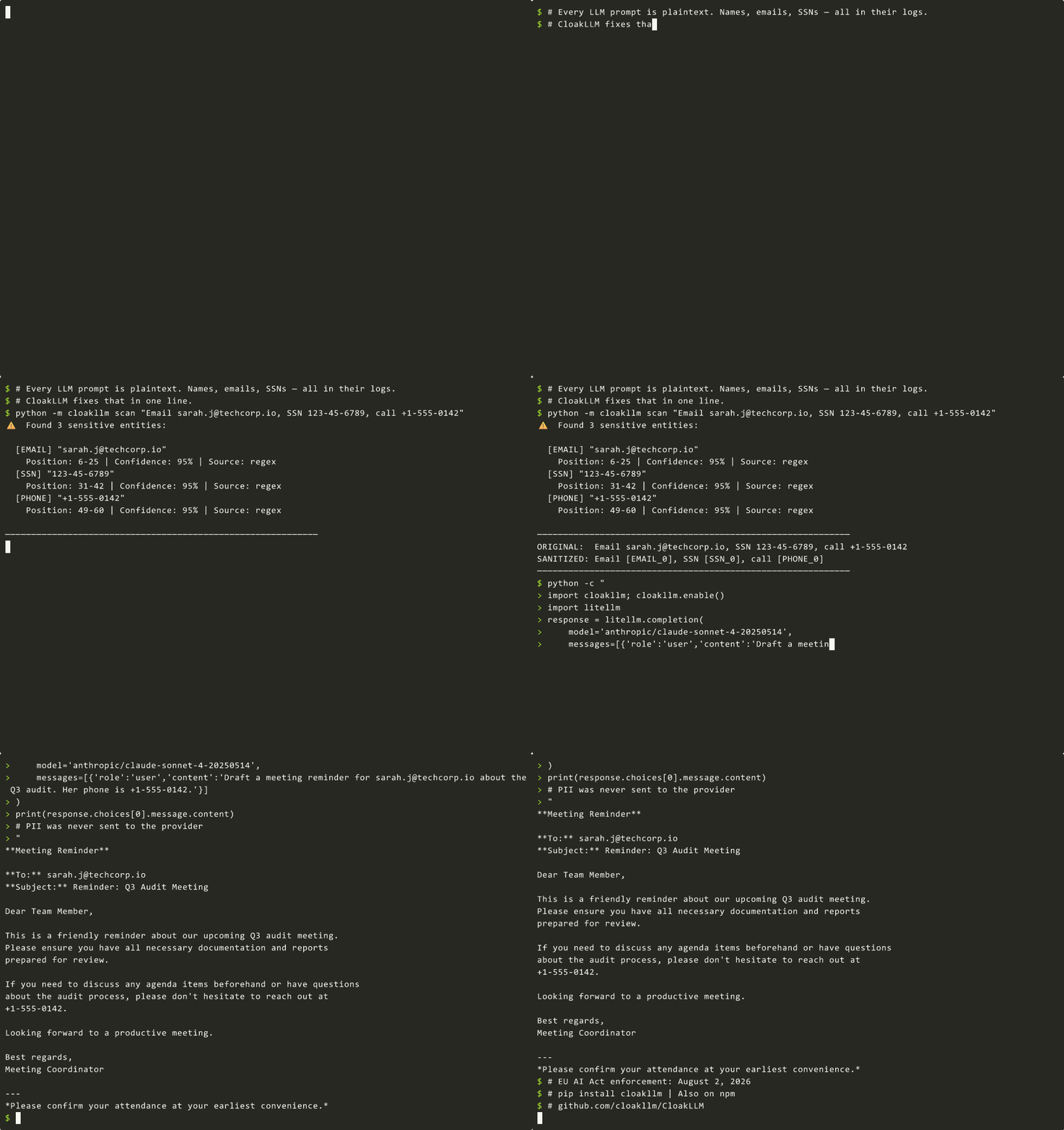
▶ Watch interactive demo on asciinema
SDKs
| SDK | Version | Install | Docs |
|---|---|---|---|
| CloakLLM-PY | 0.5.0 | pip install cloakllm |
Python README |
| CloakLLM-JS | 0.5.0 | npm install cloakllm |
JS/TS README |
| CloakLLM-MCP | 0.5.0 | python -m mcp run server.py |
MCP README |
What it does
- PII Detection — emails, SSNs, credit cards, phone numbers, API keys, and more
- LLM-Powered Detection — opt-in local Ollama integration catches context-dependent PII that regex misses (addresses, medical terms)
- Reversible Tokenization — deterministic
[CATEGORY_N]tokens that preserve context for the LLM - Redaction Mode — irreversible
[CATEGORY_REDACTED]replacement for GDPR right-to-erasure - Tamper-Evident Audit Logs — hash-chained entries for EU AI Act Article 12 compliance
- Custom LLM Categories — user-defined semantic PII types (PATIENT_ID, EMPLOYEE_NUMBER) via configurable Ollama detection
- Per-Entity Hashing — deterministic HMAC-SHA256 hashes per detected entity for cross-request correlation without storing PII
- Performance Metrics — per-pass timing breakdowns (regex, NER, LLM) in audit logs and via
shield.metrics()API - Incremental Streaming —
StreamDesanitizerstate machine replaces tokens as chunks arrive, no full buffering - Cryptographic Attestation — Ed25519-signed sanitization certificates with Merkle tree batch proofs and replay-resistant nonces
- Multi-Language PII Detection — 13 locales (DE, FR, ES, IT, PT, NL, PL, SE, NO, DK, FI, GB, AU) with locale-specific patterns
- Context Risk Analysis —
ContextAnalyzerscores re-identification risk in sanitized text (token density, identifying descriptors, relationship edges) - Security Hardened — Ollama SSRF prevention, thread-safe operations, ReDoS protection, CLI PII redaction by default
- Detection Benchmark — 108-sample labeled PII corpus with recall/precision/F1 harness, CI-enforced thresholds
- Middleware Integration — drop-in support for LiteLLM and OpenAI SDK (Python) and OpenAI/Vercel AI SDK (JS)
- MCP Server — use CloakLLM directly from Claude Desktop, Cursor, or any MCP-compatible client
Quick Start
Python
pip install cloakllm
# Option A: OpenAI SDK
from cloakllm import enable_openai
from openai import OpenAI

client = OpenAI()
enable_openai(client)  # Wraps OpenAI SDK — all calls are now protected

# Option B: LiteLLM
import cloakllm
cloakllm.enable()  # Wraps LiteLLM — all calls are now protected
JavaScript / TypeScript
npm install cloakllm
const cloakllm = require('cloakllm');

cloakllm.enable(openaiClient);  // Wraps OpenAI SDK
MCP (Claude Desktop)
Add to your claude_desktop_config.json:
{
  "mcpServers": {
    "cloakllm": {
      "command": "python",
      "args": ["-m", "mcp", "run", "server.py"],
      "cwd": "/path/to/cloakllm-mcp"
    }
  }
}
This exposes six tools to Claude: sanitize, sanitize_batch, desanitize, desanitize_batch, analyze, and analyze_batch.
Roadmap
Upcoming: normalized token standard, pluggable detection backends, and enterprise key management.
License
MIT
Reviews (0)
Sign in to leave a review.
Leave a reviewNo results found