director
Health Warn
- License — License: Apache-2.0
- Description — Repository has a description
- Active repo — Last push 0 days ago
- Low visibility — Only 5 GitHub stars
Code Pass
- Code scan — Scanned 5 files during light audit, no dangerous patterns found
Permissions Pass
- Permissions — No dangerous permissions requested
No AI report is available for this listing yet.
Director — a standalone Go CLI to coordinate many concurrent Claude Code sessions across repos via an append-only log + deterministic projections.
Director


An engineering daybook your agents actually keep.
You work with Claude Code across several projects, in blocks: days or weeks deep in one, an afternoon in another, back to the first, sometimes a few parallel worktree sessions in a burst. Native agent memory remembers facts. What nothing carries across those boundaries is the coordination narrative: what was decided and why, which loops were deliberately deferred, where the baton was parked when the block ended, and what still needs you. So the human becomes the message bus, re-explaining last month's decision to this morning's session.
Director moves you from message bus to reviewer. It is a standalone Go CLI built around a shared, durable, append-only event log per repo:
- Sessions
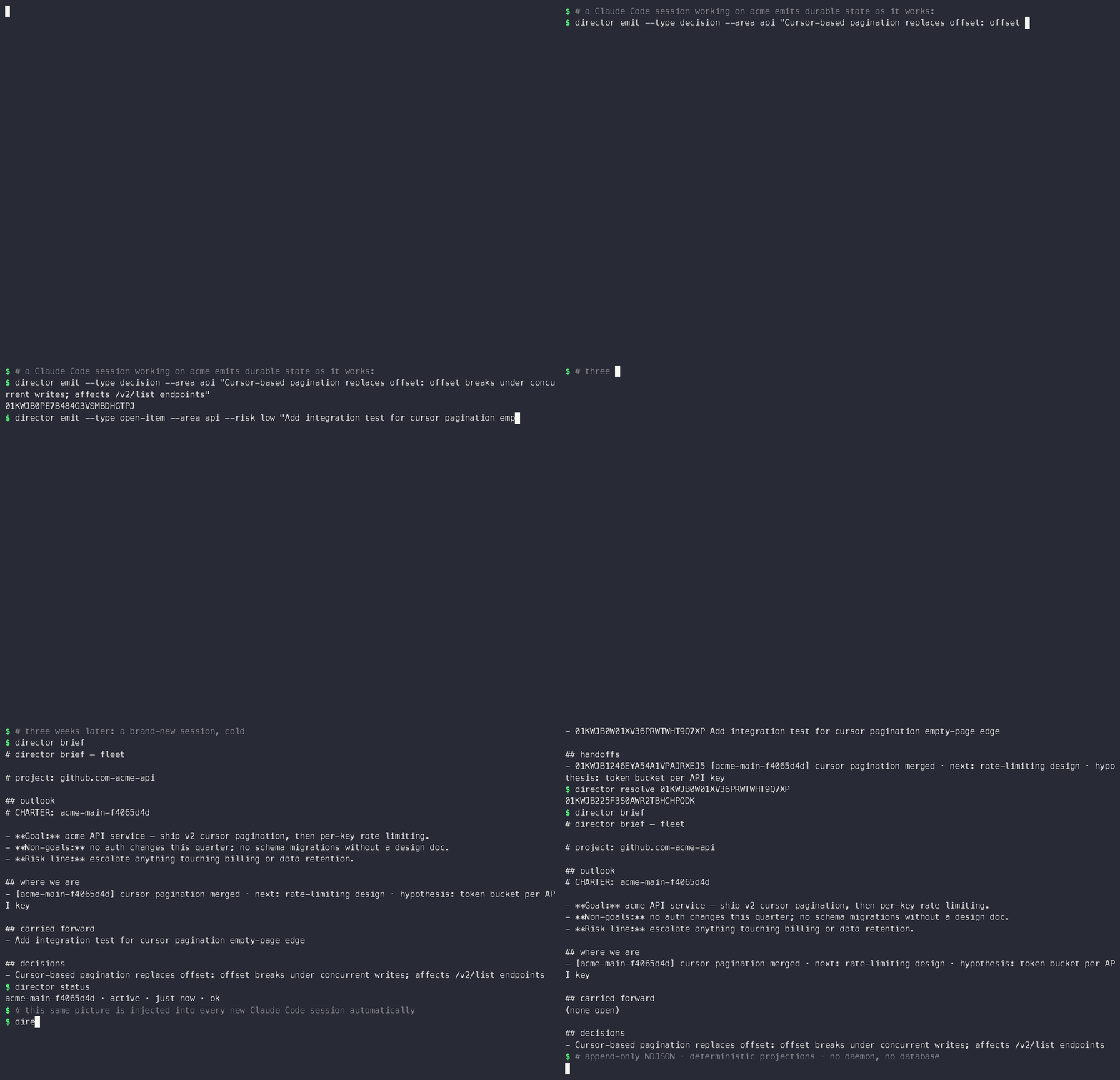
emittyped events as they work (decision·open-item·handoff·note) andresolveopen loops when they truly close. - Deterministic folds project the log into
render(the machine digest),brief(the human re-orientation view), andstatus(the one-line-per-workstream cockpit). - A SessionStart hook injects the CHARTER + digest into every new session as ground truth, so re-entering a project after three weeks starts from your parked handoff instead of from git archaeology.
- The log is model-agnostic: the next session can be you tomorrow, you after a compaction, or a stronger model you escalate a stuck problem to, with the tried-and-failed hypotheses traveling along. Escalate with context, not with amnesia.
The LOG (plus the deliberately-edited living docs) is the only system of record; sessions and every rendered view are disposable caches reconstructible from it. A single static binary, stdlib-first, one vetted build-time dependency (github.com/oklog/ulid/v2). No daemon, no database, no cloud: the log is plain NDJSON you could read with cat.
Status: v1. Director ships the hook-first coordination core plus repo adoption with an opt-in open-loop scan (see Status & scope). Single-machine.
New here?
docs/getting-started.mdis the task-oriented first-run guide (install → adopt → first session → cockpit), plus how the model uses Director and a troubleshooting section. This README is the reference.
Why Director
The design in four ideas — the full argument, including honest comparisons, is docs/why-director.md:
- A portfolio, not a swarm. Director's concurrency axis is time and projects, not just parallel terminals: one human, many workstreams, mostly one active at a time, dormant-between-blocks as a first-class state. Simultaneous sessions share the log and the cockpit too (supported, just not required).
- The git of coordination. Fierce about invariants (no open loop silently vanishes, a decision another session needs is durable and visible, history is append-only) and completely agnostic about your process. Not a methodology; it constrains state, never the path. Nudges, never gates.
- The durability gradient. Director owns only the fast layer (coordination in flight); plans and architecture docs own the slower ones. One home per fact; truth flows up, never sideways.
- Steering is a hat, not a daemon. No master session: the big picture is a durable projection owned by nobody, and any session wears the steering hat by reading
brief+status. If a session dying loses real information, that's a liability, not an architecture.
How it compares, in one line each (full versions): memory tools answer "what does the agent know?" while Director answers "what is in flight?"; issue trackers (beads et al.) hold the work items while Director holds the narrative between tasks; native multi-session features (Agent Teams) are session-scoped by design while Director is the durable, git-adjacent layer underneath them; and versus a markdown file plus discipline, Director adds append-only integrity under concurrent writers, a byte-identical verifiable fold, resolve lifecycle semantics, and push-injection that doesn't depend on the model remembering to read a file.
Install
Prebuilt binaries for macOS and Linux (amd64/arm64) are published on the releases page; docs/getting-started.md covers install-from-release.
Or build the binary, put it on your PATH, then run the installer:
go build -o bin/director ./cmd/director
sudo install bin/director /usr/local/bin/director   # or copy it anywhere on PATH
director install
director install does three things, all idempotent and self-contained:
- Writes the hook shims. The shims are embedded in the binary, so
installmaterializes them (executable) into the hooks dir — there is no manual copy step. - Merges the hooks into
~/.claude/settings.json. Every entry it writes carries a"_managedBy":"director"tag, so Director's hooks run alongside GSD's and any hand-rolled hooks without clobbering them. Re-running adds nothing;director uninstallremoves only Director's tagged entries and the shims and command files it wrote. Pass--settings <path>to target a project or test settings file. - Materializes the slash commands. The
/director:completeand/director:handoffcommands (also embedded) are written under~/.claude/commands/director/, namespaced so they never clobber a user's owncomplete/handoffcommands.
The installed hook commands point at the shims, not the binary directly, so rebuilding or relocating director never requires rewriting settings.json (re-run install to refresh the shims to the current binary). If ~/.claude/settings.json already has a malformed (non-object) hooks value, install refuses rather than overwrite it.
| Variable | Default | Selects |
|---|---|---|
DIRECTOR_HOOKS_DIR |
~/.claude/director/hooks |
where install writes the shims and the settings entries point; override to relocate them |
DIRECTOR_COMMANDS_DIR |
~/.claude/commands/director |
where install writes the /director:* slash commands |
DIRECTOR_HUB |
~/.director |
the central hub that holds all cross-repo coordination state |
DIRECTOR_BIN |
(PATH) | which director binary the shims invoke (defaults to director on PATH) |
DIRECTOR_HANDOFF_NUDGE_TOKENS |
(unset) | the context-fill handoff nudge: an absolute token threshold at which sessions are nudged toward /director:handoff; unset or 0 disables it. Fires once per crossing and re-arms only after context falls below half the threshold (a compaction or a context clear) |
The binary must be on
PATH. The shims resolvedirectorviaDIRECTOR_BIN→PATH; if it's missing they exit 0 (fail-safe) and coordination silently no-ops.
Adopt an existing repo
A director's projects already exist, so adoption of existing repos is on the critical path. Adoption is tiered by depth: Tier 0 registers the repo (identity + CHARTER + fleet row), Tier 1 optionally scans it for open loops to import, and Tier 2 (planned) is an LLM-assisted import of the repo's real backlog. From inside (or pointing at) a repo:
director adopt [<dir>] # defaults to the current directory
adopt (Tier 0) derives the repo's stable workstream identity (handling worktrees, remotes, and forks — see Identity), creates projects/<repo-key>/ in the hub, scaffolds a ~3-line CHARTER stub there, and registers the workstream in the fleet. Filling in the CHARTER (goal, non-goals, and the standing "needs a human" risk line) is the one manual step today; a planned adopt-time pass will instead draft a CHARTER proposal from the repo's main docs (README, architecture notes, planning files) for you to confirm, so adoption starts from an informed draft rather than a blank stub. Re-adopting never clobbers an edited CHARTER.
A bare adopt stops there (Tier 0). With --scan it also runs Tier 1: scans the repo's tracked files for open loops — TODO / FIXME / DEFERRED / HACK / XXX and unchecked markdown checklist items (- [ ]) — and offers to import the ones you pick as open-item events. Tier 1 is opt-in because this keyword scan is noisy on real repos (it surfaces docs/comments/test fixtures, not just real loops); the accurate brownfield import is the planned Tier-2 LLM-assisted import. The point of importing is to consolidate loops that would otherwise scatter between memory and per-project docs into their one home in the LOG.
director adopt                # Tier 0 only — identity + CHARTER + register
director adopt --scan         # also scan tracked files; pick which open-loops to import
director adopt --import-all   # scan and import every discovered open-loop, no prompt
Flags may go before or after the optional <dir> (director adopt path/to/repo --scan).
Commands
write path (model-emitted):
  emit        append a semantic event (decision|open-item|handoff|note)
  resolve     close an open-item by its ULID

projections:
  render      deterministic machine digest (+ --verify, manifest)
  brief       human re-orientation view (the bigger picture)
  status      one-line-per-workstream fleet cockpit
  open-items  this workstream's unresolved open-items (ULID + body), for /complete

fleet lifecycle (hook-emitted):
  register    create/refresh this workstream's fleet row
  heartbeat   touch liveness
  done        archive the workstream's row

adoption & install:
  adopt       bring an existing repo into the fleet (CHARTER + open-loop import)
  install     idempotent merge of Director hooks into settings.json
  uninstall   remove only Director-managed hook entries

misc:
  version     print the director version
emit — the model write path
emit is the only sanctioned way a semantic event reaches the LOG (never Edit/Write a log file):
director emit --type decision|open-item|handoff|note --area <subsystem> \
  [--risk low|escalate] [--to <handle>] [--refs <ulid,ulid>] <body>
emit prints the new event's ULID to stdout — note it; that is the id used to --refs or resolve the event later.
resolve — close an open-item
director resolve <ulid>
resolve appends a close-marker for an open-item. The <ulid> must be one the CLI surfaced (from emit, render, or open-items) — resolve validates the target and rejects invented ids, non-open-items, and already-closed items.
The three projections
| Command | Audience | What it is |
|---|---|---|
render [--project <key>] [--verify] |
machines / hooks | the deterministic digest a session-start injects; --verify re-folds and asserts the digest is byte-identical, exiting non-zero on drift. Also writes a manifest under health/. |
brief [--project <key>] |
human | the on-demand bigger-picture re-orientation view (outlook from CHARTER, latest handoff per workstream, open/escalate items, recent decisions), at project or whole-fleet altitude. |
status |
human | the one-line-per-workstream fleet cockpit: handle · liveness · heartbeat recency · the Needs-you band (open escalate items). |
brief and render share the same byte-identical fold — the human reads the same picture a fresh session reads. A fourth, narrower projection, open-items, lists the current workstream's unresolved open-items (ULID + body); it exists to feed resolve and /director:complete.
Fleet lifecycle
register / heartbeat / done maintain a workstream's liveness row and are normally fired by the hooks, not run by hand. Liveness is derived from heartbeat age (TTL/lease) — never self-declared: a workstream that stops heartbeating ages to idle (after 4h) then dormant (after 2d), and dormant is a first-class state (a project parked between blocks), not a fault. A workstream whose branch no longer exists reads gone regardless of heartbeat: it looks complete and is the /director:complete candidate. done archives the row to fleet/archive/<date>/ rather than deleting it.
The four event kinds
There are exactly four model-emitted semantic kinds. Pick by what the fact is:
| Kind | Use it for | Lifecycle |
|---|---|---|
decision |
a choice + what it affects | carries --risk low|escalate |
open-item |
an open loop / follow-up / deferred item — the canonical home for "documented, not dropped" | open → closed (via resolve) |
handoff |
a positional snapshot: current task · next action · hypotheses | — |
note |
FYI / context for a parallel or future session | — |
- There is no
blockerkind. "Stuck, needs a human" is anopen-itemwith--risk escalate— exactly the open-set that surfaces instatus's Needs-you band. doneis not a semantic kind — it is fleet-liveness only (a hook marks the session terminal). "What's done" belongs in ahandoffbody.
The protocol skill
skills/director/SKILL.md is the model-facing coordination protocol. It teaches a session two load-bearing habits that no hook can perform for it:
- Continuous boundary-flush — emit durable state to the LOG as you work (the moment a decision is made or a loop is deferred, and a
handoffat each natural boundary), never batched for the end of a session. Transient working state survives a compaction only if the model wrote it to the LOG during a turn. - Ground Truth — treat the CHARTER + digest injected at session start as the authoritative current picture: build on it, do not re-derive it by re-scanning the repo or re-reading the log.
Identity
A workstream's id is <repo>-<branch>-<shortid>, derived deterministically from a canonical repo-key (a git fallback chain that collapses worktrees, prefers a normalized remote, and falls back to the common-dir path) plus the branch, and persisted at .director/workstream-id in the worktree. A resumed or compacted session re-derives the same id and updates the same fleet row; after a branch rename the persisted id stays put. This stability is what makes the fleet free of zombie rows.
Status & scope
In v1: the hook-first coordination core (CLI write path, identity, event store, fleet/liveness, render/brief/status, hooks + the _managedBy installer, the protocol skill) and adoption Tiers 0–1 (adopt: identity + CHARTER + register, plus an opt-in --scan open-loop import — see Adopt an existing repo). Single-machine.
Deferred: the Tier-2 brownfield import (LLM-assisted: parallel code-mapping, doc reconciliation, a drafted CHARTER proposal, back-dated decision records) is the immediate fast-follow. A Codex adapter is on the roadmap (see TODOS.md): the core is already agent-agnostic (plain NDJSON log + CLI write path), so only the thin delivery layer (injection, heartbeat, nudges) is Claude Code-specific today. brief --synthesize (model-narrated prose) is deferred — v1 ships the deterministic brief. A background monitor/reaper, notifications, a freshness sweep, and multi-machine sync come later.
Quality gate (the bar for "done"):
| Property | Guarantee |
|---|---|
| No data loss | zero lost entries under N concurrent emit writers and across resume-after-compaction |
| Render determinism | same inputs → byte-identical render and brief; render --verify passes |
| Identity stability | one workstream keeps one id across resume/compaction |
| Fail-safe hooks | a broken hook never blocks session start (failure surfaces in health/) |
Hub layout
DIRECTOR_HUB (default ~/.director) holds all cross-repo coordination state:
$DIRECTOR_HUB/
├── projects/<repo-key>/
│   ├── CHARTER.md          # living source of record: goal, non-goals, risk-line
│   └── log.ndjson          # append-only typed events (decision · open-item · handoff · note)
├── fleet/
│   ├── <workstream>--<uuid>-<hash>.json  # liveness row per session; -<hash> avoids slug collisions
│   └── archive/<date>/                   # terminal 'done' rows — archived, never deleted
└── health/                 # hook health log + render manifests
In each adopted worktree: .director/workstream-id (and .director/repo-key), tiny and stable.
Fresh walkthrough
# 1. Build the binary, put it on PATH, install the hooks
go build -o bin/director ./cmd/director
sudo install bin/director /usr/local/bin/director
director install

# 2. Bring an existing repo into the fleet (fill in the CHARTER it scaffolds)
cd ~/dev/src/some-project
director adopt

# 3. Open a Claude Code session in that repo — its SessionStart hook registers
#    the workstream and injects CHARTER + digest as Ground Truth.

# 4. See the cockpit
director status
# some-project-main-1a2b3c4d · active · just now · ok
License
Reviews (0)
Sign in to leave a review.
Leave a reviewNo results found