Synaptic
Health Pass
- License — License: AGPL-3.0
- Description — Repository has a description
- Active repo — Last push 0 days ago
- Community trust — 27 GitHub stars
Code Pass
- Code scan — Scanned 12 files during light audit, no dangerous patterns found
Permissions Pass
- Permissions — No dangerous permissions requested
No AI report is available for this listing yet.
Auditable code intelligence for AI agents - map dependencies, predict change impact, select the right tests, and verify refactors before they ship.
Synaptic



Synaptic is a source-grounded code maintenance platform built around three connected systems:
API maintenance, repository memory, and a persistent knowledge graph. Together they
let an engineer or AI assistant understand what the code does, remember what has happened to
it, and make bounded repairs without guessing.
- API maintenance keeps external dependencies and SDKs safe to change. Dependency bots
can tell you a new version exists; Synaptic inventories the APIs your code actually uses,
detects source-grounded breaking changes, finds the affected call sites, plans a bounded
repair in an isolated worktree, verifies graph invariants and selected tests, and only
publishes a draft PR when the evidence is complete. - Repository memory preserves the history that usually lives in people, chats, failed
branches, incident notes, and old PRs. It records previous changes, regressions, decisions,
procedures, verification results, and external artifacts as source-linked evidence, then
retrieves that memory through the CLI or MCP server so future work starts with context
instead of archaeology. - The knowledge graph is the structural map underneath everything. Synaptic turns any
folder, monorepo, or federated set of repositories into a persistent, queryable graph of
symbols, files, resources, calls, imports, inheritance, SQL usage, dynamic-dispatch hazards,
and cross-repo edges across 30+ languages with
tree-sitter.
The graph answers architectural questions, traces reverse impact ("what would this change
break?"), forecasts and speculatively runs changes before you make them, plans safe refactors,
diffs architecture across git history, and audits SQL for performance and security. Memory adds
what the graph cannot infer from the current tree alone. API maintenance uses both to turn
upstream change into evidence-backed repair plans. The engine and terminal workflow ship as a
single static Rust binary (synaptic) with no runtime or interpreter. An optional nativesynaptic-ui addon provides visual single-repository, workspace federation, and MCP setup plus a
searchable Tools view for every Synaptic task on Windows, Linux, and macOS. Synaptic writes
machine-readable graphs alongside human-readable reports and 2D/3D/SVG
visualizations, and exposes an MCP server so an AI coding assistant can use these systems before
grepping or reading files.
Architecture explorer
Turn an existing graph.json into a self-contained, offline architecture map:
synaptic chart
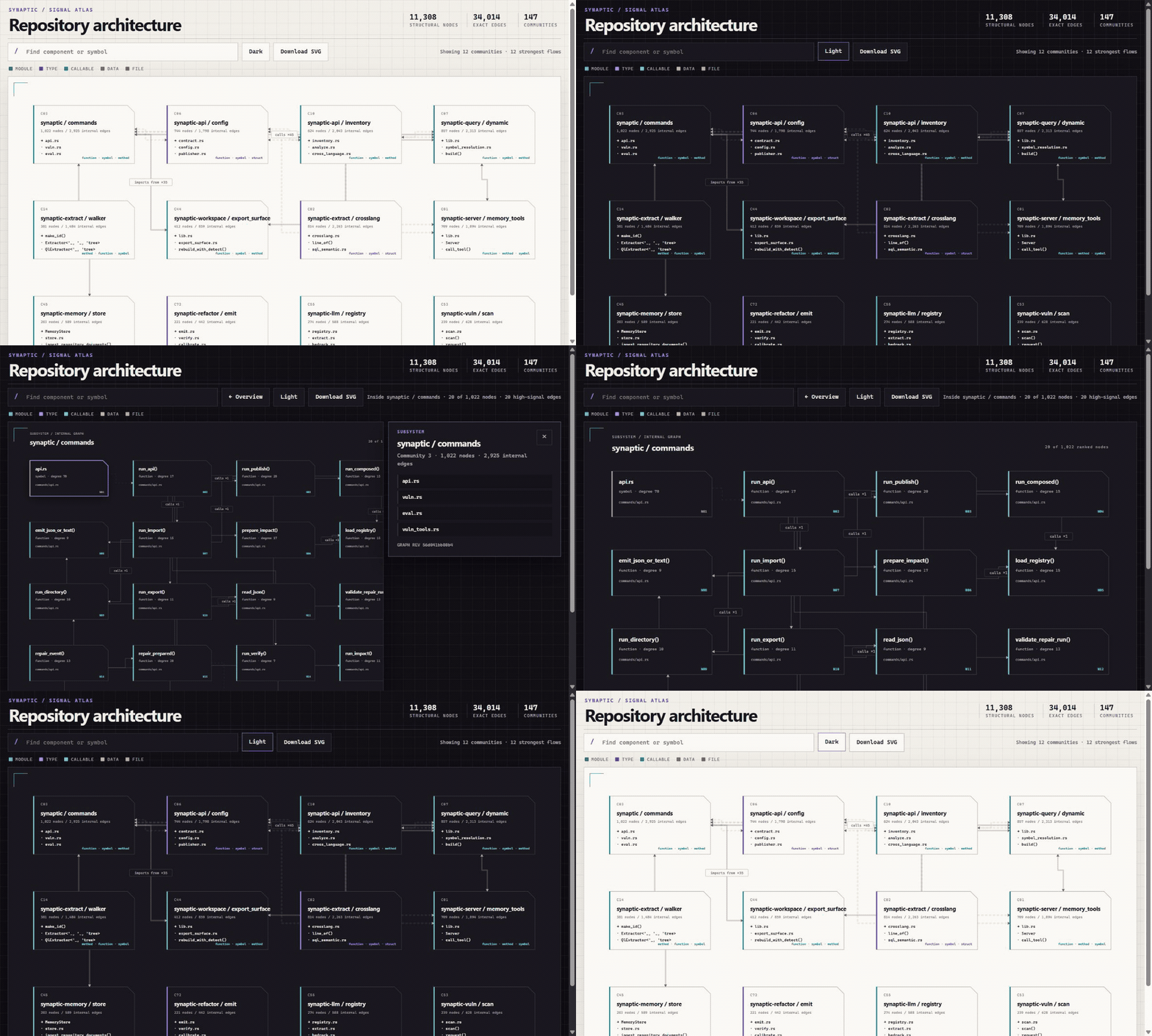
The overview ranks source-grounded communities and their strongest exact relationships. Search,
switch themes, or open any subsystem without rebuilding the graph.
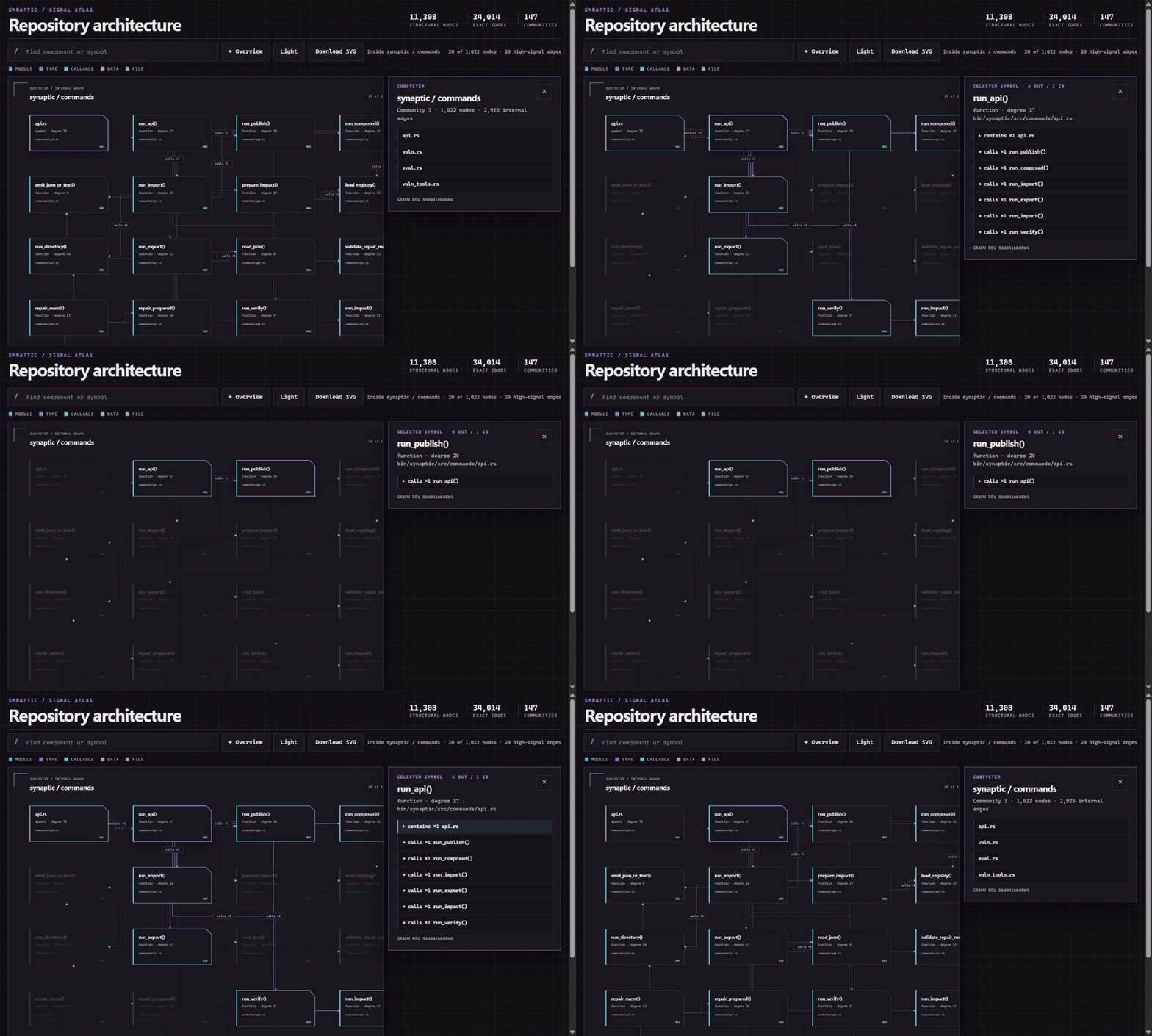
Inside a subsystem, select a symbol to isolate its real one-hop dependencies. The inspector shows
incoming and outgoing relations, and each row continues directly to the connected symbol.
The desktop app's App screen checks the GitHub Release published by the release workflow,
downloads the matching archive, verifies its published checksum, and updates the bundled
executables. Add to applications installs it for the current user and makes it searchable from
Windows Start, macOS Applications, or the Linux application menu without administrator access.
Removing the desktop installation does not touch project data, graphs, settings, or a separately
installed CLI.
The desktop app follows the operating system's light or dark preference on first launch and saves
the user's choice after that.
If someone downloads only synaptic-ui, its first-run screen automatically downloads the
verified command tools from the latest GitHub Release and places them beside the app. No terminal,
PATH change, or system-wide install is required.
If you do not want to run the MCP server yourself, Synaptic Cloud is a paid hosted MCP
service for using Synaptic with your projects: synapticgraph.com.
For commit-triggered graph sync and verified API or dependency draft repairs, follow the
GitHub automation guide.
Use Synaptic with a project
Start from any repository root. Synaptic writes its index and reports to synaptic-out/
and keeps project-specific configuration under .synaptic/.
The easiest path is to ask your AI coding agent to install and configure Synaptic for
the current repository, then have it follow the
Installation,
Quickstart, and
Assistant Integration
guides. If you prefer to do it yourself, the manual path is:
# 1. Install the binary from this repository
cargo install --path bin/synaptic

# Or download a prebuilt binary from GitHub Releases, then confirm it works
synaptic --version

# Optional: install and launch the native setup UI
cargo install --path bin/synaptic-ui
synaptic-ui

# 2. Build the first graph for your project
cd path/to/your/project
synaptic extract .

# 3. Ask structural questions without rereading the whole codebase
synaptic query "authentication flow"
synaptic affected parse_config
synaptic search --pattern god-class

# 4. Keep the graph current as the project changes
synaptic update
synaptic watch
synaptic hook install
For a normal project setup, add a .synapticignore if there are generated, vendored,
or sensitive paths you do not want indexed; extract also honors .gitignore and skips
common secrets like .env and key files. Use synaptic hook install when you want Git
commits, checkouts, and graph merges to keep synaptic-out/graph.json fresh automatically.
Once the graph exists, turn on the higher-level systems as needed:
# Repository memory: ingest history, docs, decisions, and outcomes
synaptic memory refresh --root .
synaptic memory search "previous auth migration"

# API maintenance: configure monitored APIs and check real usage
synaptic api init
synaptic api discover --json
synaptic api coverage --json
synaptic api scan --offline --json

# AI assistant integration: serve the graph and memory over MCP
synaptic serve
synaptic install codex --global
The safest mental model: run extract first, use query / affected / search to explore,
add hooks or watch when the project is active, then enable memory and api workflows when
you want Synaptic to preserve history or maintain external contracts.
Why
- Structural clarity. God nodes, surprising cross-module connections, import cycles, and
community structure are computed for you. - Impact and foresight. Reverse impact, change forecasting, and speculative test runs
answer "what depends on this?" and "what would this change break?" before you touch the code. - Token economy. Querying a compact graph costs a fraction of feeding raw files to an
LLM, so an assistant can answer those questions without loading the repo. - Confidence you can audit. Every inferred relationship is tagged
EXTRACTED,INFERRED, orAMBIGUOUS. - Scales past one repo. A workspace can federate many repos with real cross-repo edge
resolution (export surfaces plus import / tsconfig / module-federation aliases). - Offline by default. A code-only corpus never makes a network call. The optional
semantic pass over docs and papers is the only feature that needs an API key.
Highlights
- 30+ languages via tree-sitter, each built and tested in isolation in CI, plus
regex-based extractors for a few formats and script extraction for Vue/Svelte/Astro and
Razor/Blazor. See Languages. - One command to a full graph plus 2D, 3D, and SVG visualizations, a Markdown report,
and GraphML / Cypher / DOT / Obsidian / wiki exports. See Output Formats. - Graph queries: relevant-subgraph search, shortest path, node explanation,
reverse-impact ("what depends on this"), find-all-references (synaptic references/
thefind_referencestool: everywhere a symbol is used, including the imports and
inheritance a caller-only view misses), and per-file symbol outlines. See
Querying. - Dynamic-dispatch awareness: event buses (Node EventEmitter, DOM CustomEvent, C# events)
and Electron IPC link a publisher to its subscriber through a channel node, so a handler reached
only across the bus is not a phantom 0-caller. Reflection and dynamic dispatch that cannot be
resolved statically (by-name lookups, dispatch tables,eval, dynamic import, .NET/Python/JVM
reflection) are cataloged so a "0 dependents" answer is never mistaken for "safe to change":synaptic hazards(and thedynamic_hazardsMCP tool) list the sites, andaffectedattaches a
caveat when a symbol is reachable only dynamically. - Time-travel diff:
synaptic diff <rev1> [rev2](or--since <date>) reports how the
graph changed between two git revisions, added/removed dependencies, removed APIs,
architectural drift, new cycles, and hotspots, with a Markdown or self-contained HTML report. - Architectural search (SYNQL):
synaptic searchruns a small Cypher-inspired query
language over the graph, matching on structure (kind, visibility, LOC, fan-in/out,
variable-length paths) withcount(...)aggregation,--explain, saved queries, and a
library of named patterns (singleton, factory, observer, service-locator, god-class). Not
text search.synaptic search --file <path>lists every symbol defined in a file, ordered
by line, with no query needed. - Safe refactor:
synaptic refactor rename/move/extractemit a confidence-scored
execution plan (plan.json+plan.md) for an AI agent to apply, thenrefactor verify
rebuilds and checks the graph held (the definition moved/renamed, no references lost, no new
cycles). Synaptic never edits source itself. - Change forecasting and speculative execution:
synaptic predictforecasts a change's
blast radius, public APIs at risk, at-risk tests, new cycles, risk score, and a verify
checklist before you edit (--edit "<kind>:<symbol>"forecasts a described edit before any
code is written);synaptic speculatethen applies the change in a throwaway git worktree
and actually runs the at-risk tests plus a build/type-check, reporting real pass/fail — the
ground-truth half of prediction; andsynaptic eval replayreplays history to score forecast
quality against git ground truth (co-edited tests, removed APIs), turning prediction accuracy into
a CI-gateable metric. See
Commands. - SQL performance & security audit:
synaptic sql auditflags row-level-security gaps,
over-broad grants, likely SQL injection, missing indexes on filter/foreign-key columns,SELECT *, non-sargable predicates, N+1 patterns, and missing primary keys over the SQL-aware
graph (extraction now models columns, indexes, RLS policies, and grants, and links application
queries to the tables they touch).synaptic sql advise --query "<sql>"critiques a candidate
query before you write it, cross-referenced against the graph's tables/indexes/RLS. See
SQL Auditing. - Resource graph (universal, on by default): data/resource files (data JSON and
.mcmeta
underassets/,data/, and generated dirs) are indexed as graph nodes, and reference-like
strings inside them bind to the file, resource (by path-derived id likens:path), or code
symbol they name — soaffectedandquery_graphspan code and resources. A generated
resource that duplicates a hand-authored one at the same logical path gets ashadowsedge
(surfaced byreadiness_audit). Framework-agnostic — a MinecraftResourceLocationis just
one instance of the logical-id shape. Localization JSON also contributes a bounded set of
key-only search aliases (never translated prose), so message catalogs are discoverable
without one graph node per translation.extract --no-resourcesrestores the code-only graph. - Port/readiness audit:
synaptic audit readinessranks likely port blockers from graph,
source, and config signals: framework sentinel returns, placeholders/stubs,
generated-resource noise, and project metadata. The MCPreadiness_audittool exposes the
same structured report. - MCP server (stateless protocol 2026-07-28 with legacy compatibility through
2025-11-25) exposing 30 core tools, five vulnerability tools, and five
read-only repository-memory tools over stdio or HTTP:
subgraph search, source reading, reverse-impact, find-all-references, dynamic-dispatch hazards,
PR/working-tree blast radius, change forecasting, predictive test selection, edit-impact prediction,
structural search, time-travel diff, plan-only rename, and SQL audit/advise, plus prompts, completions,
resource subscriptions, and structured tool output. See
MCP Server. - Source-grounded repository memory: a temporal overlay for previous
changes, failed attempts, regressions, decisions, procedures, verification,
external issue/PR/CI/incident artifacts, semantic community summaries, and
revision-aware file/symbol lineage. Git hooks capture exact commits and
refresh knowledge; principal policy, compact/federated stores, checksummed
team bundles, retrieval benchmarks, and aggregate impact evidence are built
into the CLI and MCP surface.
See Repository Memory. - Self-maintaining API workflows:
synaptic apiinventories SDK versions,
discovers contracts, records coverage gaps, detects source-grounded breaking
changes, localizes affected call sites, and prepares bounded repairs in an
isolated worktree. Verification fails closed on incomplete evidence, and only
the explicitpublishstage can create or update an idempotent draft PR. See
API maintenance. - Dependency vulnerability management:
synaptic vulnreads every lockfile in
a repository across 12 package ecosystems, matches resolved versions against an
OSV corpus, and decides whether each advisory actually applies here rather than
stopping at a version match. Findings carry an evidence ladder, a dependency
path, a CVSS-derived priority, graph-backed call sites and entry-point
exposure, and a remediation plan; applicable findings with a fixed target can
become bounded, isolated repairs whose patched dependency resolution and
repository tests must pass before Synaptic can create one deterministic draft
GitHub PR or GitLab MR. Checksummed export/import keeps repair and provider
credentials separated, and Synaptic never approves or merges. Accepted risks
are time-boxed and expire on their own. Five MCP tools let assistants check packages, run a
graph-backed scan, inspect exposure evidence, and request a bounded repair
hand-off. Whole-repository scans stay local by default; an agent must opt in
before the dependency list is sent to OSV. See
Vulnerability Management. - Incremental rebuilds, file watching, and git hooks keep the graph current. See
Incremental Updates. - Graph-aware PR dashboard with blast radius and merge-order conflict detection. See
PR Dashboard.
Token economy
A core payoff of querying a compact graph is reading a small answer instead of the whole
codebase. query_graph defaults to a terse, ranked list of the most relevant symbols (a
few hundred tokens); pass full=true for the whole subgraph with its edges. The figures
below measure a full subgraph response (at a 2,000-token budget) on Synaptic's own source
(199 Rust files, 56,408 lines, 510,966 cl100k tokens) -- one such answer to a
structural question is ~1,950 tokens, versus reading the source files it actually touches:
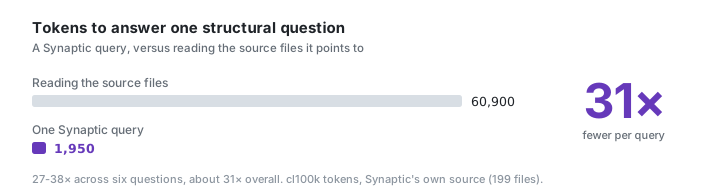
Across six questions spanning different subsystems, querying the graph used 27-38x fewer
tokens (about 31x overall) than reading the files the answer references:
| Question | Query response | Read the files | Fewer tokens |
|---|---|---|---|
| http request handling | 1,804 | 48,803 | 27x |
| session create / reap | 1,974 | 65,578 | 33x |
| query_graph subgraph | 2,011 | 53,759 | 27x |
| extraction walker | 1,977 | 70,443 | 36x |
| PR fetch / rank | 1,926 | 73,231 | 38x |
| incremental merge | 2,010 | 53,440 | 27x |
A query response stays small no matter how big the repo gets (it is capped by the token
budget), so the ratio grows with the codebase. Note the graph.json index itself is large
because it encodes every symbol and edge; you never load it into context, you query it and
get back only the slice above.
Reproducible. Tokens are exact cl100k_base counts viacargo run -p synaptic-server --example tokcount. The baseline is the unique source files
referenced by the result (whole files, the conservative grep-then-read case; it does not
count the dead-end files you would open without the graph). Run synaptic extract . on any
repo and compare for yourself. This is a context-compression measurement, not an end-to-end
agent-savings claim; the paired SWE-bench/BEIR methodology is in BENCHMARKS.md.
Advanced-tool performance
The analysis tools answer in milliseconds because they run over the in-memory graph, not the
source. Criterion micro-benchmarks (dev machine; run cargo bench -p synaptic-synql -p synaptic-refactor):
| Operation | Workload | Time |
|---|---|---|
SYNQL property query (search) |
WHERE/loc/fan_out over a 2,000-node graph |
~0.47 ms |
SYNQL relationship-pattern join (search) |
one-hop join over a 2,000-node graph | ~0.97 ms |
Safe-refactor rename plan (refactor rename) |
hot symbol, ~120 call sites across 40 files, incl. the textual scan | ~4.9 ms |
The 0.6.3 graph-pipeline audit added dedicated Criterion coverage for construction,
incremental comparison, and federation (cargo bench -p synaptic-graph -p synaptic-incremental -p synaptic-workspace). On the audit fixtures, one-pass
16 x 500-node federation measured 136.1 -> 6.07 ms, a 10k-node topology
comparison 54.92 -> 9.77 ms, and a 1,000-site duplicate edge 240.74 ->
0.56 ms. These are machine-dependent micro-benchmarks; the committed fixtures
and growth curves are the reproducible evidence.
Time-travel diff is build-bound rather than query-bound: the graph delta itself is
near-instant, and the cost is building each revision in a throwaway git worktree. Built
graphs are cached per commit SHA under synaptic-out/history/, so a repeat diff of the same
commits returns immediately and only the working-tree side is rebuilt.
Accuracy
The token study above is a smoke test on one repo. The relationships Synaptic extracts are
validated separately, against a hand-labeled corpus of mini-repos whose true call edges,
test linkages, blast radii (including distractor nodes that must not be flagged), and
cross-language couplings (including look-alikes that must not connect) are written out by
hand in a ground_truth.toml. A preflight fails the run if any labeled symbol does not resolve,
so a dropped node becomes a loud failure rather than a quietly smaller denominator. Every number
below is exact set-comparison against those labels, reproducible with synaptic eval corpus:
| Fixture | Family | Call P/R/F1 | Aff-test rec | Blast rec / excl / size | Cross P/R/F1 |
|---|---|---|---|---|---|
| systems-rust | systems-rust | 100/50/66 | — | 100% / 100% / 1.0 | — |
| scripting-python | scripting-python | 100/100/100 | 100% | 100% / 100% / 2.0 | — |
| web-ts | web-ts | 100/100/100 | — | 100% / 100% / 1.0 | — |
| oo-java | oo-java | 100/100/100 | — | 100% / 100% / 1.0 | — |
| systems-go | systems-go | 100/100/100 | — | 100% / 100% / 1.0 | — |
| deep-python (multi-hop) | scripting-python | 100/100/100 | 100% | 100% / 100% / 3.0 | — |
| cross-lang-ts-rust | cross-lang | — | — | — | 100/100/100 |
| cross-lang-grpc | cross-lang | — | — | — | 100/100/100 |
| cross-lang-queue | cross-lang | 100/100/100 | — | — | 100/100/100 |
| cross-lang-pyo3 | cross-lang | 100/100/100 | — | — | 100/100/100 |
| cross-lang-ws | cross-lang | 100/100/100 | — | — | 100/100/100 |
Across 11 fixtures / 6 language families / 42 labeled symbols (all resolved): pooled call edges
precision 100% / recall 94% / F1 97% over 18 labeled edges; blast-radius recall 100% with
0 distractors leaked; affected-test recall 100% over the labeled linkages with the one
labeled unrelated test correctly not selected; cross-language precision 100% / recall
100% / F1 100% over 6 labeled couplings with 6 distractor couplings (look-alike routes, a
wrong-service gRPC stub, an unregistered PyO3 helper, ...) correctly not connected. Reading
the numbers honestly:
- No false call edges were observed in this 18-edge corpus (precision 100%); that is a
result on the corpus, not a guarantee at scale. - Recall is 100% for Python/TypeScript/Java/Go, which resolve cross-file calls. The 50%
on Rust is real and expected: Rust call resolution is intra-file, so a module-qualified
cross-file call is a true miss. Cross-file reachability is still preserved throughimports
edges, which is why blast-radius recall stays 100%. - Blast radius is scored for noise, not just misses: each seed labels distractor nodes that
must stay out, and none leaked (100% exclusion); the average reported impact-set size equals
the true affected-set size, so the walk is not over-broad. - Affected-test selection is multi-hop: the
deep-pythonfixture changes a leaf three call
hops below its test and still selects it, while a deliberately unrelated test is excluded
(so recall is not bought with precision). - Cross-language precision is earned across five boundary kinds: a TypeScript
fetch("/session")connects to the Rust axum handler that serves it (and a mounted/api/usersclient reaches its prefix-composed route); a Python gRPC client reaches its tonic
server; a Kafka producer reaches its consumer; a Pythonimportreaches its PyO3-exported Rust
function; a JS WebSocket command reaches its C# handler — while every look-alike distractor
(a/sessionspath, a wrong-service stub, a wrong topic, an unregistered PyO3 helper, an
unhandled message) is correctly left unconnected.
The corpus is intentionally small and hand-verified; it validates extraction correctness on
representative shapes, not internet-scale coverage. The scale section measures real
repositories. See BENCHMARKS.md for methodology and the ground-truth format.
Prediction calibration
The change-forecast layer attaches a confidence to each predicted co-change. synaptic eval calibrate measures whether that confidence is meaningful: it walks recent history, and for each
commit uses every changed file as a seed, asks the predictor (trained only on prior commits)
which files should co-change, then scores each prediction's confidence against what actually
changed. It reports a reliability table (predicted vs. observed hit rate per confidence
bin), a Brier score, the Brier skill score against an always-guess-the-base-rate
baseline (so the Brier number is interpretable), and expected calibration error.
This is a per-repo property: confidence reflects each repo's commit habits, so run it on yours.
On this repo's own (squash-heavy, synthetic) history the skill score is negative — co-change
prediction there is worse than guessing the base rate, because squashed commits touch many
files at once and inflate apparent co-change. That is the metric working: it refuses to dress up
a predictor that is miscalibrated on this history. Methodology in BENCHMARKS.md.
Scale
Extraction throughput across real OSS repositories spanning size tiers and language families,
each cloned at a pinned SHA (synaptic eval scale; network + git, opt-in). Each timing is the
median of 5 reps. The 2026-08-12 run covered 10 repositories, 9 language families, 783,928
supported LOC, 71,437 nodes, and 111,851 edges with no skips. Warm throughput ranged from
44k to 339k LOC/s; median cold-to-warm speedup ranged from 1.4x to 2.8x. The largest checkout
measured here, Humanizer (476,967 supported LOC), took 7.07s cold and 2.69s warm.
Those are machine-specific development-worktree results, not universal or clean-release
claims. "Cold" clears Synaptic's AST cache but the checkout and OS file cache were warm;
incremental timing re-extracts a named unchanged source file and is not patch latency. Full
method, per-repository results, limitations, exact SHAs, and raw samples are in
BENCHMARKS.md.
Extraction quality at scale
Scale measures how fast extraction runs; a graph that anchored every declaration to the wrong
line would post identical timings. synaptic eval quality measures whether the graph is right,
across 60 pinned repositories covering all 39 shipped languages (80,061 files, 938,001 nodes),
using properties that need no hand labels: anchor exactness, parse and recovery health,
determinism, incremental equivalence, and an independent universal-ctags comparison.
The 2026-08-15 run: pooled anchor exactness 735,198 / 735,493 (99.96%), with 60/60
repositories deterministic and incrementally equivalent and no skips. 30 of 39 languages are
exact on every checked declaration.
The corpus is language-complete by construction — a test fails when a shipped extractor has no
repository exercising it — and each repository carries pinned bounds, so a regression exits
non-zero naming the repository and metric. The oracle is published as a symmetric difference,
never a recall score: ctags is an independent second opinion, not ground truth. Method,
per-language results, and the defects this benchmark found are in BENCHMARKS.md.
Install
Synaptic builds with a stable Rust toolchain (pinned to 1.97.1 via
rust-toolchain.toml).
# From a clone, installs the `synaptic` binary onto your PATH:
cargo install --path bin/synaptic

# Optional native workspace/MCP setup app (uses `synaptic` from the same directory or PATH):
cargo install --path bin/synaptic-ui

# ...or build it in-tree:
cargo build --release -p synaptic -p synaptic-ui
Prebuilt CLI and optional UI binaries for Linux/macOS/Windows are attached to each tagged
GitHub Release (see the release workflow). Optional integrations are
behind feature flags (off by default): pg (Postgres introspection), push (live
Neo4j/FalkorDB export), and office / gws / media (spreadsheet / Google-Workspace /
audio-video ingest), e.g. cargo install --path bin/synaptic --features pg,push. See
Installation,
Desktop UI, and
Configuration.
Once installed, update in place with synaptic self-update (verifies a SHA-256
checksum and prompts before replacing the binary). Opt in to a background
"update available" notice with synaptic self-update --enable — off by default,
runs at most once a day, and never blocks normal commands. cargo install /
source builds can self-update too, but the swap installs the default-feature
prebuilt binary.
Quickstart
# 1. Build the graph for the current directory -> synaptic-out/
synaptic extract .

# 2. Ask the graph a question (returns a relevant subgraph)
synaptic query "authentication flow"

# 3. What would changing a symbol break? (reverse impact)
synaptic affected parse_config

# 4. Serve the graph to an AI assistant over MCP
synaptic serve
extract honors .synapticignore / .gitignore and skips sensitive files (.env, keys).
A code-only corpus runs fully offline; the optional LLM semantic pass over docs and papers
(extract --semantic) needs an API key (e.g. OPENAI_API_KEY). See
Quickstart.
Output artifacts (synaptic-out/)
| Artifact | What it is |
|---|---|
graph.json |
Full graph (node-link JSON), query it without re-reading files |
GRAPH_REPORT.md |
God nodes, surprising connections, suggested questions, import cycles |
graph.html |
Interactive 2D explorer (search + community color) |
graph-3d.html |
Interactive 3D force graph (search, relation toggles, federation colors) |
graph.svg |
Static layout (Barnes-Hut, component-packed, asset-shaped) |
chart.html |
On-demand architecture map with community-to-symbol drill-down from synaptic chart |
graph.graphml / graph.cypher / graph.dot |
Import into Gephi / Neo4j / Graphviz |
callflow.html / tree.html |
Mermaid call-flow + D3 file tree |
obsidian/, wiki/ |
Obsidian vault / Markdown wiki (with --obsidian / --wiki) |
Commands
| Command | What it does |
|---|---|
extract [path] |
Build the graph and write synaptic-out/. Flags: --directed, --obsidian, --wiki, --semantic |
export <format> |
Re-emit a format from an existing graph.json (no rebuild) or push live to Neo4j/FalkorDB |
chart |
Create an offline interactive architecture map with source-backed subsystem drill-down. Flags: --graph, --out, --repo, --max-communities |
query <text> |
Return a relevance-ranked subgraph (each node scored). Flags: --max-nodes, --repo, --dfs, --since <ref> (boost code changed on the branch), --seed-changed, --json |
path <from> <to> |
Shortest path between two nodes |
explain <node> |
Show a node and its neighbours |
affected <node> |
Nodes that (transitively) depend on a node; adds a caveat when a "0 dependents" symbol is reachable only via dynamic dispatch. Flags: --depth, --relation |
hazards |
List reflection / dynamic-dispatch sites the graph records, so a "0 dependents" answer is not mistaken for "safe". Flags: --repo, --kind, --limit |
search [synql] |
Structural search via SYNQL or a named --pattern. Flags: --explain, --save/--saved, --json |
diff <rev1> [rev2] |
Time-travel graph diff between two git revisions. Flags: --since, --report, --html, --scope |
refactor <action> |
Plan a safe rename/move/extract for an agent, then verify the graph (never edits source) |
predict [paths...] |
Forecast a change before applying it: blast radius, at-risk tests, risk, removed APIs, cycles. Flags: --base, --edit "<kind>:<symbol>", --gate |
speculate [paths...] |
Run a change for real in a throwaway worktree: at-risk tests + a build/type-check, reporting pass/fail. Flags: --patch, --test-cmd, --check-cmd |
audit readiness |
Static port/readiness audit: ranks framework sentinel returns, placeholders/stubs, generated-resource noise, and project metadata. Flags: --profile, --severity, --repo, --json |
sql <action> |
audit SQL for performance + security over the SQL-aware graph, or advise --query "<sql>" on a candidate query before writing it. Flags: --severity, --explain --db-url (live EXPLAIN, needs --features live-explain) |
eval replay [from] |
Replay history to score forecast quality against git ground truth (CI-gateable). Flag: --min-test-recall |
eval quality |
Measure extraction correctness across the pinned real-world corpus, gated against per-repo baselines (network + git, opt-in). Flags: --language, --repo, --pin, --update-baselines |
update [paths...] |
Incrementally rebuild after files change (--full for a full rebuild) |
watch |
Rebuild automatically as files change (single repo; use workspace build --watch for a workspace) |
serve |
Run the MCP server (stdio, or --http <addr> --api-key <key>) |
prs [number] |
Graph-aware PR dashboard / detail. Flags: --triage, --conflicts, --base, --repo |
workspace <action> |
Multi-repo / monorepo federation (init/add/discover/build/federate/coordinate/sync/status/list). build --watch keeps a federated graph live across every member repo |
global <action> |
The cross-repo global graph store (~/.synaptic) |
memory <action> |
Ingest, record, search, compact, exchange, and evaluate durable source-grounded repository memory |
api <action> |
Inventory API dependencies, discover contracts, measure coverage, scan changes, assess impact, and safely repair/verify/publish a draft PR |
merge-graphs <graphs...> |
Compose several graph.json files into one namespaced graph |
ingest <source> |
Ingest an external source (cargo / mcp / scip / pg / url; office / gws / media behind feature flags) |
hook <action> |
Manage git hooks + the graph.json merge driver |
install / uninstall [platform] |
Install the Synaptic skill for a host assistant |
cache <action> |
Maintain the on-disk extraction cache |
self-update |
Update the binary from the latest GitHub release (opt-in). Flags: --enable/--disable (background notice), --check, --yes |
The full reference with every flag is in Commands. Runsynaptic <command> --help for the flag list at the terminal.
Use it from an AI assistant (MCP)
synaptic serve                                                        # stdio MCP server
synaptic serve --http 127.0.0.1:8765 --api-key "$SYNAPTIC_API_KEY"   # HTTP server
synaptic serve --allow-memory-write                                   # opt-in outcome recording
synaptic serve --memory-principal reviewer \
  --memory-repository-claim owner/repo                                # scope-filtered memory
synaptic serve --graph promoted/graph.json --immutable-graph \
  --expected-graph-sha256 "$GRAPH_SHA256"                             # authenticate exact loaded bytes
synaptic serve --http 127.0.0.1:0 --ready-file /run/synaptic/ready.json # race-free child startup
The server exposes 30 core tools, five vulnerability tools, and five read-only
repository-memory tools:
graph navigation (query_graph, get_node,get_source, get_neighbors, get_community, god_nodes, graph_stats, shortest_path),
impact analysis (affected, find_callers, find_callees, find_references, dynamic_hazards,predict_impact, affected_tests, predict_edit), federation (list_repos, repo_stats), change/PR review (working_changes_impact,list_prs, get_pr_impact, triage_prs), the advanced trio (structural_search,time_travel_diff, plan-only plan_rename), port/readiness audit (readiness_audit), and SQL auditing (audit_sql, advise_sql).
Vulnerability work adds vuln_check_dependency, vuln_findings,vuln_explain, vuln_scan, and vuln_brief; a scan writes only withrecord: true and sends dependency coordinates to OSV only with online: true.
On federated graphs, agents select a tag from list_repos; scans, findings,
explanations, ledgers, and repair briefs are then isolated to that member,
including external checkouts and Git-cached repositories. Artifact-only members
are explicitly reported as not scannable.
Memory retrieval adds search_memory, explain_history,find_similar_change, known_pitfalls, and explain_decision;record_change_outcome is advertised only with --allow-memory-write.
It also serves MCP prompts, argument completions, resource templates and
subscriptions, and a small REST surface (/api/stats, /api/query, ...) for non-MCP
clients. Tool output is tuned to stay token-lean (terse defaults, capped lists); addserve --concise (or set SYNAPTIC_CONCISE) to lower the default sizes further.
For digest-pinned or read-only deployments, serve --immutable-graph --expected-graph-sha256 <HEX> authenticates the exact byte buffer it parses
and disables disk hot-reload, source catch-up, and filesystem watching.--http 127.0.0.1:0 --ready-file <PATH> binds before atomically publishing the
kernel-assigned address, avoiding port reservation races in process supervisors.synaptic install wires the graph into a host assistant (a PreToolUse hook for
Claude; a native MCP server for Codex, with synaptic install codex --global for the Codex
desktop app). See MCP Server and
Assistant Integration.
Languages
30+ languages via tree-sitter, each built and tested in isolation in CI: Python,
JavaScript/TypeScript (+ JSX/TSX, Vue/Svelte/Astro), Go, Rust, Java, C#, Kotlin, Swift, C,
C++, Objective-C, Ruby, PHP, Scala, Groovy, Lua, Dart, Elixir, Julia, Zig, Bash, PowerShell,
Verilog, Fortran, CodeQL QL, and regex/delegation extractors for Classic ASP, Salesforce Apex,
Pascal/Delphi, and Razor/Blazor. Plus data and project formats: SQL, JSON, YAML,
HCL/Terraform, .NET project files (.csproj/.sln/.slnx), and Markdown structure.
Framework-aware edges for PHP/Laravel and Dart/Flutter. Full breakdown in
Languages.
Documentation
The graph-native, vendor-neutral self-maintaining API workflow is documented in
API maintenance.
The full documentation lives in the project wiki:
- Getting started: Home - Installation - Quickstart
- Concepts: Architecture - Languages
- Using it: Commands - Extraction - Querying - Analysis and Reports - Output Formats - Visualizations
- Integrations: MCP Server - Assistant Integration - Ingestion - Semantic Analysis
- Scaling: Workspaces and Federation - Incremental Updates - PR Dashboard
- Reference: Configuration - Development
Development
cargo test --workspace --all-features              # all tests
cargo fmt --all --check                            # formatting (enforced in CI)
cargo clippy --workspace --all-targets --all-features -- -D warnings
The codebase is 27 library crates (crates/*) plus the synaptic binary (bin/). CI
builds each language grammar in isolation so a grammar bump that silently drops nodes/edges
fails on its own. See Development and Architecture.
Star History
Community
Questions, ideas, or want to show what you built? Join us on
Discord.
License
GNU Affero General Public License, version 3 or later
(AGPL-3.0-or-later), see LICENSE and NOTICE. If you modify
Synaptic and let users interact with it over a network, the license requires you
to offer those users the corresponding source. Historical releases remain
available under the licenses under which they were received. The separately
maintained private Synaptic Platform site and B2B control plane are proprietary
and are not covered by this repository's license.
Reviews (0)
Sign in to leave a review.
Leave a reviewNo results found