Claude-Bridge
Health Warn
- License — License: MIT
- Description — Repository has a description
- Active repo — Last push 0 days ago
- Low visibility — Only 5 GitHub stars
Code Warn
- network request — Outbound network request in claude_bridge/web/app.jsx
Permissions Pass
- Permissions — No dangerous permissions requested
No AI report is available for this listing yet.
Real-time cross-machine MCP relay for Claude Code agents
Claude Bridge
Real-time cross-machine communication for Claude Code agents.



Claude Code's native Agent Teams coordinate multiple instances on the same machine. Claude Bridge fills the gap — it lets Claude Code agents on different machines communicate in real time over a shared MCP relay server.
Windows PC (Claude Code)         MacBook (Claude Code)
         |                                |
         |   SSE · Tailscale / LAN        |  ← server runs here
         +-------> Claude Bridge <--------+
                    :8765
One agent sends. The other receives. No polling hacks, no shared filesystems, no cloud dependencies.
Architecture
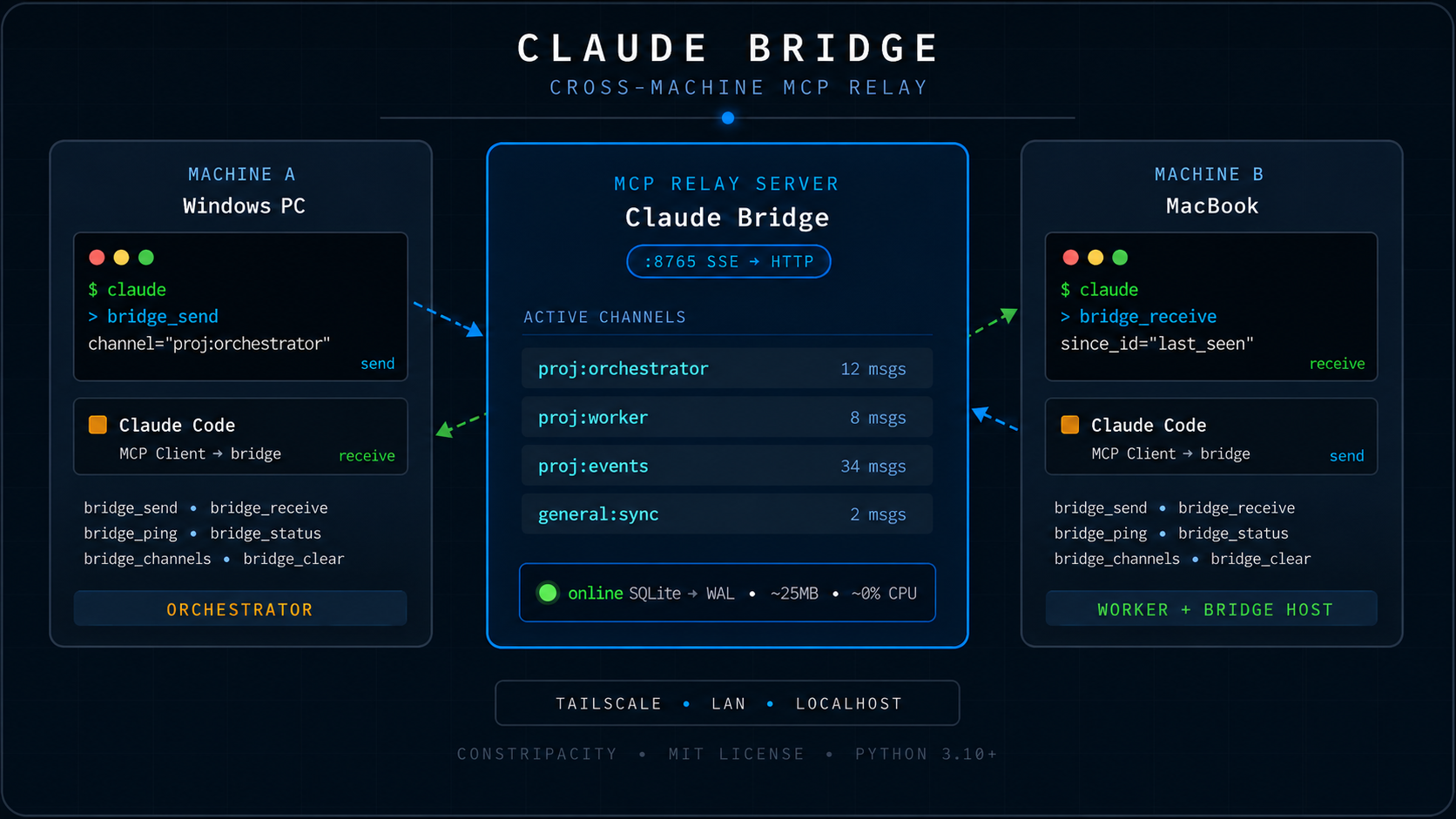
Quickstart
1. Install (on the machine that will host the server)
pip install claude-code-bridge          # server + web dashboard
pip install claude-code-bridge[tui]     # also brings the terminal UI
Why the PyPI name differs from the project name:
claude-bridgewas already taken on PyPI by an unrelated project. The distribution name isclaude-code-bridge; the import name (import claude_bridge) and the CLI command (claude-bridge) are unchanged.
Or from a clone if you'd like to hack on it:
git clone https://github.com/constripacity/Claude-Bridge.git
cd Claude-Bridge
pip install -e .[dev]              # editable install with test/lint deps
2. Start the server
claude-bridge                       # defaults: 127.0.0.1:8765, ./claude-bridge.db
# accept connections from other machines on the network:
claude-bridge --host 0.0.0.0
# or pick a custom port / db path:
claude-bridge --port 9000 --db /var/lib/claude-bridge/bridge.db
# or disable the web dashboard if you only want the MCP transport:
claude-bridge --no-dashboard
# or run as a pure stdio MCP server (no HTTP, no dashboard, no banner):
claude-bridge --stdio
The default bind changed in v0.7.3 from
0.0.0.0to127.0.0.1so a fresh install on a laptop doesn't silently expose the bridge to whatever network it's on. Pass--host 0.0.0.0(or a specific interface IP) when you actually want cross-machine reach. Combine with Authentication for anything less trusted than your own LAN/tailnet.
━━━━━━━━━━━━━━━━━━━━━━━━━━━━━━━━━━━━━━━━━━━━━━━━━
  Claude Bridge — General MCP Relay Server
  Version: 0.8.0
  http://localhost:8765/             ← Dashboard
  http://localhost:8765/sse          ← Local MCP config
  http://<host-address>:8765/sse    ← Remote machines (LAN/Tailscale)
  http://localhost:8765/api/state    ← JSON state for dashboard
  http://localhost:8765/status       ← Health check
━━━━━━━━━━━━━━━━━━━━━━━━━━━━━━━━━━━━━━━━━━━━━━━━━
3. Connect each Claude Code session to the bridge
Use the claude mcp add CLI on every machine that should use the bridge — including the host. Don't edit ~/.claude/settings.json directly; current Claude Code rejects the legacy mcpServers block at the schema level.
Host machine — points at the local server:
claude mcp add --transport sse -s user claude-bridge http://localhost:8765/sse
Remote machines — point at the host's reachable address (LAN IP, Tailscale IP, or any other network route). Make sure the host bridge was started with --host 0.0.0.0 (or the specific interface IP) — the default 127.0.0.1 only accepts local connections.
claude mcp add --transport sse -s user claude-bridge http://<host-address>:8765/sse
Single-machine / stdio mode — when there's no need for cross-machine reach, Claude Code can spawn the bridge as a subprocess and talk to it over stdin/stdout, no HTTP at all:
claude mcp add -s user claude-bridge -- claude-bridge --stdio
# share the SQLite store with an HTTP instance if you also run one:
claude mcp add -s user claude-bridge -- claude-bridge --stdio --db /path/to/shared.db
Use -s user to share the entry across all your projects, or -s local to scope it to one. Verify with claude mcp list — claude-bridge should show as ✓ Connected. If a Claude Code session is already running, type /mcp inside it to re-handshake (or restart the session) so the new tools register.
That's it. Every connected Claude Code session now has six new tools.
MCP Tools
| Tool | Description |
|---|---|
bridge_send |
Send a message to a named channel |
bridge_receive |
Read messages — pass since_id for incremental polling |
bridge_channels |
List all active channels and message counts |
bridge_ping |
Health check + server stats |
bridge_clear |
Clear all messages from a channel |
bridge_status |
Cross-channel overview with recent messages |
Usage
Agents communicate over named channels. Convention: <project>:<role>.
Machine A (orchestrator):
bridge_send(
  channel="myproject:orchestrator",
  sender="windows",
  content='{"type":"task","phase":1,"action":"run_tests"}'
)
Machine B (worker):
bridge_receive(channel="myproject:orchestrator")
→ gets the task

bridge_send(
  channel="myproject:worker",
  sender="mac",
  content='{"type":"result","phase":1,"status":"complete","tests_run":61,"failures":0}'
)
Machine A polls for results:
bridge_receive(channel="myproject:worker", since_id="<last_id>")
The since_id parameter ensures each agent only processes new messages on every poll.
If the cursor goes stale — for example after another agent runs bridge_clear and the message your since_id referred to no longer exists — bridge_receive (and GET /api/messages) returns an empty result with a since_id_not_found warning instead of silently dumping the channel from the start. Drop the bad cursor and call again without since_id to re-sync.
Channel Naming
Channels are created on first write — no registration needed.
<project>:orchestrator   →  A sends tasks to B
<project>:worker         →  B sends results to A
<project>:events         →  shared event log
<project>:debug          →  verbose diagnostics
general:sync             →  cross-project coordination
Networking
The bridge is plain HTTP + Server-Sent Events. As long as the client machine can reach the host's :8765, it works — pick whatever connectivity fits your setup:
- Single machine — use
localhost. Nothing to set up. - Same LAN — use the host's LAN IP (e.g.
192.168.1.42). No port forwarding needed. - Different networks (the original motivating case) — use a private overlay between machines:
- Tailscale is the simplest and what this project is tested against. Install on both machines, join the same tailnet, use the host's tailnet IP in the remote MCP config, and keep
:8765firewalled to the tailnet — no public exposure. - Other mesh VPNs (ZeroTier, Nebula, headscale) work the same way.
- A reverse proxy with auth on a public host works too. If you need to expose the bridge directly to a less-trusted network, enable the built-in Bearer token instead of running bare.
- Tailscale is the simplest and what this project is tested against. Install on both machines, join the same tailnet, use the host's tailnet IP in the remote MCP config, and keep
Why not use Agent Teams?
Claude Code's built-in Agent Teams (experimental, requires CLAUDE_CODE_EXPERIMENTAL_AGENT_TEAMS=1) coordinate agents on the same machine. They share a process, a filesystem, and a local network. There's no mechanism for two agents running on separate physical machines to talk to each other.
Claude Bridge is the missing layer. It's intentionally minimal — a relay, not an orchestrator. Your agents stay in control of their own logic.
CLAUDE.md
A ready-to-use CLAUDE.md is included. Drop it in your project root or add it to your global ~/.claude/CLAUDE.md to give every Claude Code session full context on how to use the bridge, which channels belong to which project, and what each machine's role is.
Web Dashboard
Open http://localhost:8765/ in any browser for a live monitor of channels, messages, and senders. Messages appear the instant they land — no 2-second lag. Click into any message for a JSON-highlighted inspector. Includes a send composer (pick a sender, type or paste JSON, ⌘↵ / Ctrl↵ to send) and a per-channel clear button. Adapts to mobile viewports automatically.
The dashboard uses a live SSE stream for the active channel's message feed and continues polling /api/state every 2 seconds for channel list and counts.
The JSON API (polling endpoints remain available for scripts and external tools):
| Endpoint | Purpose |
|---|---|
GET /api/state |
All channels + counts + senders + uptime in one call |
GET /api/messages?channel=X[&since_id=Y][&limit=N] |
Feed for one channel |
GET /api/messages/{id} |
Full message detail (parsed JSON, byte size) |
POST /api/send {channel,sender,content} |
Same effect as bridge_send |
POST /api/clear {channel} |
Drop all messages on a channel |
GET /events/channel/<name>[?since_id=Y] |
Live SSE stream for one channel |
Sends from the dashboard are indistinguishable from MCP bridge_send calls — they share the same INSERT path.
Live event stream
GET /events/channel/<name> is a Server-Sent Events endpoint. Open it and you get a real-time push of every message and clear event on that channel with ~0 ms latency. The polling JSON endpoints remain unchanged for backwards compatibility.
Events emitted:
| Event | Payload | When |
|---|---|---|
message |
{seq, id, channel, sender, content, timestamp} |
On every new message |
clear |
{channel, cleared} |
When bridge_clear or POST /api/clear runs |
cursor_stale |
{since_id} |
Reconnect cursor no longer exists — re-sync via /api/messages |
replay_truncated |
{limit} |
Backlog > 500 rows — re-sync via /api/messages |
Browser (EventSource):
const es = new EventSource('/events/channel/myproject:worker');
es.addEventListener('message', e => console.log(JSON.parse(e.data)));
es.addEventListener('clear',   e => console.log('channel cleared'));
The browser EventSource API cannot send custom headers, so when auth is enabled, pass the token as a query parameter instead:
const es = new EventSource(`/events/channel/myproject:worker?token=${encodeURIComponent(token)}`);
Access-log note: query-parameter tokens appear in server access logs. If you run the bridge behind a reverse proxy (nginx, Caddy), add a log-scrub rule for
/events/.*[?&]token=to avoid leaking tokens into your log retention.
Backlog replay on reconnect: browsers send Last-Event-ID automatically on reconnect (using the id: field from each SSE frame). TUI clients can pass ?since_id=<last-msg-id> explicitly. Up to 500 messages are replayed; if more exist, a replay_truncated event fires and the client should re-fetch via /api/messages.
Caps (env-tunable, no restart needed):
| Variable | Default | What it limits |
|---|---|---|
CLAUDE_BRIDGE_MAX_SSE |
100 | Total concurrent subscribers across all channels |
CLAUDE_BRIDGE_MAX_SSE_PER_CHANNEL |
25 | Subscribers per channel |
CLAUDE_BRIDGE_SSE_REPLAY_LIMIT |
500 | Backlog rows replayed on reconnect |
Requests past a cap get 503 Service Unavailable. A comment-line keepalive is sent every 15 s to survive the 30–60 s idle cutoff most reverse proxies enforce.
Terminal UI
If you live in a terminal, run the TUI companion instead of (or alongside) the web dashboard. Install the [tui] extra and use the module entry point:
pip install claude-bridge[tui]
python -m claude_bridge.tui
# or:  python -m claude_bridge.tui --url http://<host>:8765 --sender mac
It's a Textual app that talks to the same JSON API as the dashboard, so they're always in sync. Channels in a sidebar, live-polled feed with sender/type colouring, a JSON-highlighted inspector, send composer, filter, clear, and pause — all keyboard-driven (? for help, q to quit).
Design reference for every layout (full / compact / narrow / states) lives in docs/design/terminal/ — open index.html to browse the artboards.
Authentication
The bridge runs without auth by default — anyone who can reach :8765 can read or write any channel. That's fine for localhost, a trusted LAN, or a tailnet. If you need to expose the bridge to a less-trusted network, set a token:
# Recommended: env var (token never appears in `ps` output)
export CLAUDE_BRIDGE_AUTH_TOKEN="$(openssl rand -hex 32)"
claude-bridge

# Or read it from a file (safer than --auth-token on shared hosts)
echo "$(openssl rand -hex 32)" > /etc/claude-bridge/token
chmod 600 /etc/claude-bridge/token
claude-bridge --auth-token-file /etc/claude-bridge/token

# Or the literal value on the CLI — easy but the value shows up in `ps`
# output and /proc/<pid>/cmdline; fine for local dev, avoid on shared hosts
claude-bridge --auth-token "$(openssl rand -hex 32)"
Precedence: --auth-token > --auth-token-file > CLAUDE_BRIDGE_AUTH_TOKEN. When set, every endpoint except /status (the healthcheck) requires Authorization: Bearer <token>. Constant-time comparison; no other state. Unset everything and the bridge runs exactly as it did before — auth is fully opt-in.
Connecting clients with auth on:
# claude mcp add — pass the header on registration:
claude mcp add --transport sse -s user claude-bridge \
    http://<host-address>:8765/sse \
    --header "Authorization: Bearer $CLAUDE_BRIDGE_AUTH_TOKEN"

# TUI — picks up CLAUDE_BRIDGE_AUTH_TOKEN automatically, or pass --token:
python -m claude_bridge.tui --url http://<host-address>:8765 \
    --token "$CLAUDE_BRIDGE_AUTH_TOKEN"

# Web dashboard — open the URL in a browser. On the first /api/* call it
# prompts you for the token, stores it in localStorage, and attaches it as
# a Bearer header to every subsequent request. A green "Auth ✓" badge in
# the top-right with a `clear` button lets you rotate or forget.
stdio mode is unaffected — claude-bridge --stdio is a subprocess pipe, not a network surface, so it skips the auth check entirely.
Persistence
Messages are persisted to a local SQLite database (./claude-bridge.db by default) so they survive server restarts. Override the path with the CLAUDE_BRIDGE_DB environment variable:
CLAUDE_BRIDGE_DB=/var/lib/claude-bridge/bridge.db claude-bridge
# or:  claude-bridge --db /var/lib/claude-bridge/bridge.db
The schema is a single messages table — easy to inspect with sqlite3. Use bridge_clear to drop a channel.
Roadmap
- Optional SQLite persistence (survive server restarts)
- Web dashboard (live channel monitor in the browser)
-
claude-bridgePyPI package + CLI entrypoint - stdio transport (for pure local use without HTTP)
- Auth token support (Bearer token on every HTTP endpoint, opt-in)
- Listed on the MCP Server Registry as
io.github.constripacity/claude-code-bridge - Live SSE push stream per channel (
GET /events/channel/<name>) — dashboard + TUI switch from polling to push - WebSocket transport (alternative to SSE) — deferred unless requested
Requirements
- Python 3.10+
mcp,starlette,uvicorn,anyio,sse-starlette(declared inpyproject.toml; installed automatically bypip install claude-bridge)- A reachable network path between machines —
localhost, LAN, Tailscale, or any other route (see Networking)
Performance
The server is intentionally lightweight:
- Idle CPU: ~0% (M-series efficiency cores, no busy loop)
- Memory: ~25MB
- Latency: <5ms on LAN, <20ms over Tailscale
- Messages: persisted to SQLite (WAL mode) — survives restarts
Safe to run on a MacBook Air M3 without thermal impact.
Contributing
See CONTRIBUTING.md. PRs welcome, especially for the roadmap items above.
Credits
Constripacity – for founding this project and architecting the bridge.
License
MIT — see LICENSE.
Reviews (0)
Sign in to leave a review.
Leave a reviewNo results found