crossmem
Health Pass
- License — License: MIT
- Description — Repository has a description
- Active repo — Last push 0 days ago
- Community trust — 10 GitHub stars
Code Pass
- Code scan — Scanned 12 files during light audit, no dangerous patterns found
Permissions Pass
- Permissions — No dangerous permissions requested
This MCP server and CLI tool aggregates and indexes memory files from AI coding assistants like Claude Code and Gemini CLI into a single, searchable local database. It allows you to query your past coding context and solutions across multiple distinct projects and tools simultaneously.
Security Assessment
Overall Risk: Low. The application operates entirely locally and explicitly requires no cloud services, API keys, or network requests. The light audit scanned 12 files and found no dangerous patterns, hardcoded secrets, or dangerous permissions. Because it reads local AI memory files (like `MEMORY.md`) to build its index, it naturally accesses your project directories and ingests your development history. However, since it does not make external network requests or execute arbitrary shell commands, the risk of sensitive project data being exfiltrated is minimal.
Quality Assessment
The project demonstrates strong basic health and is under active development, with its most recent push occurring today. It is properly licensed under the standard MIT license. While it has a small community footprint at the moment (10 GitHub stars), this is typical for a niche, newly released developer utility. The codebase appears clean, well-documented, and provides clear, straightforward installation steps.
Verdict
Safe to use.
One search across all your Claude Code and Gemini CLI memories — every project, every tool. Local-only CLI + MCP server. No cloud, no API keys.
crossmem




One search across all your Claude Code and Gemini CLI memories — every project, every tool.
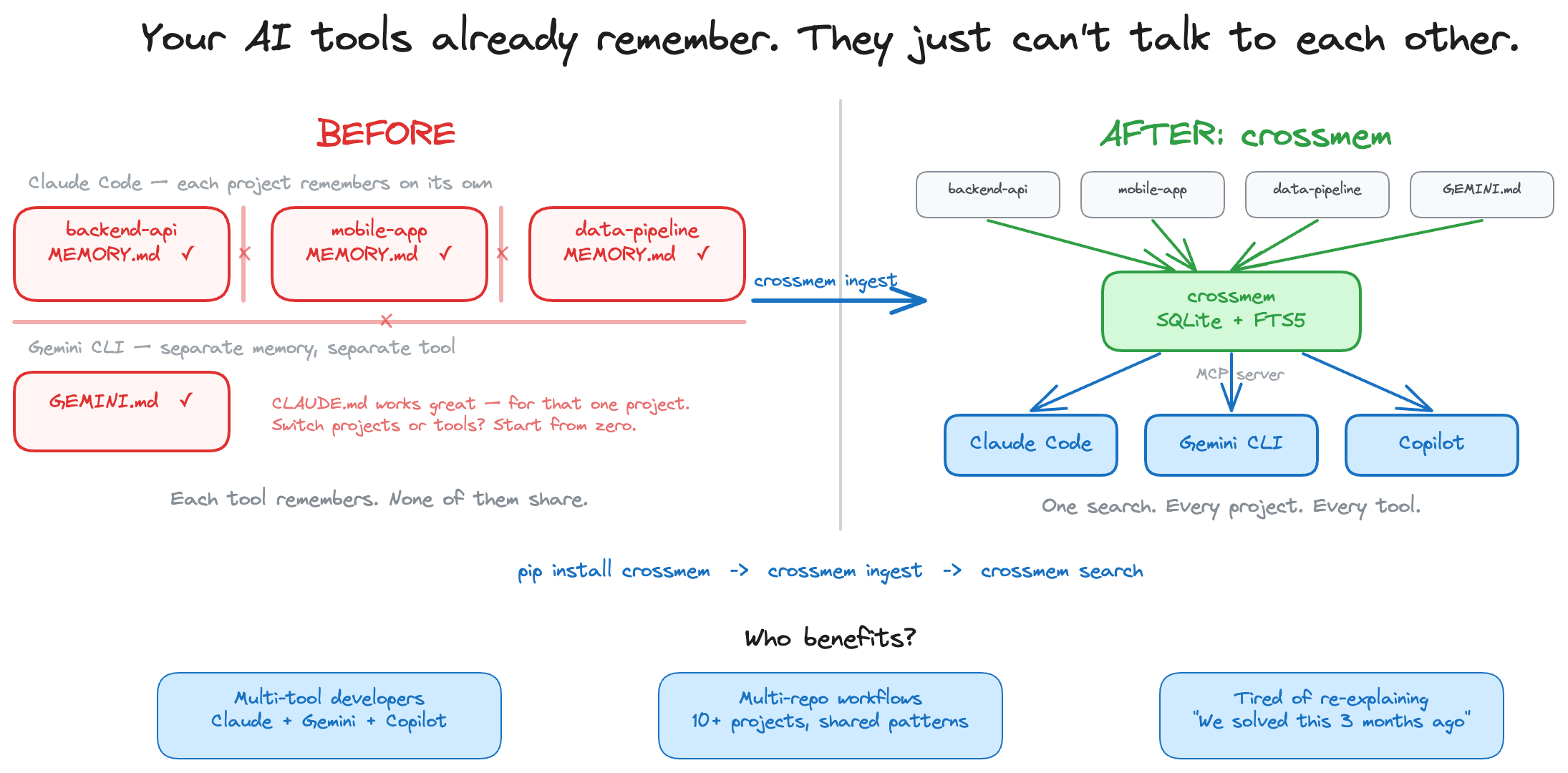

The problem
You use AI coding assistants across multiple projects. Each project's memories are locked in a silo — and each tool has its own silo too. You solved credential masking in your backend API three months ago, but when you need it in a new microservice, your AI assistant starts from scratch.
Here's what's happening under the hood:
~/.claude/projects/
├── backend-api/memory/MEMORY.md    ← Claude remembers here
├── mobile-app/memory/MEMORY.md    ← ...but can't see here
└── data-pipeline/memory/MEMORY.md ← ...or here

~/.gemini/GEMINI.md                ← Gemini's memories (separate silo entirely)
Every project is a silo. Every tool is a silo. Knowledge doesn't compound — it resets.
The fix
$ crossmem ingest
Ingested: 42 memories across 4 projects (Claude Code + Gemini CLI)

$ crossmem search "credential masking"
Found 3 results for "credential masking":

[1] backend-api / Security
    Source: MEMORY.md
    - Credentials masked in experience_memory before persisting (_mask_actions)...

[2] mobile-app / Security
    Source: MEMORY.md
    - Credentials masked via _mask_context_credentials() + _mask_text()...

[3] backend-api / Security
    Source: GEMINI.md
    - Credential masking pattern: _mask_actions for persistence, _mask_text for logs...
Three results. Two projects. Two AI tools. One query. The pattern was already solved.
How crossmem differs
- vs Mem0 — Mem0 is cloud-based and requires an API key. crossmem is local-only with zero accounts.
- vs Basic Memory — Basic Memory works within one tool. crossmem aggregates across tools and projects.
- vs grep — crossmem parses multiple formats, deduplicates, and runs as an MCP server — your AI assistant queries it automatically at session start.
Install
pip install crossmem
# or
uv pip install crossmem
Quick start
pip install crossmem        # 1. Install
crossmem ingest             # 2. Index all your AI memories
crossmem search "retry"     # 3. Search across every project
That's it. Three commands, zero config. crossmem finds Claude Code and Gemini CLI memory files automatically.
To give your AI tools direct access, add the MCP server to your config (see MCP Server below) — then mem_recall() and mem_search() just work inside your coding sessions.
Usage
# Ingest Claude Code + Gemini CLI memories
crossmem ingest

# Search across every project
crossmem search "JWT token rotation"
crossmem search "retry strategy" -p backend-api
crossmem search "docker compose" -n 5

# Save a discovery
crossmem save "Always use middleware for credential masking" -p backend-api -s Patterns

# Delete stale or wrong memories
crossmem forget 42                   # delete memory #42 (with confirmation)
crossmem forget -p old-app           # delete all memories for a project
crossmem forget 42 --confirm         # skip confirmation prompt

# Sync Claude memories → Gemini CLI
crossmem sync                        # sync everything
crossmem sync -p backend-api        # sync one project + shared patterns

# Watch for changes and auto-sync
crossmem sync-watch                  # polls every 30s
crossmem sync-watch --interval 10    # custom interval

# Visualize the knowledge graph
crossmem graph

# See what's in the database
crossmem stats
How it works
- Ingest — Finds Claude Code and Gemini CLI memory files automatically, splits into chunks, deduplicates
- Index — Stores everything locally in SQLite — no cloud, no API keys, no accounts
- Search — Full-text search with stemming. Multi-word queries use AND logic; quoted phrases for exact matches
- Learn — AI tools save new discoveries via
mem_saveduring sessions. Knowledge compounds automatically - Sync — One-way sync from Claude → Gemini, preserving each tool's own memories
How it works with your AI tools
Once the MCP server is configured, your AI assistant automatically uses crossmem:
You: "How should I handle credentials in this new service?"

AI: Let me check crossmem for existing patterns...
    [calls mem_recall → finds credential masking in 3 of your projects]

    Based on your previous work across backend-api, mobile-app, and infra-tools,
    you consistently use a middleware layer for credential masking. Here's the
    pattern from your backend-api project:
    - Credentials stored in Secret Manager, never in env vars
    - API keys masked in logs via _mask_sensitive_headers()
    ...
No copy-pasting. No "I already solved this." Your AI assistant recalls patterns from every project you've worked on — automatically.
MCP Server
crossmem runs as an MCP server so AI coding tools can search, recall, and save memories in real-time.
Setup
Add to your tool's MCP config:
Claude Code (~/.mcp.json for global, or .mcp.json in project root):
{
  "mcpServers": {
    "crossmem": {
      "command": "crossmem-server"
    }
  }
}
Gemini CLI (~/.gemini/settings.json):
{
  "mcpServers": {
    "crossmem": {
      "command": "crossmem-server"
    }
  }
}
VS Code / GitHub Copilot (.vscode/mcp.json in project root, or user settings.json):
{
  "servers": {
    "crossmem": {
      "command": "uvx",
      "args": ["--from", "crossmem", "crossmem-server"]
    }
  }
}
Note: For Claude Code and Gemini CLI, if
crossmem-serverisn't on PATH, use the sameuvxcommand shown in the Copilot config above.
Tools
| Tool | Description |
|---|---|
mem_recall |
Load project context + cross-project patterns at session start (auto-detects project from cwd) |
mem_search |
Search across all memories (query, project filter, limit) |
mem_save |
Save a discovery during a session — immediately searchable |
mem_forget |
Delete a memory by ID (find IDs via mem_search) |
mem_ingest |
Refresh the index when memory files change (auto-runs on server startup) |
Start manually
crossmem serve # starts MCP server on stdio (same as crossmem-server)
Supported tools
| Tool | Ingestion |
|---|---|
| Claude Code | ~/.claude/projects/*/memory/*.md |
| Gemini CLI | ~/.gemini/GEMINI.md |
| VS Code / GitHub Copilot | Via MCP server (no direct ingestion — uses the shared index) |
Ingestion is pluggable — PRs welcome for new tools.
License
MIT
Reviews (0)
Sign in to leave a review.
Leave a reviewNo results found