pycodemath
Health Warn
- License — License: MIT
- Description — Repository has a description
- Active repo — Last push 0 days ago
- Low visibility — Only 7 GitHub stars
Code Warn
- network request — Outbound network request in pycodemath/bench/processbench.py
- network request — Outbound network request in pycodemath/bench/real_bench.py
Permissions Pass
- Permissions — No dangerous permissions requested
No AI report is available for this listing yet.
Token-efficient exact math for AI agents (SymPy + NumPy): symbolic engine, ODE suite, optimizer, code generator.

Your code looks right. Is the math?






Pycodemath checks functions against
their formulas and returns either a proof or a concrete input that breaks them.
No guessing, no random samples. Also an exact math engine and MCP server for AI
agents: write math in a few characters, get an exact answer or standalone,
optimized Python/NumPy code back — instead of asking a language model to "do
arithmetic in its head" or to hand-write numerical loops.
Polska wersja tego dokumentu: README.pl.md.
Built as a thin, disciplined layer over SymPy + NumPy:
- Cut tokens — one short command in, one exact result out. Perfect as an
agent tool (MCP server included). - Better code than naive Python — the generator applies symbolic
simplification + common-subexpression elimination (CSE) before emitting
code (measured ~1.7x faster than naive expansion on repeated
subexpressions). - Answers you can branch on — a failure is a TYPE, not a message, and a
numerical answer can hand back the evidence behind it. See
Results you can branch on. - Check instead of compute — an identity, a derivation step by step, or
an engine answer, judged VERIFIED / REFUTED (with a counterexample) /
UNDECIDED. See Verify. - Check the math in your code — a function against its formula, float
accuracy, overflow, money, units and geometry, each with a witness or a
proof. See Check the math in your code.
text → [parser] → IR (expression tree) → [engine]     evaluate / simplify / solve
                                       → [generator]  IR → CSE → Python/NumPy source
Check the math in your code
Code that computes a formula can be checked like an identity. Pycodemath reads a
Python function, proves it equal to the formula it should compute, or hands back
the exact call that breaks it — really executed, never "it disagreed on some
random samples". The same contract runs through every check below: VERIFIED
is a proof, REFUTED always carries a concrete witness checked exactly, and
anything else is UNDECIDED with a reason. Every answer ends with acertificate: line — the check written down, re-runnable from the file alone
(see Certificates).
Does this function compute that formula? The classic off-by-one:
>>> from pycodemath import check_code, emit_test
>>> src = "def sum_to(n: int) -> int:\n    total = 0\n    for k in range(n):\n        total += k\n    return total\n"
>>> r = check_code(src, "n*(n+1)/2")
>>> r.verdict, r.counterexample.call
('refuted', 'sum_to(n=1)')
>>> r.reason
'sum_to(n=1) returns 0, the formula gives 1 — confirmed by executing the function and evaluating the formula exactly'
>>> check_code(src, "n*(n-1)/2", domain={"n": "integer, n>=0"}).verdict
'verified'
>>> "assert sum_to(n=1) == 1" in emit_test(r, module="sums")
True
Correct code comes back VERIFIED with a proof (symbolic, branch by branch, or an
exact certificate for integer code with // and %). Float rounding alone never
counts as a bug here — that is what stability is for. emit_test writes the
pytest that pins the counterexample. From the shell, on your own file (its
function is executed in an isolated worker to confirm a refutation):
python -m pycodemath "verify code sums.py:sum_to == n*(n+1)/2 --emit-test"
python -m pycodemath "verify code sums.py:sum_to == n*(n-1)/2 where n: integer, n>=0"
Floating-point accuracy, with proof. How many bits does float64 lose, where,
and why — and a rewrite that is proved equal and measured better:
$ python -m pycodemath "stability sqrt(x + 1) - sqrt(x) for x in [1e10, 1e15]"
sqrt(x + 1) - sqrt(x) [float64]: loses 41.0 bits on average (max 49.9); worst at {'x': '510800533960562.3'}
  worst: at x = 510800533960562.3 computes 1.862645149230957e-08, exact 2.2123015980434279398e-8 (49.9 bits)
  culprit: sqrt(x + 1) - sqrt(x) — cancellation: subtracting nearly equal values (41.0 bits on average); try p - sqrt(q) -> (p^2 - q) / (p + sqrt(q)) (conjugate)
certificate: REFUTED (re-evaluation) — at x = 510800533960562.3: float64 computes 1.862645149230957e-08 (emitted NumPy code), exact 2.2123015980434279398E-8 (SymPy, 40 digits): 49.9 bits lost (more than 3)
>>> from pycodemath import diagnose, improve
>>> rep = diagnose("sqrt(x + 1) - sqrt(x)", {"x": (1e10, 1e15)})
>>> round(rep.mean_bits, 1), rep.culprits[0].cause
(41.0, 'cancellation: subtracting nearly equal values')
>>> imp = improve("sqrt(x + 1) - sqrt(x)", {"x": (1e10, 1e15)})
>>> imp.best.expression, imp.best.proof.status, round(imp.best.mean_bits, 1)
('1 / (sqrt(x + 1) + sqrt(x))', 'verified', 0.4)
improve ... emit python|numpy|c prints the code that computes exactly what was
measured. No rewrite is ever returned without a proof. Compared with Herbie on the
11 Hamming benchmarks C2 did not look at while it was tuned: 7.25 bits of error
left vs 8.08 for Herbie's outputs (better on 3, worse on 5, tied on 3) — against
Herbie's published 2017 report (the 1.1 era), not today's Herbie 2.x, which could
not be installed in the measuring environment.
Will it overflow? The 2006 binary-search bug, with the input that breaks it
(executed in NumPy int32) and a fix that is proved equivalent:
$ python -m pycodemath "ranges (lo + hi) // 2 for lo in [0, 2^31-1], hi in [0, 2^31-1] as int32"
(lo + hi) // 2  [int32]  -> problems
  confirmed overflow                   lo + hi at {'hi': '2147483647', 'lo': '2147483647'} -> -2
  advice: lo + (hi - lo) // 2 [int32] removes overflow
  advice: (lo + hi) // 2 [int64] removes overflow
  advice proof: lo + (hi - lo) // 2 — verified (symbolic (integer parity cases))
  advice proof: (lo + hi) // 2 — verified (same expression)
certificate: REFUTED (execution) — overflow at lo + hi: lo + hi at hi=2147483647, lo=2147483647: got -2, exact 4294967294

$ python -m pycodemath "maxsafe exp(x) for x as float32"
x <= 88.72283172607422 is safe in float32 (exact bound 11629079/131072; interval/exhaustive proof below, executed witness above)
  first failure: exp(x) at x=88.72283935546875: got inf, exact 3.4028244988034356558e+38
  x <= 88.72283172607422 is proved safe; x = 88.72283935546875 fails (overflow at exp(x))
certificate: VERIFIED (proof) — no event in float32 over the given ranges
int8…uint64, float16, bfloat16, float32, float64: overflow, underflow,
subnormals, NaN, division by zero, lost integer precision (for t_ms in [0, 2^31-1] int as float32 — millisecond timestamps in float32). "Safe" is a proof, not a
guess. In Python: pycodemath.code.analyze(expr, ranges, dtype) andmax_safe_input.
Calculator that proves its answers
$ python -m pycodemath "factor 2^64+1"
274177 * 67280421310721
certificate: VERIFIED (proof) — product of the factors equals 18446744073709551617 exactly; each factor is proven prime; re-multiplied: the factors give the number back

$ python -m pycodemath "special zeta 3 digits 50"
1.2020569031595942853997381615114499907649862923405
certificate: VERIFIED (cross-check) — precision ladder: values at 65 and 130 digits agree; Euler-Maclaurin summation agrees with the default (Borwein) algorithm

$ python -m pycodemath "var sample 1 2 3 4"
5/3
certificate: VERIFIED (proof) — exact rational sample variance over a common denominator
Primality is proved (deterministic Miller–Rabin below 3.3·10²⁴, Lucas–Lehmer or
a re-checkable Pocklington certificate above it; anything only BPSW-probable is
UNDECIDED and says so). Number theory, combinatorics, 13 special functions at any
precision, exact descriptive statistics, 7 distributions and an A/B toolkit
(samplesize, power, ci wilson|exact, ztest, welch, holm) whose
answers always carry the peeking and multiple-comparison warnings. In Python:pycodemath.calc and pycodemath.stats.
Units and dimensions
$ python -m pycodemath "5 km/h to m/s"
25/18 m/s ≈ 1.38888888888889 m/s
certificate: VERIFIED (exact-conversion) — 5 km/h = 25/18 m/s ≈ 1.38888888888889 m/s (dimension ratio 1, exact round trip; sympy.physics.units agrees: True)

$ python -m pycodemath "units F = m*v where F:N m:kg v:m/s"
REFUTED (dimensional-analysis) — left is kg·m/s² (force), right is kg·m/s (momentum)
  left: kg·m/s²; right: kg·m/s
certificate: REFUTED (dimensional-analysis) — left is kg·m/s² (force), right is kg·m/s (momentum)
Units are a verification signal, not only a converter: check_dimensions("F", "m*v", {"F": "N", "m": "kg", "v": "m/s"}) is refuted with a witness. Absolute
°C/°F are never scaled silently, KB, month, dB are refused as ambiguous,
and rad/s is not Hz. In Python: pycodemath.convert, check_dimensions,dimension_of, pycodemath.units.
Money: no lost cents
$ python -m pycodemath "money split 100 PLN into 3"
33.34 + 33.33 + 33.33 = 100.00 PLN  (hamilton; sums exactly: True)
certificate: VERIFIED (exact) — shares sum to the total exactly (rational sum); zero weights get zero; every share within one unit of its quota; equal split: spread <= one unit; shares re-added in exact fractions

$ python -m pycodemath "money float round(x*1.23, 2) for x in 0.01..50.00 currency PLN"
float gives 0.61 where exact decimal arithmetic gives 0.62; e.g. the literal 1.23 is stored as 1.229999999999999982236431605997495353221893310546875
  witness: at x = 0.50 floats give 0.61, exact 0.62 (22 of 5000 inputs wrong)
certificate: REFUTED (execution) — float gives 0.61 where exact decimal arithmetic gives 0.62; e.g. the literal 1.23 is stored as 1.229999999999999982236431605997495353221893310546875

$ python -m pycodemath "money irr -100,230,-132"
IRR: 10%, 20% (2 rates — the IRR is not unique; exact brackets [['1/10', '1/10'], ['1/5', '1/5']])
certificate: VERIFIED (exact) — sign change (or exact zero) of the square-free factor on every bracket; root count == Sturm count on (0, inf); Descartes' rule of signs: bound and parity; each rate within 10^-12 of the true root
Also money round (8 named modes, cash steps), money vat (per line vs on the
total, with the proven worst case), money interest, money loan (the last
instalment corrects the rounding) and money npv. No floats inside: exact
fractions, Decimal at the currency's ISO 4217 scale. In Python: allocate,round_money, float_money_hazard, pycodemath.money.
Geometry and graphics
$ python -m pycodemath "rotcheck q1*q2 == R2@R1"
REFUTED (exact-witness) — the two sides differ at 1 = (1, 2, 3, 4) / sqrt(30), 2 = (2, -1, 1, 3) / sqrt(15)
  likely cause: multiplication order reversed (q1*q2 applies q2 FIRST; R1@R2 applies R2 first); row-vector (v@M) matrices read as column-vector (M@v) ones, or vice versa
certificate: REFUTED (exact-witness) — multiplication order reversed (q1*q2 applies q2 FIRST; R1@R2 applies R2 first); row-vector (v@M) matrices read as column-vector (M@v) ones, or vice versa

$ python -m pycodemath "epsilon orient2d 1e-9"
REFUTED — 2 witness(es), each re-executed in floats and decided exactly
  false_degenerate: input [[0.0, 0.0], [1.0, 0.0], [0.5, 4.656612873077393e-10]] — the epsilon test says collinear, exactly ccw
  wrong_sign: input [[128.00000000000117, 128.00000000000136], [3072.0, 3072.0], [6144.0, 6144.0]] — the epsilon test says cw, exactly ccw
certificate: REFUTED (exact-witness) — 2 witness(es), each re-executed in floats and decided exactly
Rotations without convention roulette (quat2mat, euler2mat, mat2euler, all
24 Euler conventions), predicates that never lie (orient2d, orient3d,incircle: Shewchuk's filter with an exact fallback), CSS easing with a proved
enclosure, Bézier arclength with a rigorous bracket, and emit of every formula
as Python, NumPy, C and GLSL, executed against the certified implementation. In
Python: compare_rotation_expressions, orient2d, pycodemath.geometry.
Numbers you can trust
An exact answer comes with its decimal, and the decimal is proved: every
digit printed is the correctly rounded value, decided by interval arithmetic
(sqrt(2)/2 ≈ 0.707106781186548). evalf <expr> <digits> and N(<expr>, <d>) ask for more digits; identify recognises a constant only when enough
digits exclude a coincidence:
$ python -m pycodemath "evalf exp(pi*sqrt(163)) - 640320^3 - 744 15"
≈ -7.49927402801814e-13
  15 digits, interval (rigorous)
certificate: VERIFIED (interval) — rigorous interval enclosure at 178 bits rounds to the same 15 digits at both ends

$ python -m pycodemath "identify 1.6449340668482264"
1.6449340668482264: UNDECIDED — best candidate pi**2/6 is consistent with the 17 digits given, but 17 < 50 digits cannot exclude a coincidence
  candidate pi**2/6  (deviation -3.65e-17, agrees on 16 digits, margin 11.5)
  warning: only 17 significant digits: the 150 families searched hold far more than 10^17 formulas with small coefficients, so a match to 17 digits happens by chance (the 'strong law of small numbers' — numerology); give at least 50 digits to recognise a constant
certificate: UNDECIDED (pslq+enclosure) — best candidate pi**2/6 is consistent with the 17 digits given, but 17 < 50 digits cannot exclude a coincidence
Where no rigorous enclosure exists (besselj, a non-integer zeta), the digits
are an agreement of two precisions and say so — rigorous: false, a certificate
that is UNDECIDED, never VERIFIED:
>>> from pycodemath import approx, identify
>>> a = approx("besselj(0, 1)")
>>> a.value, a.method, a.rigorous
('0.765197686557967', 'stable-doubling', False)
>>> identify("zeta(2)").value
'pi**2/6'
Measured (K2 report): sympy.nsimplify "recognises" 60 of 60 random 16-digit
numbers; identify claims 0 of the same 60. In Python: approx, evalf_to,dual, identify.
Inequalities, systems, definite integrals — every answer proved
The real line is cut at every zero and every domain boundary, each cut point is
decided exactly (in or out), and each open cell is proved to keep one sign. A
system comes with a completeness argument; an integral through a pole is found
to diverge instead of being stepped over ([-1/x] = -2 is impossible here); a
convergent one is returned only when its closed form agrees with an independent
high-precision quadrature, and one with no closed form answers converges,
value ≈ …:
$ python -m pycodemath "solve x^2 - 3x + 2 < 0"
x ∈ (1, 2)
  proof: sign decomposition (exact-roots) — 3 cells, 2 endpoints decided exactly
certificate: VERIFIED (exact-roots) — sign decomposition (exact-roots): 3 cells, 2 endpoints decided exactly

$ python -m pycodemath "solve x + y = 3, x - y = 1 for x, y"
x = 2, y = 1
  proof: rank(A) = rank([A|b]) = 2; the solution set is an affine space of dimension 0 = n - rank, and the substituted family satisfies every equation identically in its 0 parameter(s)
certificate: VERIFIED (linear) — rank(A) = rank([A|b]) = 2; the solution set is an affine space of dimension 0 = n - rank, and the substituted family satisfies every equation identically in its 0 parameter(s)

$ python -m pycodemath "integrate 1/x^2 dx from -1 to 1"
diverges to oo
  singular points inside: 0
  the integral diverges to +oo by the limit comparison test — at 0-: lim t·f = oo (nonzero); at 0+: lim t·f = oo (nonzero)
certificate: VERIFIED (proof) — the integral diverges to +oo by the limit comparison test — at 0-: lim t·f = oo (nonzero); at 0+: lim t·f = oo (nonzero)

$ python -m pycodemath "solve sin(x) = 1/2 all"
x = pi/6 + 2*pi*k, x = 5*pi/6 + 2*pi*k, k ∈ ℤ
  proof: period 2*pi (the two sides are identical after automatic simplification); solutions in one period complete (sign decomposition)
certificate: VERIFIED (interval-arithmetic) — period 2*pi proved (the two sides are identical after automatic simplification); the solutions in one period proved complete by sign decomposition
reduce x^2 < 4 for x reads the same; for x in [0, 2*pi] bounds a
trigonometric inequality; the Cauchy principal value only on request (pv). On
the K5 evaluation set (96 cases): 0 verified wrong answers, against 3 for raw
SymPy 1.14 and 5 for Maxima 5.46. In Python: solve_inequality, solve_system,periodic_solutions, definite_integral.
How many times does this loop run?
count_iterations(f) reads the loops and returns the exact count, the region
where it holds and Θ proved by a limit — then runs the function and counts.check_iterations(f, "n**2") catches an off-by-one with a real call. Recurrences
are solved with their conditions: the master theorem refuses 2T(n/2) + n/log n
(the gap between cases 1 and 2) and Akra–Bazzi answers Θ(n log log n):
$ python -m pycodemath "iterations tests/data/lint/dev/p504_zero_based_ok.py:sum_below == n + 1"
REFUTED (execution) — at n=0 the loop ran 0 times; the claim gives 1
  counted: n iterations
certificate: REFUTED (execution) — at n=0 the loop ran 0 times; the claim gives 1

$ python -m pycodemath "recurrence T(n) = 2*T(n/2) + n/log(n)"
Θ(n*log(log(n)))
  Akra–Bazzi: Θ(n*log(log(n))) by Akra–Bazzi (master theorem refused: master theorem does not apply: gap: f = Θ(n^1 log^-1 n) with k = -1 < 0 lies between case 1 and case 2)
  check: terms [('2', '1/2')]: a_i > 0, 0 < b_i < 1
  check: g(n) > 0 for all large n
  check: p = 1 solves sum a_i b_i^p = 1
  check: polynomial growth: lim n g'(n)/g(n) = 1 (finite), so g is regularly varying and g(u)/g(n) is bounded above and below for u in [b n, n]
  check: ∫_2^n g(u)/u^(p+1) du = log(log(n)) - log(log(2))
certificate: VERIFIED (Akra–Bazzi) — Θ(n*log(log(n))) by Akra–Bazzi (master theorem refused: master theorem does not apply: gap: f = Θ(n^1 log^-1 n) with k = -1 < 0 lies between case 1 and case 2)
>>> from pycodemath import count_iterations, check_iterations
>>> src = "def pairs(n: int) -> int:\n    c = 0\n    for i in range(n):\n        for j in range(i):\n            c += 1\n    return c\n"
>>> r = count_iterations(src)
>>> str(r.main), r.valid_for, str(r.theta), r.certificate.points, r.certificate.agree
('n*(n - 1)/2', 'n >= 1', 'n**2', 39, True)
>>> check_iterations(src, "n**2/2").reason
'at n=1 the loop ran 0 times; the claim gives 1/2'
Also complexity f.py:f is O(n log n) (O, Theta, Omega, o, omega — decided by a
limit) and master <a> <b> <f>. On the C5 set: SymPy's rsolve gives a closed
form for 5 of 20 recurrences and refuses every divide-and-conquer one; the
empirical big_O package names the right class for 10 of 17 loops (C5 report,
same cases). The CLI runs YOUR file; over MCP (math_iterations) nothing runs
unless the agent passes execute=true.
Lint the math in your repo
python -m pycodemath.lint src/ (or the pycodemath-lint script) finds the
places where the mathematics in your code computes the wrong value — float
formulas that lose precision, integer overflow for a declared NumPy dtype,round() and binary floats on money, == on floats, ^ used as a power, arange off by one against the function's :math: formula. Every finding
carries a witness: a concrete input that was executed, and the exact value it
should have produced, computed independently. Where a fix exists it is proved
equal.
$ python -m pycodemath "lint tests/data/lint/dev/p401_gross.py --concise --no-cache"
p401_gross.py:3:12: PCM401 binary floats change this amount: round(price * 1.23, 2) at price=0.50 = 0.61, exact 0.62 — use Decimal
p401_gross.py:3:12: PCM503 round() is half-to-even: round(price * 1.23, 2) at price=1.50 = 1.84, exact 1.85 with HALF_UP
Found 2 findings in 1 file.
certificate: REFUTED (witness) — PCM401 line 3: binary floats change this amount: round(price * 1.23, 2) at price=0.50 = 0.61, exact 0.62 — use Decimal (+1 more)
Exit codes as ruff (0 clean, 1 findings, 2 error — for lint only). Rules:--list-rules, --explain PCM401. SARIF for GitHub code scanning: --format sarif (example workflow in examples/github-action/pcm-lint.yml). pre-commit:
hook id pycodemath-lint. pytest: pytest --pcm checks every :math: /@spec as a test (installed as a plugin that does nothing without the flag).
On L1's held-out set: 13 of 13 expected findings, 0 false positives. In Python:lint_source, lint_paths, spec, LintConfig.
For agents: six more MCP tools
math_eval answers every line above (its payload gains result — the module's
own result object — and certificate). Five typed tools take what does not fit
one line: math_check_code (a function's source; by default the code is only
read and proved, never run — a refutation that needs running it stays
UNDECIDED until the agent passes execute=true), math_iterations andmath_lint (source too, the same execute=false default), math_stability andmath_ranges (a dict of variable ranges). math_recheck re-runs any
certificate. All six answer with the same six fields: text, kind,status, result, certificate, error.
Install
pip install -e .                  # core: sympy + numpy
pip install -e .[mcp]             # + MCP server for AI agents
pip install -e .[dev]             # + pytest
Requires Python ≥ 3.11. The package ships a py.typed marker, so everything
below is fully typed for an installed caller — including the overloads that
make full_result=True change the return type. No cast() anywhere.
Quick start
One-shot CLI (scriptable)
Every command below is a real invocation with its real output.
$ python -m pycodemath "diff sin(x)*x dx"
x*cos(x) + sin(x)

$ python -m pycodemath "integrate 2*x dx"
x**2

$ python -m pycodemath "solve x^2 - 4 for x"
-2, 2

$ python -m pycodemath "sin(x)^2 + cos(x)^2"
1

$ python -m pycodemath "eig [[2,1],[1,2]]"
3, 1

$ python -m pycodemath "solve_nd x^2+y^2-4; x-y for x,y at 1,1"
x = 1.4142135623746899, y = 1.4142135623746899
Errors go to stderr with exit code 1, results to stdout with exit code 0 —
safe to call from scripts and agent tools. On Windows consoles setPYTHONUTF8=1.
REPL
python -m pycodemath # or just: pycodemath
Type help for the full command table (derivatives, integrals, equation
solving, matrices, root finding, optimization, the whole ODE suite, code
generation, and every check in Check the math in your code).
Names are read strictly: speed*time has two variables, never ten letters; an
unknown command word is refused with "did you mean". In the REPL, implicit on
splits multi-letter names into letters (2xy = 2*x*y) and implicit off
restores the default; a certificate records which mode its claim was read in.
MCP server (math for any AI agent)
pip install -e .[mcp]
claude mcp add pycodemath -- python -m pycodemath.cli.mcp_server
Exposes math_eval, that accepts the same commands as the REPL —
an agent sends diff sin(x)*x dx and receives x*cos(x) + sin(x) exactly,
with zero mental arithmetic. What it sends BACK is
a structured response, not just prose.
Its twin, math_verify, CHECKS instead of computing — an identity, a
derivation or an engine answer — see Verify.
Four more tools check code and certificates: math_check_code,math_stability, math_ranges, math_recheck — see
For agents.
Results you can branch on
A numerical answer is not only a number. It matters whether a root is
rock-solid or scraped in on the last allowed iteration; whether an integral is
accurate or merely finished. Pycodemath makes both askable — and typed.
A failure is a type, not a message
Everything the library refuses raises a subclass of PycodemathError, so a
caller branches on the class instead of string-matching a message:
| exception | what happened | when |
|---|---|---|
ParseError |
the text was refused before any math | bad syntax, mismatched matrix |
DomainError |
a bad value, shape, option or point | n <= 0, unknown method, sample outside the domain |
DivergenceError |
the iterate escaped | function unbounded below, no root in that direction |
StagnationError |
the run stopped making progress | step size collapsed, value stopped moving |
NonConvergenceError |
the iteration limit ran out | max_iter reached with the residual still large |
NotAMinimumError |
the run ARRIVED — at the wrong kind of point | started on a maximum, a saddle or an inflection |
BudgetExhaustedError |
YOUR evaluation budget ran out, not the math's | max_evals reached while refining an integral |
TimeBudgetError |
YOUR wall clock ran out, with nothing to show | SymPy still working after 120 s on a symbolic call |
NoClosedFormError |
the engine SEARCHED and found no closed form | integrate exp(sin(x)) dx, an infinite sum, dsolve y' = t²+y² |
UnsupportedFormError |
the engine has no METHOD for this shape — it never searched | solve exp(x)+x^5-3 for x mixes x with exp(x) |
The first two are refusals of the INPUT; the rest are outcomes of a RUN.
That line matters — it is the same line the structured results and the MCP
payload draw, below.
>>> from pycodemath import parse, minimize, DivergenceError
>>> try:
...     minimize(parse("-x^2"), "x", 1.0)
... except DivergenceError:
...     print("unbounded below — no minimum to find")
unbounded below — no minimum to find
Messages name the offending value and say what to do next, so the prose is
worth reading when a human is the one reading it:
>>> minimize(parse("-x^2"), "x", 1.0, method="sgd")
DomainError: minimize: unknown method 'sgd' — available: gd, newton, bfgs
full_result=True — the evidence behind the answer
root_find, minimize, root_find_nd and minimize_nd return a bare number
by default. Ask for the full result and you get a SolveResult instead: the
same value, plus what the loop knew.
>>> from pycodemath import root_find
>>> root_find(parse("x^2 - 2"), "x", 1.0)
1.4142135623746899
>>> root_find(parse("x^2 - 2"), "x", 1.0, full_result=True)
SolveResult(value=1.4142135623746899, iterations=5, residual=4.510614104447086e-12, converged=True, status='converged')
residual is how far the RETURNED point still is from solved (|f(x)| for
root finding, ‖∇f(x)‖∞ for minimization), recomputed at that point — not the
smallest value seen along the way.
The interesting half is failure. Under full_result=True an iteration outcome
is RETURNED as data instead of raised: value is the last iterate — where the
solver gave up, not an answer — and converged is the only field to branch on.
>>> minimize(parse("-x^2"), "x", 1.0, full_result=True)
SolveResult(value=1085298990978.309, iterations=152, residual=2170597981956.618, converged=False, status='diverged')
>>> minimize(parse("x^4"), "x", 1.0, lr=1.0, full_result=True)
SolveResult(value=1.0, iterations=9, residual=4.0, converged=False, status='stagnated')
status comes from a single vocabulary — converged, diverged,stagnated, not_converged, not_a_minimum (importable as SOLVE_STATUSES)
— mirroring the exception classes above, so a run reports the same outcome
whichever way you ask for it.
An INPUT refusal raises BOTH ways. DomainError is not an iteration outcome:
there is no last iterate to hand back, and inventing a status for it would be
a lie.
>>> minimize(parse("-x^2"), "x", 1.0, method="sgd", full_result=True)
DomainError: minimize: unknown method 'sgd' — available: gd, newton, bfgs
A residual of inf means the quantity could not be measured at the failed
run's last iterate — not that it was enormous.
What converged actually claims
converged=True means the value is an answer to the question that was asked
— a ROOT for the root finders, a MINIMUM for the minimizers. Not "an exit test
fired", which is a weaker claim, and until v0.3 module 8 the two came apart in
both directions. Three lines, each reproducible:
>>> minimize(parse("-x^2"), "x", 0.0, full_result=True)
SolveResult(value=0.0, iterations=1, residual=0.0, converged=False, status='not_a_minimum')
>>> from pycodemath import minimize_nd
>>> minimize_nd(parse("x^2 - y^2"), ["x", "y"], [0.0, 0.0], full_result=True)
SolveResult(value=[0.0, 0.0], iterations=1, residual=0.0, converged=False, status='not_a_minimum')
>>> root_find(parse("exp(x)"), "x", 0.0, full_result=True)
SolveResult(value=-100.0, iterations=100, residual=3.720075976020836e-44, converged=False, status='not_converged')
The first two are the point of not_a_minimum: a vanishing gradient holds at
EVERY stationary point, so a maximum and a saddle pass the exit test exactly as
well as a minimum. Before this was checked, both came back converged=True.
When the gradient test fires, the solver now probes f around the point and
reports the outcome as refuted only when it has found a strictly lower value
nearby — the definition of "not a minimum", rather than a verdict read off a
curvature sign. That distinction is what makes x^4 at 0 (a minimum) and -x^4
at 0 (a maximum) separable at all: both have f'' = 0, so no second-order test
can tell them apart, and the first is still accepted:
>>> minimize(parse("x^4"), "x", 0.0)
0.0
The third line is the other direction, and it is the reason residual is not a
substitute for converged: exp(x) = 0 has no root, and the iterate simply
walked left until the function had DECAYED below the tolerance. A refused run
can carry a residual of 3.7e-44. Rejecting the wrong answer also finds a right
one that was previously missed — exp(x) - 1e-11 really does have a root, and
the run used to stop 2.4 short of it:
>>> root_find(parse("exp(x) - 1e-11"), "x", 0.0)
-25.32843600828441
And converged=True does not require the residual to be under tol either.
Plain gradient descent near a minimum can only resolve f to the rounding noise
of float64, which happens while ‖∇f‖ is still around 1e-8; the value is
right to eight significant figures, and reporting that as a stall — which it did
— was a false alarm:
>>> minimize(parse("sin(x)"), "x", 0.0, full_result=True)
SolveResult(value=-1.5707963180031523, iterations=183, residual=8.791744282758072e-09, converged=True, status='converged')
not_a_minimum is the one status you should NOT retry with a bigger max_iter.
The run had no trouble converging and more iterations cannot help: the step at a
stationary point is zero, so the iterate cannot move however long you let it run.
Start from a different point, beside that one.
One honest limit: finding no lower value is not a PROOF of minimality. The probe
is finite — a set of directions at a set of distances — and a function can hide a
descent between two samples. It is the same epistemic status the gradient test
always had, and strictly stronger: everything accepted before is accepted now,
minus what can be positively refuted.
Quadrature has its own result type
integrate_num returns a QuadratureResult, not a SolveResult, and the
difference is deliberate: a solver's residual is MEASURED at the returned
point, while an integral's error_estimate is INFERRED from two grids under a
smoothness assumption an integrand can violate. One field cannot honestly hold
both a fact and a guess.
>>> from pycodemath import integrate_num
>>> integrate_num(parse("sqrt(x)"), "x", 0.0, 1.0, full_result=True)
QuadratureResult(value=0.666585482066724, error_estimate=5.598027019277178e-05, evaluations=201, refinements=0, converged=True, status='converged')
Pass tol and the fixed grid becomes locally adaptive — panels are refined
only where the integrand is difficult. On √x (whose fourth derivative blows
up at 0) that is 1 005 evaluations against the 262 145 a globally halved grid
would need, and over a million subintervals for a fixed one:
>>> integrate_num(parse("sqrt(x)"), "x", 0.0, 1.0, tol=1e-10, full_result=True)
QuadratureResult(value=0.6666666666666469, error_estimate=2.4271240969151142e-11, evaluations=1005, refinements=201, converged=True, status='converged')
max_evals (default 100 000) is your explicit budget. Running out raisesBudgetExhaustedError — and note that this is NOT a diagnosis of the
integrand: the value existed, the refinement was still paying off, only your
permission ran out. That is why it is its own class.
error_estimate is an estimate, never a bound. Where the smoothness
assumption fails, the estimate is not merely loose — it is optimistic. Here
every grid node and every node of its halving lands on a maximum of the
cosine, both grids agree exactly, the estimate is 0.0, and the true integral
is 0.0 against a returned 1.0:
>>> integrate_num(parse("cos(16*pi*x)"), "x", 0.0, 1.0, 4, full_result=True)
QuadratureResult(value=1.0, error_estimate=0.0, evaluations=9, refinements=0, converged=True, status='converged')
And converged on the fixed path is not a quality claim either — with notol requested, nothing could fail to be delivered. A narrow Gaussian comes
back converged=True while being wrong by 19%; the quality lives inerror_estimate, which does report it:
>>> integrate_num(parse("exp(-10000*x^2)"), "x", -1.0, 1.0, full_result=True)
QuadratureResult(value=0.014310170408337155, error_estimate=0.002575056679501588, evaluations=201, refinements=0, converged=True, status='converged')
From an agent: the MCP response
The math_eval tool returns the same evidence across the process boundary, as
MCP structuredContent. Four fields, always present, null where they do not
apply:
{"text": "...", "solve": {...}|null, "quadrature": {...}|null, "error": {...}|null}
text— the readable answer, byte-identical to what the REPL prints. On a
run that did not converge it carries a caveat, so a client that renders only
text cannot mistake a last iterate for an answer.solve— theSolveResultofroot/min/solve_nd/min_nd.quadrature— theQuadratureResultofnintegrate.error— the refusal:type(the exception CLASS NAME),message, androute(the command that asks the same question numerically, ornull).
The rule an agent needs is one line: branch on error (was it refused?) and
on converged (is the value an answer?). An iteration outcome is DATA, not
an error. The same command shows both halves of that boundary:
$ min -x^2 for x at 1
{"text": "1085298990978.309  (NOT CONVERGED — status diverged, residual 2.1706e+12 after 152 iterations)",
 "solve": {"value": 1085298990978.309, "iterations": 152, "residual": 2170597981956.618,
           "converged": false, "status": "diverged"}, "quadrature": null, "error": null}

$ min -x^2 for x at 1 method sgd
{"text": "error: minimize: unknown method 'sgd' — available: gd, newton, bfgs",
 "solve": null, "quadrature": null,
 "error": {"type": "DomainError", "message": "minimize: unknown method 'sgd' — available: gd, newton, bfgs",
           "route": null}}
route is what a symbolic refusal carries instead of a structured result. It
turns the sentence "compute numerically" into the name of the call to make:
$ integrate exp(sin(x)) dx
{"text": "error: integrate: no closed form — compute numerically or simplify the expression",
 "solve": null, "quadrature": null,
 "error": {"type": "NoClosedFormError",
           "message": "integrate: no closed form — compute numerically or simplify the expression",
           "route": "nintegrate"}}
A route of null is informative in its own right — it means retrying
numerically is not on the menu, so the question has to change.
The one-shot CLI has no --json flag: it prints the same readable text the
REPL does. A script that wants the structured payload calls the builder
directly — it is a plain dict, and it needs neither a running server nor themcp extra:
>>> from pycodemath.cli.mcp_server import math_eval
>>> math_eval("root x^2-2 for x at 1")["solve"]["status"]
'converged'
>>> math_eval("det [[1,2],[3]]")["error"]["type"]
'ParseError'
Two notes an integrator should know. math.inf is not expressible in JSON, so
an unmeasurable residual or error_estimate arrives as null — JSON's own
word for "no value". And a failure travels as data only where a structured
result exists (the four solvers and quadrature); ODE, symbolic, linear algebra
and code generation still travel as error, but with their class name inerror.type, which is already the machine-readable half.
What these surfaces do NOT promise
converged=Trueon a fixed-grid integral means nothing was requested, not
that the answer is good. Readerror_estimate.error_estimateis an estimate. It can be 0.0 and wrong (above).max_evalsandlrstay parameters of the Python API only — measured
not to earn their way into the grammar (see Trailing
options below).tol(onmin,min_nd,nintegrate) andmax_iter(onmin,min_nd) DO reach the REPL
and MCP command grammar now — without them every integral still runs the
fixed-grid path, sorefinementsis0andconvergedistrue.
A symbolic call cannot hang forever
Some inputs make SymPy work indefinitely. integrate 1/(x^5+x+1) dx did not
finish in 500 seconds — and it is not alone: integrate log(x)/(x^5+x+1) dx andseries exp(sin(exp(x))) for x n 14 do not finish either.
Bare SymPy does not finish them either — the cost is inherited, not caused here.
But a library that hands an agent a call which never returns gives it nothing to
work with: no result, no exception, no payload. Every failure in this series is a
type you can branch on; this was the one that never arrived.
Every symbolic entry point now runs under a wall-clock budget — 120 seconds by
default — and refuses in the same vocabulary as everything else:
>>> from pycodemath import time_budget, symbolic, E
>>> with time_budget(0.5):
...     symbolic.integrate(E("1/(x^5+x+1)"), "x")
TimeBudgetError: integrate: gave up on 1/(x**5 + x + 1) after the 0.5s time budget — SymPy was still working and there is no partial result. This is NOT 'no closed form': an answer may well exist. Raise the budget (pycodemath.time_budget) or compute numerically.
with time_budget(seconds): is how you say in advance how long you are willing
to wait; it replaces the default for everything called inside the block, andmath.inf opts out of budgets entirely. A budget nested inside another never
extends it — the tighter deadline wins — so a library call can shorten its own
allowance but never lengthen its caller's.
"I did not let it look long enough" is not "there is no answer"
The distinction module 8 drew for converged applies here to time, and it is the
reason this is a separate exception rather than a reused one:
>>> symbolic.integrate(E("exp(sin(x))"), "x")
NoClosedFormError: integrate: no closed form — compute numerically or simplify the expression
That refusal is a fact about the problem, and it is reached in well under a
second. TimeBudgetError is a fact about our patience and claims nothing
about whether an answer exists. Retrying it unchanged is pointless — reach forerror.route instead (see below).
It is also deliberately not BudgetExhaustedError, which quadrature raises whenmax_evals runs out. That one promises something this one cannot: there, the
run is making measurable progress and re-running with a bigger allowance finishes
the job. Here there is no partial result to improve on.
A symbolic refusal says what to do next — in data
Until now the symbolic engine was the one engine with no structured evidence at
all. Ten raise PycodemathError(...) statements — every one of them on the
symbolic surface — carried four different mathematical outcomes with four
different remedies under a single class name. An agent that wanted to know
whether to stop or to re-ask numerically had to parse the English.
Two things fix that, and neither is a new result type — a symbolic run has no
iterate, no residual and no partial value, so there would be nothing to put in
one. First, the class now says which kind of refusal it is:
>>> symbolic.integrate(E("exp(sin(x))"), "x")
NoClosedFormError: integrate: no closed form — compute numerically or simplify the expression
>>> symbolic.solve(E("exp(x)+x^5-3"), "x")
UnsupportedFormError: solve: no symbolic method for this equation in 'x' — find a numerical root instead (root <expr> for x at <x0>)
The first means the engine ran its method and came back empty-handed; read it as
a limit of this engine's reach, not as a proof that no answer exists. The
second means it has no method for the shape at all — SymPy's own words for that
were multiple generators [x, exp(x)], and they are now on __cause__ for
whoever is debugging rather than in the message an agent receives.
Second, every exception carries route: the command that asks the same question
numerically, or None when this grammar has none.
>>> from pycodemath import NoClosedFormError, summation
>>> try:
...     symbolic.integrate(E("exp(sin(x))"), "x")
... except NoClosedFormError as exc:
...     print(exc.route)
nintegrate
>>> try:
...     summation(E("1/(k^2+k+1)"), "k", 1, "oo")
... except NoClosedFormError as exc:
...     print(exc.route)
None
Same class, two different next moves: the integral has a numerical counterpart,
the infinite sum has none — so for the sum there is nothing else to try and the
question itself has to change. That is the distinction route exists to make
readable without prose. A TimeBudgetError carries one too, derived from the
operation that expired.
A route is a fact about the API, never a promise about the answer. The
command may itself fail, and it may need input the symbolic call did not:nintegrate needs bounds, because a definite integral is a different question
from an antiderivative, and root needs a starting point.
How the default was chosen
Measured, cold, on one machine — and the finding was that there is no gap to
aim at:
| class | slowest measured |
|---|---|
| every README example and its neighbours | 0.51 s |
| finishes with a correct answer | 14.7 s (integrate 1/(x^9+x+1) dx) |
| finishes with a correct refusal | 14.5 s (integrate exp(-x^2)*log(x)/(x^2+1) dx) |
| does not finish | ∞ (integrate 1/(x^5+x+1) dx, still running at 500 s) |
Within a single family — integrate 1/(x^n+x+1) dx — the cost runs 0.18 s,
0.23 s, 0.44 s, 14.7 s, then never returns at all. The legitimate tail is
continuous and the failure is at infinity, so no threshold separates "slow" from
"never" by measurement.
120 s therefore errs generous, on purpose: 8× the slowest correct call
measured, 235× the slowest fast-path one. A default that breaks a working call
would be a regression; a default that fires only on work nobody would have waited
for costs an agent two minutes before it is told to try something else.
What the guard does not promise
An asynchronous interrupt is delivered between two bytecodes, so a thread sitting
inside a single long C-level call (a huge integer operation, a compiled extension)
does not notice it until that call returns. Every hang measured here is
pure-Python SymPy and is interrupted; one that is not would overrun its budget.
The guard bounds what CPython lets it bound.
On Python 3.13 there is one more limit. CPython 3.13 (only — 3.11, 3.12 and
3.14 are unaffected; gh-139622) lets an asynchronous exception skip every
handler of the frame it is raised in. The guard therefore holds back while the
interrupted frame sits inside a try / with / finally, and interrupts once
execution is somewhere nothing would be skipped. Engine calls are interrupted as
before; a loop written directly inside your own with time_budget(...) block is
refused when it ends rather than cut short.
The hard version: isolated
For a call that must end on time no matter what it hits, run it in the worker
process:
>>> from pycodemath import isolated, symbolic, E
>>> isolated(symbolic.integrate, E("x*sin(x)"), "x", budget=5.0)
Expr(-x*cos(x) + sin(x))
>>> isolated(pow, 7, 10**7, budget=1.0)
TimeBudgetError: pow: gave up on 7 after the 1s time budget — the call was stuck where the in-process guard cannot reach (one long C-level call), so its worker process was stopped and there is no partial result. This is NOT 'no closed form': an answer may well exist. Raise the budget or compute numerically.
The call runs under the same guard inside one warm worker; if no answer comes
back by budget + 0.5 s, the worker is killed and TimeBudgetError is raised.
Measured on Windows / Python 3.12: 7 ** (10**7) under a 2 s budget took
7.9–8.7 s in-process and was refused after 2.52–2.53 s through isolated
(5 of 5 runs). It is opt-in because it costs about +0.4 ms per call (pickling and a
pipe) and 1.2 s to start the worker once — and again only after a kill. A worker
that dies without answering is IsolationError, not a budget.
Trailing options: tol, max_iter, budget
The Python API always had tol and max_iter on minimize/minimize_nd,tol on integrate_num, and time_budget for the symbolic engine. Modules
5–10 deferred wiring them into the command grammar itself, five separate
times. Module 11 closes that gap, on evidence rather than symmetry: each knob
below is one that was measured to change an outcome, and the ones left out
were measured not to.
They are key value pairs at the end of a command, in any order, each at
most once:
| option | commands | what it does |
|---|---|---|
tol <t> |
min, min_nd |
accept once the gradient falls under t (default 1e-9) |
tol <t> |
nintegrate |
refine panels until the estimated error fits inside t — the fixed grid runs unchanged without it |
max_iter <k> |
min, min_nd |
iteration allowance (default 10000) |
budget <s> |
the six symbolic commands | replaces the 120 s default for this one call |
$ python -m pycodemath "min x^4 for x at 1 tol 1e-5"
0.029229144526165384
Without tol that call does not converge — measured: the default tol=1e-9
needs 678,594 iterations against gradient descent's default max_iter=10000
budget, so it raises NonConvergenceError unless max_iter is also raised
to match. tol 1e-5 reaches an acceptable point in 1,456 iterations instead —
the looser target is the fix that actually works here, not a bigger budget.
$ python -m pycodemath "nintegrate sqrt(x) dx from 0 to 1 tol 1e-10"
0.6666666666666469
Without tol the fixed 100-panel grid is off by 8.1e-05 on √x (the
derivative blows up at 0, which is exactly where quadrature is weakest);
aiming tol 1e-10 gets the true error down to 2e-14, at the cost of 1,005
evaluations instead of 201 — read this as the error_estimate field made
actionable, not merely readable.
budget <s> bounds the same call time_budget bounds in Python, quoted in
its own refusal:
$ integrate 1/(x^9+x+1) dx budget 0.3
{"text": "error: integrate: gave up on 1/(x**9 + x + 1) after the 0.3s time budget — SymPy was still working and there is no partial result. This is NOT 'no closed form': an answer may well exist. Raise the budget (pycodemath.time_budget) or compute numerically.",
 "solve": null, "quadrature": null,
 "error": {"type": "TimeBudgetError",
           "message": "integrate: gave up on 1/(x**9 + x + 1) after the 0.3s time budget — SymPy was still working and there is no partial result. This is NOT 'no closed form': an answer may well exist. Raise the budget (pycodemath.time_budget) or compute numerically.",
           "route": "nintegrate"}}
Measured in both directions: the same integral that this 0.3 s budget
refuses answers correctly under budget 60 (14.9 s) — raising the number is
a real lever, not a bigger stall.
A malformed option is never silently ignored, the house rule since module 2:
an unknown key, a repeated key, or an unreadable value is a ParseError
(min x^2 for x at 0 lr 0.5 — the line could not be read, no engine was
consulted); a readable value outside its domain is a DomainError
(tol 0, tol inf, budget -1) — tol must be finite for the same reasonbudget must: an infinite tolerance would certify the untouched starting
guess as "converged". error.route still names a bare command — never a
command with options attached, because how tightly to ask a question is
yours to choose, not something a refusal can guess.
What stayed out, and why. lr — measured on the Rosenbrock valley and1000*x^2: it only trades one non-convergence for another, wheremethod newton|bfgs (already in the grammar) is the fix that works.max_iter/tol on root and solve_nd — Newton self-terminates there
(quadratic convergence, or its own divergence/stagnation detectors), andmax_iter 100000 measurably manufactured a false root of x*exp(-x) atx=745 where the function underflows to exact zero. max_evals onnintegrate — unexhausted on every probed integrand (the worst took 83,033
of the 100,000 default). A knob whose only measured effect is waste or harm
stays a Python-API-only parameter.
Verify: check instead of compute
A calculator answers "what is it?". A derivation from a language model needs a
different question answered: is it right? Pycodemath answers it with three
words, and never a fourth:
- VERIFIED — PROVED: a symbolic argument closed.
- REFUTED — false, with a counterexample: a concrete point, confirmed at
two precisions so it is not rounding noise. - UNDECIDED — neither. Agreement at every sampled point is UNDECIDED, never
rounded up to VERIFIED. It is a first-class answer, not a failure: a verifier
that guesses is worse than no verifier, because it is trusted.
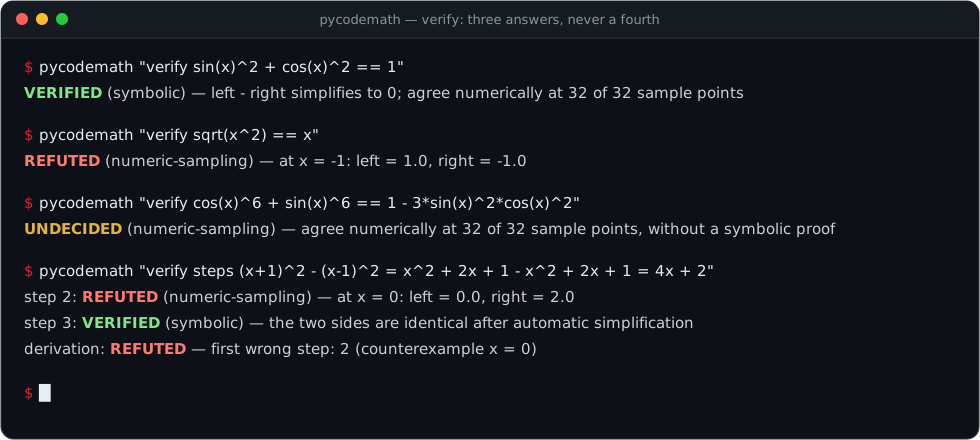
An identity — verify <a> == <b>:
$ python -m pycodemath "verify sqrt(x^2) == x"
REFUTED (numeric-sampling) — at x = -1: left = 1.0, right = -1.0

$ python -m pycodemath "verify (x^2-1)/(x-1) == x+1"
VERIFIED (symbolic) — left - right simplifies to 0; agree numerically at 31 of 32 sample points (1 not evaluable)

$ python -m pycodemath "verify cos(x)^6 + sin(x)^6 == 1 - 3*sin(x)^2*cos(x)^2"
UNDECIDED (numeric-sampling) — agree numerically at 32 of 32 sample points, without a symbolic proof
The last one is a true identity; SymPy's simplify just does not close it, so
the honest answer is UNDECIDED. What "equal" means is fixed and worth knowing:
values on the principal branch (log(x^2) == 2*log(x) is refuted at x = -1),
equality where BOTH sides are defined (hence the second example), and decimals
meaning the decimal written (0.1 + 0.2 == 0.3 holds).
A derivation — verify steps. Neighbouring steps are checked pairwise, so a slip
is reported once, at the step that made it, with a counterexample:
$ python -m pycodemath "verify steps (x+1)^2 - (x-1)^2 = x^2 + 2x + 1 - x^2 + 2x + 1 = 4x + 2"
step 2: REFUTED (numeric-sampling) — at x = 0: left = 0.0, right = 2.0
step 3: VERIFIED (symbolic) — the two sides are identical after automatic simplification
derivation: REFUTED — first wrong step: 2 (counterexample x = 0)
Equation steps (one per line, or joined by ->) must keep the same solution set
over the reals — squaring both sides is caught even though every old root
survives it:
$ python -m pycodemath "verify steps sqrt(x) = x - 2 -> x = (x-2)^2 -> x^2 - 5x + 4 = 0 -> x = 1 or x = 4"
step 2: REFUTED (solution-sets) — x = 1 solves step 2 but not step 1
  warning: step 2 gains the root x = 1 — squaring both sides adds roots: check each one against step 1
step 3: VERIFIED (symbolic) — left - right of step 2 is -1 times that of step 3, with the same poles, so the solution sets coincide
step 4: VERIFIED (symbolic) — left - right of step 3 equals that of step 4, with the same poles, so the solution sets coincide
derivation: REFUTED — first wrong step: 2 (counterexample x = 1)
In the interactive REPL, typing just verify steps reads one step per line
until an empty line.
An engine answer — certify <command> runs integrate, diff, solve,limit, dsolve or nintegrate, then checks the answer by a route that did
not produce it (an antiderivative by finite differences before any symbolic
calculus — re-deriving with the engine that made the answer would agree with
its own mistakes):
$ python -m pycodemath "certify integrate x*cos(x) dx"
x*sin(x) + cos(x)
certificate: VERIFIED (symbolic) — d/dx of the result: the symbolic derivative matches (the two sides are identical after automatic simplification); finite differences agree at 16 of 16 points

$ python -m pycodemath "certify dsolve y for y(t)"
y(t) = C1*exp(t)
certificate: VERIFIED (symbolic) — each of the 1 solution(s) satisfies y' = y (symbolic proof; finite differences agree) — that they are ALL the solutions is not certified
A certificate claims what it says and nothing more: dsolve — every returned
function solves the equation, not that they are all the solutions; solve —
completeness is proved only for rational functions (elsewhere a missing real
root can be found, never ruled out); nintegrate — the value is within the
run's own error_estimate.
Every check is bounded in time (120 s by default; a trailing budget <s>
replaces it). A CHECK that runs out is an UNDECIDED verdict with methodtime-budget, not an error. On certify, the command's own budget bounds the
computation (which, running out, is the usual TimeBudgetError refusal) and,
separately, the certificate.
For an agent, the MCP tool math_verify takes the same lines (the leading wordverify is optional) and returns the verdict as structuredContent, with the
same rules as math_eval: six fields, always present, null where they do not
apply — text (what the REPL prints), answer (certify: the answer that was
certified), verdict (status, method, counterexample, detail), steps
(status, first_error, counterexample, and one entry per step with its own
verdict, effect and warning), certificate (the check as a re-checkable
JSON certificate, below), and error (a refusal, exactly asmath_eval returns it — route included). Like math_eval, it is a plain
function returning a plain dict:
>>> from pycodemath.cli.mcp_server import math_verify
>>> math_verify("sqrt(x^2) == x")["verdict"]
{'status': 'refuted', 'method': 'numeric-sampling', 'counterexample': {'x': '-1'}, 'detail': 'at x = -1: left = 1.0, right = -1.0'}
>>> derivation = math_verify("steps sqrt(x) = x - 2 -> x = (x-2)^2")["steps"]
>>> (derivation["first_error"], derivation["checks"][0]["effect"])
(2, 'gains-roots')
>>> math_verify("certify integrate exp(sin(x)) dx")["error"]["route"]
'nintegrate'
The same checks from Python, without the command grammar:
>>> from pycodemath.verify import check_equal, check_steps, certify
>>> check_equal("log(x^2)", "2*log(x)").counterexample
{'x': '-1'}
>>> check_steps("2x + 3 = 7 -> 2x = 4 -> x = 2").status
<VerdictStatus.VERIFIED: 'verified'>
>>> certify("integrate", "2*x", "x", "x^2 + 5").status
<VerdictStatus.VERIFIED: 'verified'>
Certificates: a check anyone can re-run
A verdict on the screen is a claim about a run nobody else saw. certificate
writes the run down — the claim as typed and as parsed, the verdict with its
exact counterexample, the budget, the versions of pycodemath, SymPy, mpmath and
Python, and a sha256 of all of it — as one JSON object (schema: 1, with akind: identity, derivative, integral, roots, limit, ode,quadrature, steps). recheck re-runs the check from the file alone:
$ pycodemath certificate verify sqrt(x^2) == x > c.json
$ pycodemath recheck c.json
REPRODUCED — identity: sqrt(x**2) == x
  recorded: refuted (numeric-sampling); re-run: refuted (numeric-sampling) at x = -1
  digest: ok
A certificate that does not reproduce — another verdict, a digest broken by a
hand edit, a claim that parses differently today — is an error (exit code 1)
naming each mismatch. The digest is tamper EVIDENCE, not a signature: anyone can
recompute it, which is why recheck never trusts the recorded verdict and
re-runs the check instead. Different versions are a note, not a failure. The
same from Python (and math_verify carries the certificate in itscertificate field):
>>> from pycodemath.verify import issue, recheck
>>> cert = issue("identity", "sqrt(x^2)", "x")
>>> cert.verdict["counterexample"]
{'x': '-1'}
>>> cert.digest.startswith("sha256:")
True
>>> recheck(cert.to_json()).ok
True
Limits, series and symbolic sums
Beyond diff/integrate/solve, the engine handles limits (including
one-sided and at infinity), Taylor/Laurent expansions and symbolic summation
— finite or infinite. All real invocations with real outputs:
$ python -m pycodemath "limit (1+1/n)^n for n to oo"
E

$ python -m pycodemath "series exp(x) for x n 4"
x**3/6 + x**2/2 + x + 1

$ python -m pycodemath "sum k for k from 1 to n"
n**2/2 + n/2

$ python -m pycodemath "sum 1/k^2 for k from 1 to oo"
pi**2/6
A divergent sum or a nonexistent limit refuses with a readable error instead
of returning a symbolic echo.
Optimization: Newton and BFGS where gradient descent stalls
min / min_nd default to plain gradient descent; method newton|bfgs
switches to second-order methods with Armijo backtracking line search.
On the Rosenbrock valley (start (-1.2, 1)) gradient descent refuses after
10 000 iterations, while BFGS converges in 36:
$ python -m pycodemath "min_nd (1-x)^2 + 100*(y-x^2)^2 for x,y at -1.2,1 method bfgs"
x = 0.999999999999454, y = 0.9999999999989762
ODE suite
Symbolic (dsolve) plus a full numerical toolbox — scalar and systems,
forward and backward in time (t1 < t0), all refusing to silently jump over
singularities (a readable error instead of garbage):
| solver | what it does |
|---|---|
solve_ode_num |
classic fixed-step RK4 |
solve_ode_adaptive |
Dormand–Prince 5(4), adaptive step (like ode45) |
solve_ode_dense |
adaptive + dense output: callable sol(t) anywhere |
solve_ode_events |
event detection g(t,y)=0 (+ terminal events) |
solve_ode_stiff |
implicit BDF2 + Newton for stiff equations |
solve_ode_stiff_adaptive |
variable-step BDF2 with local error control |
solve_ode_system_* |
vector variants of all of the above |
Adaptive integration of a smooth problem takes 41 steps at rtol 1e-8:
$ python -m pycodemath "ode_adaptive y*cos(t) for y(t) from 0 to 5 at 1 rtol 1e-8"
y(5) = 0.3833049965035854  (41 adaptive steps)
On the stiff classic y' = -1000(y - cos t) the explicit pair is limited by
stability (378 steps at rtol 1e-6; with the same budget fixed-step RK4
returns astronomically wrong finite values). The adaptive BDF gets there in
313 steps — and starting on the slow manifold, where stiffness is pure, in
58 steps vs 357:
$ python -m pycodemath "odestiff_adaptive -1000*(y-cos(t)) for y(t) from 0 to 1 at 0"
y(1) = 0.5411432587540607  (adaptive BDF, 313 implicit steps)
The system variant handles the Van der Pol oscillator with μ=1000 over[0, 2000] in 5 332 steps (~1 s) — an explicit method would need ≥ 2 000 000.
Code generation
code <expr> emits standalone, CSE-optimized NumPy source (real output):
$ python -m pycodemath "code (sin(x)+cos(x))^2 + (sin(x)+cos(x))^3"
import numpy as np


def f(x):
    """Pycodemath: f(x) — NumPy code."""
    _c0 = np.sin(x + (1/4)*np.pi)
    return 2*_c0**2*(np.sqrt(2)*_c0 + 1)
The Python API also generates standalone ODE integrators — including an
adaptive one and one with dense output whose emitted interpolant is
bit-for-bit identical to the engine (measured max difference: 0.0 on nodes
and off-node grids, forward and backward):
>>> from pycodemath import generate_ode_dense
>>> art = generate_ode_dense(parse("y*cos(t)"), "t", "y")
>>> sol = art(1.0, 0.0, 5.0, 1e-8)   # standalone DOPRI5, returns an interpolant
>>> sol(2.5)
1.8193369962907706
>>> len(sol.ts)                      # accepted nodes
42
Event detection from the API:
>>> from pycodemath import solve_ode_events
>>> ev = solve_ode_events(parse("cos(t)"), "t", 0.0, (0.0, 10.0), parse("y"), rtol=1e-8)
>>> [round(t, 6) for t in ev.event_times]      # π, 2π, 3π
[3.141593, 6.283185, 9.424778]
Design contracts
- One IR (
Expr/Matrix) shared by the engine and the generator. - Numerical loops run on compiled functions (
lambdify+ LRU cache) —
zero SymPy calls per iteration. - Divergence or a domain problem raises a readable
PycodemathError—
never NaN/garbage in a result. - The parser resolves only a whitelist of mathematical functions — unknown
names become symbols, not Python code; string literals and attribute
access are rejected outright, and evaluation cost is bounded so a single
expression (e.g.9**9**9) can't exhaust memory. - Tests measure real numbers first, then assert them with a margin —
2914 tests, all green, on Ubuntu and Windows (CI + mypy included).
Every example in this file is one of them: they are extracted and executed
bytests/test_docs.py.
License
MIT — see LICENSE.
Reviews (0)
Sign in to leave a review.
Leave a reviewNo results found