ThreadOS
Health Pass
- License — License: MIT
- Description — Repository has a description
- Active repo — Last push 0 days ago
- Community trust — 10 GitHub stars
Code Pass
- Code scan — Scanned 12 files during light audit, no dangerous patterns found
Permissions Pass
- Permissions — No dangerous permissions requested
No AI report is available for this listing yet.
ThreadOS is an x86 operating system written from scratch in C and assembly
ThreadOS



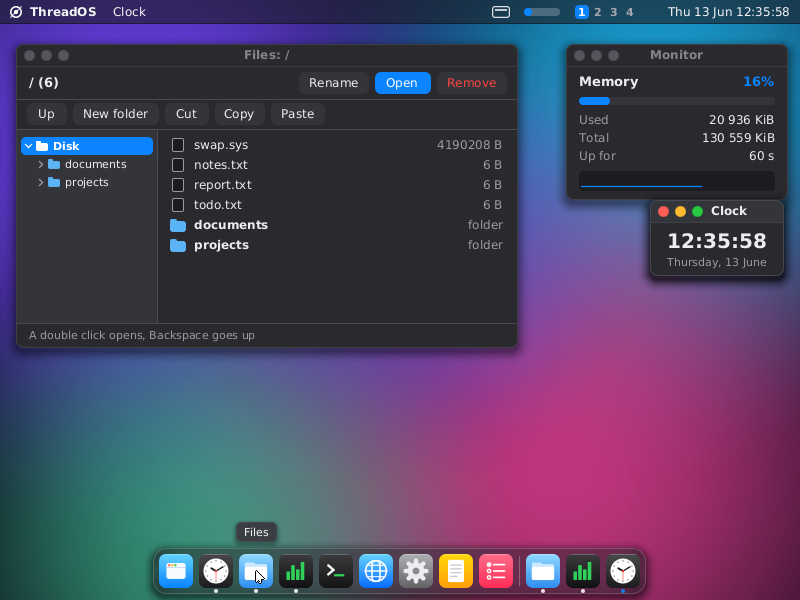
ThreadOS is an x86 operating system written from scratch in C and
assembly. It has its own kernel, drivers, filesystem, TCP/IP stack, TLS
1.3, UEFI boot loader, installer and compositing desktop. It runs in QEMU
and on real UEFI PCs.
- Architecture
- Installing on a PC
- Building
- Running in QEMU
- Testing
- Repository layout
- Maintenance
- Features
- Roadmap
Architecture
Two kernels, one source tree.
| 32-bit kernel | 64-bit kernel | |
|---|---|---|
| Mode | protected mode, paging | long mode, 4-level paging with NX |
| Sources | boot/, kernel/ |
boot64/, kernel64/ + the shared part of kernel/ |
| Syscalls | int 0x80 (kernel/syscall.c) |
syscall/sysret (kernel64/syscall64.c) |
| Boots via | Multiboot 1 (QEMU -kernel) or Multiboot 2 (GRUB) |
Multiboot 2 (GRUB) or threadboot (UEFI) |
| Output | build/threados.bin + build/initrd.img |
build/threados64.bin + build/initrd64.img |
The two columns share more than they differ. Drivers, the filesystem, the
network stack, the window compositor and most of the kernel live inkernel/ and are compiled twice. The list is SHARED64 in theMakefile. Only the CPU-mode-specific parts have two implementations:
paging, interrupts, context switching, the syscall entry and process
setup. The 32-bit kernel is still built and tested, because a second
compilation catches width and pointer-size bugs in the shared code.
Boot paths (64-bit).
- BIOS or UEFI with GRUB:
build/threados64.isoboots GRUB, and GRUB
loads the kernel and initrd through Multiboot 2. - UEFI with threadboot (
boot/efi/efiboot.c), the project's own PE32+
loader. It readsthreados64.binandinitrd64.imgfrom the EFI system
partition, sets a GOP mode (the panel's native resolution, from EDID),
builds the Multiboot 2 tags itself (memory map, framebuffer, ACPI RSDP,
EFI system table), exits boot services and jumps to the kernel. The
installer and the USB image use this path. The kernel keeps the UEFI
runtime services, which it uses to write firmware boot entries.
Userland. Programs are freestanding ELF files packed into the initrd
(scripts/mkinitrd.py). They can also be run from disk. Sources inuser/ build for both kernels: user/uapi.h includes eitheruser/usys.h (32-bit) or user64/usys64.h + user64/compat64.h
(64-bit). Crypto, TLS, HTTP and DNS are header-only code. The programs
that use them link against libthread.so, which the kernel maps into
every process once. On the 64-bit side, programs can also be built
against musl (libc/, with upstream musl in third_party/musl). js
(QuickJS) is built this way.
C++ programs use the host compiler's libstdc++ on top of musl, without
exceptions (libc/cxx/). The first is litehtml (third_party/litehtml),
an HTML/CSS layout engine, which lays pages out on ThreadOS exactly as
it does on Linux. The 64-bit web browser (apps/browser/web.cpp) draws
its pages.
Graphics. The compositor (kernel/desktop.c) runs in the kernel. It
draws with kernel/gfx.c (anti-aliased shapes, shadows, blur) andkernel/ttf.c (a TrueType rasteriser that matches FreeType with hinting
off). Ring 3 programs draw into their windows through system calls, using
the same primitives (user/udraw.h) and a small widget kit
(user/ugui.h).
Installing on a PC
Every push to main produces a
release:
| Asset | Contents |
|---|---|
threados64.iso |
Hybrid BIOS/UEFI disc: live system and installer |
threados-stick.img.xz |
Raw GPT disk image for a USB stick (UEFI only) |
update.txt, threados64.bin, initrd64.img, BOOTX64.EFI |
A signed system update |
- Write
threados64.isoto a USB stick: Rufus in DD image mode,
balenaEtcher, ordd if=threados64.iso of=/dev/sdX bs=4M conv=fsync. - Disable Secure Boot. threadboot is not signed.
- Boot from the stick and choose Install ThreadOS onto this computer's
disk. There are two modes:- beside another system: copies three files into
\EFI\ThreadOS\on
the existing EFI partition and adds a boot entry at the end of the
boot order; - whole disk: writes a new GPT, a FAT32 EFI partition and a TFS3 data
partition, and adds a boot entry first in the boot order.
- beside another system: copies three files into
- Updating an installed system:
run update check, thensudo run update. See Releases and updates.
Building
Prerequisites
Debian/Ubuntu:
sudo apt-get install build-essential gcc-multilib make python3 \
    qemu-system-x86 grub-pc-bin grub-efi-amd64-bin xorriso mtools \
    ovmf clang lld openssl
| Needed for | Packages |
|---|---|
| kernels and initrds | gcc with -m32 support (gcc-multilib), make, python3 |
discs (iso, iso64) |
grub-pc-bin, grub-efi-amd64-bin, xorriso, mtools |
threadboot (efi, stick) |
clang, lld, mtools |
| running and testing | qemu-system-x86, ovmf, openssl |
| optional tests and tools | Python freetype-py and fonttools (font tests), Pillow (screenshots), Node.js (JavaScript comparison tests) |
A test that is missing an optional tool prints SKIPPED and the reason.
Targets
| Command | Produces |
|---|---|
make |
build/threados.bin, build/initrd.img (32-bit) |
make kernel64 |
build/threados64.bin, build/initrd64.img |
make efi |
build/BOOTX64.EFI (threadboot) |
make iso64 |
build/threados64.iso (builds the 64-bit kernel and threadboot first) |
make iso |
build/threados.iso (32-bit) |
make stick |
build/threados-stick.img |
make libc64 |
musl for ThreadOS (built automatically when needed) |
make browser |
litehtml and its layout test, for ThreadOS and for the host |
make clean |
removes build/ |
Variables:
| Variable | Meaning |
|---|---|
BUILD=<dir> |
build somewhere other than build/ |
VERSION=<n> |
system version written into the initrd (default 0) |
KVM=1 |
use /dev/kvm in the run targets |
AUDIO=pa|pipewire|alsa |
attach an Intel HDA card to the run targets |
T=a,b / J=n |
test groups to run / how many at once (make test) |
-j works for all targets. Most of a clean build's time goes to musl
and QuickJS.
Running in QEMU
make run              # 64-bit system from the hybrid disc, to the desktop
make run KVM=1        # with hardware virtualisation
make run32            # 32-bit kernel
make run-iso64-uefi   # the hybrid disc under OVMF
make run-stick        # the USB image under OVMF, exactly as a PC boots it
The serial console is on stdio. The kernel logs everything there, which
makes it the first place to look when something goes wrong. Inside the
system, hardware lists PCI devices and disks lists block devices.
Testing
make test                   # every group, 4 at once
make test T=files,filetree  # selected groups
make test J=8               # more parallel VMs
make fuzz                   # parsers under ASan/UBSan on the host
The suite (scripts/run_tests.py) has more than 100 groups and over 1800
assertions. Each group is one file, scripts/tests/t_<group>.py. It
boots a real kernel in QEMU and checks the system from outside:
- the screen, through QMP screendumps. Text is read back glyph by glyph
in the system's own fonts (scripts/ptest.py). - the serial port, and keyboard and mouse input sent through QMP.
- disk images read back with
mtoolsand a GPT parser. - OVMF, which boots an installed disk or fails to.
- independent implementations used for comparison: OpenSSL (ciphers,
TLS, signatures), FreeType (fonts), Node.js (JavaScript), glibc (libc
output).
A full run takes 20–30 minutes on four cores with KVM.
To run tests against a build that is not in build/, pass the images
explicitly:
make BUILD=/tmp/b -j8 all kernel64 efi
python3 scripts/run_tests.py -tfiles /tmp/b/threados.bin /tmp/b/initrd.img \
    /tmp/b/threados64.bin /tmp/b/initrd64.img
Do not rebuild build/ while a test run is using it.
The network groups run a DNS server on host port 53, because QEMU's user
network sends guest DNS queries there. Run them as root, or once runsudo sysctl -w net.ipv4.ip_unprivileged_port_start=53.
CI: .github/workflows/build.yml builds everything and runs a
cross-section of groups. It is started by hand from the Actions tab.
Repository layout
boot/            32-bit entry, GRUB menus (grub.cfg, grub64.cfg)
boot/efi/        threadboot, the UEFI loader
boot64/          long-mode entry, ISR and syscall stubs, AP startup
kernel/          shared kernel code + the 32-bit kernel; headers in kernel/include/
kernel64/        64-bit-only kernel code, linker script
user/            ring 3 programs and the header-only libraries (crypto, TLS, HTTP, GUI kit)
user64/          64-bit-only programs, the 64-bit syscall layer
libc/            musl port: replaced files (overlay/), linker script, tests
apps/js/         the QuickJS host (`js`)
apps/browser/    the litehtml browser: its test, and the patches to litehtml
third_party/     unmodified upstream code: musl 1.2.5, QuickJS, litehtml
fonts/           DejaVu subsets used by the kernel and programs
scripts/         build helpers, release signing, test runner and tests
tests/fuzz/      host-side fuzzing harnesses
docs/            screenshots and the development journal
Maintenance
Adding things
| What | Where |
|---|---|
| a ring 3 program | user/<name>.c; add it to USER_ELFS and/or USER64_ELFS and to the mkinitrd.py lines of $(INITRD) / $(INITRD64). Initrd names are at most 15 characters. |
| a 32-bit system call | kernel/syscall.c and a wrapper in user/usys.h |
| a 64-bit system call | kernel64/syscall64.h (number), kernel64/syscall64.c (handler), user64/usys64.h (wrapper), plus user64/compat64.h if shared programs need it under the 32-bit name |
| a driver | kernel/<name>.c, kernel/include/<name>.h; add $(BUILD)/<name>.o to OBJS and <name> to SHARED64 |
| a test group | scripts/tests/t_<name>.py, registered in GROUPS in scripts/run_tests.py |
Test helpers read layout constants directly from C sources
(_kernel_define() in scripts/ptest.py). When you change a window
layout, keep its #defines as plain integers and update the helpers.
Releases and updates
.github/workflows/release.yml runs on every push to main:
- Builds with
VERSION=<workflow run number>. The version is stored in
the initrd as the fileversion. - Runs
scripts/mkupdate.pyto writeupdate.txt: the version, then the
size and SHA-256 of the kernel, initrd and loader. The last line is an
ECDSA P-256 signature over everything before it. - Publishes the release
v<n>with the update files, the ISO and the
compressed stick image.
On an installed system, update (user/update.c) downloads update.txt
from https://github.com/DaniuPl/ThreadOS/releases/latest/download/ and
checks the signature against the public key compiled into the program.
It then checks every file's size and hash. Only after that does it write
the files to the EFI partition, through SYS64_UPDATE_WRITE, which is
admin only.
The signing key. The private key exists only in the repository secretTHREADOS_UPDATE_KEY (PEM, P-256). It must never be committed. To create
or rotate it:
openssl ecparam -name prime256v1 -genkey -noout -out update-key.pem
openssl ec -in update-key.pem -pubout -outform DER | tail -c 65 | xxd -p -c 65
- Put the PEM in the secret.
- Replace
official_key[]inuser/update.cwith the 65 printed bytes. - Release once. Systems older than that release will refuse updates
signed with the new key until they are updated by hand, or until an
admin writes the new key in hex toupdate.key.
Generated files
These files are committed. Regenerate them only when their inputs change:
| File | Generator |
|---|---|
fonts/*.ttf |
scripts/mkfonts.py <dir with DejaVu fonts> (needs fonttools) |
user/caroots.h (built-in CA roots) |
scripts/mkcaroots.py (reads the host CA bundle) |
user/certdata.h (certificate test data) |
scripts/mkcertdata.py (needs openssl) |
docs/*.png |
scripts/screenshots.py (needs a built system, OVMF and Pillow) |
Third-party code
third_party/ holds upstream releases, trimmed but not modified. Seethird_party/README.md for versions and what was left out. To update
one, replace its directory. ThreadOS-specific changes to musl live inlibc/overlay/, changes to litehtml as patches in apps/browser/patches/.
QuickJS is wrapped by apps/js/. After an update, runmake test T=libc.
Features
- Desktop: a compositor with a glass menu bar, a dock, rounded
windows with shadows, dark and light themes, wallpapers, animations,
notifications, search (Ctrl+Space), four virtual desktops, snapping
and Alt+Tab. It runs at the panel's native resolution, with HiDPI
scaling. - Programs:
- file manager (folder tree, cut/copy/paste)
- terminal (Tab completion, pipes)
- text editor
- web browser (litehtml, HTML and CSS)
- settings, task manager, calculator, calendar, paint, mixer
- picture viewer (PNG, JPEG, BMP)
- 64-bit media player (MP3, WAV, AAC, FLAC, Ogg, M4A, MP4/MOV, Matroska, AVI)
- installer
updatejs(QuickJS)
- Hardware:
- storage: AHCI, NVMe and ATA
- USB: xHCI, EHCI and UHCI host controllers; HID keyboard and mouse,
mass storage, RNDIS Ethernet and Bluetooth HCI - network cards: RTL8139 and e1000
- Intel HD Audio
- PS/2 keyboard and touchpad with wheel
- ACPI, SMP
- Kernel:
- processes and threads on all cores;
fork/exec, copy-on-write,
demand paging and swap - signals, pipes, shared memory, memory-mapped files
- shared libraries
- users, an admin role and
sudo
- processes and threads on all cores;
- Storage: TFS3, our own filesystem (directories, files up to
64 MiB), and FAT12/16/32 with long names. - Network and security:
- ARP, IPv4, ICMP, UDP, TCP, DHCP and DNS
- TLS 1.3 with X.509 validation
- AES-GCM/CCM, ChaCha20-Poly1305, X25519, ECDSA, RSA, SHA-1/2
- WPA2 key derivation
Roadmap
- Wi-Fi: a driver for a common laptop chip and an 802.11 layer. The WPA2
cryptography is already done. - Ethernet chips found in laptops (Realtek RTL8111/8168).
- Images and external style sheets in the browser.
- Removing the big kernel lock from drivers, the filesystem and swap.
Contributing, security, license
- Discord: questions, ideas, screenshots from real hardware, and
help with getting ThreadOS to boot on your machine. - CONTRIBUTING.md: review rules. The first one is that
every feature comes with a test that would fail without it. - AGENTS.md: instructions for AI coding assistants.
- SECURITY.md: reporting vulnerabilities, and the update
trust model. - docs/JOURNAL.md: the development journal, with the
reasoning behind every major decision.
Licensed under the MIT license (see LICENSE). third_party/
keeps its upstream MIT licenses. fonts/ is under the Bitstream Vera /
DejaVu license (fonts/LICENSE-DejaVu.txt).
Reviews (0)
Sign in to leave a review.
Leave a reviewNo results found