seo-agent
Health Pass
- License — License: MIT
- Description — Repository has a description
- Active repo — Last push 0 days ago
- Community trust — 44 GitHub stars
Code Warn
- network request — Outbound network request in core/index.py
Permissions Pass
- Permissions — No dangerous permissions requested
No AI report is available for this listing yet.
Open-source SEO audit agent — real-browser checks, backlink scoring, and multi-engine AI citation tracking (Claude, ChatGPT, Gemini, Perplexity, Copilot) via SearchApi
seo-agent
A local SEO co-pilot built with Python, Browser Use, and the Claude API. Visits real pages in a visible browser window, extracts SEO signals, checks for broken links, scores backlinks, surfaces GSC quick wins, maps internal link clusters, and writes structured reports — resumable if interrupted.
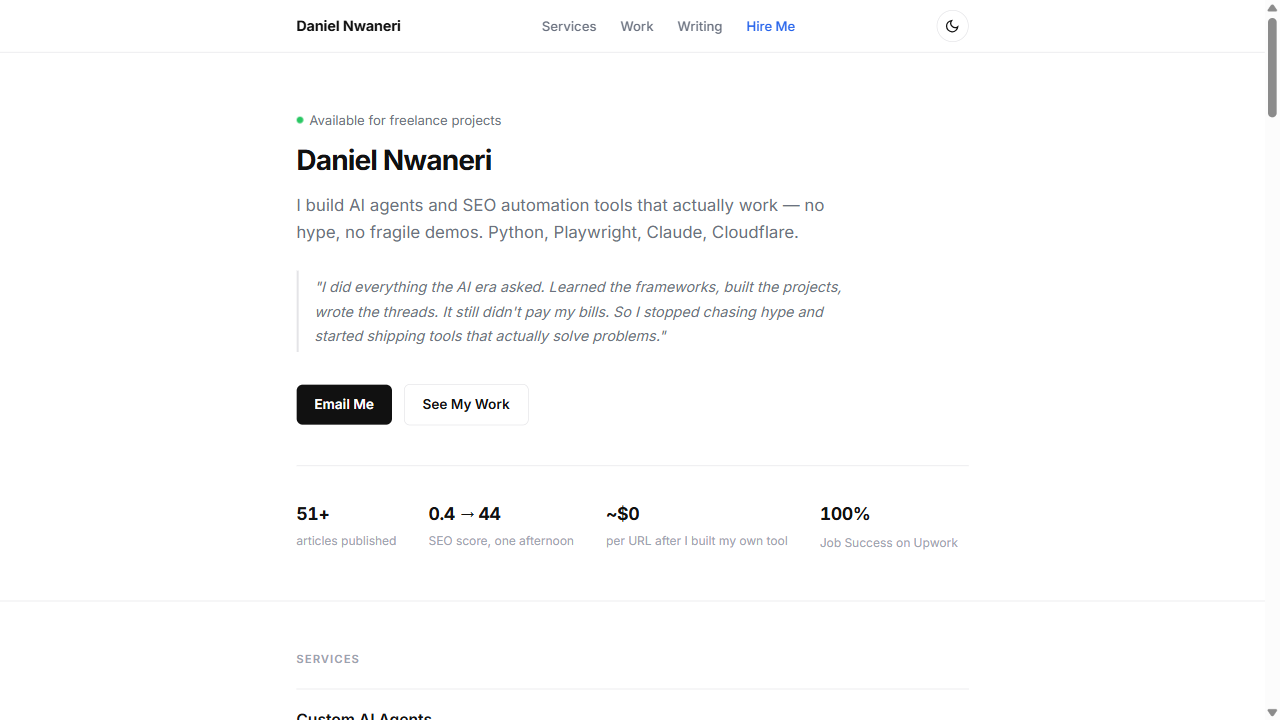
Ran it on my own sites. Found a title cannibalising its own homepage, a position 9.5 query with 0% CTR, two missing internal links, and an orphan page with no path to it.
Everything is open source.
Table of Contents
- What It Does
- Stack
- Installation
- Configuration
- Usage
- Modules
- Output
- PASS/FAIL Rules
- Cost
- Scheduling
- Attestation Verification
- Environment Variables
- Architecture
- Contributing
- Writing
- License
- Limitations
What It Does
Core audit (runs on a URL list):
- Visits each URL in a real Chromium browser — not a headless scraper
- Extracts title, meta description, H1s, and canonical tag via Claude API
- Checks for broken same-domain links asynchronously using httpx
- Detects edge cases (404s, login walls, redirects) and pauses for human input
- Writes results to
report.jsonincrementally — safe to interrupt and resume - Generates a plain-English
report-summary.txton completion
Standalone modules (run independently on any data):
qualify-backlinks— score a list of referring domains for niche relevance and traffic qualitygsc-insights— parse a Search Console export and find quick wins and cannibalisationrelevance-score— score candidate pages as internal link sources for a target URLcluster-audit— map your full site into topic clusters, find orphans and missing hubsserp-features— query SearchApi for each target query and detect which SERP features are present (AI Overview, featured snippet, PAA, image pack, video results, local pack, knowledge panel)llm-visibility— query Claude, ChatGPT, Gemini, Perplexity, and Bing Copilot with your target queries and check whether your domain gets cited across each engine
Stack
- Browser Use — real browser navigation via Playwright
- Anthropic Claude API — structured SEO signal extraction (Haiku for modules, Sonnet for core)
- SearchApi — structured Google SERP data for feature detection, plus ChatGPT, Gemini, Perplexity, and Bing Copilot answer-engine queries for LLM visibility
- httpx — async broken link detection and SearchApi calls
- Python 3.11+, flat JSON state files, no database required
Installation
git clone https://github.com/dannwaneri/seo-agent
cd seo-agent
pip install -r requirements.txt
playwright install chromium
Configuration
Set your Anthropic API key:
# macOS/Linux
export ANTHROPIC_API_KEY="sk-ant-..."

# Windows PowerShell
$env:ANTHROPIC_API_KEY = "sk-ant-..."
Or add it to a .env file in the project root — the agent loads it automatically:
ANTHROPIC_API_KEY=sk-ant-...
Add your URLs to input.csv:
url
https://example.com
https://example.com/about
https://example.com/contact
Usage
Core audit
Interactive mode — pauses on edge cases (login walls, 404s):
python main.py
Auto mode — skips edge cases, logs them to needs_human[] in state, continues:
python main.py --auto
Resume after interruption — already-audited URLs are skipped automatically:
python main.py --auto
# Starting audit: 4 pending, 3 already done.
With project isolation (each client gets separate input, state, and reports):
python main.py --project acme --auto
python main.py --project globex --auto
With cost-curve tiered routing (cheaper checks first):
python main.py --tiered --auto
With AI rewrite suggestions:
python main.py --rewrite --auto
python main.py --rewrite --voice-sample my-writing-sample.txt --auto
With viewport screenshots (saves one PNG per URL to screenshots/):
python main.py --tiered --screenshot
# screenshots/dannwaneri-com.png
# screenshots/dannwaneri-com-ai-agents.png
Standalone modules
Backlink qualifier — score a .txt or .csv list of referring domain URLs:
python main.py qualify-backlinks backlinks.txt --niche "AI agents python"
python main.py qualify-backlinks backlinks.txt --niche "SEO tools" --project acme
GSC insights — parse a Search Console query export:
python main.py gsc-insights gsc-export.csv
python main.py gsc-insights gsc-export.csv --min-impressions 100 --project acme
Relevance scorer — score candidate pages as internal link sources:
python main.py relevance-score --target https://example.com/target-page --pages pages.txt
python main.py relevance-score --target https://example.com/target --pages pages.txt --project acme
Cluster audit — map site pages into topic clusters:
python main.py cluster-audit --pages pages.txt
python main.py cluster-audit --pages pages.txt --project acme
SERP feature detection — detect which SERP features are present for your target queries (via SearchApi):
# single query
python main.py serp-features --query "does twitch pay nigerians" --project naija-payments

# from a GSC export (checks top 20 queries by impressions)
python main.py serp-features --queries gsc-export.csv --project naija-payments

# plain text file, one query per line
python main.py serp-features --queries queries.txt --max 10 --project acme
Requires a SearchApi key (see Environment Variables):
export SEARCHAPI_KEY="your-key-here"
Outputs serp-features.md — a feature matrix table and per-query opportunity notes.
LLM visibility checker — check whether Claude, ChatGPT, Gemini, Perplexity, and Bing Copilot cite your domain when answering your target queries:
# against a plain text file of queries, all five engines
python main.py llm-visibility --domain dannwaneri.com --queries queries.txt --project dannwaneri-com

# against a GSC export (checks top 20 queries by impressions), specific engines only
python main.py llm-visibility --domain naija-vpn.com --queries gsc-export.csv --project naija-payments --engines chatgpt,gemini
Requires ANTHROPIC_API_KEY for the Claude check and SEARCHAPI_KEY for the other four (see Environment Variables).
Outputs llm-visibility.md — a per-engine score, a citation matrix (query × engine), and mention details.
Limitations: Claude's check runs against its training data, so anything published after its cutoff won't appear regardless of quality. The other four engines are queried live and reflect the current web. Re-run quarterly. A 0% score on a new site is expected across all engines; it reflects data availability, not content quality. In practice, don't expect all five engines to agree — see the SearchApi Developer Ambassador piece for real numbers on how little overlap there actually is.
Modules
Most modules use Claude Haiku. Prompts are in prompts/. llm-visibility's non-Claude engines go through SearchApi instead. Results write to markdown files in the project directory or repo root.
Backlink Qualifier
Scores each referring domain on three axes:
| Signal | Weight | What it measures |
|---|---|---|
| Niche relevance | 50% | Topical alignment with your target niche (0–100) |
| Traffic quality | 30% | Estimated real traffic vs. spam traffic (0–100) |
| Spam score | 20% (inverted) | Link farm signals, thin content, private blog network patterns (0–100) |
Composite score = niche * 0.50 + traffic * 0.30 - spam * 0.20
Tiers: Insert Worthy (≥80), Useful (60–79), Neutral (40–59), Borderline (20–39), Avoid (<20 or spam >70).
Fetches pages via real browser. Caches results to flat JSON — crash at URL 47, restart at URL 48.
GSC Insights
Parses a Search Console query export CSV. Flags quick wins: position 4–20, impressions ≥50 (configurable), CTR <5%. Sends the top 50 rows to Haiku with a prompt that specifically asks for queries where two pages compete — the cannibalisation signal you can't see by sorting a spreadsheet.
Relevance Scorer
Scores candidate pages as sources for internal links pointing at a target URL:
| Signal | Weight | What it measures |
|---|---|---|
| Topical alignment | 40% | How closely the source page's topic matches the target |
| Anchor opportunity | 35% | Whether the source page naturally mentions the target's topic |
| Link equity | 25% | Estimated page strength as a link source |
Checks existing links deterministically before scoring — never recommends a link that already exists.
Tiers: Strong Link (≥75), Good Opportunity (55–74), Possible (35–54), Skip (<35).
Cluster Audit
Builds the full internal link graph from a page list. Counts incoming links per page — zero incoming means orphan. Sends the complete graph to Haiku: cluster mapping, missing hub detection, cross-cluster link suggestions, and a prioritised fix list.
SERP Feature Detector
Calls SearchApi's Google engine for each query and detects seven feature types from the structured JSON response — no browser, no CAPTCHA, no bot detection:
| Feature | What it means for you |
|---|---|
| AI Overview | Google is summarising this topic — open with a direct 40–60 word answer; use structured headings |
| Featured snippet | Optimise for answer-box format — direct answer in first paragraph. Rare now that AI Overview covers most of the same queries. |
| People Also Ask | Add an FAQ section using the exact PAA question wording as <h3> headings |
| Image pack | Add optimised images with keyword-matching alt text and file names |
| Video results | Includes YouTube Shorts. A short explainer video (or Short) could rank in this slot |
| Local pack | Organic intent is local; consider whether this query is worth targeting |
| Knowledge panel | Entity query — structured data and authoritative content help |
Results write to serp-features.md with a feature matrix and per-query opportunities.
Requires a SearchApi account (searchapi.io). Set SEARCHAPI_KEY in your environment before running — the same key used by llm-visibility's non-Claude engines.
LLM Visibility Checker
Queries each of your target queries against Claude, ChatGPT, Gemini, Perplexity, and Bing Copilot, and checks whether your domain gets cited in the response. Claude runs through the Anthropic API directly against its training data; the other four run live through SearchApi's answer-engine endpoints (modules/searchapi_client.py). Use --engines to run a subset instead of all five.
Results write to llm-visibility.md with a per-engine visibility score, a citation matrix (which engines cited you for which query), and per-engine mention details with the source link that got matched.
Limitations: Claude's check reflects its training data cutoff — content published after that won't appear regardless of quality. The SearchApi-backed engines are queried live, so they reflect the current web, but individual calls can fail (seen both a 503 and a request timeout from Bing Copilot in testing) — a failed query is logged as an error for that engine and doesn't stop the run. A 0% score on a new domain is expected across all engines. In practice, the five engines rarely agree with each other — running only one gives a partial, sometimes misleading picture of your actual AI visibility.
Output
report.json — structured audit result per URL:
{
  "url": "https://example.com",
  "title": { "value": "Example", "length": 7, "status": "PASS" },
  "description": { "value": null, "length": 0, "status": "FAIL" },
  "h1": { "count": 1, "value": "Welcome", "status": "PASS" },
  "canonical": { "value": "https://example.com", "status": "PASS" },
  "broken_links": { "count": 0, "status": "PASS" },
  "flags": ["Meta description is missing"]
}
report-summary.txt — plain-English summary:
https://example.com          | FAIL [description]
https://example.com/about    | PASS
https://example.com/contact  | FAIL [title, canonical]

1/3 URLs passed
Module outputs write to markdown files: backlink-report.md, gsc-insights-report.md, relevance-report.md, cluster-report.md.
PASS/FAIL Rules
| Field | FAIL condition |
|---|---|
| Title | Missing or longer than 60 characters |
| Description | Missing or longer than 160 characters |
| H1 | Missing (count = 0) or multiple (count > 1) |
| Canonical | Missing |
| Broken links | Any same-domain link returning non-200 status |
The 60-character title limit is a display threshold, not a ranking penalty. Titles over 60 characters get truncated in Google search results. The agent flags display risk, not a ranking violation.
Cost
The default audit routes every URL through Claude Sonnet. --tiered routes cheaper checks first.
| Tier | What runs | Approximate cost per URL |
|---|---|---|
| Tier 1 | Deterministic Python checks (title length, H1 count, link parsing) | $0 |
| Tier 2 | Claude Haiku — meta description suggestion | ~$0.0001 |
| Tier 3 | Claude Sonnet — full extraction + opening paragraph rewrite | ~$0.006 |
Without --tiered, every URL uses Tier 3. With --tiered, Tier 1 runs first and escalates only when needed. A 20-URL audit at Tier 3 costs about $0.12.
Module runs (backlink qualifier, GSC insights, etc.) all use Haiku — cost is negligible for typical site sizes.
Scheduling
For weekly audits, schedule a batch file or cron job.
Windows (run-audit.bat):
@echo off
set ANTHROPIC_API_KEY=your-key-here
cd /d C:\path\to\seo-agent
python main.py --auto
macOS/Linux (cron):
# Every Monday at 7am
0 7 * * 1 cd /path/to/seo-agent && ANTHROPIC_API_KEY=your-key python main.py --auto
Attestation Verification (Optional)
seo-agent ships with opt-in instrumentation that cross-checks each Claude API call against Anthropic's billing-side usage records — independent verification that catches ghost calls, model substitution, and token-count drift. The pattern lives in production-safe-agent-loop; seo-agent is the first real workload wired into it.
Opt-in. If ATTESTATION_LEDGER_DB is unset (default), every instrumentation point is a no-op. seo-agent runs identically — same behavior, same outputs, no SQLite writes, no overhead. Set the env vars only if you want shadow-mode verification.
How it works:
- Each of the six Claude-calling modules records a fingerprint (timestamp, model, tokens in/out) after a successful
messages.create(). Fingerprints land in a local SQLite database. run_verifier.pycompares fingerprints against Anthropic's usage records, in one of two modes:- Admin API mode — hits
/v1/organizations/usage_report/messagesautomatically (Team/Enterprise orgs only). - CSV mode — reads an exported CSV from Console > Analytics > Usage (works on individual orgs).
- Admin API mode — hits
- Drift findings get written to an append-only
diff_reportstable for review.
Safety guarantees — three independent failsafes:
- Every
record_fingerprint()call is wrapped intry/except: pass. Instrumentation cannot break the agent. - Missing
production-safe-agent-loopon the path → silent no-op. - Unset
ATTESTATION_LEDGER_DB→ silent no-op.
See core/attestation_setup.py for the helper module and run_verifier.py for the cron script. Configuration is documented in .env.example.
Environment Variables
| Variable | Required for | Notes |
|---|---|---|
ANTHROPIC_API_KEY |
Everything | Claude API access |
SEARCHAPI_KEY |
serp-features, llm-visibility (ChatGPT/Gemini/Perplexity/Copilot) |
From searchapi.io |
PAGESPEED_API_KEY |
--pagespeed |
Free at console.cloud.google.com |
SMTP_HOST |
--email |
e.g. smtp.gmail.com |
SMTP_PORT |
--email |
e.g. 587 |
SMTP_USER |
--email |
Your email address |
SMTP_PASSWORD |
--email |
App password recommended |
SMTP_FROM |
--email |
Sender address |
ATTESTATION_LEDGER_DB |
Attestation (optional) | Path to local SQLite ledger. Unset = instrumentation no-ops. |
PSAL_PATH |
Attestation (optional) | Path to production-safe-agent-loop clone. Defaults to ~/production-safe-agent-loop. |
ANTHROPIC_API_KEY_ID |
Attestation (optional) | API key NAME (or apikey_01... id) — what billing records use to identify the key. |
ATTESTATION_USAGE_CSV |
Attestation CSV mode | Path to a CSV exported from Console > Analytics > Usage. |
ANTHROPIC_ADMIN_API_KEY |
Attestation API mode | Admin API key (Team/Enterprise orgs). Skip if using CSV mode. |
Architecture
seo-agent/
├── main.py               # Entry point — core audit + module sub-commands
├── config.py             # SMTP and PageSpeed config helpers
├── input.csv             # Default URL list
├── requirements.txt
├── .gitignore
│
├── core/                 # Audit engine
│   ├── browser.py        # Playwright browser driver
│   ├── extractor.py      # Claude API extraction layer
│   ├── linkchecker.py    # Async broken link checker
│   ├── hitl.py           # Human-in-the-loop pause logic
│   ├── reporter.py       # Report writer (JSON + summary)
│   ├── state.py          # State persistence + run history
│   └── index.py          # Standalone core entry point
│
├── modules/              # Standalone analysis modules
│   ├── backlink_qualifier.py
│   ├── cluster_audit.py
│   ├── gsc_insights.py
│   ├── relevance_scorer.py
│   ├── serp_features.py    # SearchApi-based SERP feature detection
│   ├── llm_visibility.py   # Multi-engine LLM visibility checker (Claude + SearchApi engines)
│   └── searchapi_client.py # SearchApi.io client — ChatGPT, Gemini, Perplexity, Bing Copilot
│
├── prompts/              # Haiku prompt templates for each module
│   ├── backlink_qualifier.md
│   ├── cluster_audit.md
│   ├── gsc_insights.md
│   └── relevance_scorer.md
│
└── premium/              # Optional paid features (PDF reports, email delivery)
    ├── cost_curve.py
    ├── enhanced_reporter.py
    ├── rewrite_agent.py
    ├── pagespeed.py
    ├── structured_data.py
    └── email_reporter.py
Contributing
Pull requests are welcome. The full codebase — core audit engine, all four modules, all prompts — is open source.
To contribute:
git clone https://github.com/dannwaneri/seo-agent
cd seo-agent
pip install -r requirements.txt
playwright install chromium
# make your changes
# run the inline acceptance tests
python main.py  # runs __main__ test block
Writing
Articles about building and running this agent:
- How to Build a Local SEO Audit Agent with Browser Use and Claude API — freeCodeCamp
- I Ran My Own SEO Agent on My Two Domains — It Went from 0.4 to 44 in One Afternoon — dev.to
- I Was Paying $0.006 per URL for SEO Audits Until I Realized Most Needed $0 — dev.to
- How to Build a Cost-Efficient AI Agent with Tiered Model Routing — freeCodeCamp
- I Built a Local AI Agent That Audits My Own Articles — It Flagged Every Single One — dev.to
- I Gave My SEO Agent a Real Site. It Found Bugs I'd Missed for Weeks. — the co-pilot build with all 4 modules
- I Tested 5 AI Engines On My Own Sites. None Agreed. — dev.to, the SearchApi multi-engine
llm-visibilitybuild
Limitations
Known constraints to be aware of before running:
Core audit
- Runs headfully (visible browser window) — not designed for server-side CI pipelines
- Per-URL delay of 2 seconds is intentional; removing it may cause rate-limiting on target servers
- Broken link checker only checks same-domain links by default
SERP feature detection (serp-features)
- Requires a SearchApi key (
SEARCHAPI_KEY), shared withllm-visibility's non-Claude engines. - Results reflect the SERP at time of the API call, not a guaranteed match for what you'd see from your exact location.
answer_box(featured snippet) rarely fires on live results now — AI Overview has replaced it for most query types tested so far.- AI Overview detection checks the
ai_overviewtop-level key andrelated_questionstype — if Google changes how it structures this in the response, the detection may need updating.
LLM visibility (llm-visibility)
- Tests Claude (Haiku model, via training data) plus ChatGPT, Gemini, Perplexity, and Bing Copilot (live, via SearchApi) — pass
--enginesto limit to a subset - Claude's result reflects a training data cutoff; recently published content will not appear regardless of quality
- A visibility score of 0% on a site less than 1–2 years old is normal and expected across all five engines
- The SearchApi-backed engines reflect the current web, not a training snapshot — re-run Claude's check quarterly; the others can be re-run any time
- ChatGPT only returns cited sources when
web_search=trueis set — the client sets this automatically, but it's easy to miss if you're calling SearchApi directly - Bing Copilot has occasionally errored (503, timeout) during testing — a failed engine query is logged and skipped, it doesn't abort the run
- Requires
SEARCHAPI_KEYfor the four SearchApi-backed engines; Claude only needsANTHROPIC_API_KEY
Backlink qualifier
- Scores are Claude's assessment based on page content at time of fetch — not Ahrefs/Moz DR scores
- Cache (
backlink-state.json) is never invalidated automatically; stale entries accumulate over time
Author
Daniel Nwaneri — dannwaneri.com · DEV.to · GitHub
License
MIT. See LICENSE.
Reviews (0)
Sign in to leave a review.
Leave a reviewNo results found