GatewayStack
Health Warn
- No license — Repository has no license file
- Description — Repository has a description
- Active repo — Last push 0 days ago
- Low visibility — Only 7 GitHub stars
Code Warn
- network request — Outbound network request in apps/admin-ui/src/App.js
- network request — Outbound network request in apps/admin-ui/src/App.tsx
Permissions Pass
- Permissions — No dangerous permissions requested
This tool provides a user-scoped AI governance and control plane for agentic systems. It acts as an identity and policy gateway that verifies OAuth tokens and enforces per-user rate limits and audit trails for LLM and tool calls.
Security Assessment
The tool does not request dangerous system permissions or execute raw shell commands. However, the codebase does make outbound network requests (found in the admin UI source files), which is expected for a gateway that verifies external OAuth tokens. The automated scan did not find any hardcoded secrets. Because this tool is specifically designed to intercept and route sensitive authentication tokens and user identity data, it inherently handles highly sensitive information. Overall risk is rated as Medium due to the security-critical nature of the gateway. Developers must ensure their own implementation uses strong environment variables for secrets and secure token validation.
Quality Assessment
The project is very new and currently has low community visibility with only 6 GitHub stars. While the repository was updated very recently (indicating active development), the automated scanner warned about a missing license file. Interestingly, the project's README displays an "MIT License" badge, suggesting the license was either recently added or named non-standardly. Until the licensing is clearly verified in the repository, enterprise users should proceed carefully.
Verdict
Use with caution — the concept is solid and actively maintained, but you should verify the license status and review the token-handling logic before relying on it for production identity management.
Core packages to implement an Agentic Control Plane. User-scoped AI governance and control plane for agentic systems. Modular identity, policy, rate limits, routing, and audit layers for LLM and tool calls.
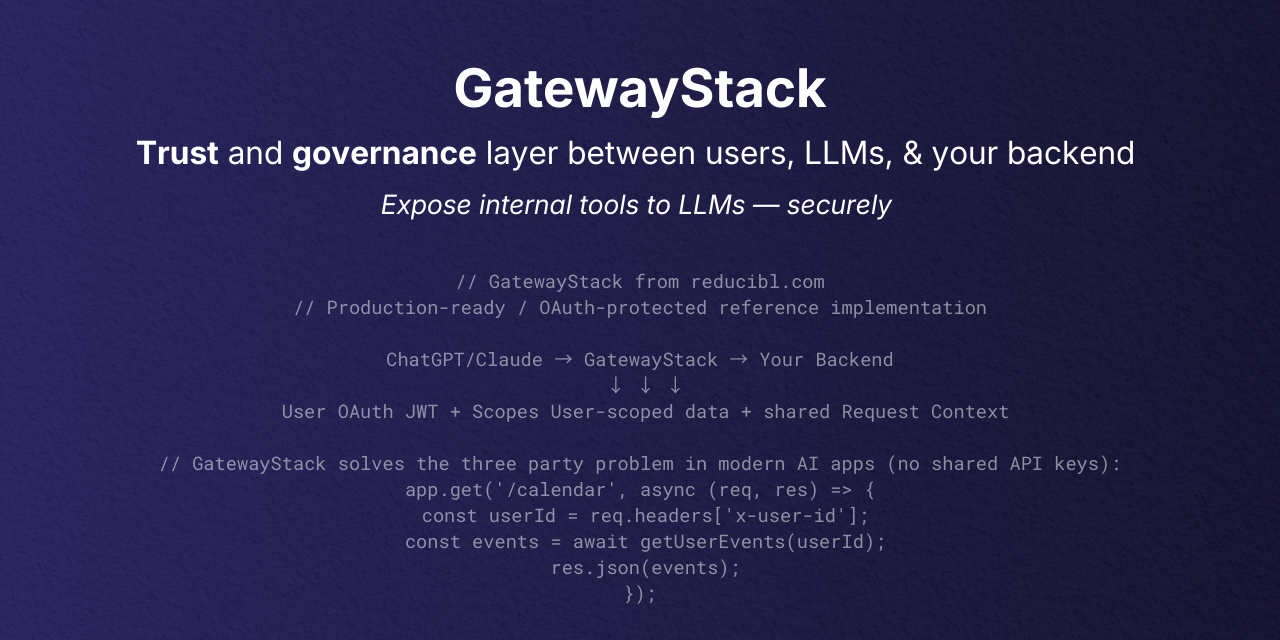




See, price, and control every tool call your AI agents make.
agenticcontrolplane.com · the data · one-command install
GatewayStack is the MIT-licensed open core of Agentic Control Plane. It runs in your infrastructure, in the agent's runtime call path, and makes every tool and model call identified, policy-checked, priced, and logged — whatever framework the agent runs on.
Install
Coding agents (Claude Code, Cursor, Codex, OpenClaw) — one command, no code changes:
curl -sf https://agenticcontrolplane.com/install.sh | bash
First controlled call in about thirty seconds. The script documents what it does and won't do.
Your own framework code — drop in a package:
npm install @gatewaystack/identifiabl express
import express from "express";
import { identifiabl } from "@gatewaystack/identifiabl";

const app = express();

app.use(identifiabl({
  issuer: process.env.OAUTH_ISSUER!,
  audience: process.env.OAUTH_AUDIENCE!,
}));

app.get("/api/me", (req, res) => {
  res.json({ user: req.user.sub, scopes: req.user.scope });
});

app.listen(8080);
Every request now requires a valid RS256 JWT. req.user is the verified identity.
What you get
- Cost X-ray. Every call priced. Runs split into the orchestration loop vs the leaf sub-tasks, so you can see which step is the bill and move the cheap, bounded work to a cheaper model.
- Tool-surface control. Allow / ask / redact / deny, per operation, scoped by agent, role, or user. Deny-by-default on the destructive stuff. Enforced at the call, outside the model — a prompt-injected agent can't talk its way past it.
- Audit. Every tool and model call logged: who triggered it, which agent, what it returned, what it cost, how long it took. Attributable and exportable.
Every number we publish is metered from our own production workspaces, not estimated: agenticcontrolplane.com/data.
Modules
Each layer ships as a framework-agnostic -core package plus an Express middleware wrapper. Use one or all. Detailed breakdown →
| Module | npm | What it does |
|---|---|---|
@gatewaystack/identifiabl |
 |
RS256 JWT verification, identity normalization |
@gatewaystack/transformabl |
 |
PII detection, redaction, safety classification |
@gatewaystack/validatabl |
 |
Deny-by-default policy engine, scope/permission enforcement |
@gatewaystack/limitabl |
 |
Rate limits, budget tracking, agent guard |
@gatewaystack/proxyabl |
 |
Auth mode routing, SSRF protection, identity-aware proxy |
@gatewaystack/explicabl |
 |
Structured audit logging, health endpoints |
Full stack example
Wire all six layers together. Each is optional — use only what you need.
npm install @gatewaystack/identifiabl @gatewaystack/transformabl @gatewaystack/validatabl \
  @gatewaystack/limitabl @gatewaystack/proxyabl @gatewaystack/explicabl @gatewaystack/request-context express
import express from "express";
import { runWithGatewayContext } from "@gatewaystack/request-context";
import { identifiabl } from "@gatewaystack/identifiabl";
import { transformabl } from "@gatewaystack/transformabl";
import { validatabl } from "@gatewaystack/validatabl";
import { limitabl } from "@gatewaystack/limitabl";
import { createProxyablRouter, configFromEnv } from "@gatewaystack/proxyabl";
import { createConsoleLogger, explicablLoggingMiddleware } from "@gatewaystack/explicabl";

const app = express();
app.use(express.json());

// 1. Establish request context for downstream layers
app.use((req, _res, next) => {
  runWithGatewayContext(
    { request: { method: req.method, path: req.path } },
    () => next()
  );
});

// 2. Log every request
app.use(explicablLoggingMiddleware(createConsoleLogger()));

// 3. Require verified RS256 token
app.use(identifiabl({
  issuer: process.env.OAUTH_ISSUER!,
  audience: process.env.OAUTH_AUDIENCE!,
}));

// 4. Detect PII and classify content safety
app.use("/tools", transformabl({ blockThreshold: 80 }));

// 5. Enforce authorization policies
app.use("/tools", validatabl({
  requiredPermissions: ["tool:read"],
}));

// 6. Apply rate limits and budget caps
app.use("/tools", limitabl({
  rateLimit: { windowMs: 60_000, maxRequests: 100 },
  budget: { maxSpend: 500, periodMs: 86_400_000 },
}));

// 7. Route /tools to your tool/model backends
app.use("/tools", createProxyablRouter(configFromEnv(process.env)));

app.listen(8080, () => {
  console.log("GatewayStack running on :8080");
});
Or clone and run the reference gateway directly:
git clone https://github.com/agentic-control-plane/GatewayStack
cd GatewayStack
npm install
npm run dev   # gateway on :8080, admin UI on :5173
Why this is a separate layer
AI apps have three actors — user, LLM, backend — and no shared identity layer. The backend sees a service token, not a person, so it can't tell who the agent is acting for, whether the action was authorized, or what it cost. GatewayStack closes that gap at the tool-call boundary. The full argument →
Repository layout
| Path | Description |
|---|---|
packages/ |
Six -core packages (framework-agnostic) + six Express middleware wrappers, plus request-context, compat, and integrations |
apps/gateway-server |
Express reference server wiring all six layers, /protected/* samples, Docker image |
apps/admin-ui |
Vite/React dashboard that polls /health |
demos/ |
MCP issuer + ChatGPT Apps SDK connectors that mint demo JWTs |
tools/ |
Echo server, mock tool backend, Cloud Run deploy helper |
tests/ |
Vitest smoke tests |
docs/ |
Auth0 walkthroughs, conformance output, endpoint references, troubleshooting |
Testing
npm test
135 tests across 17 test files covering all five core packages.
Prerequisites
- Node.js 20+
- npm 10+ (or pnpm 9)
- An OIDC provider issuing RS256 access tokens (Auth0, Okta, Entra ID, Keycloak, etc.)
Docs
- The Three-Party Problem
- Package Breakdown
- Examples
- Demos
- Environment & Health Endpoints
- Deployment
- Troubleshooting
- Production Checklist
Related repos
- acp-install — the one-command installer for coding agents and MCP clients
- acp-governance-sdks — TypeScript + Python SDKs for scoped subagents and delegation chains
- delegation-chain-spec — ADCS, the open spec for agent-to-agent delegation
- agentgovbench — 48-scenario benchmark across agent runtimes
Contributing
- Run the tests:
npm test - Read
CONTRIBUTING.md - Report issues on GitHub Issues
GatewayStack is the runtime. The hosted console — dashboard, team management, cost X-ray, policy UI — is Agentic Control Plane. Free for individuals.
Reviews (0)
Sign in to leave a review.
Leave a reviewNo results found