MathTerm
Health Warn
- License — License: MIT
- Description — Repository has a description
- Active repo — Last push 0 days ago
- Low visibility — Only 5 GitHub stars
Code Fail
- rm -rf — Recursive force deletion command in package.json
- fs module — File system access in test/automath.test.js
- fs module — File system access in test/clipboard.test.js
- fs module — File system access in test/replay.js
Permissions Pass
- Permissions — No dangerous permissions requested
No AI report is available for this listing yet.
A macOS terminal that typesets LaTeX in any program's output (Claude Code, cat, nvim)
mathterm
A terminal that typesets LaTeX. Any $...$ that shows up on screen is rendered with KaTeX as real
vector text, the same way Obsidian or a browser shows it. That includes cat output, Claude Code's
replies, and the file you're editing in nvim. No plugins, and no cooperation from the program.
https://github.com/user-attachments/assets/fc305b93-685c-445c-b600-f4ab60ab0228
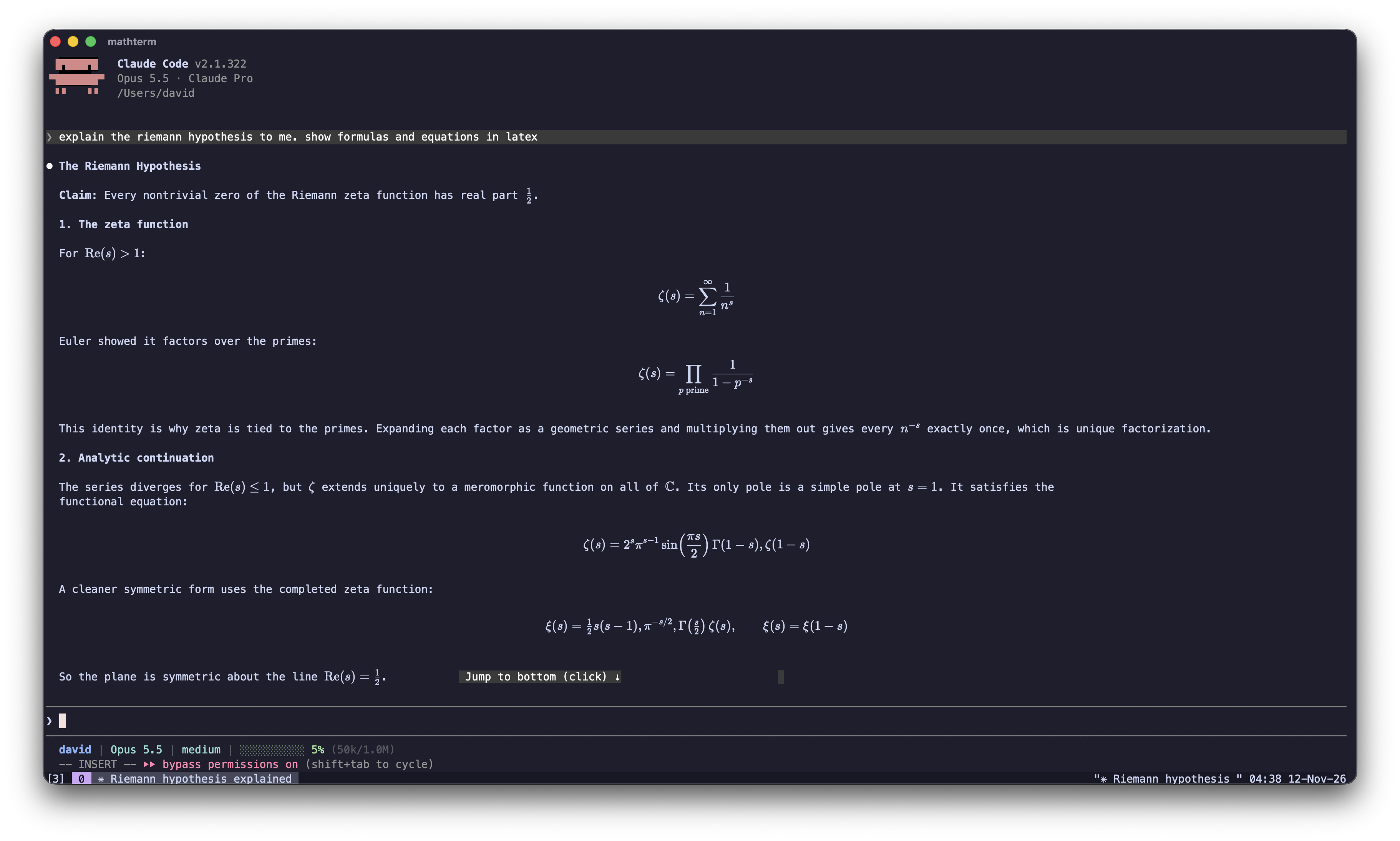
How it works
mathterm is a normal terminal: xterm.js in a Tauri window, with your login shell in a pty. After every
redraw it scans the visible text for $...$, $$...$$, \(...\) and \[...\]. It then lays typeset
math over the cells where the source sits, in the source's own colors.
- Editors: the line under the cursor (or a
$$block containing it) shows the raw LaTeX, so you can
edit it, like Obsidian's live preview. Line numbers and splits are handled. - Room to breathe: display math grows into the blank lines around it, which is how Claude Code and most
markdown lay out equations, so it renders at full size instead of being squeezed into one row. - Few false positives:
$5 and $10stays text, code fences and`inline code`are skipped, and
anything KaTeX can't parse is left alone. - No gaps: math usually renders narrower than its LaTeX source, so the text after it is redrawn
flush against it. - Copy works: the cells still hold the source, so copying an equation gives you its LaTeX.
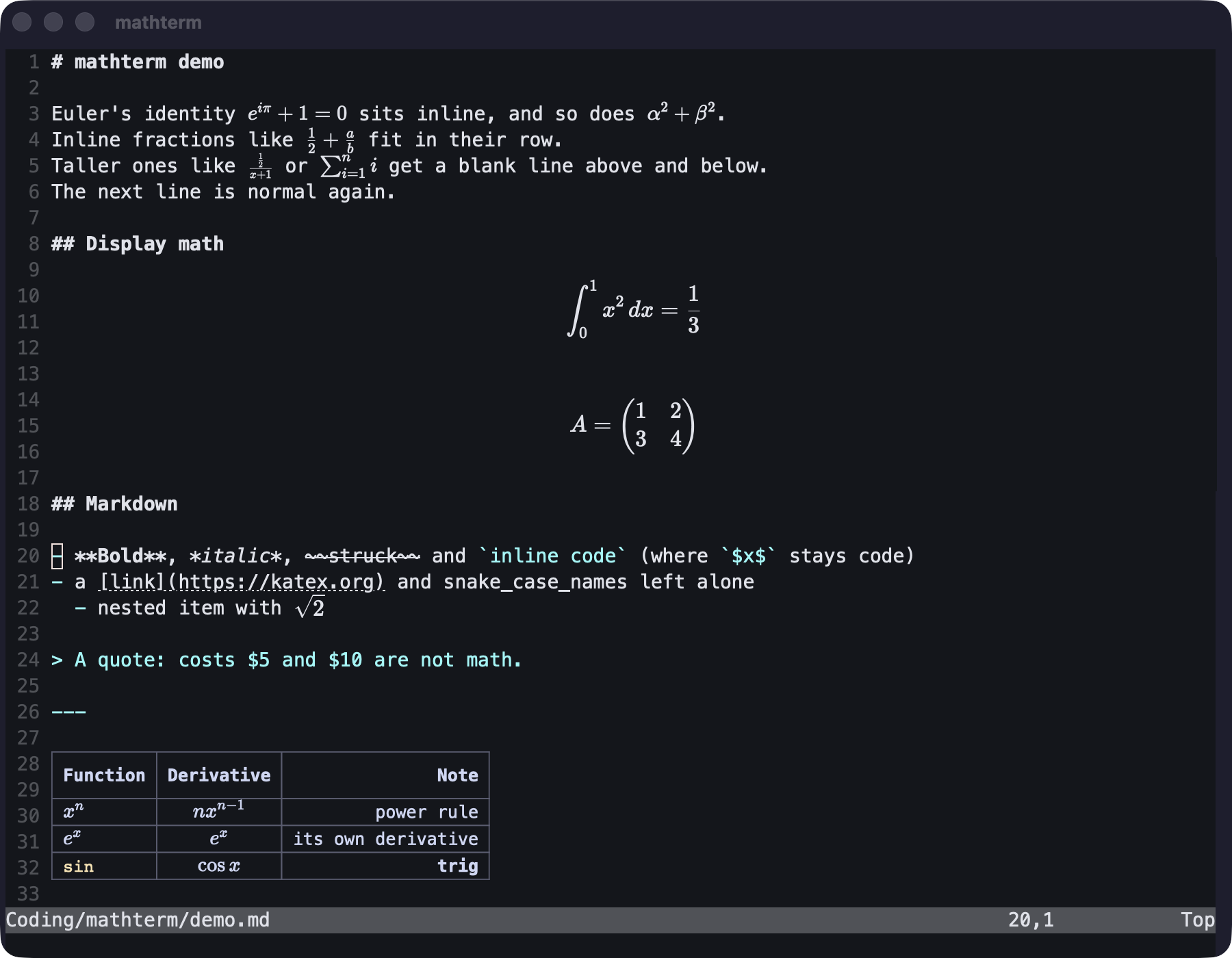
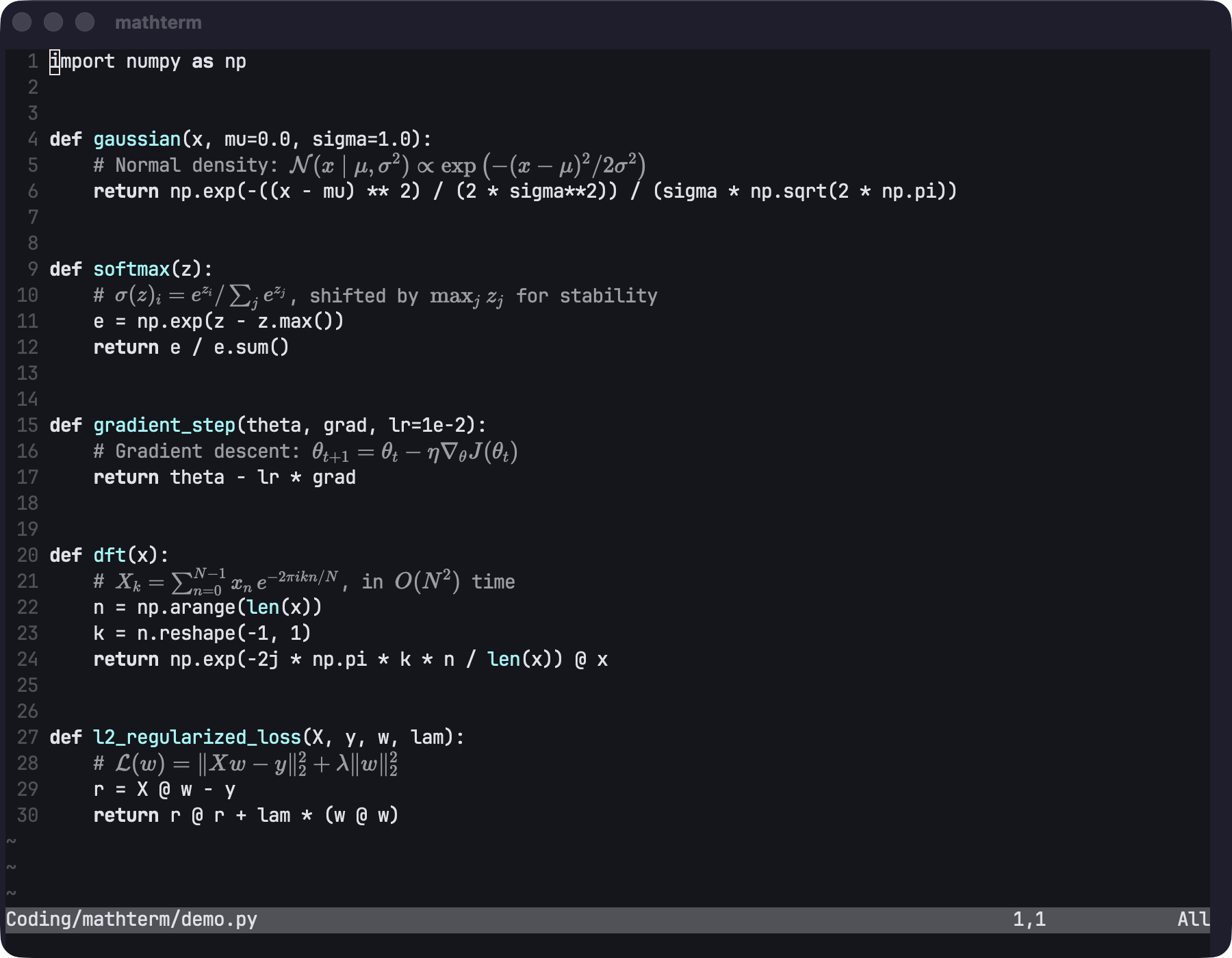
Cmd-Shift-M toggles detection.
Install
macOS only for now (Apple silicon and Intel).
Download
mathterm-macos.zipfrom Releases and unzip it.Move
mathterm.appto Applications.The app isn't notarized by Apple yet, so macOS blocks the first launch. Right-click it and choose
Open, or run:xattr -dr com.apple.quarantine /Applications/mathterm.app
Build from source
Requires Node and Rust (brew install rust).
npm install
npm run app    # builds mathterm.app and installs it in /Applications
npm start runs it from source instead (dev mode).
Config
~/.config/mathterm/config.json:
{
  "theme": "catppuccin-mocha",
  "fontSize": 14,
  "fontFamily": "Menlo, monospace",
  "lineHeight": 1.2,
  "autoDetectIgnore": ["*.tex", "*.sty", "*.cls"],
  "renderer": "webgl"
}
Built-in themes are default and catppuccin-mocha. theme can also be an object with xterm.js theme
keys (background, foreground, black ... brightWhite) to use any other scheme.
autoDetectIgnore pauses math detection while the running program was opened on a matching file, e.g.nvim hw7.tex, since a .tex source usually has its PDF next to it. Patterns are globs matched against the
file name of each argument, so program names work too ("htop"). The value shown is the default. With
nvim's set title, switching files with :e is picked up as well.
renderer: "dom" uses xterm's DOM renderer instead of WebGL (slower scrolling; try it if rows draw stale).
| Keys | |
|---|---|
| Cmd-N / Cmd-W | New / close window |
| Cmd-F | Find in scrollback (Enter / Shift-Enter: next / previous, Esc: close) |
| Ctrl-Cmd-F or Fn-F | Full screen |
| Cmd-+ / Cmd-- / Cmd-0 | Zoom in / out / reset |
| Cmd-Shift-M | Toggle math detection |
| Cmd-click | Open a link (hover shows the URL) |
Status
Early prototype, macOS only. Known gaps:
- Inline math split across rows by a program that wraps its own output (rather than the terminal wrapping it)
stays raw LaTeX. Widening the window usually fixes it. - Tall inline math with text directly above and below is shrunk to fit its row.
- TUIs that draw code blocks without backticks (Claude Code does) can get
$var$-like text typeset.
Detection is heuristic, so real examples help most. If something renders wrong, please
open an issue with the raw text.
Roadmap
- Detection polish: check Claude Code's handling of inline
$...$and\(...\), and recognize code
blocks drawn without backticks.
The plans and changelog are in notes/.
How this was built
mathterm was built with heavy use of AI: most of the code was written by Claude (Anthropic's model) through
Claude Code, from my direction, testing and bug reports. I set the design and priorities and checked every
change against real use (Claude Code chats, nvim, tmux). The development notes in notes/ record
what was tried, what broke and why, including approaches that were reverted. Issues and PRs are welcome
either way.
License
MIT, see LICENSE.
Reviews (0)
Sign in to leave a review.
Leave a reviewNo results found