contextweaver
Health Warn
- License — License: Apache-2.0
- Description — Repository has a description
- Active repo — Last push 0 days ago
- Low visibility — Only 5 GitHub stars
Code Pass
- Code scan — Scanned 12 files during light audit, no dangerous patterns found
Permissions Pass
- Permissions — No dangerous permissions requested
No AI report is available for this listing yet.
Budget-aware context compilation and context firewall for tool-heavy AI agents.
contextweaver






Context firewall + tool router for tool-heavy AI agents. Phase-specific,
budget-aware context engineering with a deterministic core — large tool
outputs stay out of the prompt, large catalogs collapse to a fewChoiceCards, and your token bill drops 42–75 % on the committed
benchmarks.
1150+ tests passing · minimal core dependencies · deterministic by default · Python ≥ 3.10
pip install contextweaver        # install
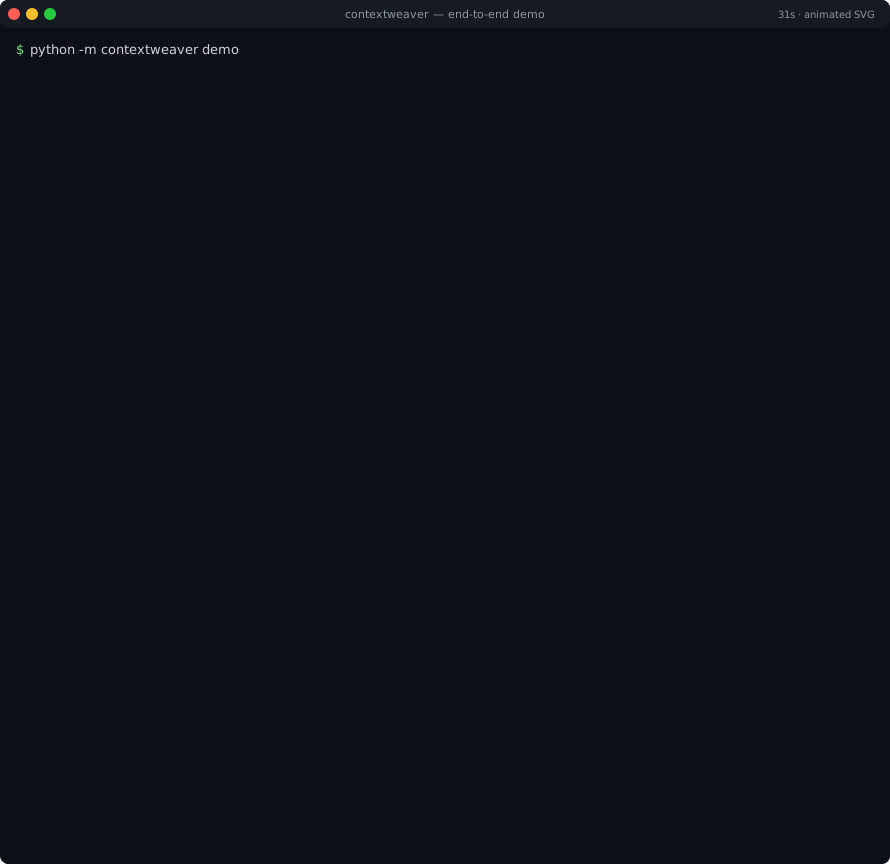
python -m contextweaver demo     # 5-step end-to-end demo
📖 Documentation · 🧭 Which pattern fits my use case? · 📊 Benchmark scorecard · 🎬 Replay demo (.cast)
The Problem
Even with 200K-token context windows, dumping everything into the prompt is expensive,
slow, and degrades output quality. More context ≠ better answers — context engineering
(deciding what the model sees, when, and at what cost) is the lever that actually moves
quality and latency.
Imagine a tool-using agent with a 100-tool catalog and a 50-turn conversation history.
At each step the agent must answer four questions:
- Route — which tool should I call?
- Call — what arguments?
- Interpret — what did it return?
- Answer — how do I respond to the user?
Naive approach A — concatenate everything:
100 tool schemas (≈50k tokens) + 50 turns (≈30k tokens) = 80k tokens
Cost: $0.48/request at GPT-4o rates  ·  Latency: 3–5s TTFT
Quality: LLM loses focus — needle-in-haystack accuracy drops with context size
Token limit: 8k → 10× overflow
Naive approach B — cherry-pick manually:
Pick 10 tools, last 5 turns → lose dependency chains
Agent hallucinates tool calls, repeats questions, forgets context
contextweaver approach — phase-specific budgeted compilation:
Route phase:  5 tool cards (≈500 tokens), no full schemas
Answer phase: 3 relevant turns + dependency closure (≈2k tokens)
Result:       2.5k tokens, complete context, deterministic
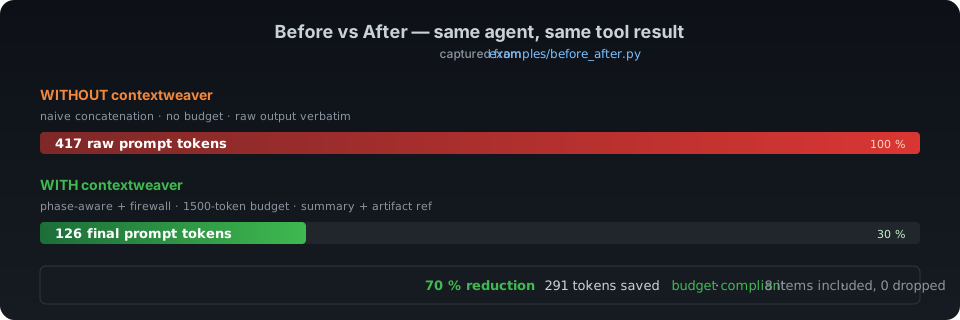
Cost:         41.6%–74.5% fewer prompt tokens [^naive-baseline]  ·  Latency: sub-second  ·  Quality: relevant context only
[^naive-baseline]: Measured against the "concatenate all tool schemas + full
conversation history" baseline using tiktoken.cl100k_base on the four
committed benchmark scenarios. Range 41.6 %–74.5 %, average 55.8 %.
Reproducible via make benchmark-matrix && make scorecard — see the
vs. naïve concat baseline section of
benchmarks/scorecard.md and the
methodology in scripts/baseline_naive.py.
See examples/before_after.py for a runnable side-by-side comparison.
How contextweaver Solves It
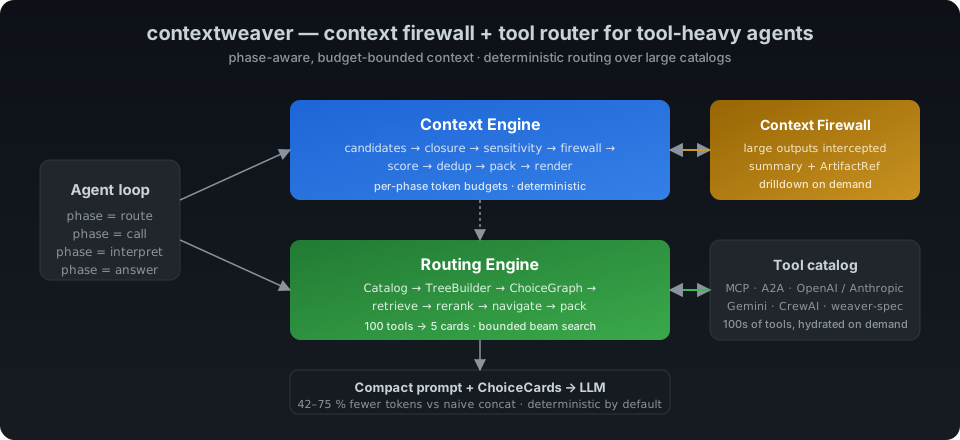
contextweaver provides two cooperating engines:
                ┌────────────────────────────┐
  Events ──────>│      Context Engine         │──> ContextPack (prompt)
                │  candidates → closure →     │
                │  sensitivity → firewall →   │
                │  score → dedup → select →   │
                │  render                     │
                └────────────────────────────┘
                           ▲ facts / episodes
                ┌──────────┴─────────────────┐
  Tools ───────>│      Routing Engine         │──> ChoiceCards
                │  Catalog → TreeBuilder →    │
                │  ChoiceGraph → Router       │
                └────────────────────────────┘
Context Engine — eight-stage pipeline:
- generate_candidates — pull phase-relevant events from the log for this request.
- dependency_closure — if a selected item has a
parent_id, include the parent automatically. - sensitivity_filter — drop or redact items at or above the configured sensitivity floor.
- apply_firewall — tool results are stored out-of-band; large outputs are summarized/truncated before prompt assembly.
- score_candidates — rank by recency, tag match, kind priority, and token cost.
- deduplicate_candidates — remove near-duplicates using Jaccard similarity.
- select_and_pack — greedily pack highest-scoring items into the phase token budget.
- render_context — assemble final prompt string with
BuildStatsmetadata.
Routing Engine — four-stage pipeline:
- Catalog — register and manage
SelectableItemobjects. - TreeBuilder — convert a flat catalog into a bounded
ChoiceGraphDAG. - Router — beam-search over the graph; deterministic tie-breaking by ID.
- ChoiceCards — compact, LLM-friendly cards (never includes full schemas).
Quickstart
Install
pip install contextweaver
contextweaver ships with a minimal, opinionated core: tiktoken,PyYAML, and rank-bm25. These power accurate token budgeting, YAML
catalog/config files, and the default lexical retrieval backend.
Optional capabilities are gated behind extras so the core install stays small:
| Extra | What it adds |
|---|---|
contextweaver[cli] |
Rich-formatted CLI rendering (rich) |
contextweaver[retrieval] |
Fuzzy lexical matching backend (rapidfuzz) |
contextweaver[otel] |
OpenTelemetry tracing + metrics export |
contextweaver[ann] |
Approximate-nearest-neighbour backend (reserved) |
contextweaver[graph] |
NetworkX-backed graph ops (reserved) |
contextweaver[fastmcp] |
FastMCP catalog adapter |
contextweaver[langchain] |
LangChain integration helpers |
contextweaver[all] |
All optional capabilities |
Or from source:
git clone https://github.com/dgenio/contextweaver.git
cd contextweaver
pip install -e ".[dev]"
Adopting in 5 lines from an existing OpenAI / Anthropic / Gemini agent
from contextweaver.adapters.openai_messages import from_openai_messages
from contextweaver.context.manager import ContextManager
from contextweaver.types import Phase

mgr = ContextManager()
from_openai_messages(messages, into=mgr)   # also: from_anthropic_messages / from_gemini_contents
pack = mgr.build_sync(phase=Phase.answer, query="...")
See Adopting from an existing chat history
for the full snippet (including the to_* inverse adapters for round-tripping
back into the provider SDK).
10-Minute Quickstart
For a guided setup with prerequisites, three runnable examples, expected output,
and next steps, see docs/quickstart.md.
Already have an agent and not sure which piece you need?
See Which pattern fits my use case? — a symptom-based
decision tree (long conversations → full pipeline; 50+ tools → routing-only;
huge tool outputs → firewall-only) that points each branch to one concrete
next step.
Minimal agent loop
from contextweaver.context.manager import ContextManager
from contextweaver.types import ContextItem, ItemKind, Phase

mgr = ContextManager()
mgr.ingest(ContextItem(id="u1", kind=ItemKind.user_turn, text="How many users?"))
mgr.ingest(ContextItem(id="tc1", kind=ItemKind.tool_call,
                       text="db_query('SELECT COUNT(*) FROM users')", parent_id="u1"))
mgr.ingest(ContextItem(id="tr1", kind=ItemKind.tool_result,
                       text="count: 1042", parent_id="tc1"))

pack = mgr.build_sync(phase=Phase.answer, query="user count")
print(pack.prompt)   # budget-aware compiled context
print(pack.stats)    # what was kept, dropped, deduplicated
Route a large tool catalog
from contextweaver.routing.catalog import Catalog, load_catalog_json
from contextweaver.routing.tree import TreeBuilder
from contextweaver.routing.router import Router

catalog = Catalog()
for item in load_catalog_json("catalog.json"):
    catalog.register(item)

graph = TreeBuilder(max_children=10).build(catalog.all())
router = Router(graph, items=catalog.all(), beam_width=3, top_k=5)
result = router.route("send a reminder email about unpaid invoices")
print(result.candidate_ids)
Runtime Loop (4 Phases)
For a complete route -> call -> interpret -> answer reference flow, see:
examples/full_agent_loop.pyfor a runnable end-to-end script.docs/guide_agent_loop.mdfor the flow diagram, pseudo-code, and module map.
The runtime loop example demonstrates:
- Route-phase prompt assembly with ChoiceCards.
- Call-phase prompt assembly with selected tool schema hydration.
- Interpret-phase firewall behavior (large tool output summarized into context).
- Answer-phase context composition with accumulated history and result envelopes.
Framework Integrations
Looking for "where does contextweaver fit alongside my runtime?" — start with the
How contextweaver Fits positioning page, then jump into the
Cookbook for copy-paste recipes.
| Framework | Guide | Use Case |
|---|---|---|
| MCP | Guide | Tool conversion, session loading, firewall · Security note |
| A2A | Guide | Agent cards, multi-agent sessions |
| FastMCP | Cookbook recipe | Composed MCP servers → bounded-choice routing |
| LlamaIndex | Guide | RAG + tools with budget control |
| OpenAI Agents SDK | Guide | Swarm hand-offs with unified context |
| Google ADK / Vertex AI | Guide | Gemini tool-use with context budgets |
| LangChain + LangGraph | Guide | Chain + graph agents with firewall |
| Pipecat | Guide | Real-time voice agents with async context build |
| CrewAI | Guide | Role-based crews with bounded tool shortlists |
| Pydantic AI | Guide | Type-safe agents with lossless message round-trip |
| smolagents | Guide | Hugging Face CodeAgent / ToolCallingAgent with step-log ingestion |
| Agno | Guide | Toolkit-routed agents; layers above Agno Memory |
Core Concepts
| Concept | Description |
|---|---|
ContextItem |
Atomic event log entry: user turn, agent message, tool call, tool result, fact, plan state. |
Phase |
route / call / interpret / answer — each with its own token budget. |
ContextFirewall |
Intercepts tool results: stores raw bytes out-of-band, injects compact summary (with truncation for large outputs). |
ChoiceGraph |
Bounded DAG over the tool catalog. Router beam-searches it; LLM sees only a focused shortlist. |
ResultEnvelope |
Structured tool output: summary + extracted facts + artifact handles + views. |
BuildStats |
Per-build diagnostics: candidate count, included/dropped counts, token usage, drop reasons. |
See docs/concepts.md for the full glossary,docs/architecture.md for pipeline detail and design rationale,
and docs/troubleshooting.md for common issues, debugging
techniques, and performance optimisation tips.
Why Trust contextweaver?
1. Test Coverage & Reliability
contextweaver is built for production use with comprehensive quality gates:
- 1100+ passing tests across all modules — context pipeline, routing engine, firewall,
adapters, stores, CLI, sensitivity enforcement - mypy strict type checking — zero errors across all source files
- ruff clean linting — zero warnings
- CI pipeline on every pull request and on pushes to
main(see workflows) - Deterministic by default — tie-break by ID, sorted keys; identical inputs always
produce identical outputs. Configurable retrieval backends (TF-IDF, BM25, fuzzy)
preserve determinism within each mode. - Public benchmark scorecard — top-k recall, token savings, and routing latency at
catalog sizes 50 / 83 / 1000, plus context pipeline metrics across three reference
scenarios. Seebenchmarks/scorecard.md(regenerate withmake scorecard).
Run the full suite yourself:
git clone https://github.com/dgenio/contextweaver.git
cd contextweaver
pip install -e ".[dev]"
make ci  # fmt + lint + type + test + example + demo (all pass)
Most agent libraries fail unpredictably when context exceeds token limits. contextweaver's
deterministic design and comprehensive test coverage ensure your agent behaves the same way
every time — critical for debugging, testing, and production deployment.
2. Design Rationale
Every architectural choice was made for a reason:
| Decision | Reason |
|---|---|
| Minimal core dependencies | A small, audited set of widely-used deps (tiktoken, PyYAML, rank-bm25, mcp, jsonschema, typer, rich); no heavy ML / cloud-SDK packages pulled in by default. |
| Protocol-based interfaces | EventLog, ArtifactStore, EpisodicStore, FactStore are typing.Protocol — swap backends without forking. |
| Async-first context engine | Async-compatible compilation API for real-time integrations; build_sync() wrappers for synchronous callers, with room for future non-blocking execution. |
| Phase-specific token budgets | Route / call / interpret / answer phases each get their own budget — no one-size-fits-all truncation. |
| Context firewall | Large tool outputs stored out-of-band; only compact summaries reach the prompt. |
| Dependency closure | parent_id chains keep tool results coherent — tool calls are never separated from their results. |
These aren't accidental features. They are design decisions optimized for reliability,
extensibility, and production use. A minimal, audited core-dependency set means you
can adopt contextweaver without disrupting your existing stack.
See docs/architecture.md for full pipeline detail and design rationale.
3. Standardization via Protocol Support
contextweaver supports both emerging agentic protocols out of the box:
MCP (Model Context Protocol) — convert tool definitions and results into native contextweaver types:
- Compatible with any MCP server (Claude Desktop, VS Code, custom servers)
- Structured content, output schemas, binary artifacts, and per-part annotations all handled
ingest_mcp_result()for one-call result ingestion with automatic artifact persistence
A2A (Agent-to-Agent) — multi-agent session management with unified context:
- Agent cards converted to
SelectableItemfor routing - Cross-agent session loading via
load_a2a_session_jsonl() - A2A results stored in
ResultEnvelopewith facts and artifact handles
weaver-spec — canonical contracts for the Weaver Stack (contextweaver,
ChainWeaver, agent-kernel):
- Lossless
to_weaver_*/from_weaver_*round-trips forSelectableItem,ChoiceCard,RoutingDecision, andFrame(viaResultEnvelope) weaver_contractsis an opt-in dep —pip install 'contextweaver[weaver-spec]'- Validated in CI on every PR against the JSON Schemas at
raw.githubusercontent.com/dgenio/weaver-spec/main/contracts/json/
(the source the gate fetches; the same documents are also published athttps://weaver-spec.dev/contracts/v0/)
contextweaver is positioned to become the standard context management layer for AI agents.
Supporting MCP, A2A, and weaver-spec now means your codebase is future-proof as these
protocols mature and gain wider adoption.
4. Framework Agnostic
contextweaver works with any LLM provider and any agent framework:
- LLM providers: OpenAI, Anthropic, Google, open-source models — no API keys required
by contextweaver itself - Agent frameworks: LlamaIndex, LangChain, LangGraph, OpenAI Agents SDK, Google ADK,
Pipecat, custom loops - No vendor lock-in: stdlib-only core; no cloud dependencies; runs anywhere Python 3.10+ runs
| Framework | Guide | Use Case |
|---|---|---|
| MCP | Guide | Tool conversion, session loading, firewall |
| A2A | Guide | Agent cards, multi-agent sessions |
| FastMCP | Cookbook recipe | Composed MCP servers → bounded-choice routing |
| LlamaIndex | Guide | RAG + tools with budget control |
| OpenAI Agents SDK | Guide | Swarm hand-offs with unified context |
| Google ADK / Vertex AI | Guide | Gemini tool-use with context budgets |
| LangChain + LangGraph | Guide | Chain + graph agents with firewall |
| Pipecat | Guide | Real-time voice agents with async context build |
| CrewAI | Guide | Role-based crews with bounded tool shortlists |
| Pydantic AI | Guide | Type-safe agents with lossless message round-trip |
| smolagents | Guide | CodeAgent / ToolCallingAgent with step-log ingestion |
| Agno | Guide | Toolkit-routed agents; layers above Agno Memory |
You are not locked into a specific framework or LLM provider. contextweaver is a layer
beneath frameworks — context management as a composable primitive.
5. Versioning & Compatibility
contextweaver follows Semantic Versioning:
- Breaking changes to public APIs only in major versions
- Deprecation policy: deprecated public APIs are warned for at least one minor version and removed only in a later major release
- API stability: public APIs in
contextweaver.*are stable; internal_*modules may change - Python support: 3.10+ (aligned with Python's active security support lifecycle)
| Version | Status | Notes |
|---|---|---|
| 0.1.x | ✅ Current | Foundation engines (context + routing), MCP/A2A adapters, CLI, sensitivity |
| 0.2.0 | 🚧 In progress (Q2 2026) | Framework integration guides, benchmark suite, distributed stores |
| 0.3.0 | 📋 Planned (Q3 2026) | DAG visualization, merge compression, LLM-assisted labeler |
| 1.0.0 | 📋 Planned (Q4 2026) | API freeze, production benchmarks, enterprise features |
Adopting a library is a long-term commitment. contextweaver's versioning policy ensures you
can upgrade safely, and the roadmap shows where it's headed.
Weaver Spec Compatibility
contextweaver implements weaver_contracts >= 0.2.0, < 1.0 (canonical
contracts for the Weaver Stack — see
weaver-spec).
| Invariant | Status | Where enforced |
|---|---|---|
| I-03 — Routing presents bounded choices, not full schema catalogs | ✅ Satisfied | ChoiceCard strips args_schema; routing returns ≤ top_k cards. See src/contextweaver/routing/cards.py and docs/gateway_spec.md. |
| I-05 — contextweaver receives Frames, not raw output | ⚠️ Satisfied on the Frame adapter path | The canonical Frame-shaped ingestion lives on the spec adapter: tool outputs above firewall_threshold are stored out-of-band as ArtifactRefs and the LLM-facing ResultEnvelope maps to a spec Frame via adapters/weaver_contracts.py. The legacy raw-output ingestion APIs (ContextManager.ingest_tool_result(raw_output=...), ingest_mcp_result(...)) still exist for backwards compatibility; treat them as non-canonical for spec compliance. |
Contract adapters (pip install 'contextweaver[weaver-spec]'):
from contextweaver.adapters.weaver_contracts import (
    to_weaver_routing_decision,
    from_weaver_routing_decision,
    to_weaver_frame,
    from_weaver_frame,
)
Round-trips are lossless via a reserved metadata["_contextweaver"] payload;
see docs/weaver_spec_mapping.md for the full
mapping table.
CI conformance — every PR runs scripts/weaver_spec_conformance.py,
which does both a Python round-trip (cw → spec → cw == cw) and JSON-Schema
validation. CI fetches the schemas fromraw.githubusercontent.com/dgenio/weaver-spec/main/contracts/json/, which
mirrors the published documents at https://weaver-spec.dev/contracts/v0/
(same content, different host). Run locally with make weaver-conformance.
6. Roadmap & Community
v0.1 (✅ Complete)
- Context Engine: 8-stage pipeline (candidates → closure → sensitivity → firewall → score → dedup → select → render)
- Routing Engine: Catalog, DAG builder, beam-search router, choice cards
- Protocol adapters: MCP (full content types, structured content, output schemas) and A2A
- Stores:
EventLog,ArtifactStore,EpisodicStore,FactStorewith protocol-based interfaces - 1100+ passing tests, mypy strict, ruff clean, minimal core dependencies
v0.2 (🚧 In Progress — Q2 2026)
- Framework integration guides: LlamaIndex, LangChain, LangGraph, OpenAI Agents SDK, Google ADK, Pipecat
- Benchmark suite: token reduction, latency, and accuracy vs. naive concatenation
- Distributed stores: Redis-backed
EventLog, S3-backedArtifactStore
v0.3 (📋 Planned — Q3 2026)
- DAG visualization: interactive routing graph inspector
- Merge compression: deduplicate similar tool results across turns
- LLM-based labeler: auto-generate namespace labels for tool catalogs
- LLM-based extractor: structured fact extraction with prompt-based schema
v1.0 (📋 Planned — Q4 2026)
- API freeze: no breaking changes in 1.x releases
- Production benchmarks: 1M+ turn deployments
- Enterprise features: audit logging, compliance tags, PII redaction
Community:
- GitHub Discussions — ask questions, share patterns
- GitHub Issues — report bugs, request features
- CHANGELOG — track every release
contextweaver is under active development with a clear roadmap. v0.1 is feature-complete
for basic use cases; v0.2 adds production-ready integrations; v1.0 is the API stability milestone.
Comparison
Snapshot of the launch landscape as of 2026-05-20 — see footnotes for the
versions referenced and the evidence behind each non-trivial claim. Will be
refreshed each minor release.
| Approach | Tool routing | History compaction | Sensitivity firewall | Deterministic | MCP-native |
|---|---|---|---|---|---|
| contextweaver (this repo, v0.9.0) | ✅ Bounded DAG + beam search · per-phase ChoiceCards [^cw-route] |
✅ Phase-aware budgeted compilation · 42–75 % token reduction vs naïve [^cw-bench] | ✅ Built-in (size-gated, with ArtifactRef drilldown) [^cw-fire] |
✅ By default — tie-break by sorted IDs [^cw-det] | ✅ Native proxy + gateway runtimes per docs/gateway_spec.md [^cw-mcp] |
| Naïve concat-everything | ❌ No router · prompt carries every tool schema | ❌ No compaction · prompt grows with turn count | ❌ Raw outputs in the prompt | ⚠️ Only if the upstream LLM is | ⚠️ Compatible but no shaping |
| LangGraph memory (0.6.x) | ❌ Out of scope — LangGraph routes state, not tools | ⚠️ Optional via ConversationSummaryMemory (LLM-based, non-deterministic) [^lg-mem] |
❌ Not provided | ⚠️ Workflow yes; memory summarizer no | ⚠️ Possible via custom adapter, not first-class |
| LlamaIndex retrievers (0.11.x) | ⚠️ Tool retrieval via ObjectIndex is unranked similarity, no bounded routing |
⚠️ ChatMemoryBuffer token-bounded · no phase awareness [^li-mem] |
❌ Not provided · large outputs flow through verbatim | ⚠️ Retriever yes; summarizer no | ⚠️ Possible via custom tool wrapper |
| Raw MCP (modelcontextprotocol v0.1) | ❌ Servers expose tools; routing across many servers is the client's problem | ❌ Out of scope for the protocol | ❌ Out of scope for the protocol | ✅ Wire protocol is deterministic | ✅ — is the protocol |
[^cw-route]: contextweaver.routing.router.Router ships a four-stage pipeline (retrieve → rerank → navigate → pack) with deterministic tie-break by id. Locked by tests/test_cards.py::test_make_choice_cards_byte_identical_stable_order.
[^cw-bench]: Range from the committed scorecard (benchmarks/scorecard.md) using tiktoken.cl100k_base against the naïve baseline (scripts/baseline_naive.py). Average 55.8 %; min 41.6 % on the smallest scenario; max 74.5 % on stress_conversation.jsonl.
[^cw-fire]: contextweaver.context.firewall.apply_firewall plus ArtifactRef drilldown selectors (head / lines / json_keys / rows). See docs/context_firewall.md and the firewall_drilldown_recipe.
[^cw-det]: Determinism is an invariant — see docs/agent-context/invariants.md and make scorecard-check in the CI gate.
[^cw-mcp]: src/contextweaver/adapters/mcp_proxy.py, mcp_gateway.py, mcp_proxy_server.py, mcp_gateway_server.py. Bound by docs/gateway_spec.md.
[^lg-mem]: LangGraph 0.6 docs ("Memory"): ConversationSummaryMemory requires an LLM round-trip to produce a summary; output is non-deterministic across runs even with temperature=0 due to model jitter.
[^li-mem]: LlamaIndex 0.11 docs ("Chat memory"): ChatMemoryBuffer(token_limit=...) truncates oldest-first; no phase awareness and no dependency closure.
Most agent frameworks offer one or two of these capabilities. contextweaver
ships all five as a composable, framework-agnostic layer that runs under
whichever framework you already have.
CLI
contextweaver ships with a CLI for quick experimentation:
contextweaver demo                                    # end-to-end demonstration
contextweaver init                                    # scaffold config + sample catalog
contextweaver build --catalog c.json --out g.json    # build routing graph
contextweaver route --graph g.json --query "send email"
contextweaver print-tree --graph g.json
contextweaver ingest --events session.jsonl --out session.json
contextweaver replay --session session.json --phase answer
Examples
| Script | Description |
|---|---|
minimal_loop.py |
Basic event ingestion → context build |
full_agent_loop.py |
End-to-end route → call → interpret → answer runtime loop |
tool_wrapping.py |
Context firewall in action |
routing_demo.py |
Build catalog → route queries → choice cards |
before_after.py |
Side-by-side token comparison: WITHOUT vs WITH contextweaver |
mcp_adapter_demo.py |
MCP adapter: tool conversion, session loading, firewall |
a2a_adapter_demo.py |
A2A adapter: agent cards, multi-agent sessions |
crewai_adapter_demo.py |
CrewAI adapter: BaseTool → catalog → routing |
pydantic_ai_adapter_demo.py |
Pydantic AI adapter: tools + lossless message round-trip |
smolagents_adapter_demo.py |
smolagents adapter: tools + MultiStepAgent step-log ingestion |
agno_adapter_demo.py |
Agno adapter: toolkit → catalog + session-history ingestion |
langchain_memory_demo.py |
LangChain memory replacement: InMemoryChatMessageHistory vs contextweaver |
cookbook/byot_recipe.py |
Bring-your-own-tools cookbook recipe — wrap plain Python callables and route |
cookbook/firewall_drilldown_recipe.py |
Cookbook recipe: firewall a large tool result, then drill into the artifact |
architectures/mcp_context_gateway/ |
Launch reference architecture — 60-tool MCP-style gateway end-to-end: ChoiceCards, lazy schema hydration, context firewall on a 16 KB result, artifact-backed answer prompt (guide) |
architectures/slack_ops_bot/ |
Production reference architecture — internal Slack ops bot with ~50 tools, firewall on log/grep outputs, persistent facts (guide) |
make example # run all examples
FAQ
Q: What token budgets should I use?
Start with the defaults (route=2000, call=3000, interpret=4000, answer=6000).
Inspect pack.stats after each build and increase any phase that drops too many items.
Q: My tool result was summarized. Why?
The context firewall intercepts every tool_result item (not just large ones).
Raw data is stored out-of-band; access it via mgr.artifact_store.get("artifact:<item_id>").
Provide a custom Summarizer to control how the summary is generated.
Q: How do I debug what was kept or dropped?
Inspect pack.stats (a BuildStats object) after every build_sync() / build() call:included_count, dropped_count, dropped_reasons, dedup_removed.
Q: Does this work with [framework X]?
Yes, contextweaver is framework-agnostic — it compiles context; you send pack.prompt
to any LLM or framework. See dedicated guides for
MCP,
A2A,
LlamaIndex,
LangChain + LangGraph,
OpenAI Agents SDK,
Google ADK / Vertex AI,
Pipecat,
CrewAI,
Pydantic AI,
smolagents, and
Agno. If your runtime isn't listed, the
bring-your-own-tools cookbook recipe
is the canonical starting point.
Q: What's the performance overhead?
Typically 10–50 ms for a context build (depends on event log size and deduplication).
For real-time / async agents, run build_sync() in a worker thread (e.g.await asyncio.to_thread(mgr.build_sync, phase, query)) so the synchronous
pipeline does not block the event loop.
See docs/troubleshooting.md for the full troubleshooting
guide, debugging techniques, optimisation tips, and 10+ common issues with solutions.
Development
make fmt      # format (ruff)
make lint     # lint (ruff)
make type     # type-check (mypy)
make test     # run tests (pytest)
make example  # run all examples
make demo     # run the built-in demo
make ci       # all of the above
See CONTRIBUTING.md for setup instructions.
Roadmap
| Milestone | Status | Highlights |
|---|---|---|
| v0.1 — Foundation (2026-03) | ✅ complete | Context Engine + Routing Engine cores, CLI scaffold, sensitivity enforcement, in-memory stores |
| v0.2 — Determinism + benchmarks (2026-04) | ✅ complete | Naïve-concat baseline, scorecard, weekly cron, gold set 50→200, ScoringConfig sweep |
| v0.3 — Framework integrations (2026-05-11) | ✅ complete | LlamaIndex, LangChain + LangGraph, OpenAI Agents SDK, Google ADK, Pipecat guides + interop matrix |
| v0.4 — MCP gateway + weaver-spec (2026-05-16) | ✅ complete | Gateway spec, MCP proxy + two-tool gateway runtime, weaver-spec interop, JSON Schemas + drift gate |
| v0.5 — Persistent stores + reports (2026-05-17) | ✅ complete | SqliteEventLog, JsonFileArtifactStore, BuildStats.report(), RouteResult.explanation(), stats CLI |
| v0.6 — Adopter surface (2026-05-17) | ✅ complete | Typer + Rich CLI rewrite, OTel GenAI semconv, provider message adapters (OpenAI / Anthropic / Gemini), 5-line adoption snippet |
| v0.7 — Reference architectures + routing pipeline (2026-05-18) | ✅ complete | Explicit routing pipeline, embedding backend, history-aware routing, code-review bot + voice agent architectures, FastMCP CodeMode hooks |
| v0.8 — CrewAI + Mem0 (2026-05-19) | ✅ complete | CrewAI adapter (Phase 1), Mem0 external-memory backend, provider-SDK-leak invariant tests |
| v0.9 — Launch polish + adapters (2026-05) | 🚧 in progress | contextweaver mcp serve CLI, full MCP Context Gateway architecture, CrewAI/Pydantic AI/smolagents/Agno adapter Phase 2 |
| v1.0 — API stability | 📋 planned | API freeze, semantic-versioning commitment, long-term support window |
| Future | 📋 planned | DAG visualization, LLM-assisted labeler, distributed stores, multi-agent coordination |
See CHANGELOG.md for the detailed release history.
License
Apache-2.0
Reviews (0)
Sign in to leave a review.
Leave a reviewNo results found