pergam
Health Warn
- License — License: MIT
- Description — Repository has a description
- Active repo — Last push 0 days ago
- Low visibility — Only 6 GitHub stars
Code Pass
- Code scan — Scanned 12 files during light audit, no dangerous patterns found
Permissions Pass
- Permissions — No dangerous permissions requested
No AI report is available for this listing yet.
Permanent versioned URLs for HTML reports, dashboards, and specs your AI generates — works with Claude Code, Cursor, Codex. Self-hostable in one docker compose, MIT, no telemetry.
📜 pergam
Immutable parchment for what your AI builds.
A tiny self-hostable service — or a hosted endpoint — that turns every HTML report, dashboard, or design doc your AI generates into a permanent, versioned URL your team can actually open.






Try it live → · Docs · Claude Code skill · API health
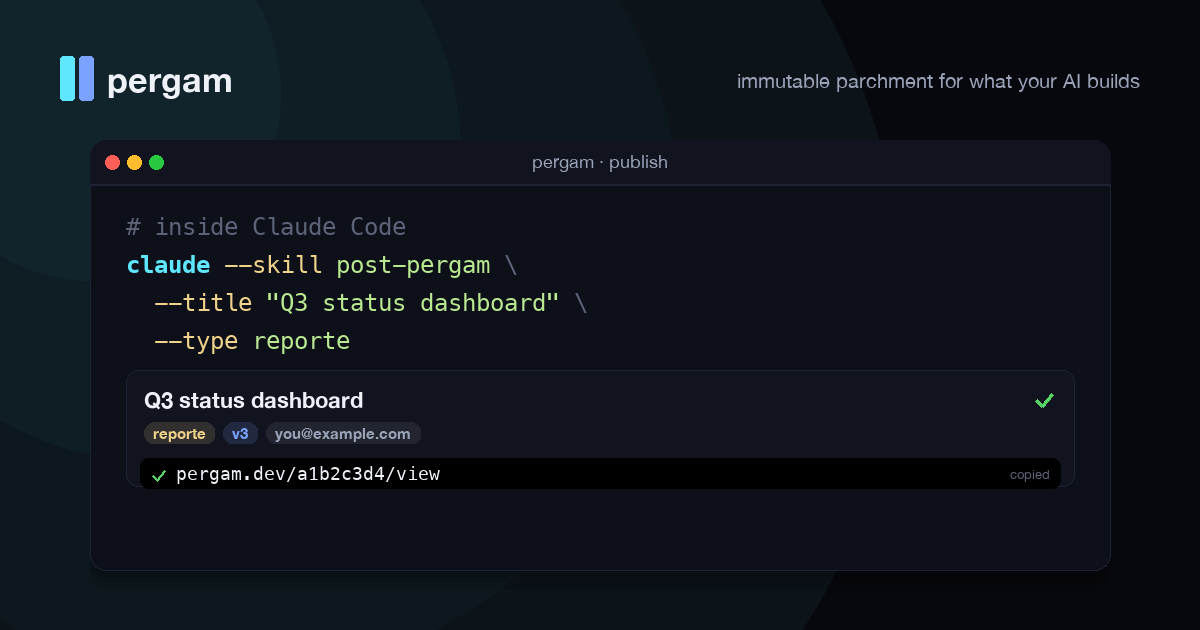
🤔 Why pergam
Your AI generates beautiful HTML — reports, dashboards, design docs, plans. Then those artifacts vanish into chat scrollback. You lose the URL, you lose the version, you lose the trail.
pergam fixes that. One prompt → one shareable, permanent URL. Versioned. Immutable. No accounts, no telemetry, no SaaS lock-in. Self-host it in a docker compose up, or use the hosted service for quick public links.
✨ Features
- 📦 Publish HTML via one
POST, get a stable URL back. - 🕰️ Versioned — every logical
idkeeps full history.v1,v2, … all reachable forever. - 🔒 Immutable — pergams can't be edited or deleted, only superseded with a new version.
- 🧭 Visible versions — every pergam opens under a slim bar with its title, type, tags, author and
v3 of 5, a version selector with each version's note, and a notice on older versions linking to the current one./{id}/diff/v2..v5shows what changed between two versions, section by section. - 🤖 AI-native — ships with a Claude Code skill so your agent can press "ship" and hand back a link without you babysitting
curl. - 🪞 Built-in viewer — on pergam.dev, a sandboxed iframe with strict CSP: Mermaid + jsDelivr allowed, everything else blocked. A self-hosted server frames each version under its version bar the same way: sandboxed in an opaque origin, with the hosted viewer's CSP, so a published script cannot reach the API.
- 🏷️ Typed and tagged — a
typeper pergam from a configurable list (PERGAM_TYPES, five by default) plus free-form tags. Filter the index by type, author or tag; pin what matters, archive what doesn't. - 🧹 Lint before publishing —
POST /lintreports external resources, broken TOC anchors and malformed Mermaid blocks with their line and column, and stores nothing; the skill runs it before every self-hosted publish. - 🔎 Searchable —
?q=searches titles and the visible text of every pergam, with highlighted snippets. - 📡 Atom feed —
/feed.atomfollows new publications, filtered by tag or author. - 🚚 Portable —
/{id}/exportandPOST /importmove a pergam to another server with its id, versions, dates, tags and notes; the skill promotes one between named servers in one command. - 🧩 JSON API —
/api/pergamslists, filters, pages and counts like the index;/api/pergams/{id}returns one pergam with its versions. - 🔐 Owners behind your proxy — with
TRUST_PROXY_USER=1the author comes from an authenticating reverse proxy (X-Forwarded-User), and only a pergam's owner and the collaborators they list can add versions or edit it. - 🐳 Self-hostable — a few small Python modules, one Postgres database, one
docker compose up. - ☁️ Also hosted — pergam.dev for public 1-year shares. Zero setup, drag-and-drop.
- 🪶 Tiny stack — Python stdlib +
psycopgfor the server. A tiny edge worker for the hosted variant. No framework, no build step.
⚡ Quickstart
Two paths, depending on whether you want full history or just a quick public link.
🐳 Self-host (versioned, durable, MIT)
git clone https://github.com/diesilveira/pergam
cd pergam
docker compose up -d --build
curl http://localhost:1111/healthz       # → {"ok":true}
Publish your first pergam:
curl -sS -X POST http://localhost:1111/pergam \
  -H 'Content-Type: application/json' \
  -d '{"title":"Hello","html":"<h1>hi</h1>","type":"otro","author":"[email protected]"}'
You'll get a view_url back — open it in a browser. That's the whole loop. ✨
☁️ Hosted (zero setup, 1-year TTL)
Drag any .html onto pergam.dev and you get a public link. No account, no key. Same thing via the API:
curl -sS -X POST https://api.pergam.dev/share \
  -H 'Content-Type: application/json' \
  -d '{"title":"Hello","html":"<h1>hi</h1>"}'
Response: {"token": "…", "view_url": "https://pergam.dev/s/…", "expires_at": "…"}.
🤖 Claude Code skill
Install the post-pergam skill once and any project gets a "publish this as a pergam" verb:
git clone https://github.com/diesilveira/pergam
cp -r pergam/skills/post-pergam ~/.claude/skills/
Inside any project, ask Claude:
"armá un pergam de X y publicalo"
The skill auto-picks the server and backend: a server the user names ("publish it on team") from ~/.config/pergam/servers.json, else $PERGAM_URL, else the file's default, else hosted:
https://api.pergam.dev→ hosted (Flow A, 1-year TTL)- Any other URL, like
http://localhost:1111→ self-hosted (Flow B, versioned), with an optional CA bundle per server for private TLS
See skills/post-pergam/SKILL.md for the full contract — when to bump a version, the type taxonomy, and the HTML guidelines for what the AI should produce.
🧱 Architecture
┌─────────────┐      ┌──────────────────┐      ┌──────────────┐
│   Client    │ ───→ │      pergam      │ ───→ │   Postgres   │
│ (AI / curl) │      │ (Python, stdlib) │      │  (4 tables)  │
└─────────────┘      └──────────────────┘      └──────────────┘
- One Python process, no framework — just
http.server+psycopg. - Four Postgres tables: immutable
pergams (id, version, …)with a composite key,pergam_meta (id, tags, archived, pinned, origin, collaborators)for what belongs to the id rather than to a version,pergam_textwith each version's extracted text and full-text search document, andpergam_notewith the optional note of each version. Latest version peridresolved on read through thepergams_latestview. - Framed documents: the view page loads each version in an iframe from
/{id}/v{n}/contentand talks to it only through apostMessagebridge, so the frame is sandboxed withoutallow-same-originand/contentcarries the hosted viewer's CSP (no connection, form or frame to the API,frame-ancestorslimited to the server), with a CSPsandboxdirective for when it is opened on its own. - Hosted side is a separate ~200 LOC subset: token-based, TTL-bound, no versioning. See
web/worker/for a reference deployment on Cloudflare Workers + KV.
Full schema, request flow, and config knobs → DOCS.md.
📖 Docs
| Topic | Where |
|---|---|
| 🔌 Full API reference | DOCS.md § API |
| 🕰️ Versioning model | DOCS.md § Versioning |
| ⚙️ Configuration | DOCS.md § Configuration |
| 🚢 Deployment guide | DOCS.md § Deployment |
| 🤖 Claude Code skill | skills/post-pergam/SKILL.md |
| ☁️ Hosted variant (example: Cloudflare) | web/worker/ |
| 🌐 Landing source | web/public/ |
🤝 Contributing
Issues and PRs welcome. Open an issue first for non-trivial changes — happy to chat about it before you put time in.
If pergam is the shape of what you wanted, starring the repo is the highest-signal way to tell me. ⭐
📝 License
MIT — do whatever, no warranty.
Built by diesilveira.dev · Live at pergam.dev · v1.0.0
Reviews (0)
Sign in to leave a review.
Leave a reviewNo results found